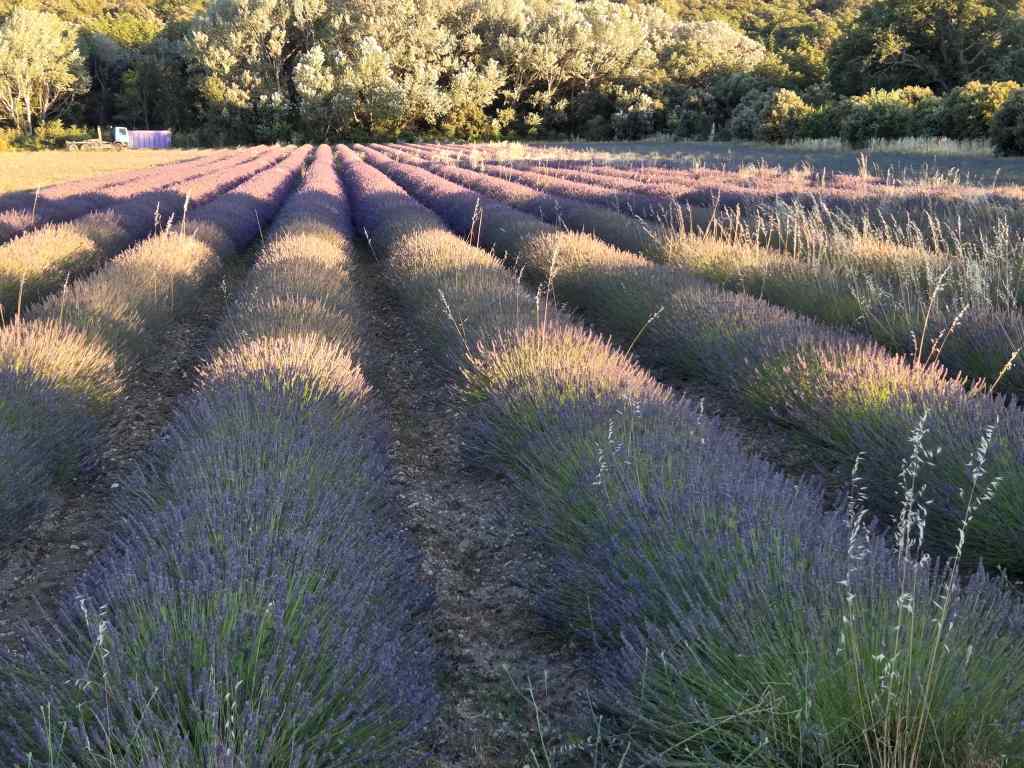
Today I woke up late. The previous night I had enjoyed attending a typically French marriage in a chateau just outside of Grignan and surrounded by lavender fields.
Lavender fields near Grignan
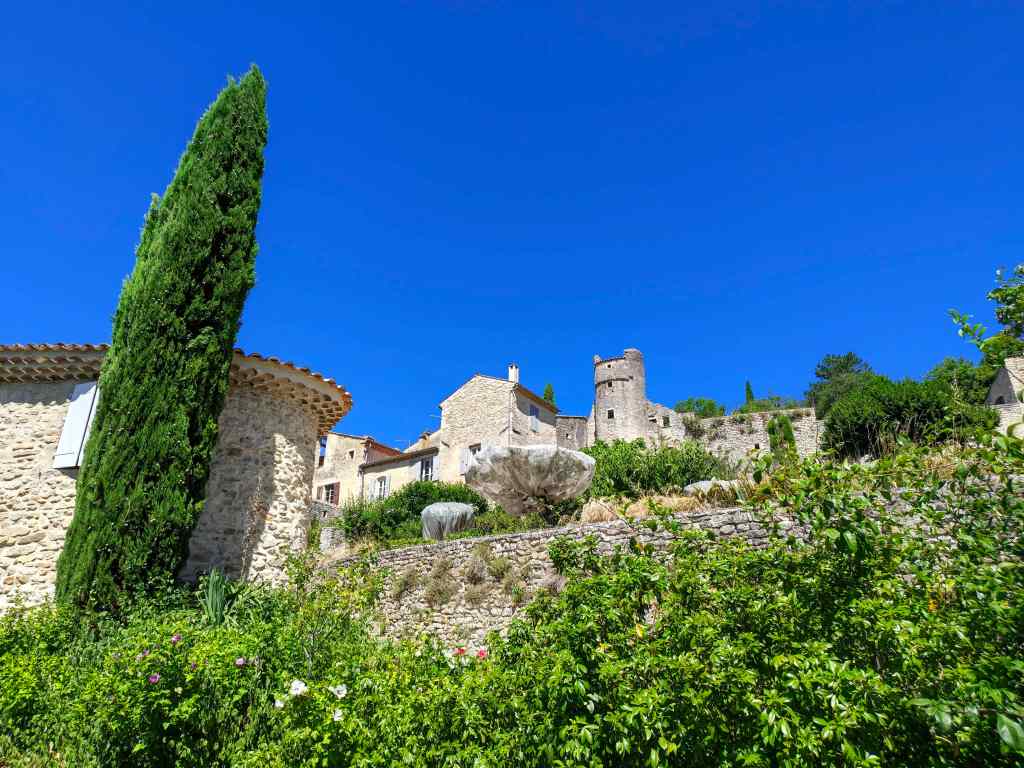
My hosts offered me yet another excellent breakfast, and then it was time to hit the road again to spend a couple of nights in the area of the Gorges de l’Ardeche. First, I made a small detour to visit yet another pretty village – Le Poët-Laval. This place was quieter than many others I had visited, and had only one restaurant, which didn’t want to serve me a coffee unless I ate lunch.
Le Poët-Laval – yet another pretty village
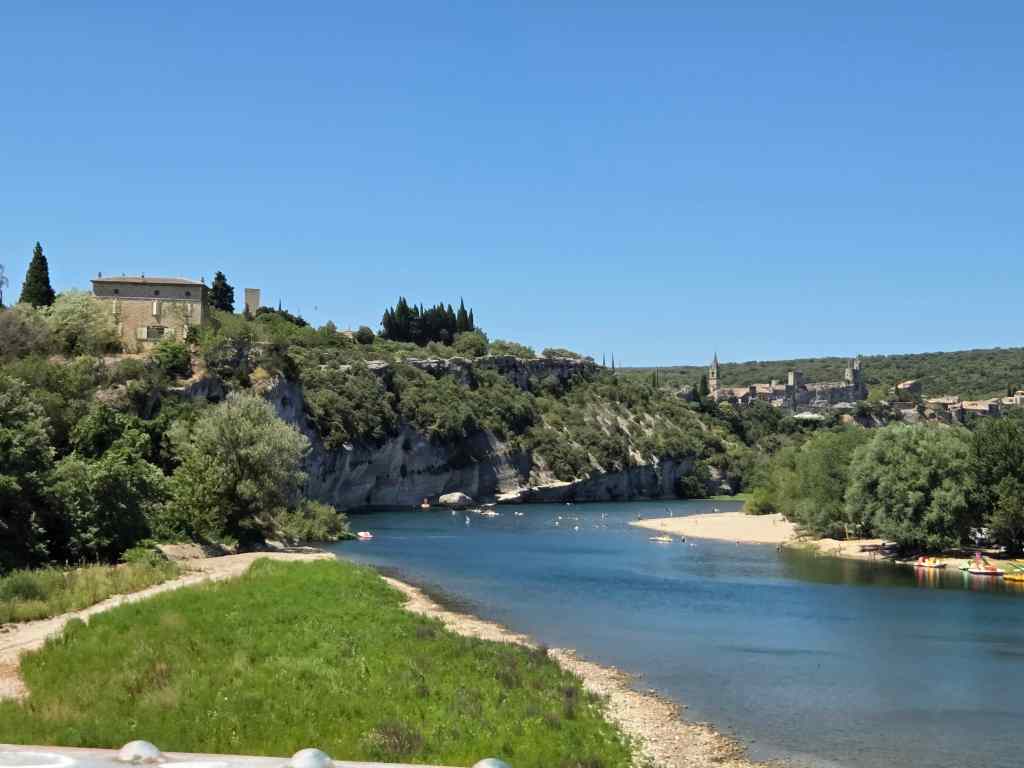
From Le Poët-Laval, I headed southwest to Saint-Martin-D’Ardeche, where I got a first glimpse of the famous river as I crossed over to its right bank. Shortly afterwards I made a stop at Aigueze, reputedly one of the prettiest villages in France and found what I was looking for – a café with a large shady terrace, which was quite happy to serve me a double expresso and some delicious ice cream (two of the local flavours I particularly liked were lavender and verbena). Refreshed, I made a short tour of the village, which apart from the usual ruined castle and church, had great views of the Ardeche river.
Aigueze…the castle…the church….…and the Ardeche river
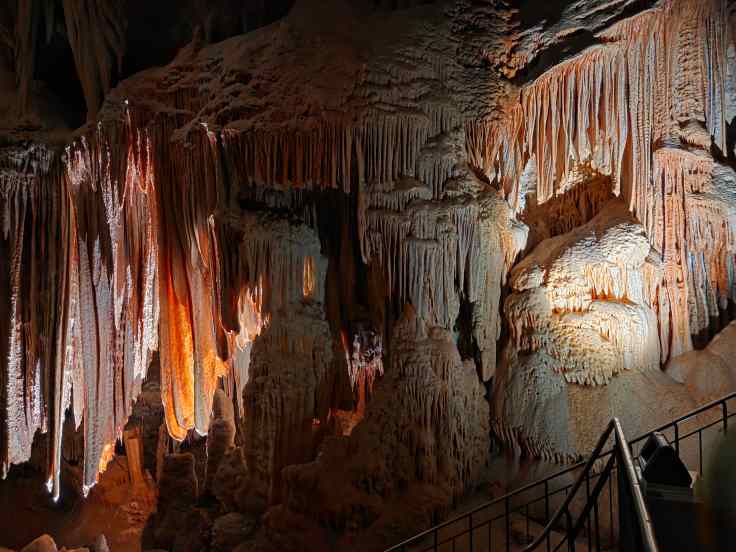
Although I would have liked to, I didn’t have time to dawdle in Aigueze since I had booked a mid-afternoon tour of the famous caves, Aven d’Orgnac. The Ardeche region is mostly made of limestone, and as a result has many caves, some of which have spectacular mineral formations, and some of which were inhabited by stone age people. Aven d’Organic is technically a sink hole rather than cave, since the entrance is from the roof of the complex. It was first explored by the great French speleologist Robert de Joly in 1935. Over many years a series of galleries stretching 6km were discovered, of which the first three are open to tourists for a one-hour guided visit.
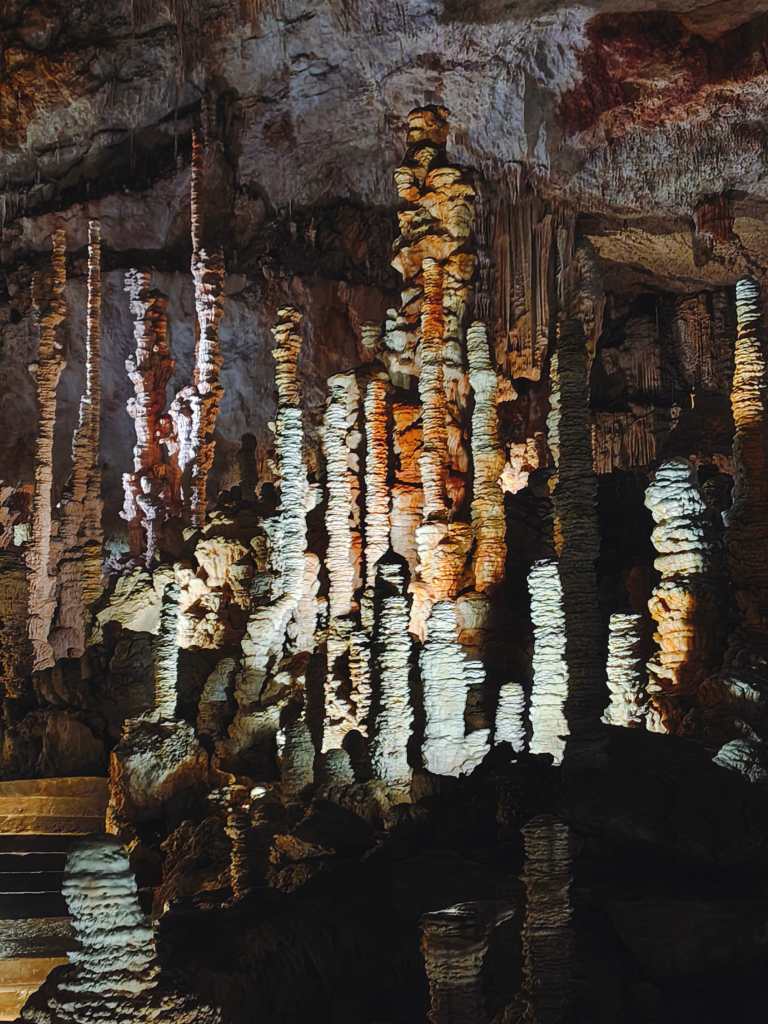
I was led down a series of steps into the first gallery, called La Salle de Joly, a vast space decorated with spectacular stalagmites.
Aven d’Orgnac – la Salle de Joly
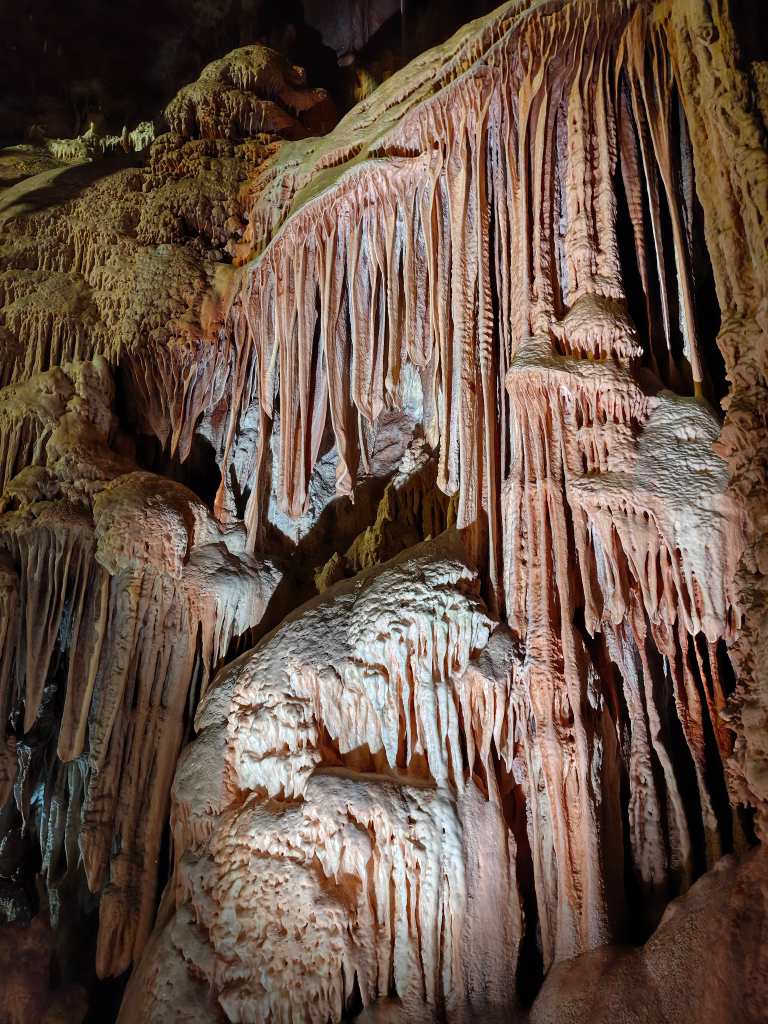
The tour continued down to the second gallery, La Salle de Chaos, which was even prettier, with red and orange colours. Our guide pointed out small urn nestling in the middle of a rock formation resembling an organ. This contained the ashes of de Joly, who asked to be buried underground in the cave he had discovered. Not a bad place to spend eternity!
Robert de Joly’s ashes rest in the Salle du Chaos“Curtains” in the Salle de Chaos, Aven d’Orgnac
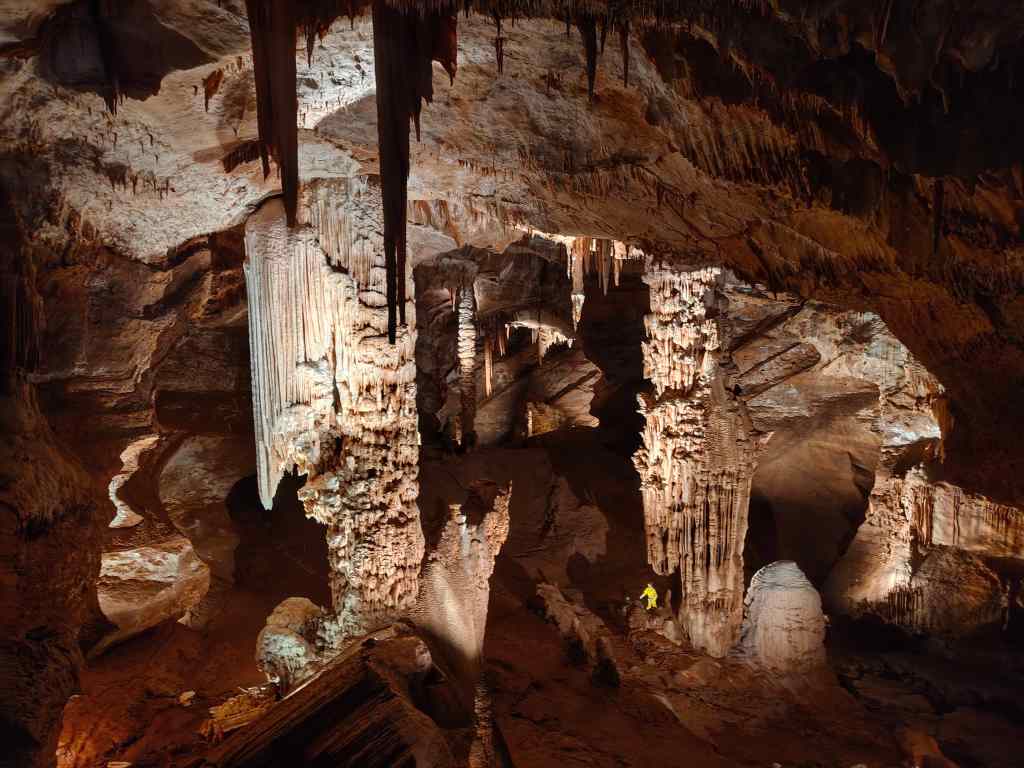
The visit ending in Salle Rouge (Red Chamber), where we watched a sound and light show before taking a lift back up to the surface. When the lift doors opened I was hit by the baking heat of the Provence afternoon sun, and was very glad I had spent an hour in the cool of the cave complex.
The Red Chamber, Aven d’Orgnac
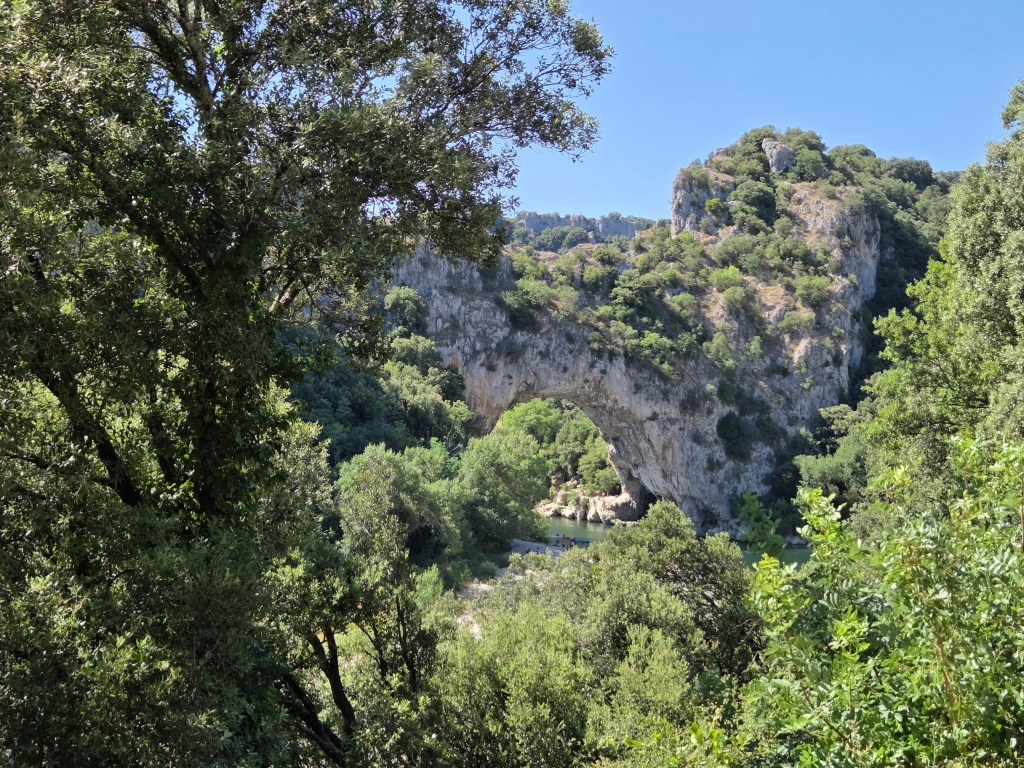
I hurried to reach my car and its air conditioning, before continuing my road to Vallon-Pont-d’Arc and then south east along the panoramic D290 road that follows the river gorge. The first stop along this scenic road is perhaps the most famous – the Pont d’Arc, huge natural rock bridge spanning the Ardeche River. It was so popular that the nearest car park was full, and I had to drive down to a second parking area and walk back in the baking sun to admire the magnificent spectacle.
Pont d’Arc – verso…..…and Pont d’Arc recto
Just after Pont d’Arc the most spectacular part of the D290 begins. Eleven scenic belvederes have been built along the road at the places offering the very best views. I was lucky that the full tourist season had not yet started, and it was relatively easy to park and admire the views (not always the case apparently in July/August).
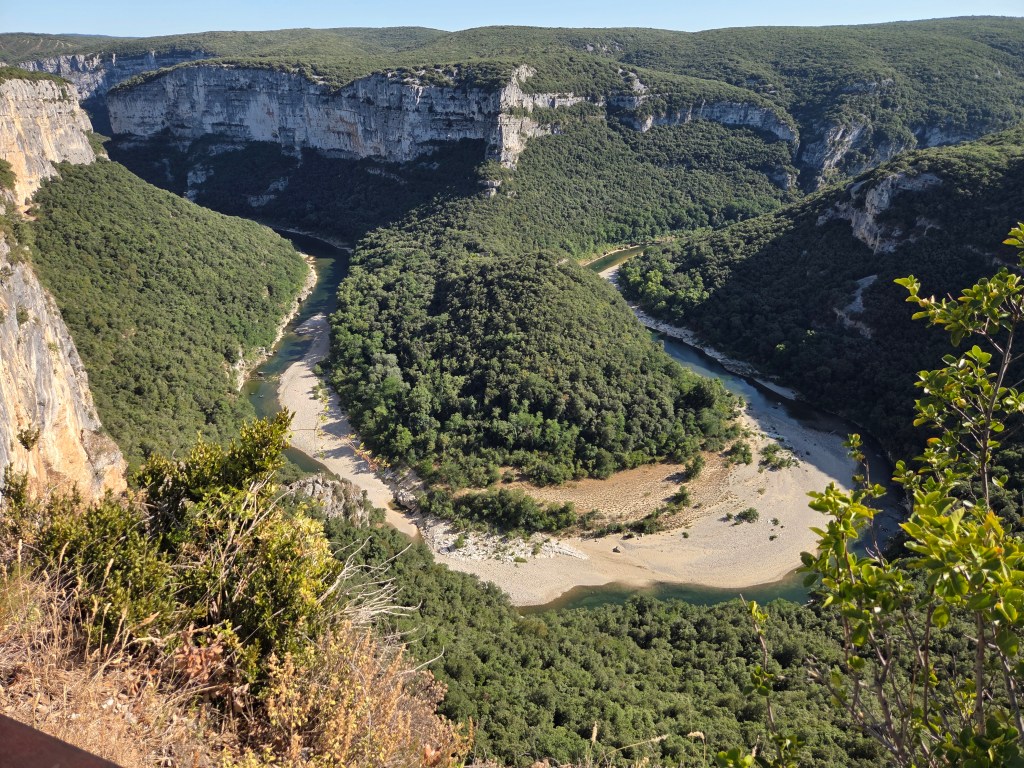
Gorges de l’Ardeche – the river meanders
Since I returned to this road the next day, I will show just one of the photos I took here – more pictures coming tomorrow! After being blown away by the splendour of the Ardeche Gorges, in the early evening I reached my destination for the next two nights, the fascinating Saint-Montan. This was not only just another beautiful village, since in addition it had a very unusual history which I will also cover in my next post.
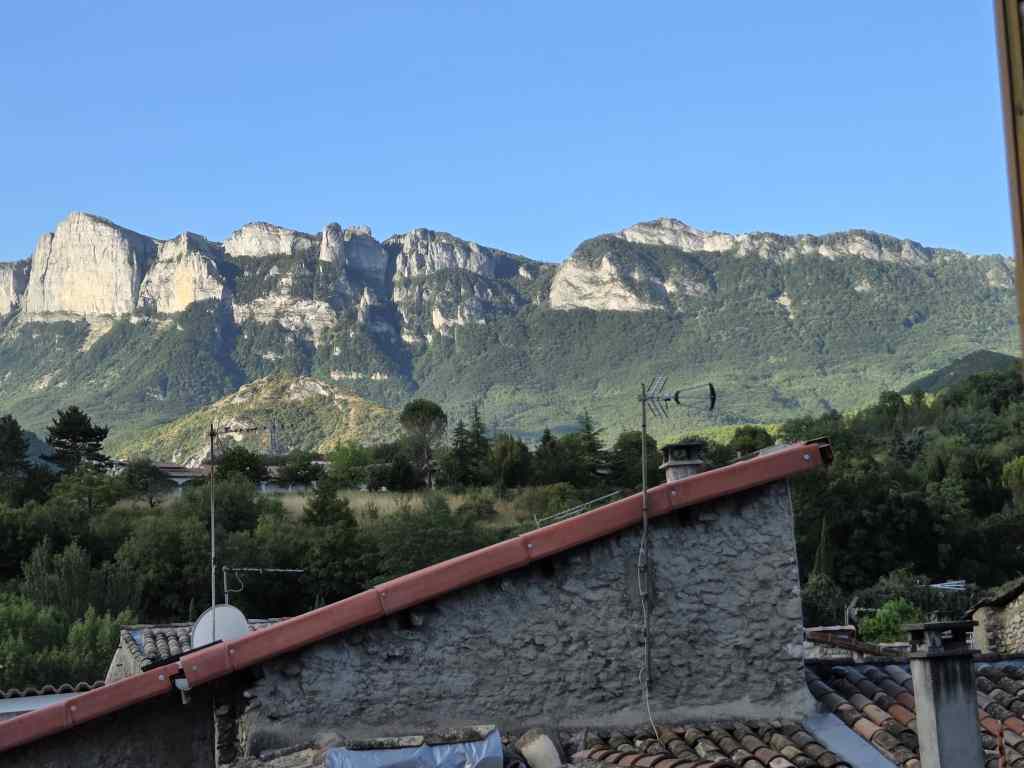
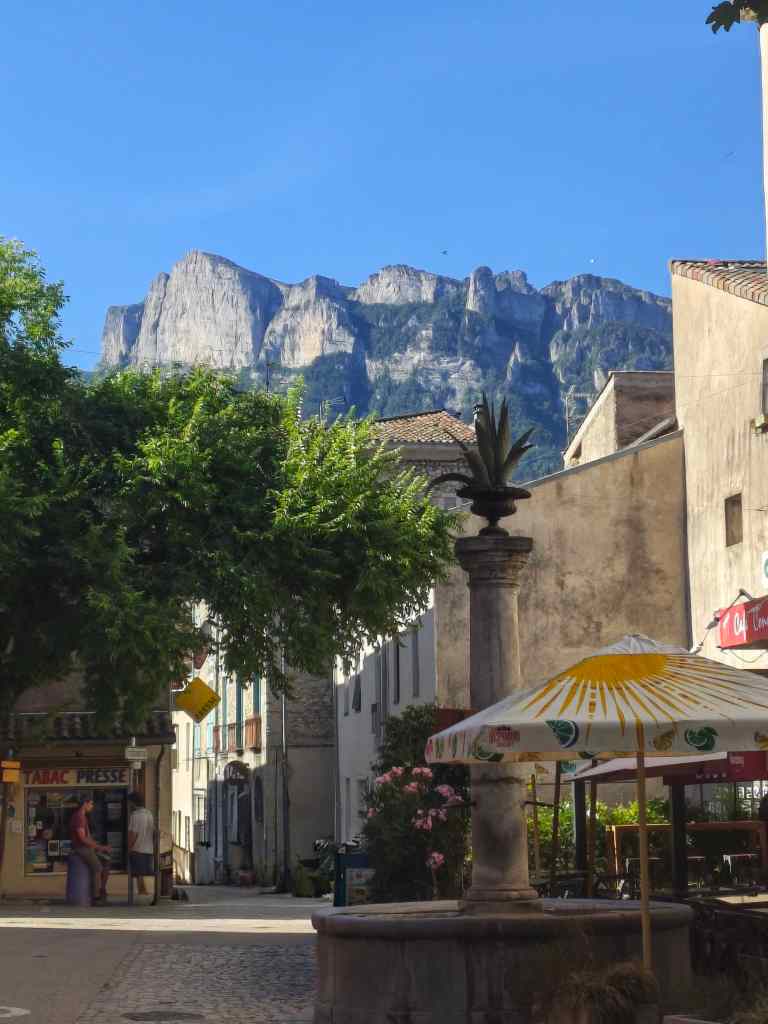
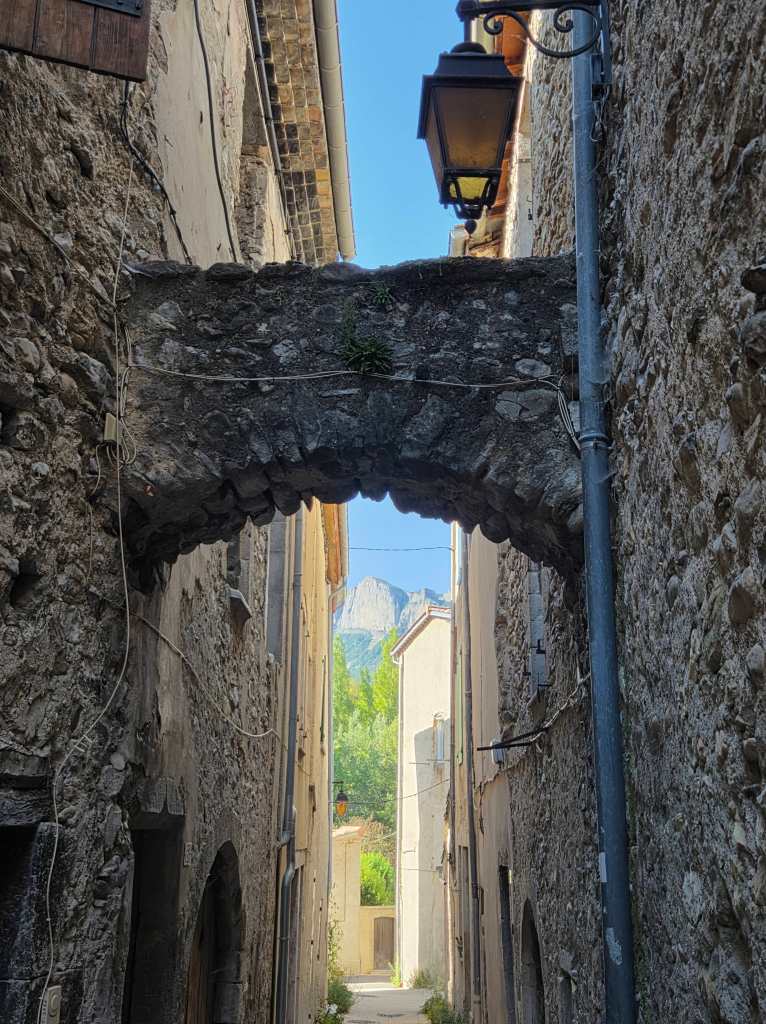
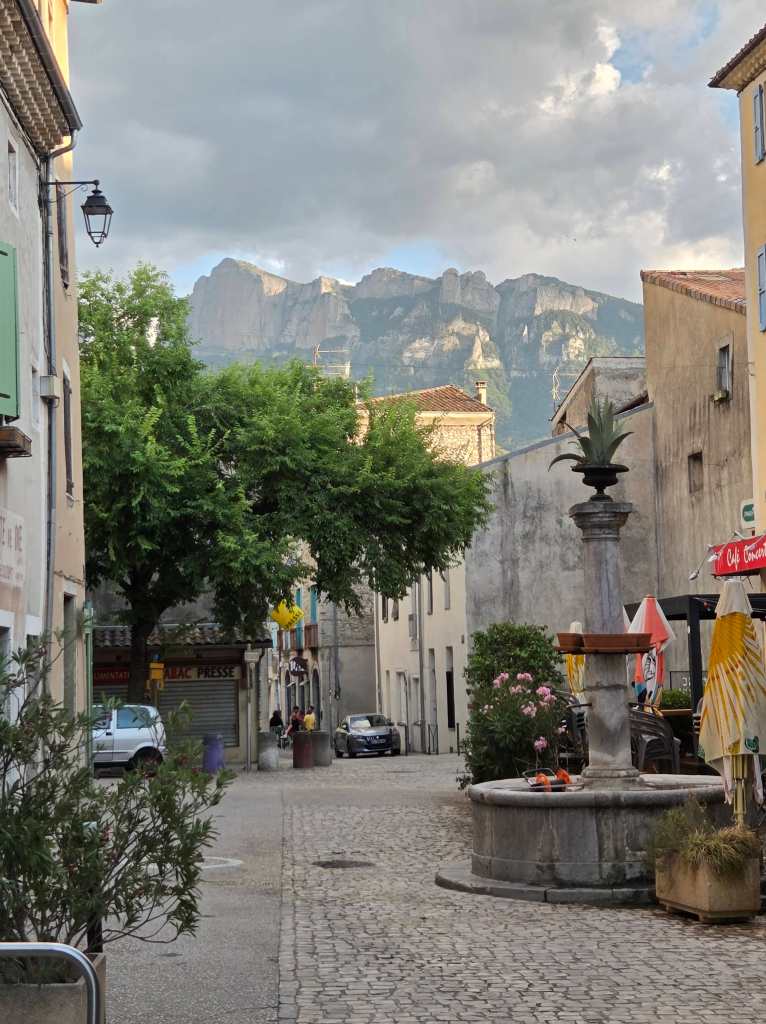
After waking up, I flung open my bedroom windows to be greeted by a great view of the area around Saillans. I spent a final half and hour exploring more hidden passages and admiring the backdrop of the mountains surrounding the town on all sides.
Looking out over the roofs of Saillans from my bedroom windowSaillans’ square in the morning lightAnother dark passageway with imposing mountains in the background
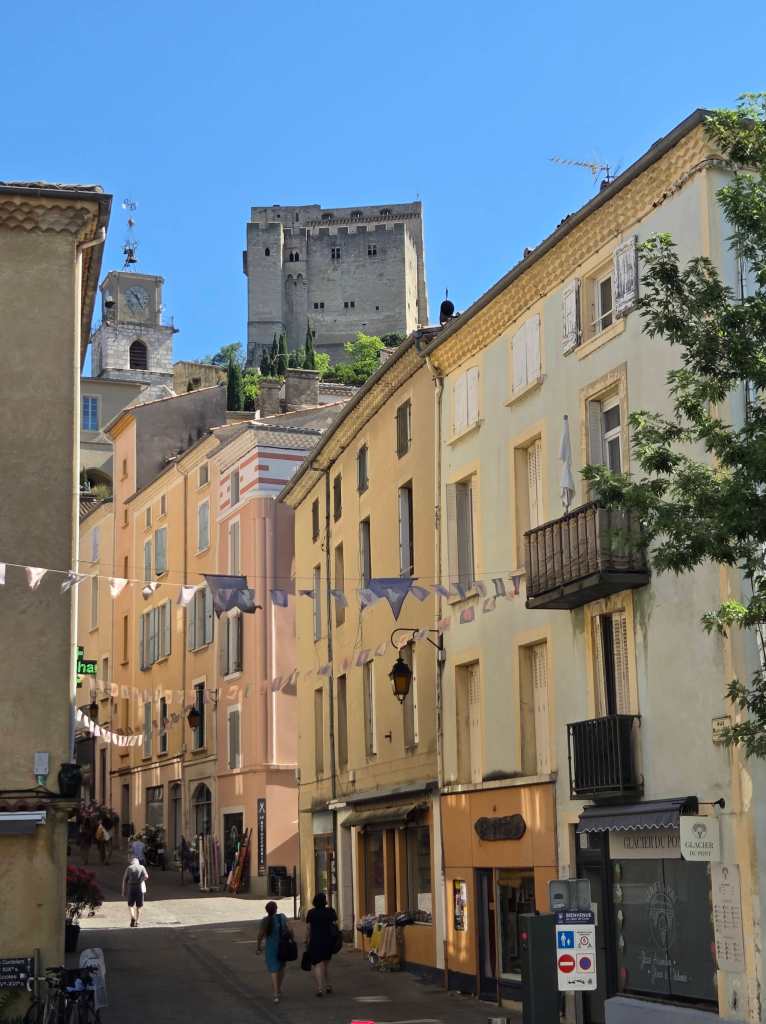
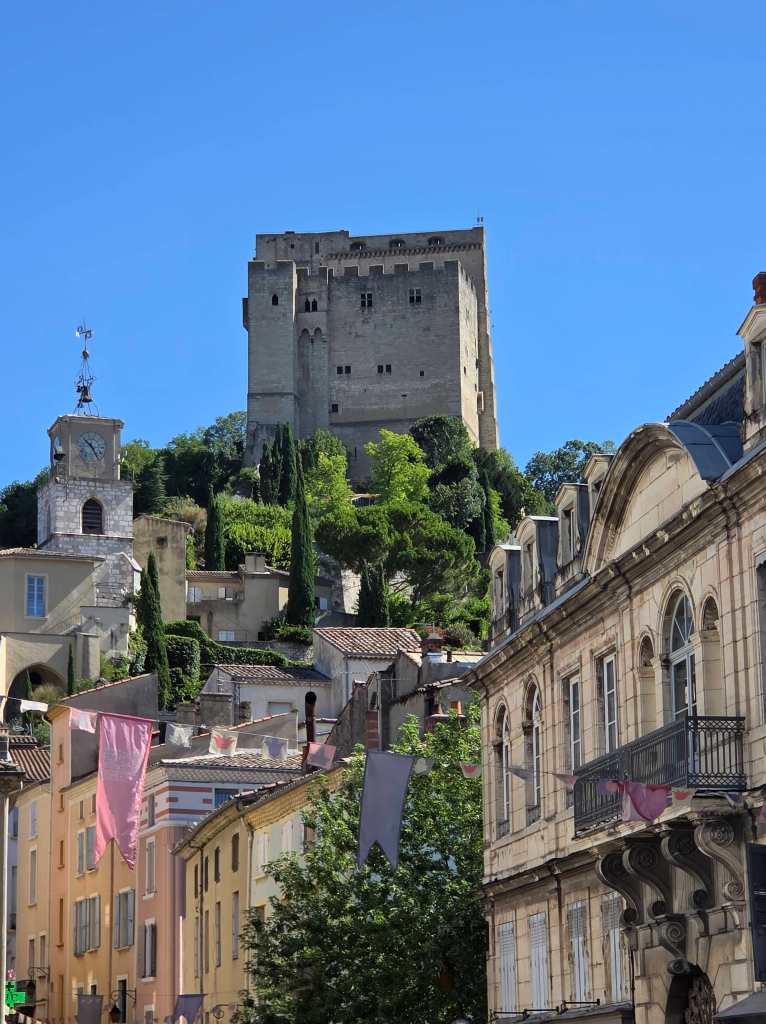
Then I got back in my car and headed to the next impossibly pretty town of my trip – Crest (pronounced “kray” in English), famed for its tower – possibly the tallest stone keep in all of Europe. Indeed the Tour de Crest was visible for miles from the road as I approached the town.
La Tour de Crest – The Tower of Crest
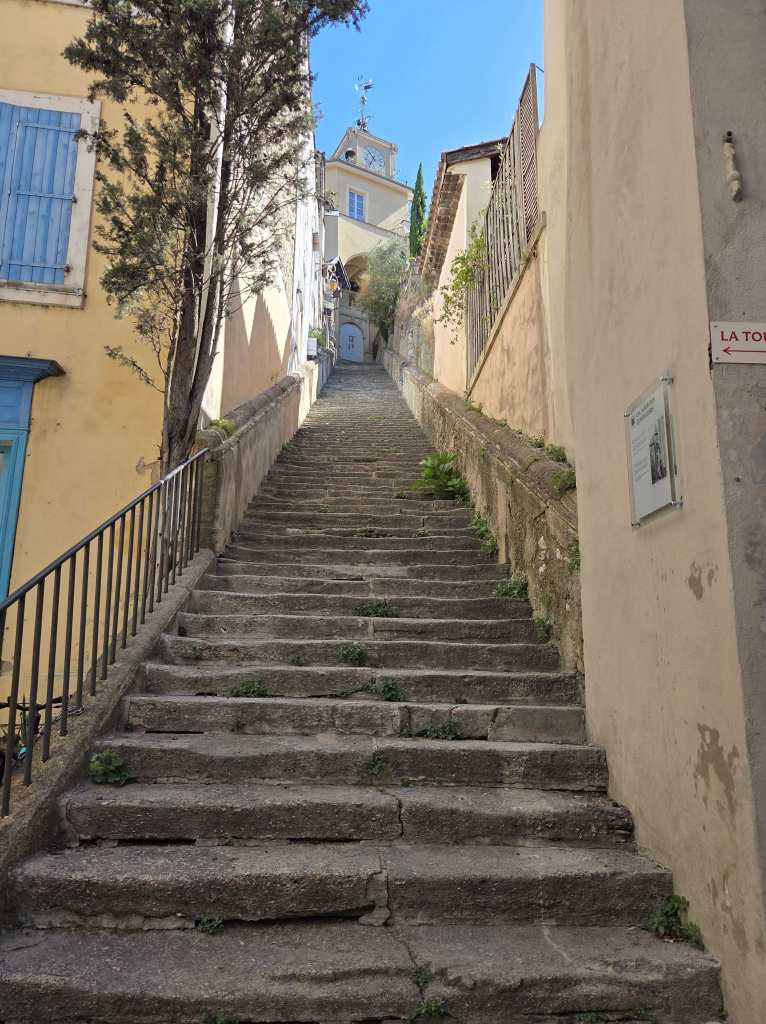
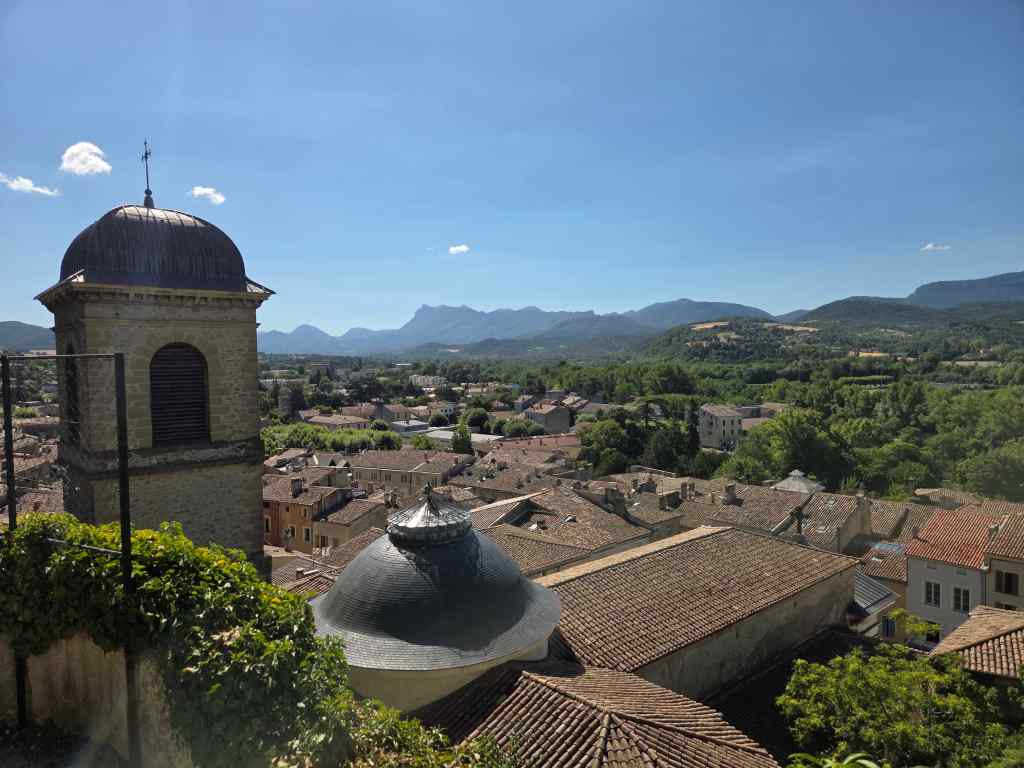
I parked my car, strolled through the town and then up an imposing set of steps to visit the tower. The building has a long history; it was originally built in 1394 and was part of a castle complex, and then a prison from the 1700s to the mid nineteenth century. I worked my way steadily up through a series of rooms with displays about the tower’s history until I reached the roof, which offered wonderful views but which was swept by a strong wind – the famous Mistral – which made me worried I would be blown away.
So many steps for my little legs!The view from just below the Tower of Crest
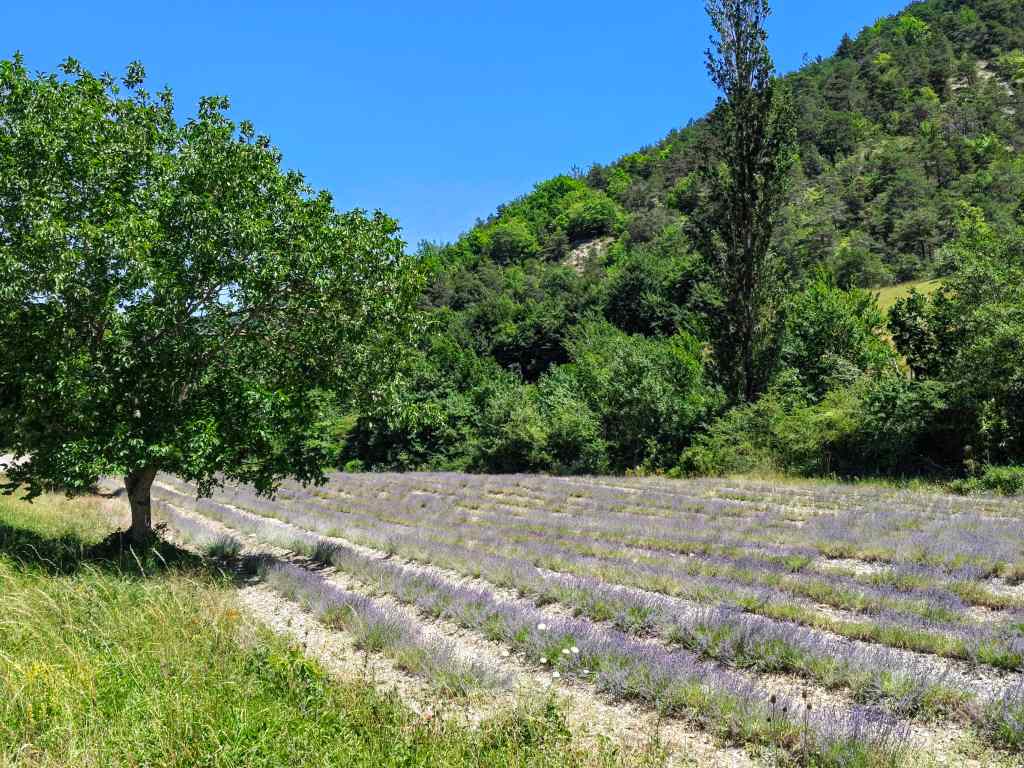
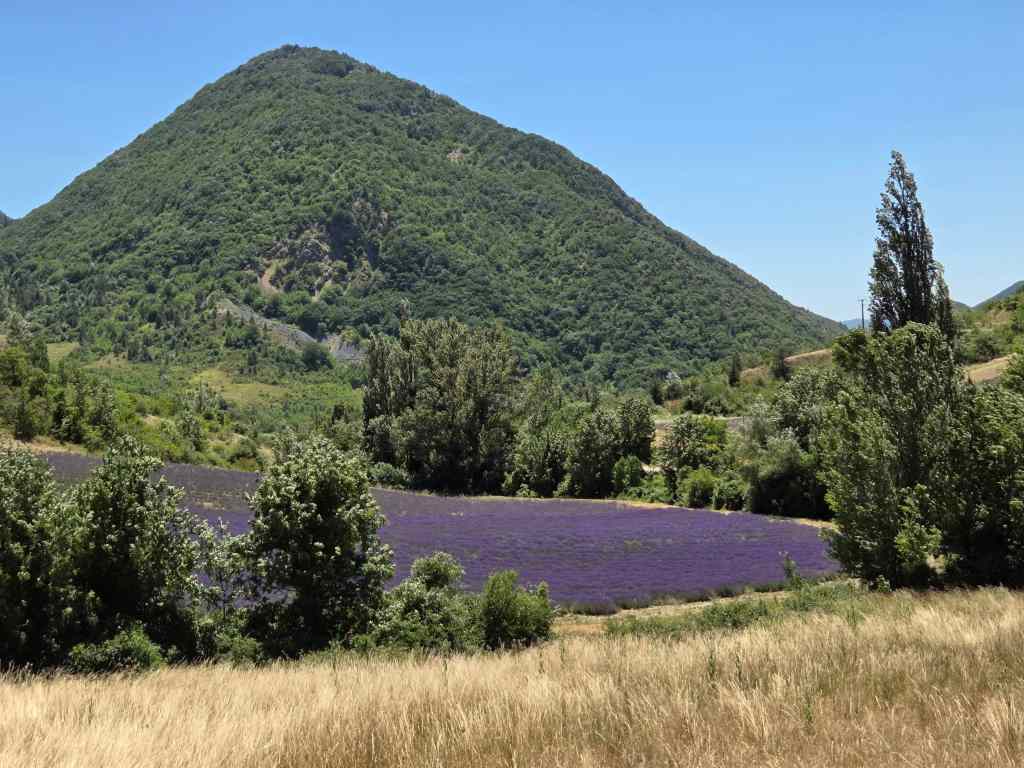
After visiting the tower, I had a coffee in the town’s main square before continuing my drive south along a pretty road. Occasionally I passed fields of lavender – the harvest that year was unusually late, and a few fields were still in bloom. I stopped to breath in the scent and admire the hundreds of butterflies visiting the flowers.
Lavender fields in the Drome region….and butterflies
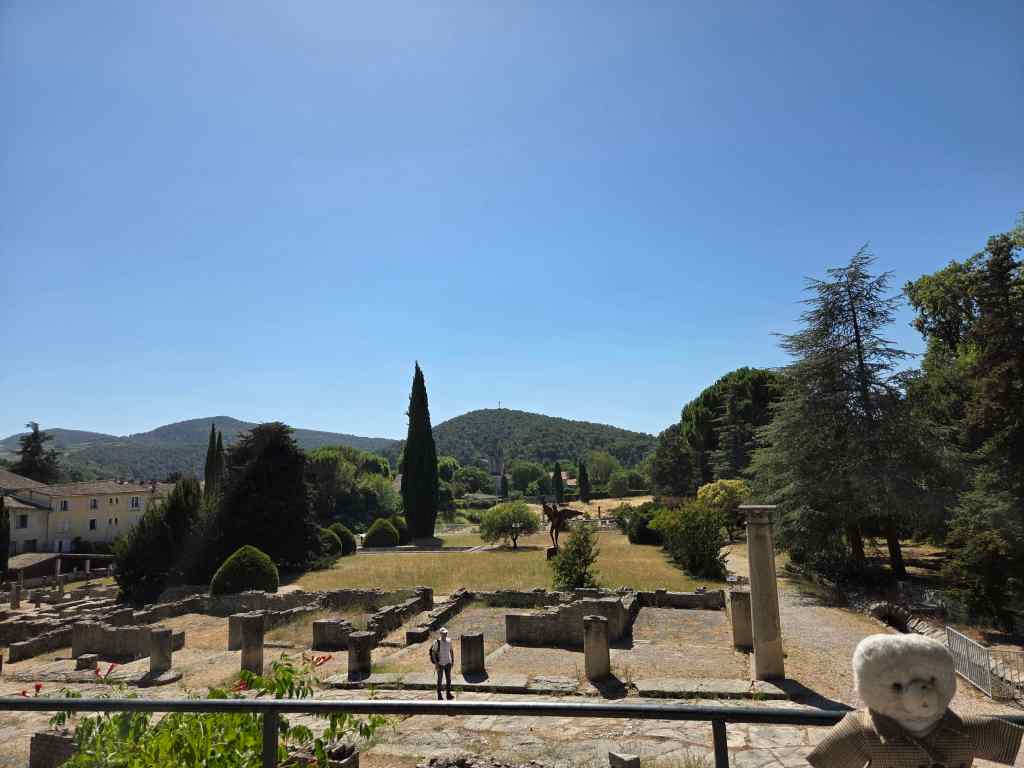
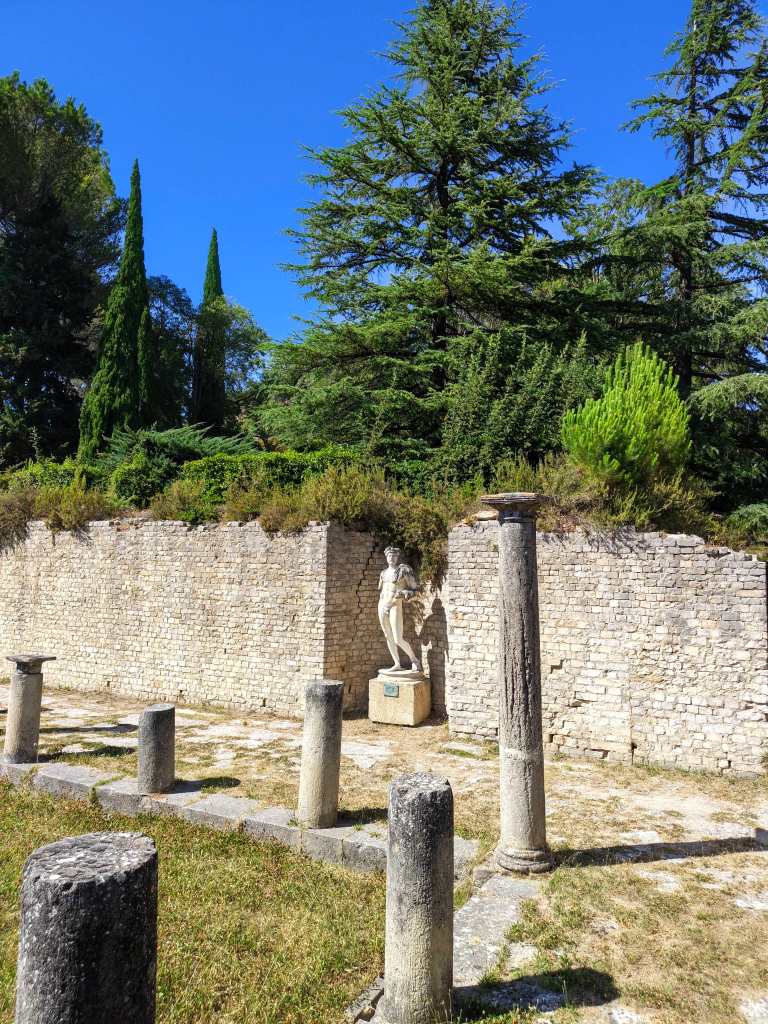
My route took me further south, past Nyons (which I would visit on a different day) and on to Vaison-la-Romaine in the Vaucluse region of France. This ancient town was once a major Roman city and many ruins remain to this day. I summoned up just enough energy to explore them in the heat of mid-afternoon sun.
Roman ruins in Vaison-la-Romane
Vaison-la-Romane also has a medieval area with a Roman bridge, which is supposed to be pretty, but it was very hot and I didn’t want to arrive at my gite late, since I wanted to spend a bit of time chilling beside their pool after two very busy days of sightseeing. I stopped at a roadside shop selling food specialities of the region and bought some bread, olives, cherries, cheese and wine for dinner.
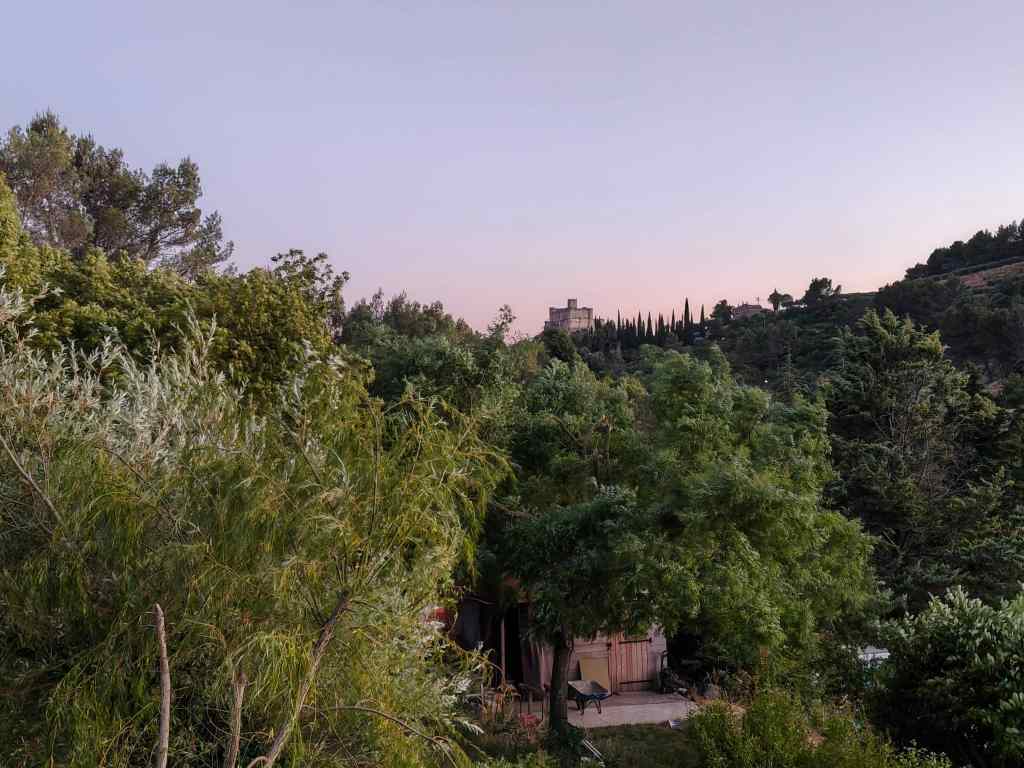
My lodgings were wonderful – a small bed and breakfast which had been bought as a ruin by a couple, who had then stylish renovated it themselves (the husband was formerly a builder by profession). I spent the evening by the pool enjoying the food I had bought – including probably the best cherries I have ever tasted – and watching the sun set over the nearby Chateau du Barroux.
Looking out from my room to the Chateau de Barroux
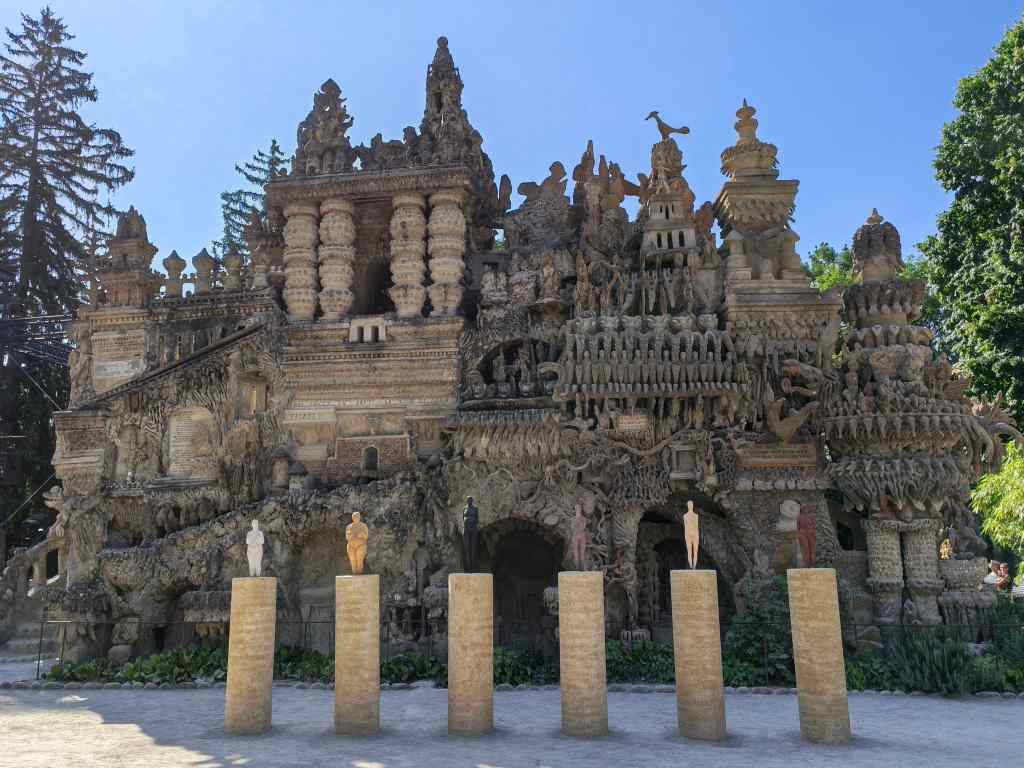
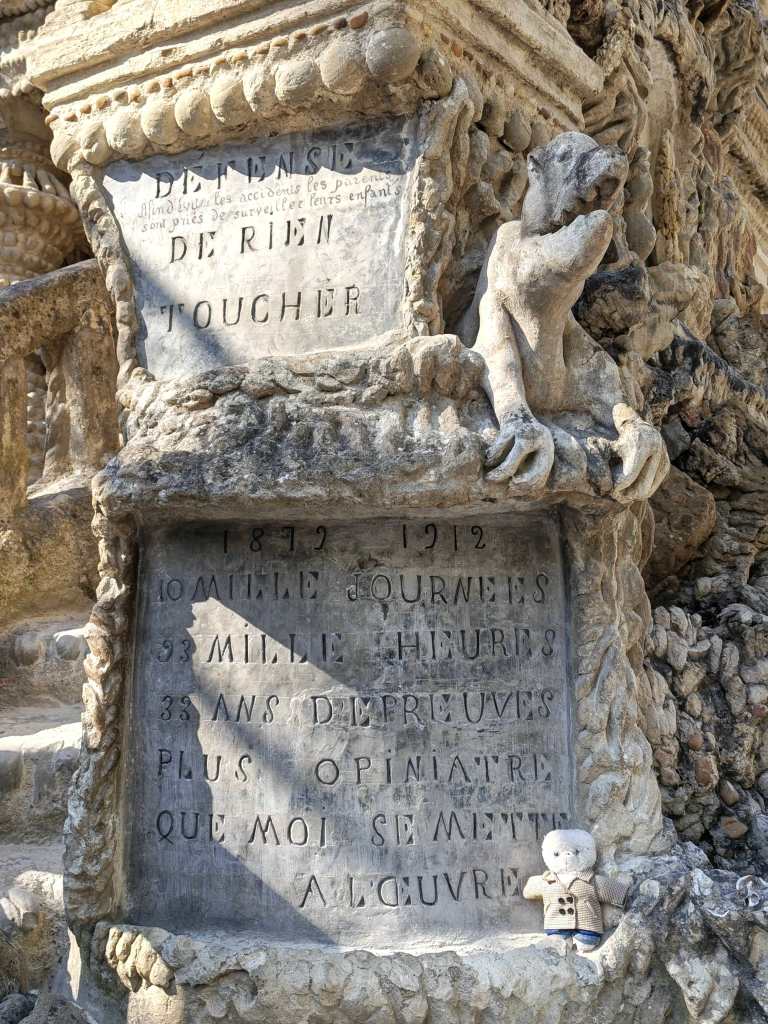
Back on Road! This time I am in France for a week, attending a wedding but also taking the opportunity to explore a bit at the same time. My first stop is Hauterives, about an hour’s drive south of Lyon. It is a pleasant village, but one which would have remained totally anonymous had it not been for “Facteur Cheval” – the village postman in the late 1800s. Not content with a mail round covering some 40km on foot, Ferdinand Cheval became interested in the different rocks he found in the countryside, began to take them back to his house in a wheelbarrow…….and in 1879 started to build a monument in his back garden, using the samples he had collected plus small amounts of purchased chalk and cement. Totally self-taught and unaided, he carried on building for thirty three years. He let his imagination run wild, helped by pictures on the postcards and magazines he was delivering to other people every day. He finally finished his project in 1912, aged 76.
The North facade of the Palais Ideal du Facteur Laval
The incredible monument soon became a tourist attraction. Some people considered it a remarkable piece of architecture in the naif style. Others called it an ugly folly built by an uneducated peasant. One of the early visitors nicknamed it Cheval’s “Palais Ideal” or ideal palace, a name that the postman liked and adopted for his creation. A different early visitor took photographs without authorisation to make postcards, causing Cheval to bring the world’s first ever court case for visual copyright, which he won.
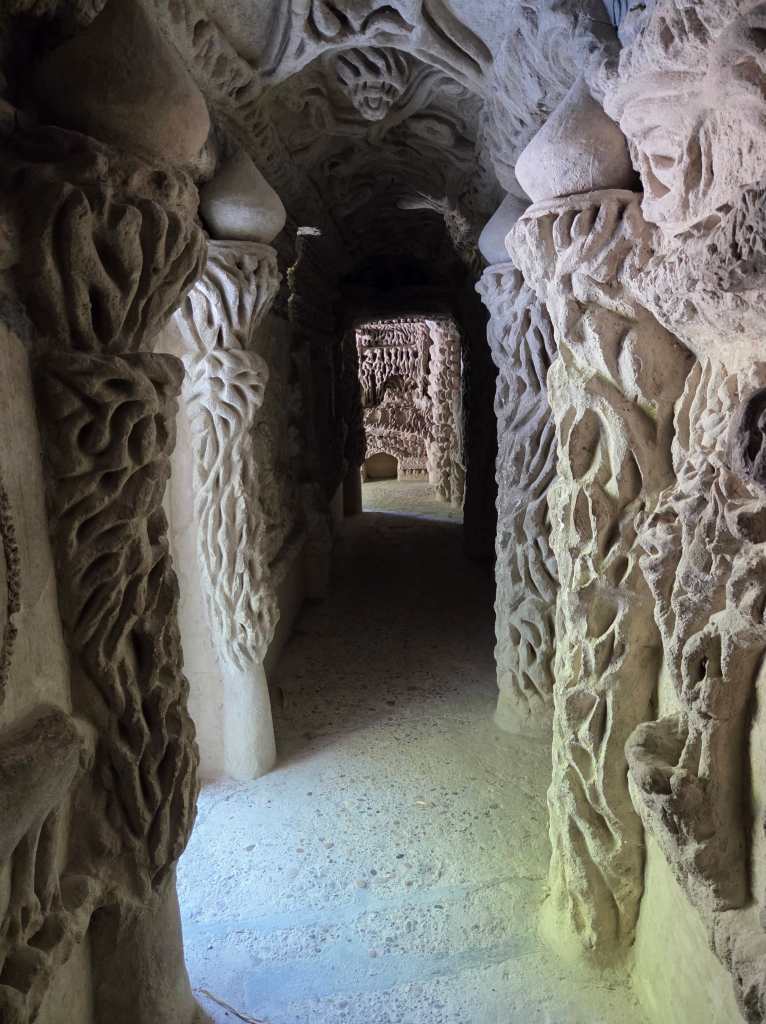
My first impression on approaching the palace’s north facade was one of puzzlement. At first sight the art work was indeed basic and bizzare, with sculptures representing scenes from the Garden of Eve including a crudely represented Adam, Eve and snake. I wondered why I had made such a detour to look at a bunch of rocks roughly held together by chalk and cement. But having made the effort to get here, I decided to give the place a chance and wandered around its outside before diving into a tunnel passing through its heart and then heading up to the roof.
Inside the Palais Ideal
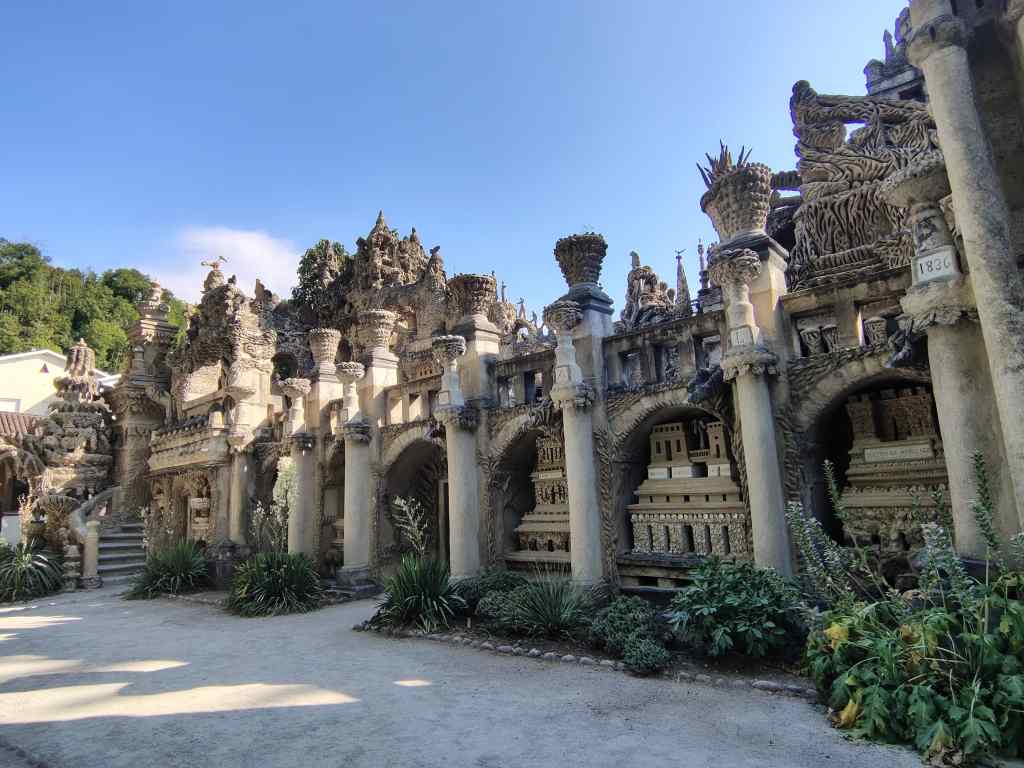
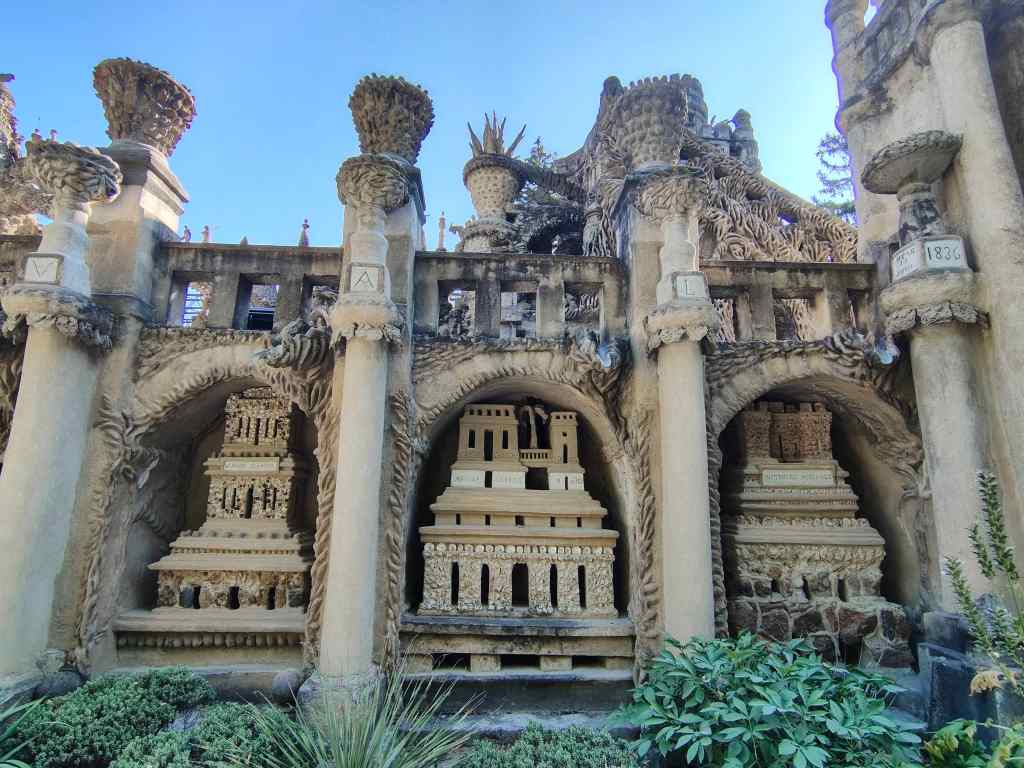
After a short time, the “palace” began to grow on me. On the west side were reproductions of architecture from around the world – a house in Algers, a swiss chalet, a mosque, a medieval european castle, even an attempt to represent the White House in the USA.
The West facade of the Palais IdealThe “White House” is on the left in case you didn’t recognise it…..
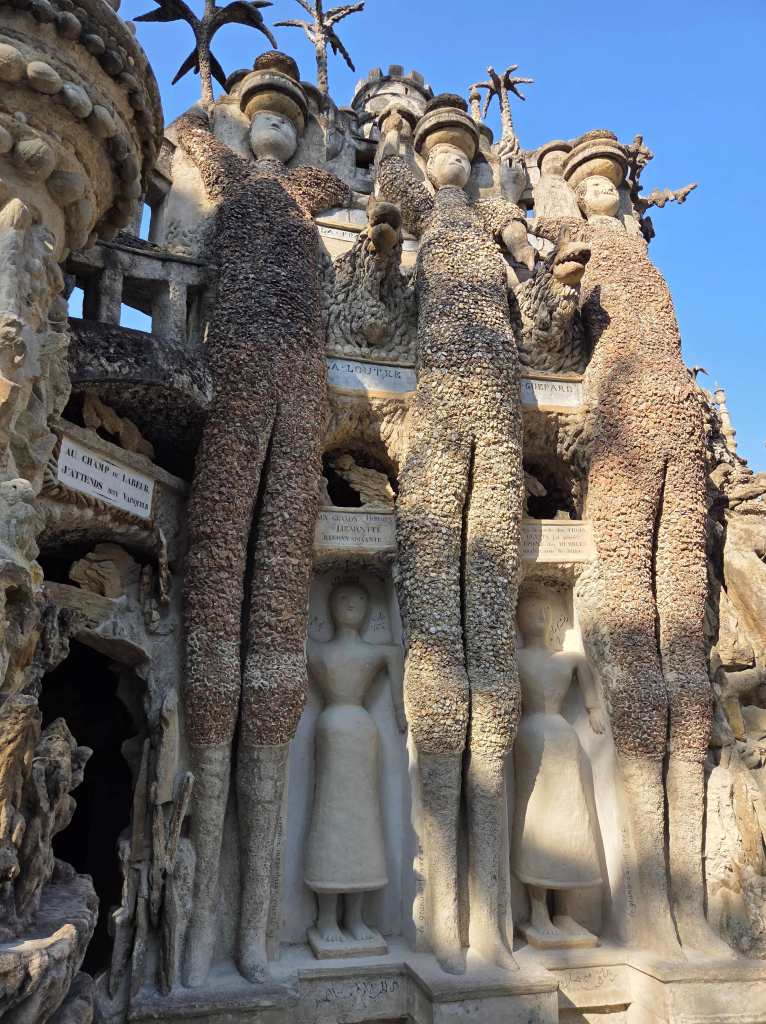
On the east facade were three strangely-chosen giants from past history – Archimedes, Vercingetorix and Caesar. And all over the palace were inscriptions reflecting a deeply personal, humanist view of the world.
Giants of the Palais IdealInscriptions at the Palais Ideal
When it was finally time to leave I was enchanted by what I had seen and very glad I had come. The Palais Ideal is a remarkable creation, unique in the world – the work of a single man, uneducated perhaps, but with a strangely haunting vision of architecture…..and of life.
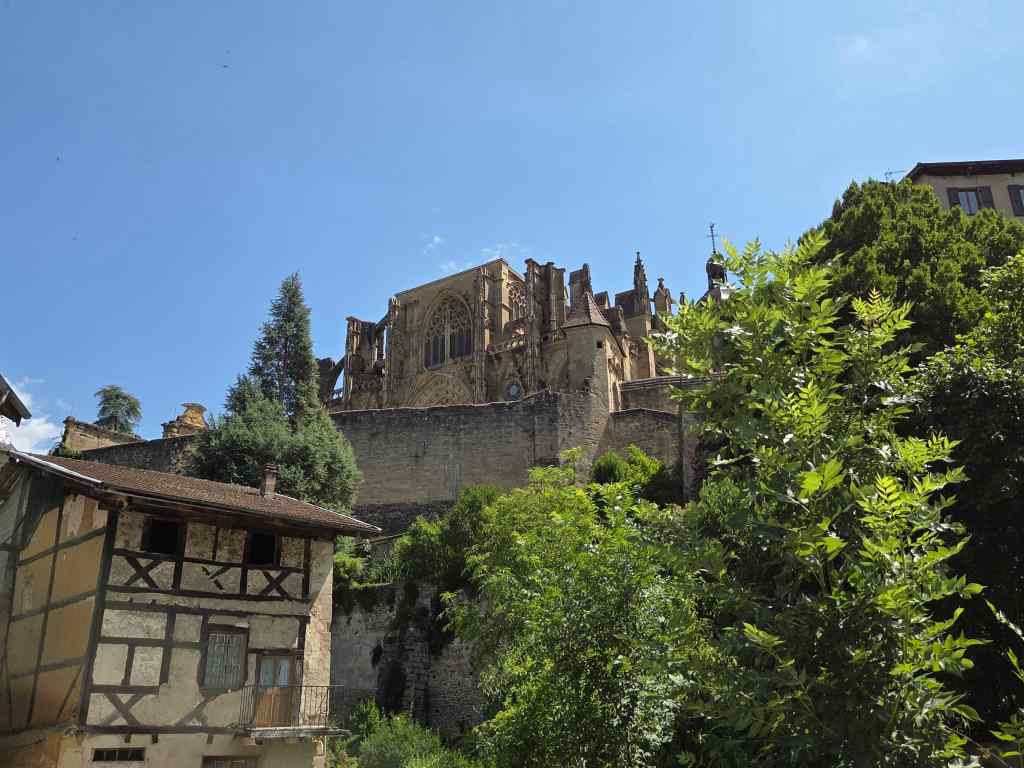
Inspired, happy and with a strange peaceful feeling, I headed onwards, south to Saint-Antoine-L’Abbaye, a small village located in the Isere department of France, which won the title of “France’s favourite village” in 2025 – a coveted award made annually.
Saint-Antoine-L’Abbaye from below
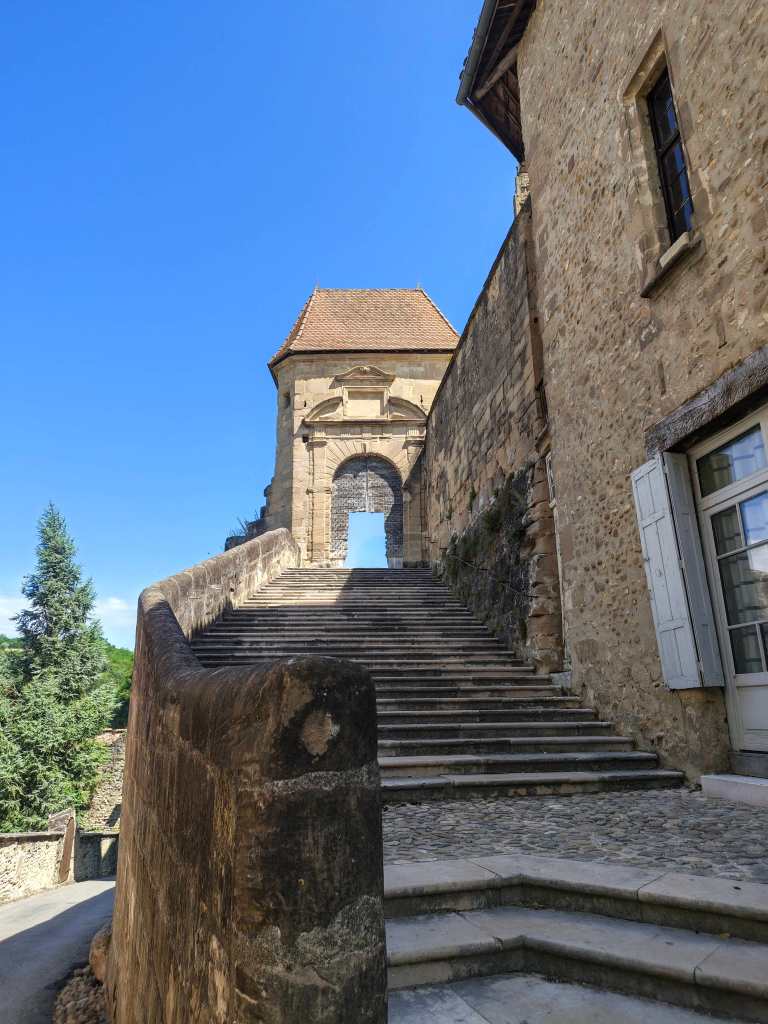
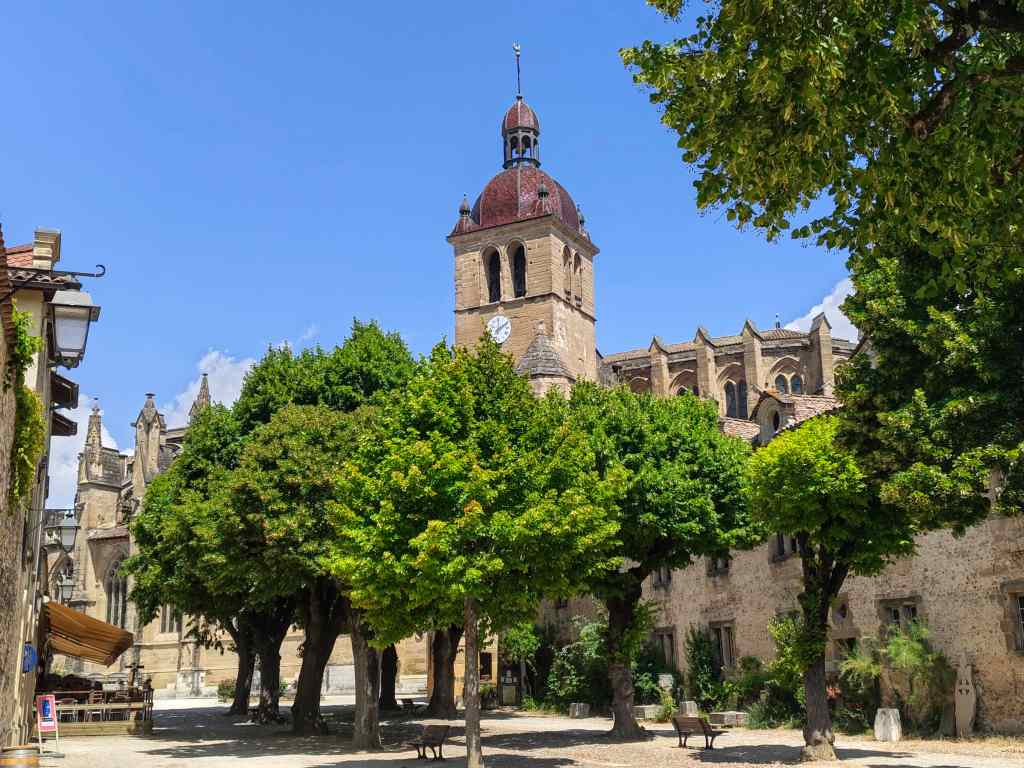
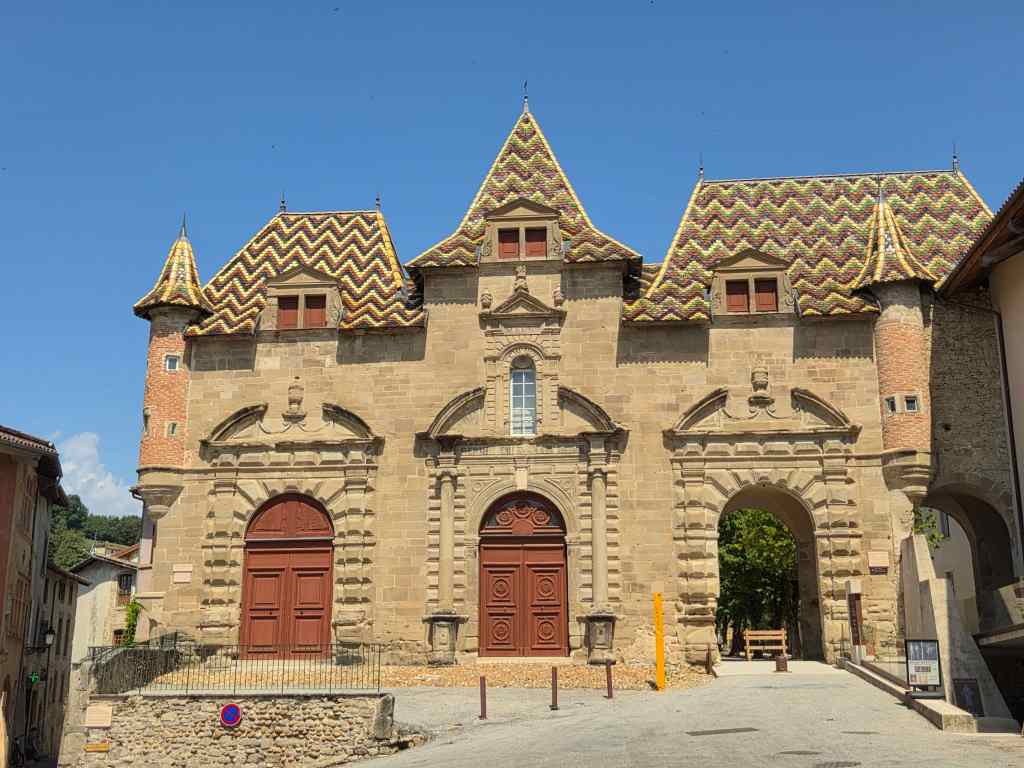
I left my car at the foot of a steep hill and clambered up to the 900-year old gothic abbey to find a sun-drenched village square and some beautiful old buildings. After wandering around in the heat, I discovered a wonderful small shady garden in an inner courtyard and sat down to enjoy a fresh breeze whilst the sleepy village baked in the midday sun.
The steep walk upSaint-Antoine-L’Abbaye’s main squareBeautiful Building in Saint-Antoine-L’Abbaye
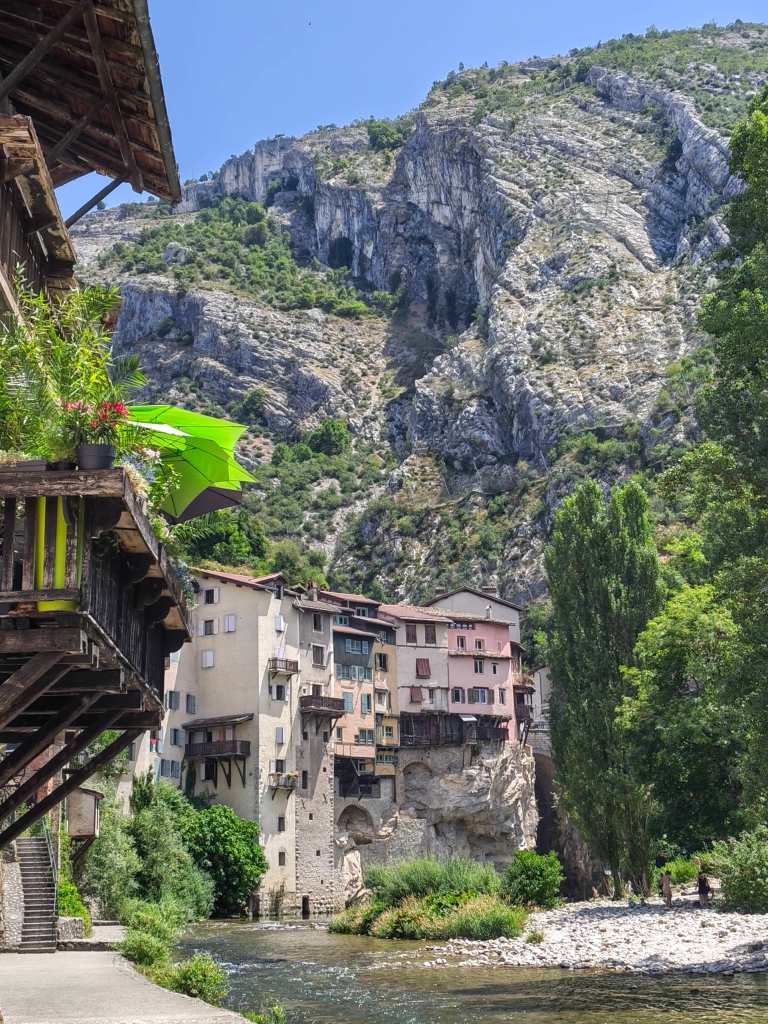
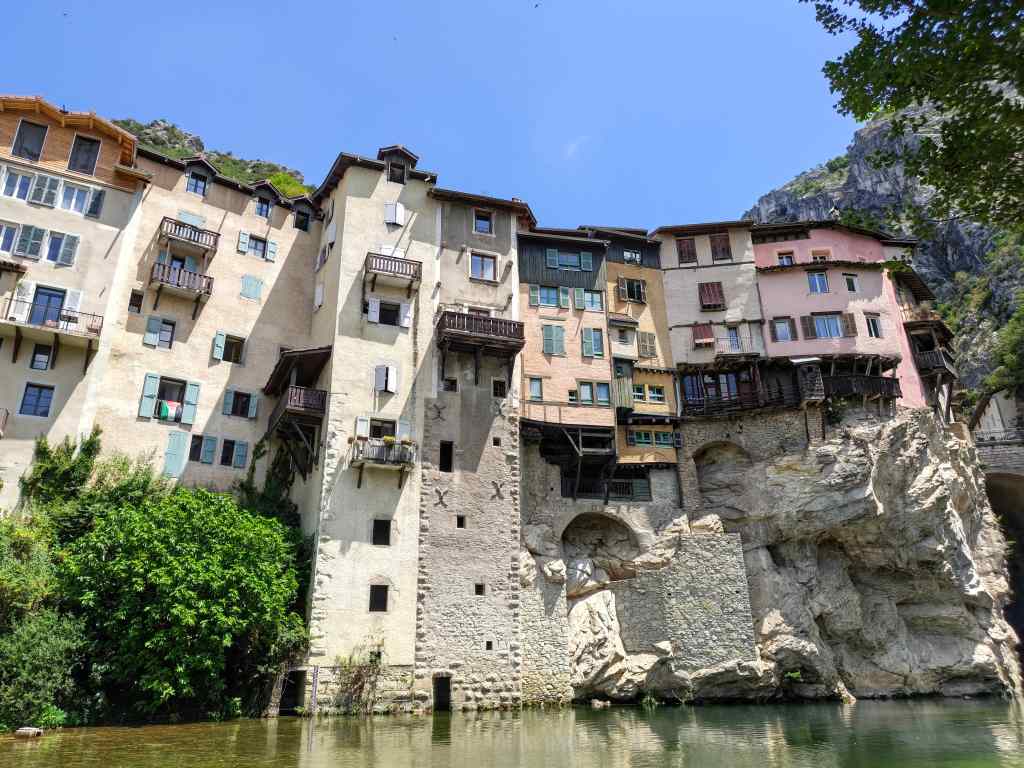
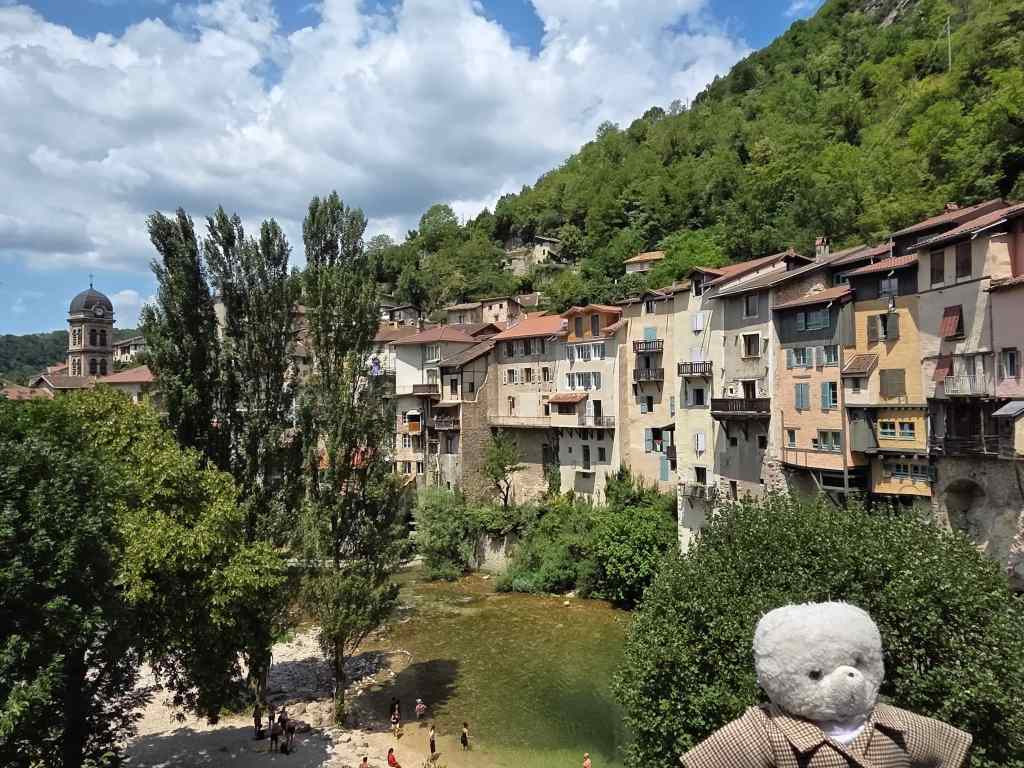
Feeling very relaxed, I decided it was time to move on again – this time south to the Vercors, a rugged mountainous area of France famous as a centre for the resistance against the Nazis during the second world war. The gateway to this region was another impossibly pretty village called Pont-en-Royans, with curious suspended houses hanging over the side of a small river.
Pont-en-Royans’ hanging housesPont-en-Royans
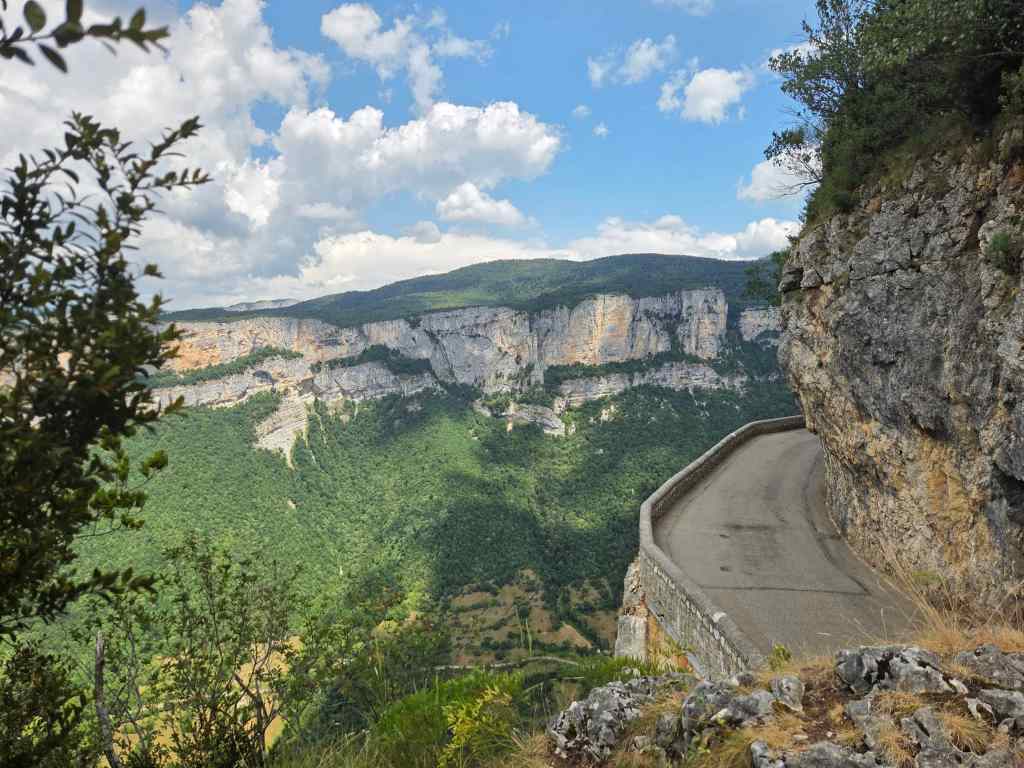
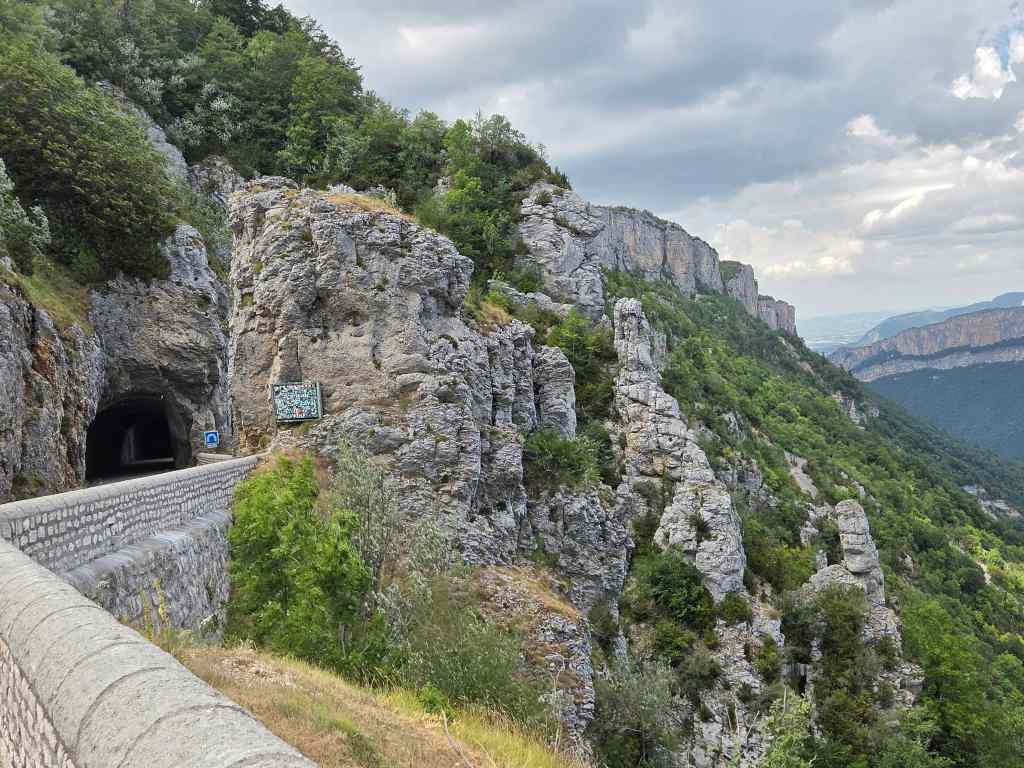
From there my path headed up steeply into the mountains to the Route Combe Laval, a famous mountain road carved into the face of a cliffs and reputed to be one of the most exciting drives in Europe. It was indeed a spectacular road, with narrow tunnels cut in the rock and sweeping views of the mountains.
La Combe LavalDescending from La Combe Laval towards Die
I continued to the French city of Die, where sadly I didn’t have time to stop except to do a short tasting of the local wines in a cellar just outside of the centre. Die is known for its sparkling wines made from a unique local grape, Clairette…….but unfortunately I found that this style of wine was not really to my taste. I carried on to my overnight destination of Saillans, a small town in the Drome region, which was barely mentioned in my guide book and which I had only chosen because its location was convenient for the next day’s driving. However Saillans turned out to be a very positive surprise – its compact historical centre was packed with an unusually high concentration of bars and restaurants, which serviced a local population that seemed unusually young for a small French village lost in the countryside.
The main square, Saillans
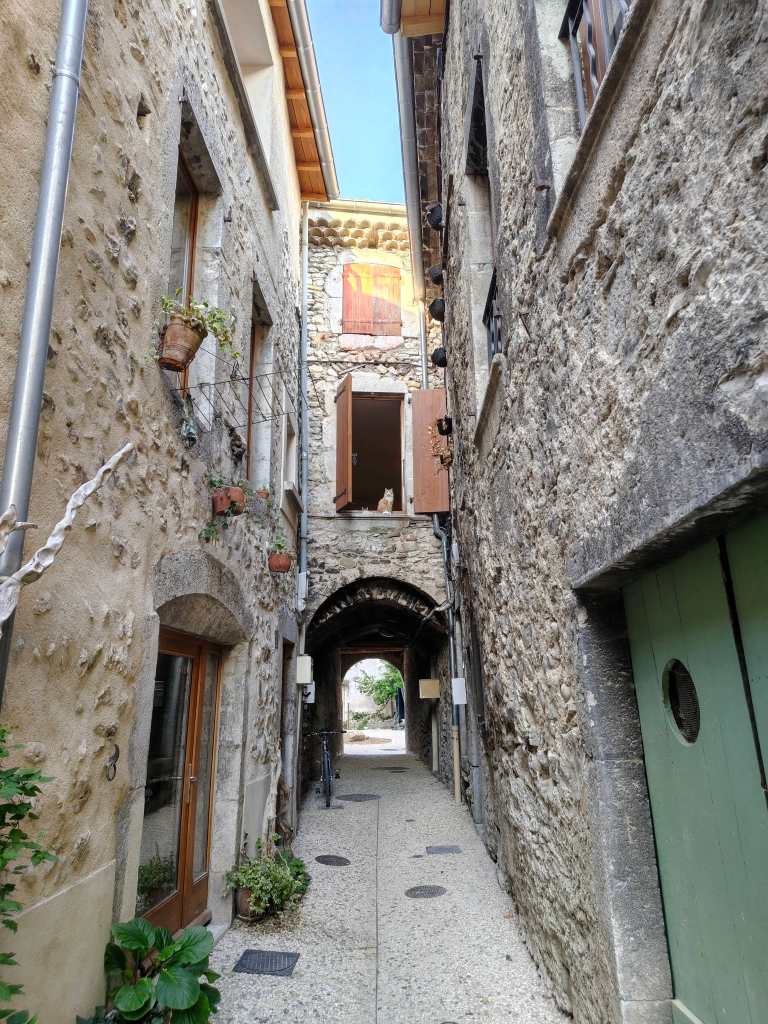
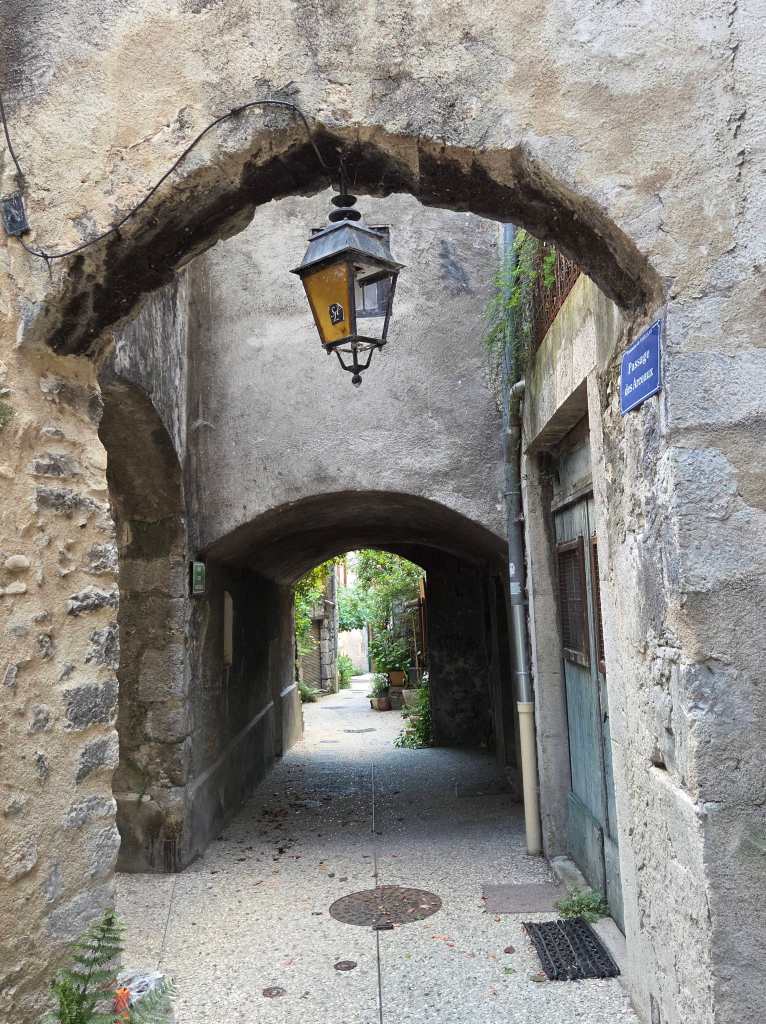
A sign in the town’s main square proposed an interesting short walking tour, which led me through narrow passageways shaded by frequent arches……..
Shady passageways in Saillans
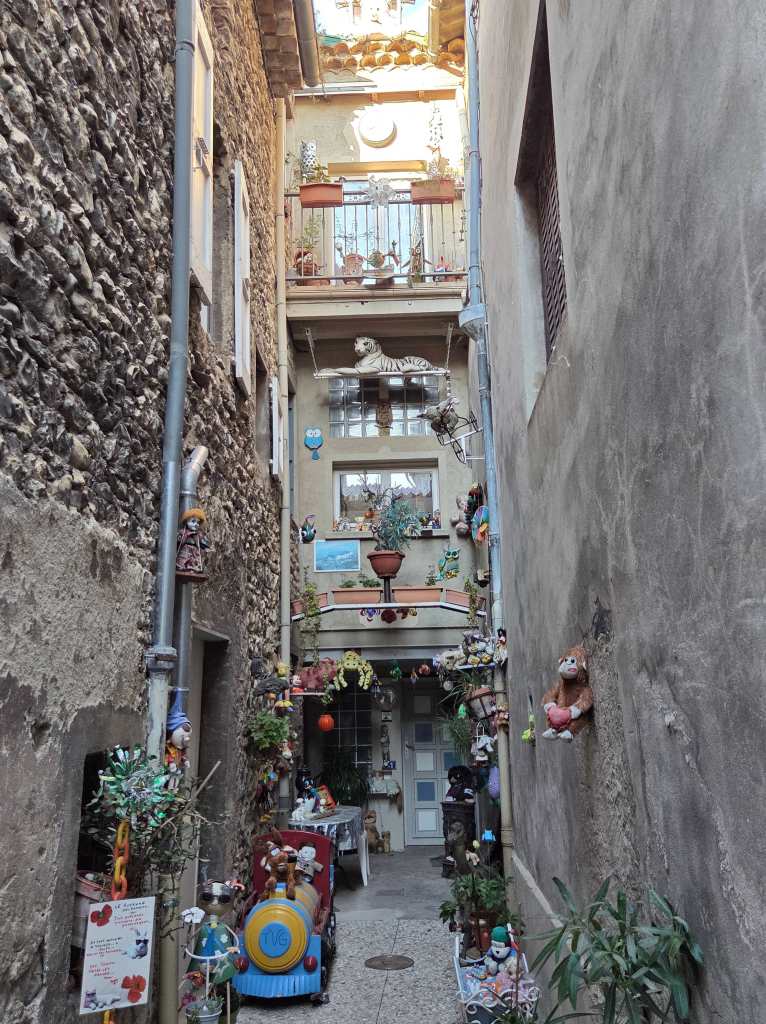
…….and strange cul-de-sacs. In one of these the owners had left an amazing collection of toys, with a sign encouraging parents to let their children play there. The town had a young, bohemian and arty feel – quite unlike the usual sleepy provincial French village.
A children’s playground, Saillans – spot me, Trouspinet if you can!
After the walking tour I settled down to eat and drink at one of Saillans’ busy cafés. 15€ bought me an enormous cheese platter which was almost too much to eat, so I had to order some of the local red wine to help me wash it down. The Drome is not France’s most prestigious wine area, but its produce was perfectly drinkable and at 4€ a glass, who cares. When I paid for dinner I had the unusual experience of being pleasantly surprised by how small the bill was, and headed off to my room to digest my meal and review the day’s events. France is a remarkably rich tourist destination – in the space of just one day I had contemplated one of the world’s strangest architectural works, visited the two stunning villages of Saint-Antoine-L’Abbaye and Pont-en-Royans, done one wine tasting, driven one of Europe’s most spectacular mountain roads and ended up in the interesting small arty town of Saillans. I don’t think such a variety of attractions in such a small area exists anywhere else on earth.
And these are only some of Pompeii’s less well-known sights!
Today was the last full day of my Italy trip and I devoted it to visiting Pompeii, the famous archaeological site located half an hour away from Naples on a very crowded train. I arrived as early as I could, to avoid the heat of the afternoon sun and as many of the crowds as I could. I still faced a short queue to get in, and had to squeeze pass various tour groups just after the entrance to the complex.
Pompeii has a long history and was settled by various peoples but is best known as the prosperous Roman provincial town which was buried by the eruption of nearby Mount Vesuvius in AD79. After this disaster it remained hidden under volcanic ash until the 16th century when it was rediscovered. Major excavations only started in the 18th century and were accompanied by looting of some of the site’s art works. In recent years the excavation of Pompeii has been carried out to high archaeological standards, and even today the site continues to offer up new surprises. This was actually my third visit to Pompeii; my first was 50 years ago when I was a little cub, and I don’t recall much of it. The second was in 2000 twenty five years ago, and I remember a site which impressed by its size but not always its beauty, with lots of long, dusty and empty Roman streets laid out in a grid. But Pompeii is possibly the world’s most famous archaeological site, so I decided to make a third visit, and was very glad that I did.
I am not sure what exactly had changed since the year 2000, but this time I was enchanted by Pompeii. There seemed to be a lot more art work on display in the ruined houses, and a much bigger area to explore, including some gardens that provided a partial respite from the heat.
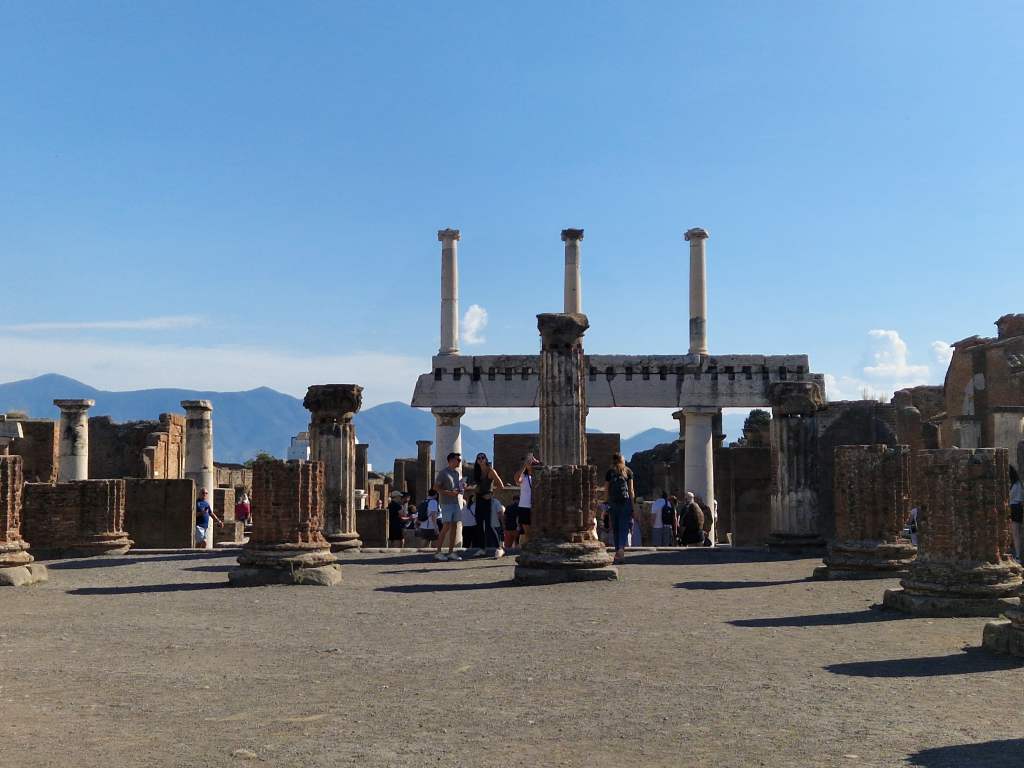
The forum – everyone’s first stop in Pompeii
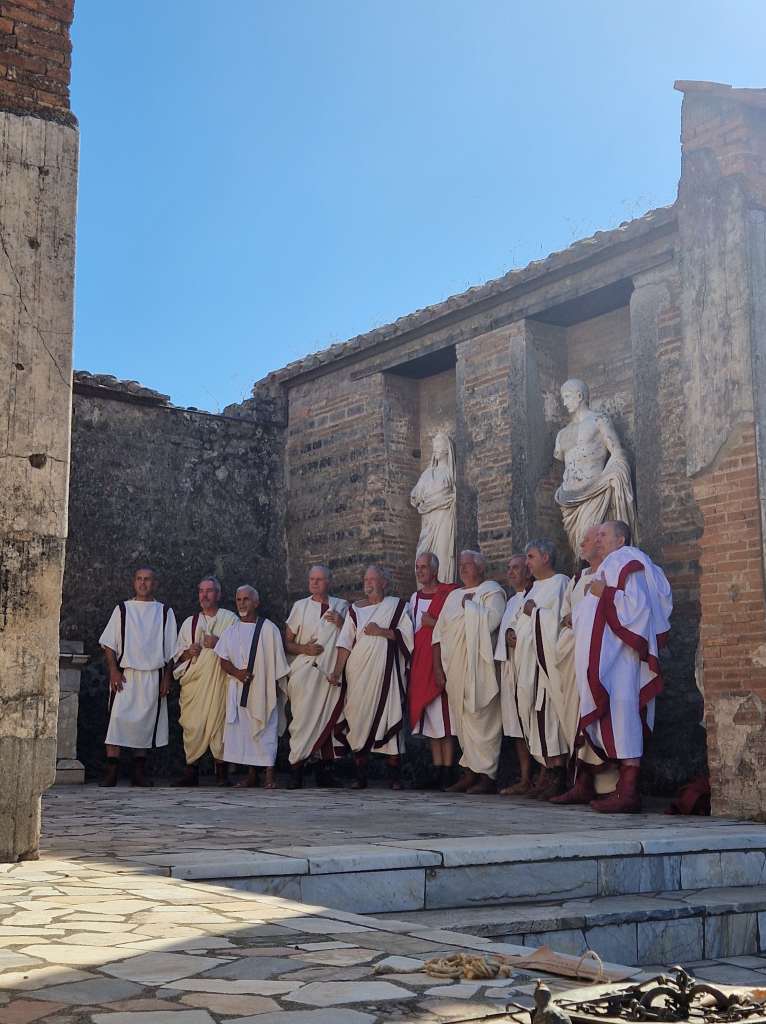
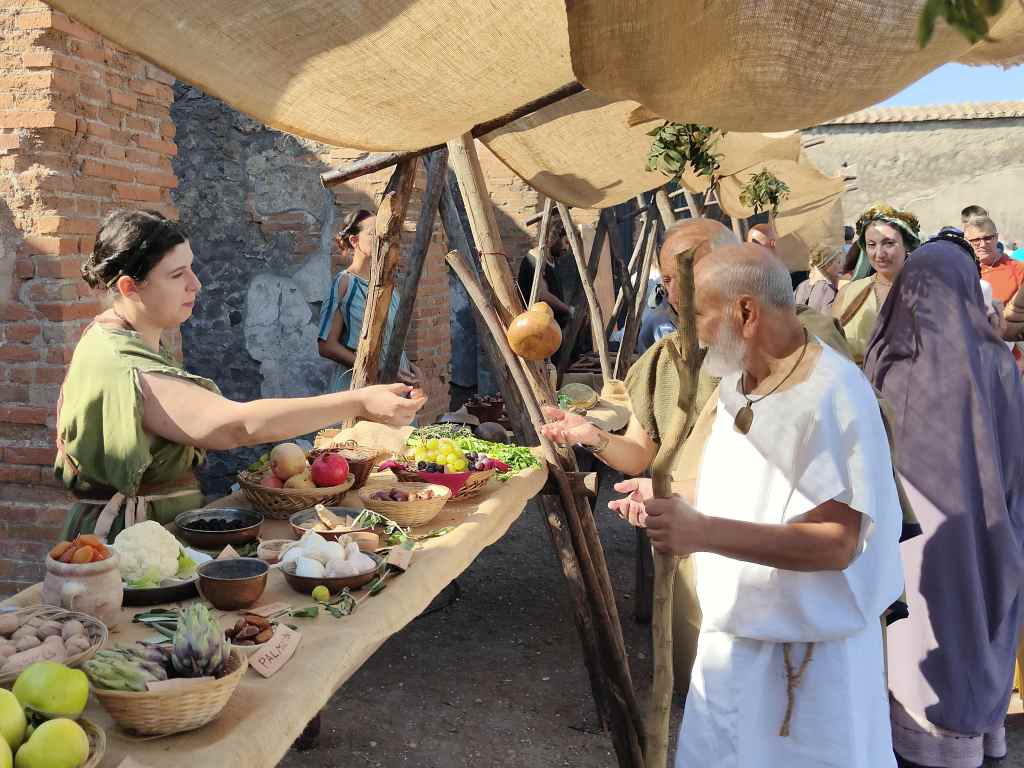
My first stop was the forum. Since this is located on the only road in from the main entrance, it is also everyone else’s first stop, and it was quite crowded. But it was still very impressive, with a fine view of the ruins and Vesuvius towering in the background. I was visiting on National Monuments Day, and to celebrate this the park authorities had arranged for staff to dress up as Romans and pretend to shop or participate in ancient religious rites.
Staff put on a show for visitors
After the forum the many visitors could disperse along several different routes into the ruins and explore them at their leisure, and except for the times I bumped into a tour group visiting the same house, I found it pleasantly quiet. I used the map provided with my ticket to plan my route and try to visit as many as the highlights as possible – seeing everything is simply not possible on one visit. Places of special interest were marked by blue dots on the map – one famous example is the House of the Faun, probably the most opulent residence in the town and owned by an important family. It is named after a small but beautiful statue of a faun that stands in its entrance.
House of the Faun, Pompeii
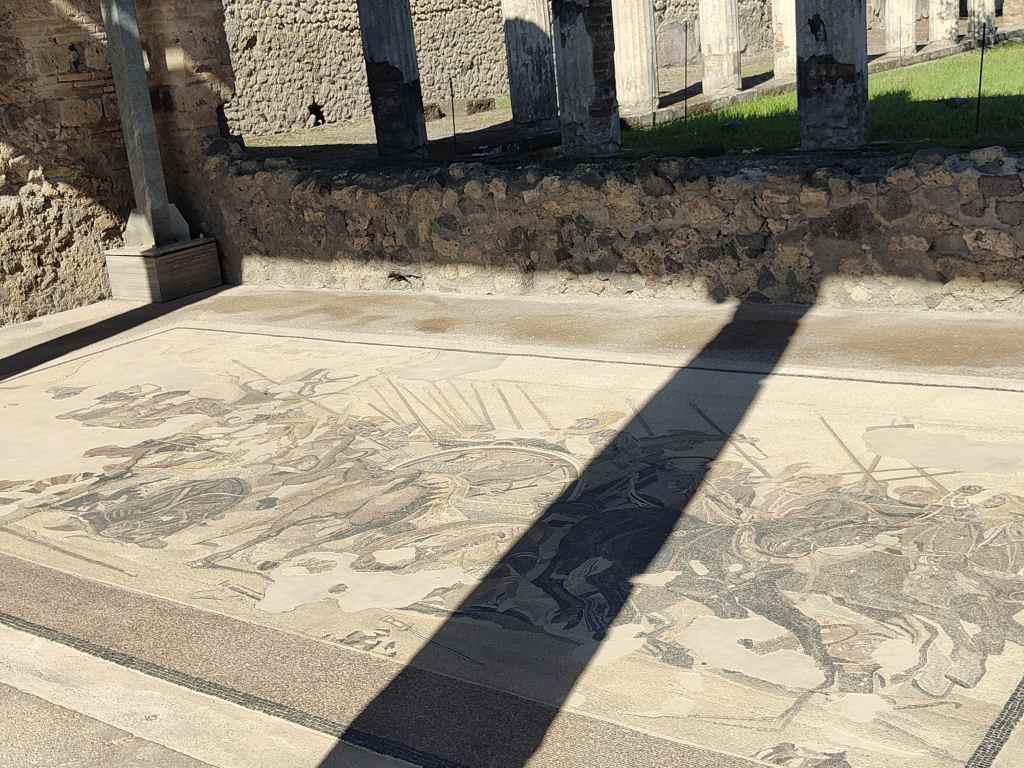
This house is also known for a famous mosaic, showing Alexander the Great in battle with the Persian Emperor Darius. The original has been moved to the Archaeological Museum in Naples (sadly not on display though when I visited) and what you see at Pompeii now is a reproduction.
A copy of the famous Alexander mosaic in the House of the Faun
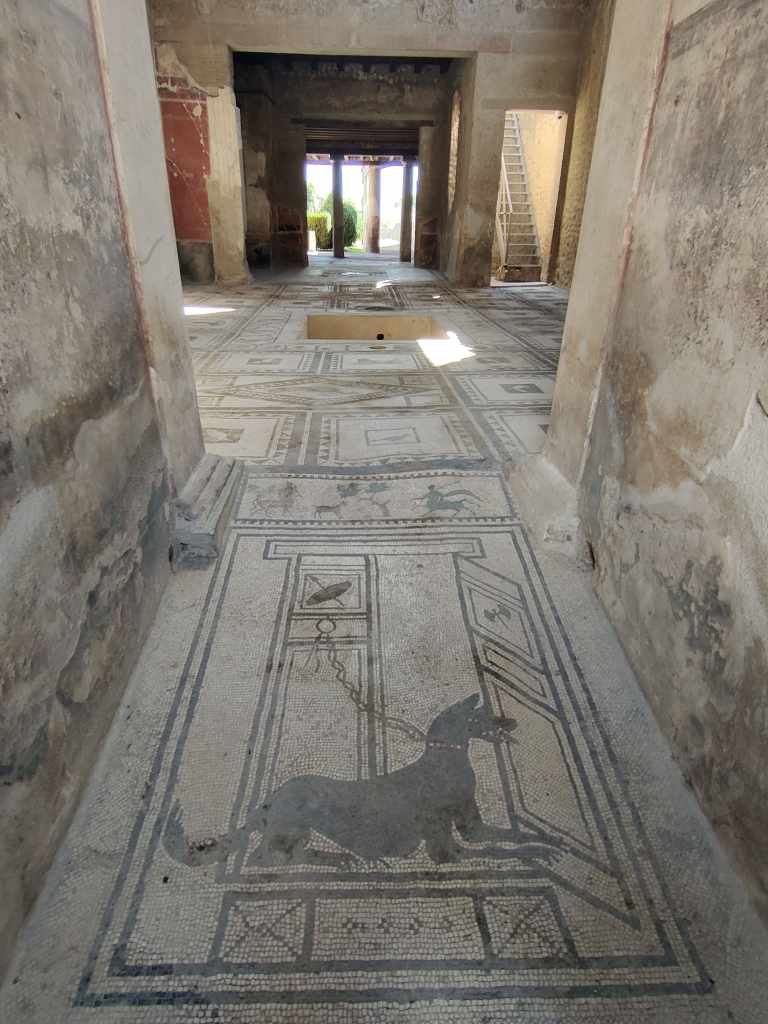
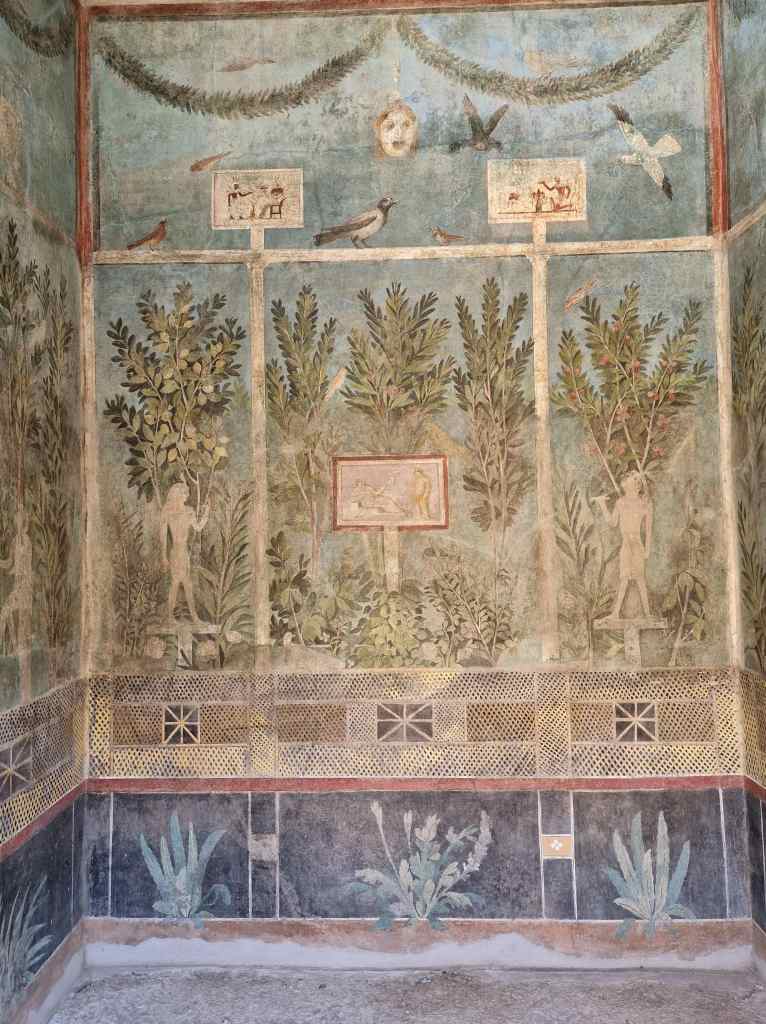
Although the Alexander mosaic is a copy, there are many other magnificent original mosaics and frescos dotted around the ruins. Some of these are well known, marked by a blue dot in the map, and attract a steady stream of visitors……..
Beautiful dog mosaic, PompeiiA once luxurious room in Pompeii
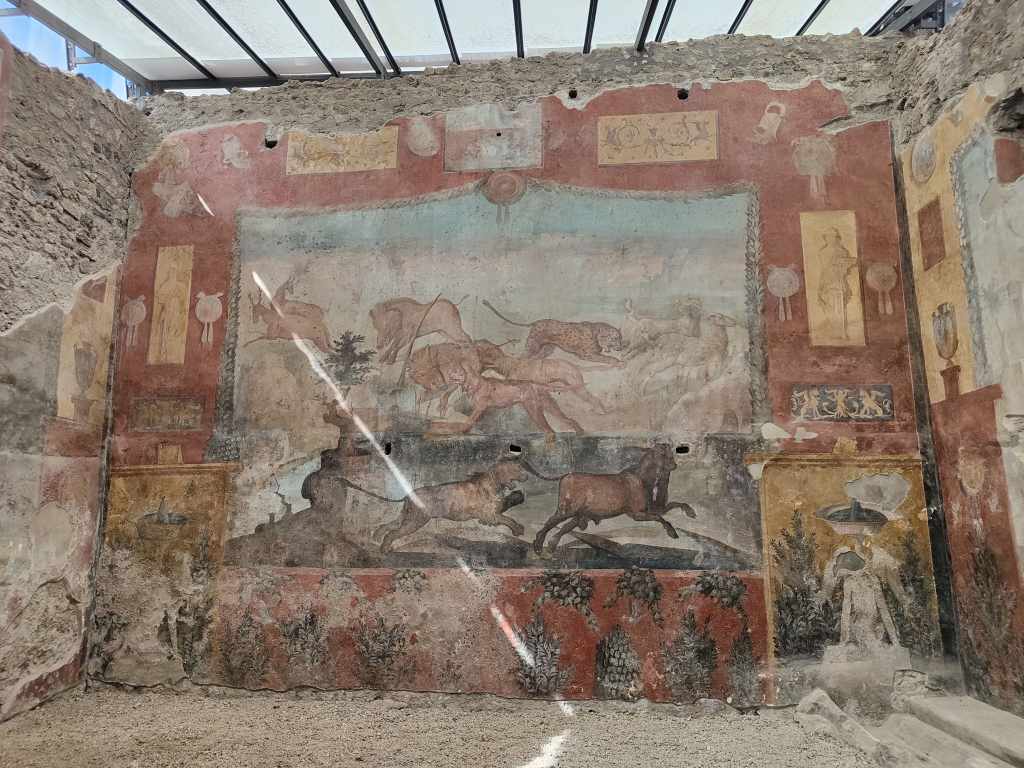
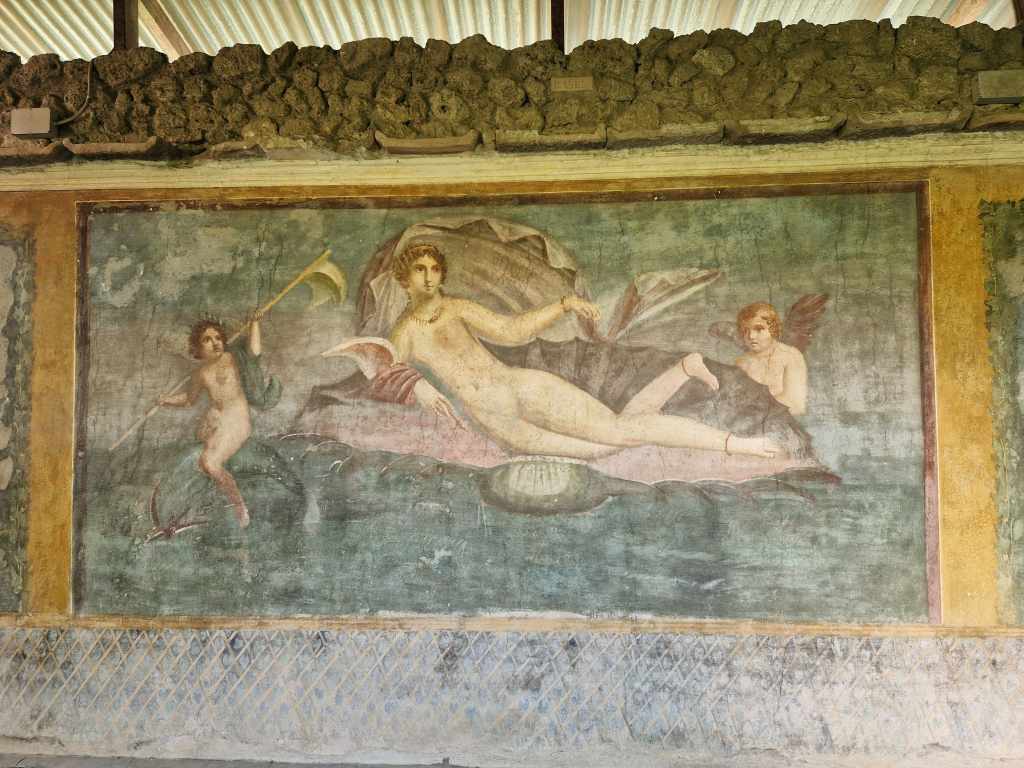
….but others, including a couple of my favourites, were less famous…
Another wonderful frescoThe Venus in a Shell fresco, Pompeii
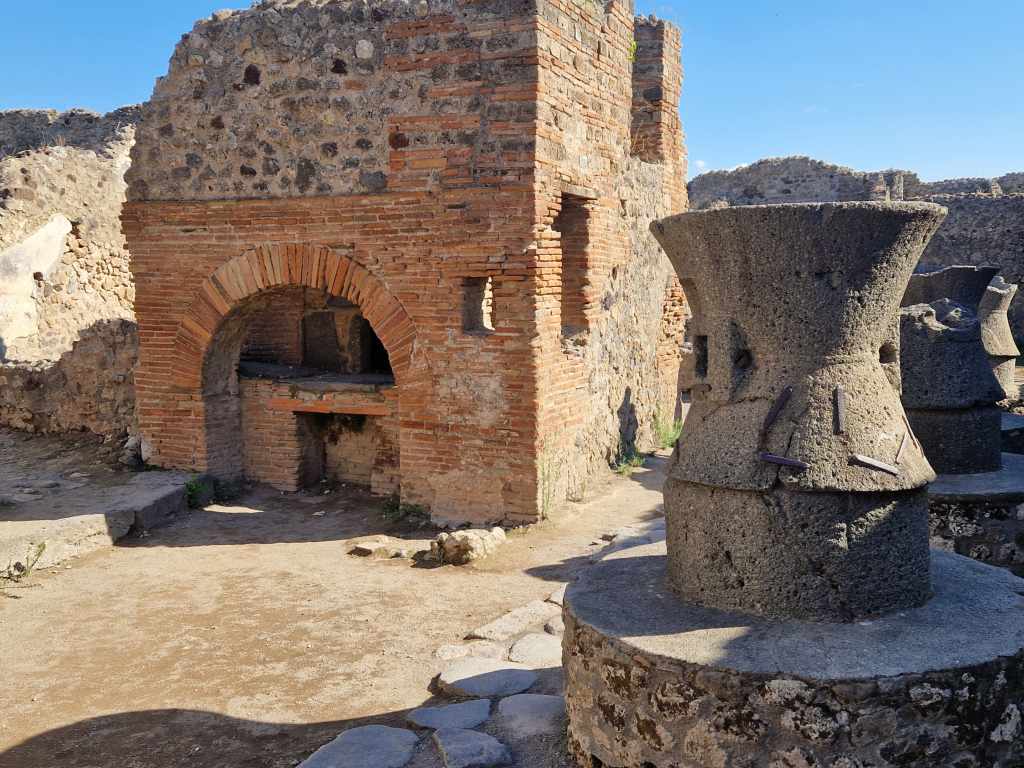
Apart from houses for rich people, with their amazing artwork, Pompeii also had many buildings providing essential services like shops and bakeries. I particularly liked this bread-making shop, with its well-preserved ovens.
A bakery in Pompeii
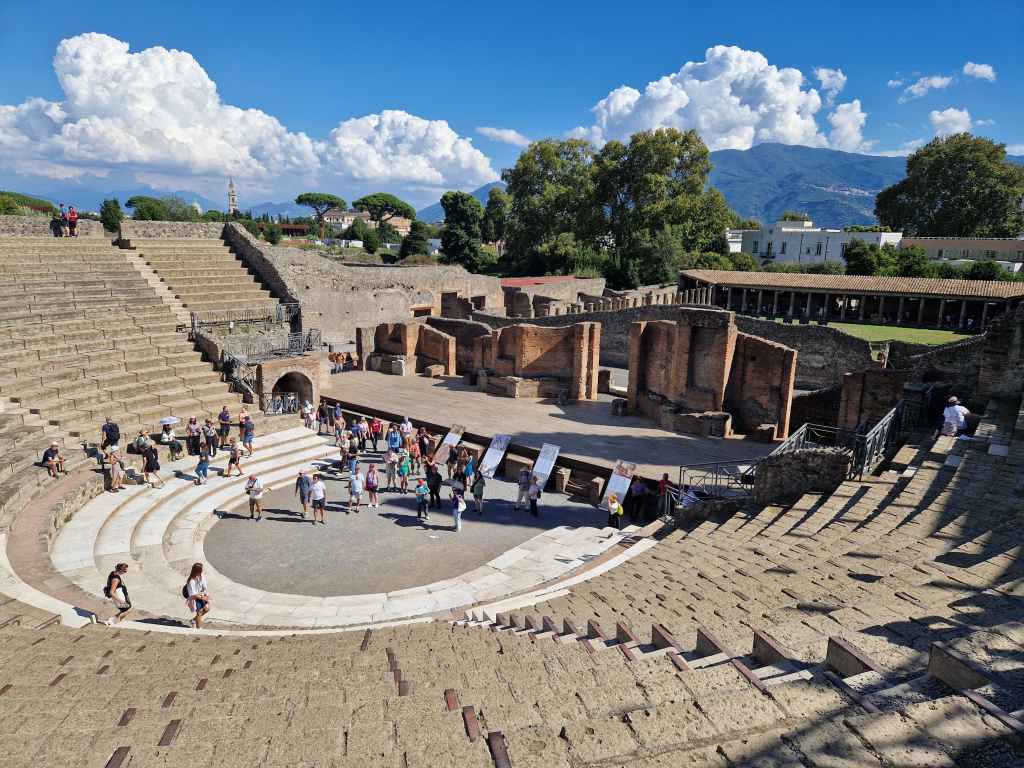
There were also leisure amenities, such as two sets of extensive baths, two theatres and one amphitheatre. That a town with a population of ten to twenty thousand could have such a range of entertainment options gives some idea of how rich the Roman Empire must have been.
One of Pompeii’s two theatres
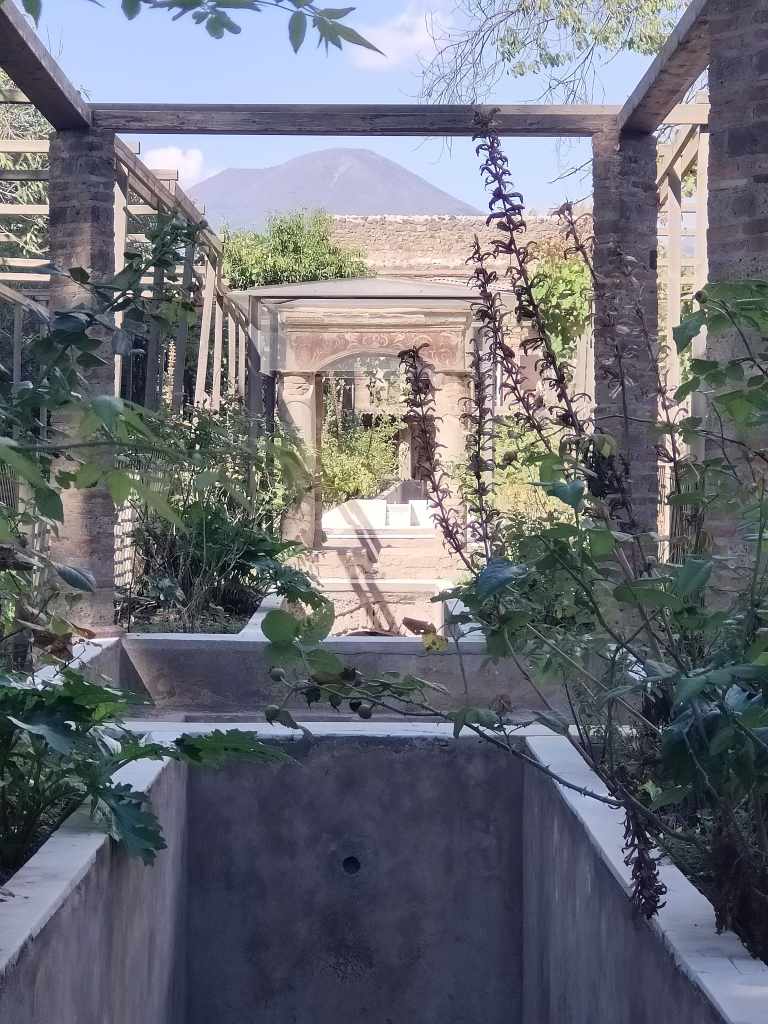
After wandering around the part of the ruins accessible with a standard ticket, I paid for a “Pompeii plus” supplement to see a couple of sites located a short way outside of the main town. The first was the Villa of Diomedes, a large property with an amazing view of the surrounding countryside and pleasant gardens.
The garden in Villa Diomedes, with Vesuvius in the background
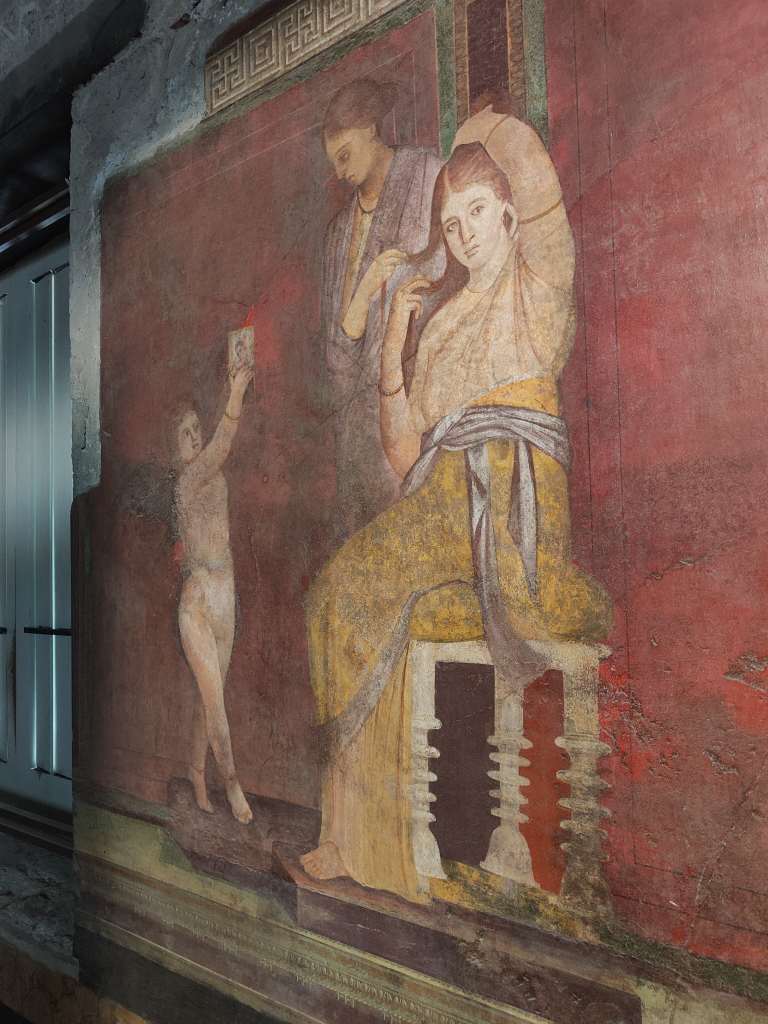
The second was the Villa of the Mysteries, so called because it contains an exceptionally preserved and beautiful fresco of what is thought to be a woman being inducted into a religious mystery cult.
The amazing fresco in the Villa of the Mysteries
Back in the main part of the town I explored some of the greener areas – one particular highlight was the Garden of the Fugitives, which contains the casts of thirteen victims of the disaster, adults and children. These people had probably successfully fled the initial phase of the eruption and had managed to take shelter here. However, a second phase saw a cloud of blisteringly hot toxic gases sweep the city and kill all remaining survivors. Their bodies were covered by volcanic ashes, and over time the organic matter rotted away to leave a hole. During the excavations these holes are injected with plaster to make a cast of the victim. Out of respect for those that died, I won’t include a picture of them in this post, but here is the garden….
Looking down onto the Garden of the Fugitives
After five hours and 20km of walking, my little teddy legs were feeling tired, and it was time to head back to the main entrance. On the way, I visited the Sanctuary of Apollo, which had been crowded on the way in but was now deserted. I stopped to take a last, rather naughty, selfie:
A naughty selfie in the Sanctuary of Apollo
It had been an exceptional day. Pompeii seemed to have improved since my last visit twenty-five years ago – certainly more has been excavated, but there also seemed to be more mosaics and frescos on display, many of them of exceptional quality. The structural integrity of some of the Roman buildings, some standing for two thousand years, puts some of Naples’ crumbling monuments to shame. Finally, I don’t think the onsite coffee shop existed earlier, and the ability to get some caffeine and cold drinks halfway through my visit had definitely helped me keep going for so long. I hope that I will be a fit enough bear to make at least one more trip to Pompeii, in another twenty-five years’ time. Excavations continue, and it will be fascinating to see what treasures they unearth.
Well, that is all for this series of posts about South Italy. It was a great trip, with a bit of everything – the amazing and anarchic city of Naples, the scenery of the Amalfi coast, the beautiful villages and cities of Puglia, and the amazing ruins of Pompeii. I will be back, in particular to explore Naples, where there were very many things that I missed, and the surrounding area where I have yet to hike up Vesuvius, visit the ruins of Herculaneum, sail to Ischia…….the list of things to do is very long!
Naples, Centro Storico – courtesy of Colette Hewitt Photography
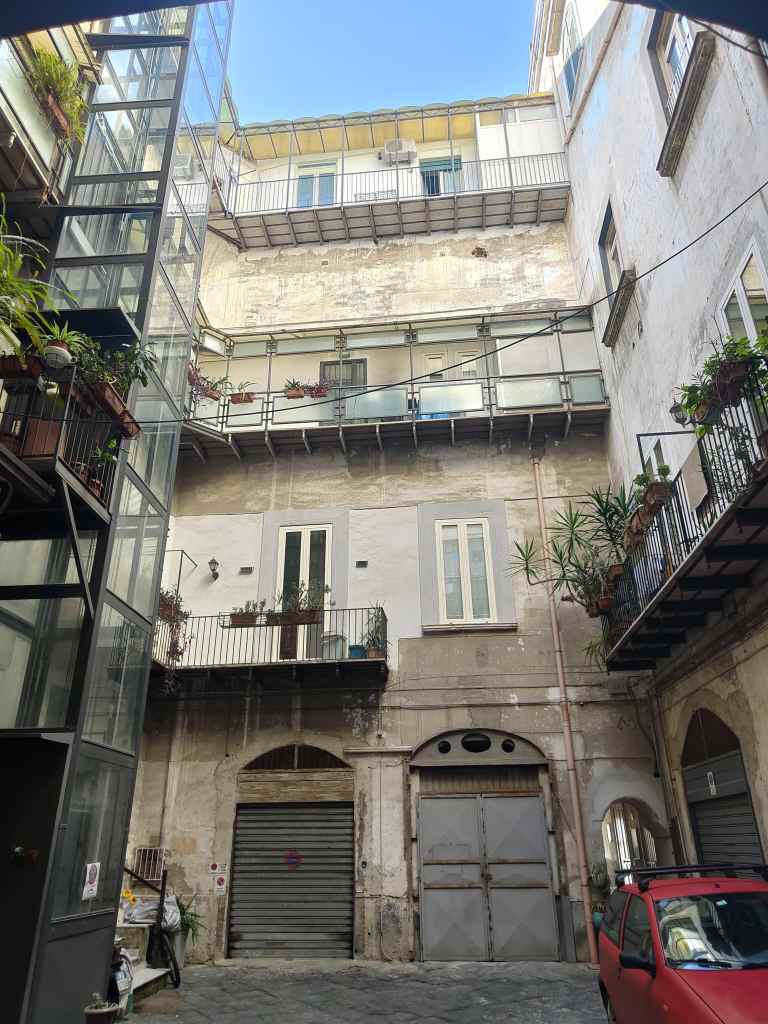
For the end of my exploration of Italy’s south, I had reserved a couple of nights in Naples. I had already spent one night here at the start of my trip, in an upmarket area near the port and the sea. This time I had chosen to stay in the centre, and my accommodation gave me a good introduction to the joys and frustrations of the city. It was a bed and breakfast establishment located in a typical Naples side street, lined with tall houses that might once have been grand, but which were now in need of refurbishment. A large wooden door opened into a rather dingy internal courtyard, from where a rickety lift took me up to the top floor of my building.
The unpromising courtyard of my B and B
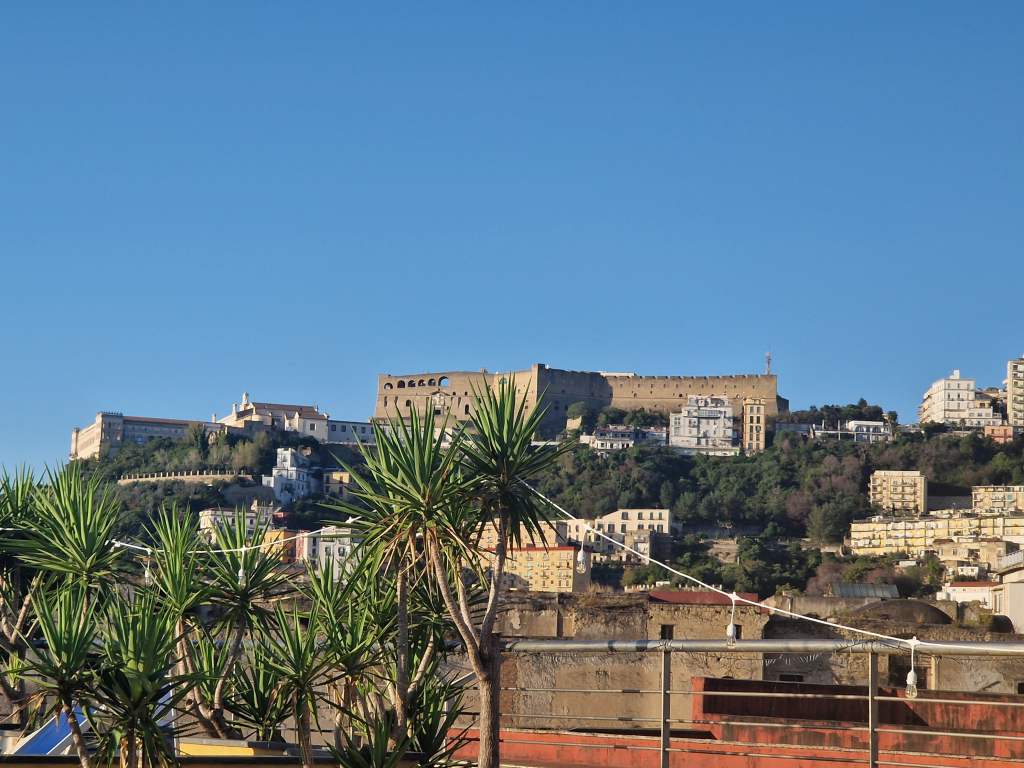
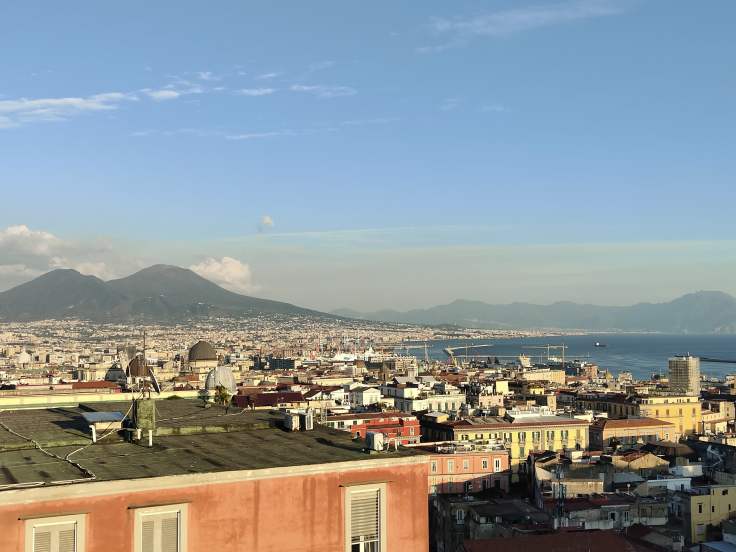
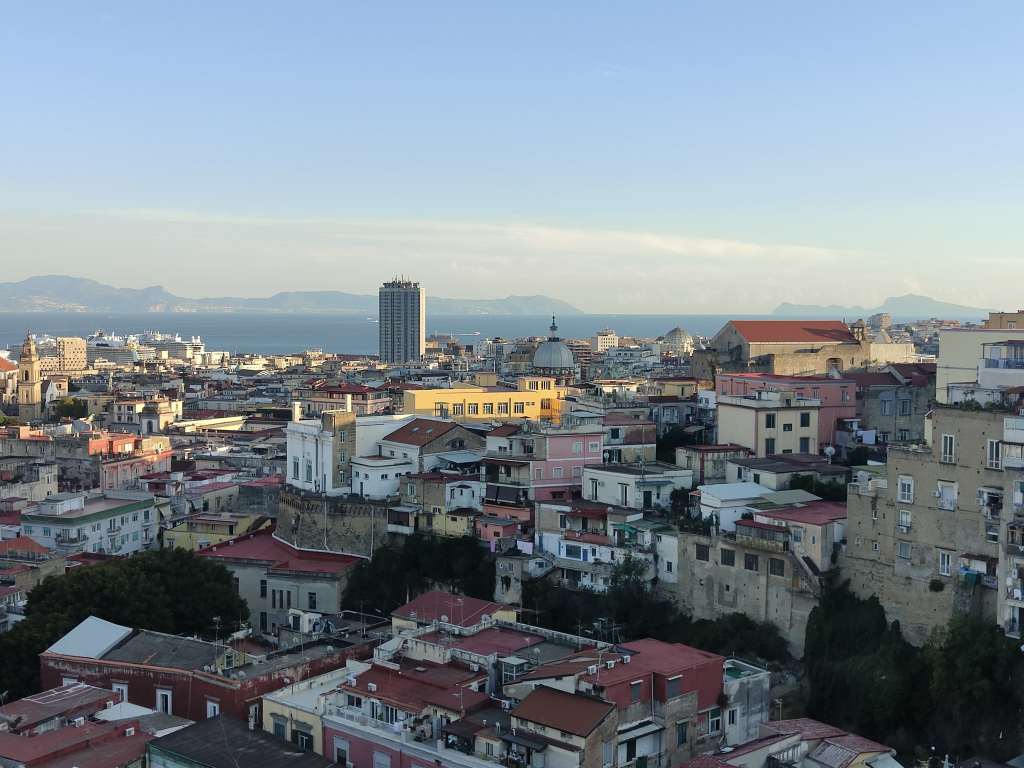
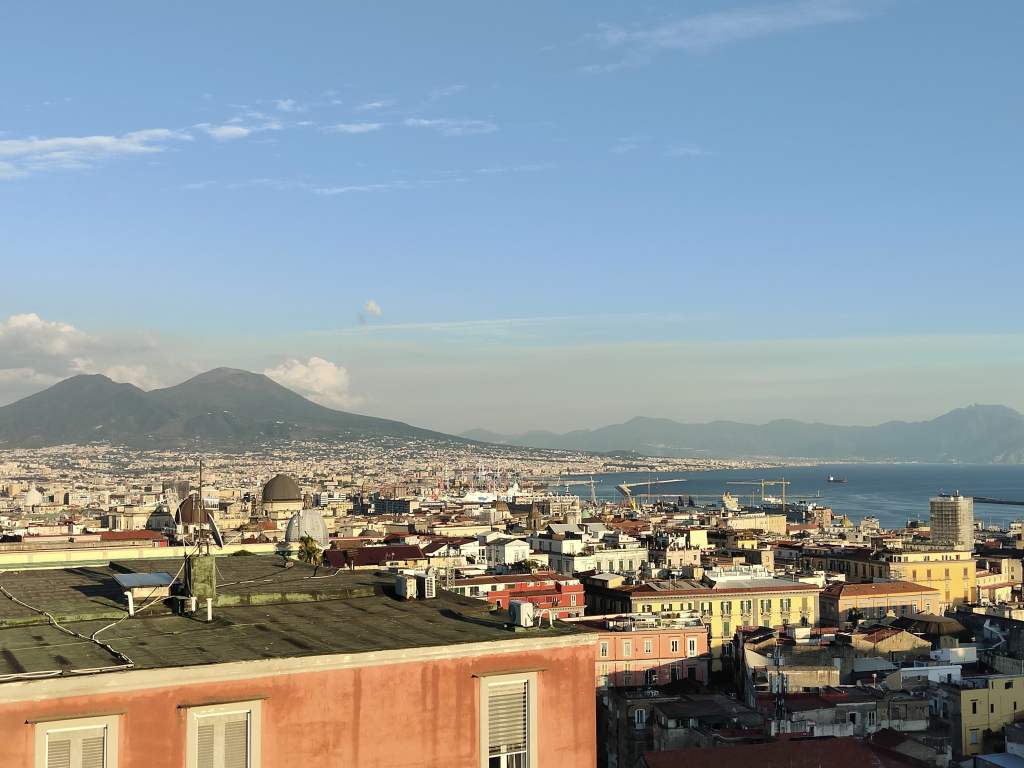
At the check in, my host led me to a room which was bigger, but not as nicely furnished, as the one I had booked. I complained and was told via Google translator that my original room was occupied. After I insisted, I was told I could have my chosen room after a two-hour wait. I was regretting my choice of accommodation until I was led up to the owner’s roof terrace for a welcome aperitif. There I enjoyed an Aperol spritz and some nibbles…and an amazing 360 degree view of Naples, a city with one of the very best settings in the whole world.
The magnificent view of Naples’ Castel St. Elmo from my terrace, looking west…….and the view east over the Bay of Naples
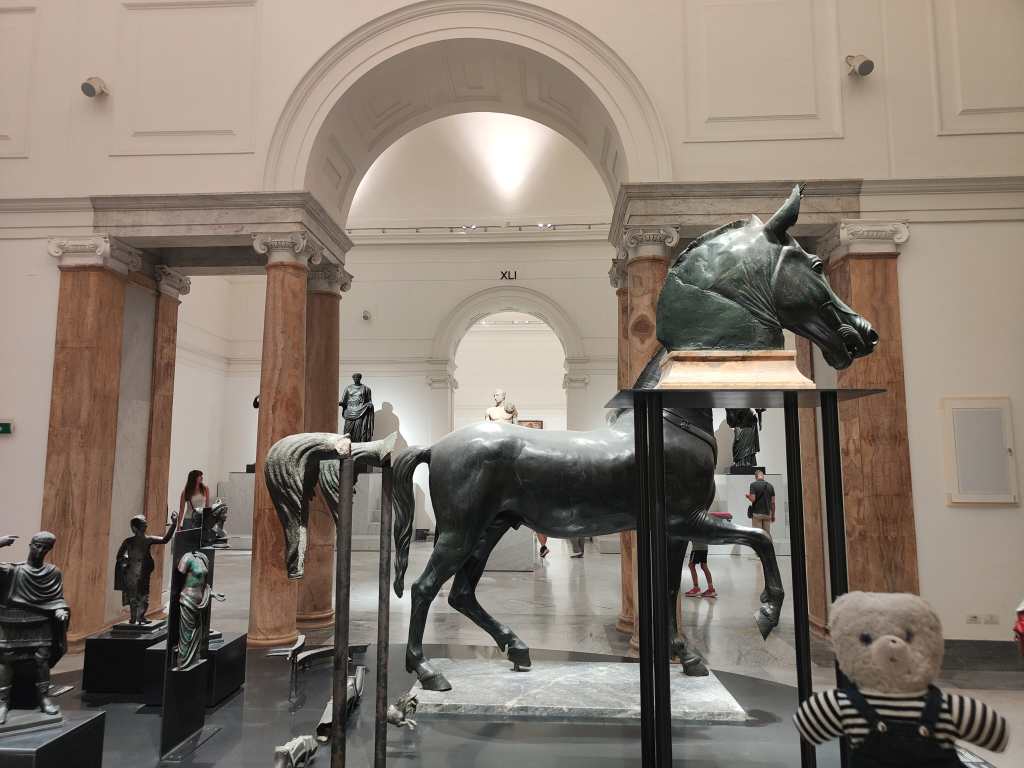
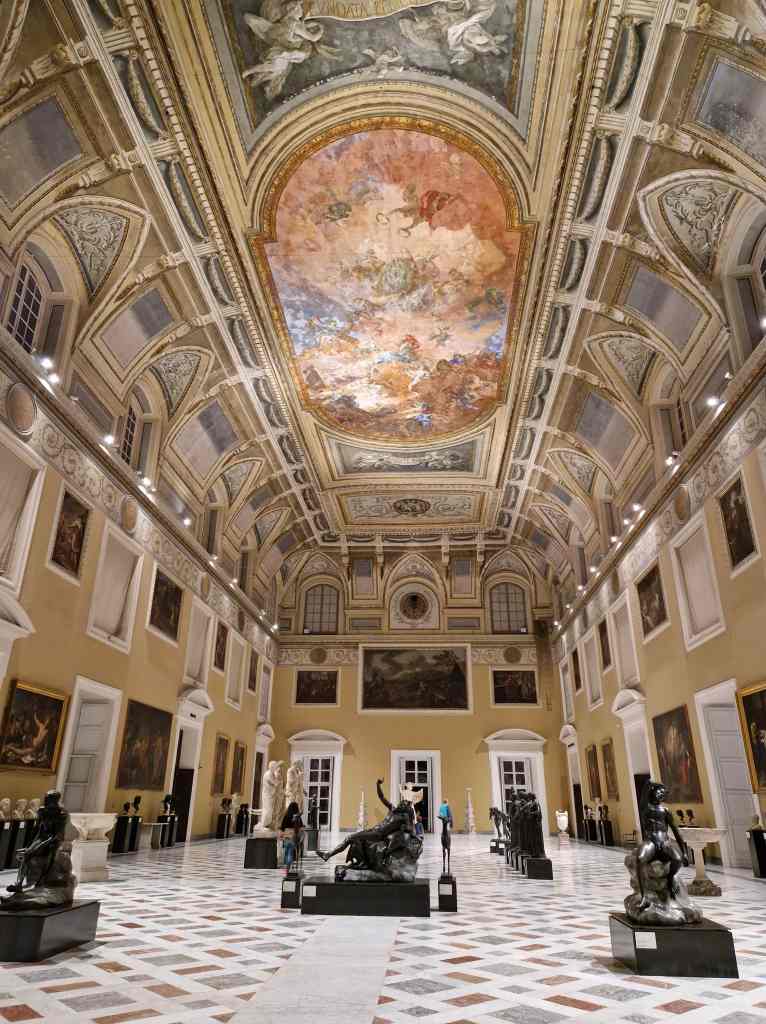
After freshening up, I set off to explore. My first stop was the Naples National Archaeological Museum, which has one of the best collections of ancient art in the world. I was lucky to visit when they had a special evening opening, and the galleries were quiet and very atmospheric.
Statues from Pompeii at the entrance of the Naples National Archaeological MuseumAn immense display room on the second floor of the Naples National Archaeological Museum A mosaic of an upwardly mobile Pompeian couple, Naples National Archaeological Museum
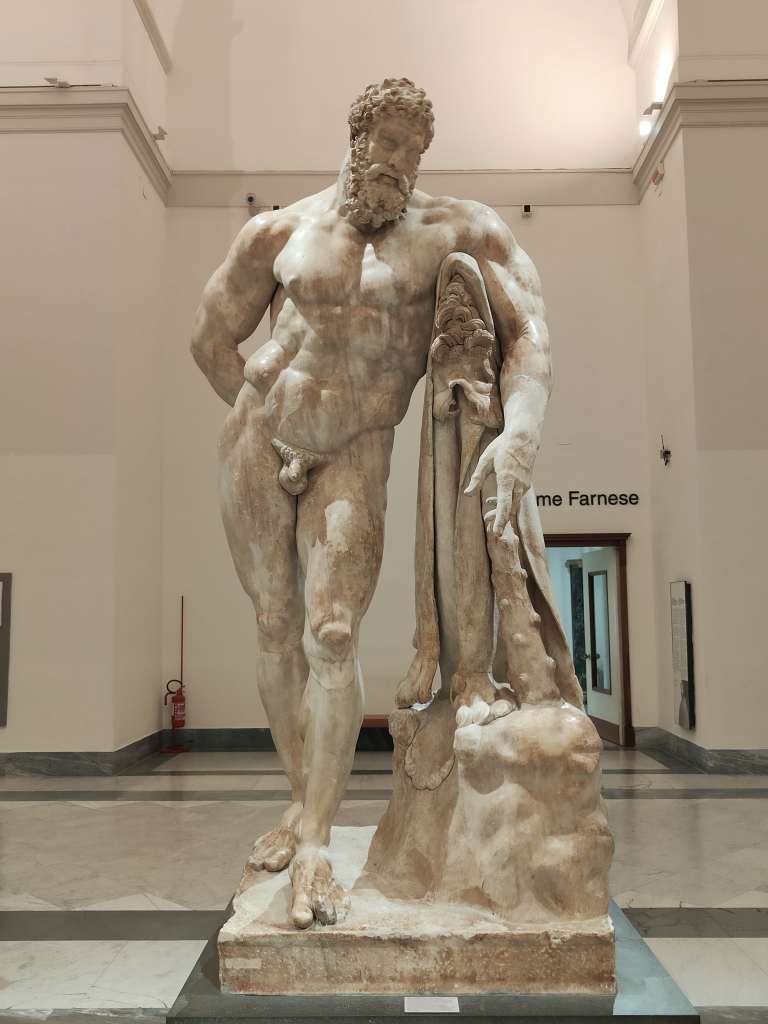
Many of the museum’s exhibits come from nearby sites like Pompeii and Herculaneum, but the museum also houses the magnificent Farnese collection, first assembled by Cardinal Alessandro Farnese (later to become Pope Paul III) in the 16th century and originally kept in his palace in Rome.
The Farnese Hercules
The museum is huge, and you could easily spend a day there, but I was a bit tired and limited myself to a couple of hours seeing the highlights. Apart from the magnificent mosaics and sculptures, there was also a fun exhibit of items that had been recovered after being stolen, together with the stories of their recovery. Some of these were quite funny, involving organised crime, disorganised crime, corrupt officials, innocent grandmas, bankrupt aristocrats or dodgy art dealers versus a special unit of the carabinieri set up to recover lost art work.
My next day was spent exploring central Naples, a chaotic, dirty, occasionally beautiful and always lively city. It is a good place to explore on foot – which is a good thing, since the traffic is terrible and the driving mad. My exploration started in the Rione Sanita district, a short walk from my accommodation. This was once where aristocracts lived, but became one of Napoli’s poorest areas with a reputation for corruption and crime. Today it is considered safe again to walk around but is still a poor, working class district, which features narrow streets lined by tall, once grand but now crumbling buildings, whose walls were covered in graffiti and from whose balconies clothes were hanging to dry. Even here though, in one Naples’ least touristy neighbourhoods, there were some stunning buildings to be seen by those brave enough to venture here.
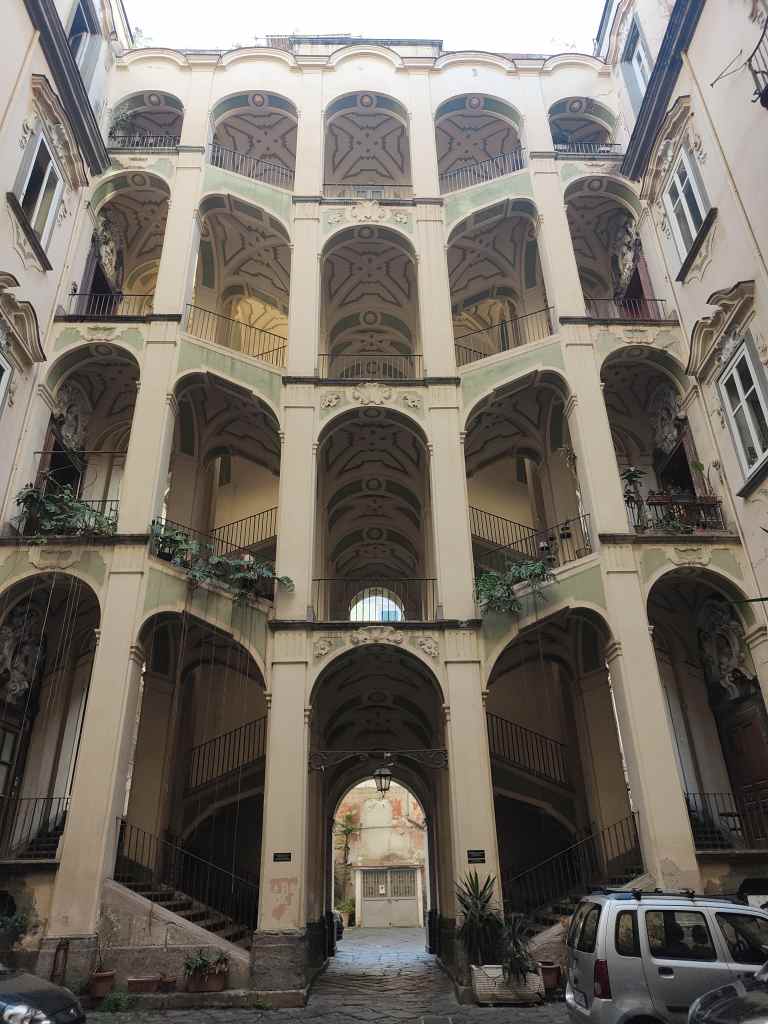
The Palazzo dello Spagnuolo seen from the street The magnificent staircase inside, if you venture into the courtyard
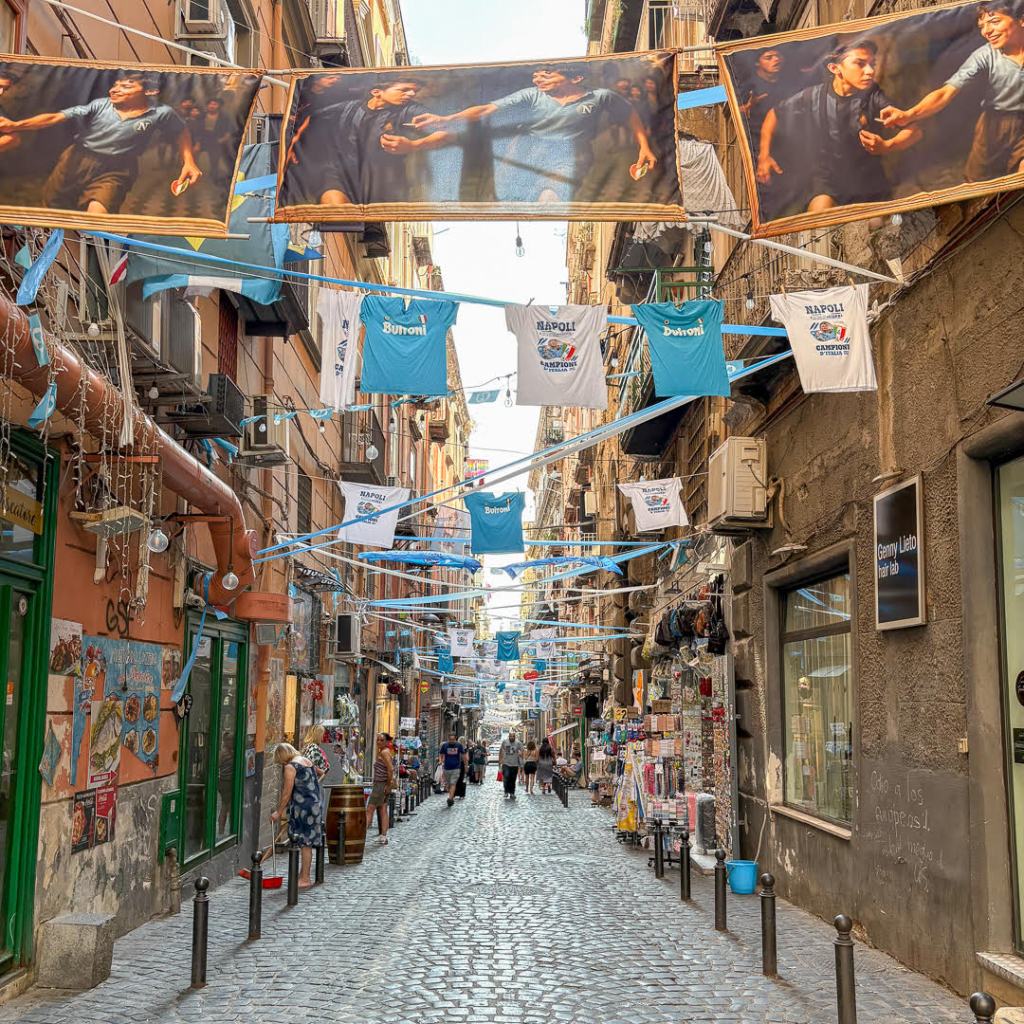
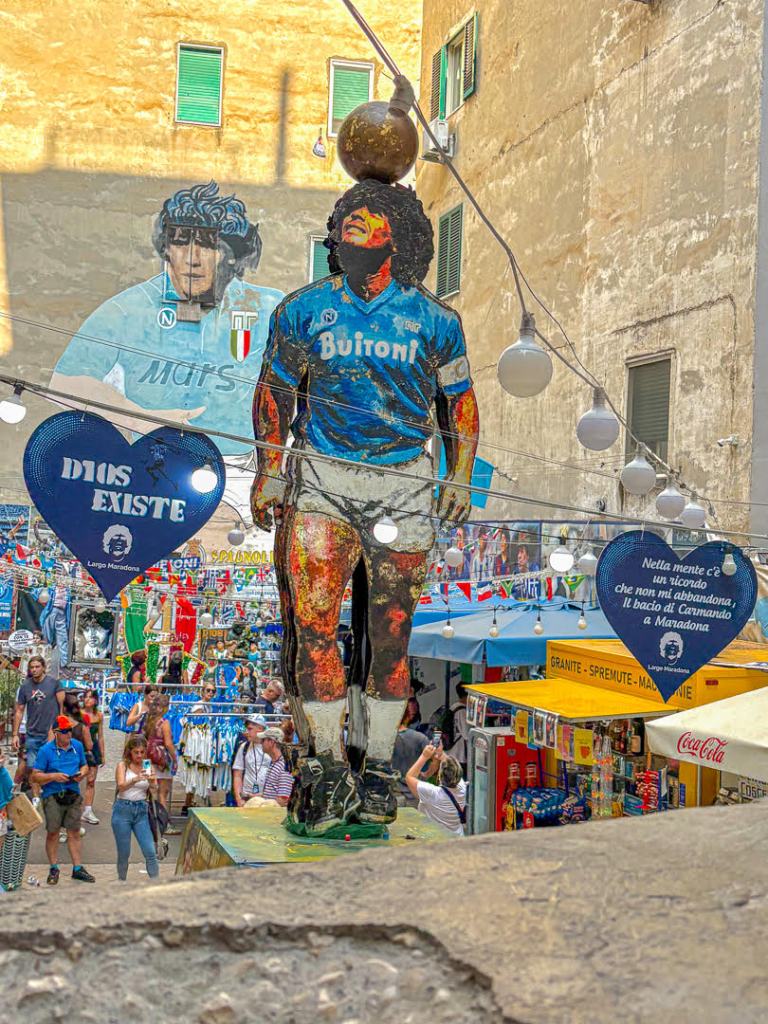
Every street seemed to have a small shrine in the wall of a house, and every small neighbourhood had a church – some dilapidated, some magnificent. Apart from Christianity, Neapolitans’ other religion is football, and every street also had a mural either devoted to the fact that Napoli had won the Italian championship four times or to the former star player Diego Maradonna, who last played for them in 1991, but is still worshiped locally.
Maradonna murual in the Centro Storico, courtesy of Colette Hewitt Photography
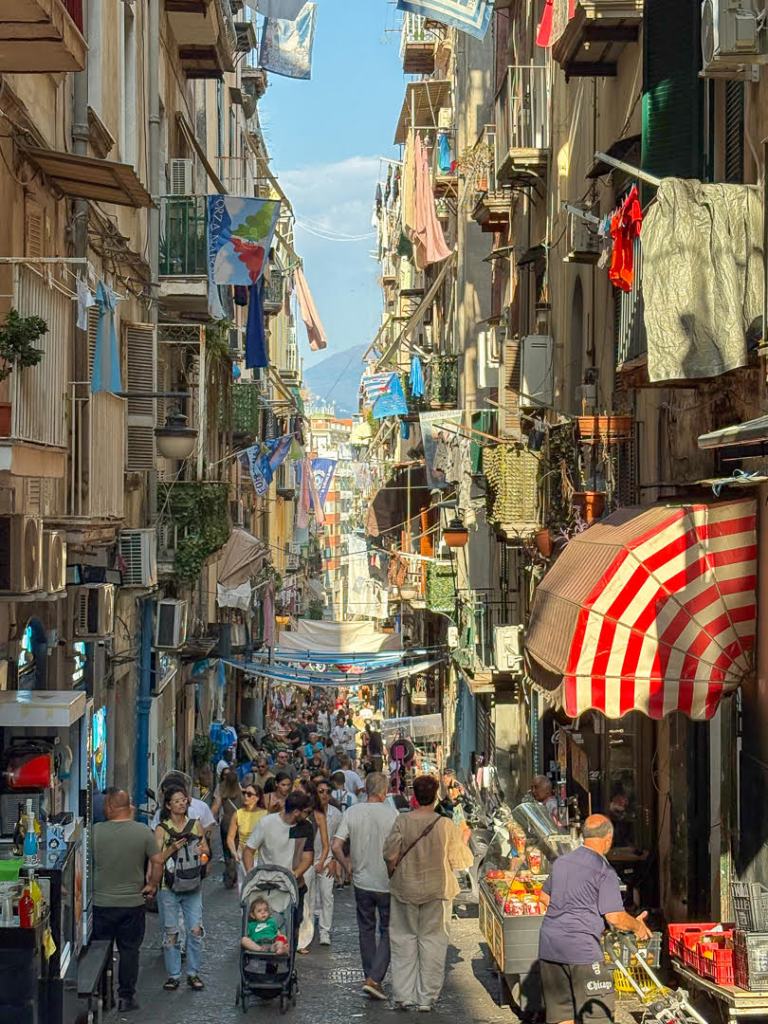
My walk then took me into Naples’ Centro Storico, the heart of the city. This was a noticeable richer area, with many more visitors. Compared to Raino Sanita, it had the same narrow streets, more old buildings, slightly less litter and graffiti, but also had cafes, restaurants and shops for tourists.
Centro Storico typical street, courtesy of Colette Hewitt Photography
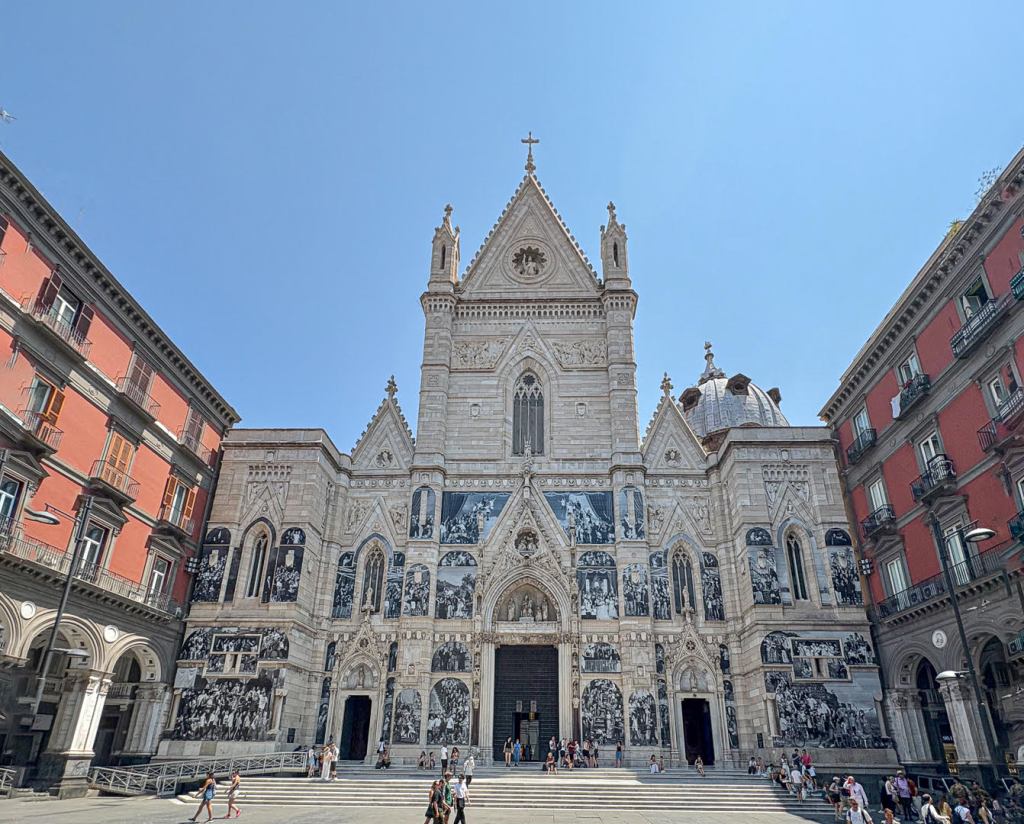
Amid all this seething, dirty and fascinating urban sprawl are many world-class tourist attractions – so many in fact that I only had time to visit a small portion of them. Best known is Naples’ Duomo, which was my next stop. It has a magnificent interior, and which houses the skull and two vials of dried blood of San Gennaro, the patron saint of the city. The latter were collected after the saint’s beheading in 305AD and the blood inside is supposed to miraculously liquefy on specific dates three times a year – a time of great celebrations amongst devotees.
Naples’ Duomo, courtesy of Colette Hewitt Photography
A short stroll further into the Centro Storico brought me to yet another beautiful church – this time a small baroque one.
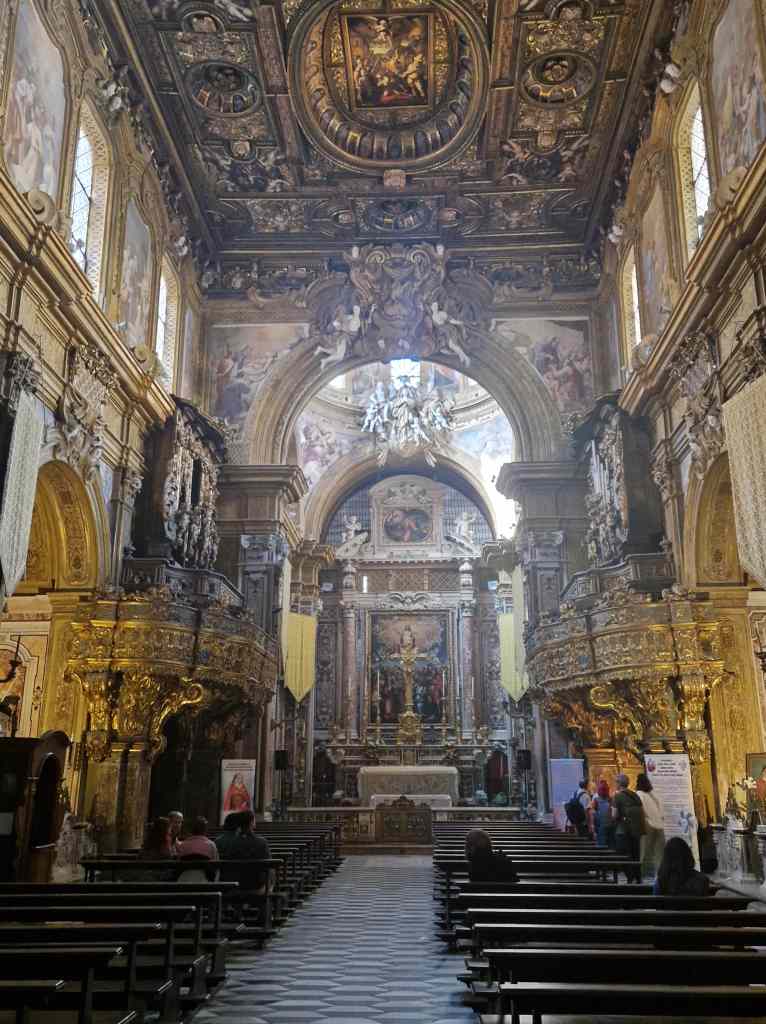
Yet another beautiful church in Naples
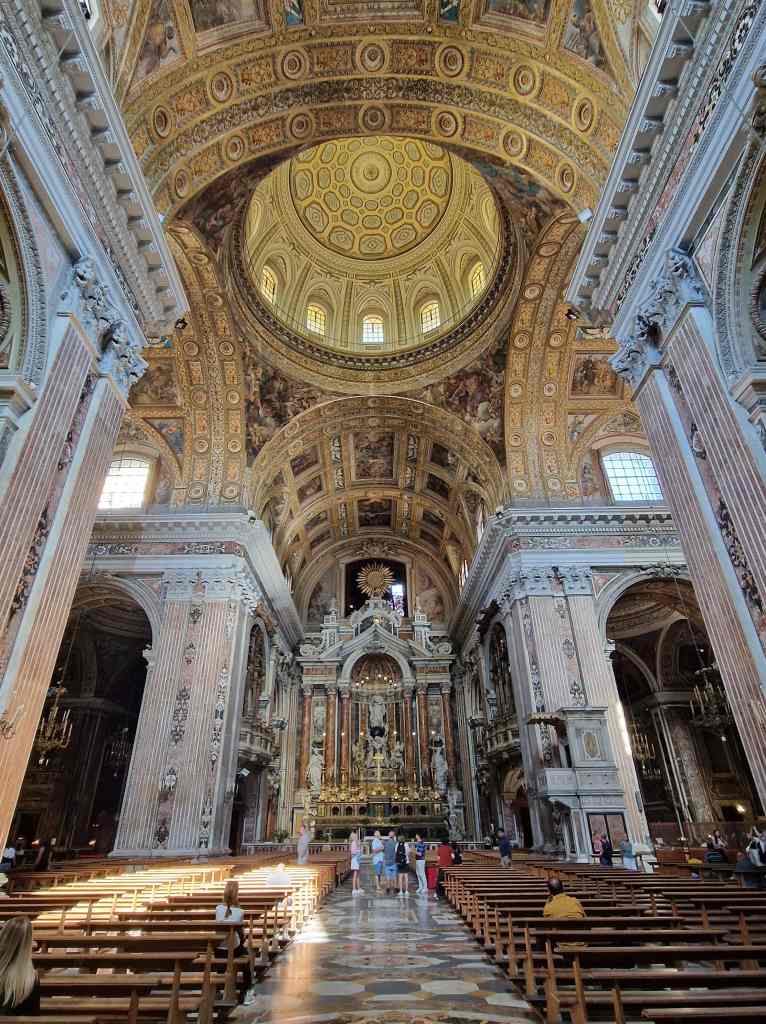
The cathedral is indeed impressive, but I found the Church of Gesu Nuovo (“New Jesus”) even better. This huge building was originally a palace, dating from 1470, but its owner fell into disgrace and it was confiscated and sold to the Jesuit order for them to convert to a church, whose construction began in 1584.
The distinctive outside of the Church of Gesu NuovoInside the Church of Gesu Nuovo
Today it is in my opinion the most beautiful church in Naples and certainly the biggest. A curious addition to the usual pictures of saints adorning the walls was an unusual twisted chunk of metal – an inscription explained that this was a bomb that fell through the church roof during WWII, but which failed to explode – something of course put down to divine intervention!
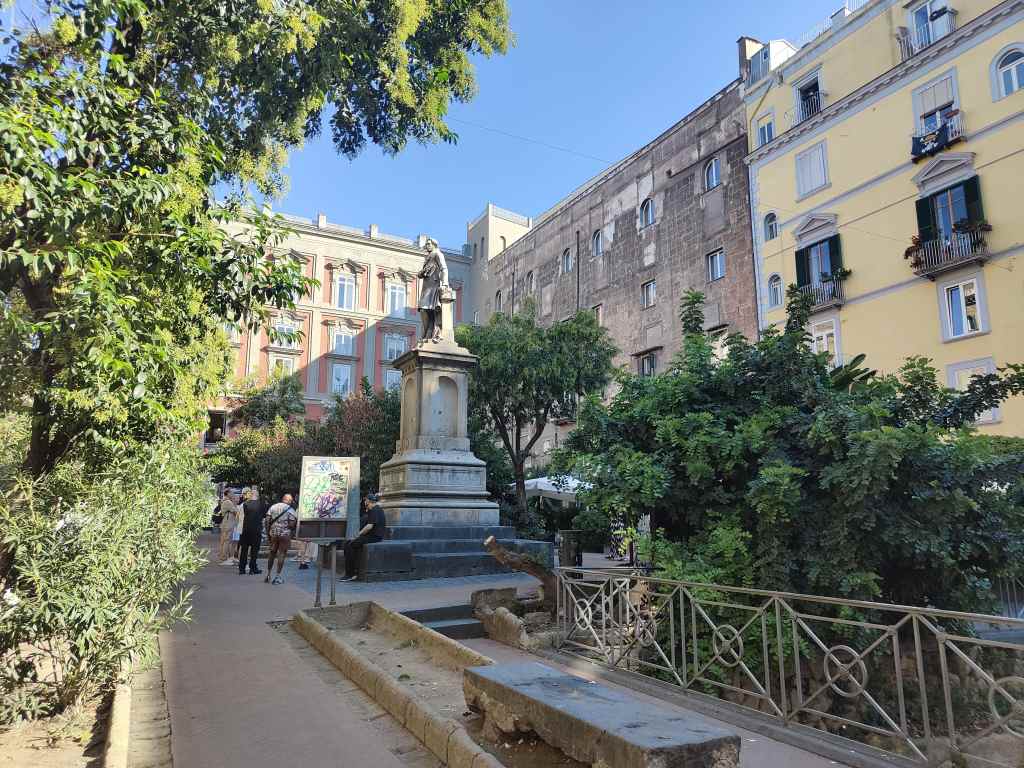
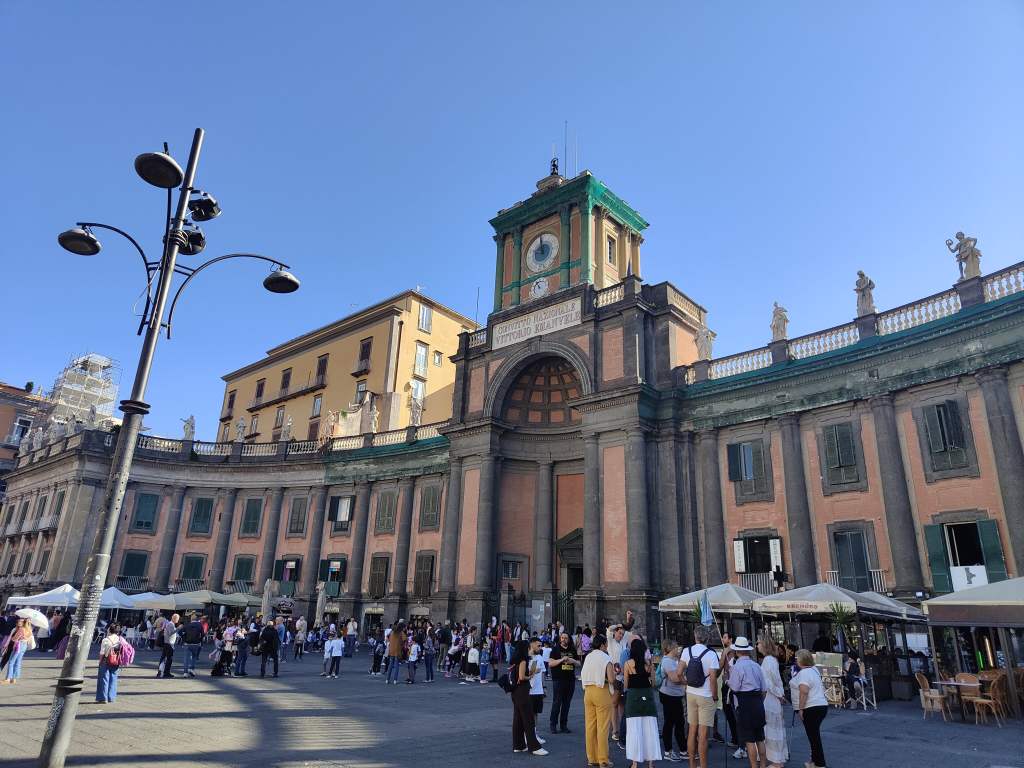
My stroll carried on past yet more interesting squares and buildings, like the Piazza Bellini and Piazza Dante.
Piazza BelliniPiazza Dante
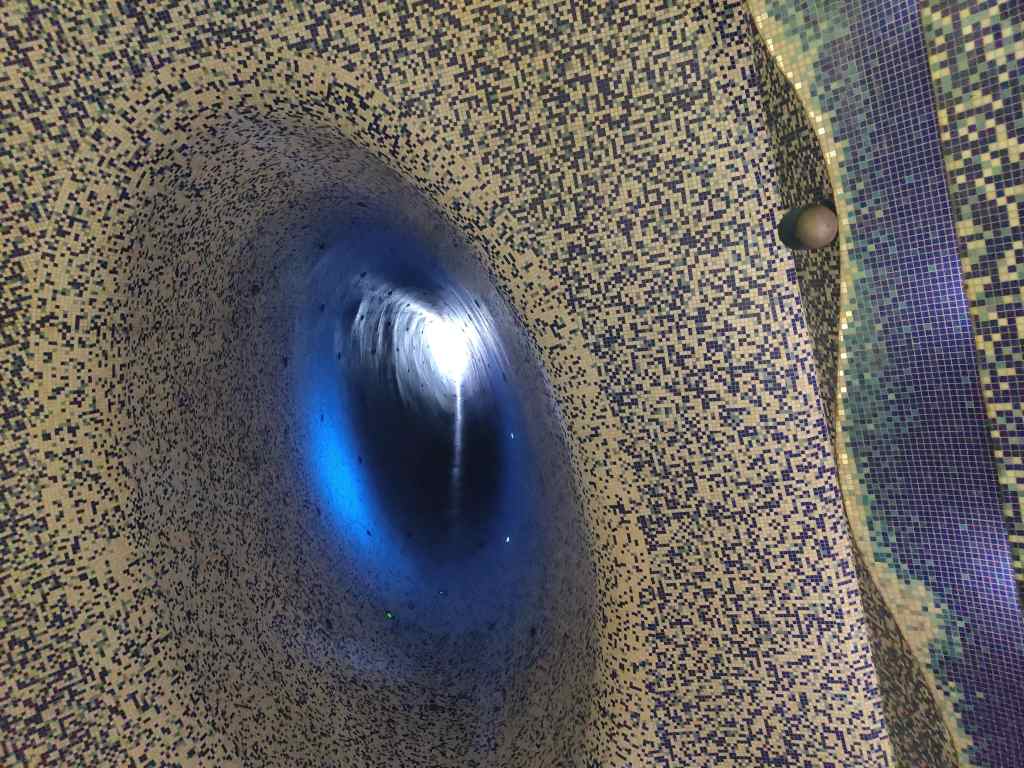
I finally ended up on Via Toledo, a main road in a more modern part of town. The metro station there is one of several in Naples that have important modern art installations, and is worth a visit even if you are not travelling anywhere.
Art installation at Toledo Metro Station, Naples
I took the metro back home and sat on my terrace enjoying the view and working on my blog as the sun set. I was hoping to see Naples’ many monuments at night, but the local authorities do not light up their buildings in the evening, so they were all hidden in darkness. This was a real shame, since I am convinced that nighttime Naples could be a spectacular sight, like Paris or Moscow – if only they would illuminate their city. To console myself I headed out for dinner in a local pizzeria, which was, as I expected, excellent and very reasonably priced. Apart from an imaginative and tasty octopus pizza and good wine, it was nice to be eating at an outside terrace in late September when I know that in London I would be shivering indoors.
A well-earned pizza after a long day’s walking around Naples
Over dinner I reflected on the last day and a half in Naples. I had found it an exceptional city, quite unlike anything I had seen elsewhere in the world – it felt like somewhere that could have been in Africa, but with European architecture. I loved its energy, crumbling historic buildings and magnificent setting on the Bay of Naples – and could forgive its chaotic traffic, noise and dirt. With some investment, Naples could rival Paris for its beauty – but for the moment I am rather glad that it remains as it is. I now had one day left to spend in the area, which I devoted to one of the world’s most famous sites – stay tuned to see which one (although I imagine many readers will already have guessed!).
Today I continued my exploration of deepest Puglia with visits to two more hilltop towns with old city centres. The first was Martina Franca, the biggest city in the area (albeit with a population of only 49,000). I found it similar to Cisternino – very picturesque with a well-defined old town which contained winding streets, churches, and a pretty main square. It was also not too busy, and was another nice place to happily lose oneself in for a couple of hours after a coffee on the main piazza.
Enjoying a cappuccino in Martina Franca’s piazzaMartina Franca’s fine piazza
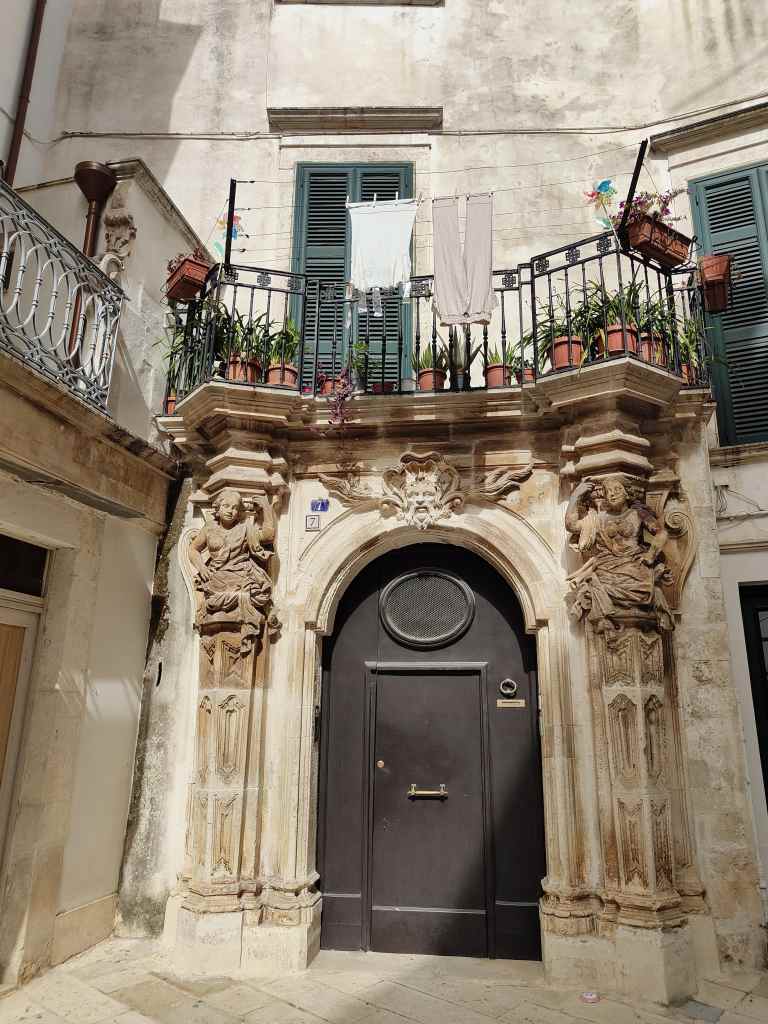
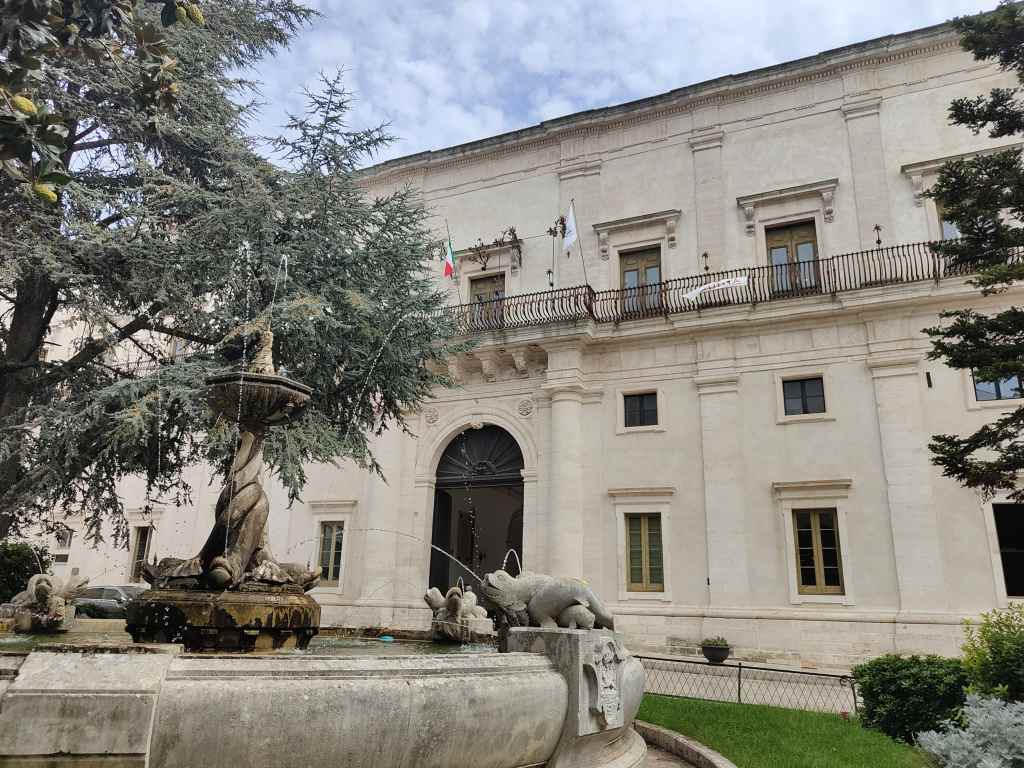
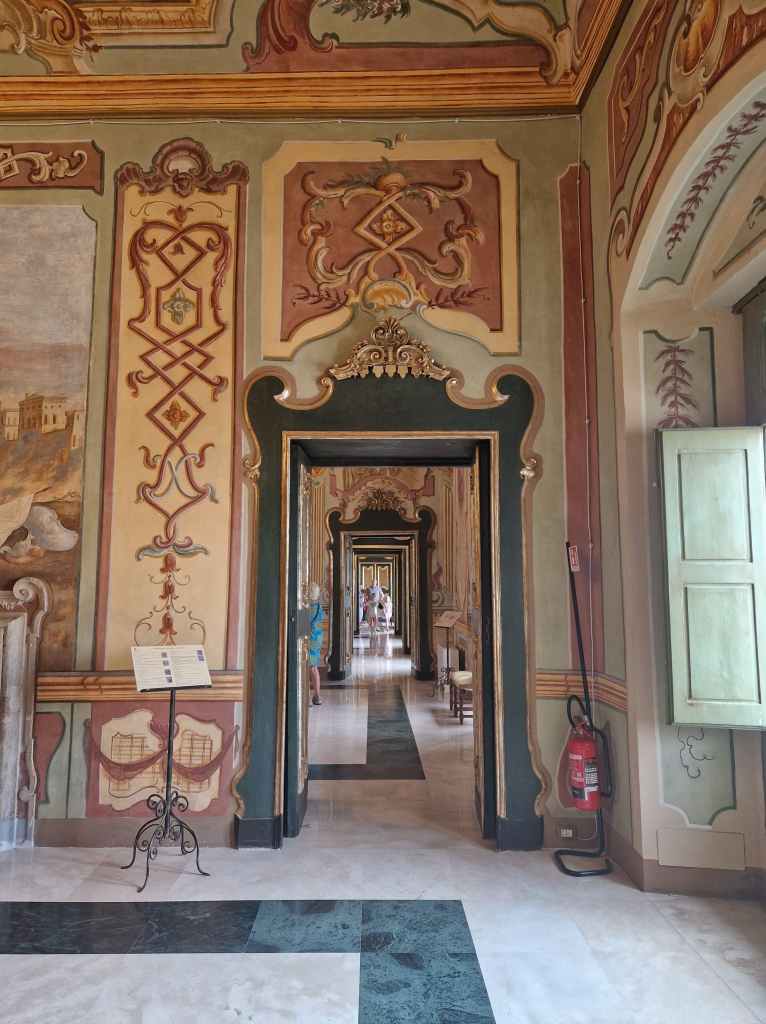
I thought that Cisternino’s small streets were more interesting, but Martina Franca had the more impressive monumental buildings, including a large church and a palace.
Building in a side street, Martina FrancaThe outside of the Palazzo Ducale, Martina Franca…….and inside
Next, I visited yet another hilltop village – Locorotundo, which I found to be more like Ostuni. It had a picturesque hilltop old town, visible for miles around from the surrounding plains, but its centre was too small to get properly lost in, and too crowded to get a feeling of discovering something for oneself. I took a couple of photos to prove I had been there before returning to Cisternino for dinner.
A photo of Locorotondo to prove that I was there
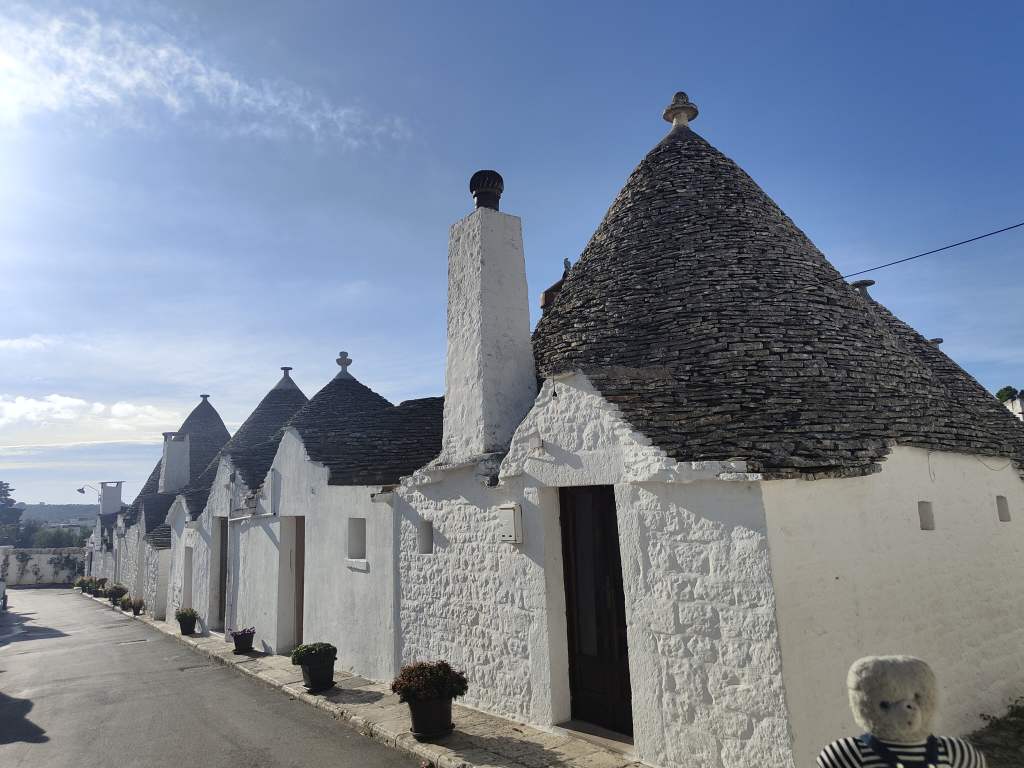
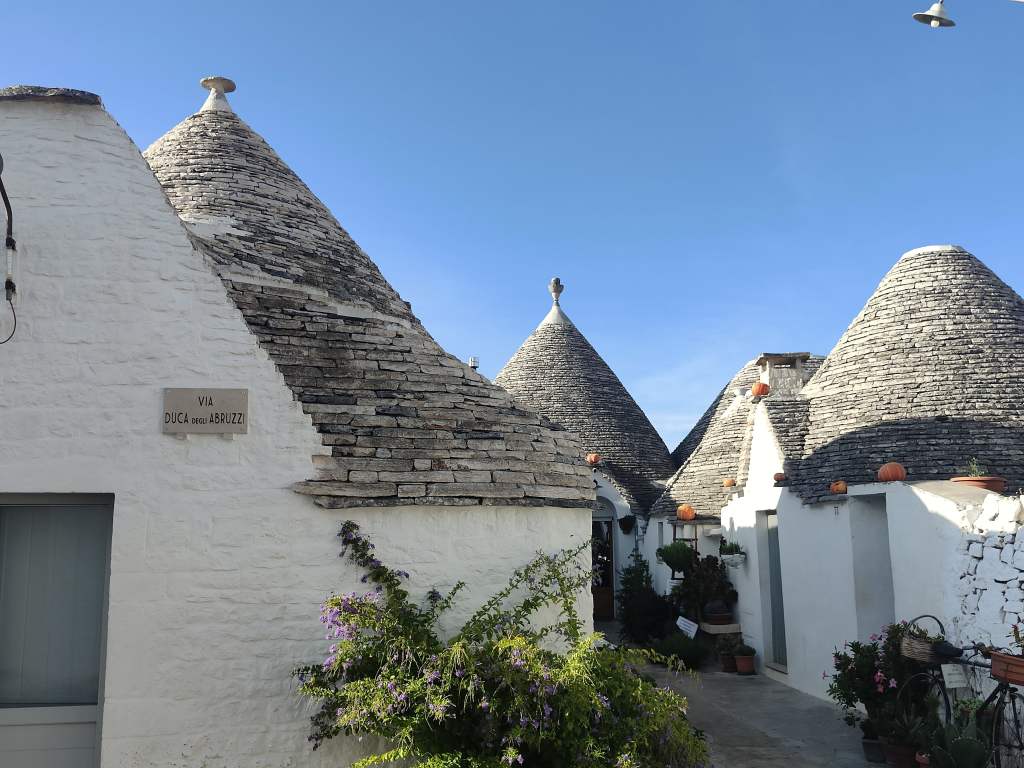
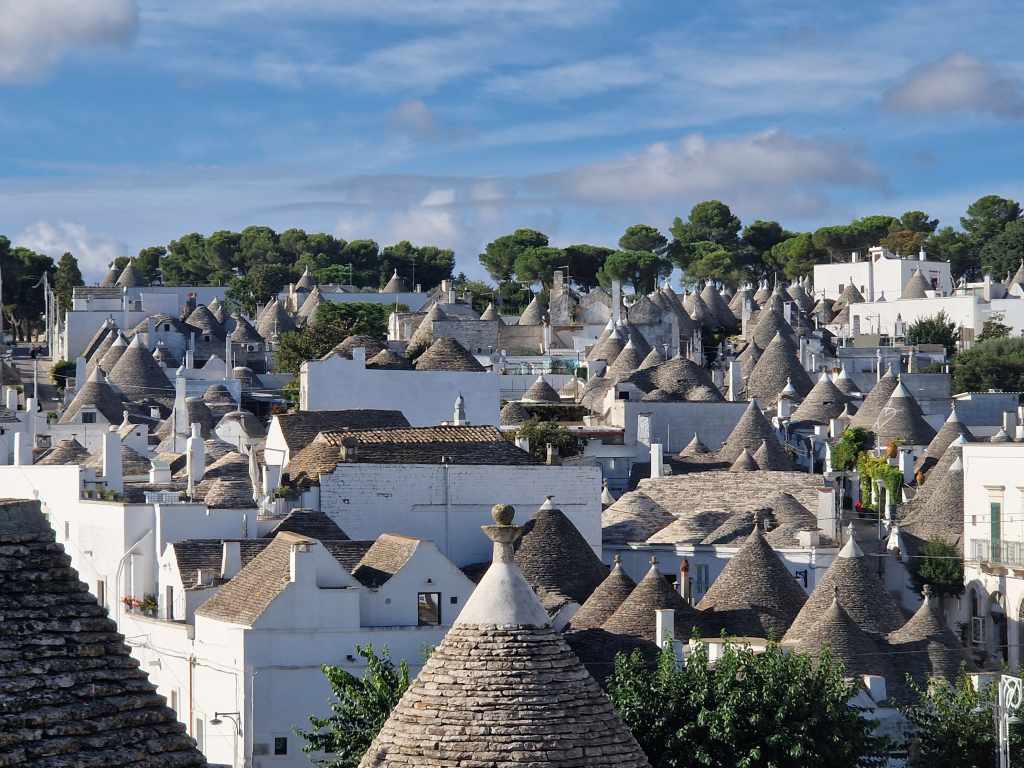
The next day I woke up early to make the four-hour trip back to Salerno to return my hire car. On the way I made a short early-morning stop at Alberobello, a small town known for its remarkable number of trulli – 1,600 apparently. These earned the town its listing as a UNESCO world heritage site, and a place on any tourist’s list of things to see in Puglia. The trulli were indeed a spectacular and strange sight, and I spent half an hour exploring them.
The first of many trulli at Alberobello
I looked at my watch, and wondered briefly whether I should not stop here longer to explore more deeply. But I had a deadline to return the hire car before the rental office in Salerno closed for its 1pm siesta break, so I decided to drive on. Leaving at that time turned out to be a good decision. On my way back to the car park, I crossed streams of other visitors heading the other way, and as I drove out of the town, I passed a veritable armada of tour buses driving in. It was clear that by 9.30 the small town would be overrun.
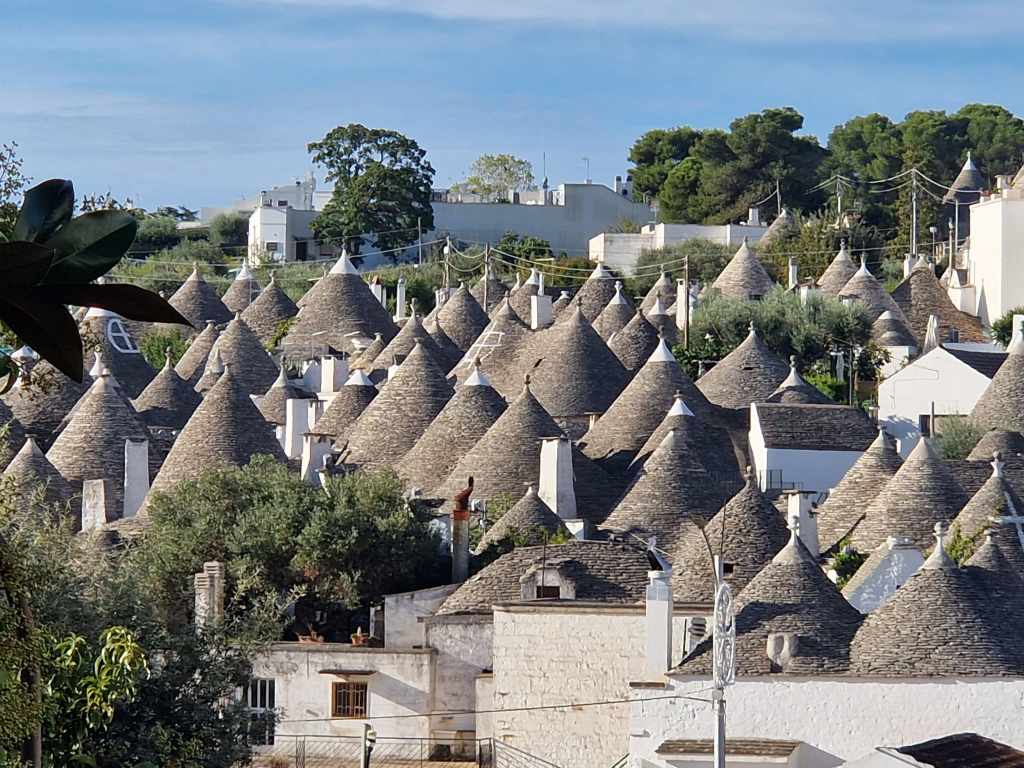
Hundreds of Alberobello’s trulli sit on one picturesque hillside
My drive back to Salerno proved challenging. Not because of the driving habits of local drivers, which were actually quite good, but because of the crazy rules imposed by the authorities. There were frequent road works (but no sign of anyone working) which were an excuse to limit the speed on perfectly good stretches of road to 50km/h (30 miles/hour) or even lower. It seemed that the government has bought thousands of “max 50km/h” signs that they did not know what to do with. The local drivers ignored these ridiculous limits and drove at an appropriate speed for the road conditions – often at twice or even three times the advertised limit. The rare speed cameras were well advertised in advance by signs and could also be spotted from far away by watching for when the drivers ahead braked suddenly. As a law-abiding foreign bear, I had an uncomfortable choice – obey the speed limit and cause a big queue of angry drivers to build up behind me, or drive like the locals. I won’t reveal my decision but let it be said that I arrived at Salerno in a slightly stressed condition just in time to return my car.
From Salerno I took the train to Naples for the last two nights of my Italian trip. I had enjoyed Puglia but thought that I had seen enough pretty villages and trulli and was yearning to experience the excitement of a big city once again. Whilst not always easy, Naples turned out to be exactly what I needed, and an exact opposite to the cute small towns of the last few days. Check out my blog tomorrow to find out more!
A teaser for my next post – the view of Naples from my accommodation!
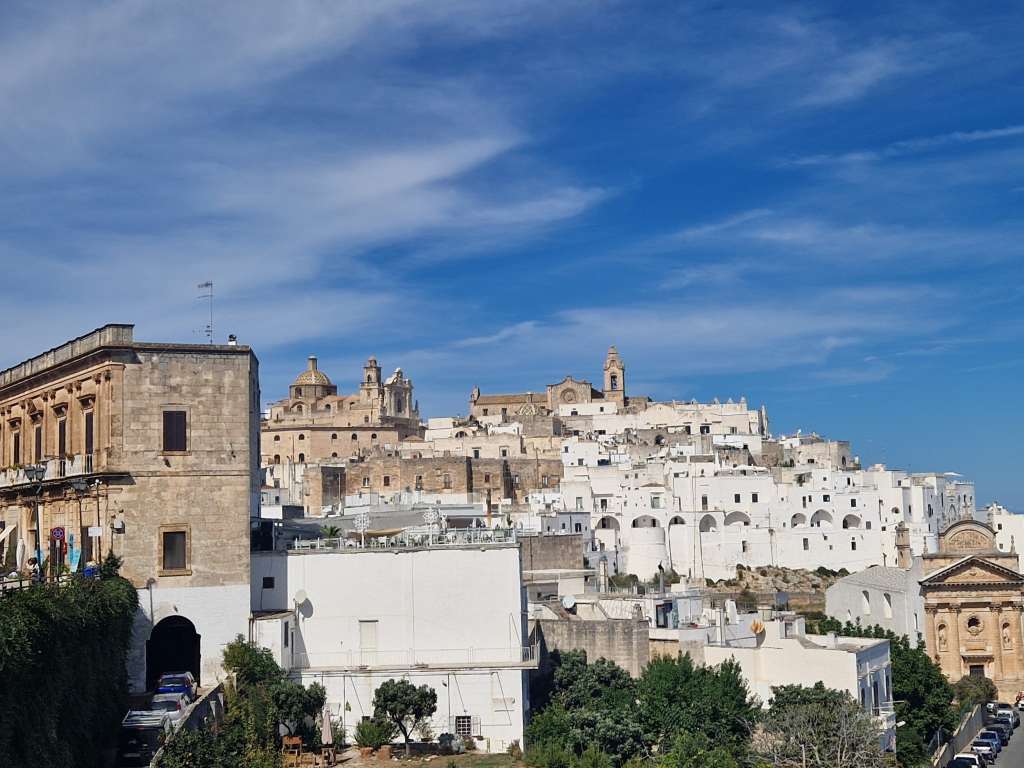
My next couple of days were devoted to exploring inland Puglia, with its pretty, white, hilltop villages and strange “trulli” (more about these below). I said a sad goodbye to Lecce and drove north to my first stop, Ostuni. This is arguably the prettiest town in Puglia, whose old town has a maze of windy lanes snaking up a hill. It dominates the surrounding plain and its visual impact is enhanced by the brilliant white colour of its houses, like villages in Greece.
Ostuni – beautiful from a distance
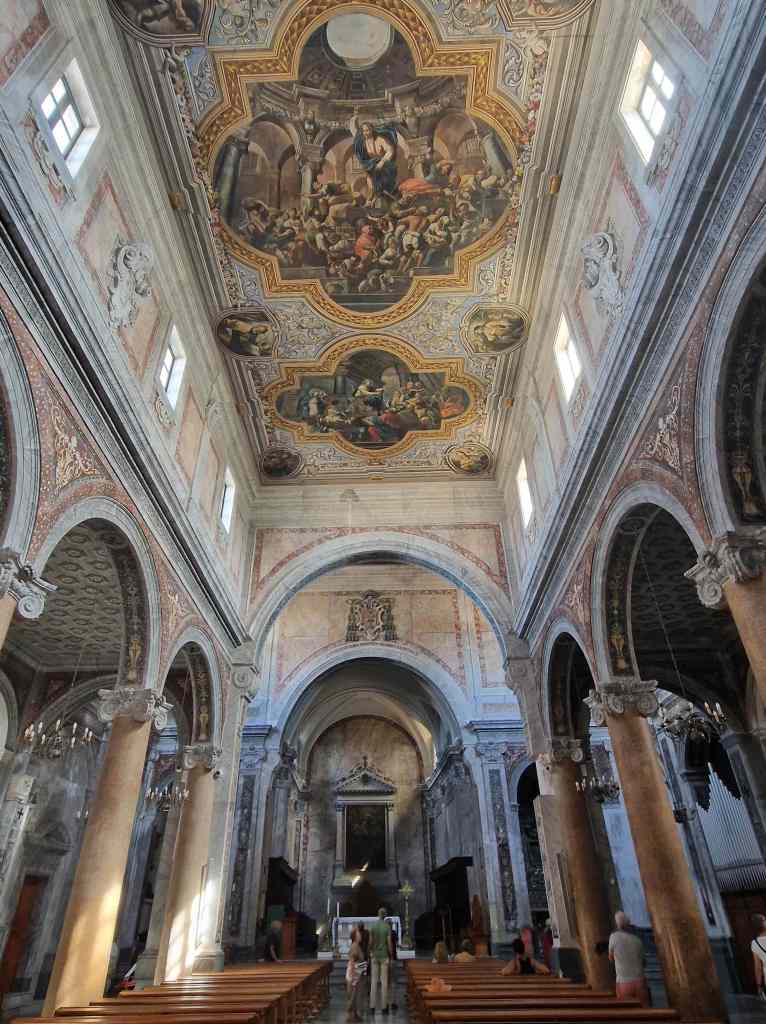
However, Ostuni’s beauty, and its proximity to the coast and the airport at Bari make it a popular destination for tour groups, and when I visited, it did not have enough small passageways to absorb the number of tourists it gets. I took lots of photos, but after a couple of hours wandering around, always seeming to come back to the same crowded piazza in front of the town’s 15th century cathedral, I had had enough and decided to drive on.
Inside Ostuni’s cathedralThe crowded piazza in front of the cathedreal
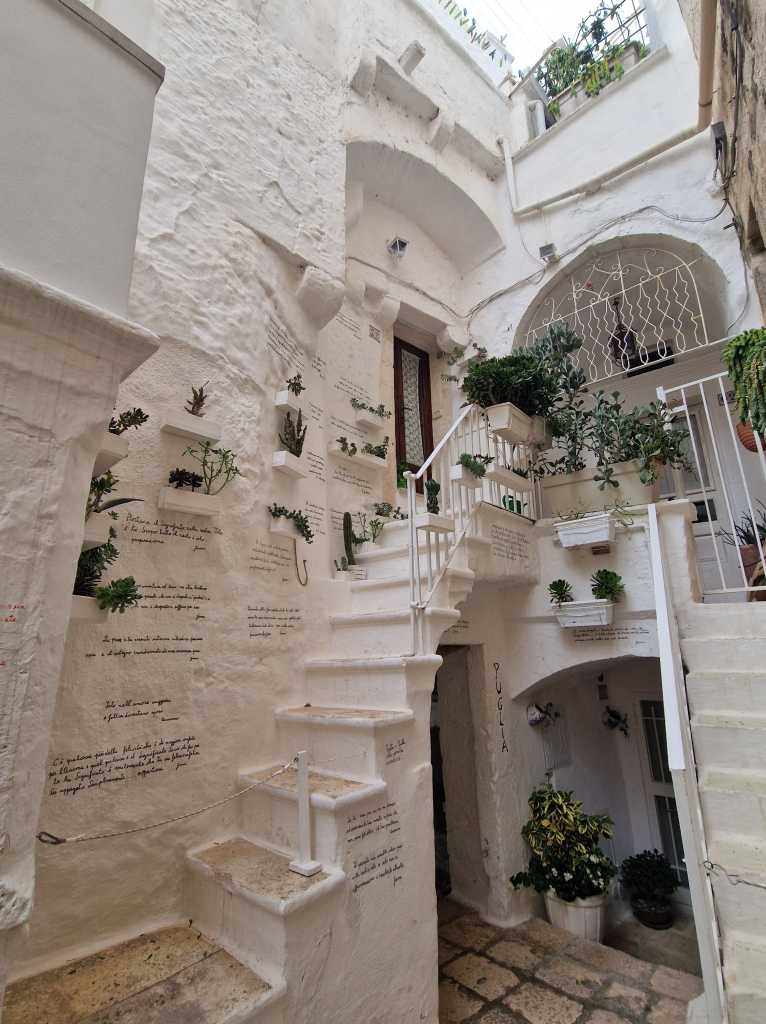
My decision to leave Ostuni earlier than I had planned left me with time to kill before I could check into my accommodation, and I decided to visit the little-known town of Cisternino. Unlike Ostuni, whose brilliant white old town is clearly visible for miles around, Cisternino’s was hidden behind more modern buildings, and on first appearances the city looked an unremarkable place. I had lunch in a local trattoria where I got a plate of excellent bombetti (little parcels of meat) for a ridiculously low price. Feeling very full after a big meal, I set off to look for the old town. I found a small archway in an ordinary looking modern building, and ducked under it to enter a different world – once again made up of winding narrow streets, white-painted houses and churches.
Hidden alleyways in Cisternino
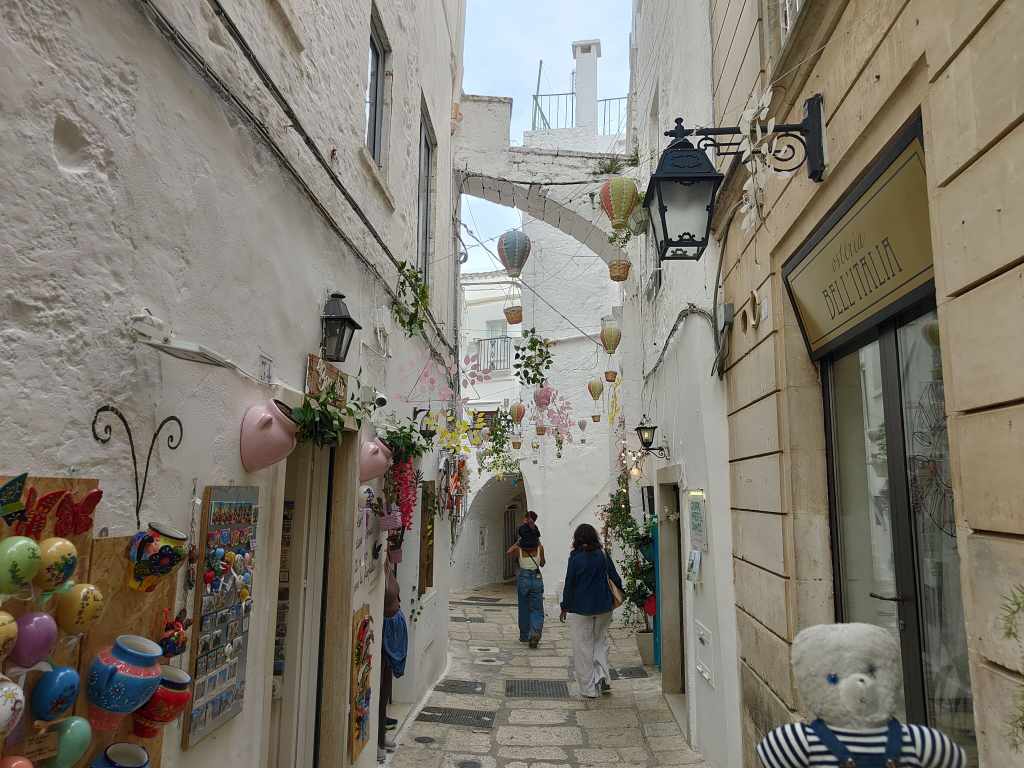
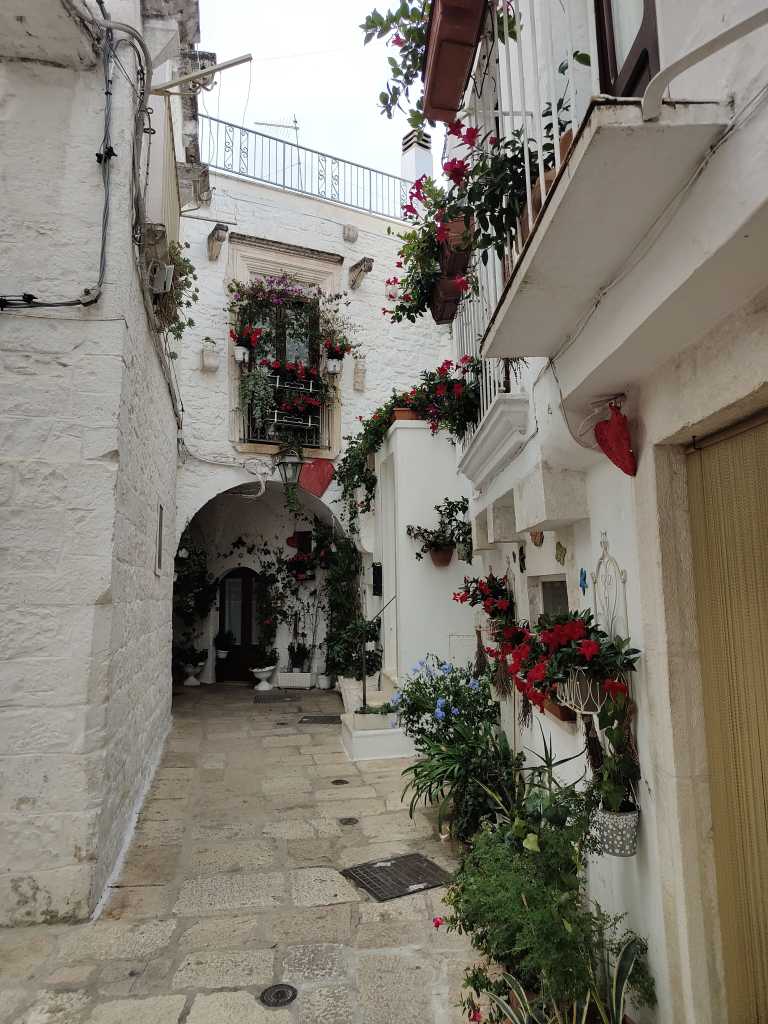
The residents of the old town had gone to great lengths to make the area interesting, decorating it in all sorts of imaginative ways. In some alleys, children’s swings with poetic inscriptions on the bottom of their seats hung above me; others were lined with red hearts and red flowers, and yet more displayed models of small hot air balloons hanging in the air above me.
Suspended art works in CisterninoRed flowers and red hearts in Cisternino
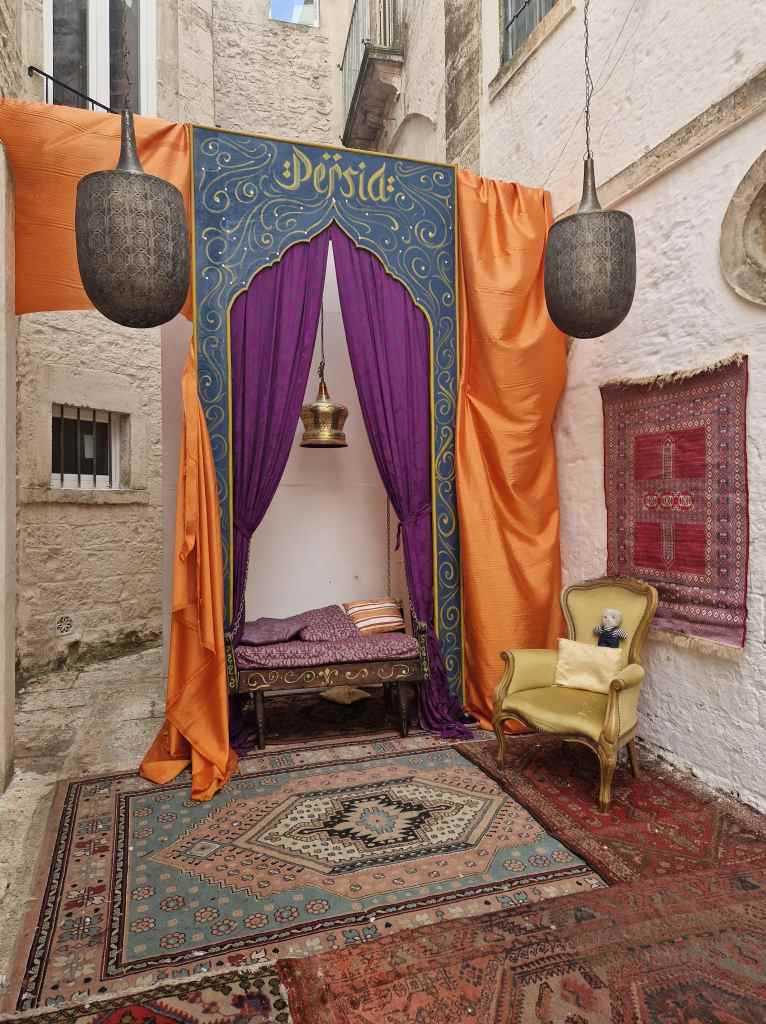
There were also some larger installations around the theme of countries in Asia – here is the one devoted to Persia:
Asian-themed display in Cisternino
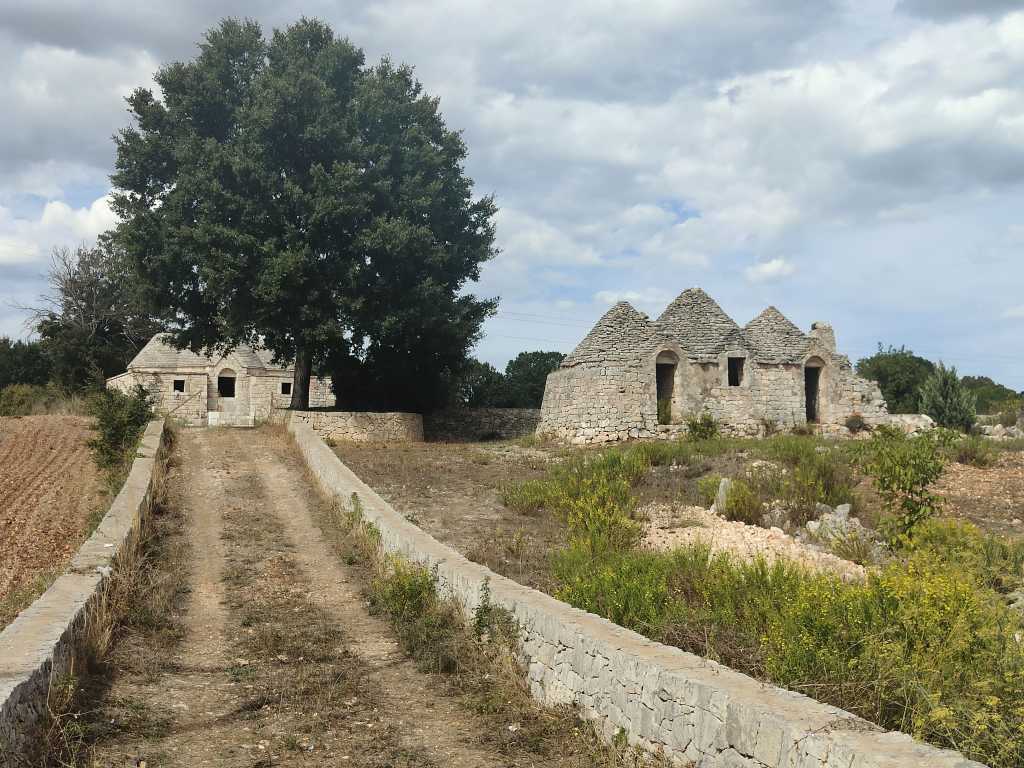
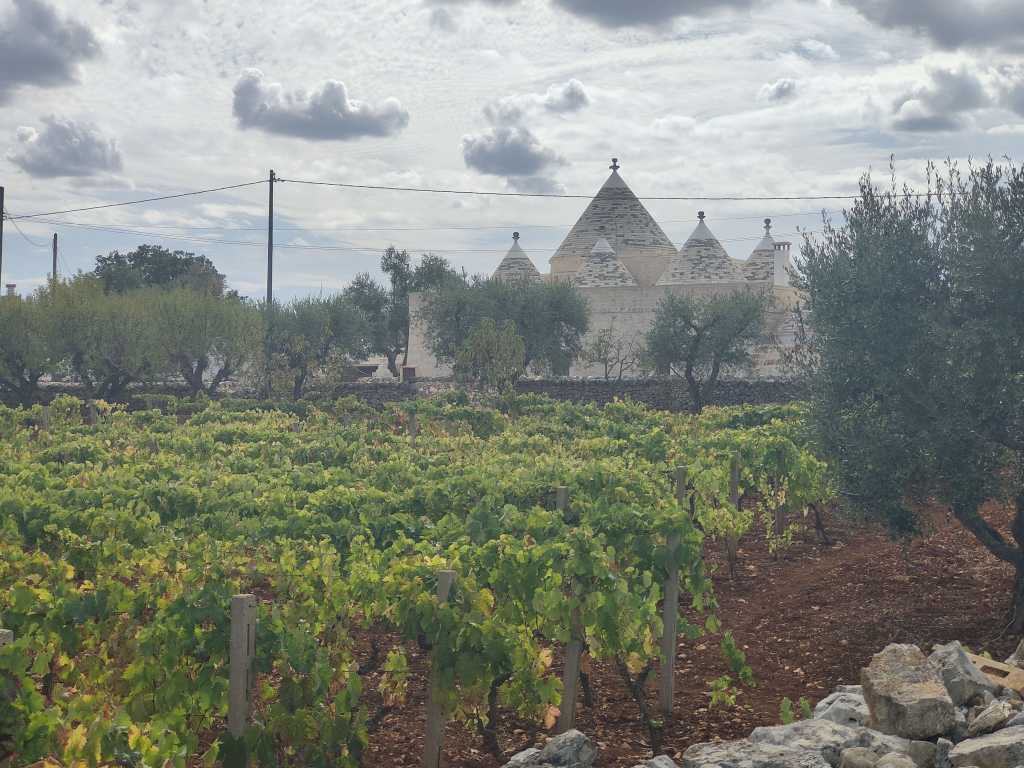
It was wonderful strolling around to see what new artistic ideas might lie behind the next corner. It was also very quiet – bumping into a fellow tourist was a pleasant surprise rather than a constant nuisance, like it had been in Ostuni. From being a stopgap to kill time before check-in, Cisternino had become one of the highlights of Puglia, and I was charmed by the place. But eventually it was time to go, and I drove on to my accommodation – a “masseria” or fortified farmhouse. The road led through the dry Puglia countryside down tiny country roads that crossed fields of olives or vines and were dotted with “trulli” – traditional stone huts with conical roofs. These were originally built as temporary storage facilities for farms, or as modest dwellings for agricultural labourers – but now many have been restored to provide accommodation for tourists.
Trulli on the backroads of PugliaTrulli and vines, Puglia
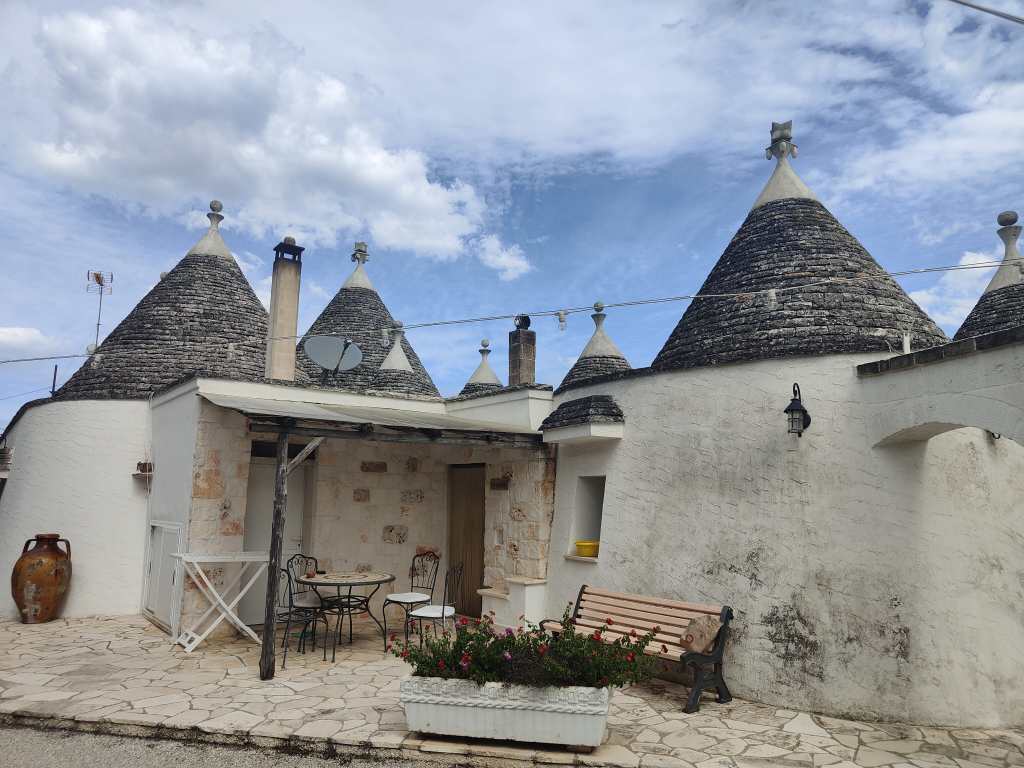
I eventually reached my masseria late in the afternoon. I had booked a room in one of these converted trulli, a popular idea with the many farmers who now make a living from agrotourism alongside cultivating crops. Staying in a trullo was something I thought I had to do whilst in Puglia, and was fun to do once, but I found the room a bit dark since the windows were very small.
My accommodation – a converted trullo
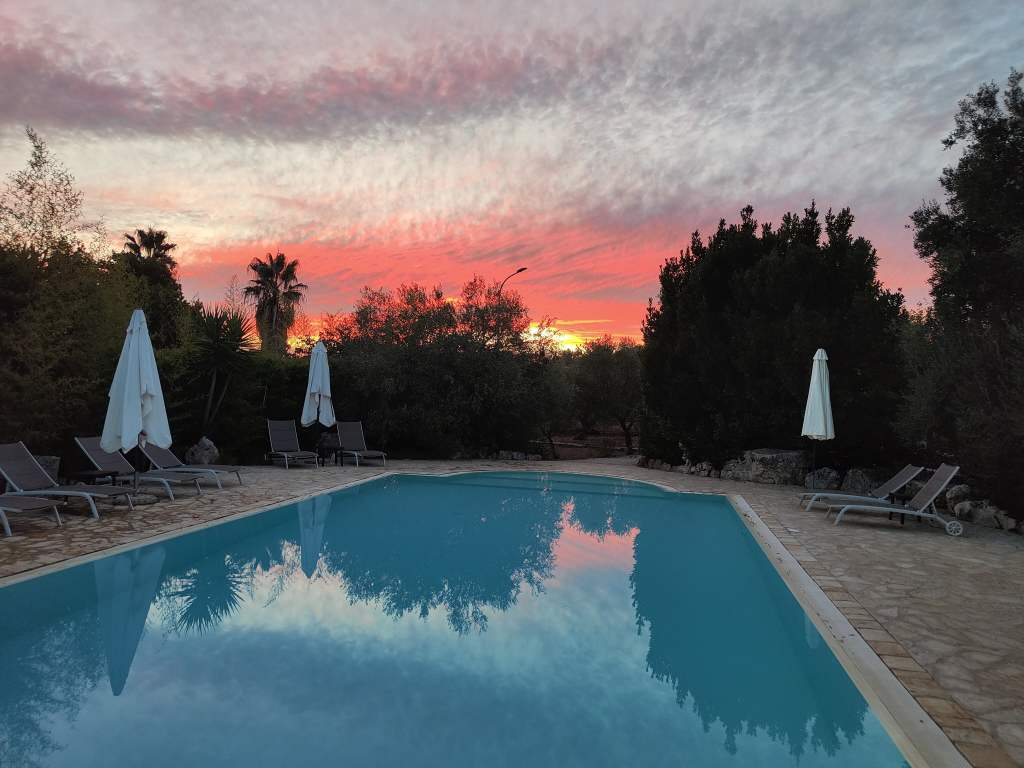
After check-in, I lay by the pool catching up on my blog. It had been a day of contrasts – I had been a bit underwhelmed by popular Ostuni, but charmed by little-known Cisternino, and was curious to see what other gems lay hidden in this remote part of inland Puglia – so remote in fact that my masseria had no mobile phone coverage.
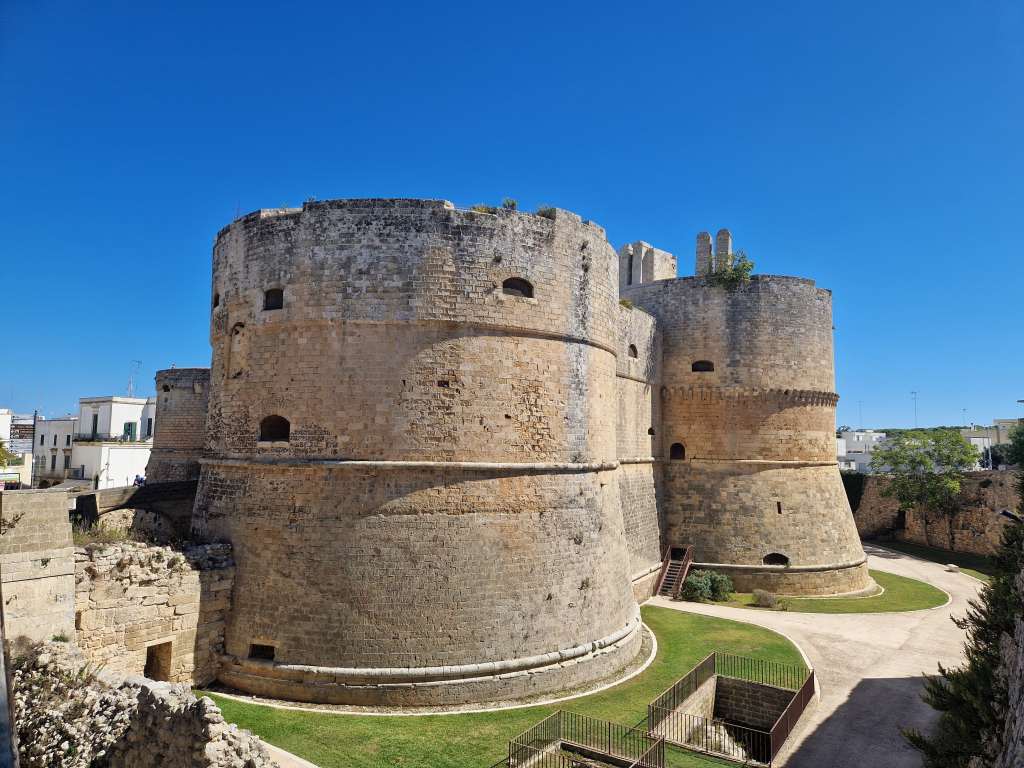
Today I made a day trip out of Lecce down to the very tip of Italy’s heel. I drove a short distance east to reach the coast, and then headed south. At first the road was not especially scenic as it went through a series of seaside resorts, some of which were so shabby that even the backdrop of the deep blue Adriatic Sea could not make them attractive. After an hour things improved when I reached the historic city of Otranto. This has Roman origins but is most noted historically for a particularly bloody event in 1480, when an Ottoman force laid siege and eventually captured the city after a fierce struggle. Much of the population was slaughtered in the aftermath of the battle, including the bishop, who was sawed in half. Surviving women and children were sold off into slavery, but eight hundred male survivors also remained. They were offered a choice – execution or conversion to Islam. All chose the former and were martyred on the spot.
Otranto’s castleOtranto’s port
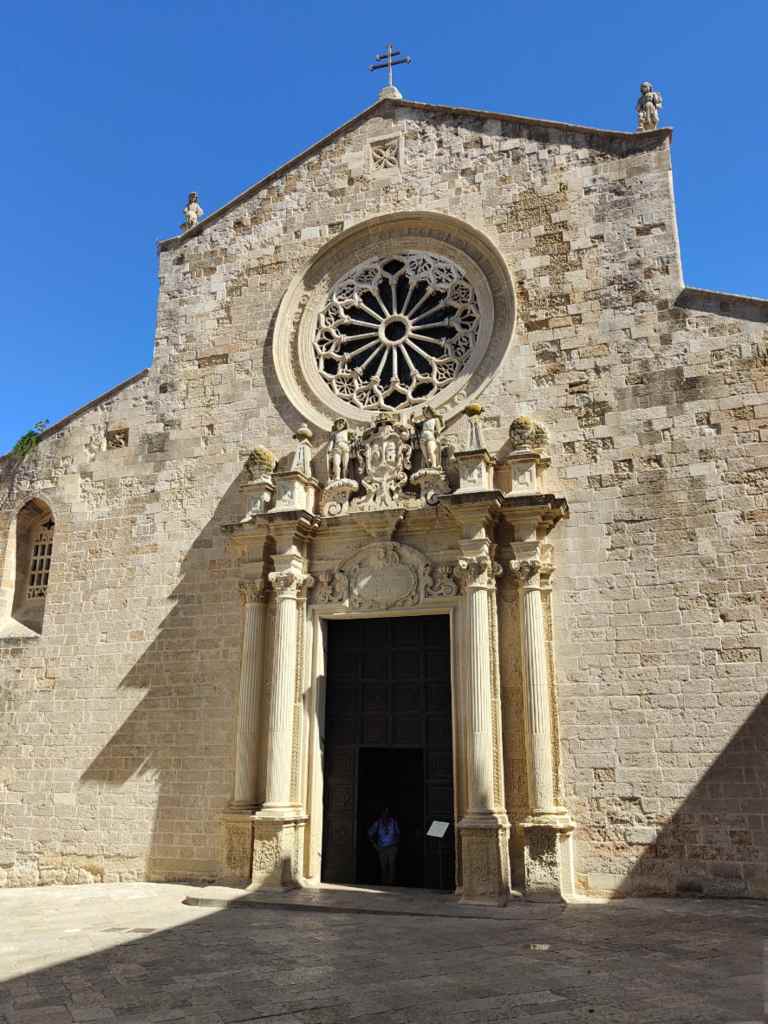
Otranto is now a pretty town with an imposing castle and an interesting looking duomo (cathedral). Seeing a large tour group enter, I opted to explore the winding streets of the old town first, but on returning found that the duomo had closed for a two-hour lunch break.
The outside of the Otranto’s Duomo
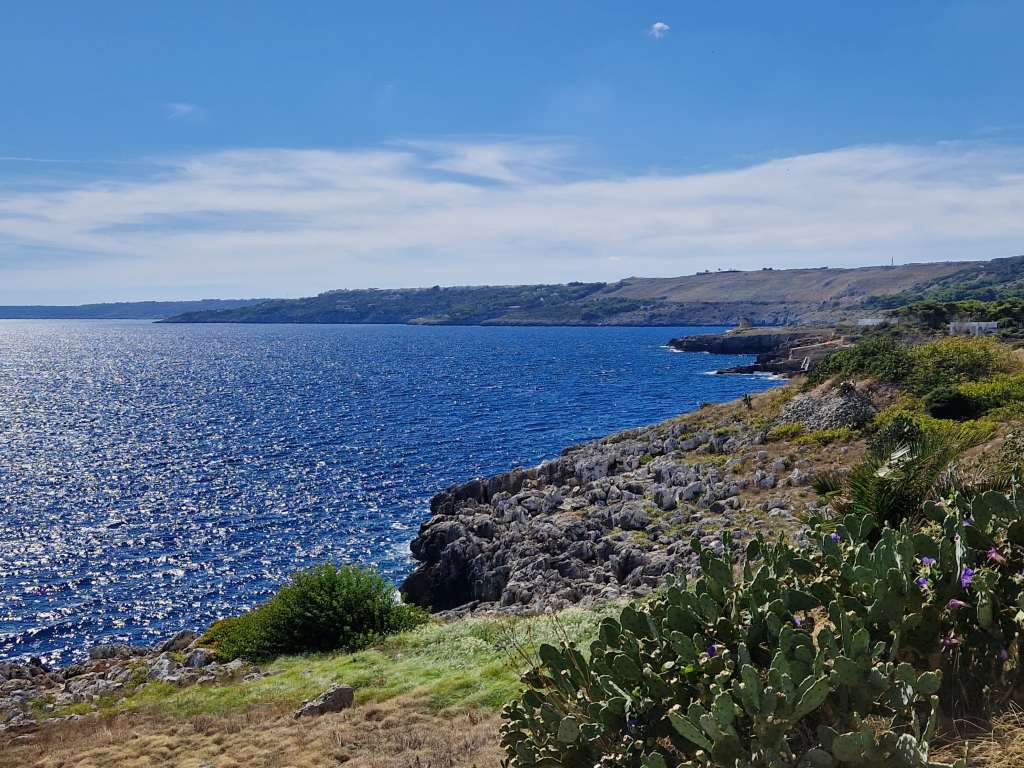
I continued my drive and the scenery became more beautiful and the seaside towns smarter, some with some interesting Moorish-style buildings.
The coast south of OtrantoOne of the moorish-style buildings lining the coastal road
My final destination St Maria de Leuca was a pleasant enough place, located at the very tip of Italy’s heel. I stopped for a coffee to celebrate reaching one of the extremities of Europe.
The end of Europe! Santa Maria de Leuca
One my drive back to Lecce I discovered what was probably the highlight of the day – Presicce, yet another beautiful small Italian town where time seems to have stopped. I arrived in the late afternoon to find the place almost deserted and all of the shops and cafes shut, except for one bar in front of the town’s ancient church. The hot sun and somnolent town risked sending me to sleep, so I ordered a gelato and coffee to wake me up before exploring a bit more.
Presicce’s beautiful church….….and pretty but empty streets
The town was exceptionally beautiful but seemed to be not only completely off the tourist trail but also slowly dying as native people left; I noticed several houses with “for sale” signs on them. This depopulation of small rural areas is a big problem in Italy’s south, so much so that the government offers tax breaks for people to go to live in small municipalities. But although Persicce was a wonderful place to visit for an hour so, it was so quiet that I wondered how I could possible live there, and headed back to enjoy the relatively busy street life of Lecce for my last evening there.
My next destination was Lecce in Puglia, an ancient city famed for its baroque buildings. Lecce was first settled in pre-Roman times, became a Roman city with an amphitheatre which survives to this day, and then spent the next few centuries changing hands between Ostrogoth invaders, the Eastern Roman Empire, Normans and Lombards. It eventually ended up as part of the Kingdom of Naples in 1463, and had a period of peace and prosperity that saw a building boom of baroque-style churches in the 1600s. Today Lecce is a popular tourist destination with a compact old city centre, which is a joy to visit on foot.
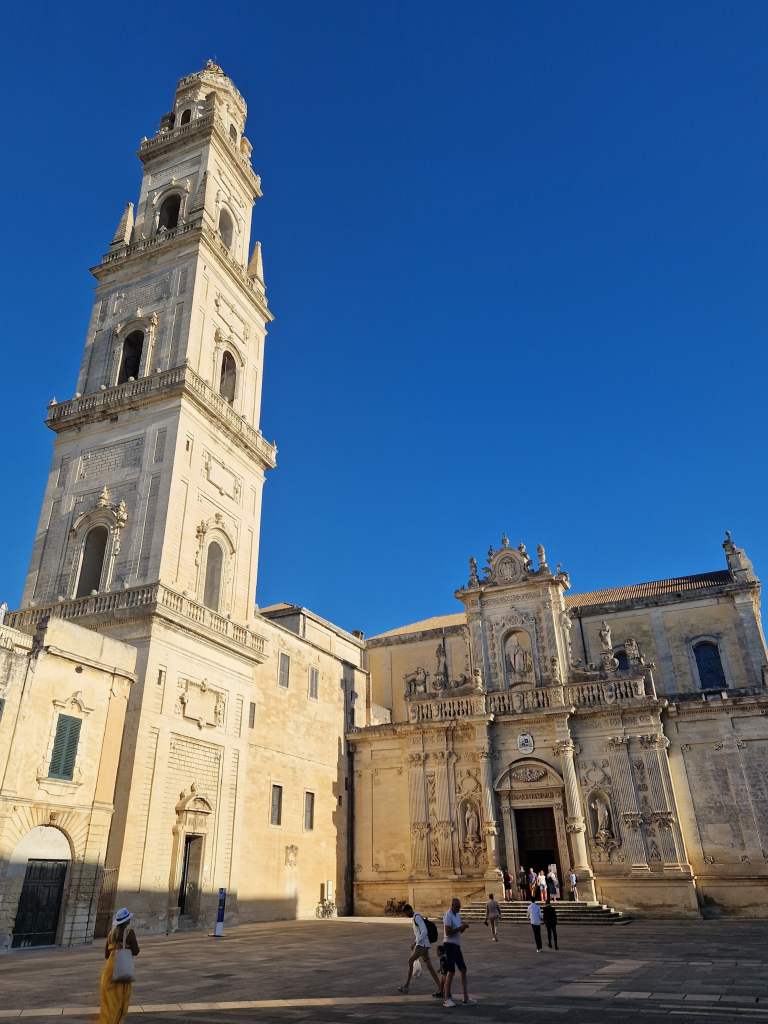
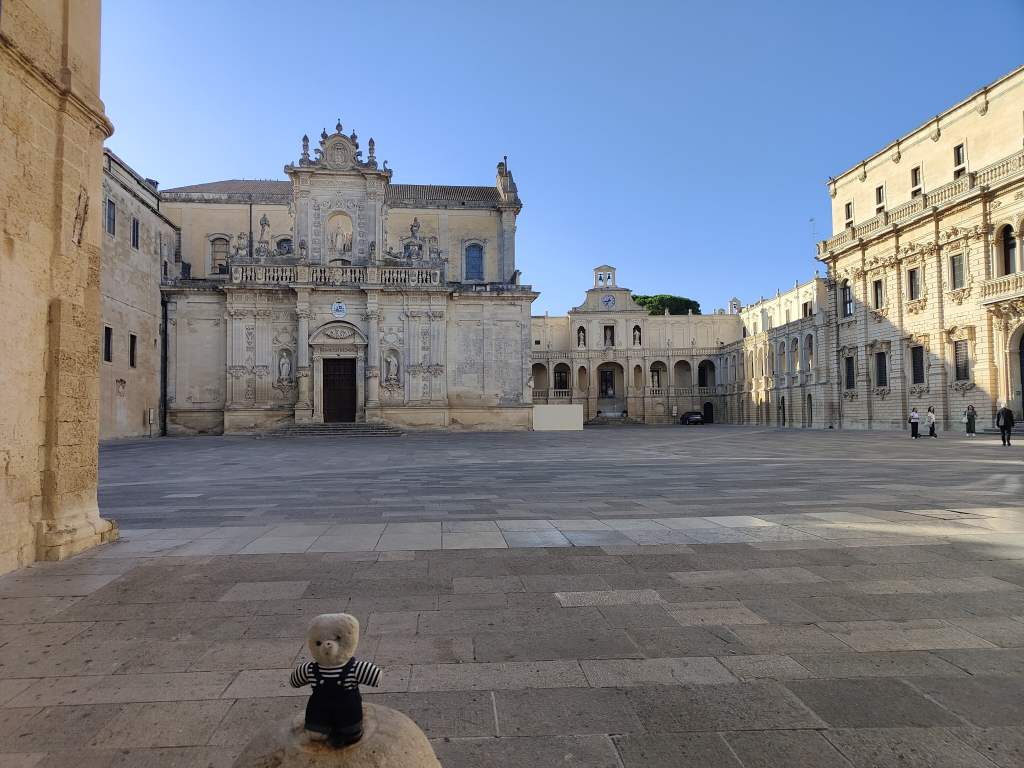
I spent a full day exploring Lecce, wandering down old streets from one beautiful baroque building to another. There are famous sights, which attract tourist groups, like Lecce’s Duomo –
Lecce’s Duomo in mid afternoonInside Lecce’s Duomo
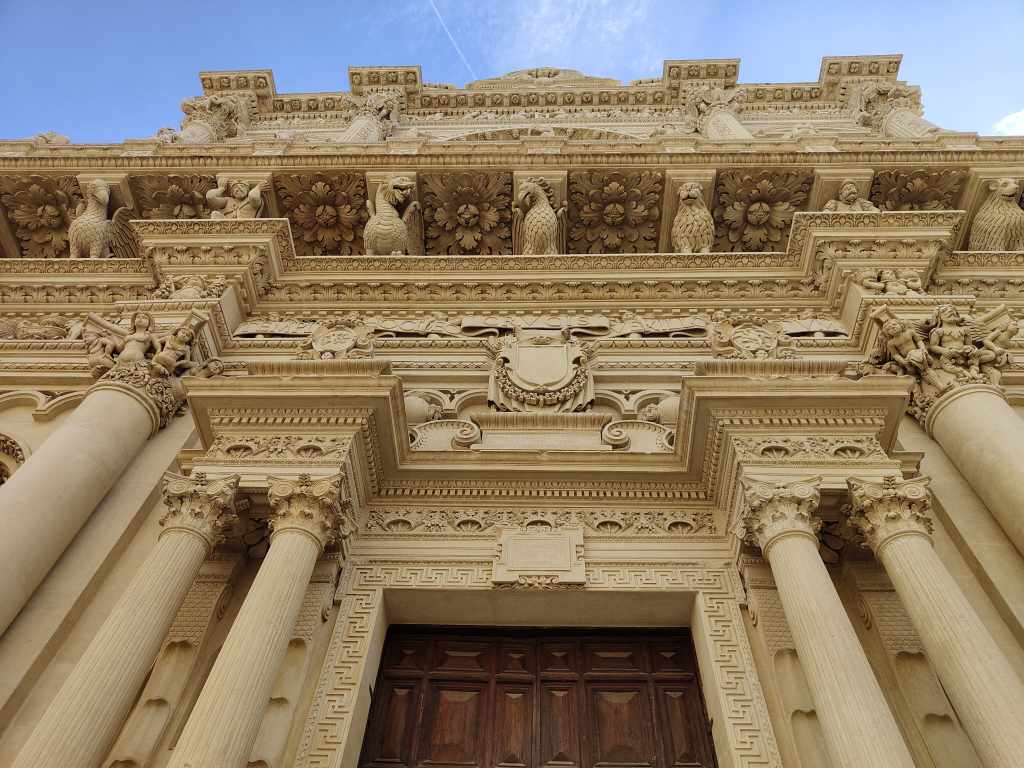
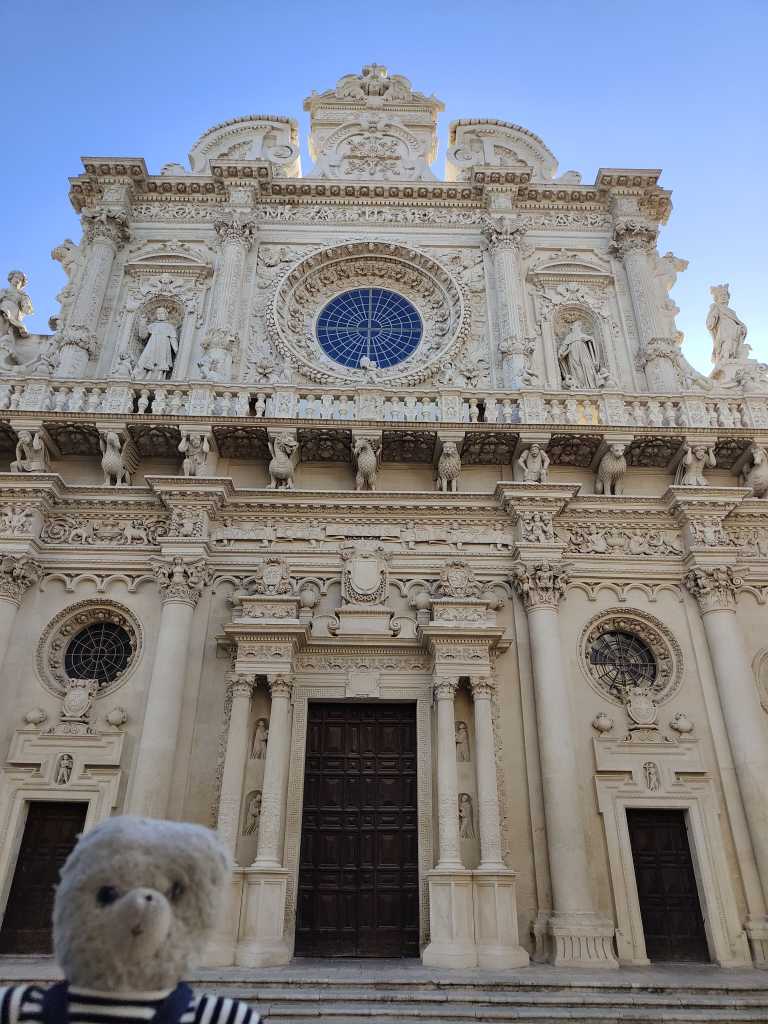
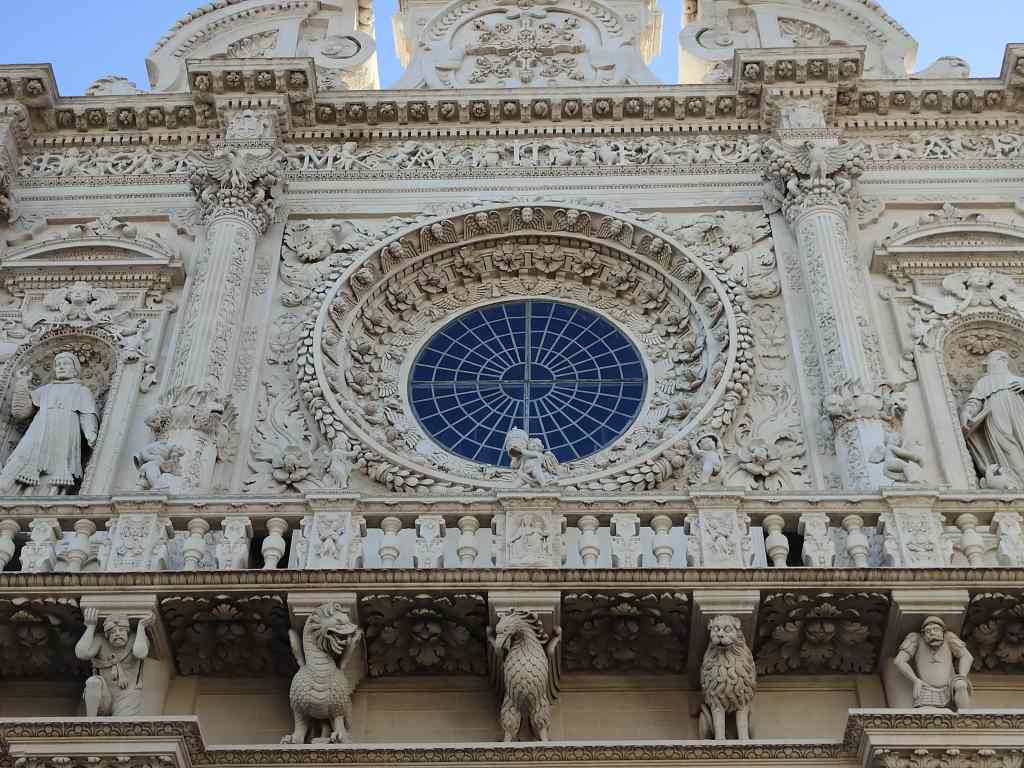
…..and the stunning Basilica di Santa Croce
The Facade of the Basilica Santa Croce
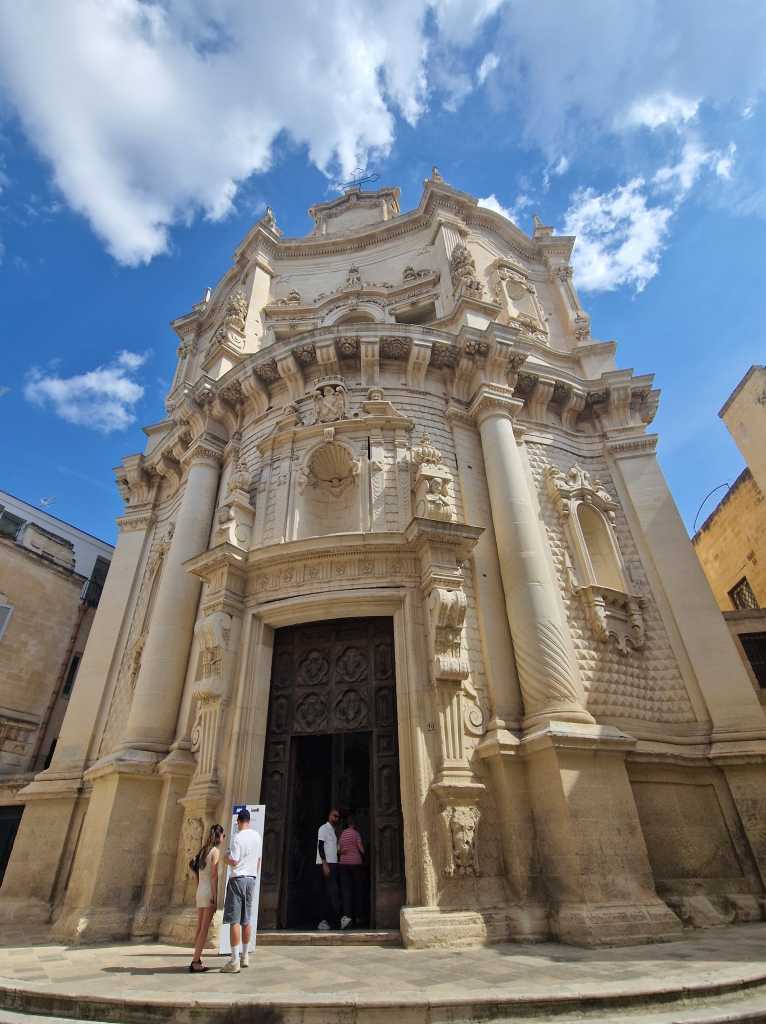
Then there are less-known baroque churches which are part of a multi-site ticket issued by the tourist office, like San Matteo –
San Matteo Church
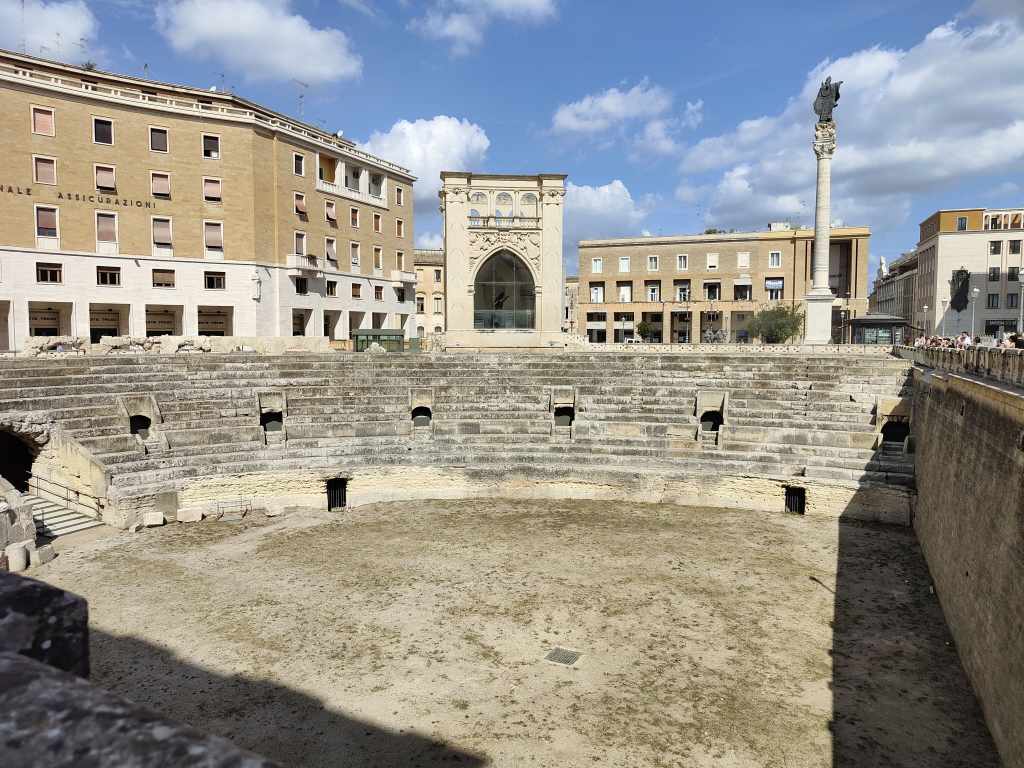
The Roman amphitheatre however is a bit of a disappointment if you have travelled a lot like me…..
Lecce’s Amphitheatre
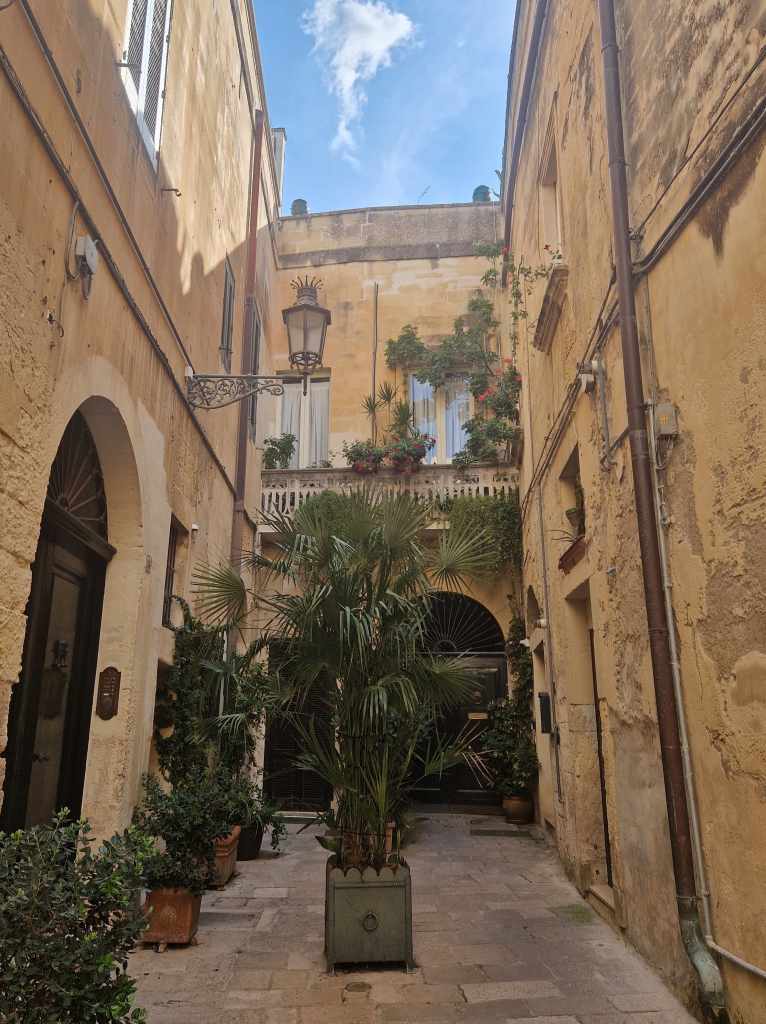
Probably the real joy of Lecce though is wandering around from cafe to cafe during the day and bar to bar at night, catching a glimpse of everyday buildings where people still live but which still have astonishing baroque features – like this quiet courtyard…
Quiet Courtyard in Lecce
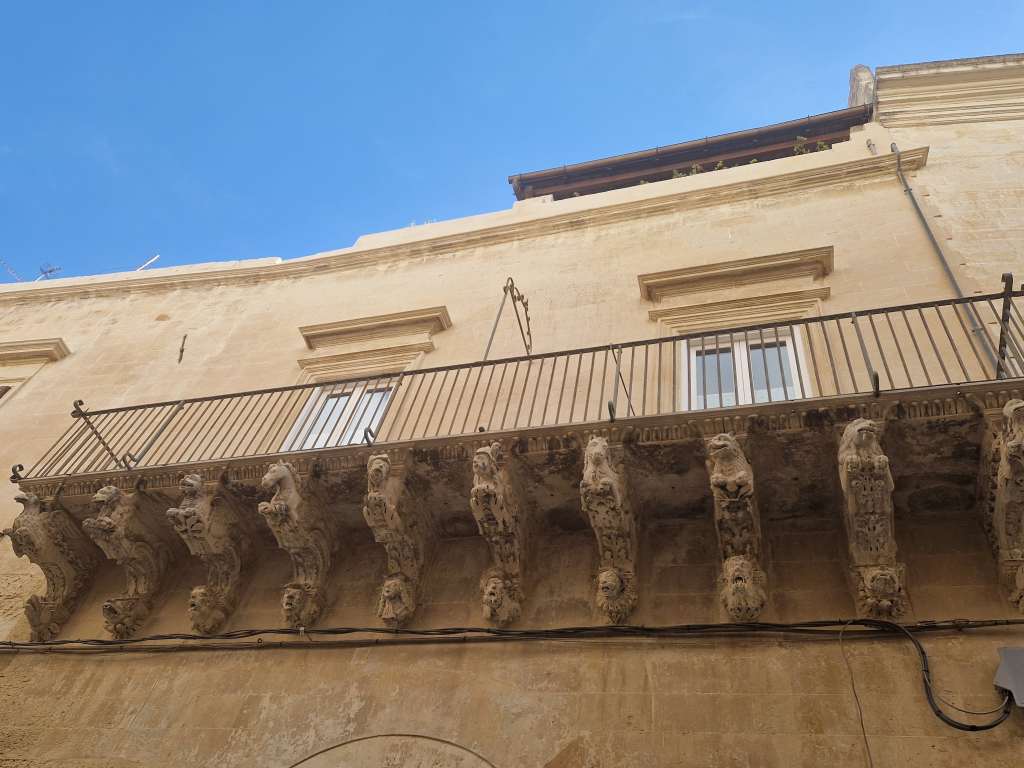
…..or this balcony…..
Balcony detail, Lecce
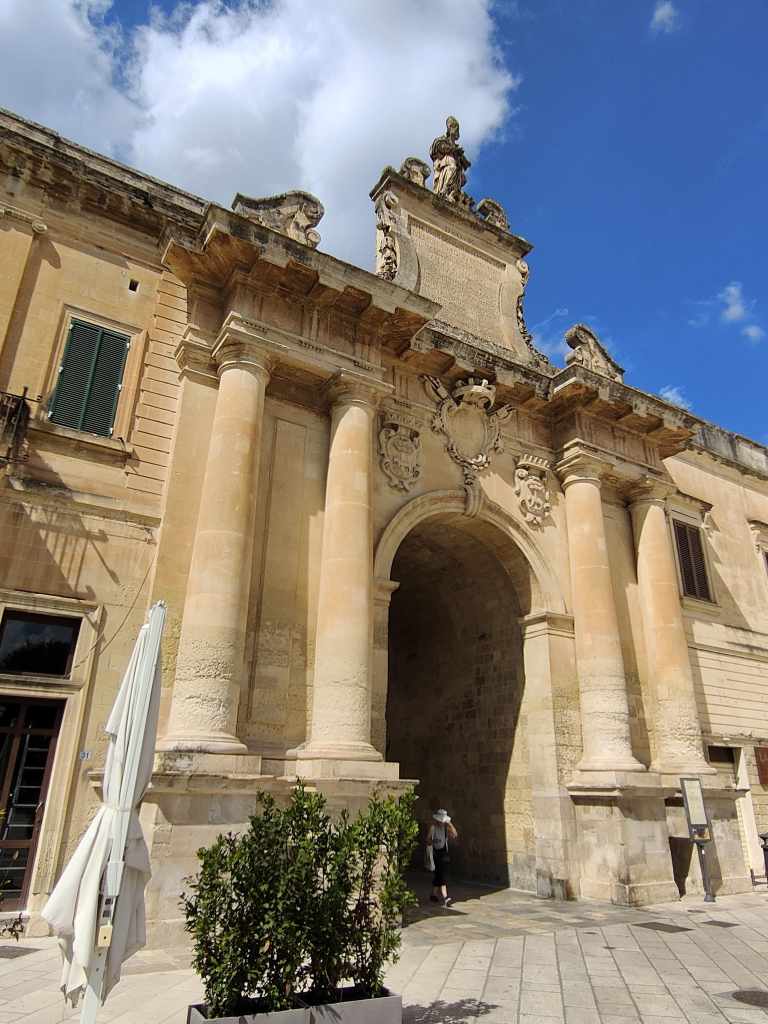
…or this gate leading into the old city.
Entrance Gate to the Old City
Once I had seen the major sites in Lecce once, I visited them again and again, enjoying how the atmosphere changed in the light of early morning or the evening. So here is the Duomo again, twice…..
The Duomo at Night, LeccePiazza del Duomo in the early morning
and Santa Croce……
Santa Croce Basilica at Night….Santa Croce in the MorningThe Amazing Carvings on Santa Croce’s facade
It all made for a very satisfying, relaxing stay. But as I sat down in front of my computer at the end of the day, I wondered what to write for my blog. There had been no problems, no amusing episodes or unique experiences to write about. I had simply had a very nice time in a beautiful city. So I decided to let the pictures do the talking for me, and this post has a lot of them, but few words.
The next day I said a sad farewell to Amalfi as I took the ferry yet again – south this time, to Salerno, where I picked up my hire car and then drove south west inland towards my next destination, the city of Matera. This is an ancient settlement, probably first inhabited in distant prehistory as a series of cave dwellings carved into the soft limestone of the cliffs of a steep ravine. In the Middle Ages the city grew to fill the ravine’s western side, and then spilt over the top of the cliff onto the surrounding plane or “Piano”. Over time, richer people moved up to the Piano, whilst the lower areas of the city, known as the “Sassi”, became crowded and desperately poor. In the 1950s the Sassi were declared unfit for human habitation and the government forced its inhabitants to relocate to new housing in the Piano. In 1986 a new law allowed reoccupation of the Sassi, and a wealthy new middle class started to move in. The area has now become a thriving tourist and cultural centre.
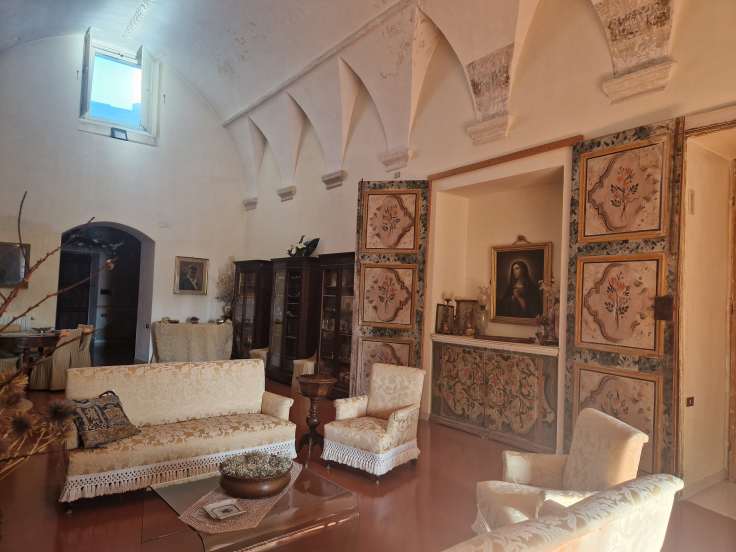
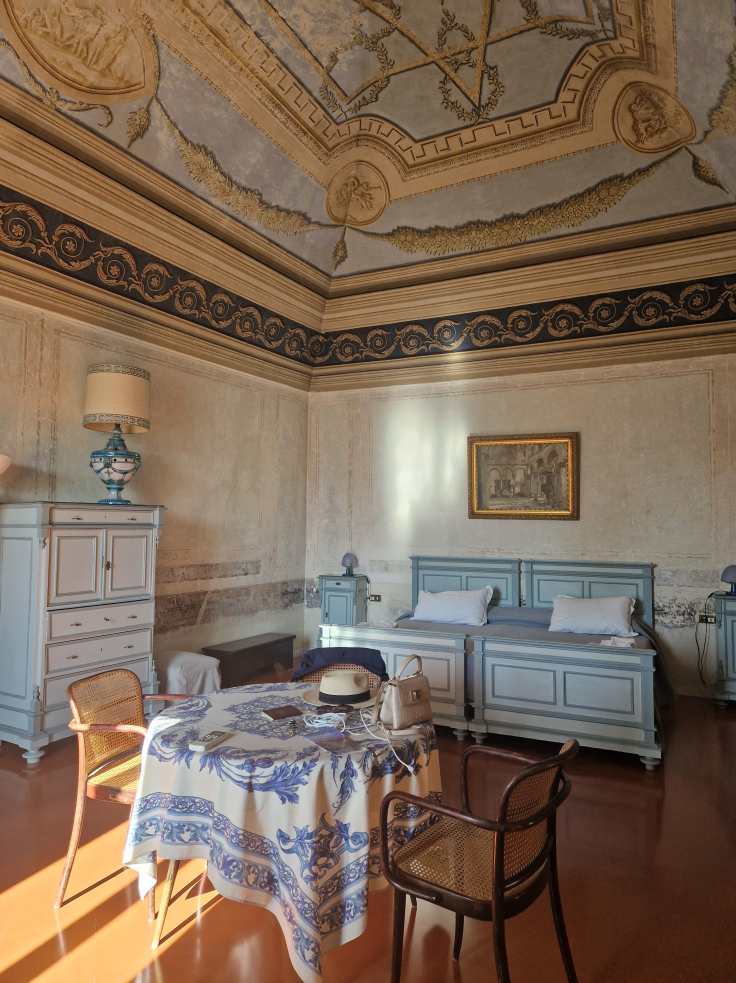
The first highlight of my visit to Matera was my accommodation – a large “palazzo” on the very edge of the Piano, whose aristocratic owner lets out three of her rooms to tourists. My rooms were enormous and had a faded elegance that I found charming.
My hotel room in Matera
The palazzo also had a garden with views over the Sassi, and after admiring the view, I set off down a set of steep steps to visit them.
View of the Sassi from my palazzo’s garden
The Sassi are an extensive maze of old buildings and narrow passageways, and my exploration lasted a full day and a half, with occasional trips back to my rooms to rest during the hot afternoon sun.
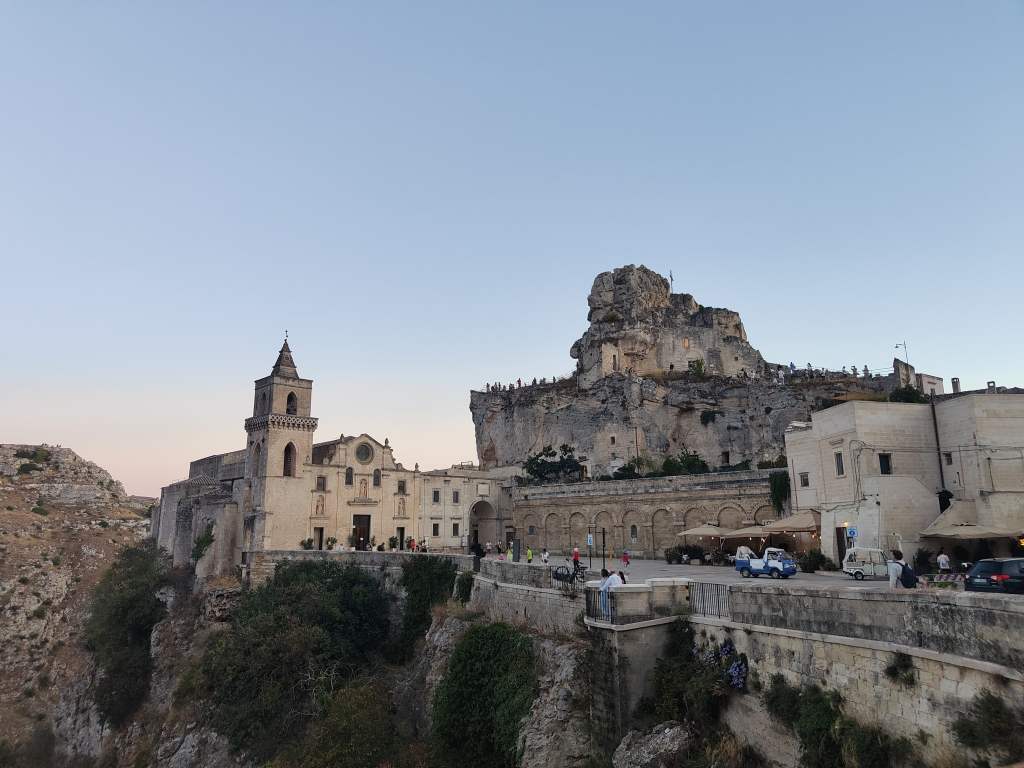
In the Sassi. On the hill, carved out of the rock, is the Church of our Lady of Virtue
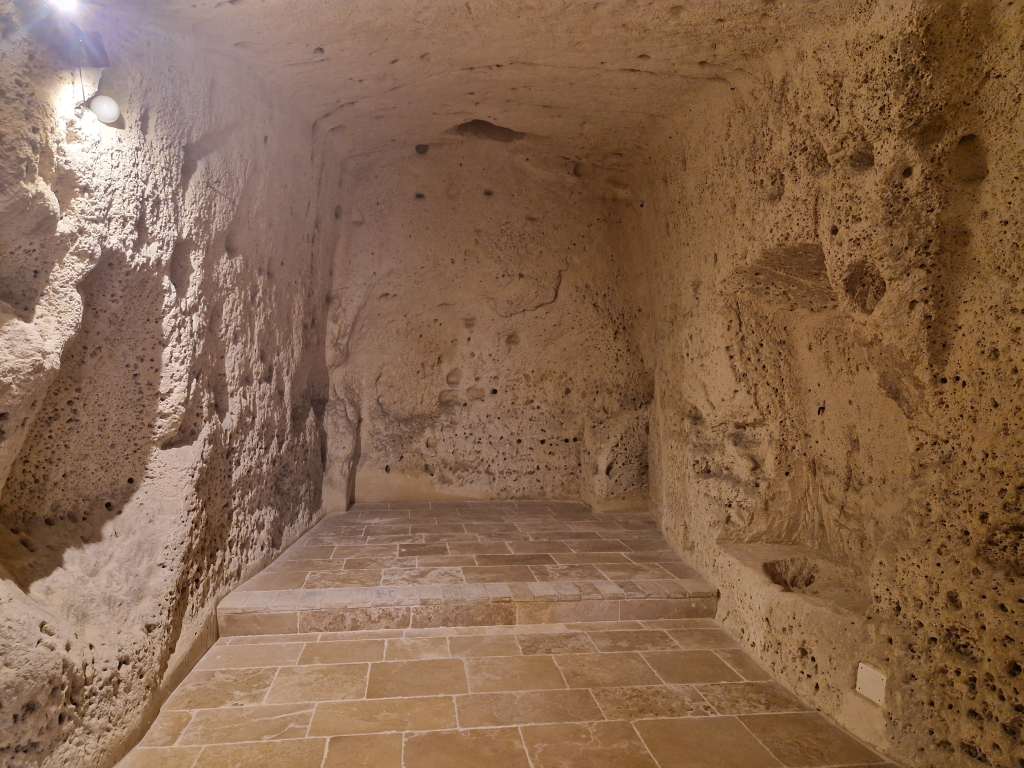
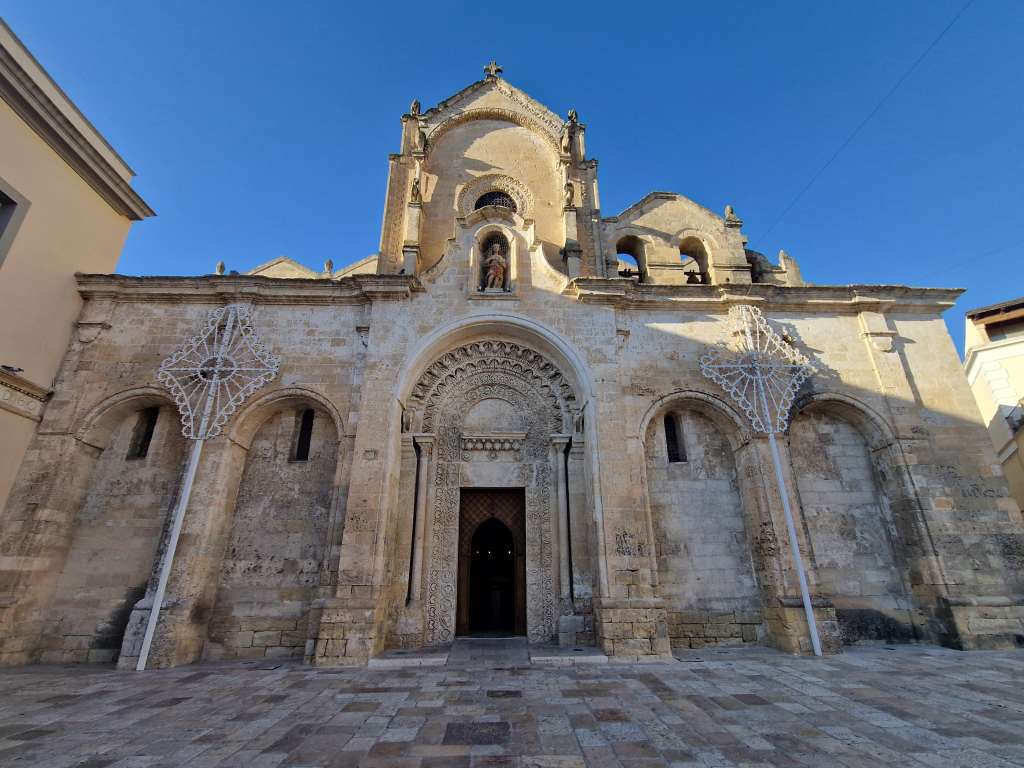
The area includes bars, restaurants and souvenir shops – but not so many as to spoil the atmosphere – as well as many ancient churches, some of which are carved out of the rock. You can also visit places showing the history of the Sassi – for example caves where an entire family and their animals fitted into one small living space, with no running water.
A cave where a whole family and their animals livedA cave complex where wine barrels were stored
I bought a ticket to visit a group of three rock churches managed by the local tourist board, and had great fun trying to find each church on the list.
Another hidden church in the Sassi
Indeed, simply wandering around the Sassi and discovering secret courtyards, narrow alleyways, and new perspectives for photos was a wonderful experience and made Matera one of the highlights of my Italy trip so far. My exploration also took in the upper city or Piano, that includes the fine cathedral and many more beautiful churches.
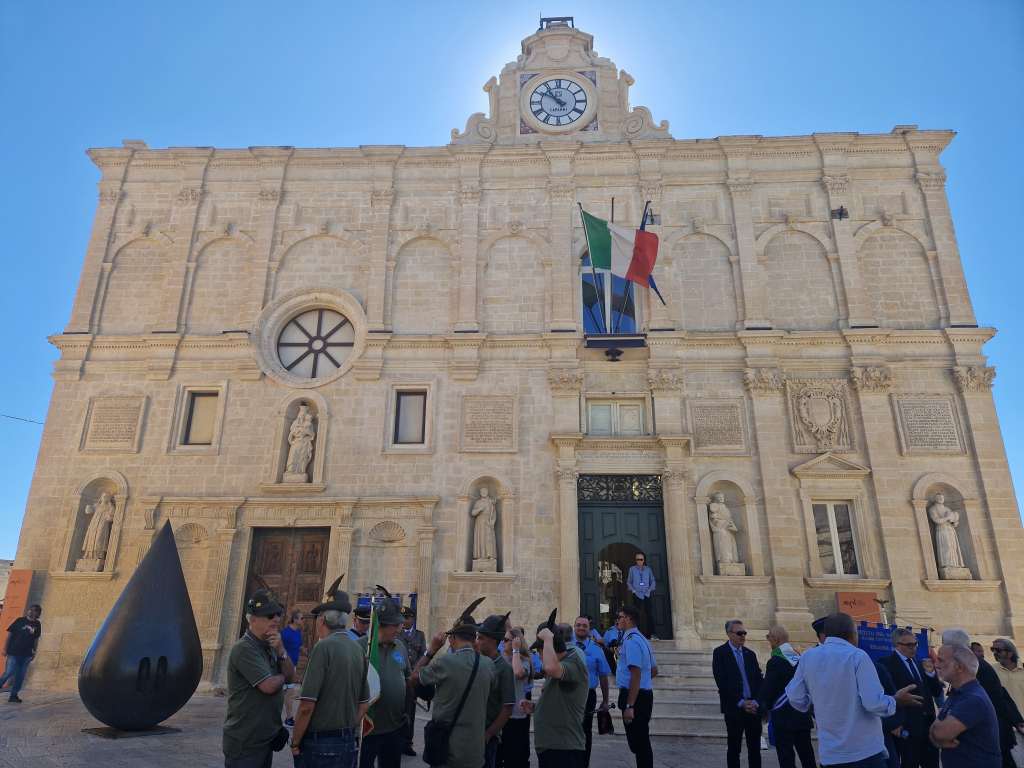
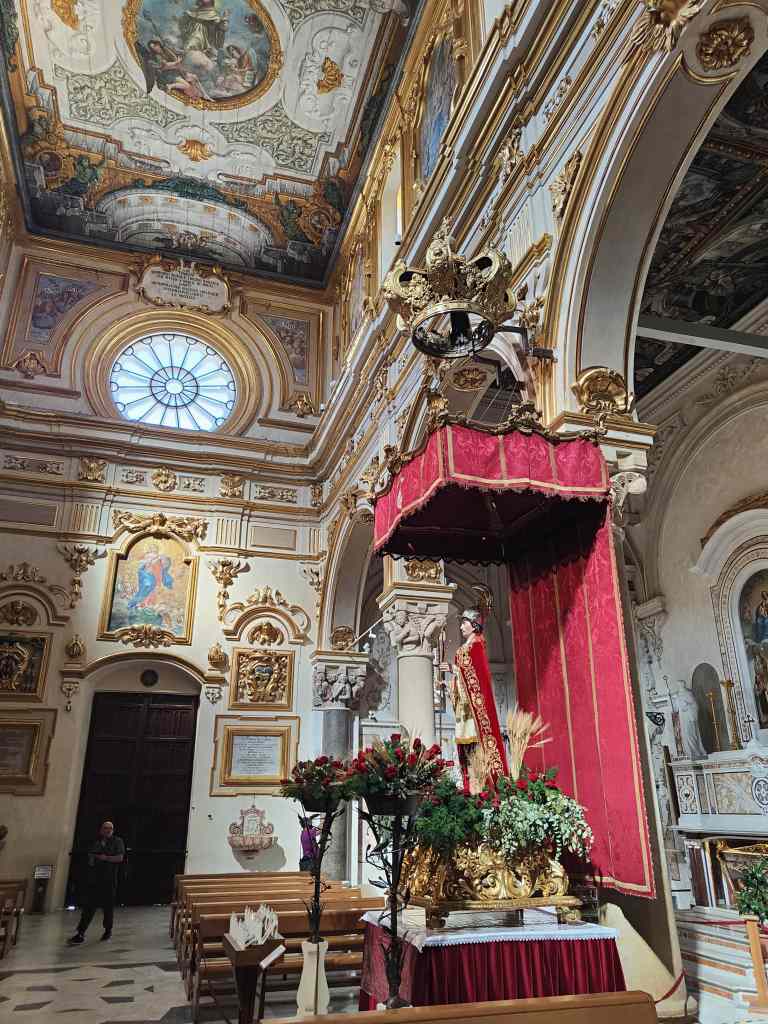
A fine building in the Piano, now a museumThe interior of the Duomo in the Piano
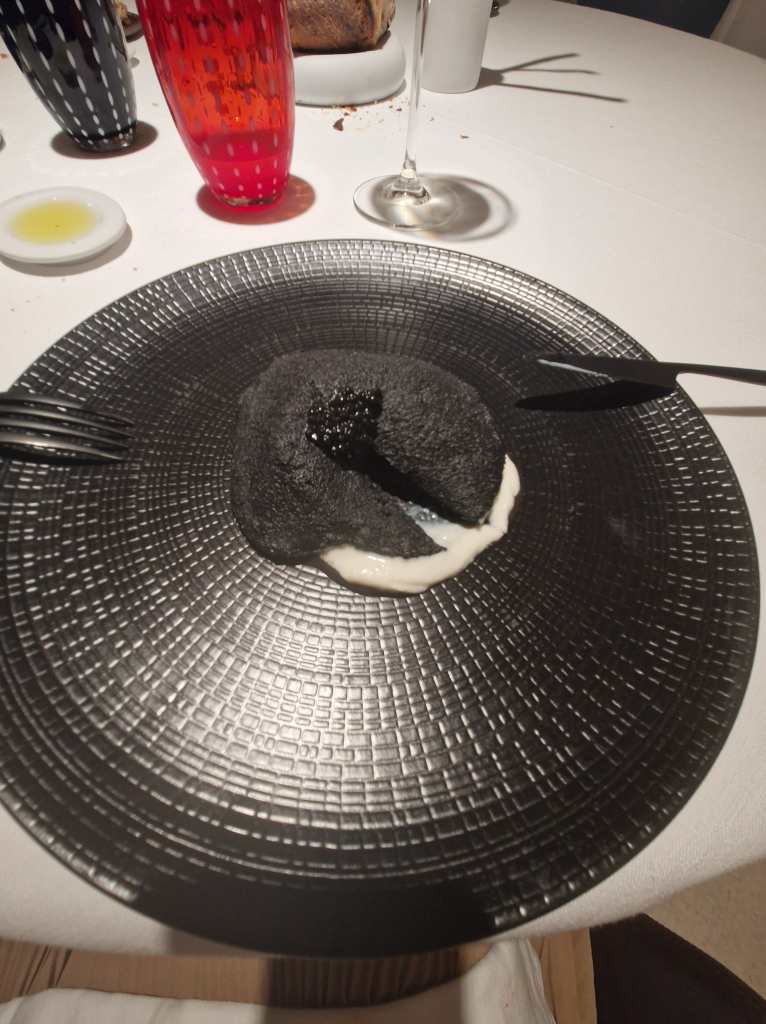
The transformation of the Sassi slums is now so complete that the area hosts three Michelin-starred restaurants, one of which I tried on my first night.
“Black pizza” in a Michelin-starred restaurant in the Sassi
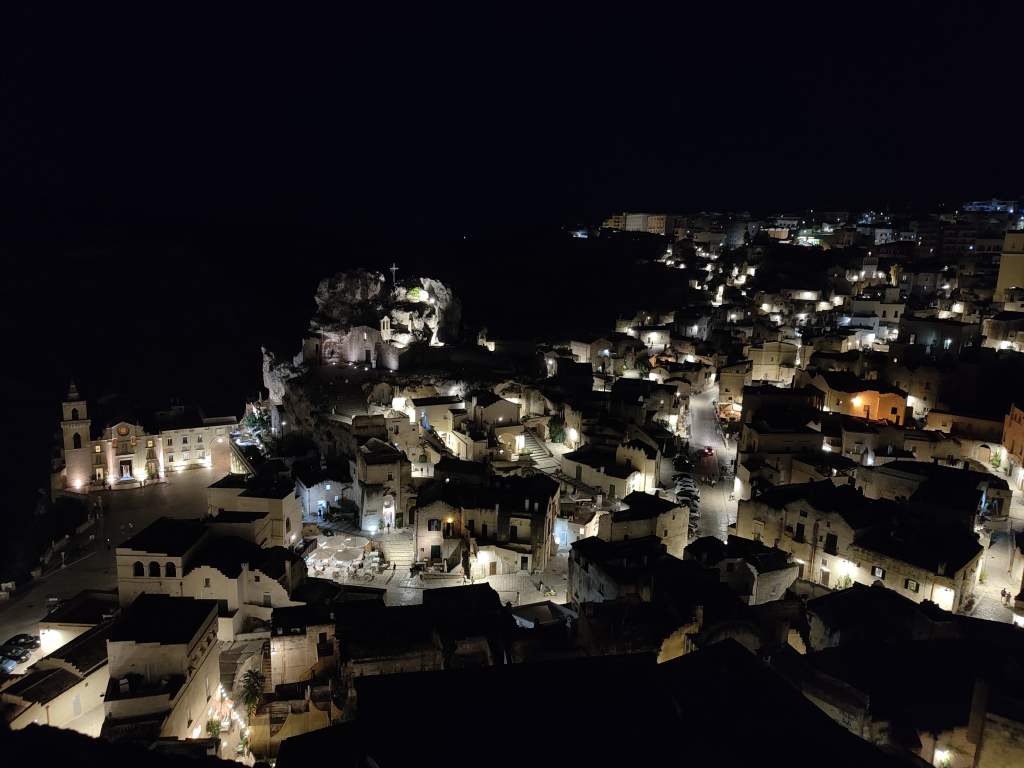
Dinner on my second night was simpler – I bought a pizza and bottle of wine from a nearby shop and enjoyed watching the evening’s shadows grow and slowly swallow the Sassi below. I noticed small groups of people on the top of the other side of the ravine, and on checking my guidebook found that this was a national park with yet more churches carved into the rocks and belvederes offering fine views back over to Matera.
A nighttime view of the Sassi
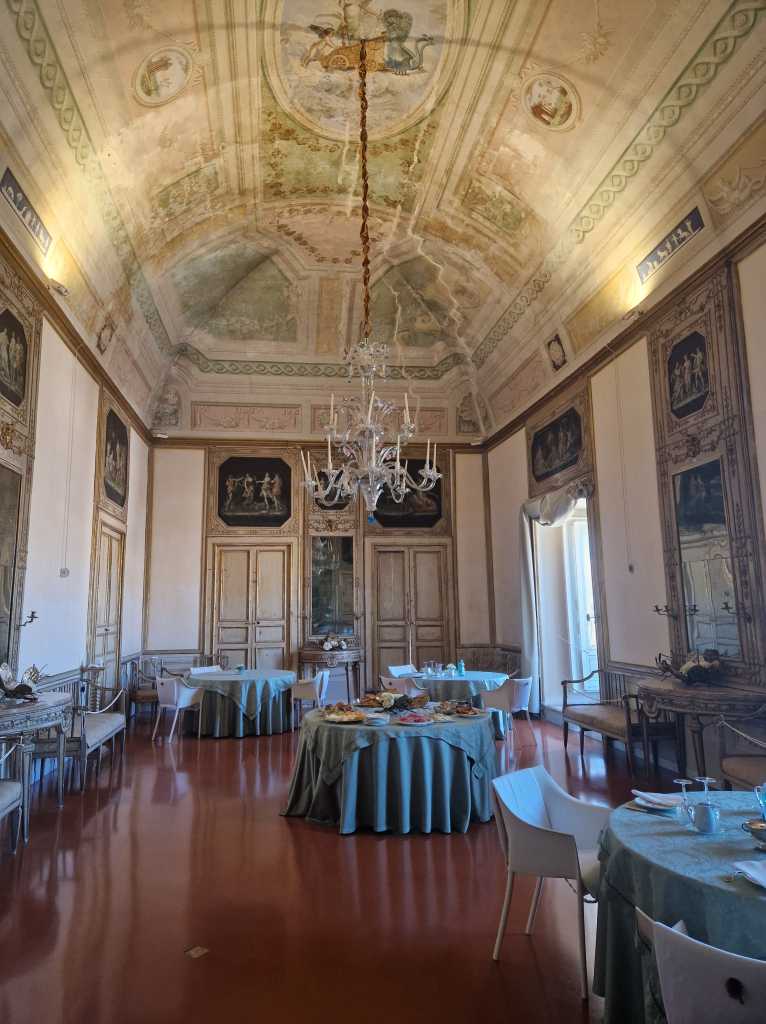
On my last morning in Matera I had breakfast in one of the elegant rooms of the palazzo….
My palazzo’s dining room
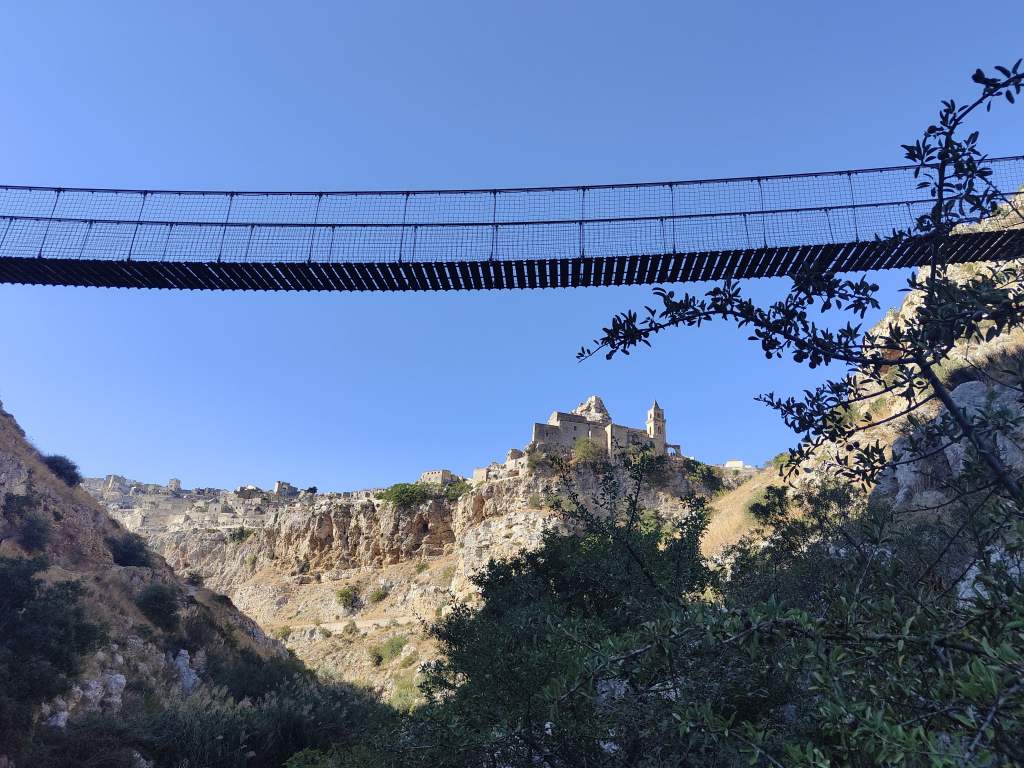
….. before quickly making one last trip into the Sassi, and then further down to the base of the ravine where a suspension bridge led across the small river.
The suspension bridge leading to the other side of the ravine
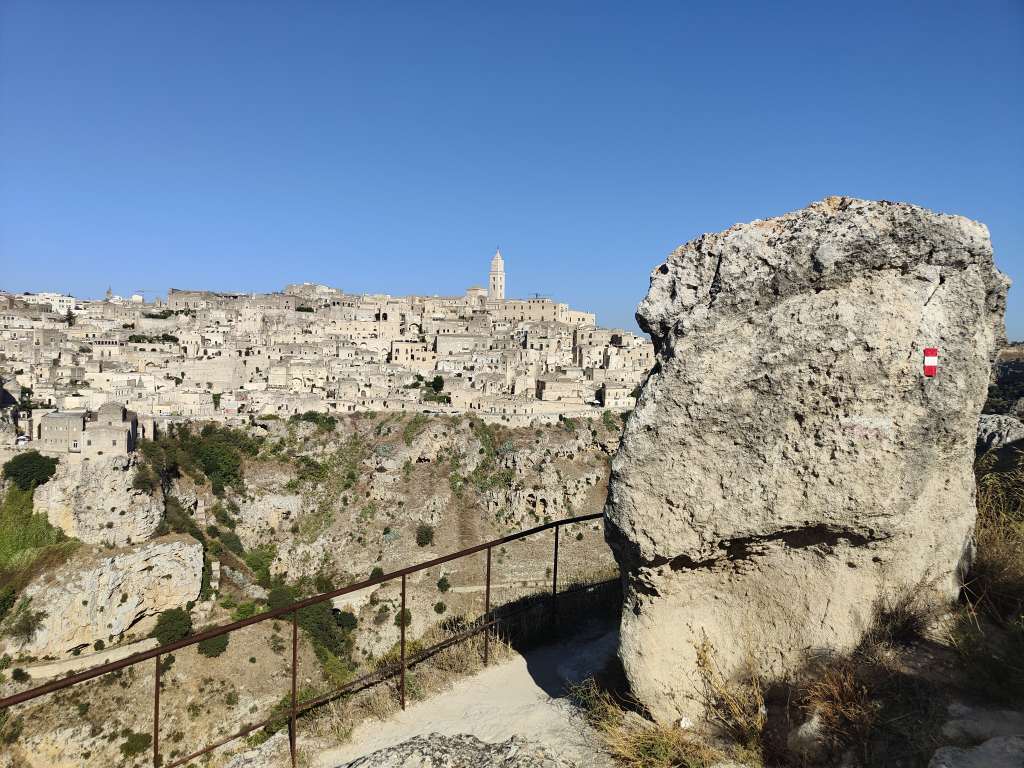
I then clambered up the other side of the ravine to get one last view of Matera. I had never heard of the city before starting the planning for this trip, but yet it was certainly one of the highlights. Let’s hope that it remains relatively unknown so that I can come back one day and enjoy wandering around its Sassi once again, without the crowds of more popular Italian tourist destinations.





















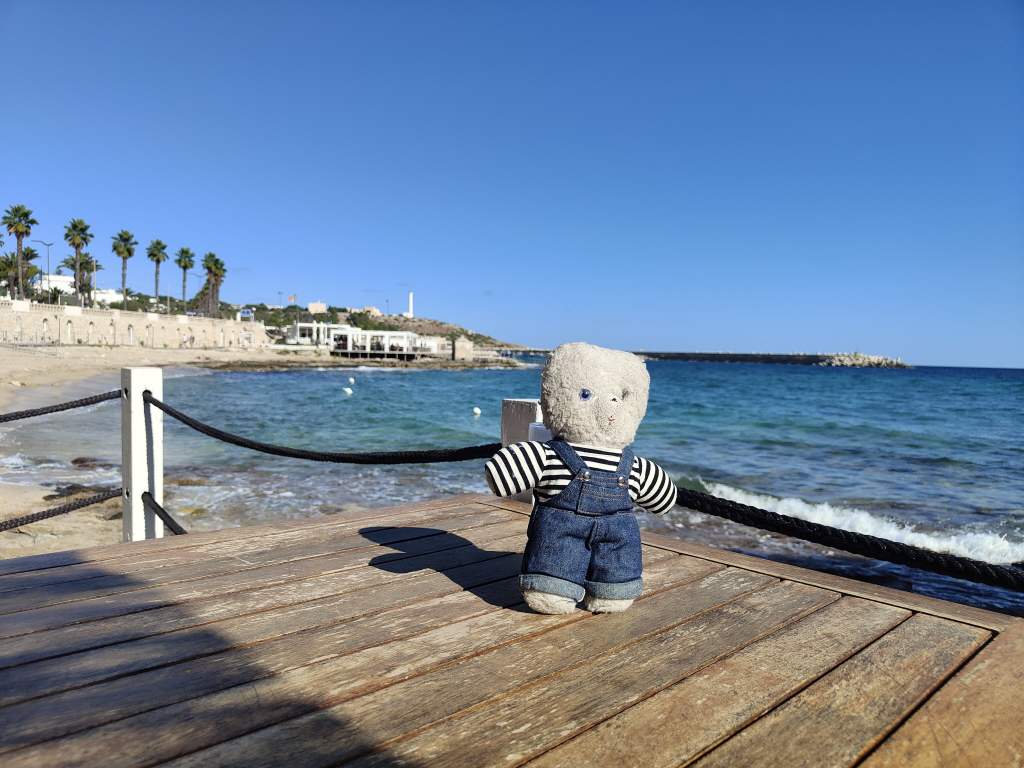

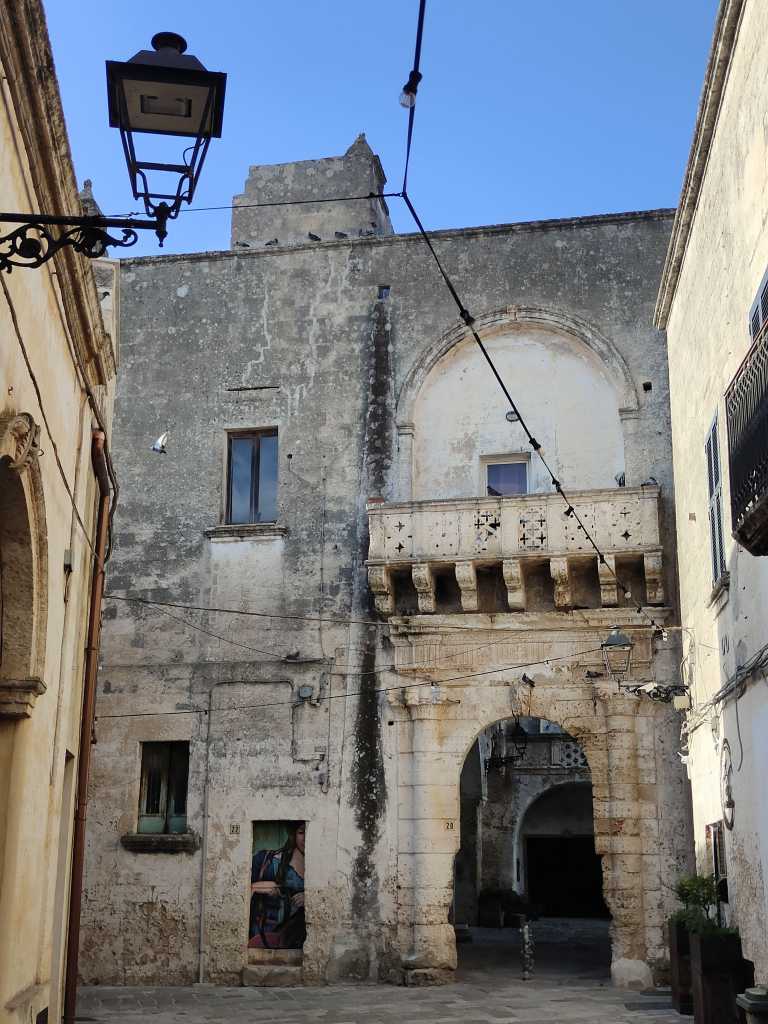
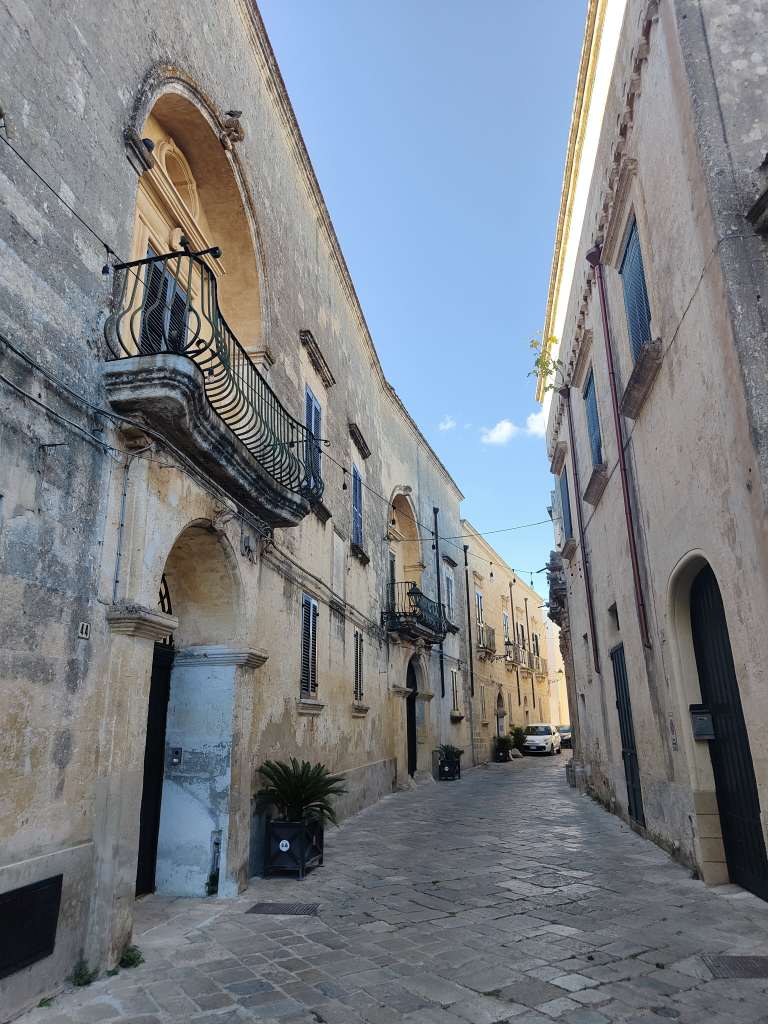






 Trouspinet travels