Etosha National Park – Okaukeujo waterhole and more elephants and rhinos!

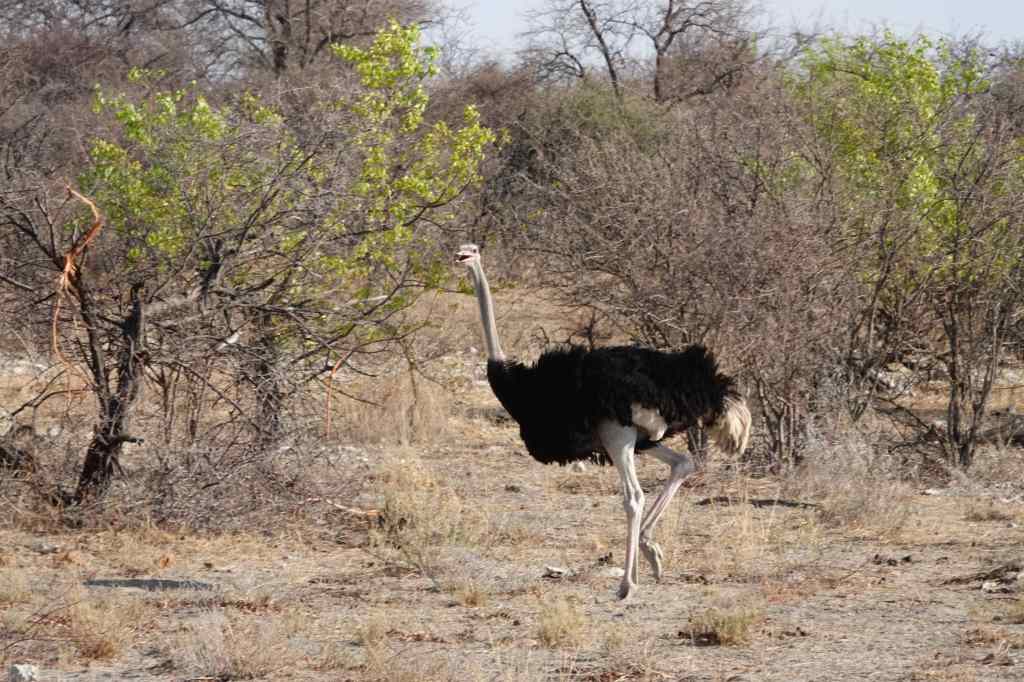
Ostrich at Etosha National Park
An Ostrich runs away from my car

Today I was due to move from the Mushara Bush camp, just outside the east gate of the park, to the Okaukuejo camp located inside the central gate. It was about 150km away, so I combined moving with a “game drive” which included parts of the park I had not visited before. I said a sad farewell to the Mushara Bush Camp, which had been a wonderful place to stay, and set off.

This morning I was less lucky with my game spotting. I tried a track called “Eland Drive”, since I had yet to see the eland, Africa’s biggest antelope. At first, there was no sign of any animals – just lots of unusually green trees, which contrasted with the dry scrub that makes most of the park. I found it surprising that animals seemed to be avoiding this cooler area with lots of edible vegetation- maybe predators were hiding somewhere, out of my sight. After an hour’s driving I finally ran into some zebra and springbok, and as I progressed, they became more and more numerous. I also glimpsed a red hartebeest….but no elands.
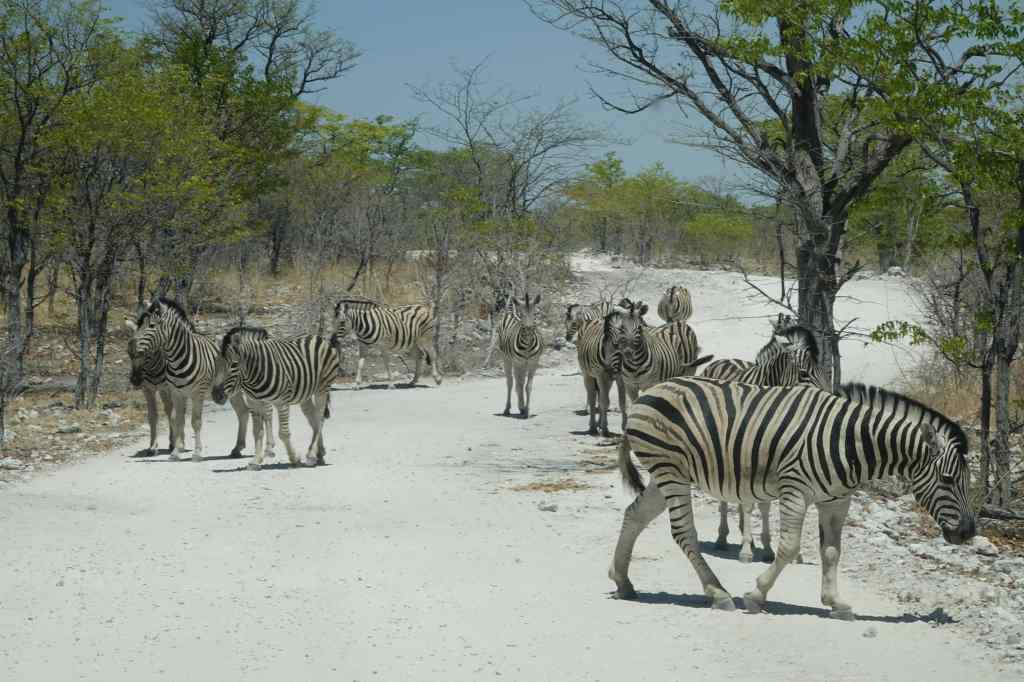
Zebra at Etosha National Park
Zebra blocking the route at Etosha

After the slight disappointment of Eland Drive, I reverted to the usual strategy of visiting waterholes. In the midday sun, these were dominated by elephants, who drank and sprayed their bodies with water to keep cool.  At my first waterhole, there was a family group with a couple of babies.
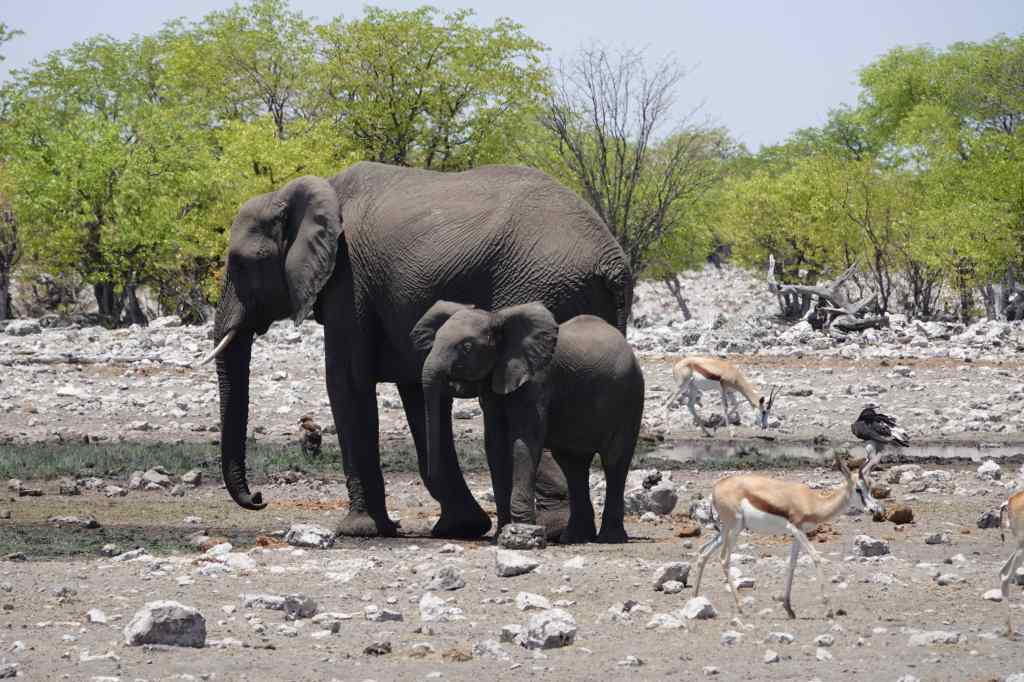
Mummy and baby elephant
Mummy and Baby Elephant at an Etosha waterhole

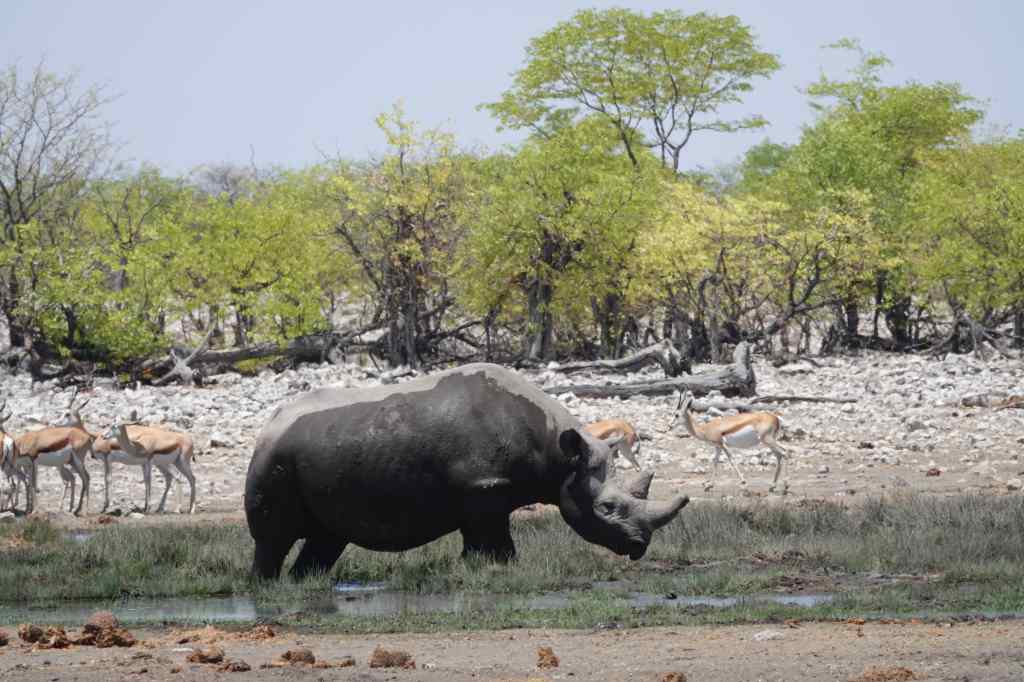
After a few minutes a rhino joined the group. Etosha has white and black rhinos. Confusingly, they are both the same grey colour and the main difference between them is the shape of their lip. This one had a pointed lip, so was probably a black rhino.
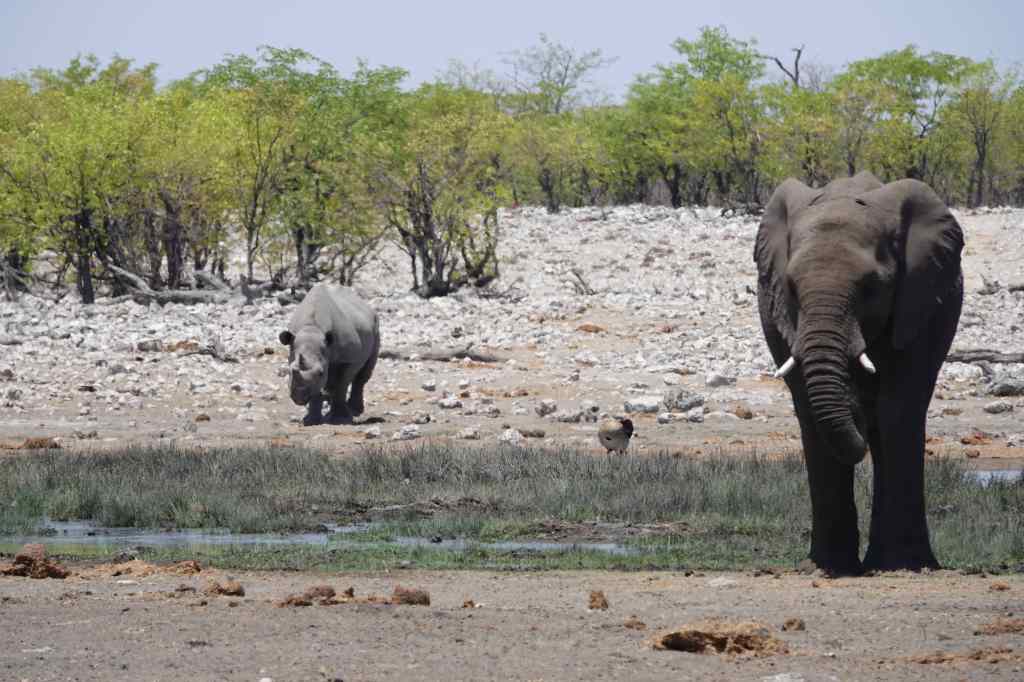
Black Rhino approaches waterhole
A black rhino joins the group….
Rhino at Etosha
….and changes colour after rolling in the mud.

The next two watering holes I visited also featured elephants. At the first, two of them were washing and drinking.
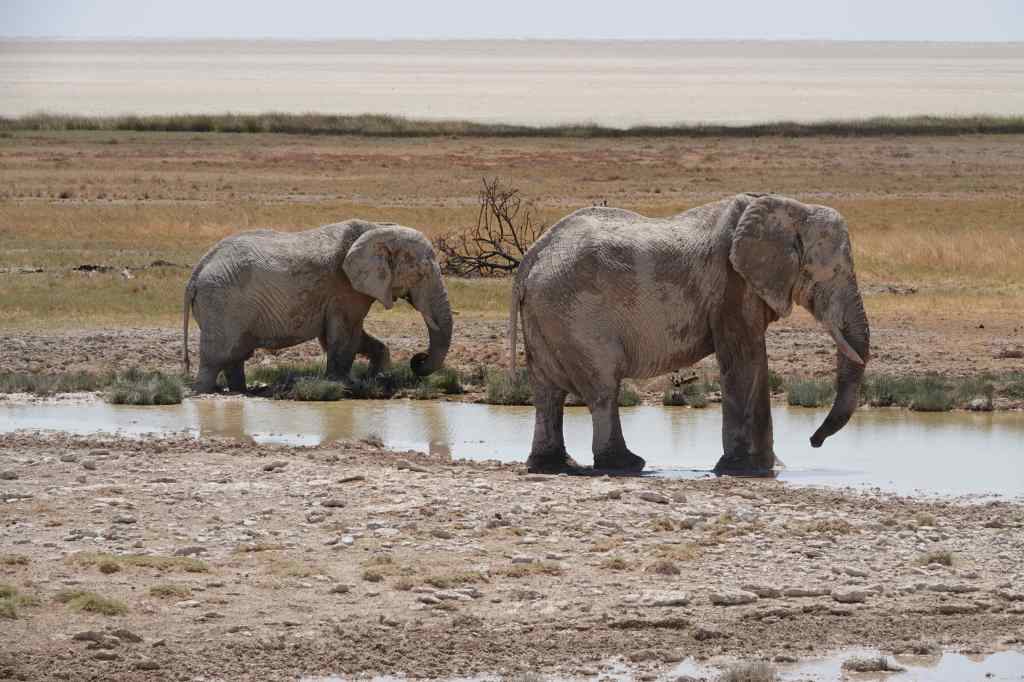
Elephants at Etosha
More elephants at Etosha….

At the second, a couple appeared to express affection to each other with their trunks.
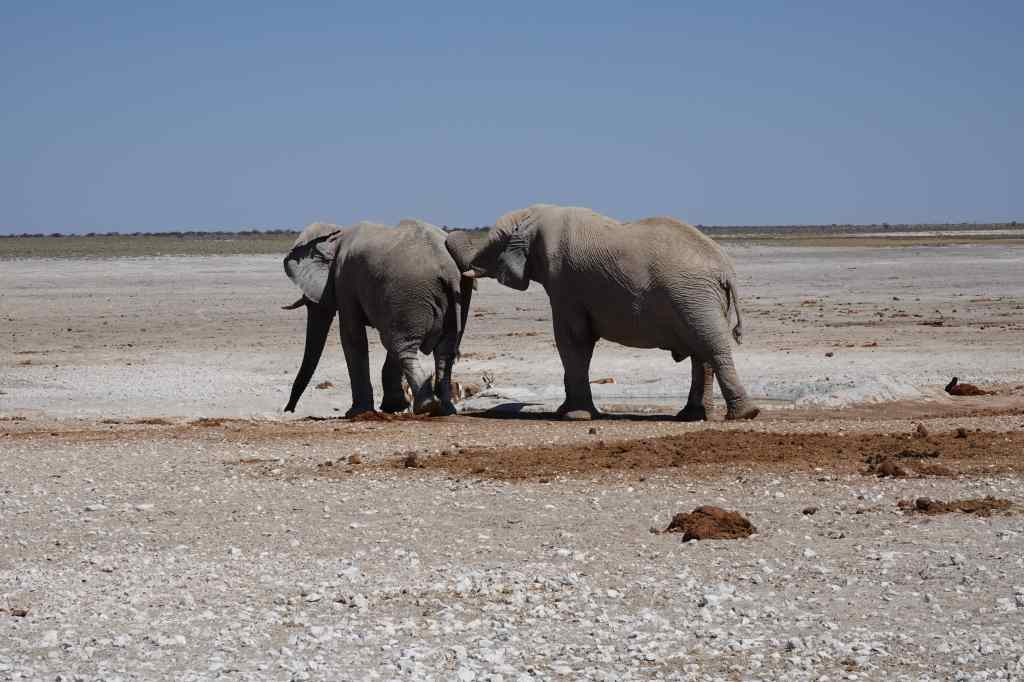
 more elephants at Etosha
….yet more elephants

I finally arrived at Okaukuejo, a government-owned camp near Etosha’s main entrance. It is famous for having a large watering hole just outside the camp, which is lit up during the night and frequently visited by lions, elephants and rhino. After checking in, I went straight there and found a viewing platform and lots of other guests with cameras and binoculars……but no animals. So instead, I headed off to the swimming pool to spend the hottest hours of the afternoon – like the elephants I had seen earlier!

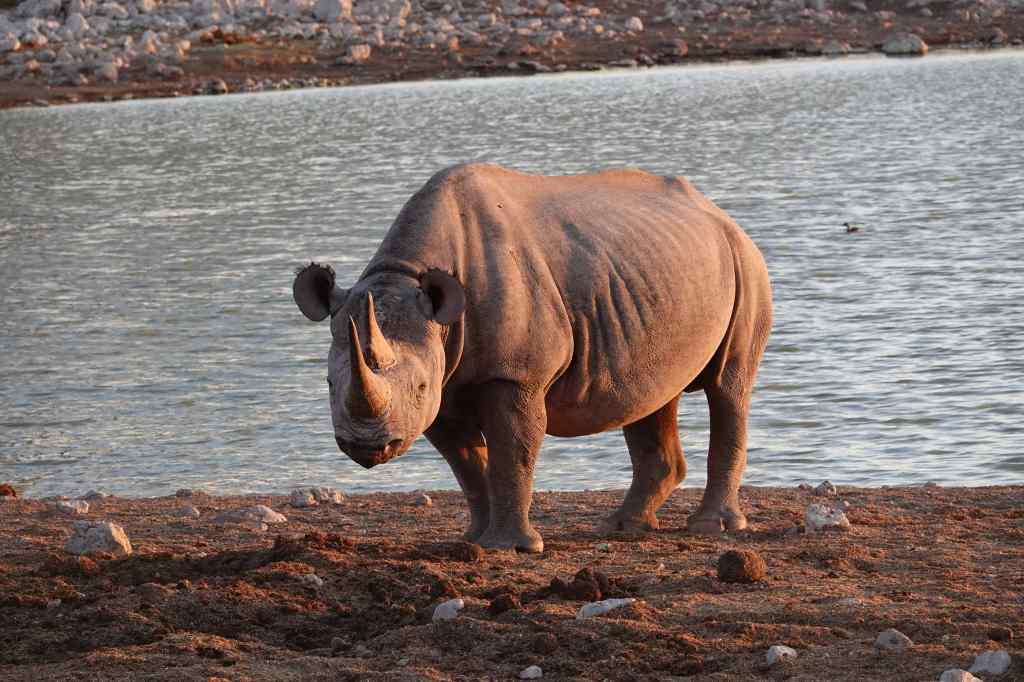
At six, as the sun was setting, I returned to the Okaukeujo waterhole to find an elephant, giraffe and magnificent black rhino. The latter approached the viewing platform, watched the crowd of humans for a while, and then lay down on the ground to snooze. It was an amazing sight, and I was a little puzzled as to why the waterhole viewing area was not overflowing with fellow tourists and their cameras.
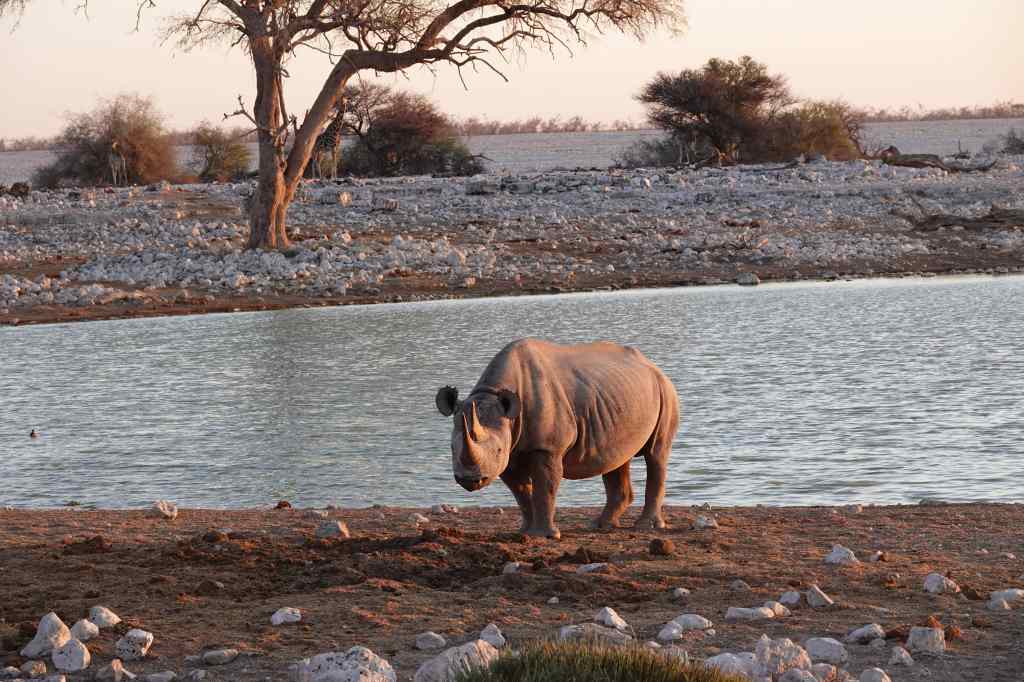
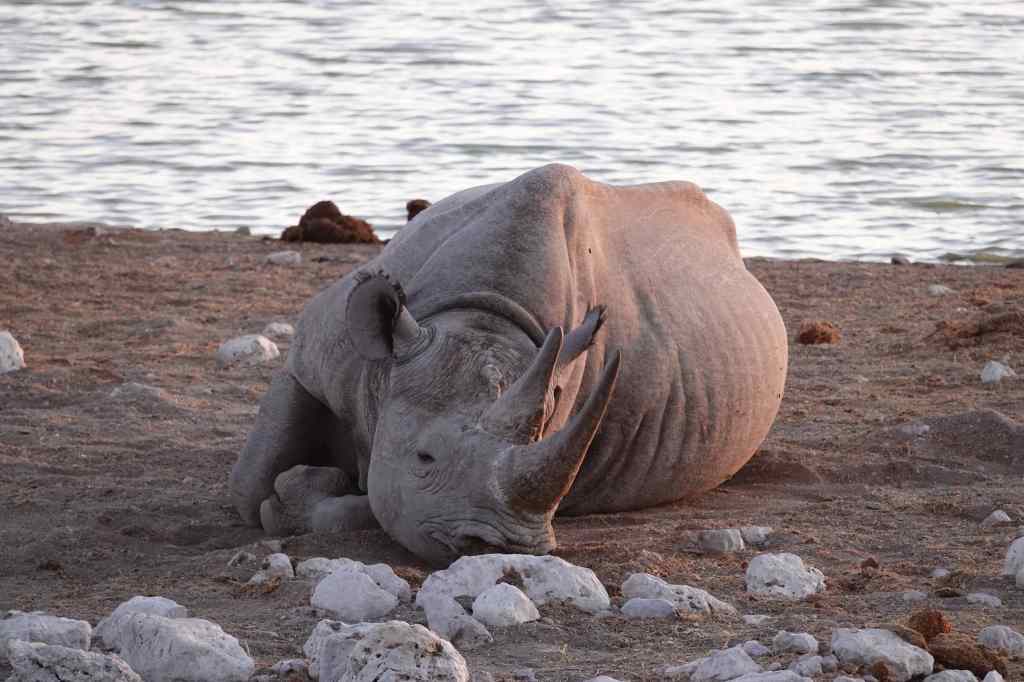
Rhino at Etosha
The rhino stares at us……
Rhino at Okaukuejo Watering Hole
…and then sits down to sleep.

With this thought in my mind, I headed off to dinner. It was a chaotic affair. The waitress told me that I had booked table 32, but after half an hour of waiting there, a group of German ladies arrived to claim my place. They went to fetch the reservation list which showed that I should have been on table 25. In any case, the choice of table made little difference since the waitresses were all busy serving in a different part of the restaurant and completely ignored us all. I realised that if I sat there patiently, I would wait forever, so I collared the person who seemed to be the drinks waitress and ordered steak and a beer. After another long wait, the steak arrived – tasty and tender, but cold – without the beer. To get this, I had to accompany my waitress to the bar and stand there reminding her of my order, as she was accosted by a stream of other complaining customers. A simple dinner of steak and a beer took ninety minutes, even thought my persistence meant that I was one of the first to be served. After finishing my beer, I hurried back to the waterhole but found it quiet – the elephant had left, and the rhino was still asleep on the ground.  I suddenly realised why the waterhole was not overcrowded with fellow guests – many of them were stuck in the restaurant, still waiting for their dinner. With nothing new to see, I headed back to my hut for an early bedtime, resolving to try my luck again if I woke up during the night.

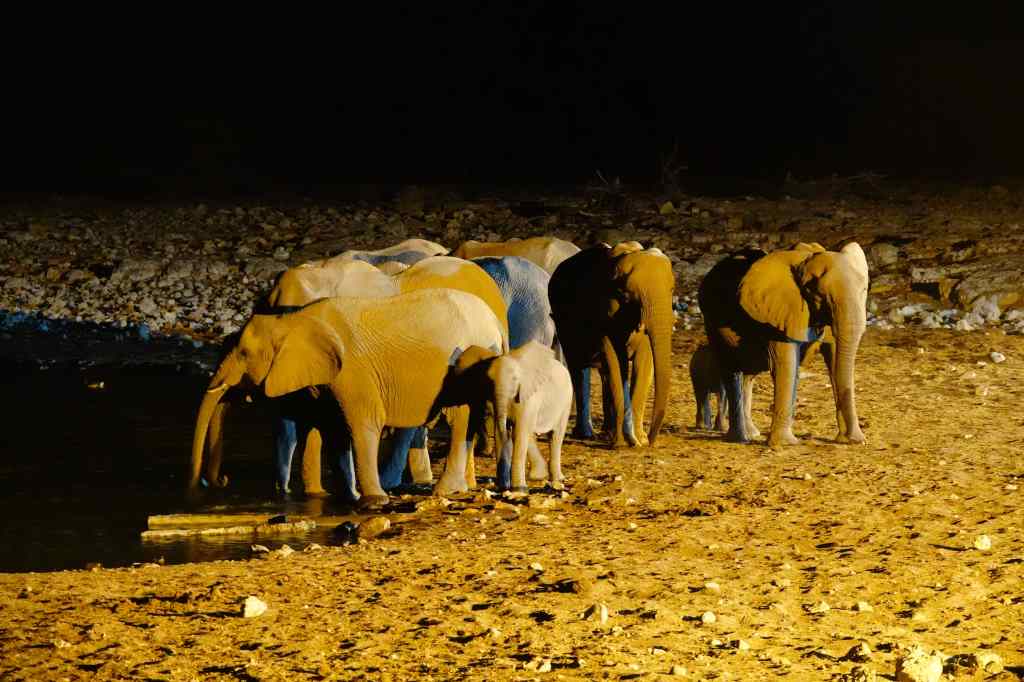
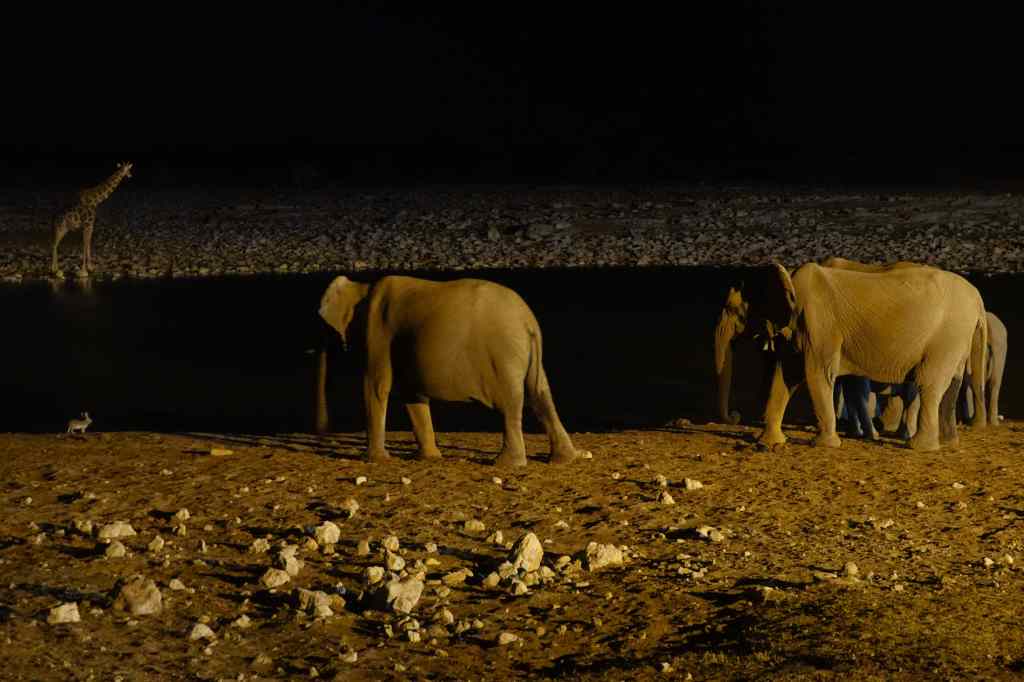
I returned to the waterhole at 2am to find a wonderful sight – a herd of elephant, including several babies, drinking quietly in the moonlight. I stayed for a half an hour, watching the elephants, a cautious giraffe, and finally a tiny scrub hare – not much bigger than me – taking its place to drink alongside the massive elephants.

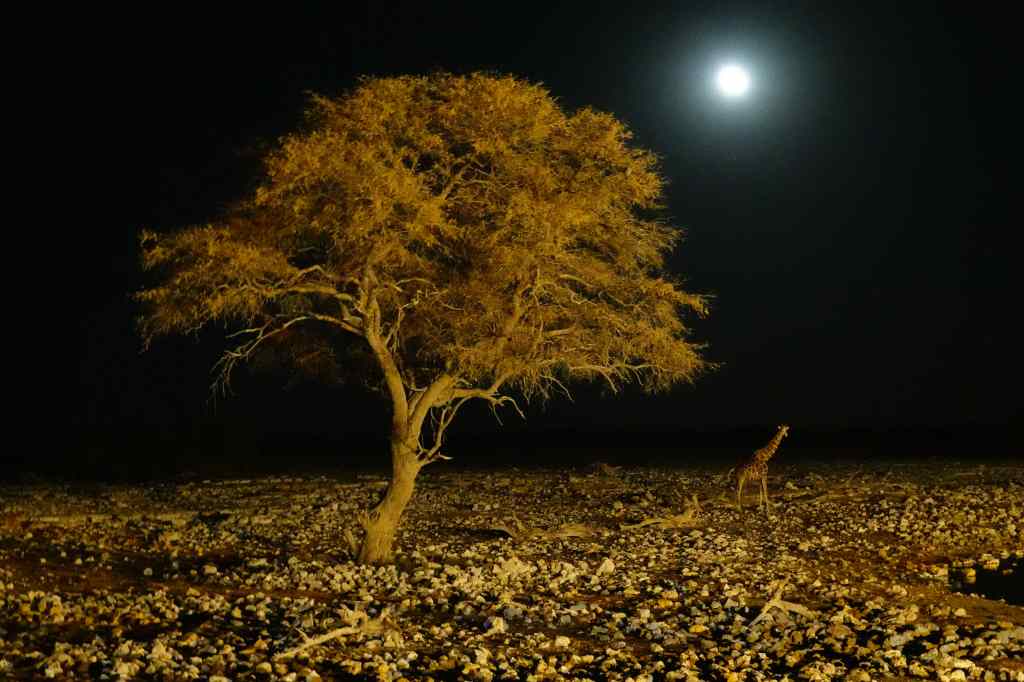
Elephants at Okaukuejo Waterhole
2am at the Okaukeujo waterhole, Etosha
A giraffe approaches Okaukuejo
A giraffe approaches the Okaukeujo waterhole
Elephants at Okaukuejo Etosha
The elephants continue to drink
scrub hare and elephants Okaukuejo
A tiny scrub hare (left) joins the elephants

Finally, the herd of elephants headed off into the night, and I decided to do the same. It had been a memorable day, and I went back to my hut to sleep for the rest of the night.
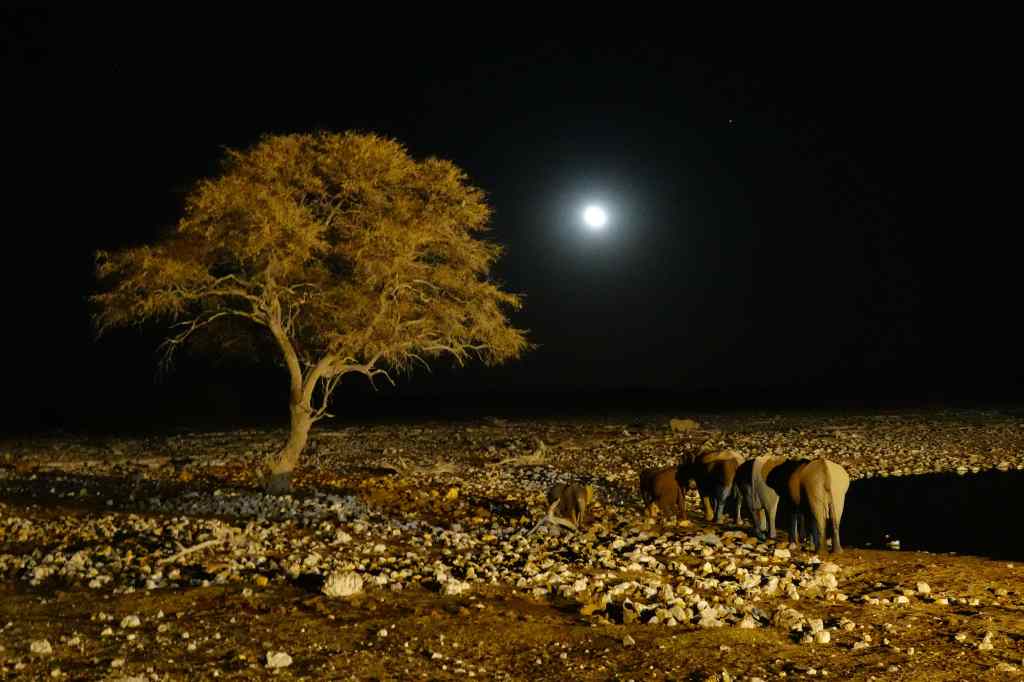
Elephant herd Okaukuejo
The elephant family leaves Okaukeujo waterhole and heads off into the night

Next Post: Twyfelfontein and its rock art

Previous Post: My first full day at Etosha
Etosha National Park – hidden leopard and lion, aggressive rhino and lots of giraffes and elephants!

Elephant Etosha
Day 1 at Etosha

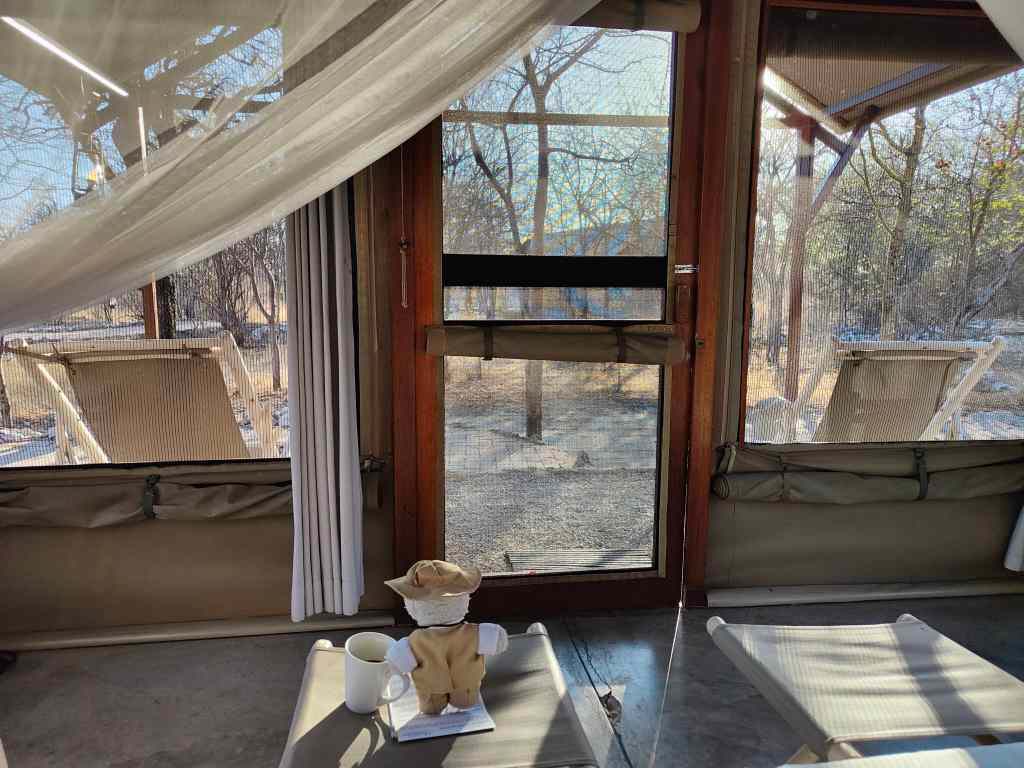
The following morning I was woken up by birds chattering in the bush outside. I opened up the flaps of my tent and sat in bed enjoying the morning air with a cup of coffee. The tent was flooded with light from all sides, and it felt like I was sitting in the open air in the middle of the bush.

camp Etosha
The morning light flooding through my room at Etosha
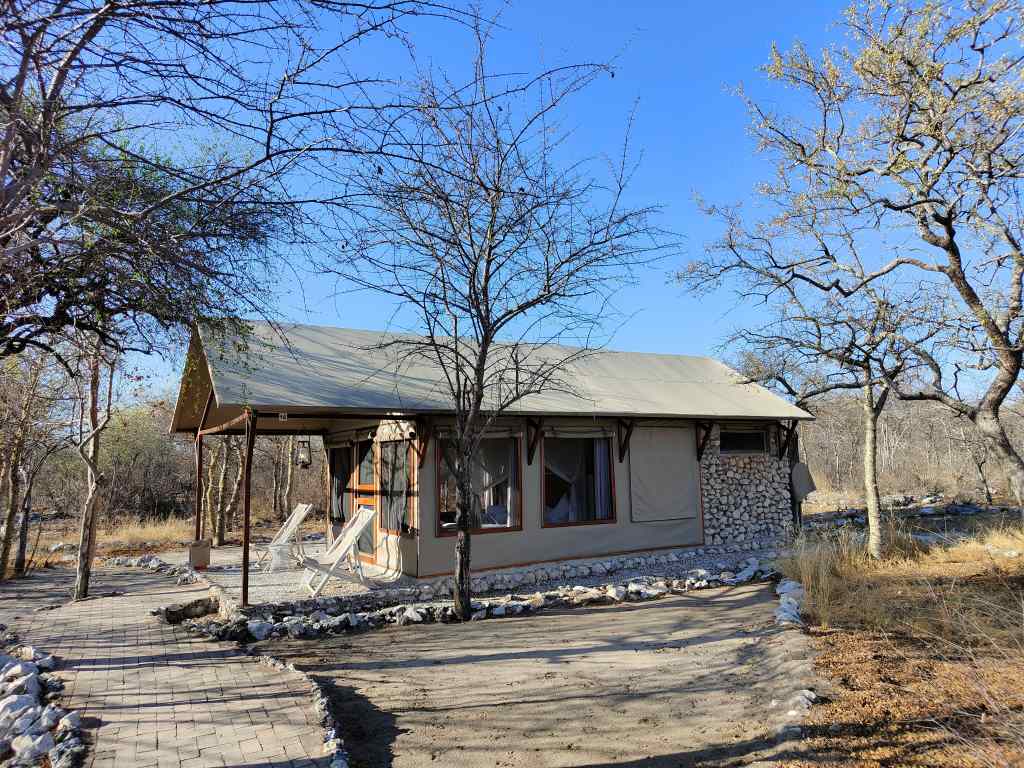
camp Etosha
The room is part hut, part tent, with canvas sides

After breakfast I set off again to the park. There are two ways to visit Etosha – one is in your own car, making your own itinerary, and one on an organised “game drive” in a truck with other tourists and a guide. The organised tour offers better chances to see animals, since the guides know where to look and communicate their sightings to other guides by phone. But having invested in a big 4×4 I wanted to keep my independence and drive myself. Serious visitors enter the park at its 06.30 opening time to have the best chances of spotting the less easily seen game – particularly the big cats. After my three days of travelling I did not have the energy for another early start and reached the park at around 9, when some of the organised groups were already returning.

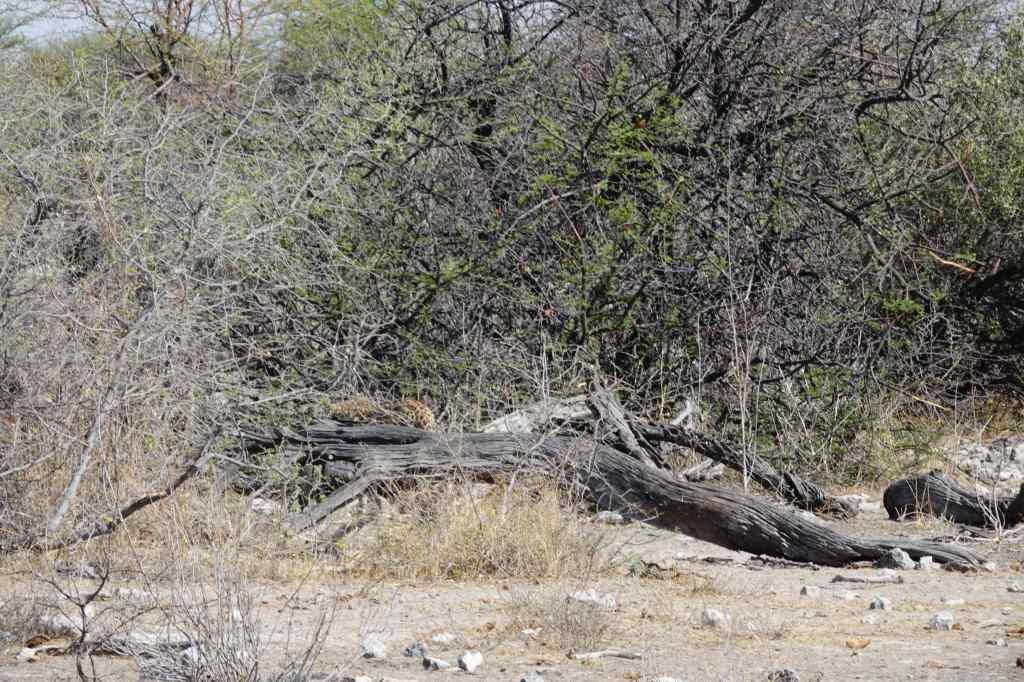
Despite my late start I was very lucky. First I spotted – very briefly – a leopard, one of the most elusive animals in Etosha National Park, but I was a little too slow to get a really good photo.

Leopard Etosha
Leopard (disappearing behind the tree trunk)

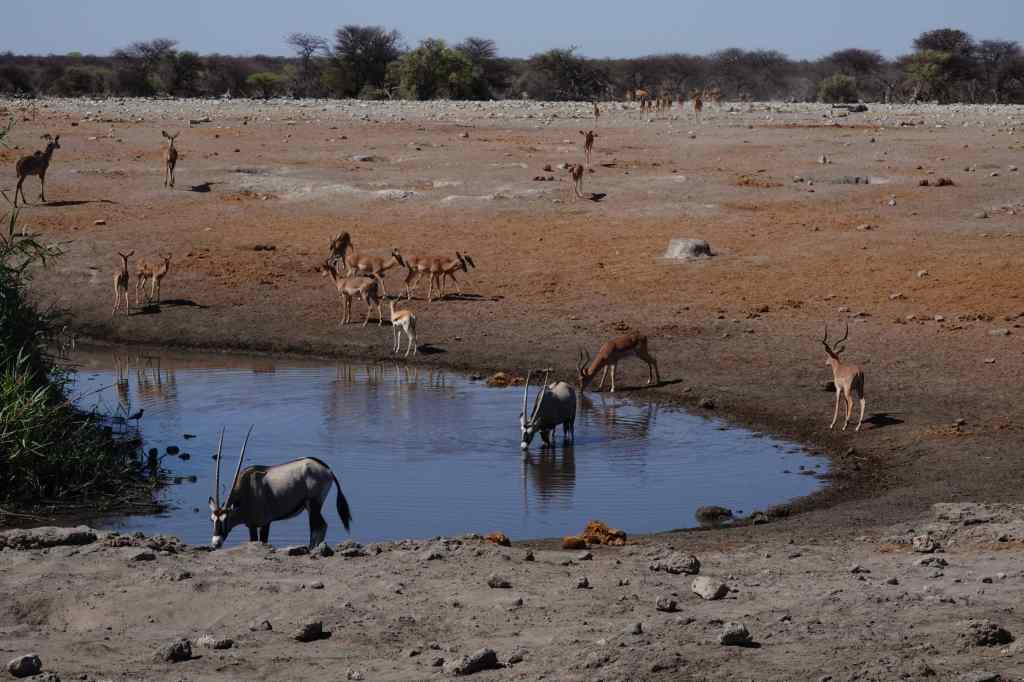
October was the end of the dry season in Etosha, and the once abundant water brought by the rains had reduced to a few waterholes where the game comes to drink. This makes for the best time for spotting wildlife. My first visit to a waterhole did not disappoint; a group of oryx and springboks were drinking, soon to be followed by zebra and some kudu.

Oryx-at-Etosha
Etosha – Oryx and Impala at the water hole

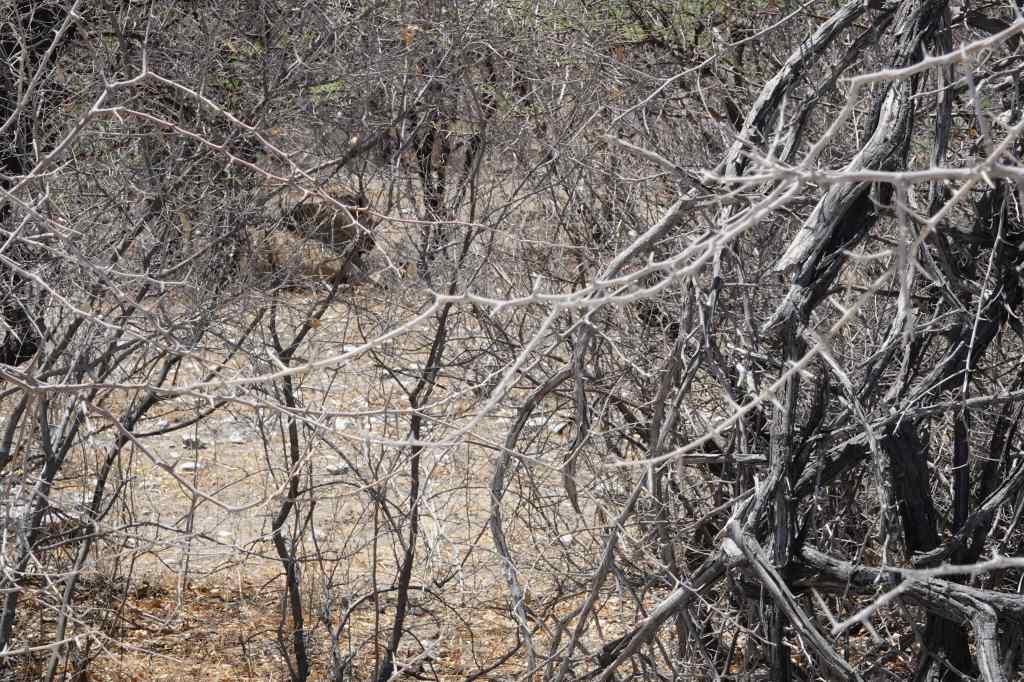
On my way to the next waterhole, I had a stroke of luck and noticed a lion, sheltering from the late morning sun under a bush. Sadly my lack of mastery of my new camera caused me to mess up my photo.

Lion-at-Etosha
Lion hiding from the sun (top left)

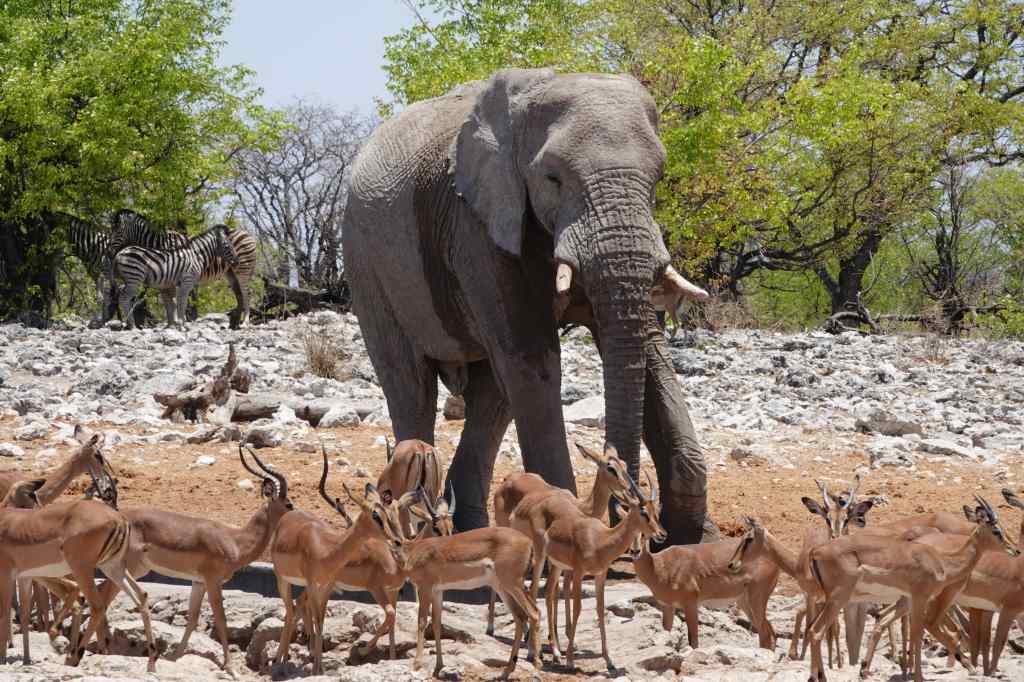
The final waterhole of my morning visit was home to a small group of elephants, who had come to drink and cool off by spraying themselves with water. Elephants seemed very common at Etosha.

Elephant-and-Impala
Elephant and Impala at a waterhole, Etosha

Watching the giraffes drink was the most interesting. They would approach very slowly, then look around for several minutes. Then they would slowly splay their legs and lower their necks to drink. I suppose that their caution is because they is only ever vulnerable to predators in this rather awkward drinking position.

Giraffe-at-Etosha
Etosha – a giraffe drinking

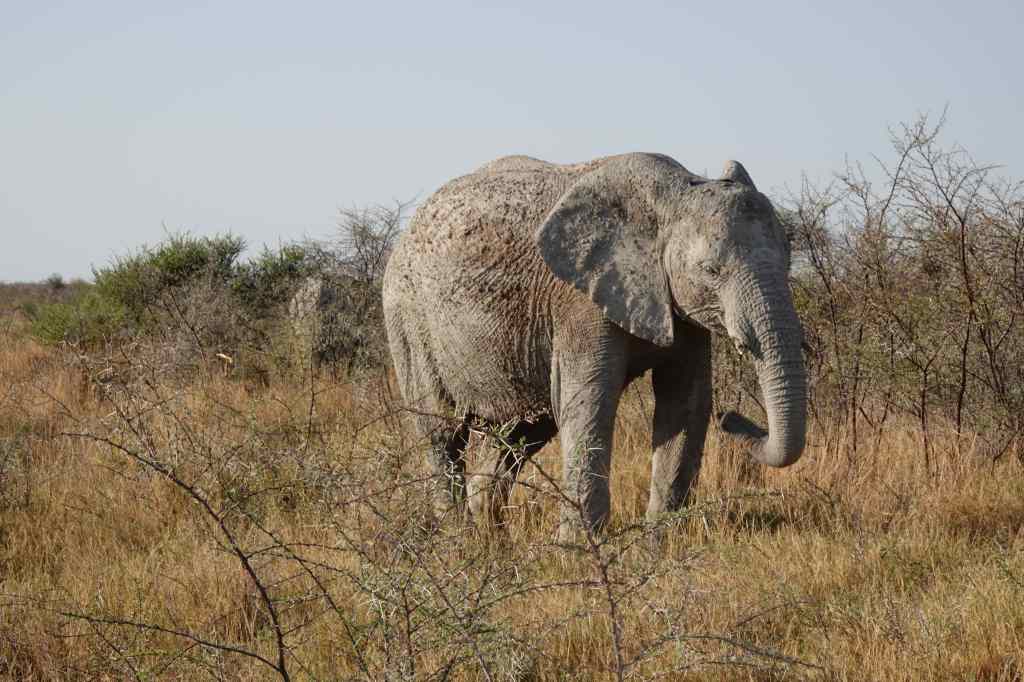
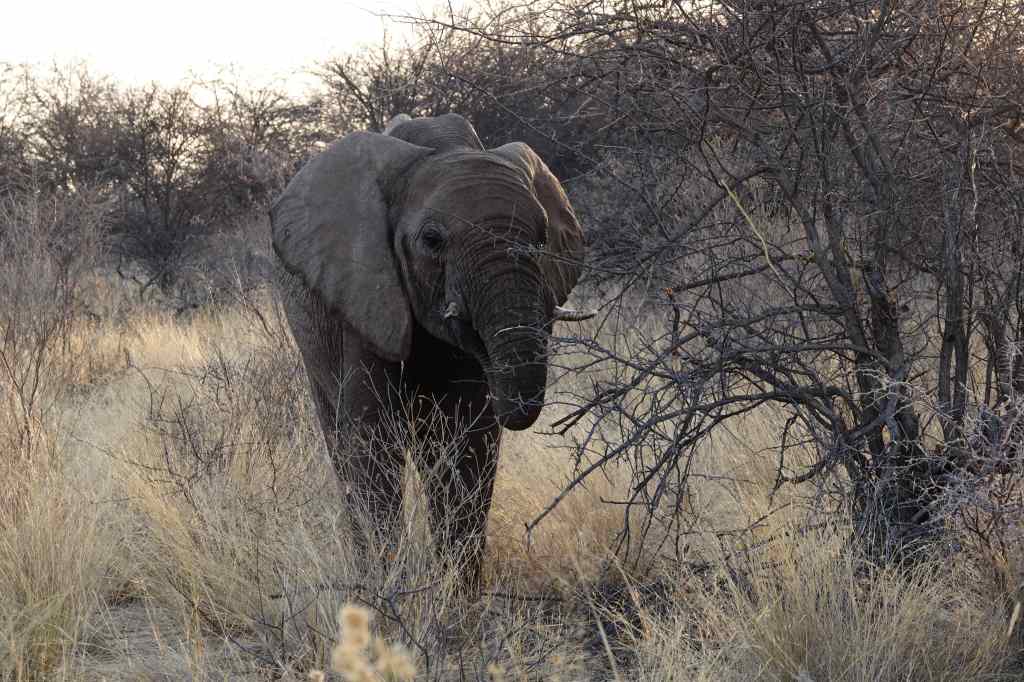
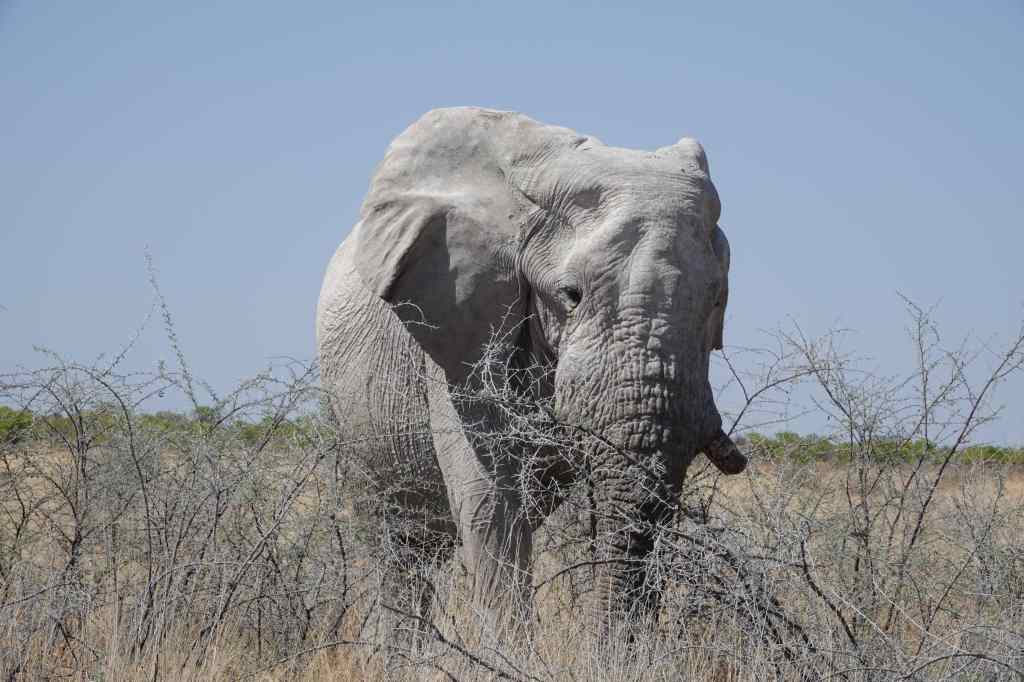
It was now one o’clock, and the hottest part of the day had arrived. This meant that animal sightings would be much harder, so I drove back to my lodge to relax by the pool. At 4pm I set off again for my evening “game drive”. I visited a couple of waterholes without luck, before setting off along a remote track.  At first the landscape was empty and dry, and I began to regret my choice of route. But then I bumped into an old, grey wrinkled elephant just standing by the side of the track. He looked a bit crumbly, and like many elephants in Etosha National Park, had broken tusks (apparently a lack of minerals means that few Etosha elephants have big healthy tusks).

Elephant-Etosha
A solitary old elephant

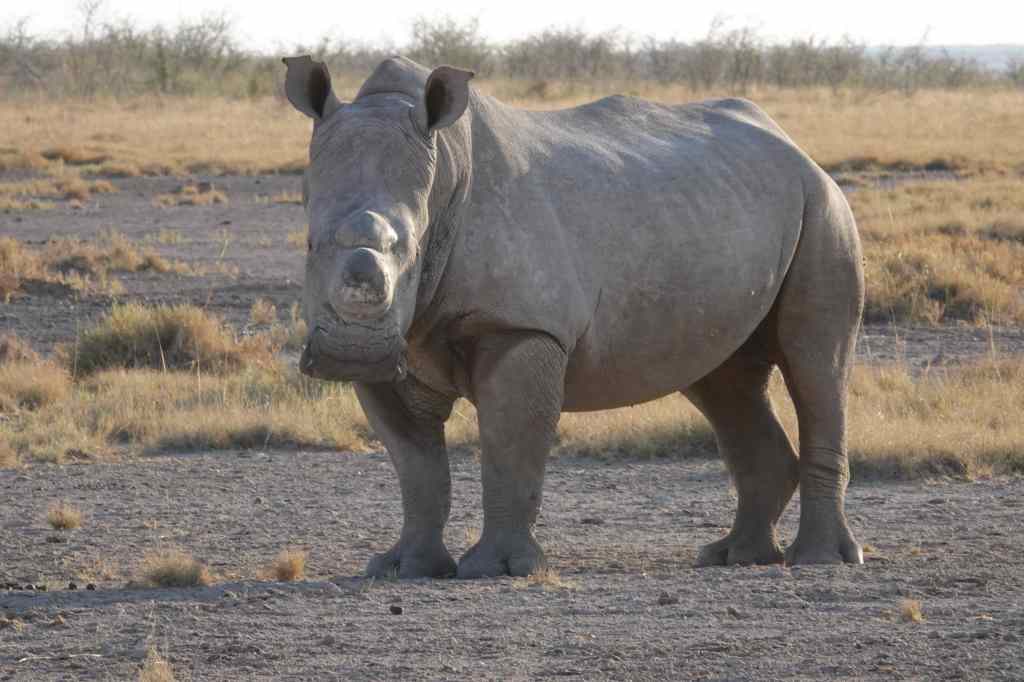
The old elephant, isolated and maybe rejected by his herd, made me feel rather sad, but transformed my feeling about my drive, which became a big adventure. I drove off onto a flat plain. In the distance, I could see the silhouettes of other lumbering elephants and tall giraffes; occasionally the track would bring me face to face with one. I’d stop to let the giraffes run away, but slow down and pass the elephants carefully – my guidebook had a whole page devoted to what you should do if an elephant charges your vehicle. I felt that I had landed on another planet, or gone back to some prehistoric time on earth, before the rise of man. I was enjoying the feeling of total detachment from the modern world when I stumbled upon the highlight of the afternoon – a rare white rhino. I stopped and we looked at each other with curiosity, whilst I took more photos.

White Rhino Etosha
Face to face with a white Rhino at Etosha

I noticed the sun was sinking on the horizon, so looked at my watch and checked the map. I was a long way from the entrance and I had an hour to reach the gate before it closed. I hurried off, initially pursued by the rhino. I raced the sun as it dipped down to the horizon and cast long shadows of trees over the plain and the road. I didn’t want to have to find out what happened to people that got stuck in Etosha after closing time, and made it there exactly at the 19.02, to be the very last vehicle to leave. As I drove off I heard a guard say “Right, home now!” to her colleague.

Back at my camp, I had another excellent dinner (fish this time – how did they get it here, so far inland?) and then collapsed into the bed in my tent, very happy with day’s game spotting. Out of all of the larger animals at Etosha, I had been lucky enough to see everything except the eland (Africa’s largest antelope) and the cheetah.

Previous Post – The Long Trip to Etosha National Park

Next Post – Day 2 at Etosha

Namibia – the long trip to Etosha National Park

A Black Rhino, Etosha National Park

Well, I hope the black rhino got your attention. The vagabond teddy bear is back on the road, this time in Namibia in Africa. Actually, I have been away for over a week already, but limited access to Wi-Fi means that I will be writing my blog with several days’ delay. My trip to Windhoek, the capital of Namibia took the best part of two days as I flew with overnights in Amsterdam and Cape Town, to where I will return for a few days at the end of the trip. My overnight in Cape Town was very pleasant; I sped through immigration and baggage collection and got a shuttle to the city’s only airport hotel. The next morning, I returned to the airport for the two hour flight to Windhoek, and had the chance to meet a fellow celebrity.

Big Man and Little Bear at Cape Town Airport

My arrival at Windhoek went much less smoothly. My flight arrived just after a huge A380, and getting through immigration, buying a sim card, and collecting my car took three hours. The hire car company made me watch a safety video, which explained that the accident rate in Namibia is 50x higher than in Europe and showed how to drive safely on Namibia’s many gravel roads. Two immaculately dressed men in suits then demonstrated how to change a car tyre – something that many tourists will need to do.

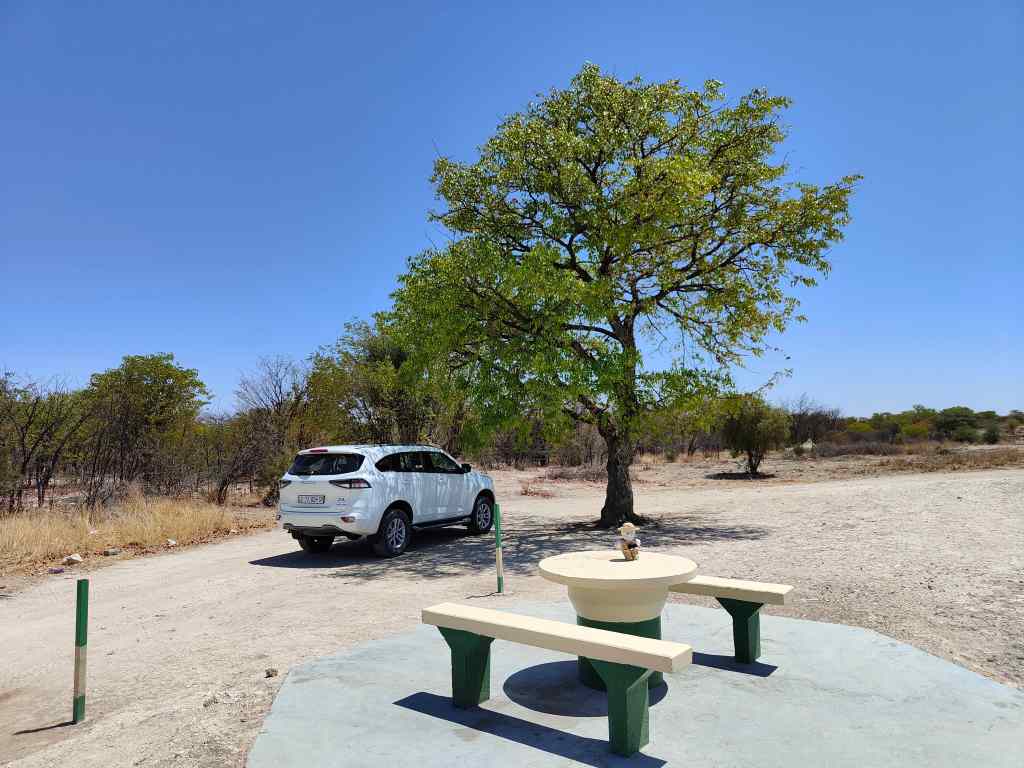
I spent the night in a small guest house in Windhoek, and had dinner in a local restaurant, finding that the steaks were good and the wine cheap – always a good start for a holiday. The next morning, I set off on the long drive north to Etosha National Park. The road was straight, asphalted, and monotonous, with one lane each way. On this type of road, the speed limit is a generous 120km/h (75m/h) and I covered the 520 km in about 6 hours including breaks. Every 10km or so the road had a rest area consisting of a table, chairs and a waste bin located under a shady tree – except for the tree, each one is identical to all the others all through Namibia.

on the road to Etosha
On the Road from Windhoek to Etosha in Namibia

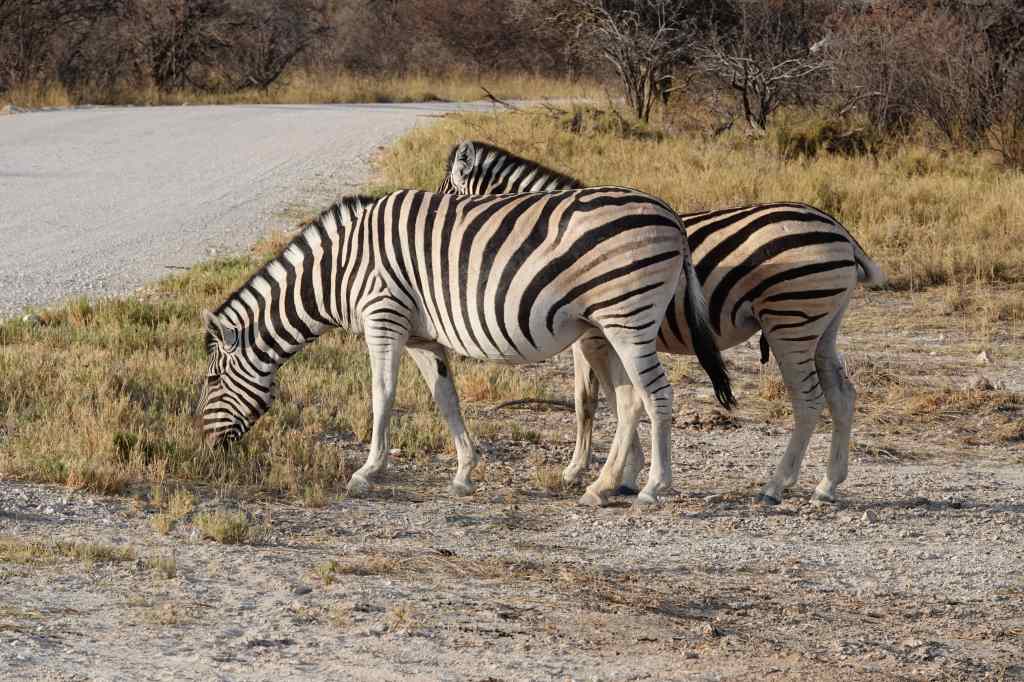
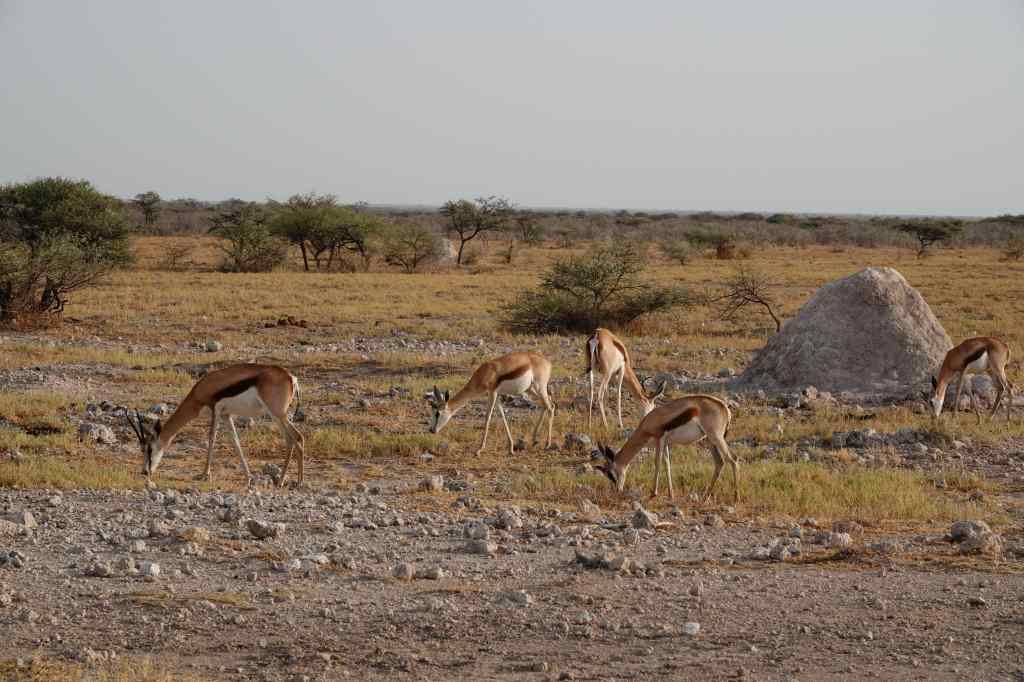
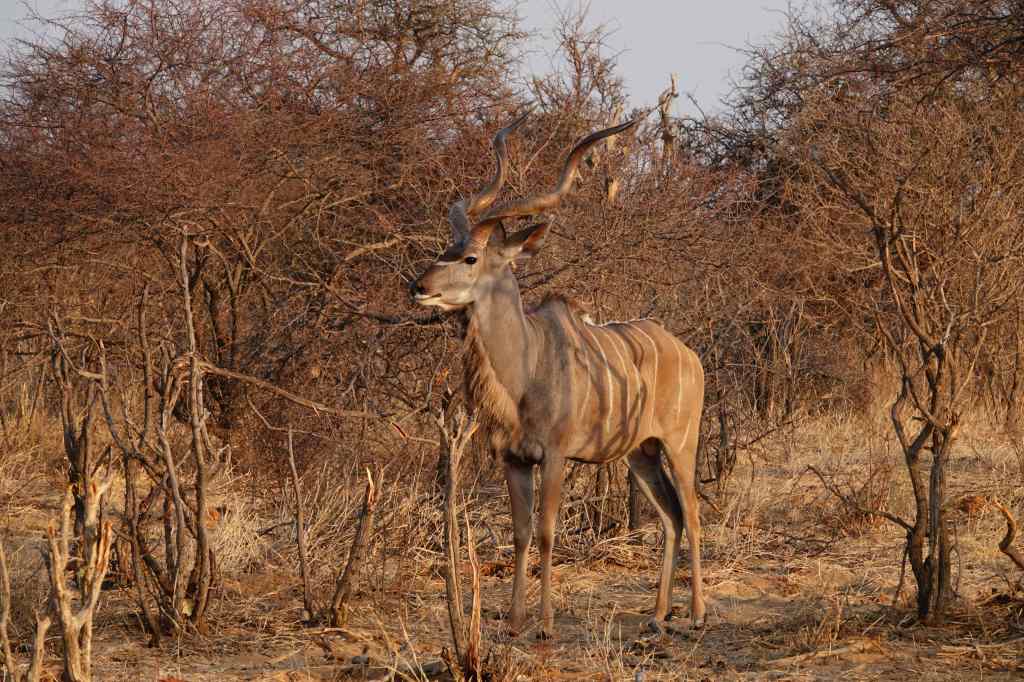
I finally arrived at 4pm at the Mushara Bush Camp, a lodge located just outside of the park. Eager to finally see something interesting after nearly three full days travelling and overnighting, I dumped my bags in my rather stylish tent, and set off to the park gate in my car, where I paid my entrance fee and bought a guidebook which had a map and several pages of drawings of the reserve’s animals. As soon as I had driven inside, a new world opened up. Antelope and giraffes stood nonchalantly by the side of the road (or sometimes in the road), as the bush began to come back to life after the heat of the midday sun. Like most newly arrived visitors, I spent a lot of time photographing giraffes, springboks and zebras – animals so common that after a couple of days I barely noticed them anymore.

giraffe at Etosha
Giraffe at Etosha
Zebra at Etosha
Zebra
springbok-Etosha
The Ubiquitous Springbok
Kudu-at-Etosha
A Kudu

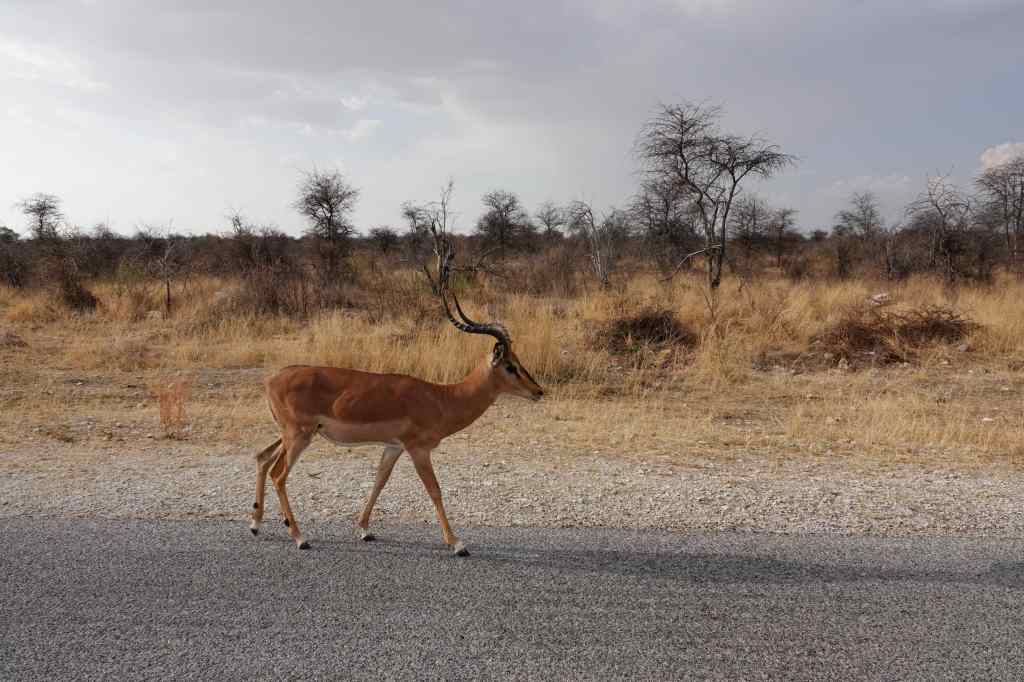
The concentration of wildlife, so close to the road, was amazing. Although I thought I was snapping common animals, when I got home and checked my photos against the park’s guide, I realised I had also spotted the rare black-faced impala.

impala etosha
The Black-Faced Impala, once rare but now common at Etosha

I spent a couple of pleasant hours driving around and trying out the settings on my complicated new camera. I was pleased that towards the end of my visit, I bumped into this elephant.

My First Elephant at Etosha

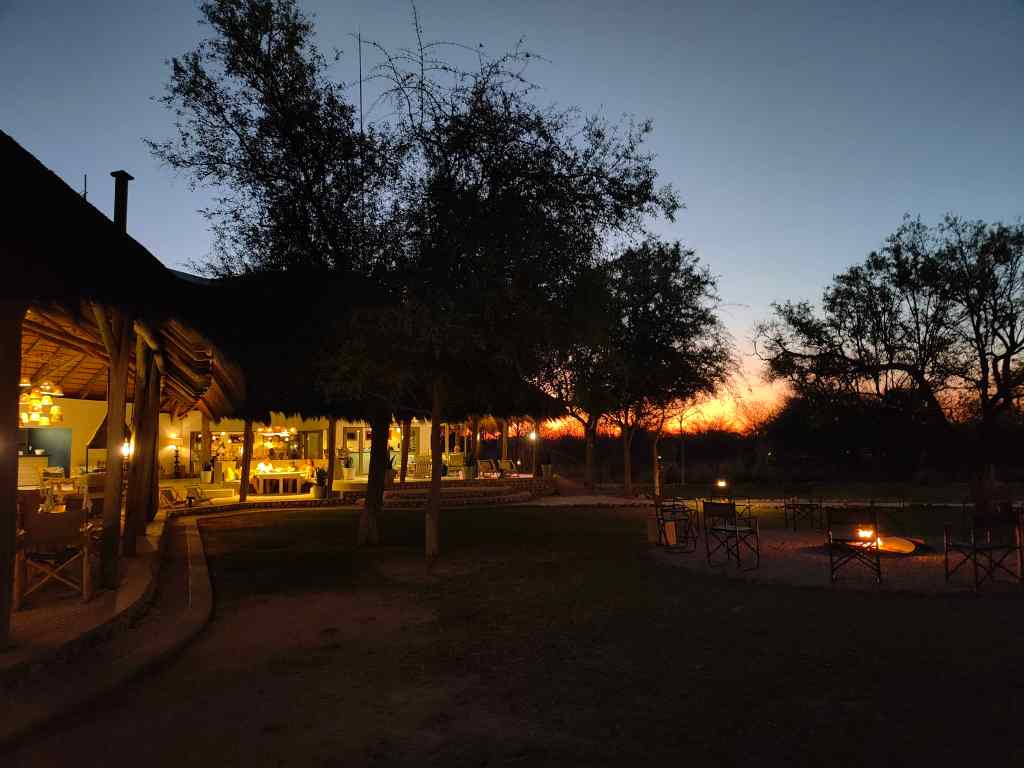
The sun sank slowly, bathing the bush in an orange light and reminding me that I had to be back in time for the park gate closure at the very precise time of 19.02.  Back at my bush camp I enjoyed a drink beside the campfire, with the background of a still dark red sky.

Mushara Bush Camp at Dusk Etosha
Mushara Bush Camp at Dusk

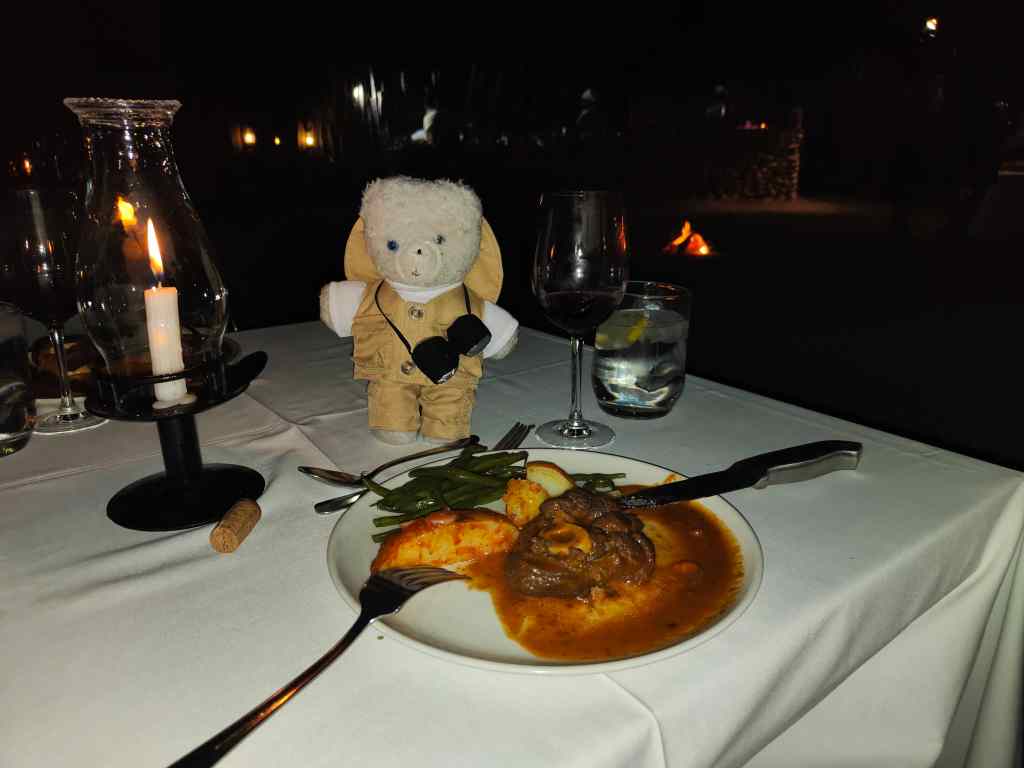
Dinner was excellent – kudu stew and impala steak (presumably not a black-faced impala).

dinner Mushara Bush Camp Etosha
Excellent Food and Wine

Then I settled down to try to watch the rugby world cup semifinal between England and South Africa, whose team is nicknamed the springboks. The lodge had no television, and I rapidly understood that the camp’s Wi-Fi would never cope with video. It even struggled with text updates, so I spent an anxious couple of hours continually hitting the “refresh” button on my browser to see England build a healthy lead, only to concede a late penalty and lose 15-16 in the dying minutes.

Trying to follow England vs South Africa by text update

Disappointed, I headed to my car to pick up a bottle of water for the night…..only to run in to a small group of springboks. Out of all the animals living in Namibia, it was the one I least wanted to see at that moment.

Next Post: First Full Day at Etosha

Back to Krakow, and Farewell to Poland

After my harrowing visit to Auschwitz, I returned to Krakow for a couple of days at the end of my trip. The weather had become cloudy, but I still enjoyed visiting the old town again.
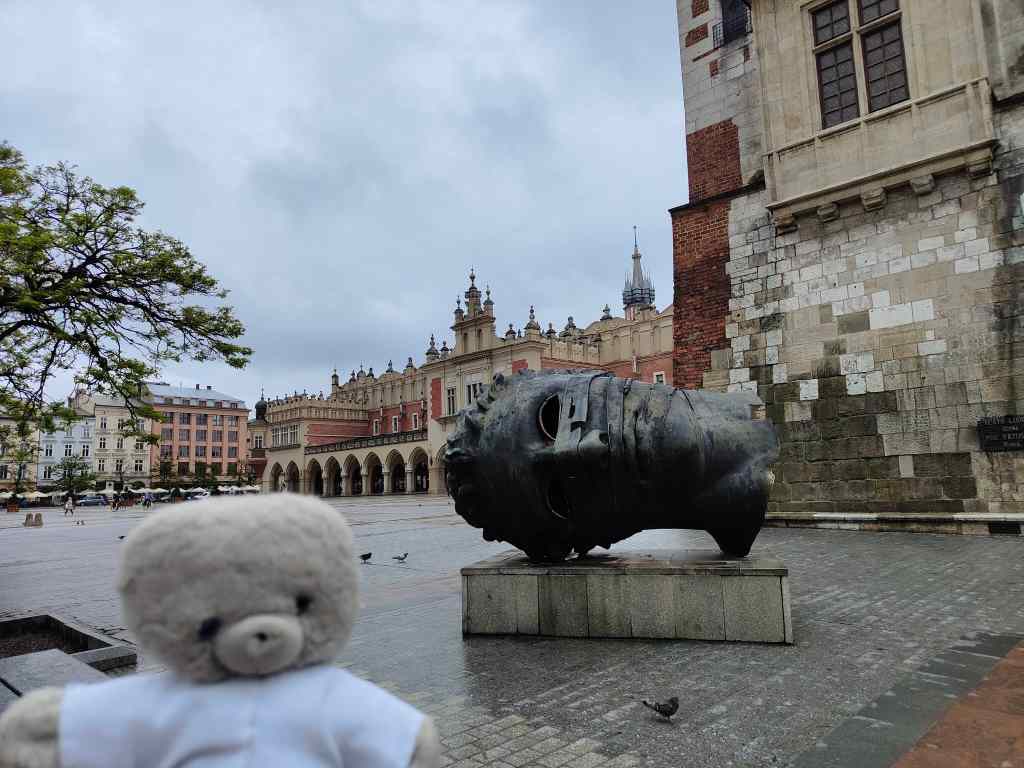
The modern statue of “Eros Unbound” in Krakow’s main square

I visited a few of Krakow’s indoor attractions, such as the Czartoryski Museum, which houses an eclectic collection of paintings, military artifacts and sculptures. The highlight of the museum is the famous picture “Lady with an Ermine” by da Vinci. It is a beautiful painting, but my enjoyment was a bit spoilt by the constant stream of tourists taking pictures. I decided that if you cannot beat them, join them, and took my own snap.

The Lady with an Ermine by da Vinci, Czartoryski Museum

My next indoor attraction was the Pharmacy Museum, housed in a pretty old house. It was an atmospheric place, with bottles of strange drugs and herbs everywhere. It also had a few unexpected hazards for small teddies like me.

Unexpected hazard in the Pharmacy Museum, Krakow

In the afternoon I visited the famous UNESCO listed salt mine at Wieliczka, a short taxi ride to the south of Krakow. Salt has been produced at this site since neolithic times, when people took brine from salty springs and evaporated the water in the sun. In the 13th century, salt rocks were found under the ground and mining developed rapidly. Under King Casimir the Great in the 14th century, revenues from salt were thought to make up a third of the country’s budget.

Over the centuries that followed, the mine developed to comprise 9 levels, the last one 327 metres below ground, and 245 km of passageways. Production of salt stopped in 1996, and the mine now operates as a tourist attraction, welcoming two million visitors per year. I arrived to find tourist visits were organised with an almost industrial efficiency. Groups of up to thirty people assemble at reception at the surface and are led down into the mine by a guide for the two-to-three-hour tour.  A new tour sets off every ten minutes.

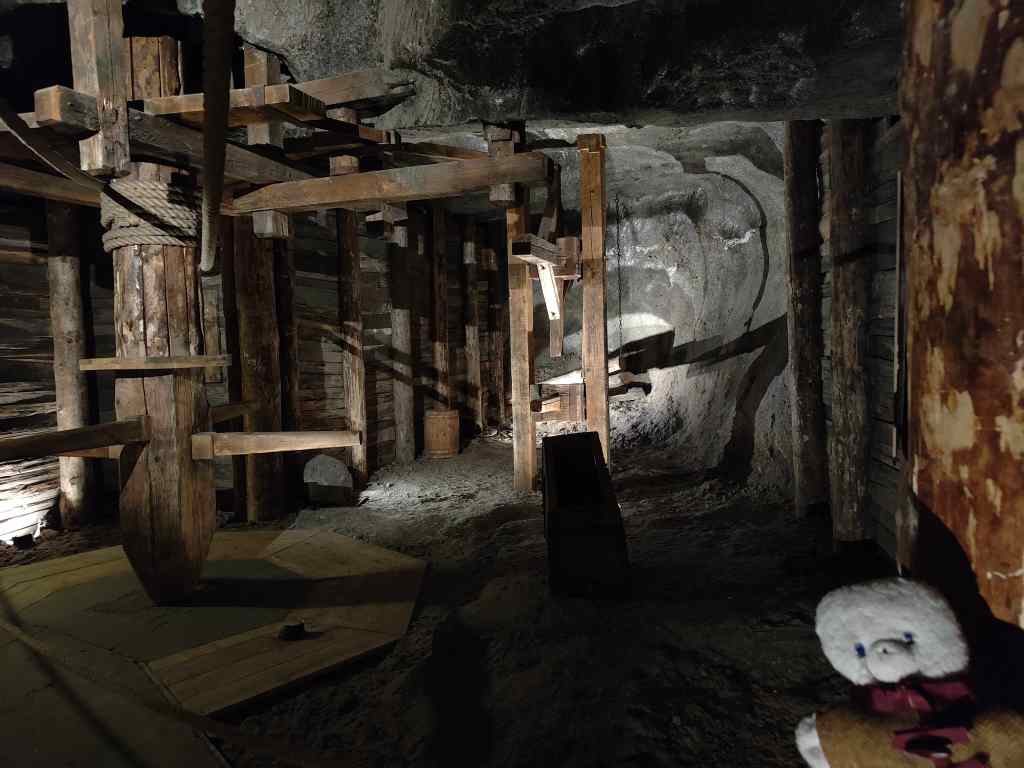
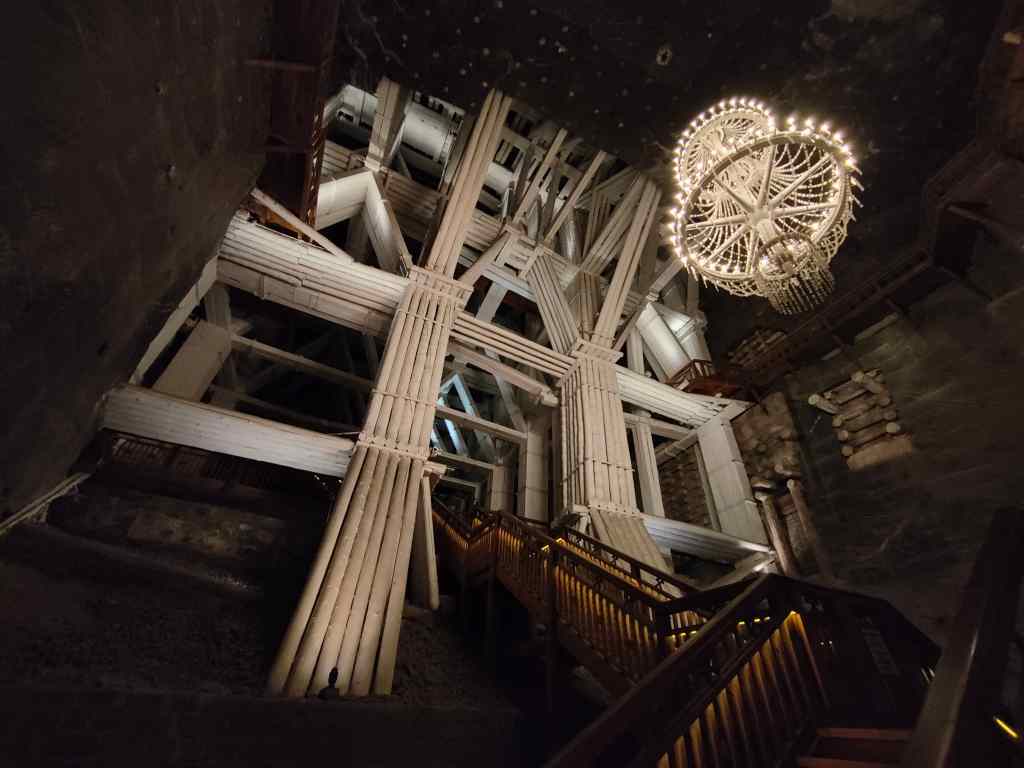
The route for visitors includes only around 2% of the total length of the mine’s galleries, reaching the fourth level underground. It was quite chilly in the mine, and I was grateful of my fur to keep me warm. We passed old mining equipment, salt lakes and huge chambers carved out by the miners.

Mine equipment, Wieliczka

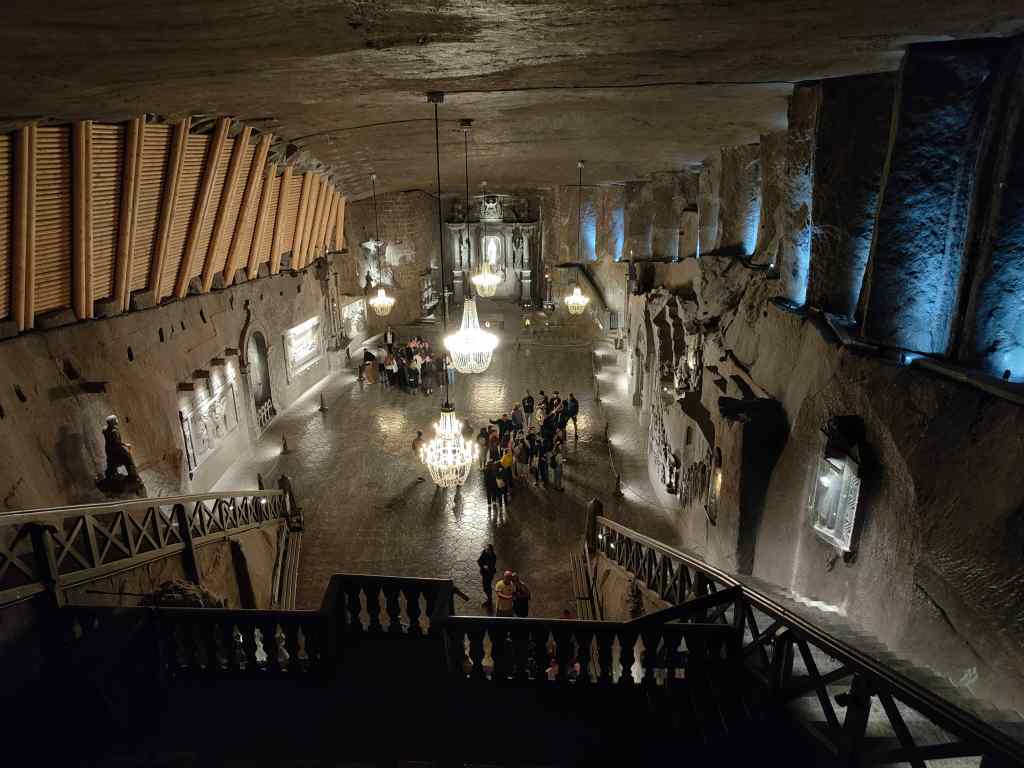
Highlight of the mine is an St Kinga’s chapel, a church, carved out of the salt rock, with many statues and bas-reliefs carved out of salt. The chapel is an active place of workshop, but only miners and their families are allowed to attend services there.  

St Kinga’s chapel, Wieliczka salt mine
The altar – all the carving is from salt, and done by the miners
An exquisite bas-relief in St Kinga’s chapel

Visitors have been coming to see the mine since the 16th century, and a large underground concert hall was created where they would listen to music.

The concert hall, Wieliczka

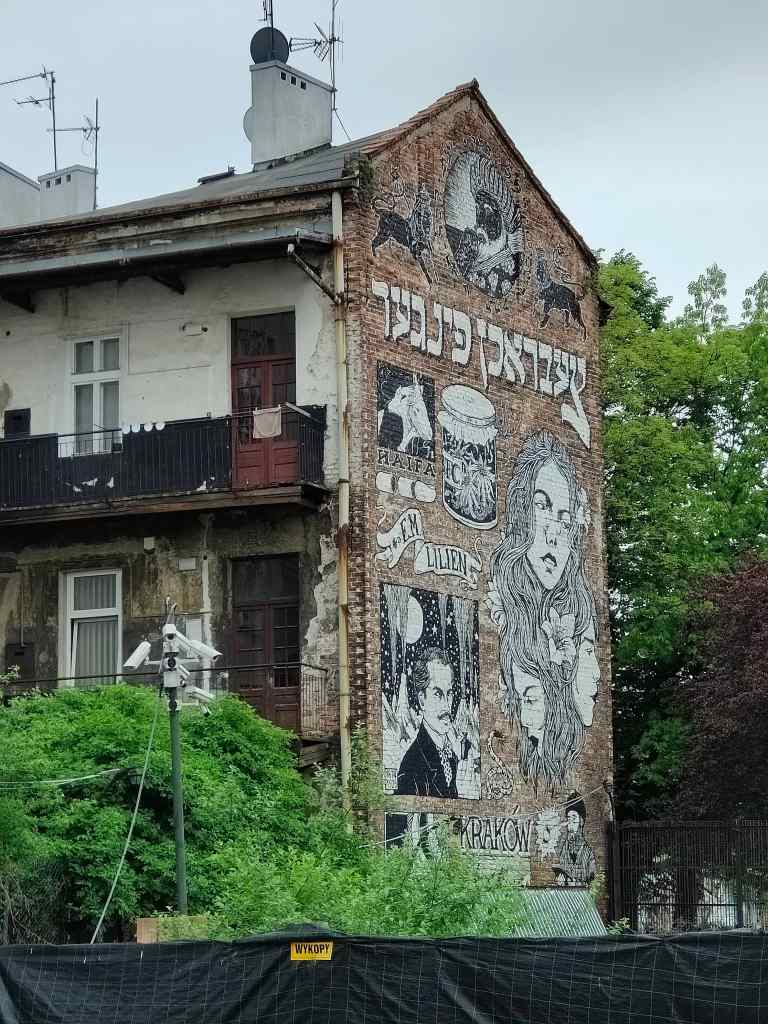
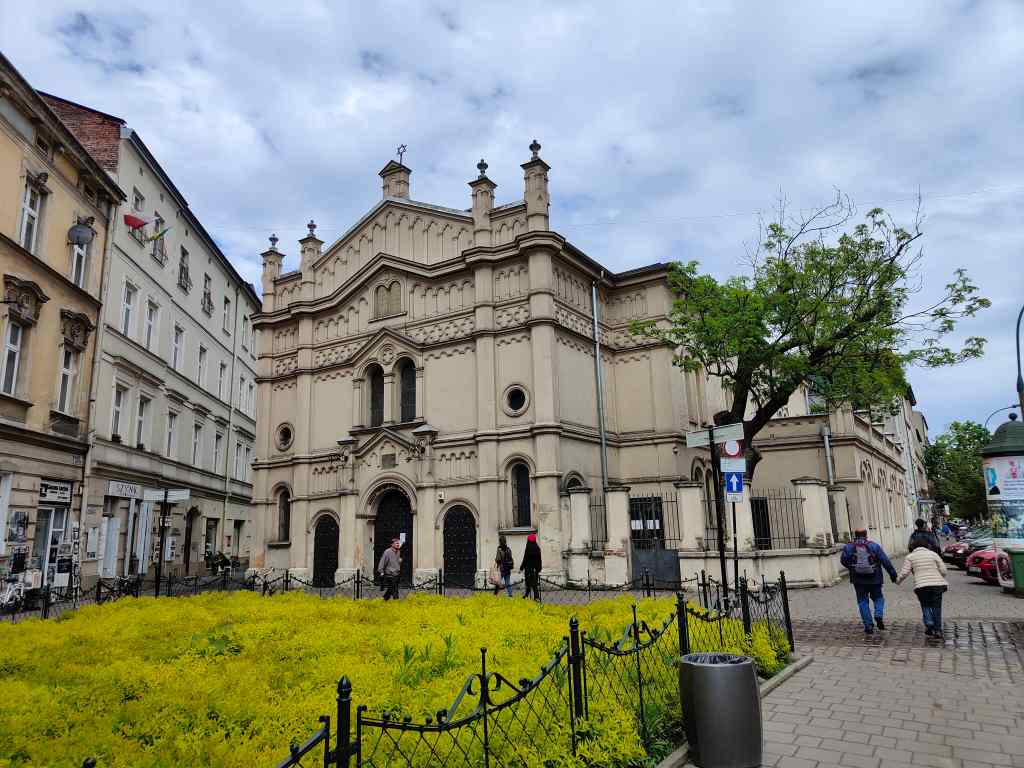
I found the mine very interesting, but was a little puzzled that it was, apparently, Poland’s most visited tourist attraction. Back at the surface, I warmed myself in the early evening sun before heading back to Krakow, where I explored the Jewish part of the city in a suburb called Kazimierz. During the second world war, this area was where the Jews were forced to live in a walled-off separate ghetto, before they were transported to concentration and then extermination camps. After the war only 3% of Poland’s Jewish population remained, but the few survivors have managed to recreate some of the character of Kazimierz, with many Jewish restaurants and a few remaining synagogues.  

Mural in Kazimierz
One of the surviving synagogues in Kazimierz

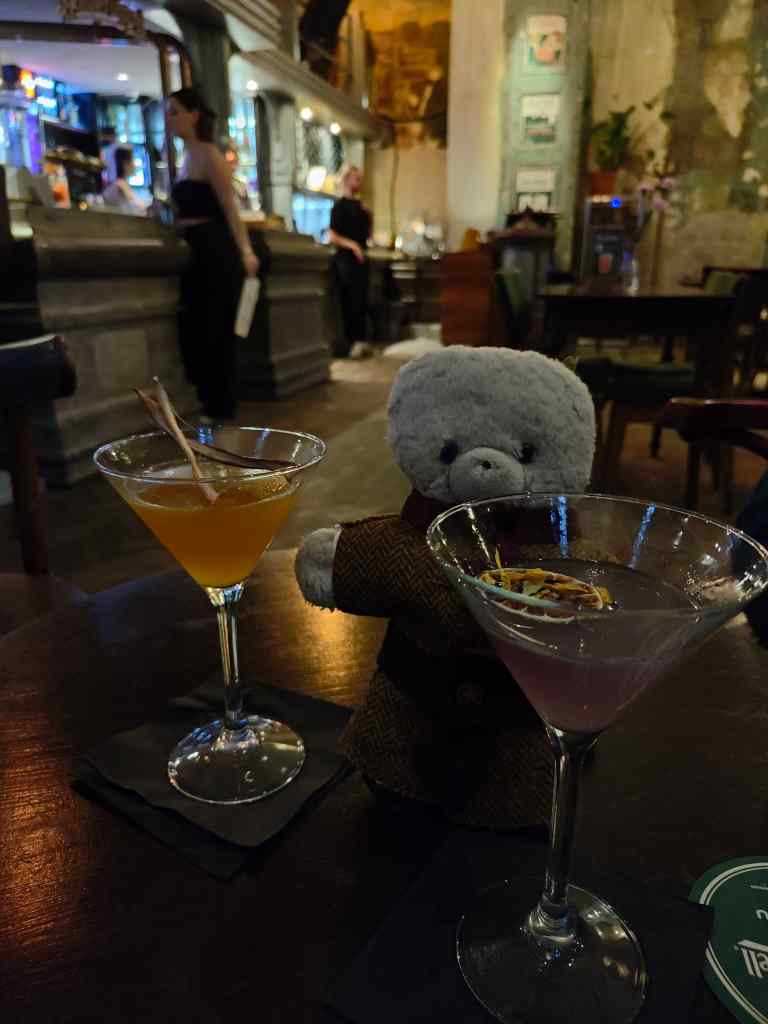
Kazimierz is also a great nightlife area, with countless cocktail bars. I spent my last night in Poland enjoying a pub crawl from one bar to the other, enjoying some excellent – and amazingly cheap – drinks.

Kazimierz night life – Last night in Poland!

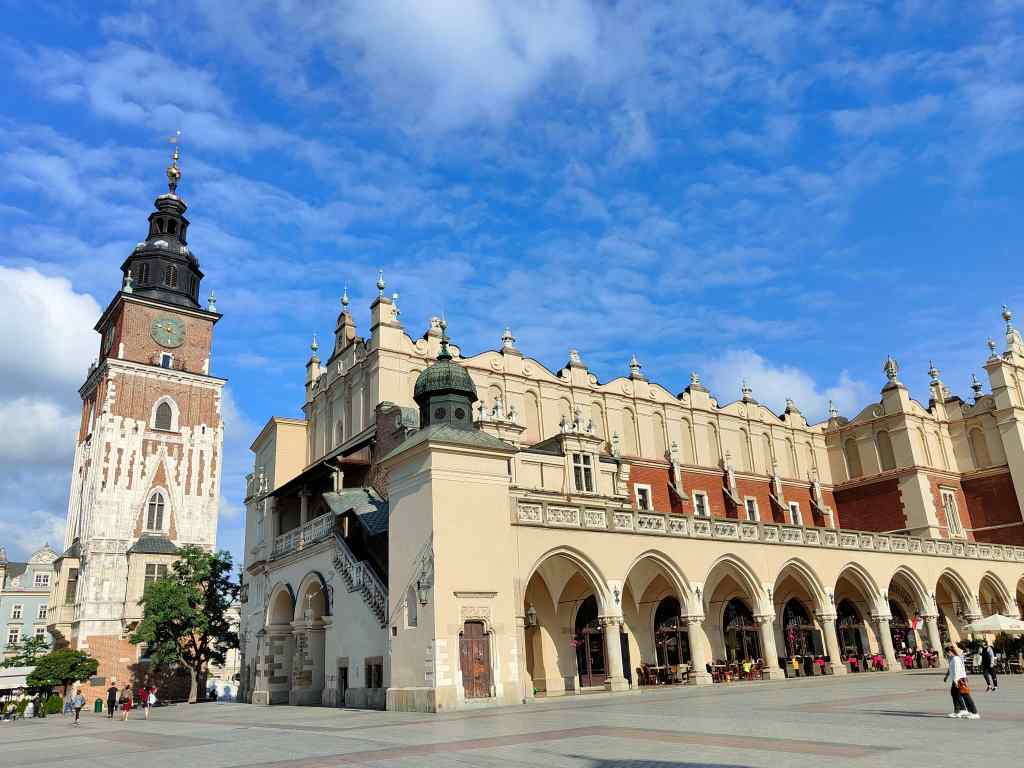
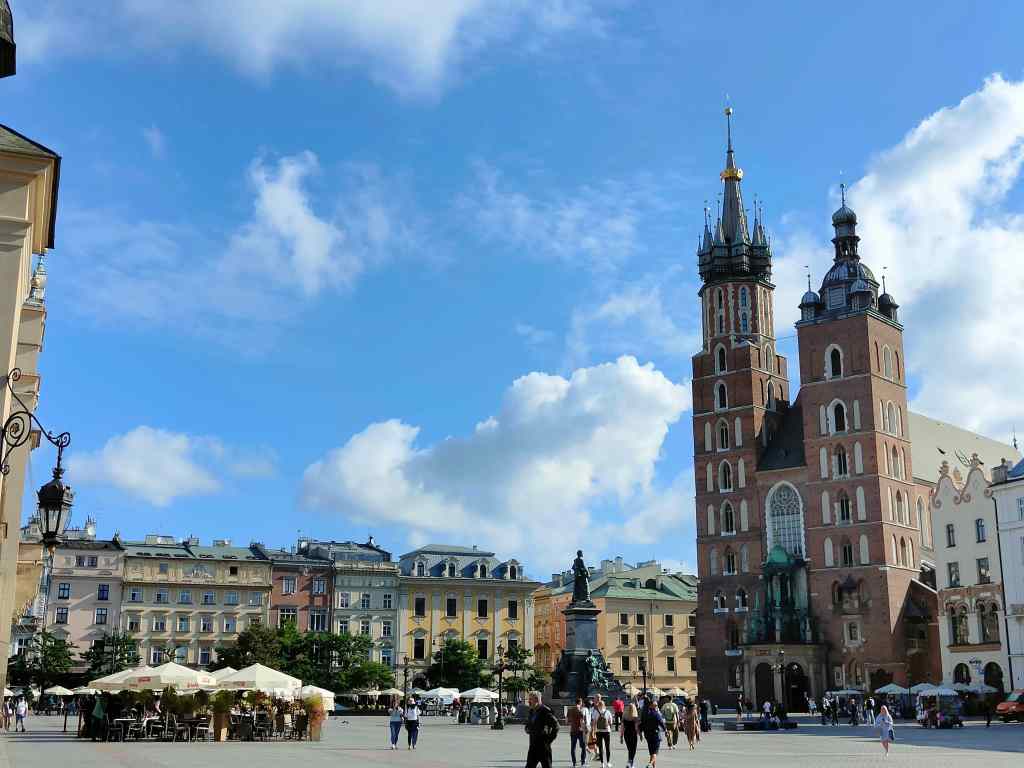
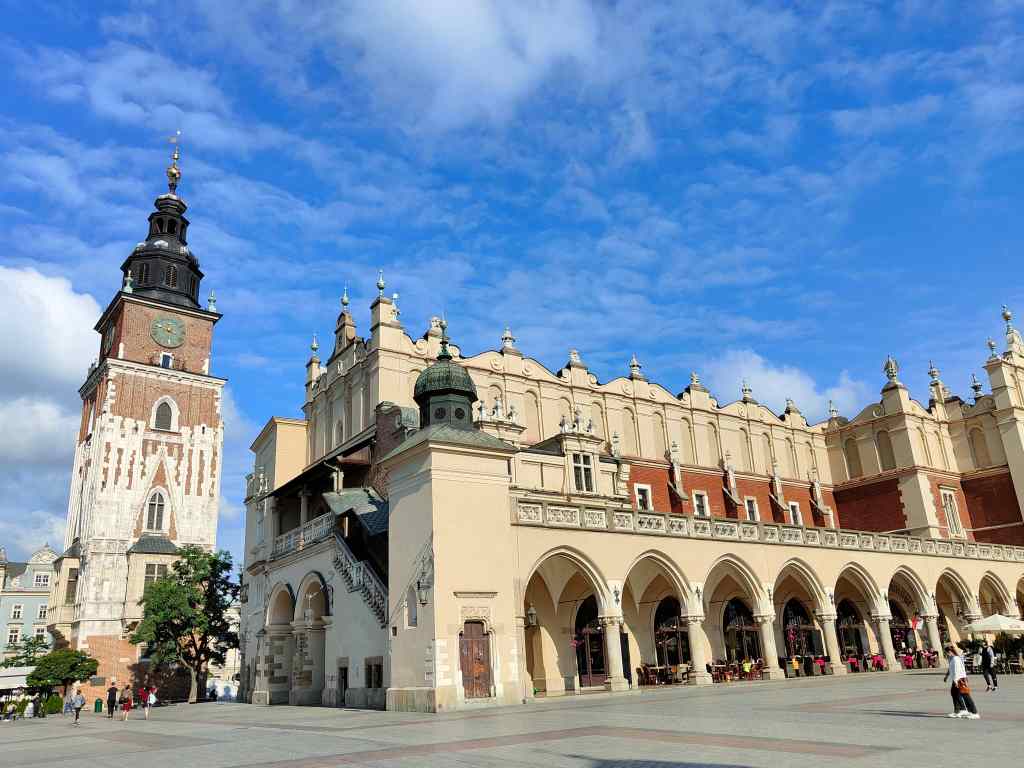
On my last morning in Krakow, before my flight back home, the sun had returned and I headed straight to the main square for some last photos and to have a cup of coffee in one of the cafés.

Last visit to the main square, Krakow

It was a good way to say goodbye to Poland, a country I had really enjoyed, with the wonderful city of Krakow and some great hiking in the nearby mountains. It is such a good value destination, and so easy to get here from London, that I think I will be back!

Previous Post: Auschwitz – my saddest post

My saddest and hardest post

Today my exploration of Poland took a completely different turn, as I went back to a particularly dark chapter of the country’s past. I drove about 3 hours northwest, to the former death camp of Auschwitz.

Before describing my visit it is worth covering a bit of Poland’s troubled history. In the middle ages, Poland was a typical European country, increasing or decreasing in size as different kings succeeded or failed in battle or diplomacy. In the 18th century it came under increasing influence from its powerful neighbours, Russia, Austria and Prussia. The three powers twice agreed to allocate large tracts of Polish land to themselves, greatly reducing the size of the Polish state, and then finally in 1797 split up Poland’s remaining territory. Poland ceased to exist as a separate country until the end of the first world war, but its independence was short-lived. Russia and Germany again agreed to partition the unfortunate country, with Germany’s invasion triggering the second world war.

The Nazis and Soviets set about trying to eradicate any separate Polish identity, by murdering thousands of intellectual and political leaders. Even worse was to follow this brutal campaign; at the start of the war Poland had a relatively large Jewish population, which the Nazis set out to eliminate. First, Jews were forced to live in cramped ghettos inside Polish cities; next they were transported to concentration camps, where they were forced to work. Finally, the Nazis built five death camps for the total extermination of the Jewish population of Europe by cyanide gas.

Auschwitz was the first such camp and the only one where much remains to be seen. This is because the Nazis tried to destroy all evidence of their extermination of the Jews before the advancing Red Army liberated the camps in 1945. The four other camps served only as death camps and were completely destroyed. Auschwitz also served as a concentration camp, and although the Nazis destroyed the gas chambers there, much of the rest was left intact. The Polish established it as a museum, so that the memory of the holocaust would not be lost.

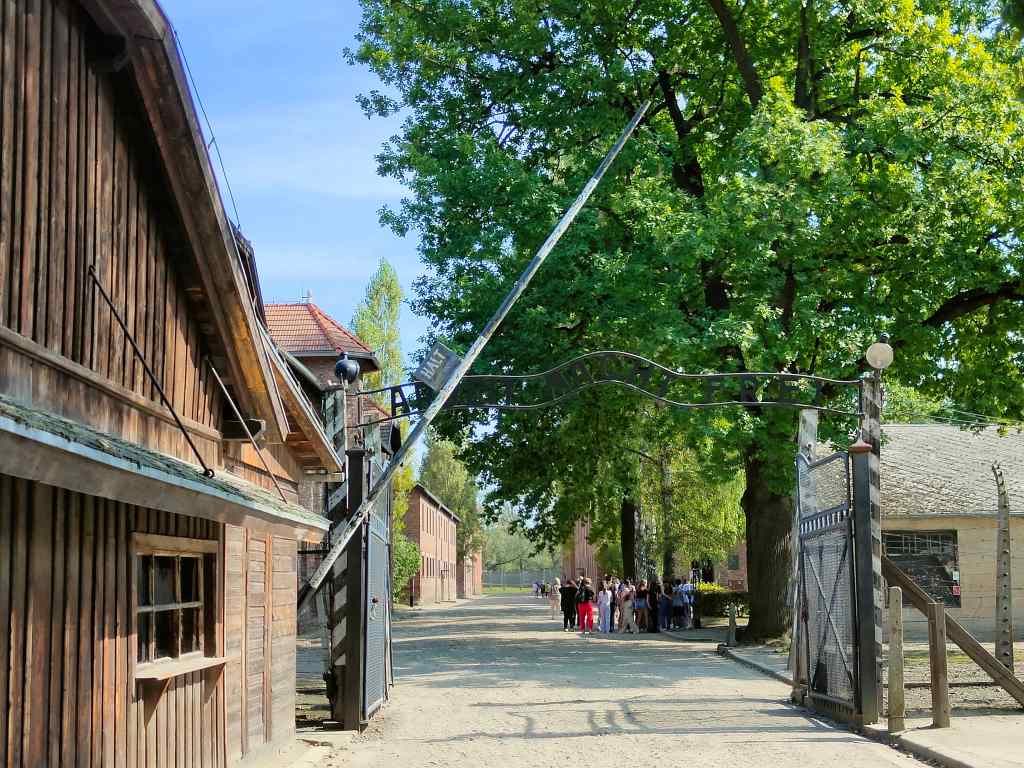
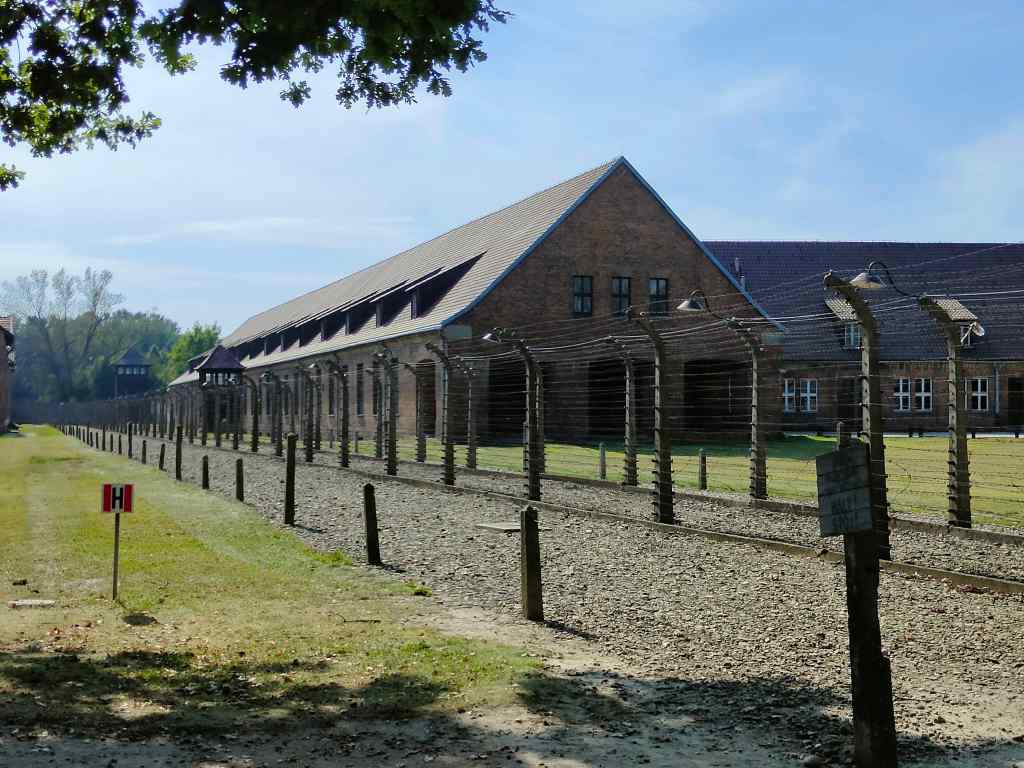
My drive to get there was uneventful and passed through some pretty villages and fields. Nothing in this sleepy part of southern Poland could hint at the scale of death and suffering inflicted on over a million people that arrived at Auschwitz.  I parked my car, found the guide I had booked a few weeks before my visit, and together we set off to visit the first part of the complex, Auschwitz 1. The buildings there were surprisingly neat and tidy – before the German invasion, they had served as barracks for the Polish Army, and initially it was used mostly as a POW camp for Polish and Russian war prisoners. We passed through the famous gate, with its ironic inscription “Arbeit march Frei” (Works makes you free).

The famous entrance to Auschwitz
Neat buildings at Auschwitz 1

Inside Auschwitz 1, many of the buildings had been devoted to a museum covering the incredibly tough life in the concentration camp part of Auschwitz, and then horrors of Auschwitz 2’s gas chambers. Moving exhibits included hundreds of shoes and discarded suitcases from victims of the gassing, and discarded cans of the Zyklon B poison used to kill people. Most moving off all was an exhibit of tons of human hair. The Nazis even shaved the hair from the dead to use as a textile material.

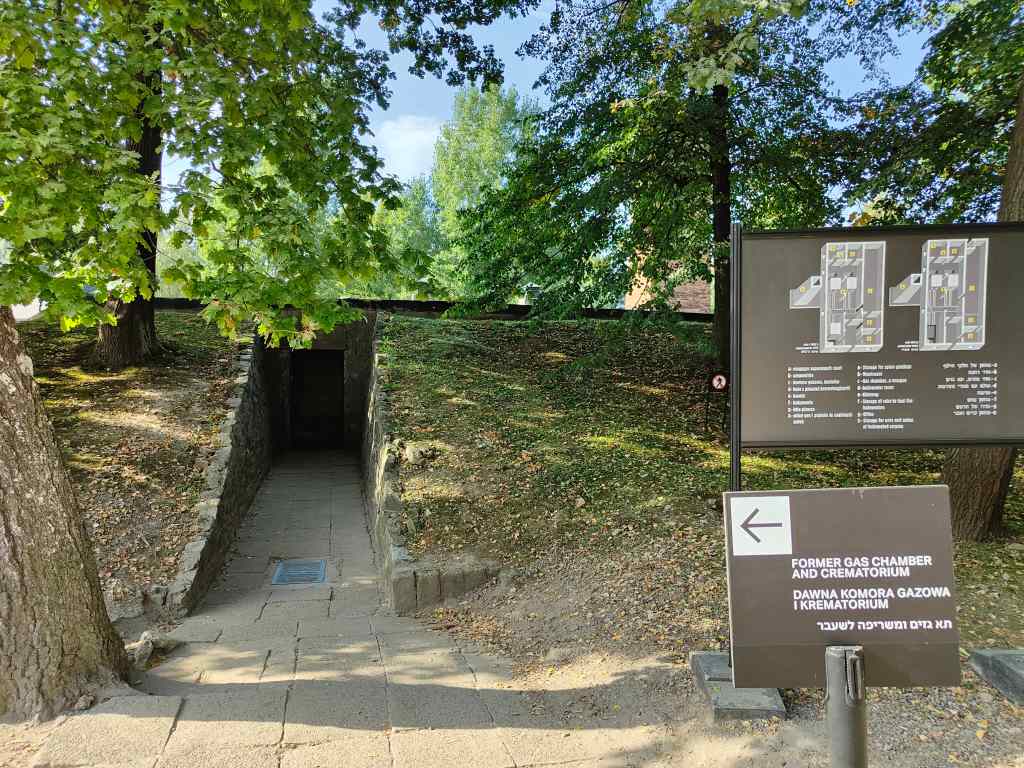
The very first Nazi gas chamber, Auschwitz

Auschwitz 1 was where the very first gas chamber was located. It was a small underground building where the Nazis experimented using cyanide gas to kill Polish and Russian prisoners. Once they had perfected the method, they built a large extension to the camp, Auschwitz 2 – Birkenhau with two much larger gas chambers.

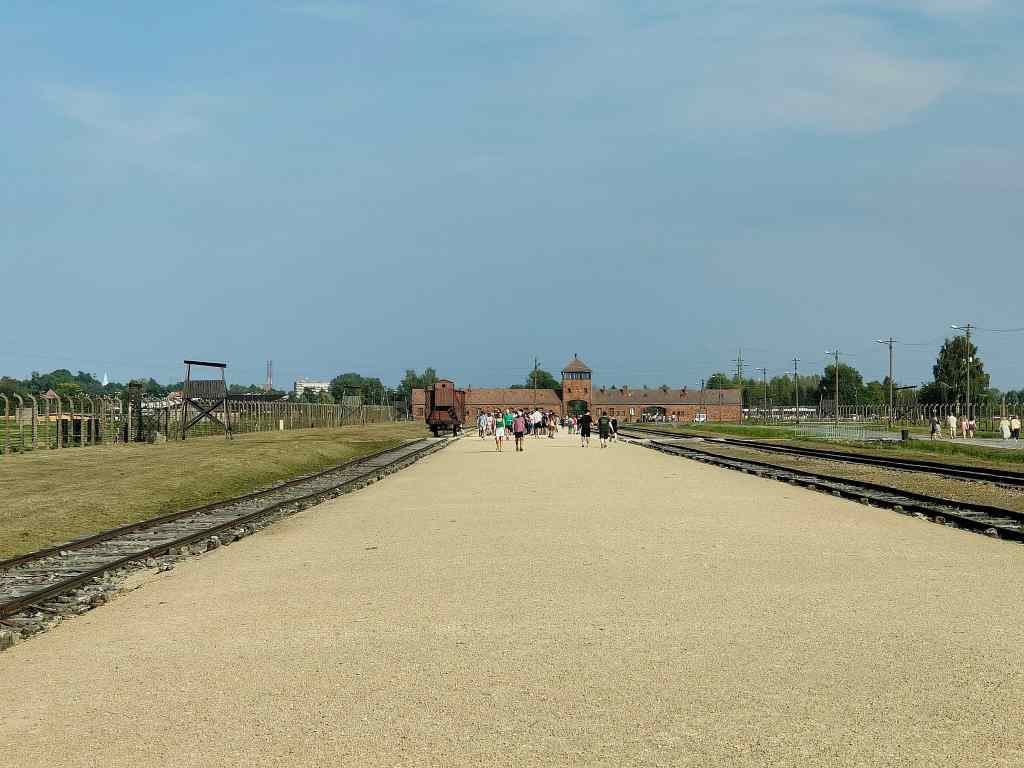
Auschwitz 2 – Birkenhau

We took a shuttle bus to get to Birkenhau to find an efficiently laid-out flat site. Two railtracks arrived right inside the camp. Trains arrived and disgorged future victims, each carrying the one case of luggage they had been allowed to take on the trip. The arrivals were inspected, and around one in twenty was selected for forced labour and taken to nearby barracks (now mostly destroyed). The remainder were told to leave their luggage, and that they would go for a shower. They were led away to the gas chambers where they were murdered. Their bodies were inspected for anything useful – gold teeth, hair – and then incinerated. For most arrivals, the time they spent alive at the camp was about the same as the time of my three-hour visit. Those that were selected for forced labour usually fared little better – most only survived a few months, and died of cold, starvation, beatings or medical experiments.

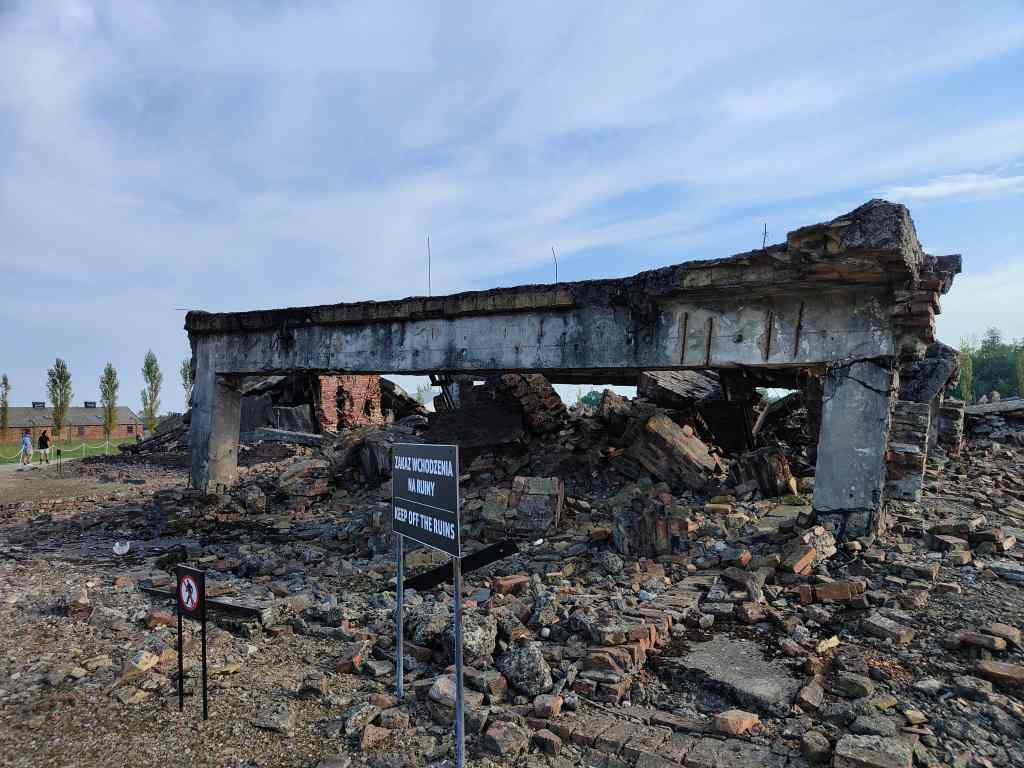
A gas chamber in ruins, Auschwitz-Birkenhau
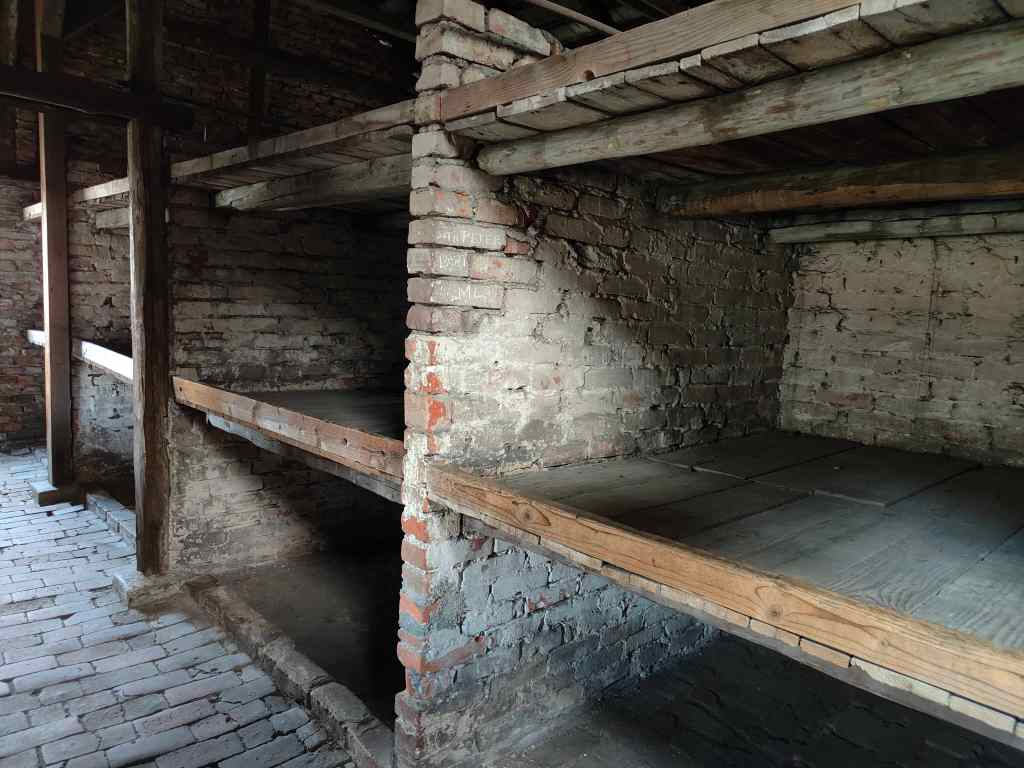
A spartan accommodation block for women, Auschwitz-Birkenhau

Today, Birkenhau has a few remaining accommodation blocks for those selected for forced labour and the ruins of two gas chambers. It also has a memorial to the victims. 1.3 million people arrived at Auschwitz, of which 1.1 million were killed. Most were Jews from around Europe, but there were also non-Jewish Polish victims, Roma, and Soviet prisoners of war.

On a hot sunny day in September, it was hard to imagine the scale of the killings on the site. I was expecting that the extinguishing of so many lives would leave some imprint on the fabric of space and time, but although the visit was deeply disturbing, I could not feel anything supernatural – it was simply a flat, hot piece of land with a few buildings on it. It was as if the Nazis had efficiently deleted not just the bodies but the spirits of all these people from time itself and that they had never existed. The Nazis only bothered to record the names of those few arrivals selected for forced labour – the others were simply killed. The only evidence of these people’s brief presence at Auschwitz was the suitcase they had brought and had been made to leave whilst they were led to their deaths. Many of these cases carried a name, so my last photo for today is in memory of Alice Frankel, whose case is one of those on display in the museum. Who was she? Was she young or old? Did she know what was going to happen to her? We will never know.

Abandoned luggage at Auschwitz

Next Post: Back to Krakow

Previous Post : Farewell to the High Tatras

High Tatras – the Valley of the Five Lakes and Szpiglasowy Wierch

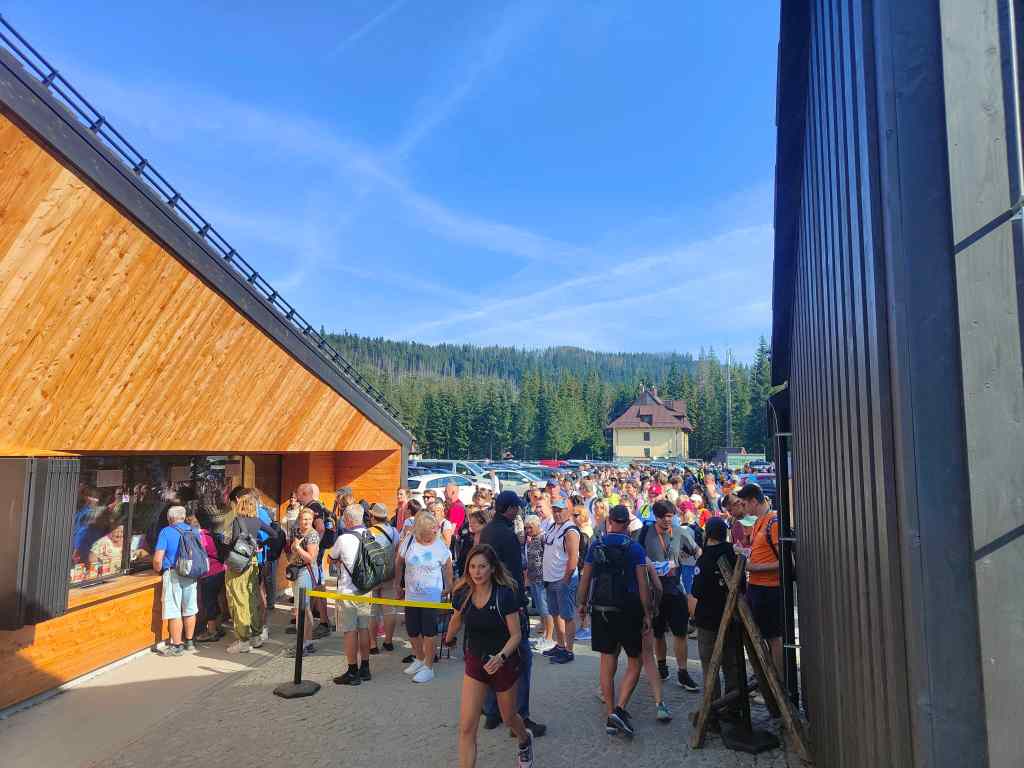
I was determined to get the most of out my last day in the Tatras by finally doing a proper, energetic hike. The most popular entry point for the Polish side of the park was a short drive away from my chalet, so I set off early……to find the place already heaving with people. I had pre-booked my parking space but I still had to stop around 1km away and take a shuttle bus to get to the park entrance. There, a large queue waited to buy entry permits, but with my e-ticket I could just walk straight in.

The busy entrance to the High Tatras park

From the entrance a long asphalted road provided the only option for walking deeper into the park. It seemed like half the population of Poland had decided to go hiking that day. Occasionally a horse drawn carriage would pass me, an option for those unable or too lazy to walk. Often the road was very pretty, but I got sick of the presence of so many other people and of walking on asphalt.

The High Tatras beckon

After a couple of kilometres, I was relieved when I saw my intended trail leading off to the right, away from the crowded road. It was great to get on to a proper hiking path, with dirt under my boots rather than bitumen. The trail was also much less busy, and I began to enjoy the scenery as it led upwards.

The path gets more interesting!

The views got more and more impressive, until finally I reached a pretty waterfall.

A pretty waterfall, High Tatras

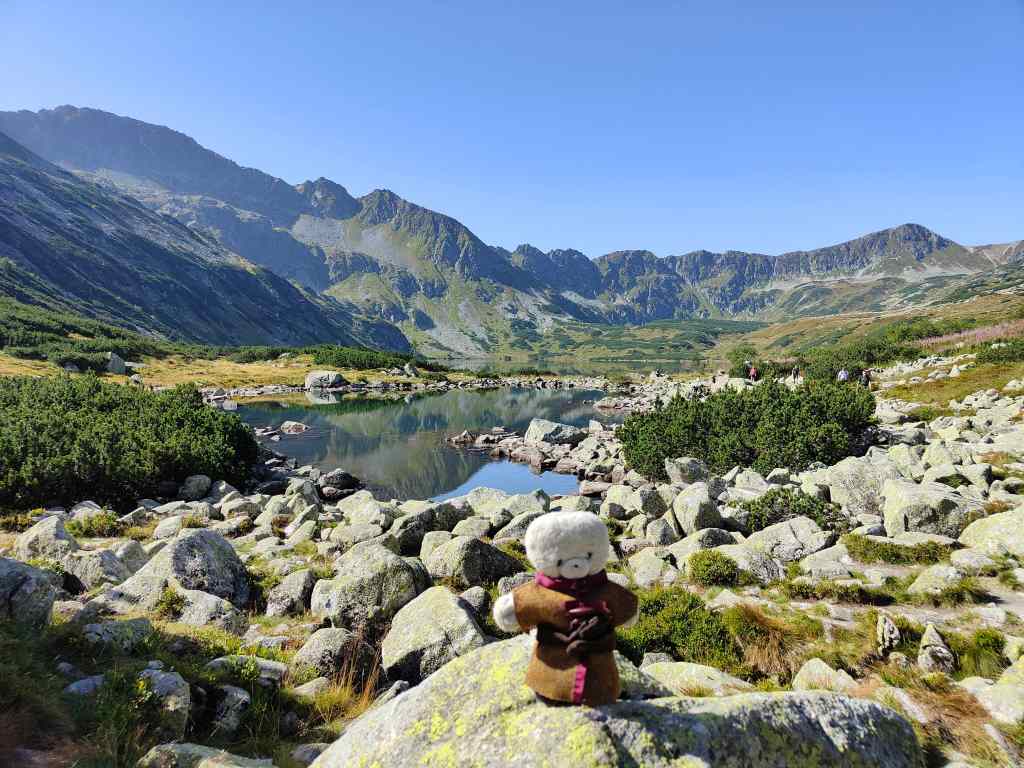
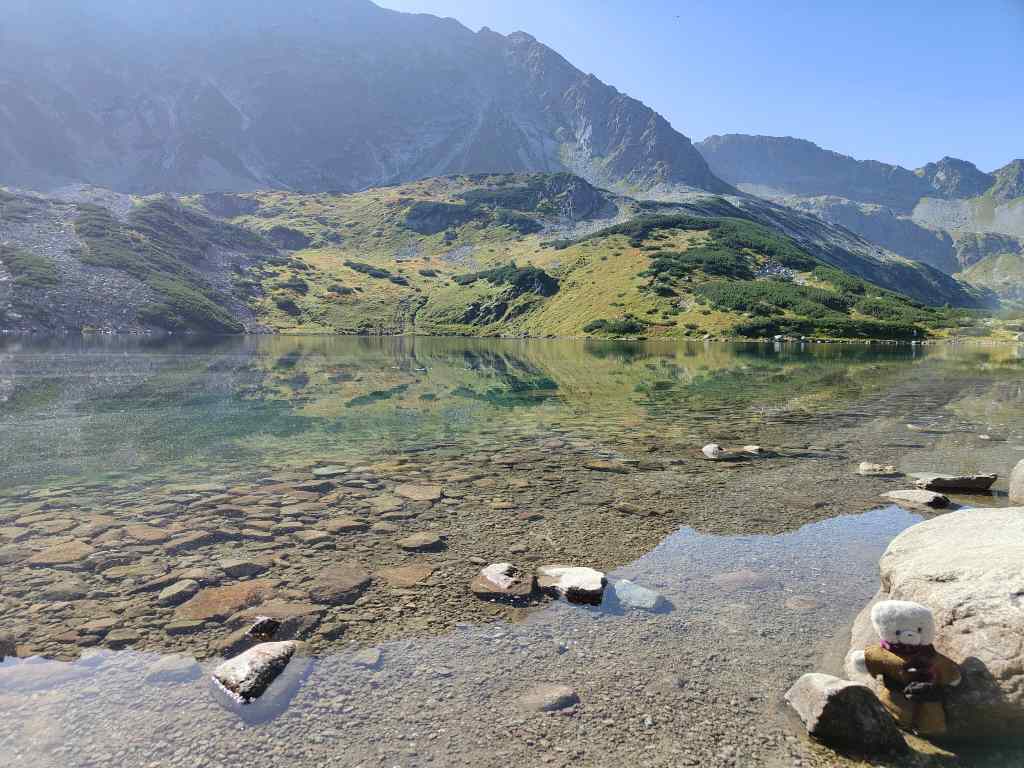
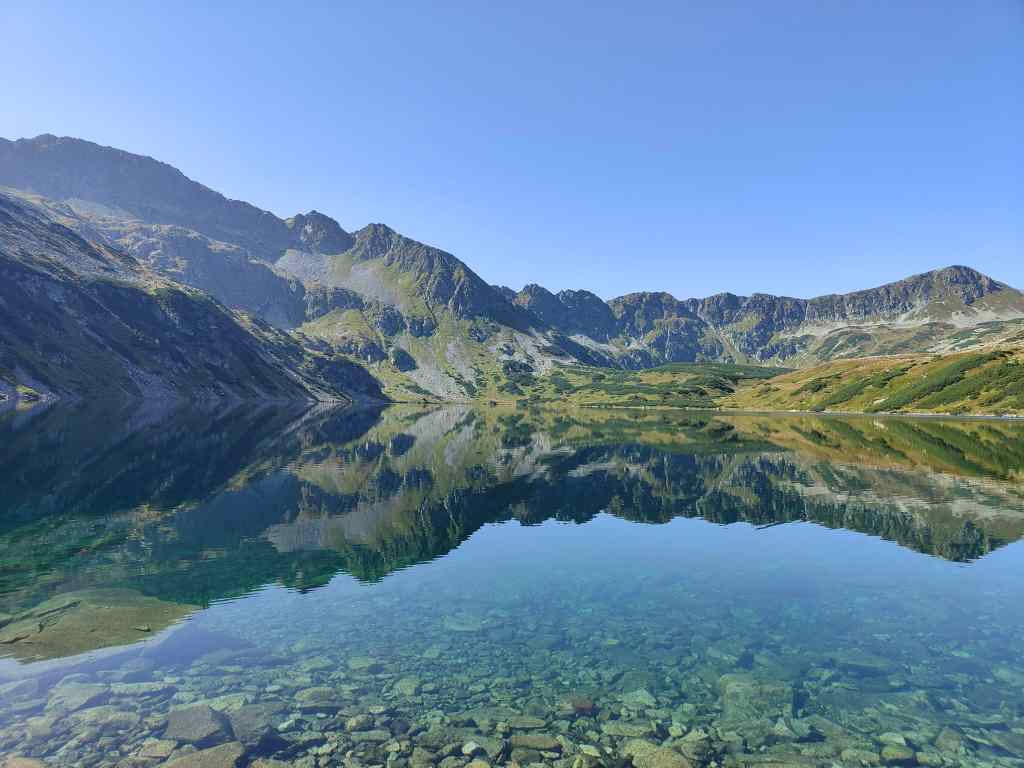
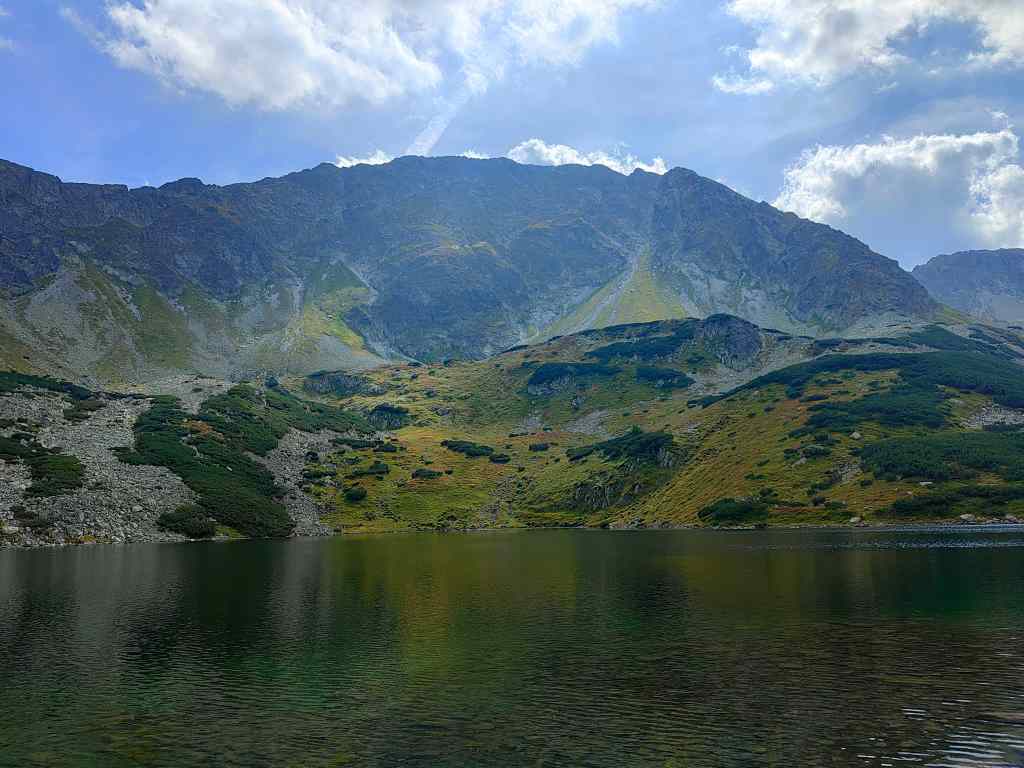
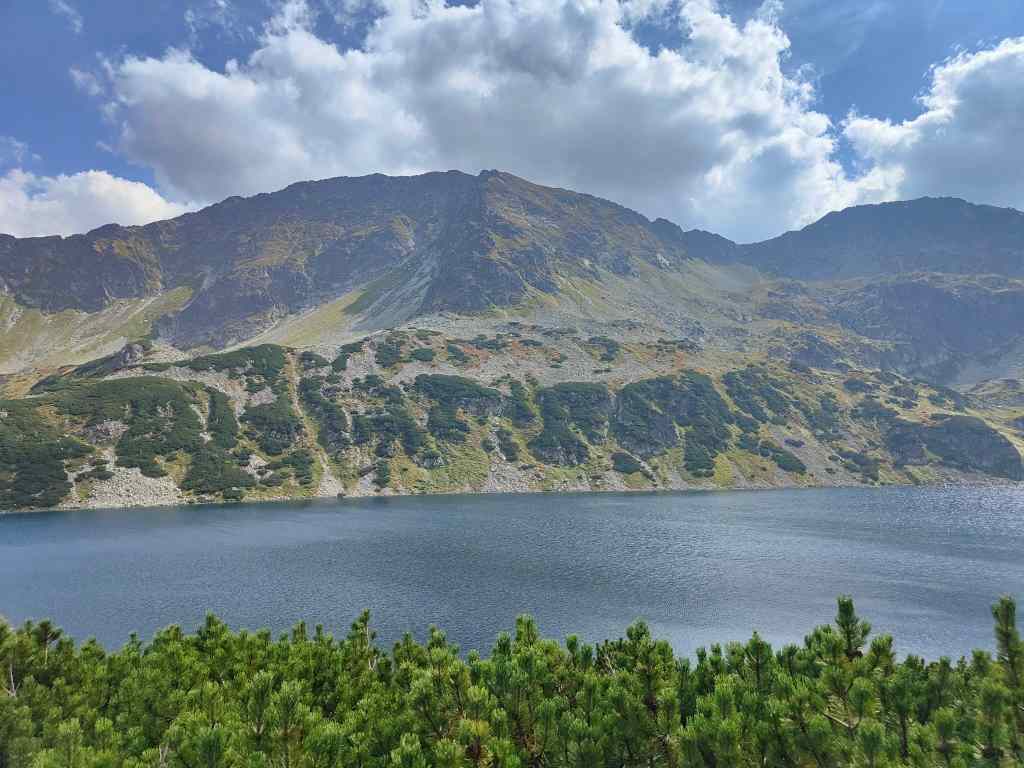
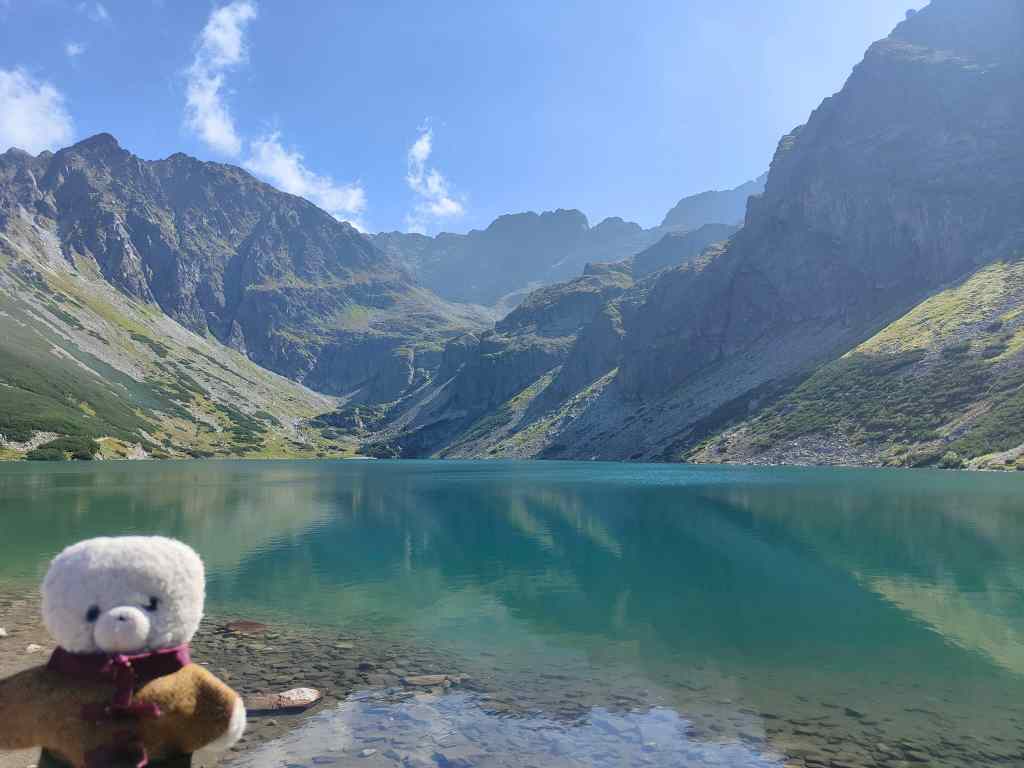
The path then continued up to the Valley of the Five Lakes – a justifiably famous highlight of the High Tatras. Five beautiful, perfectly clear lakes lay at the bottom of a broad valley, their water reflecting the surrounding mountains.  It was a great place to stop for a bit.

A couple of the Five Lakes, High Tatras

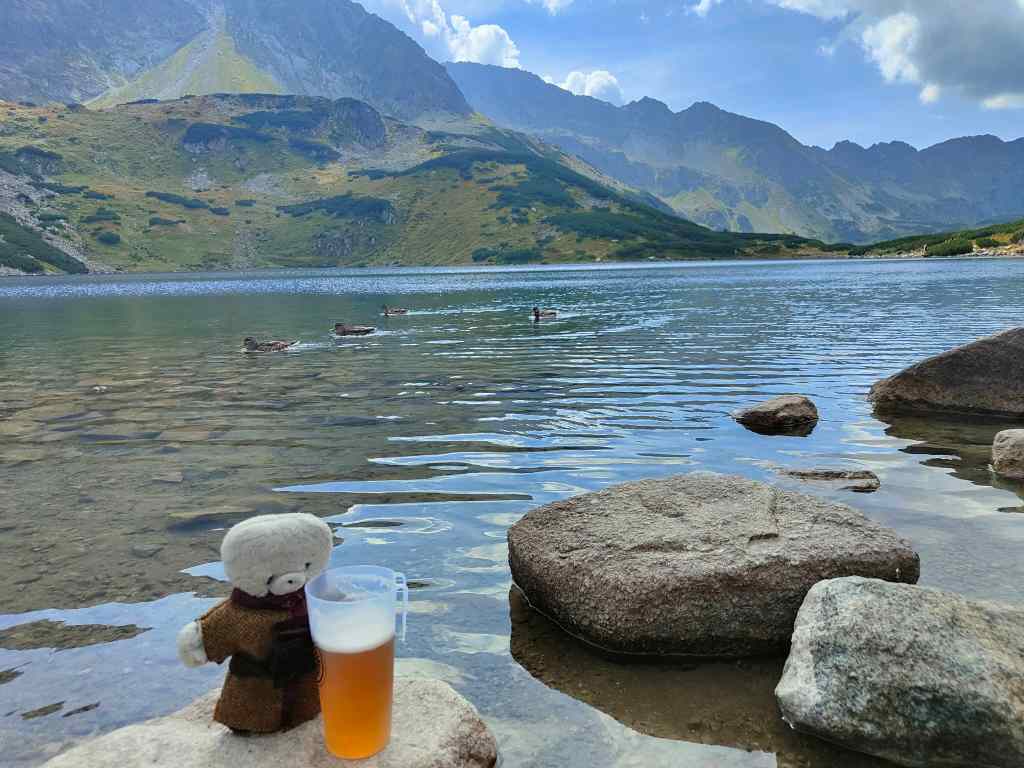
There was a chalet by one of the lakes selling snacks and drinks, so I ordered a well-known Polish energy drink – beer.

A Polish Energy Drink for Hikers

Suitably refreshed, I continued my walk enjoying the wide, open countryside.

How does the path cross the mountain?

At first, I was puzzled; I could see the path stretching out ahead and then zigzagging up the base of a very steep mountain. But then it seemed to disappear, and from a distance I could see no obvious way of climbing the imposing peak that was blocking my way.

On the way up – High Tatras

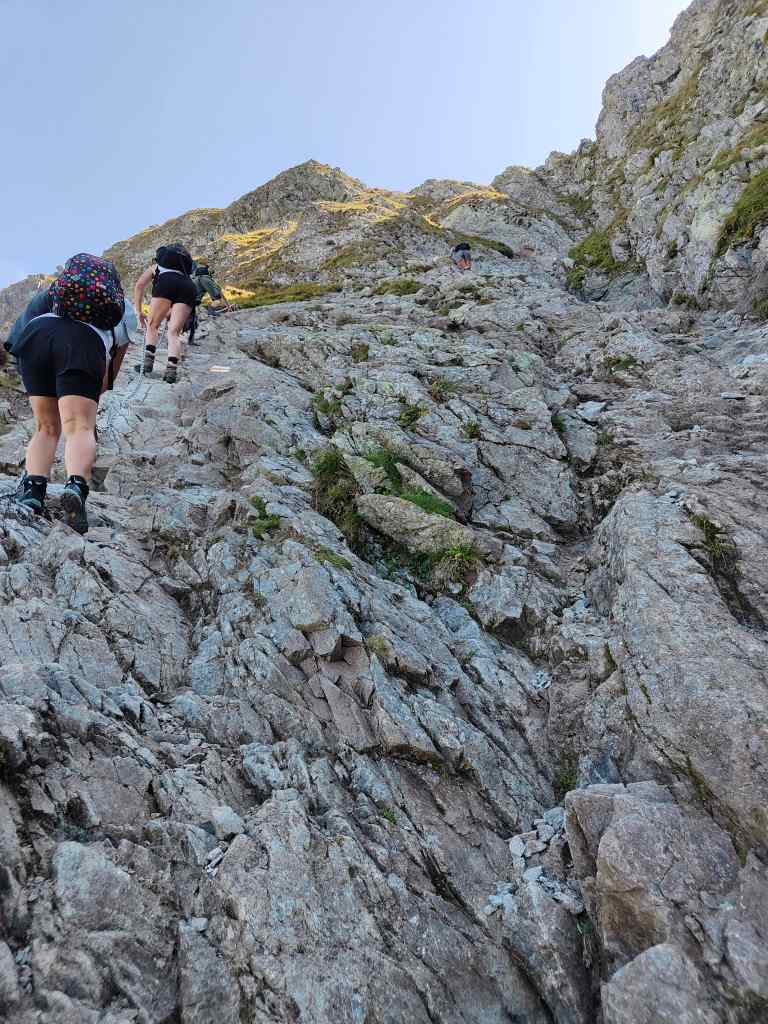
When I got closer however, I saw that my route went straight up a steep rock face, where chains had been set into the stone to help people clamber up.

Climbing with chains to Szpiglasowy Wierch

Bears are good at climbing, and this made a pleasant change to the increasingly steep walking I had been doing. Soon I was on top of the utterly unpronounceable peak “Szpiglasowy Wierch” and was rewarded with some of the most amazing mountain scenery I had ever seen, with a 360-degree view of the peaks and lakes of the High Tatras.

Amazing views from Szpiglasowy Wierch
Proof I climbed Szpiglasowy Wierch
More amazing views – Szpiglasowy Wierch, High Tatras
Wow…..Szpiglasowy Wierch, High Tatras

Having invested so much effort to get up, I spent thirty minutes at the top, finding myself a nice little nook away from the steady stream of climbers arriving and descending. Invigorated by the view, I started the descent to another of the High Tatras’ famous attractions – the large mountain lake, Morskie Oko, or “the eye of the sea”. This part of the hike was less impressive – a steady, slow descent along a well-paved trail. The famously skilled Polish builders also seemed to have been busy in the park; the trails were often made of carefully laid mountain rocks, offering a flat staircase to walk up or down.

I arrived at Morskie Oko to find a mountain lake that was slightly bigger than the ones I had seen before, and a chalet selling food and drink, which was besieged by hundreds of visitors.

The slightly disappointing Morskie Oko

After the tranquil beauty of the Valley of the Five Lakes and the spectacular views from Szpiglasowy Wierch, it was a disappointment. Morskie Oko suffers hugely from its popularity and its accessibility – to get there is a 5km hike from the park entrance along a gently sloping asphalted road.

It was along this road that I had to hike back, accompanied by hundreds of other people – some with backpacks looking fit and serious, others in T-shirts carrying pints of beer – and the inevitable horse-drawn carriages. It was an anticlimactic way to end what had been until then a truly memorable hike, and I hurried to finish it as quickly as I could. Arriving back at my car park, I had covered around 26km, and was glad to be able to sit down.

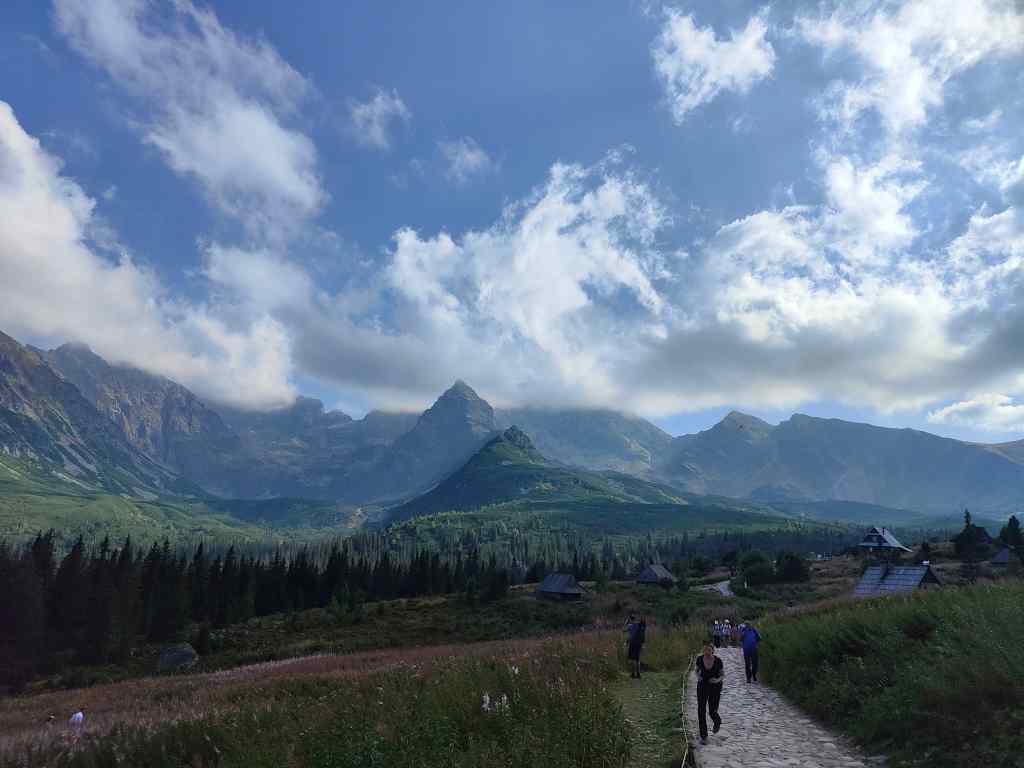
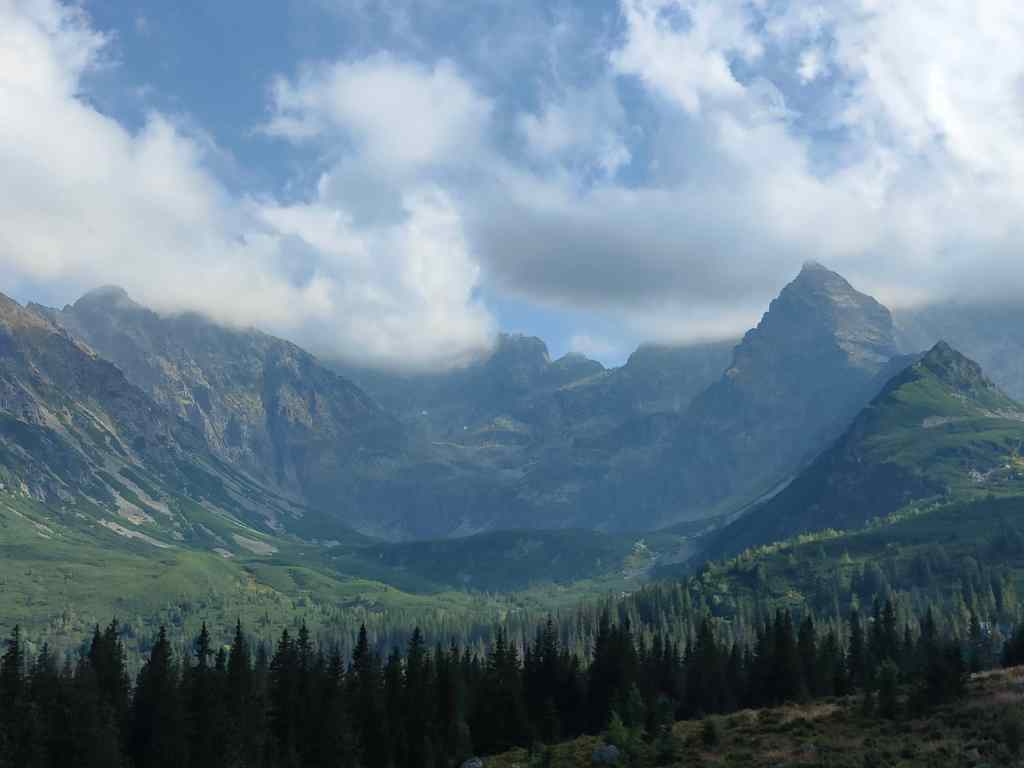
It has been a strange walk – most of it was memorable, amongst the best hiking I had ever done, but the very last part was extremely boring and initially spoiled my enjoyment. However, after a few days, the memory of the dull plod back from Morskie Oko faded, leaving the happy memories of the Valley of the Five Lakes and the views from the top of Szpiglasowy Wierch. So, to end on a high note, here are a few more photos of the best of the Polish Tatras.

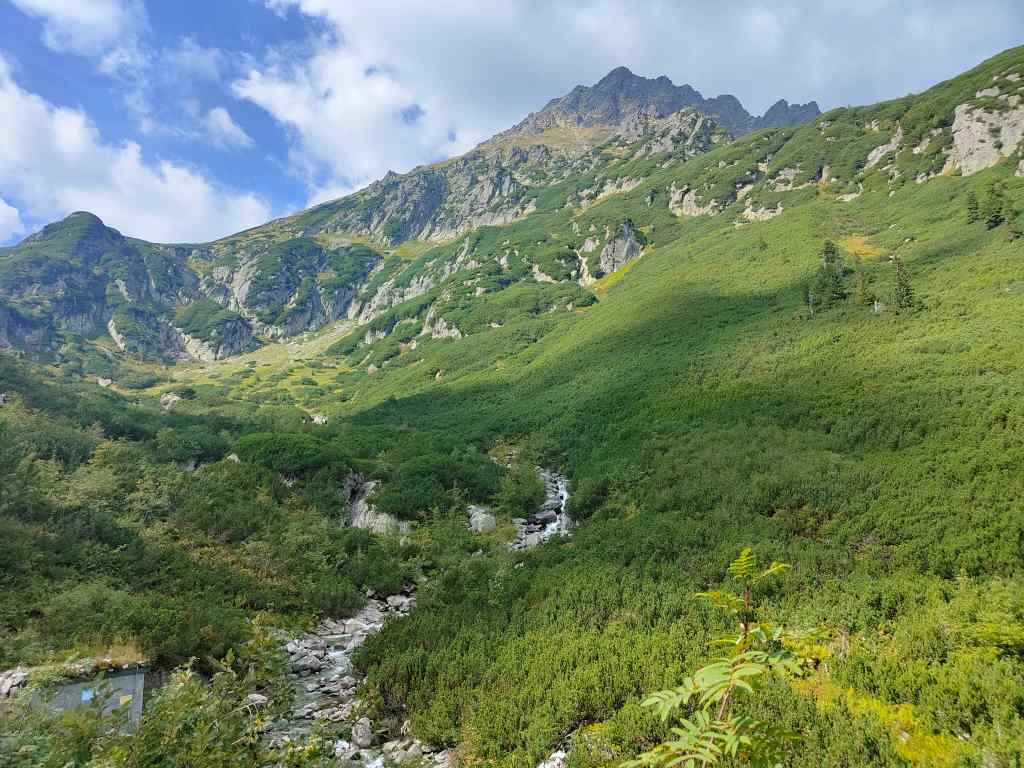
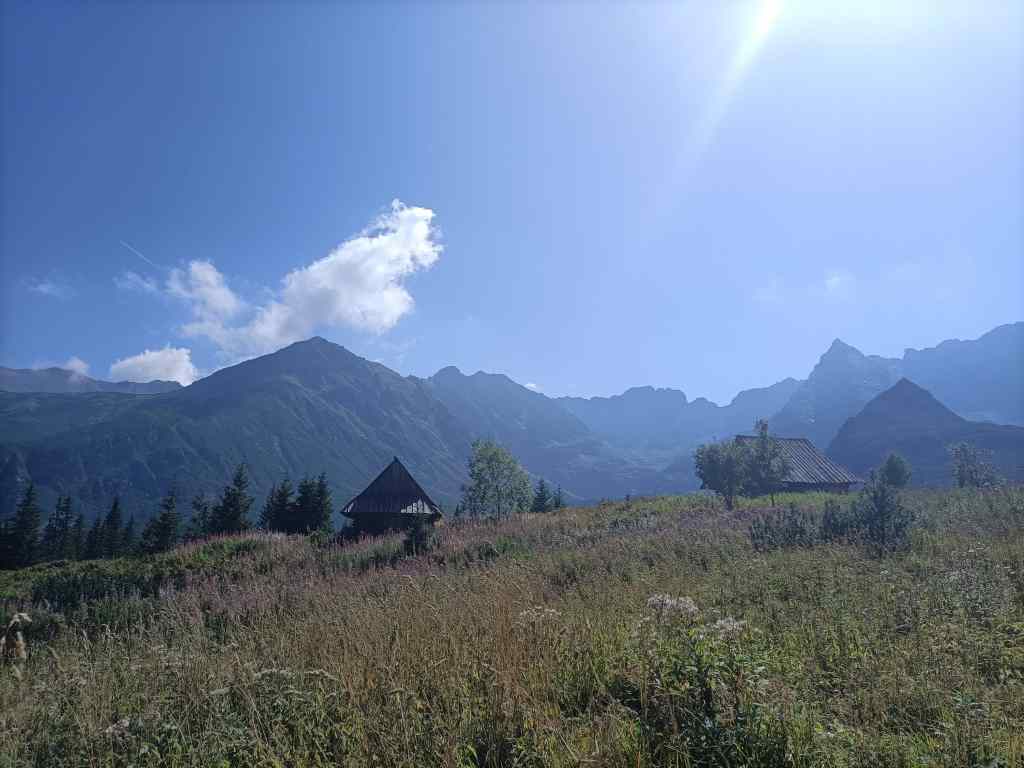
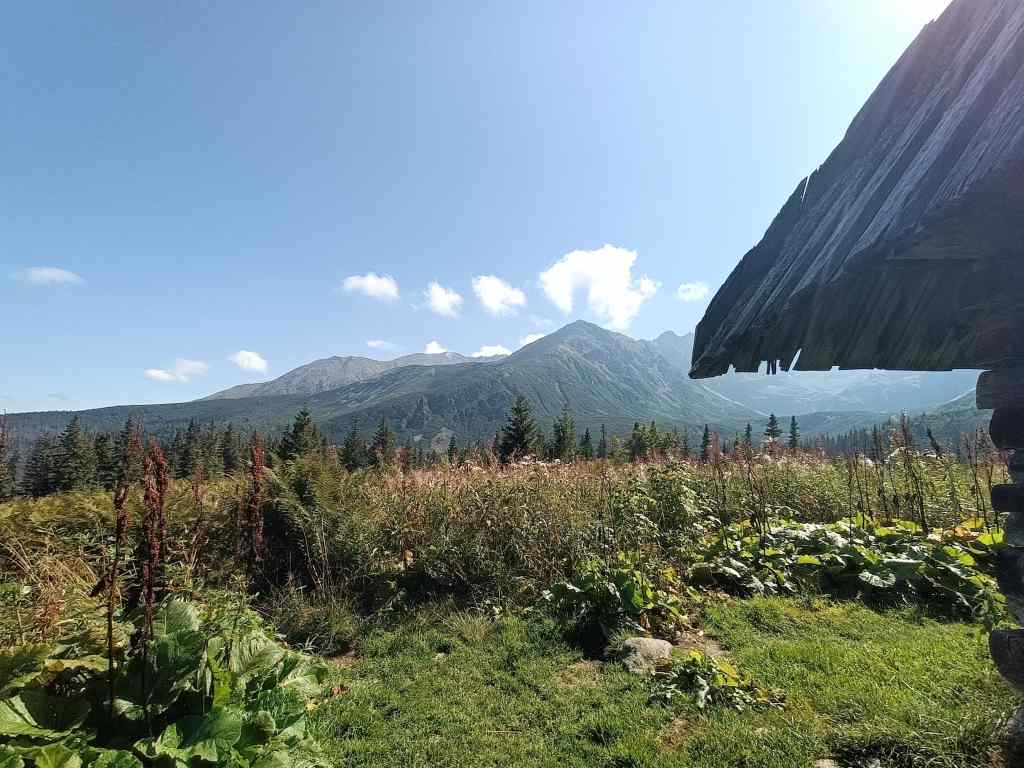
High Tatras scenery – Valley of the Five Lakes
High Tatras scenery
High Tatras scenery – Valley of the Five Lakes
The High Tatras – I will be back!

Back at my chalet I cooked burgers and steak on my barbecue and had the pleasant task of finishing off the stocks of food and alcohol I bought for my stay in the mountains (perhaps deliberately, I had bought a little too much of each). The next day I was due to leave the Tatras for a completely different type of travel experience.

Next Post – Auschwitz

Previous Post – Rafting and Hiking in Slovenia and Poland

Hiking in Štrbské Pleso, Slovakia and rafting the Dunajec Gorge, Poland

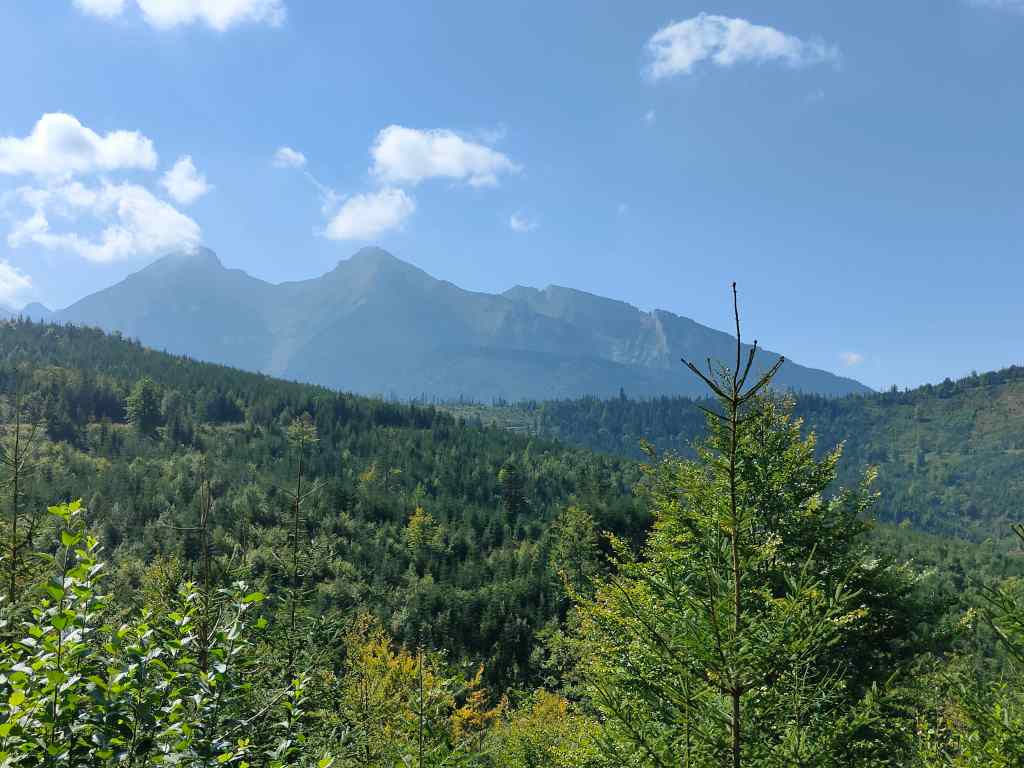
The next day I decided to explore the Tatras from the Slovak side. The border was only 20km and soon I was in Slovakia enjoying a different perspective of the mountains. On this side they are higher and rise straight up from a flat green plane.

Scenery on the way to Štrbské Pleso

After an hour, I reached a town called Tatry-Štrbské Pleso. It looked a smart Alpine ski resort town in France or Switzerland. Since I had set off a bit late, nearly all of the usual parking spaces were already taken. The only place left was the car park of the Kempinski Hotel. A sign at the entrance announced that they charged a very steep 30 euros a day. With no other choice, I drove in and had a stroke of luck – the machine that issued timed entry tickets for the car park was broken, and the hotel’s reception said that I could park for free.

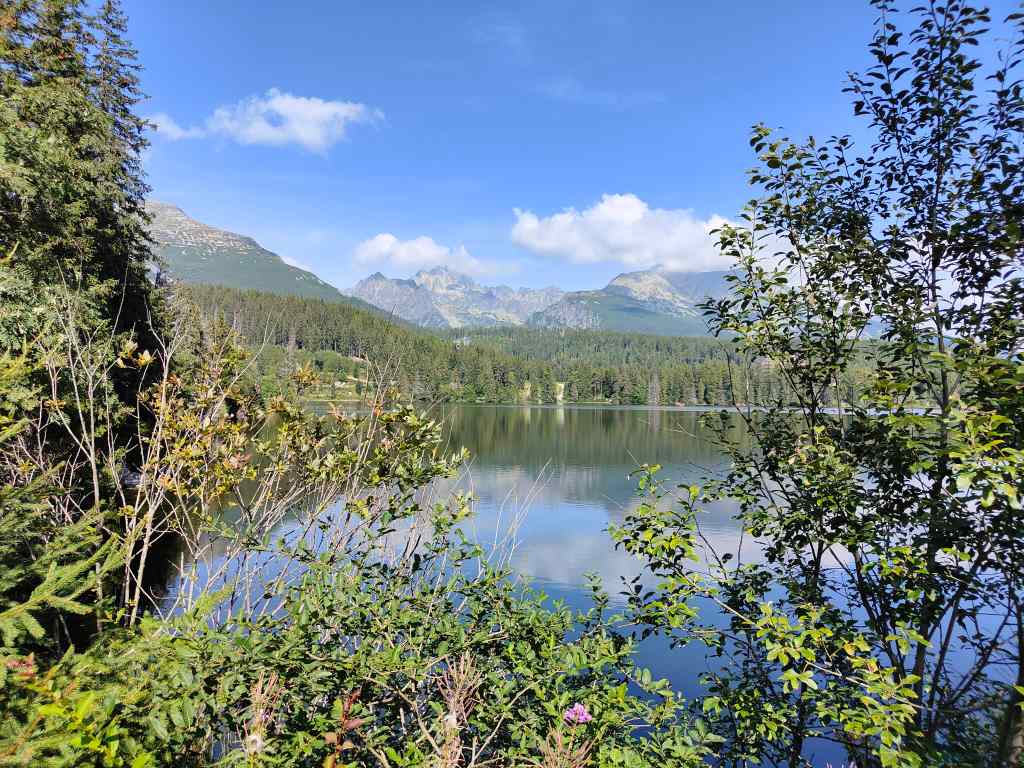
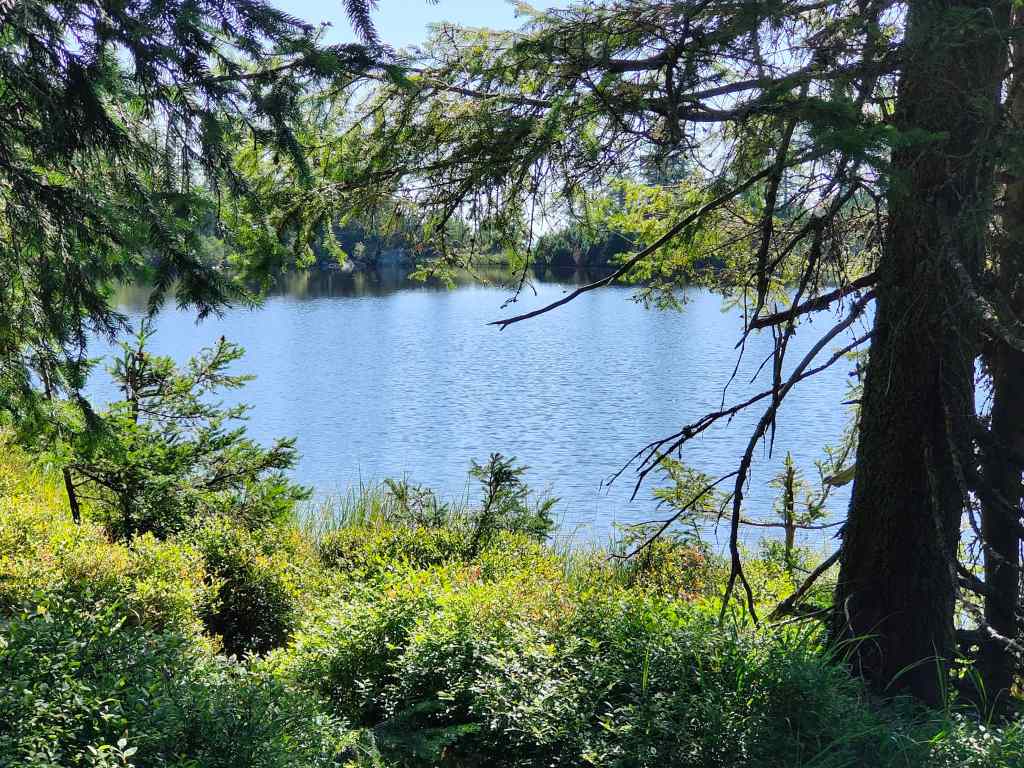
The town was located on a mountain lake. A path leading around the edge seemed to be a popular outing for visitors, and also offered some nice views of the mountains.

The Lake at Strbske-Pleso

After strolling around for a bit, I set off on my main walk – out of the town and a short way into the mountains to another, smaller lake. It was pretty but not very demanding – which was fine, since I was feeling rather lazy. Maybe another day I will try one of the more strenuous routes from Štrbské Pleso, some of which go right up into the High Tatras – including the climb to Mount Rysy on the Polish border, the highest point in the Tatras mountains.

Scenery in the Slovak Tatras
My Destination

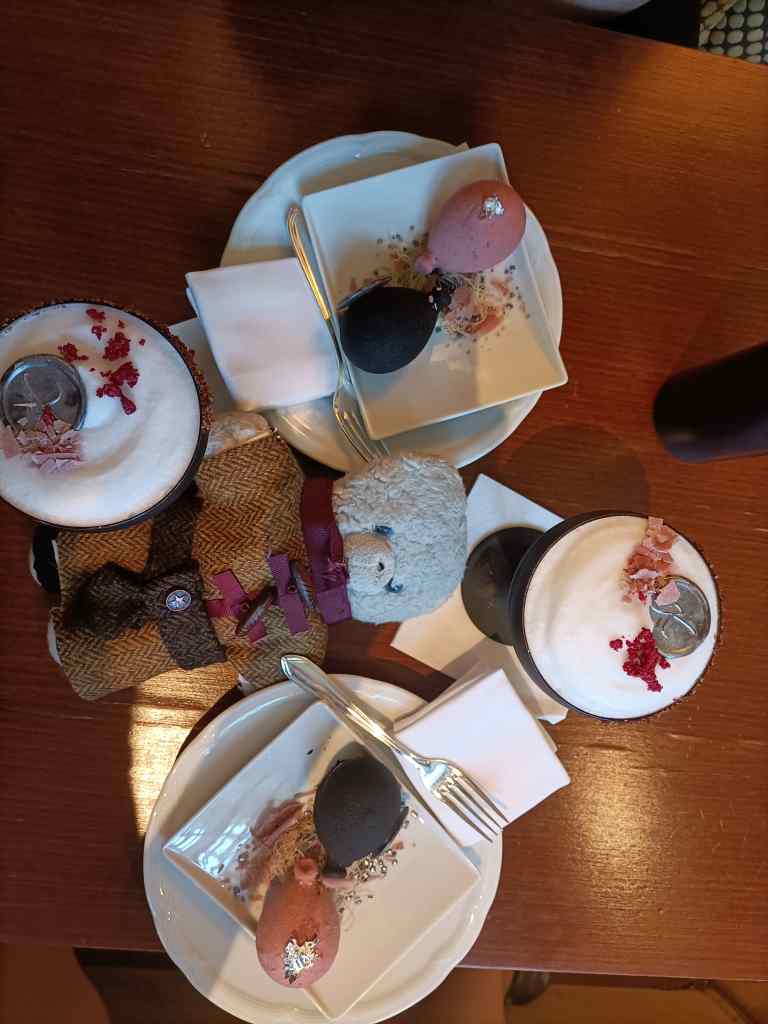
I ate my sandwiches by the side of the lake before heading back to the Kempinski, where I invested the saving I had made on parking by enjoying their special offer for a cocktail and an alcohol-infused cake. My editorial assistant had to sit and watch me eat and drink, since Slovakia has a zero mg/ml alcohol limit for driving. I don’t pity them too much though, since following me on my travels around the world is a pretty cool job.

Ordered for two but eaten by one – Kempinski Hotel, Strbske-Pleso

The following day I tried something different – rafting down the Dunajec River Gorge, a little way to the east from where I was staying. The road there took me through Slovakia again, with many neat and pretty mountain villages and some nice views of the Tatras.

More Slovak Tatras scenery near Štrbské Pleso

I stopped for lunch at a town on the river called Szczawnica back in Poland – don’t ask me how this pronounced, I am constantly amazed at the Polish language’s refusal to use vowels. This was the arrival point for the various rafting options and I ordered some more excellent local trout whilst watching the river traffic.

The most popular and famous option for visiting the gorge, recommended in all the guide books, is with a local rafting cooperative. Their rafts are large square constructions manned by two men dressed in traditional costume, who stand and steer the raft with poles. The raft has rows of seats for up to 25 tourists. These vessels move very slowly, and the people arriving looked rather bored, so instead I decided to hire a kayak and paddle myself.

I drove back to one of the hire companies I had seen at the approach to the town, and from there they took me in a mini-bus to a place 17km upstream where they kept their kayaks. I set off and paddled downstream, assisted by a gentle current.

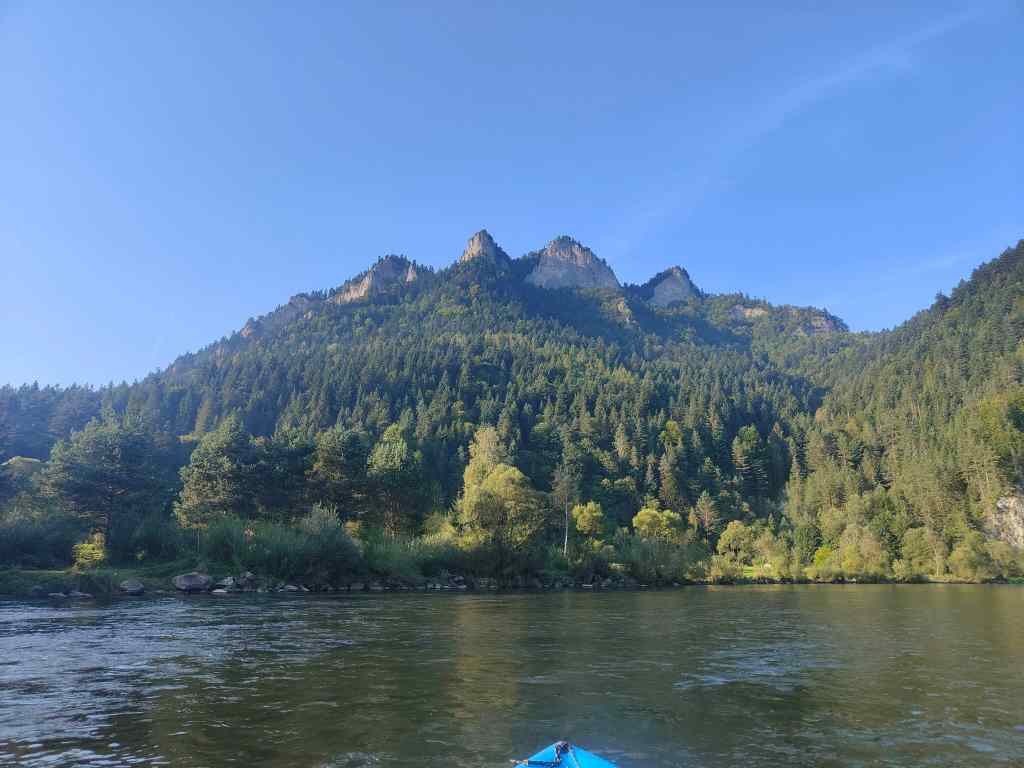
The start of my rafting on the Dunajec Gorge
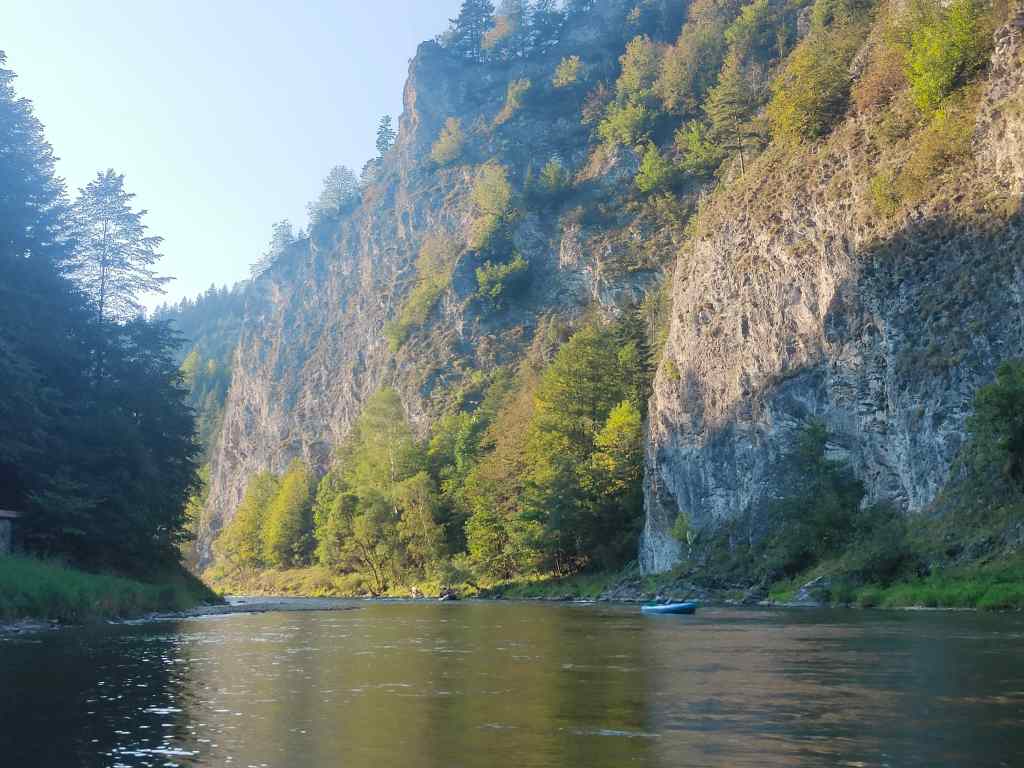
Inside the Dunajec Gorge

It was good fun, even if the scenery was pleasant rather than spectacular. I liked the way that cliffs closed in on both sides of the river, even if this meant that the gorge was in the shade and it was hard to take good pictures. There are no real rapids in the gorge, but you still have to navigate carefully to avoid getting grounded in the shallow parts of the river. After three hours I had arrived back at the kayak base, with tired arms. I was also a bit wet, but my fur helped me keep warmer than the human tourists making the trip.

It had been a another good, but slightly lazy day. Back at my chalet I had some steak and got an early night in anticipation of some rather more strenuous hiking the next day.

Next Post: High Tatras – the Valley of the Five Lakes and Szpiglasowy Wierch

Previous Post: The Tatras Mountains

The Tatras Mountains – Zapokane and Hiking Mount Koscielec

The next day I picked up my hire car and drove south for about 2 hours to the Tatras mountains that lie on the border between Poland and Slovakia. I stopped on the way to buy supplies for a few days in the chalet I had booked… and wondered again at how cheap food and (especially) drink are in Poland. The area is hugely popular with local tourists, and the road was lined with lots of holiday homes, hotels and shops selling skiing and hiking gear. I was expecting a wild and rather poor part of Europe, but instead the region felt like Switzerland – green rolling hills and pretty, neat houses. I reached my own holiday home, which was in a small village – and spent the first afternoon settling in. It was a modern building fitted out to high standards – presumably by the famously skillful Polish builders.

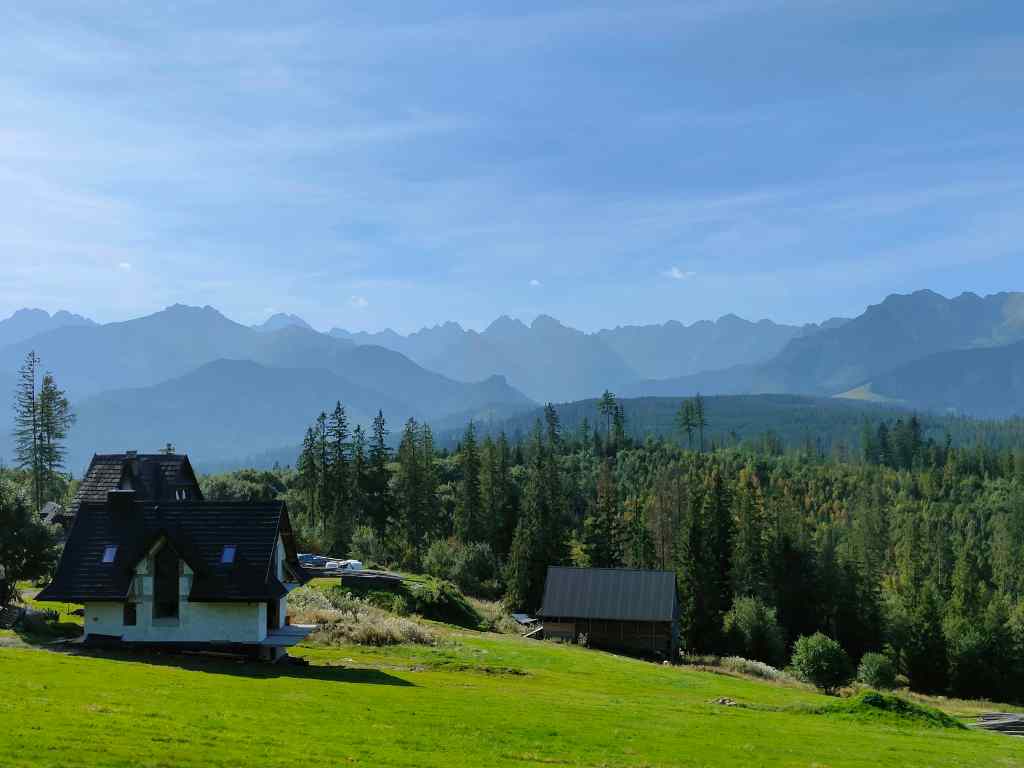
The next day I set off to go hiking. The road to the town of Zapokane for start of my trail offered a brilliant view of the mountains.

The high Tatras mountains approaching Zapokane

As I approached the Zapokane, the road became busy. Every few metres there were places offering parking. At first the prices were reasonable – 10 zlotys (2 euros) – but as I approached the starting point of my walk they rose….20, 40, and finally, where the road ended, 50 zlotys. Despite the high prices demand was strong and I got the very last space.

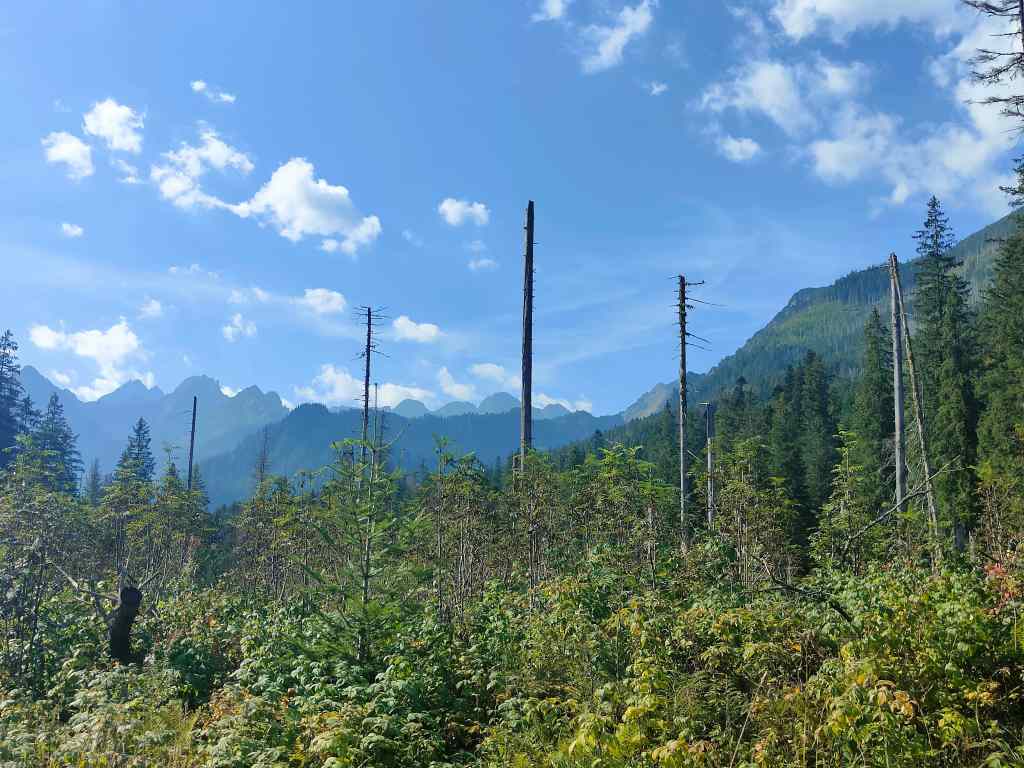
From the car park in Zapokane I still had to walk about a kilometre to the park entry and pay my entrance fee. There were lots of other hikers, who nearly all seemed to be Polish. The first part of the trail went through a forest. It was pleasant but not exceptional and at first I wondered why the region has such a lofty reputation. But then the path emerged from the forest and a spectacular vista opened up of the High Tatras mountains rising steeply from the surrounding hills.

On the approach to Mount Koscielec
High Tatras mountain scenery

After a bit more walking my destination came into sight – Mount Koscielec, nicknamed the “Polish Matterhorn”. It is the second pointy peak in the middle of the next photo.

Mount Koscielec comes into sight

At the base of the mountain was a pretty lake, with perfectly clear water, in which I saw several trout swimming.

A pretty mountain lake with trout at the base of Mount Koscielec

From there it was a steep climb up to the first pointy peak located just below the Mount Koscielec. It was quite hard work involving scrambling up rocks, but the view at the top was worth it.

Hiking up Mount Koscielec – the view from the interim summit

Mount Koscielec looms in front

I could see the main mountain ahead of me, but on my first day’s hiking I didn’t fancy another hour or so of scrambling over rocks, and I thought the view would be just as good were I was. So I enjoyed the spectacular scenery for half an hour and then headed back to Zapokane. Climbing Mount Koscielec will have to wait for when I return to the Tatras!

Views on the way back to Zapokane

I was very happy with my walk, even if chickened out of the very last part of the climb up the mountain. I returned to my chalet to have a dinner of locally caught trout, with some Polish white wine. The trout was excellent, but although Poland does many things well, wine is not its strongest suite. For my next meal I will revert to their excellent beer and vodka!

Previous Post: Krakow

Next Post: Hiking in Slovenia and Rafting the Dunajec Gorge

Krakow

The next day I set off to explore the city. Krakow has a compact but exceptionally pretty old city, as usual centred around a square. The latter was originally built in 1257 to house Krakow’s busy market, at a time when Krakow was an essential stop on many busy trade routes crossing Europe. Today the square is surrounded by cafés where you can sit and drink coffee, beer or cocktails.

Krakow’s main square with the market and its tower

One of the square’s most famous buildings is St Mary’s Basilica, dating from the 13th and 14th Century. Every hour a bugler plays a short tune from the top of tower. The tune breaks off part way through a bar – legend has it that in the 13th Century, a sentry spotted an approaching Mongol army and raised the alarm by sounding his bugle. As he played he was shot through the throat by a Mongol arrow – hence the abrupt ending to the tune. Unfortunately his alarm was in vain, the Mongols still destroyed the city.

St Mary’s Basilica, Krakow
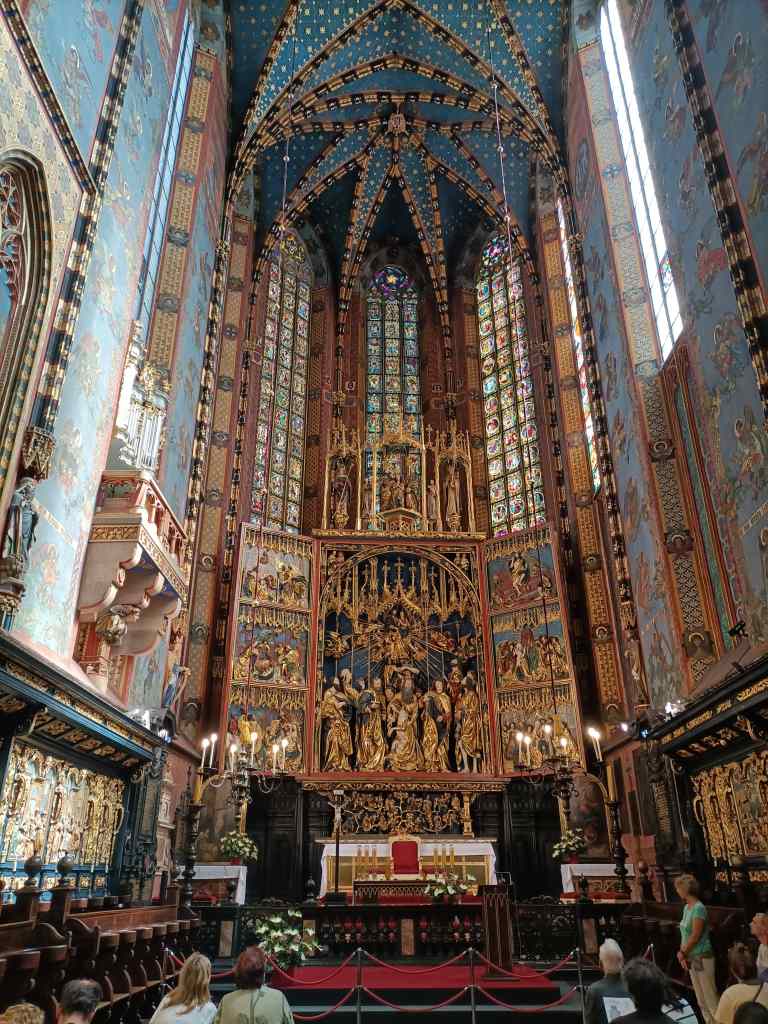
The inside of the Basilica is also pretty

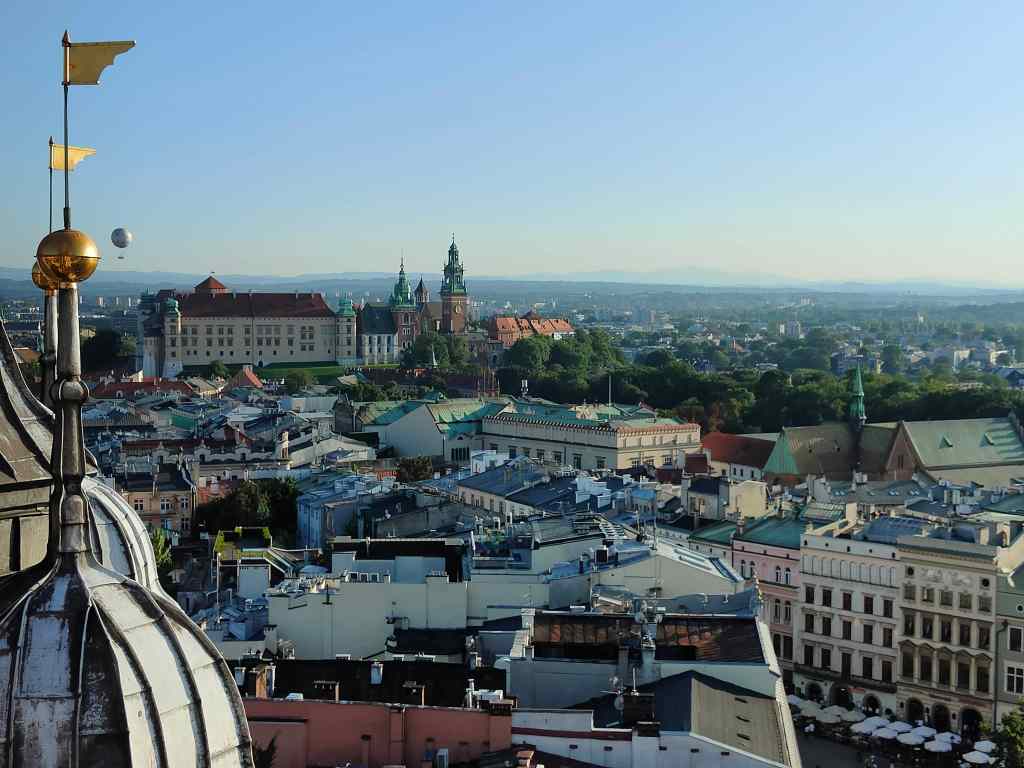
I took the opportunity to climb up to the top of tower to get an overview of the city and plan my next steps, and was rewarded with a fine view of the city and the castle with its cathedral.

View over Krakow

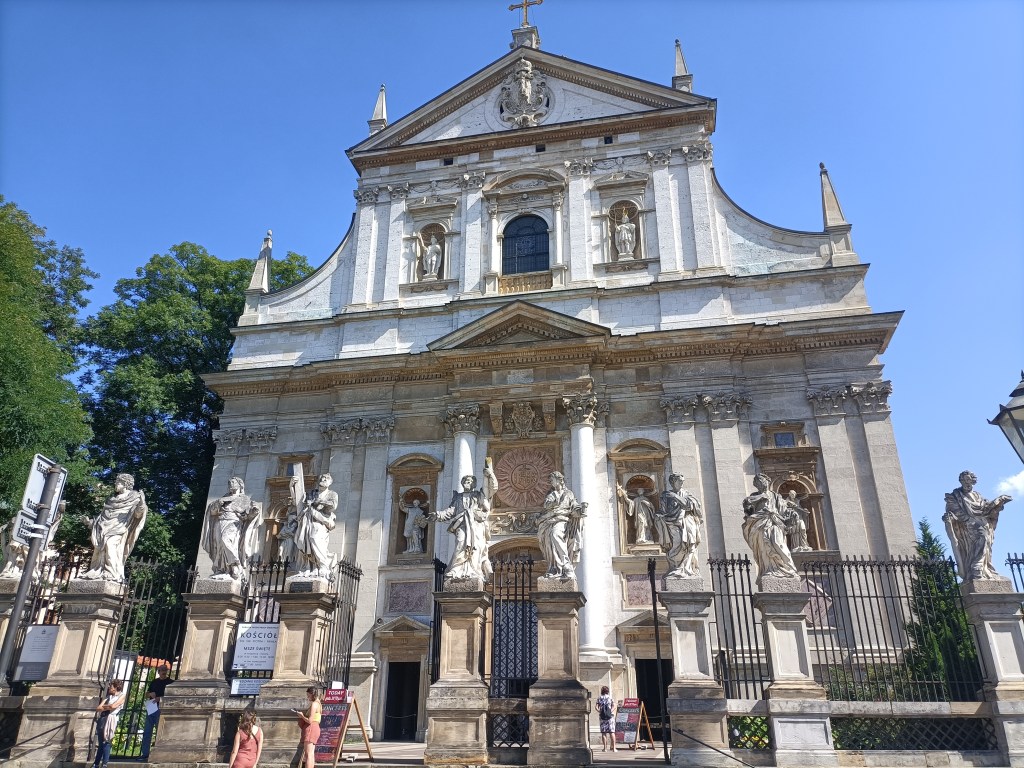
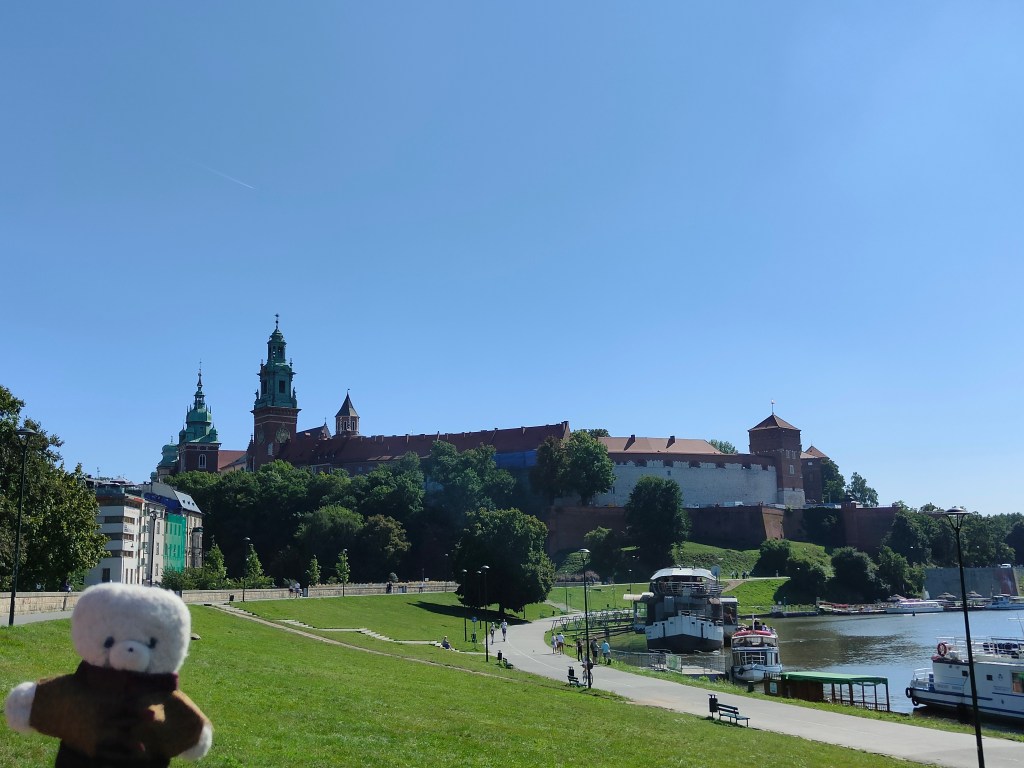
From the main square I strolled off through the old town towards the castle, finding lots of pretty buildings along the way.

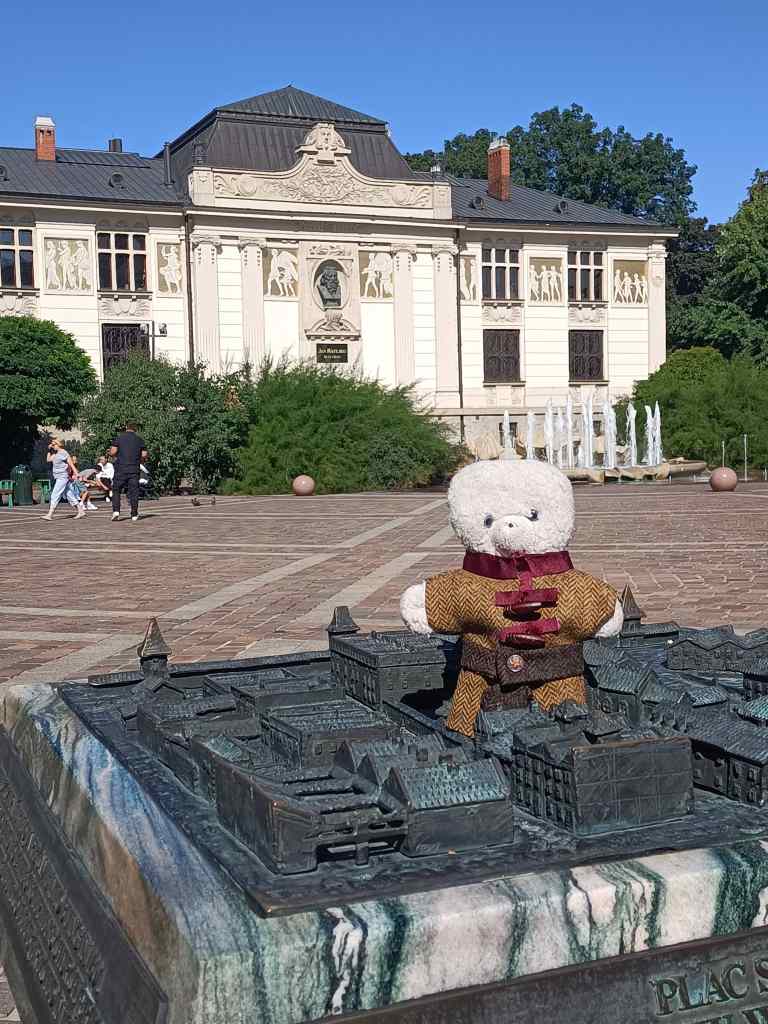
A pretty square in Krakow
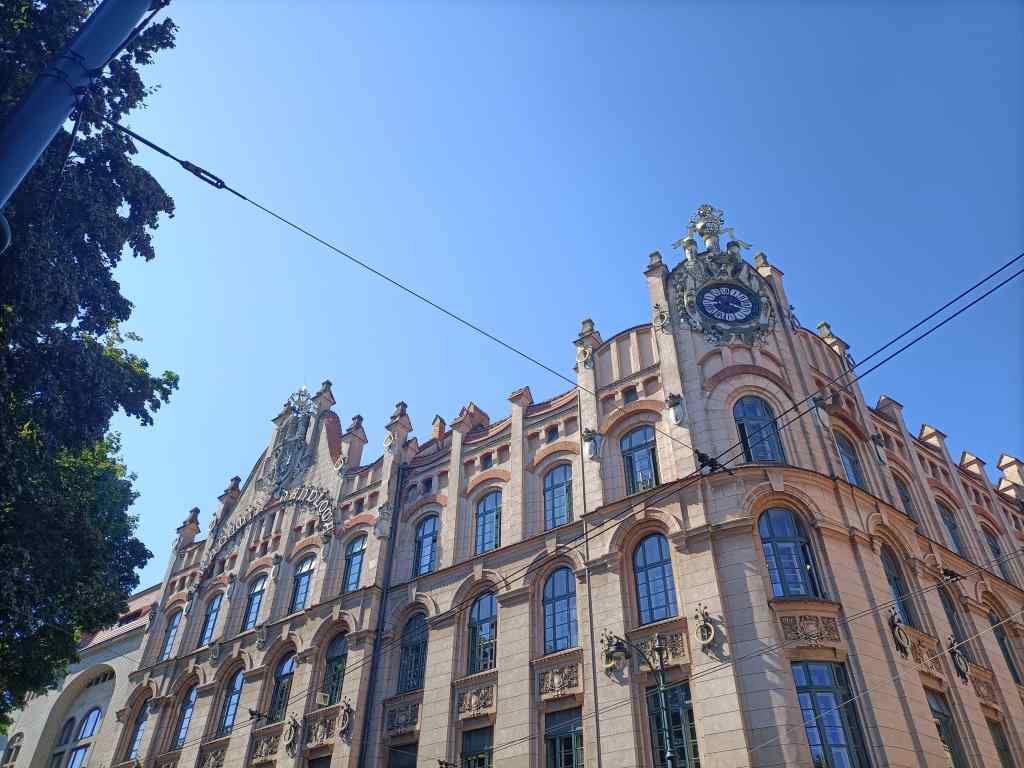
Early 20th century architecture
Saints Peter and Paul Church, Krakow
Krakow riverside and castle
In the grounds of Krakow Castle

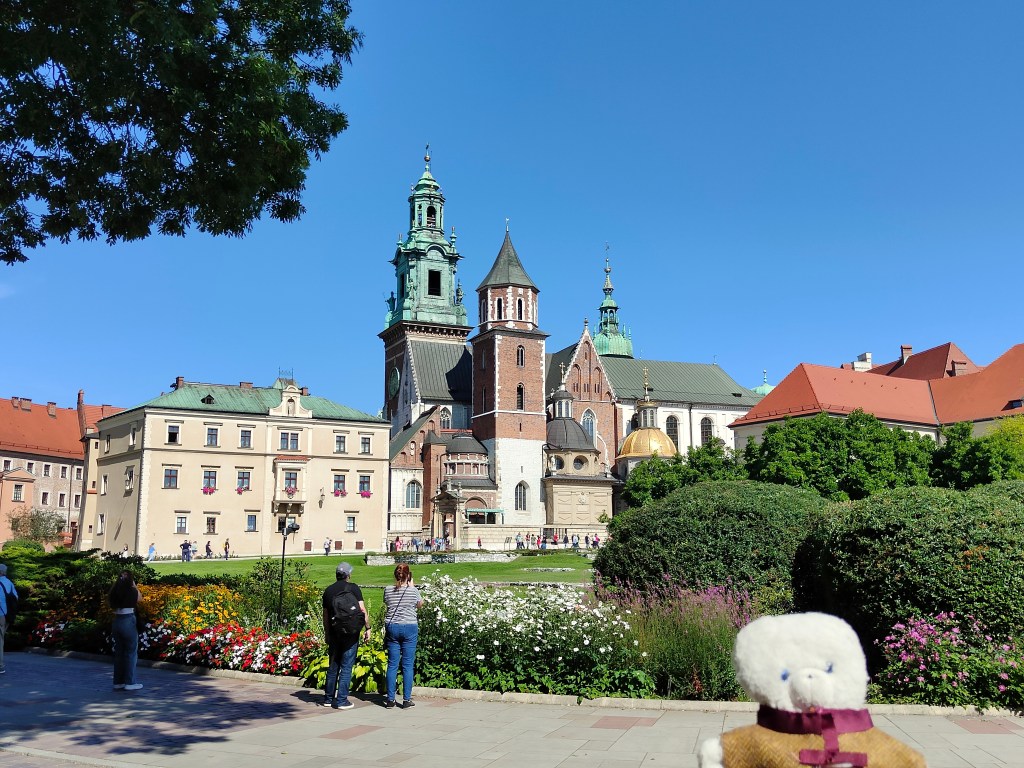
I visited the cathedral, which had a large and apparently famous bell, and a crypt housing the coffins of many past Polish kings. Krakow was the capital of Poland from 1038 until 1596, but even after the court moved to Warsaw, it remained an important business and cultural centre. My guide book said that the inside of the castle was less interesting than the outside views, so I strolled around until I found the castle gardens to relax in.

In the gardens of Krakow Castle

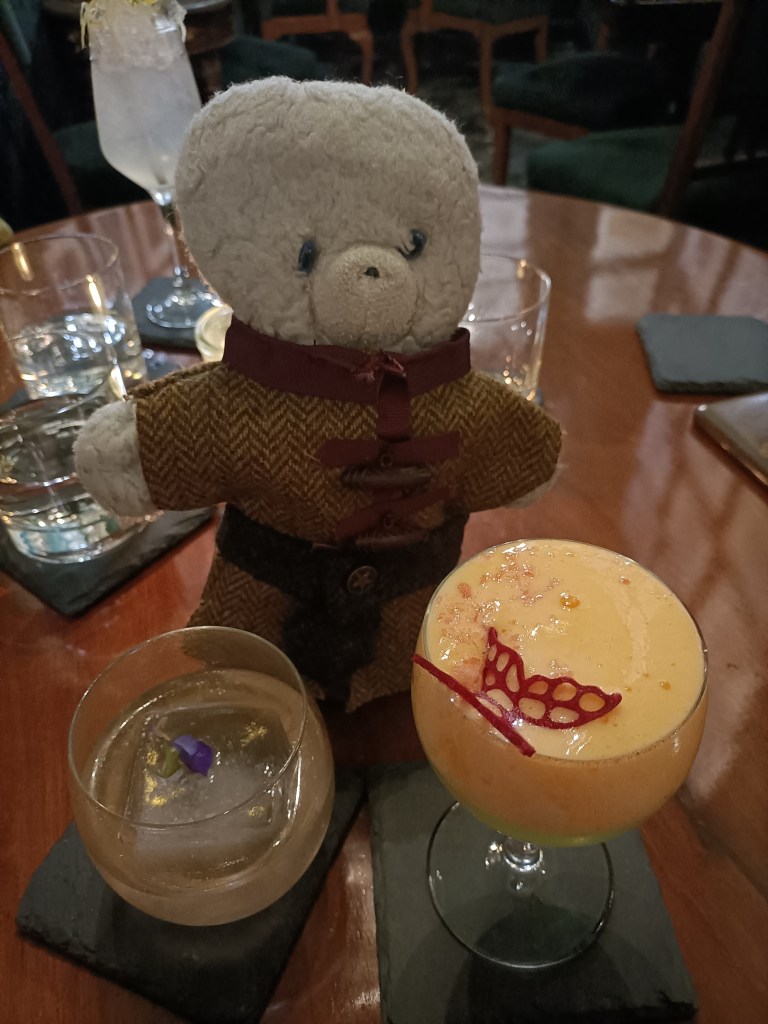
It had been a busy day with lots of walking, so I headed back to my flat before going out for cocktails and dinner. I discovered that eating and drinking out in Krakow is really cheap, and slightly over-indulged myself with some very good cocktails.

I returned to my AirbnB flat and settled down for the night. My accommodation was also very good value – there are lots of very good hotels and flats available in Krakow for visitors. Mine was right in the centre of the old town, which was very convenient except for its proximity to St Mary’s Basilica. I discovered that the bugler performs their piece every hour all throughout the night….

Next Post: High Tatras, Zapokane and Mount Koscielec

Previous Post: From Prague to Brno to Krakow

From Prague to Brno to Krakow

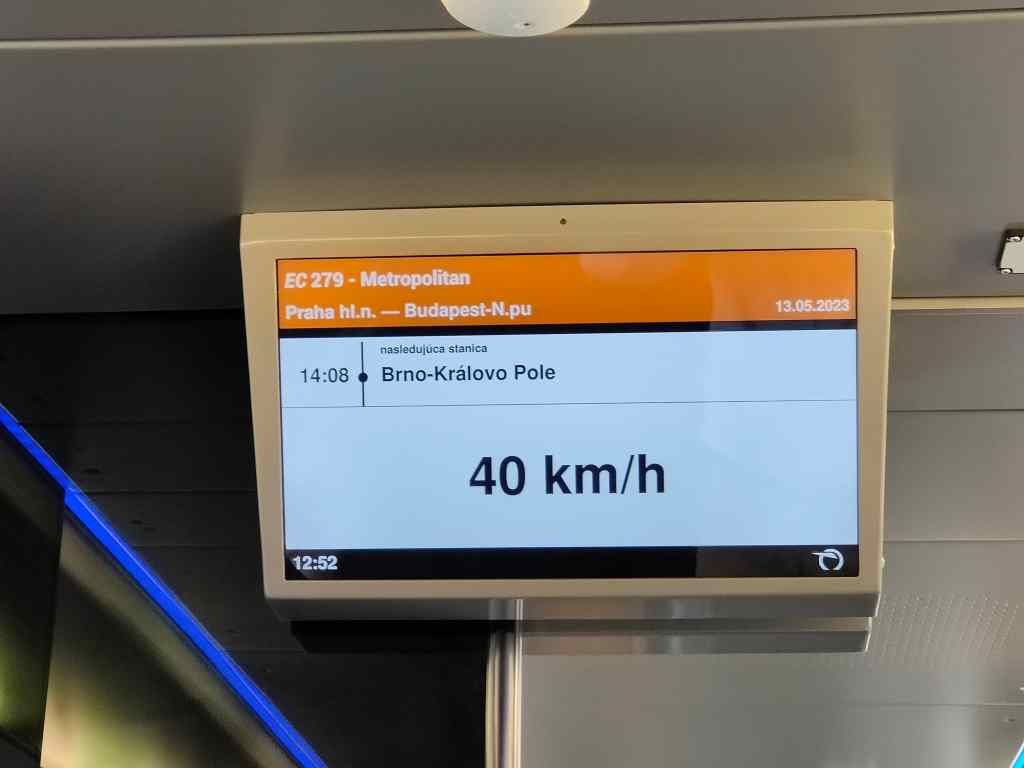
From Prague I headed by train to Brno, the Czech Republic’s second city. In contrast to my recent experience in Spain, the train was slooooowww.  

Hmmm….bus is often faster than train in this part of the world

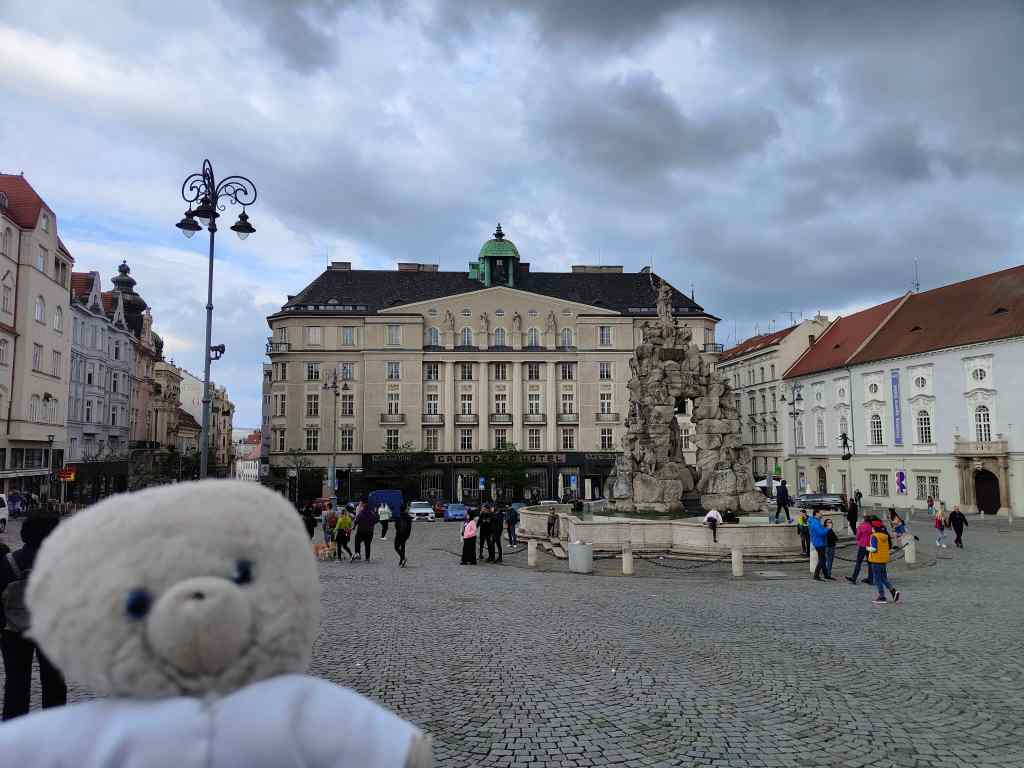
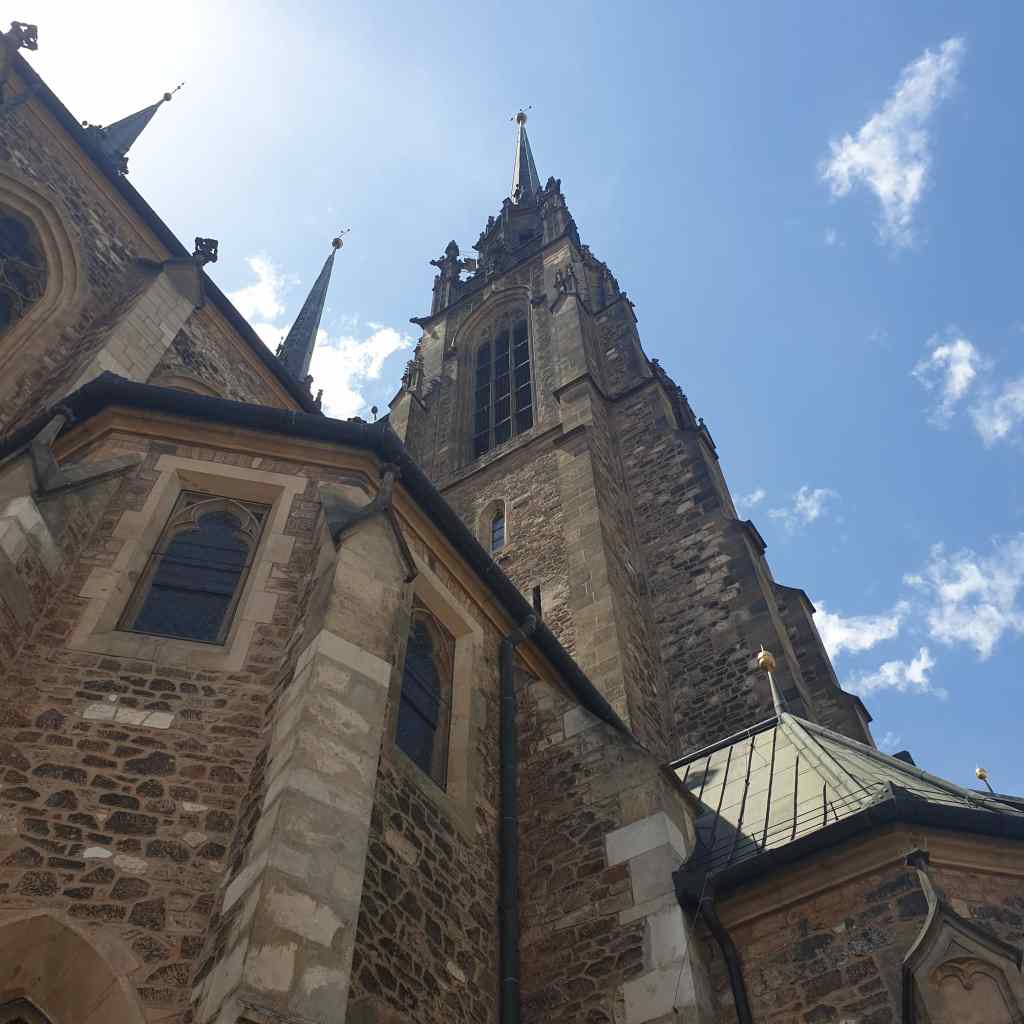
In many ways Brno is like a smaller version of Prague, with pretty architecture, a castle, lots of churches and a main square.

Brno’s main square
Brno’s main square again
One of the many churches in Brno

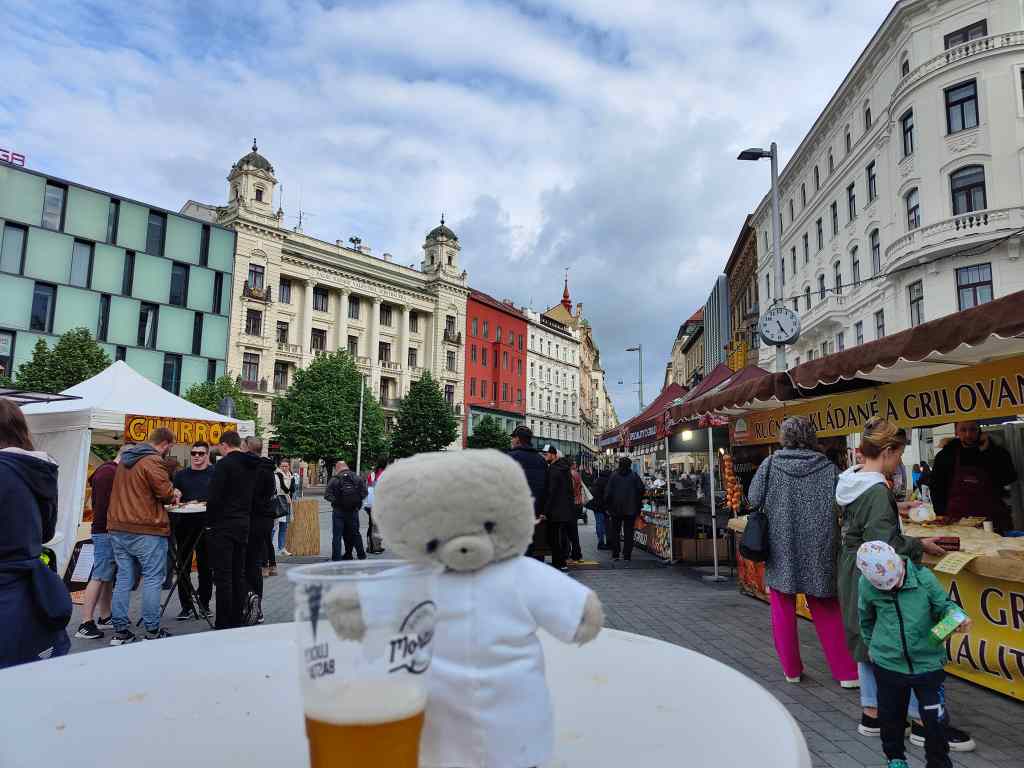
I found a market with beer stalls for some refreshment

Beer and pretty coloured houses in Brno

Brno was a nice place, a bit like a mini version of Prague with fewer tourists. I spent one night there before heading on to my main destination, Krakow, by bus. At the bus station I got a reminder a just how close to the conflict in Ukraine this part of the world is.

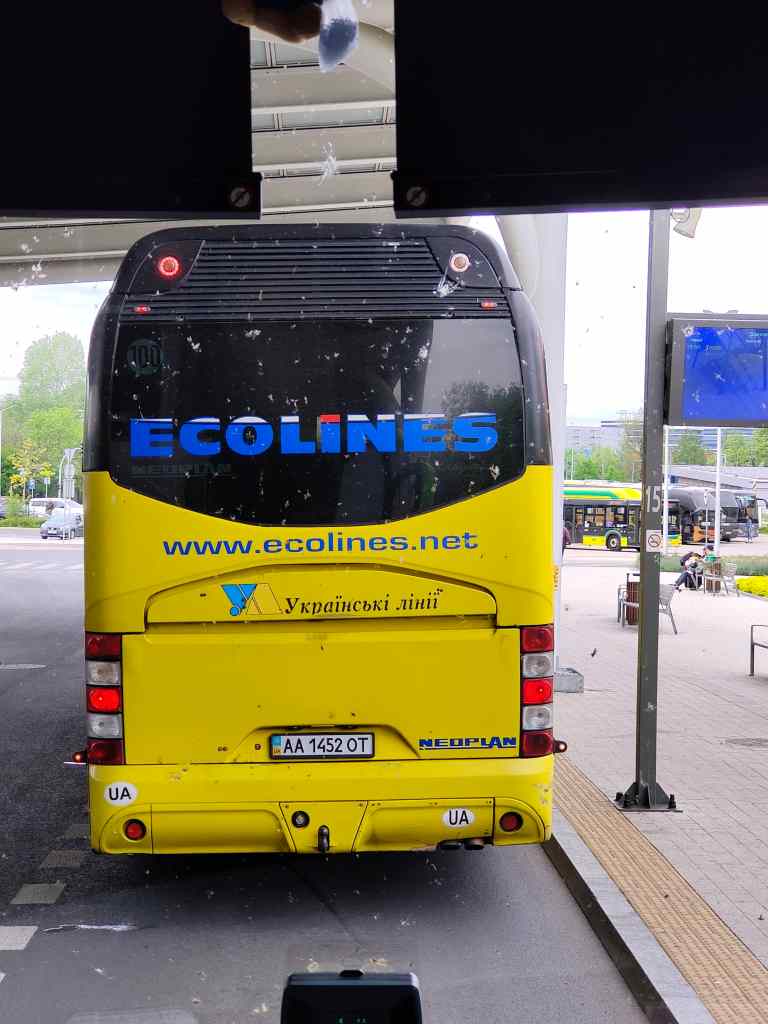
A bus heading to Ukraine from Brno

The bus trip from Brno to Krakow took about four hours, passing through some pleasant, if unspectacular, countryside

Rolling fields near the Czech/Polish border

I arrived in Krakow and walked into the old town to find my flat. I was immediately impressed by the feel of the place and looked forward to exploring the next day.

The gate to the Old Town, Krakow

Next Post: Krakow

Previous Post: Prague

Blog at WordPress.com.

Up ↑