From Franschhoek I drove east, towards the small town of Oudtshoorn, about 400km away. My route took me first over the Franschhoek pass, which offered the first of many spectacular views.
After some more driving, I reached Route 62, famous as one of South Africa’s most scenic drives. It went through a mountain pass up to plateau known as the Klein Karoo. Normally this area is semi-desert, but this year the South African winter has seen unusually heavy rain, and now the road was flanked by green plants and flowers. It was a pleasant change after the relentlessly dry landscapes of Namibia.
Flowers on the approach to Route 62The first mountain pass on Route 62
The road was good, traffic was light, and my progress was fast. To make driving even more pleasant, Route 62 heads through some nice towns like Montagu and Ladismith, which had excellent cafés.
The Barn on 62 restaurant and café, an excellent coffee stopStreet scene in Ladismith
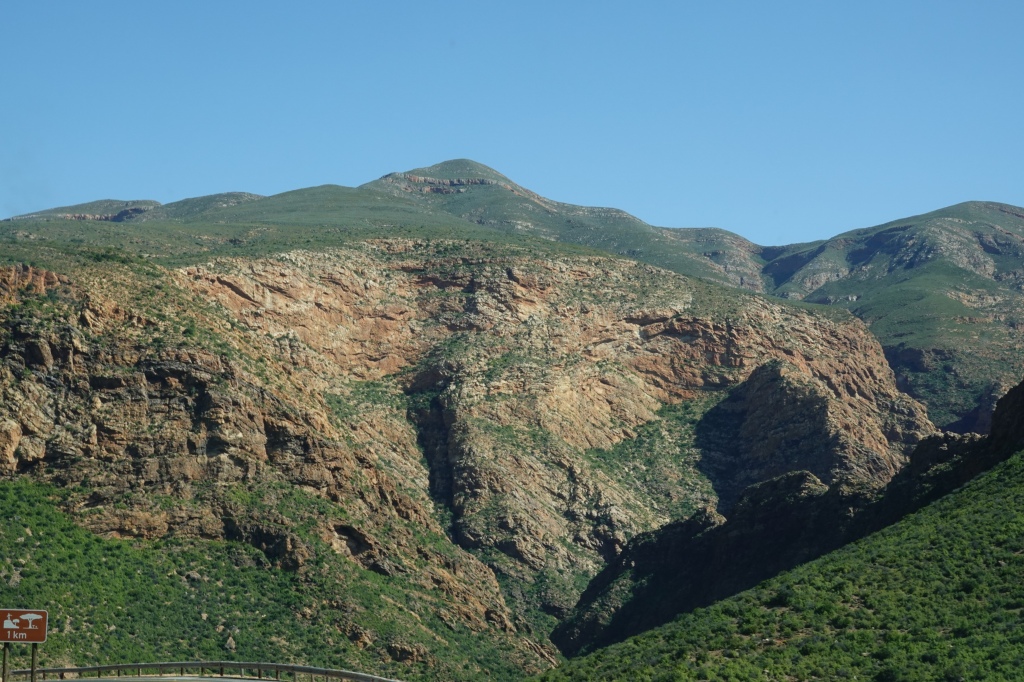
After a final mountain pass……
The final pass on the way to Oudtshoorn
…….I reached Oudtshoorn in the late afternoon. The town is known as the ostrich capital of the world, and was the centre of a brief boom in the early 1900s, when ostrich feathers were fashionable in Europe and extremely expensive. Now Oudtshoorn is a sleepy, pleasant provincial town and still a centre for ostrich farming. More about this in tomorrow’s post!
Women selling ostrich feathers at the entrance to Oudtshoorn
I relaxed in my hotel and had dinner in a local restaurant. Despite once again spending most of my time in the car, I had enjoyed the day. The scenery was spectacular and very varied, the driving fast and easy, and the small towns along the way had been welcoming and offered good coffee. South Africa lends itself to road trips.
My previous post covered the last full day of sightseeing I had in Namibia. The next day I woke early to see the rising sun casting long shadows over my lodge.
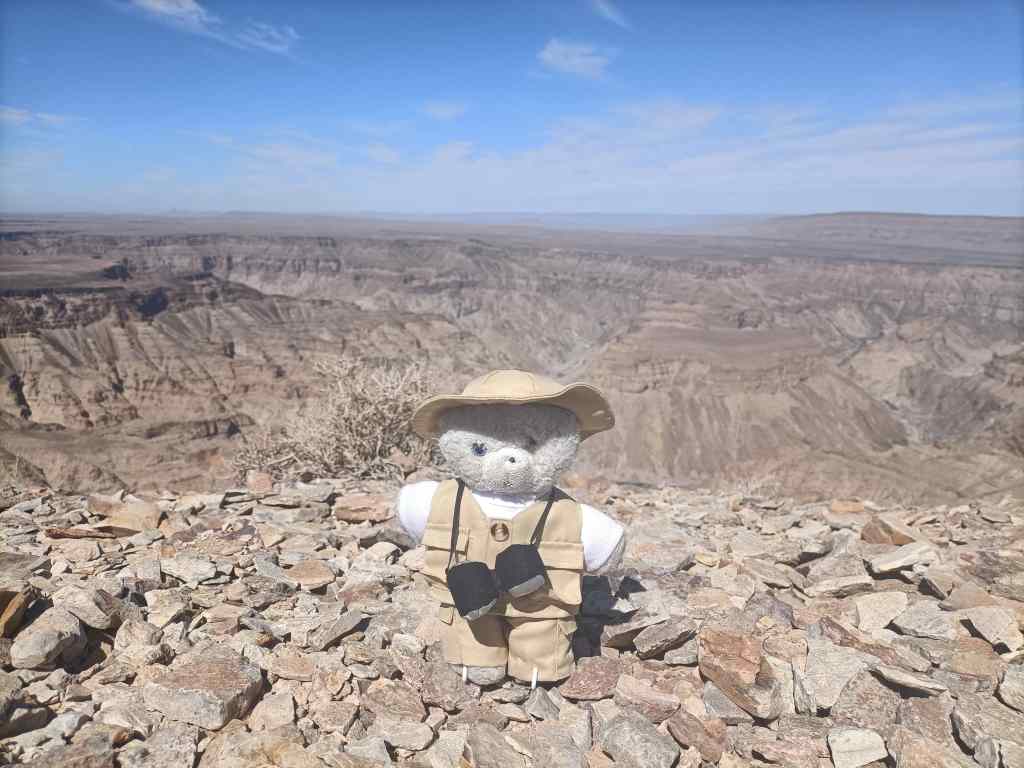
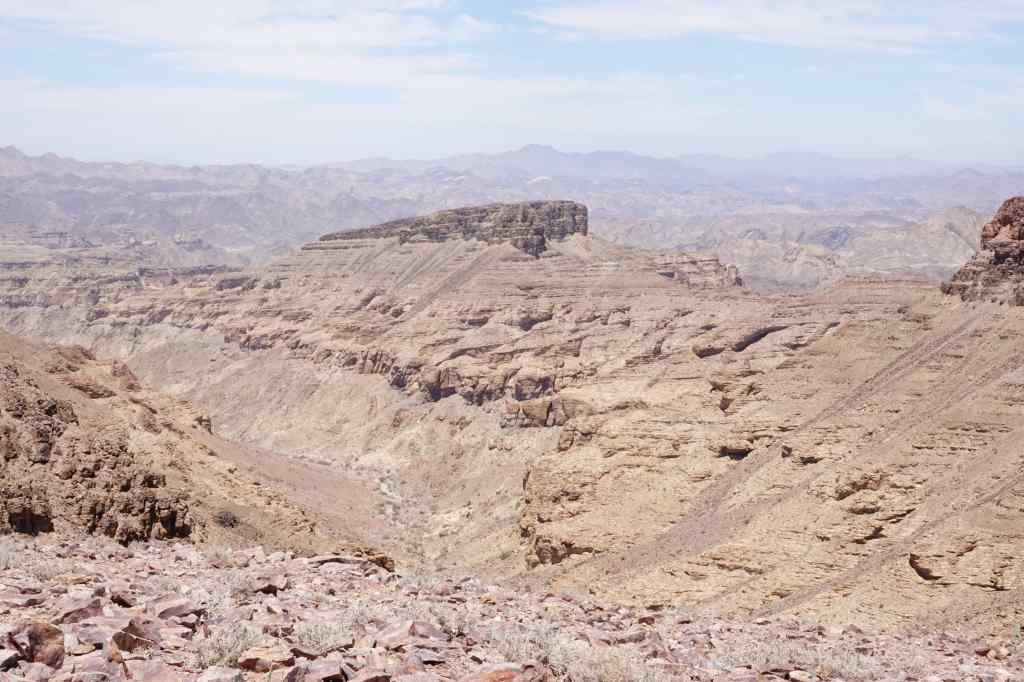
Next, I revisited Fish River Canyon briefly in the morning….
Early morning at Fish River Canyon
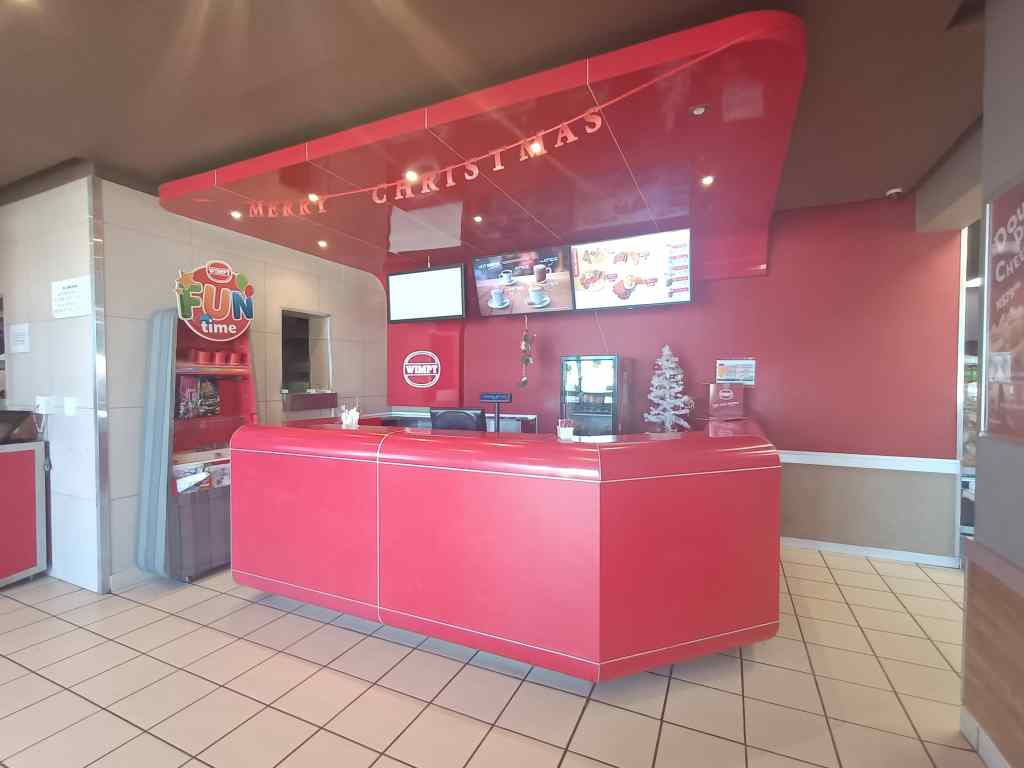
…before making a rather boring six hour drive north, to a lodge near a town called Mariental. This was not a destination in itself, but a convenient place to spend the night on the long, long way back to Windhoek. Now I know why Fish River Canyon is so little visited – it is so far away from anywhere else. Namibia’s B1 is surfaced, flat and fast, but must be one of the most boring roads on the planet. The “highlight” of these six hours was finding a Wimpy restaurant at a service station – I though they had died out, but apparently they still thrive in Africa. The décor was wonderfully sixties kitsch.
I thought it was extinct…..Wimpy lives on in Africa
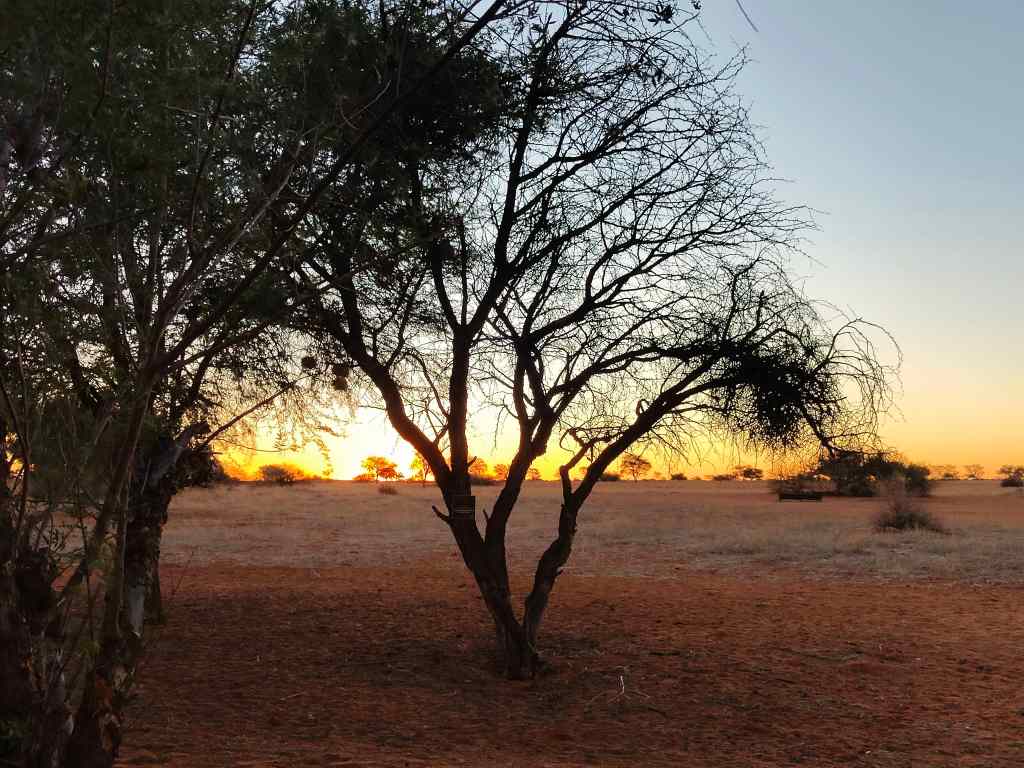
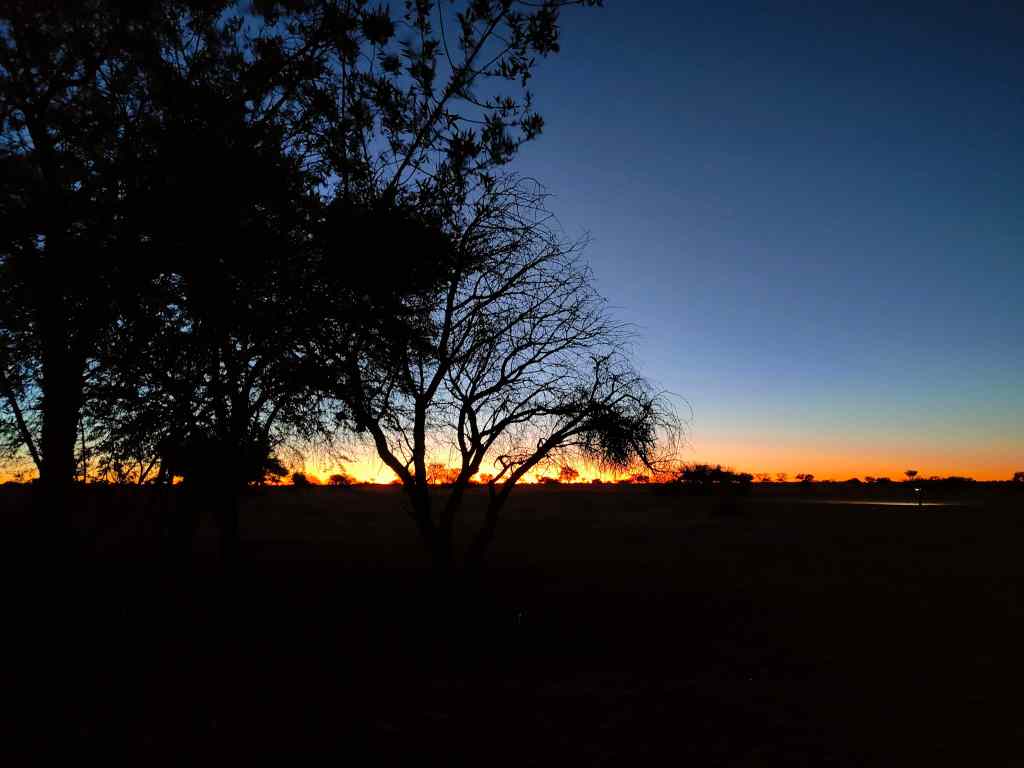
I finally arrived at around five, having driven all day (or so it seemed). I had originally intended to go on the lodge’s “sundowner” game drive, but since I was tired, I decided instead to spend my last night in Namibia sitting on the big swinging chair on my balcony, and watch the sunset with a good glass of wine.
Watching the sunset over the Kalahari desert
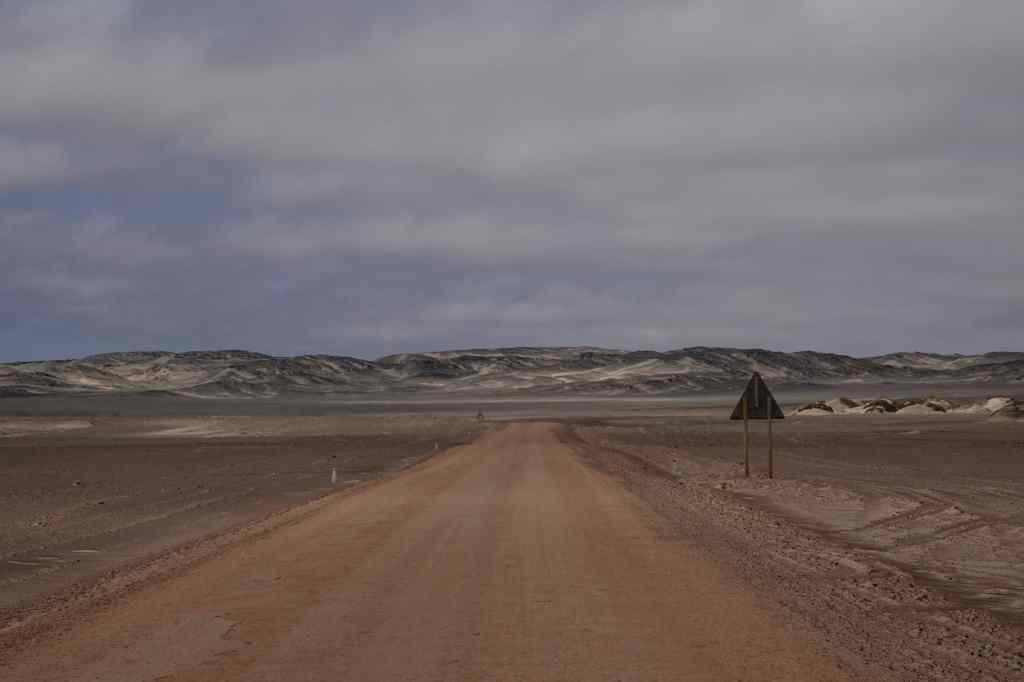
The next morning, I got up early and continued the road to the north – another 3 ½ hours – to Windhoek airport, to catch my early afternoon flight to Cape Town, where my adventure will continue. On returning my hire car, I found out that in 20 days I had driven over 5,000km – at an average speed often limited to 70km/h by Namibia’s gravel roads. Namibia has many world class attractions, but getting to them requires a big investment in time.
Be prepared for lots of this driving around Namibia…..
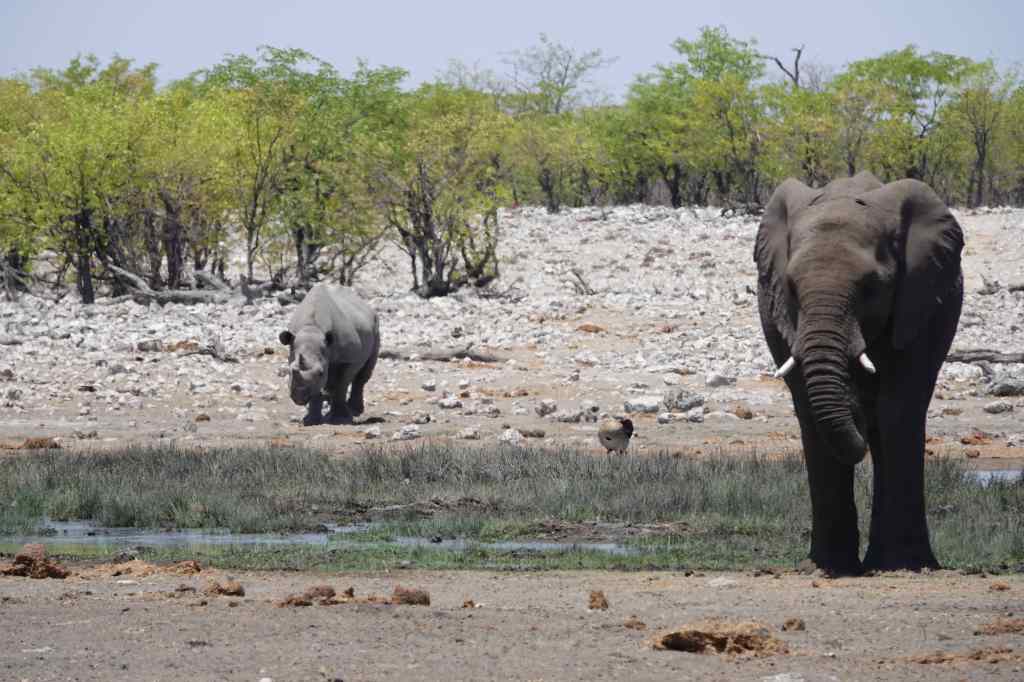
So that was the end of my Namibia trip – now I am off to South Africa for more adventures. It’s time to share a few photos of the highlights. First, there was the wonderful park of Etosha and its wildlife…..
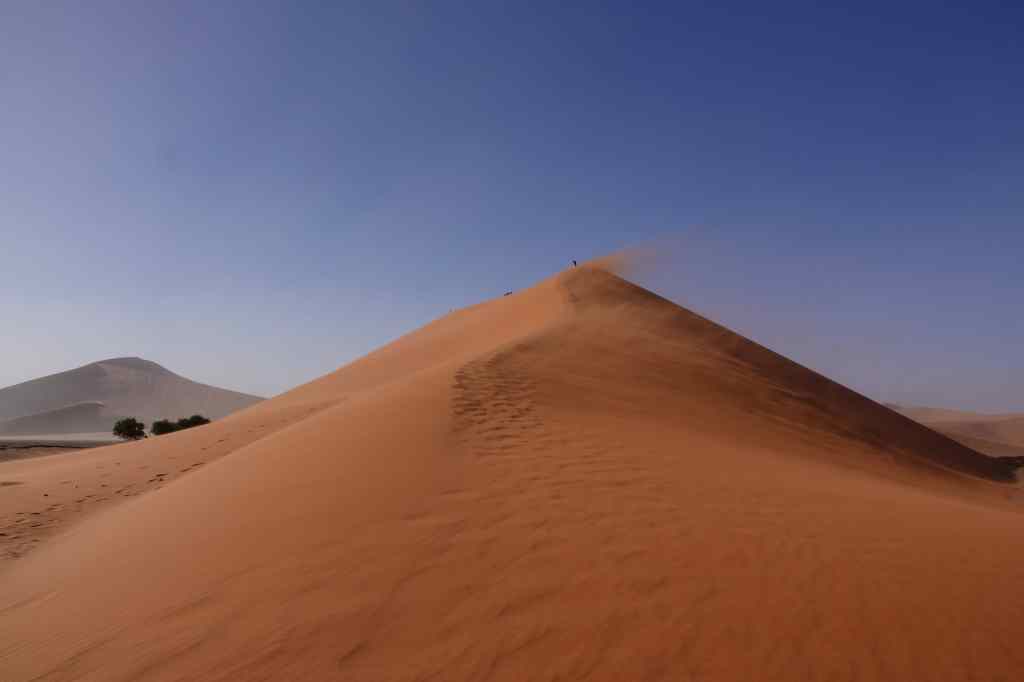
Namibia’s next world class attraction are the dunes of Sossusvlei
Sossusvlei!
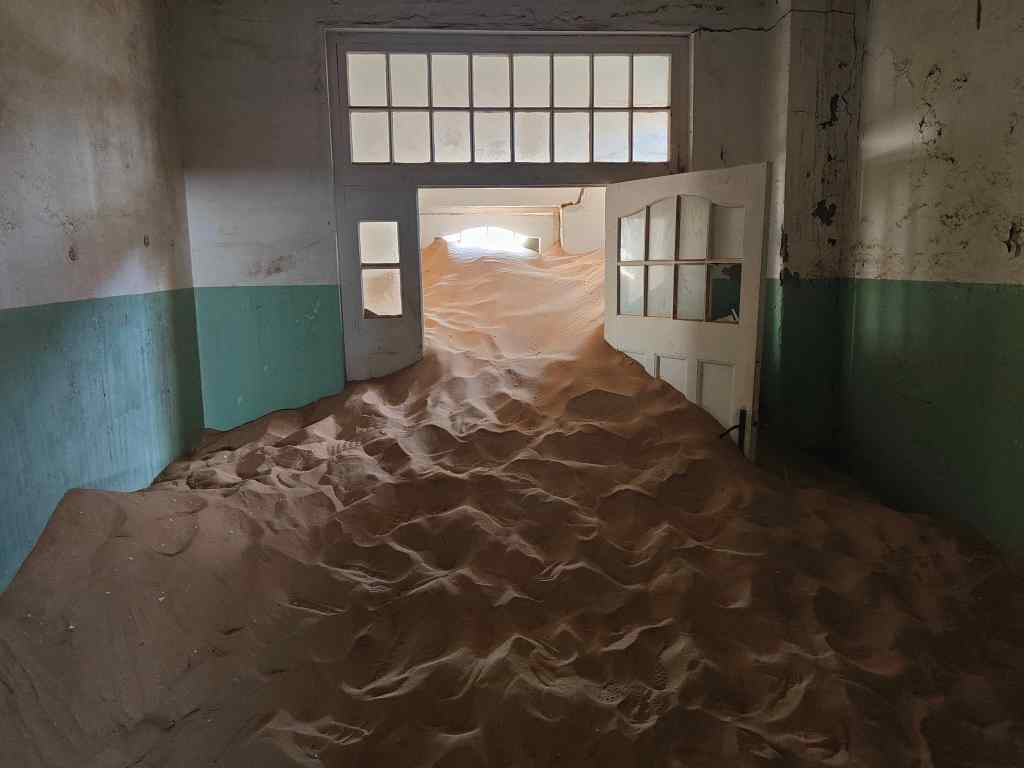
I will also always remember Kolmanskop, as a symbol of the power of nature over man……
The irresistible force of nature at Kolmanskop
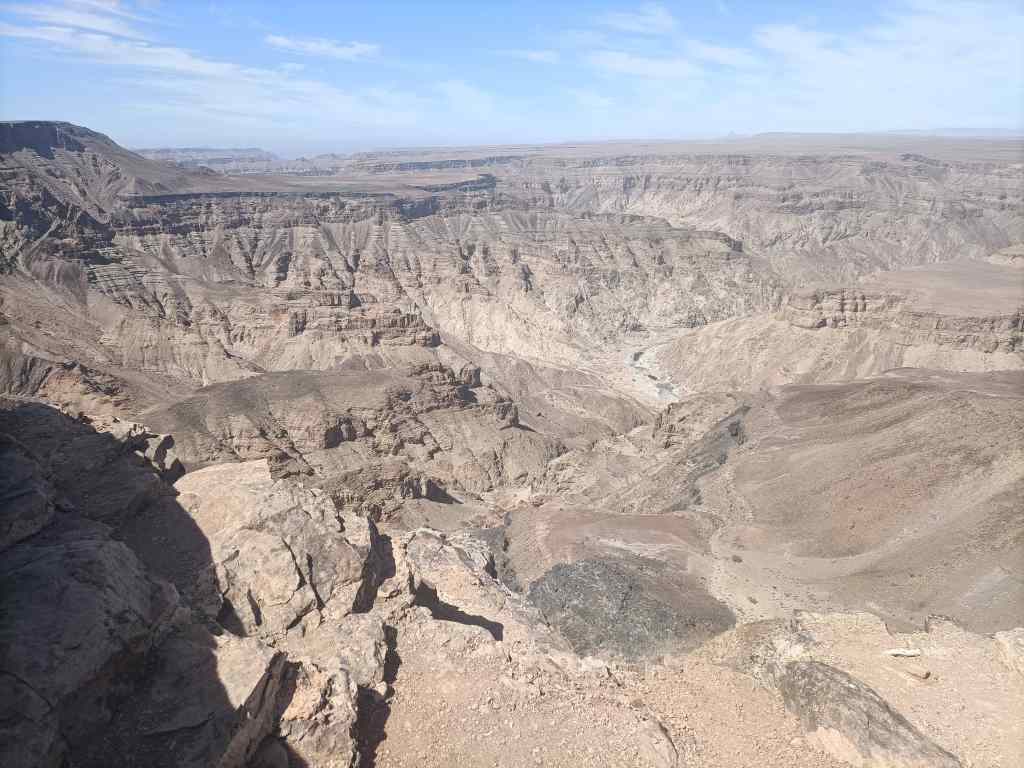
….and my solo drive down to Eagle’s Rock in Fish River Canyon. It is not often you get a view this like all to yourself.
Eagle’s Rock, Fish River Canyon
I was keen to see if South Africa can match Namibia as a travel experience. Keep reading my blog to find out!
Today was day sixteen of my tour around Namibia and it saw me return to traditional sight-seeing. My destination was Fish River Canyon, the world’s second largest canyon (after the Grand Canyon in the US) and one of Africa’s most impressive – and least visited – natural wonders. It was located a short drive from my lodge. First, I drove to the main viewing point, where there was an information display and a few other tourists taking in the awesome view.
The main viewpoint at Fish River Canyon
Fish River Canyon is 160km long, up to 27km wide and 550 metres deep. It was formed initially by a rift between the earth’s plates and then was deepened by the action of glaciers during the Ice Age 300 million years ago. For the last 60 million years the canyon has been deepened further by the flow of the Fish River – although in the dry season, the river is reduced to series of ponds of stagnant water.
I enjoyed the main viewing area for a while and then set off to the “Hiker’s Viewpoint”, for an alternative perspective. This was the starting point for a tough, 5-day, 80km hike covering the deepest and most impressive parts of the canyon. A steep path led down, marking the start of the trek. Once in the canyon, walkers have only two further emergency exits up steep cliffs before the end of the hike 80km away. Prospective hikers must register months in advance, be prepared to be totally self sufficient for 5 days, and produce a medical certificate attesting to their fitness before setting off.
The “Hiker’s Viewpoint” and main path down into the Fish River Canyon
From the Hiker’s Viewpoint I retraced my steps and then found a track heading south along the canyon edge, which I had missed earlier. The track was totally unmarked, and very few other visitors seem to have found it; without my guidebook, I would never have known it was there. After a few km it stopped at another viewpoint, where I had the views completely to myself.
Sulfur Springs ViewpointMore Fish River Canyon views
From there, another very rough track, suitable only for 4×4 vehicles, led further south. After another thirty minutes it led to the final viewpoint – Eagle Rock – which was perhaps the most impressive of all. I sat there for around thirty minutes, making sure I was fully rewarded for the effort of getting there.
Eagle Rock Viewpoint
On the drive back I passed one other car struggling to reach Eagle Rock – maybe the place gets ten visitors per day, for one of the world’s best views.
Back on the main road I headed south to Ai-Ais, a name that means “burning water” in the local language, where there are some hot springs, a government-run resort, and the place where the 80km canyon hike finally ends. I walked a short distance down the hiking route to see what it was like. To me, it was a rather unexciting dry sandy riverbed, and must have been an anticlimactic way to end an epic hike through the world’s second biggest canyon.
Must be an uninspiring end to an 80km trek…
I ended my visit at a big swimming pool filled with warm water from the hot springs. A group of schoolchildren kept me amused with their games.
Suddenly, I realised that apart from the people serving me in restaurants and hotels, I had hardly met any local black people. The owners of hotels and businesses had all been white, and my fellow travellers were all white. The legacy of Namibia’s colonial times lives on, even if today’s government is trying to improve the lot of poor black majority. I reflected on this thought whilst enjoying yet another glorious African sunset back at my lodge.
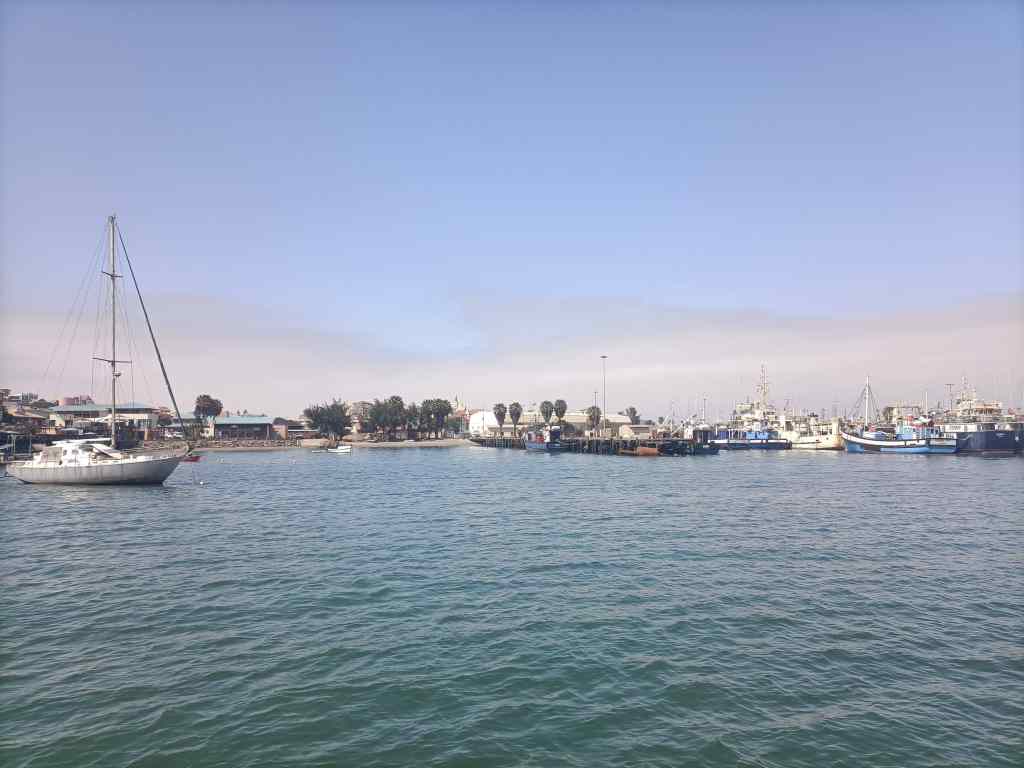
Today I had two very different experiences – one wet and one dry. I woke early to make the 8am departure of a catamaran cruise to Halifax Island, home to a colony of African penguins. The port of Luderitz was quite busy – in addition to a small fishing industry, several giant diamond-mining ships operate there. The latter scrape the sea floor, sieve the mud, and harvest large quantities of high quality diamonds.
Luderitz port
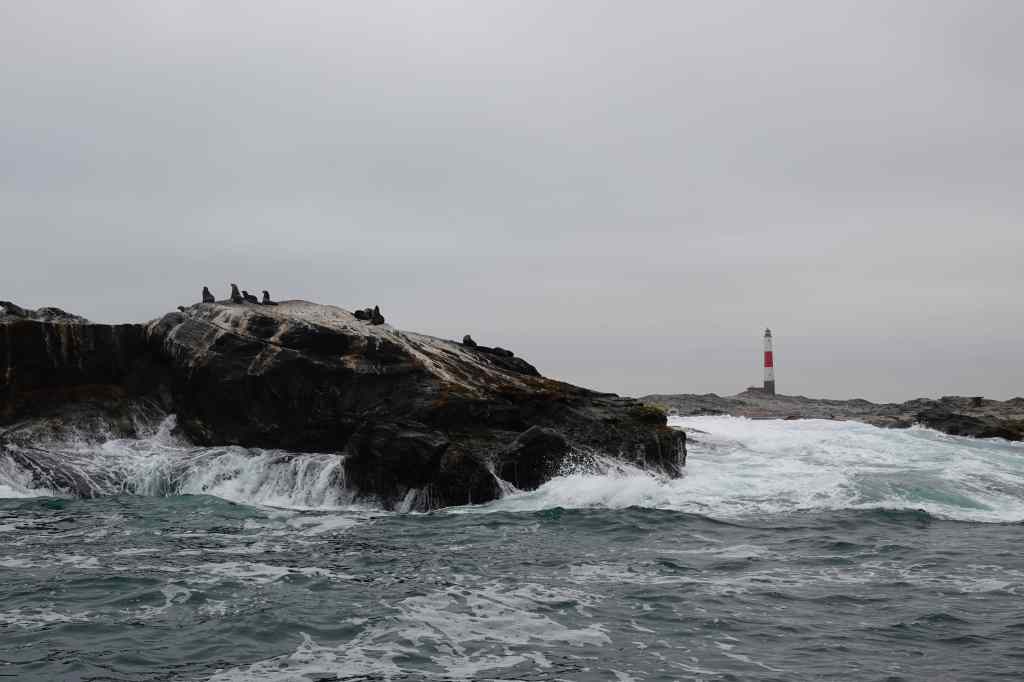
On the way to see the penguins we passed the port’s lighthouse and a few seals; dolphins also followed our boat but proved frustratingly hard to capture on film.
Luderitz lighthouse and seals
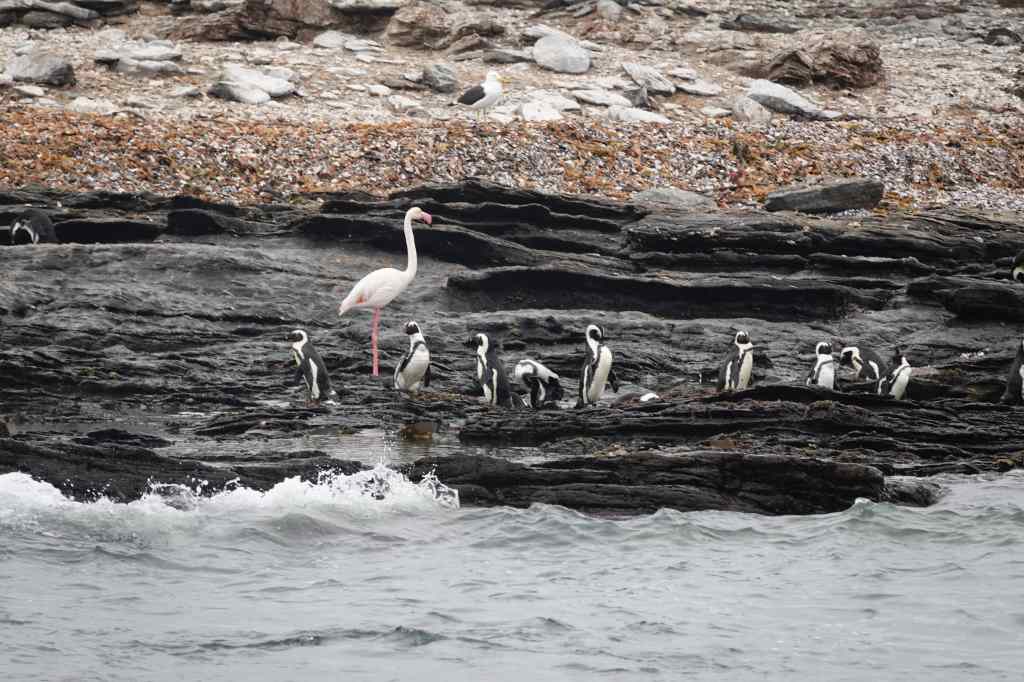
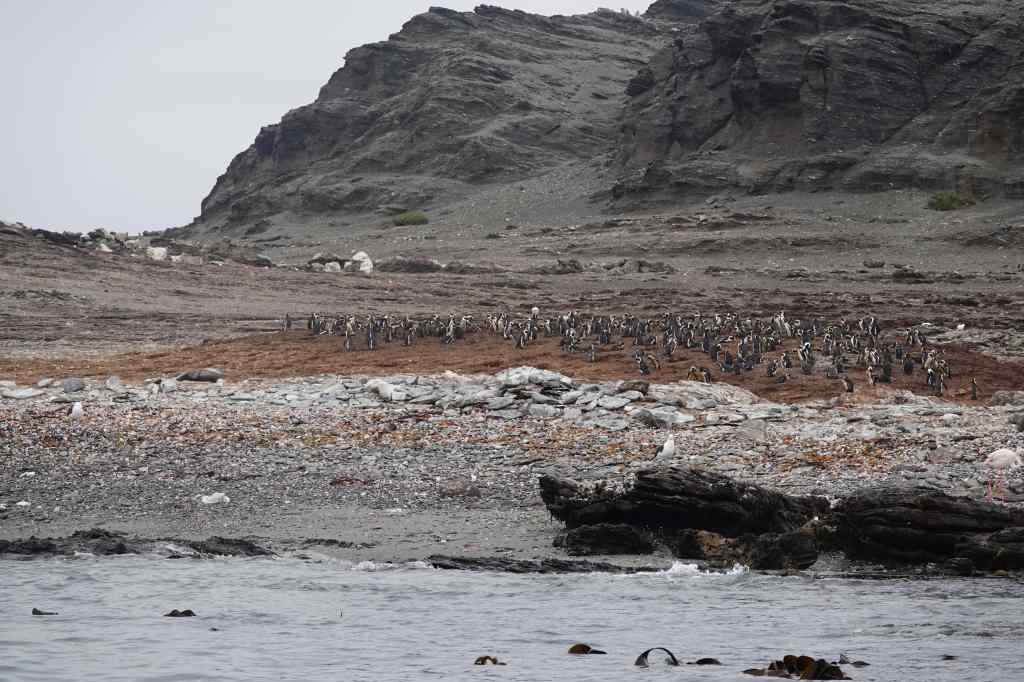
When we got to Halifax Island, we saw a large colony (about 1,000 pairs) of nesting penguins with the added bonus of a few flamingos. It was the first time I had seen penguins in the wild.
Penguins and a flamingo on Halifax Island
Most of the penguins nested in two large groups, standing on top of a large mound of guano from generations of birds. I thought this was not the most hygienic place to raise young.
Nesting in their own droppings…hmmmm
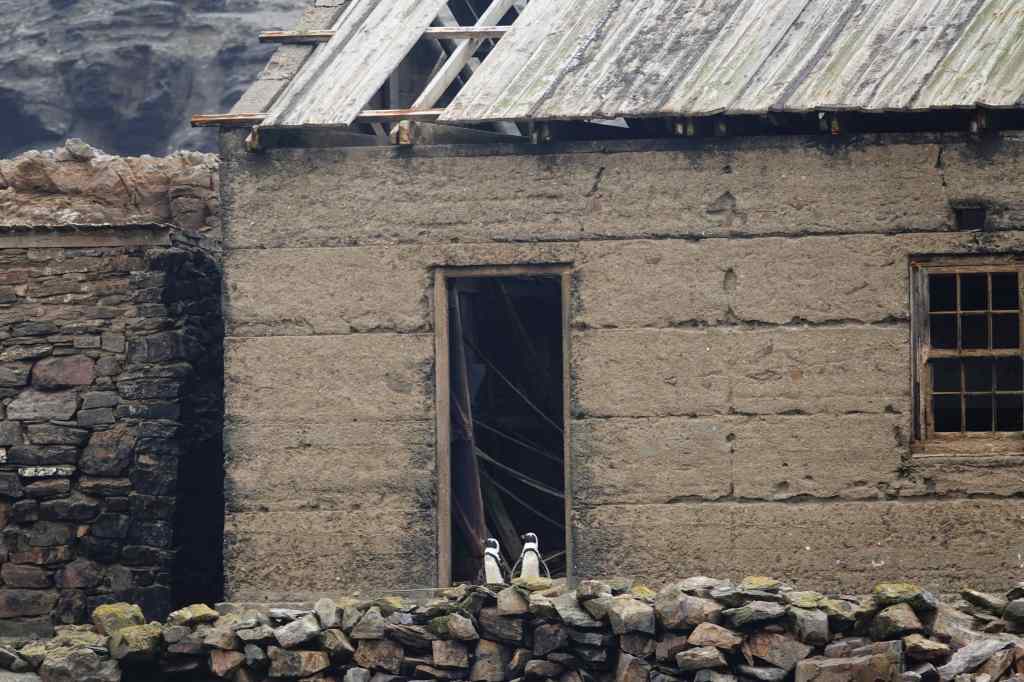
One couple had instead chosen to nest in an abandoned house, which seemed a much more sensible place to me.
Houseproud penguins on Halifax Island
After my cruise, I went shopping in the town of Luderitz to buy food to cook that evening. After many evenings of steak, I wanted to find some fresh fish….but bizarrely the city had none, despite being a fishing port. I had to buy meat yet again, and settled back in my room and looked at the sea for a midday break. A seal and a dolphin came looking for fish in the sea right in front of my room – I hope they had more success than I did!
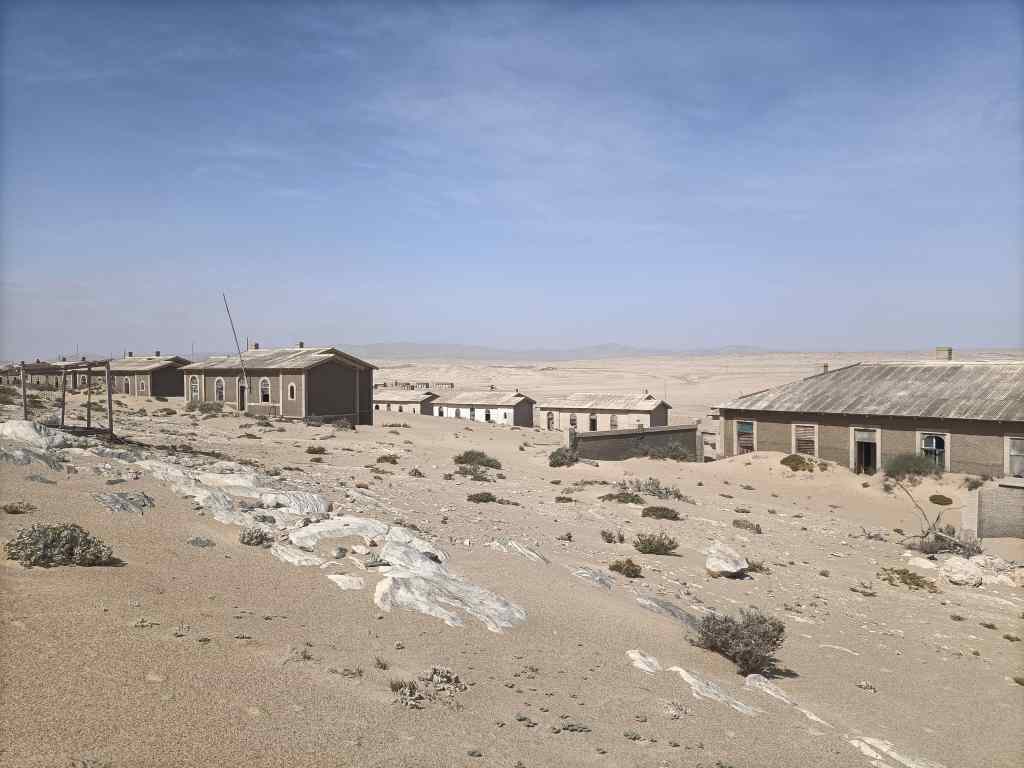
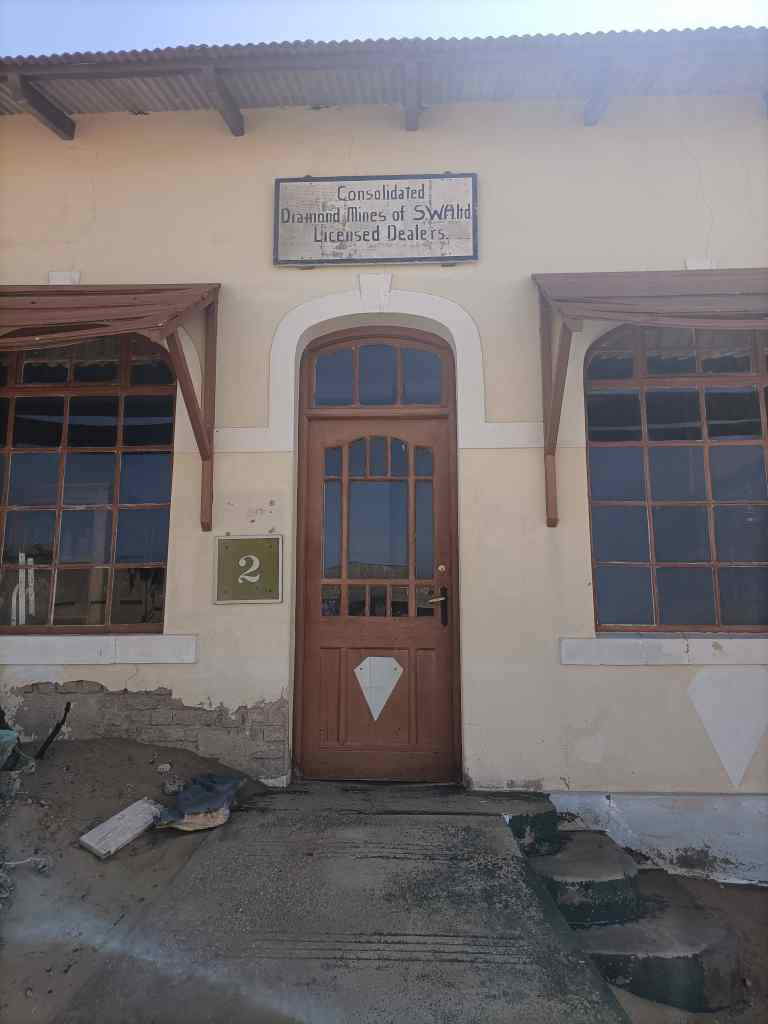
In the early afternoon, I set off for my second excursion of the day, to the abandoned diamond mining town of Kolmanskop. Diamonds were discovered by accident in the area in 1908, by a worker clearing sand from railway tracks. The find prompted a prospecting boom of which the town of Kolmanskop was initially the centre. The miners – mostly German colonists – systematically stripped and sieved the surface levels of sand, at their peak producing a million carats per year of diamonds (or about 12% of total global production). Many became rich in the process, though the native people who provided the manual labour got little or nothing for their efforts. The residents built a hospital, school, and even a casino.
Overview of KolmanskopThe diamond trading counter
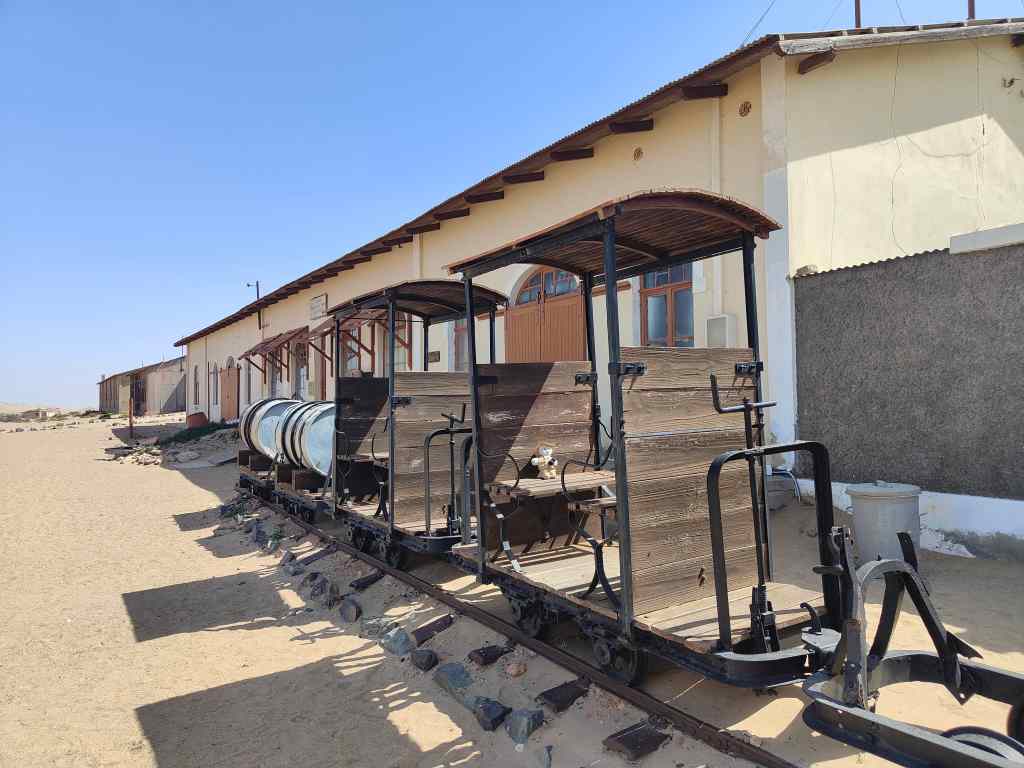
There was a butcher, baker and ice factory, and fresh water was brought in by rail and stored in a big tank on the hill above the town.
A dedicated train line kept Kolmanskop supplied
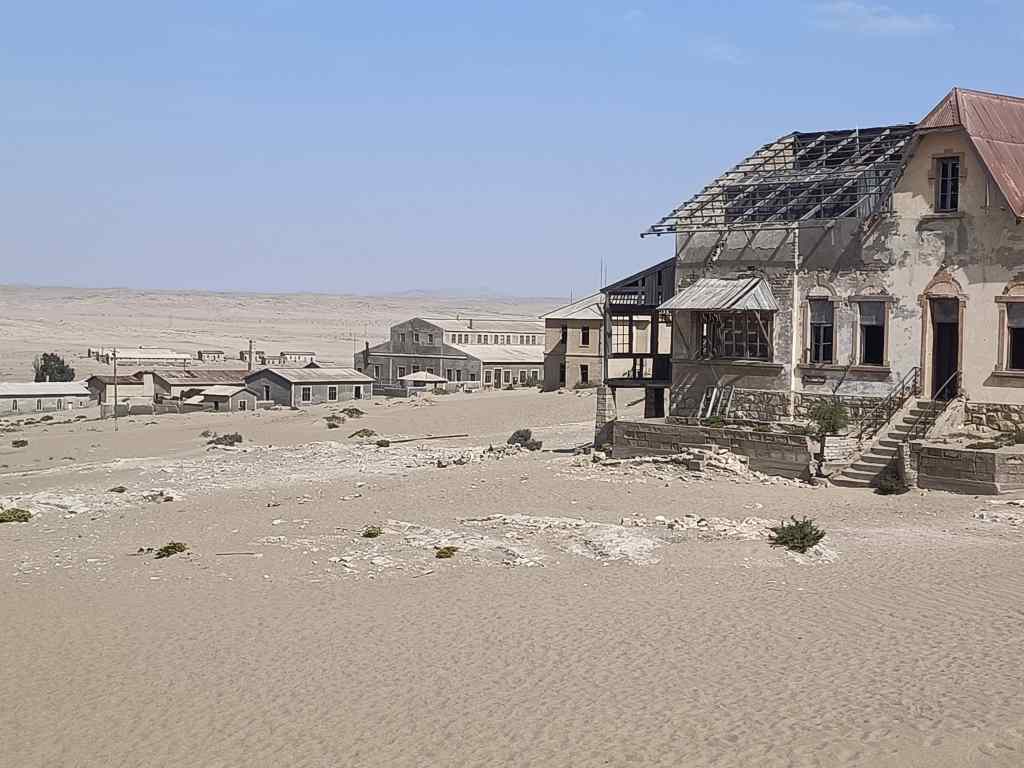
It couldn’t last. In the late 1920s, the ground around Kolmanskop was almost depleted, and in 1928 another big diamond field was found in a different place. The town’s residents abandoned it, and by the 1950s it was deserted. The sand dunes that constantly move around the area – and which even today need constant clearing from the roads and the railway line – swept in to reclaim the town.
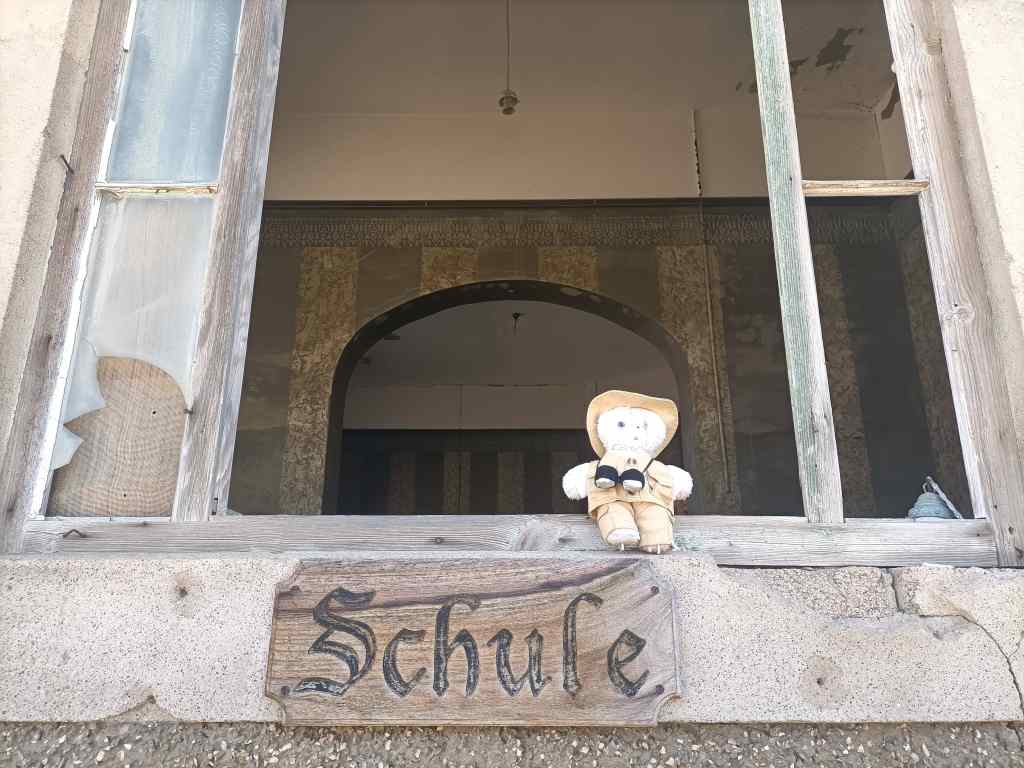
Entry to Kolmanskop’s school
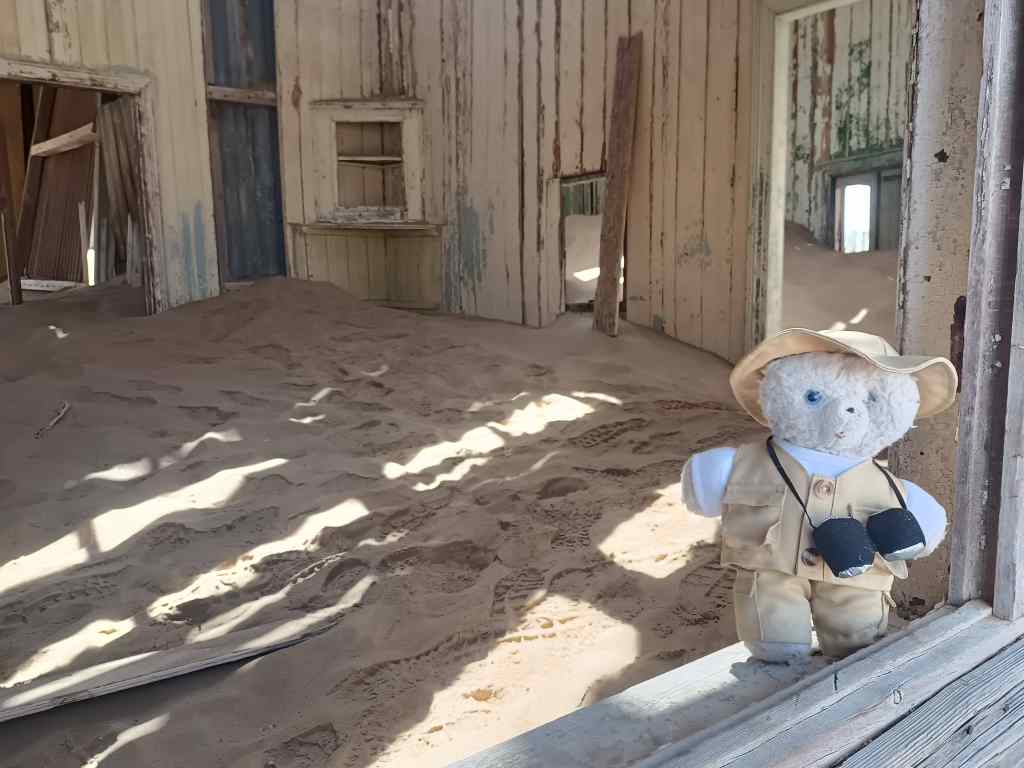
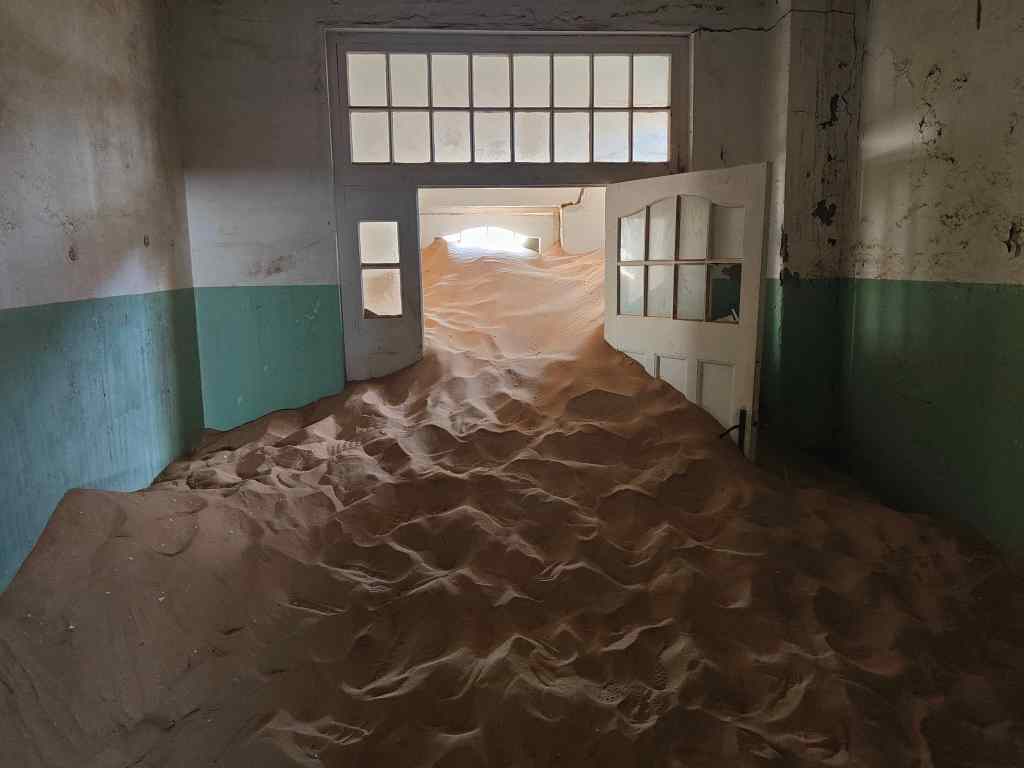
Today, Kolmanskop has become a tourist attraction. Most people visit on the guided tours in the morning, but I bought a special ticket allowing me to walk round in the afternoon, and I had the place completely to myself. A few buildings had been restored, but most had been allowed to slowly decay. The most atmospheric were those which were in the path of the shifting sand dunes. Sand would pile up on their outside walls and force an entry through doors or windows, piling up inside as a continuation of the marching dune.
The irresistible force of nature takes over Kolmanskop’s houses
I also liked some of the grandest houses, built for the town’s management – like the accountant’s, the architect’s or the quartermaster’s residences. These were built on slightly higher ground and had so far escaped the marching sand dunes.
The accountants house
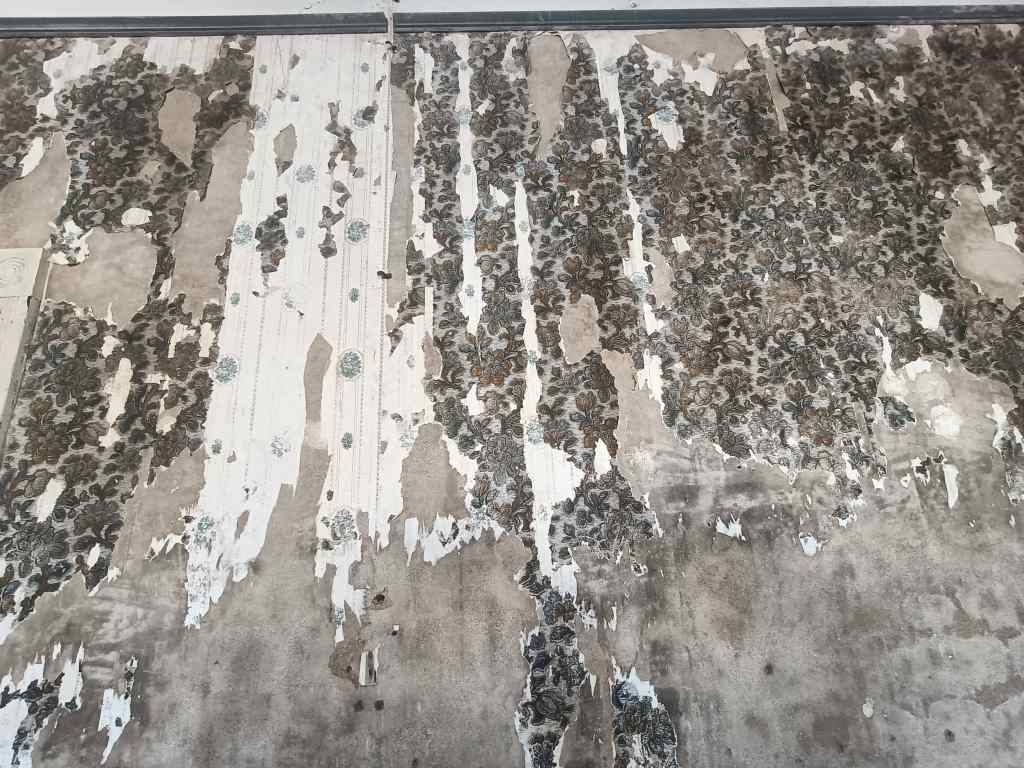
Inside, ornate wallpaper peeled from their walls, and a strange silence reigned. I sat on the veranda of the accountant’s house in the late afternoon sun, reflecting on the transience of life and the futility of humanity’s attempts to defy nature.
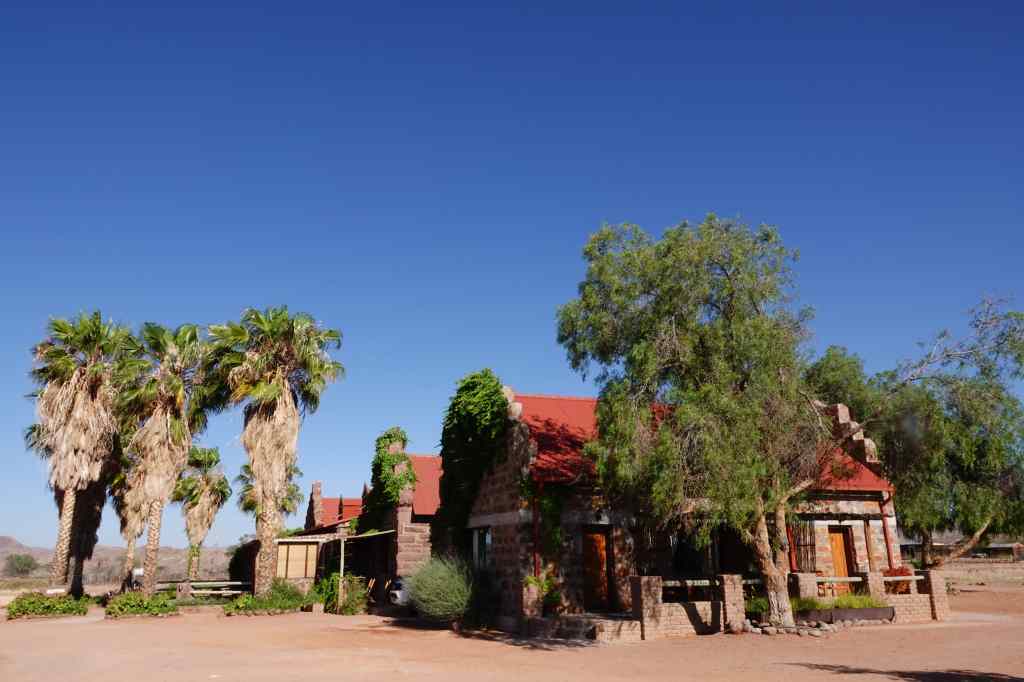
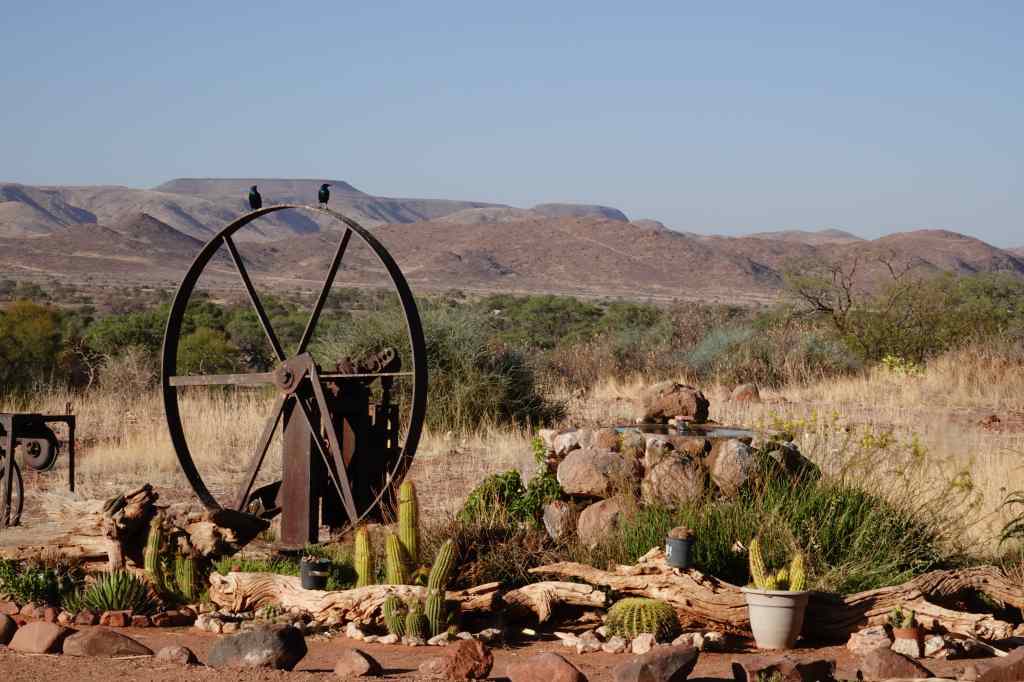
My accommodation in Duwisib was a working farm with a few guest bedrooms, which made a pleasant change to the more commercial lodges I had been staying in up until then. The splashes of green surrounding the farm – plants and fields fed by water from a well – made a welcome change to the constant brown, red and yellow of the Namib desert.
Duwisib Guest FarmSome green in the landscape for onceOld farm equipment
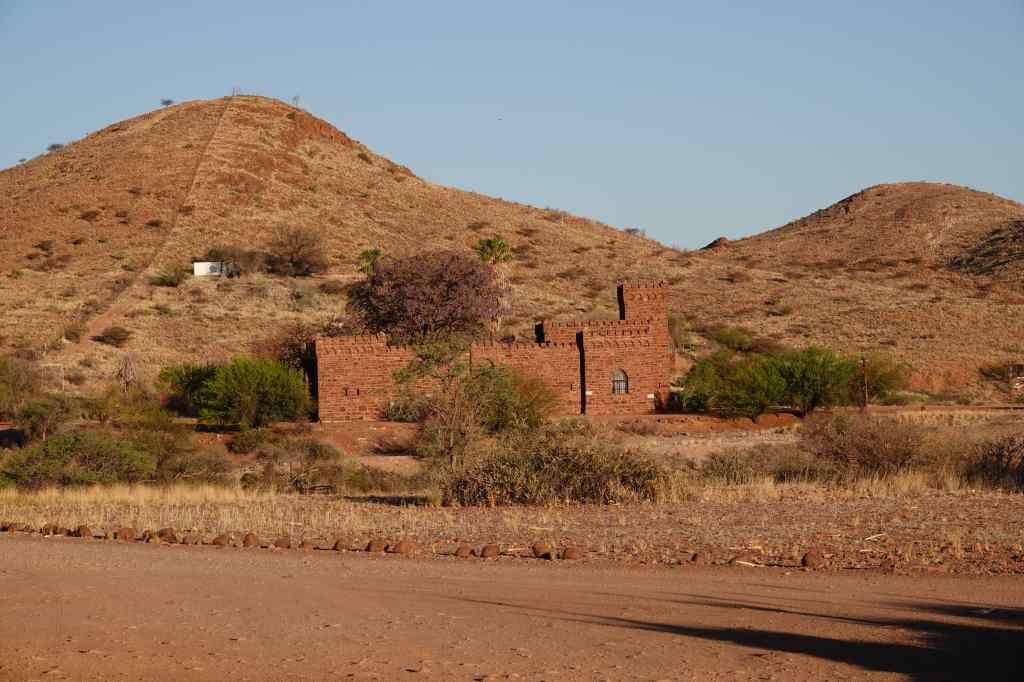
The farm’s owner showed me around and pointed out the small gothic castle improbably located a short way away.
Duwisib Castle
The latter had a strange and sad history. It was the project of a former officer in the German army, Hans Heinrich von Wolf. Poor himself, he married a rich American, Jayta Humphries, who paid for the considerable cost of the project (most of the materials were imported by ship from Germany, then hauled by oxen 300km inland). The newly wed couple camped for two years next to the building site until the work was finally finished in 1909. Von Wolf had intended to use the castle as base to live whilst establishing a farm and breeding horses – a strange project in a near-desert environment. However, the von Wolfs only enjoyed their property for five years; in 1914 war broke out whilst they were travelling to Europe and their ship was diverted to Rio de Janeiro, where Hans Heinrich was interned. He was finally released a couple of years later, and the couple continued their trip to Europe in 1916, where von Wolf rejoined the German army and was killed two weeks later. Jayta never returned to the castle, and eventually remarried and settled in Europe. After the von Wolfs, the castle’s ownership changed hands many times, and today it is owned by the government. It used to be possible to visit but never reopened after the Covid epidemic. The farm owner said we could probably see inside if we made an arrangement with the guardian, but for me it was enough to see the castle from the outside.
The guest farm also gave me the chance to meet some fellow travellers over dinner to swap stories and information. This was also a welcome change after dining on a table alone at desert lodges. I checked that the road I wanted to use the next day, the D707, was open and passable and that its reputedly great scenery was worth the extra time. One of my fellow diners had just come from that direction and assured me that all was good.
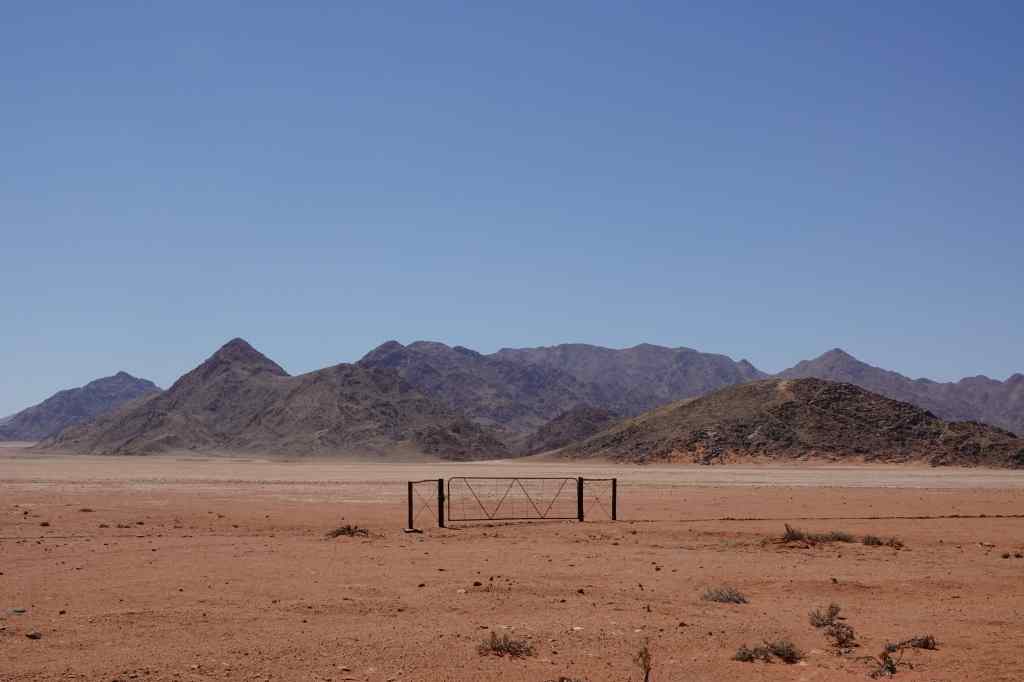
So next morning I set off on another fairly long drive, this time to Luderitz, on the coast in the southwest corner of Namibia. The D707 lived up to its scenic reputation and I made lots of stops to take pictures.
Back to red and brown scenery on the D707A gate to nowhere…Still on the D707
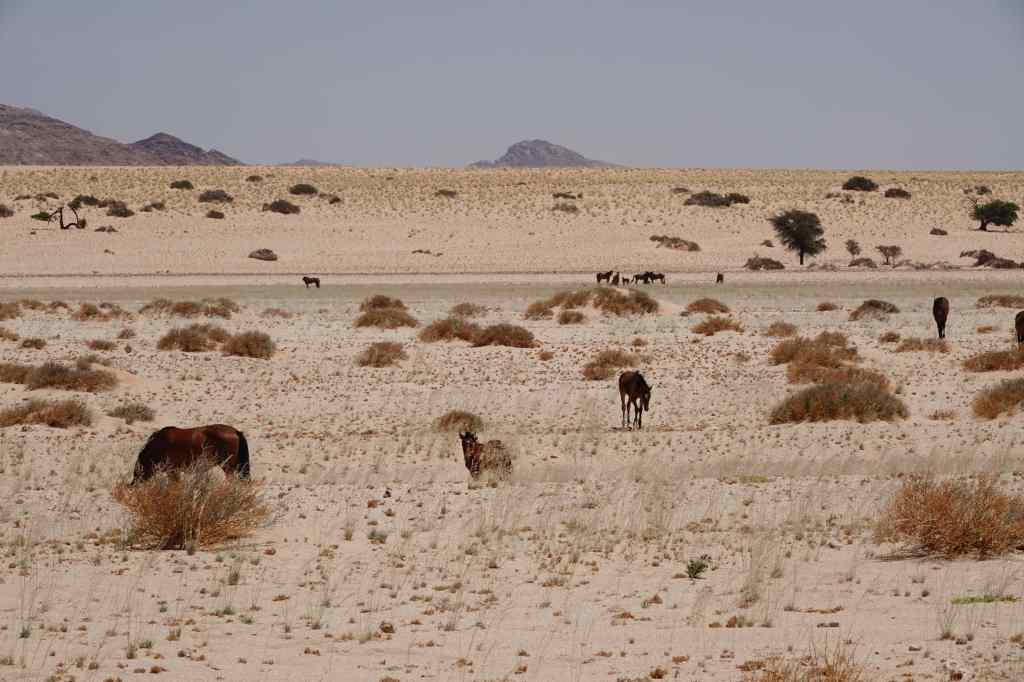
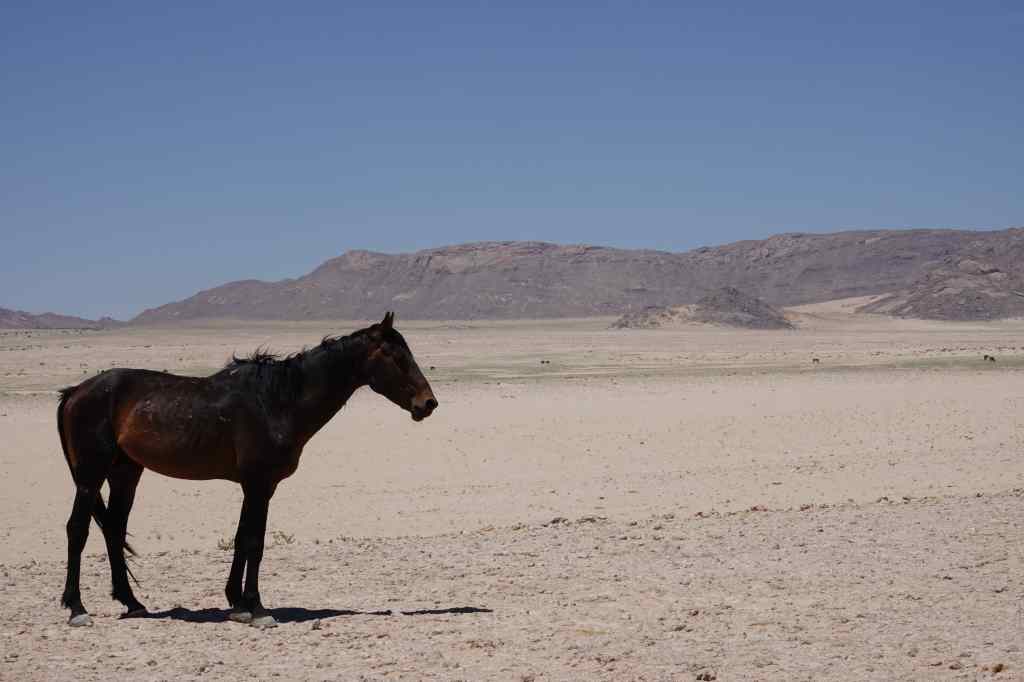
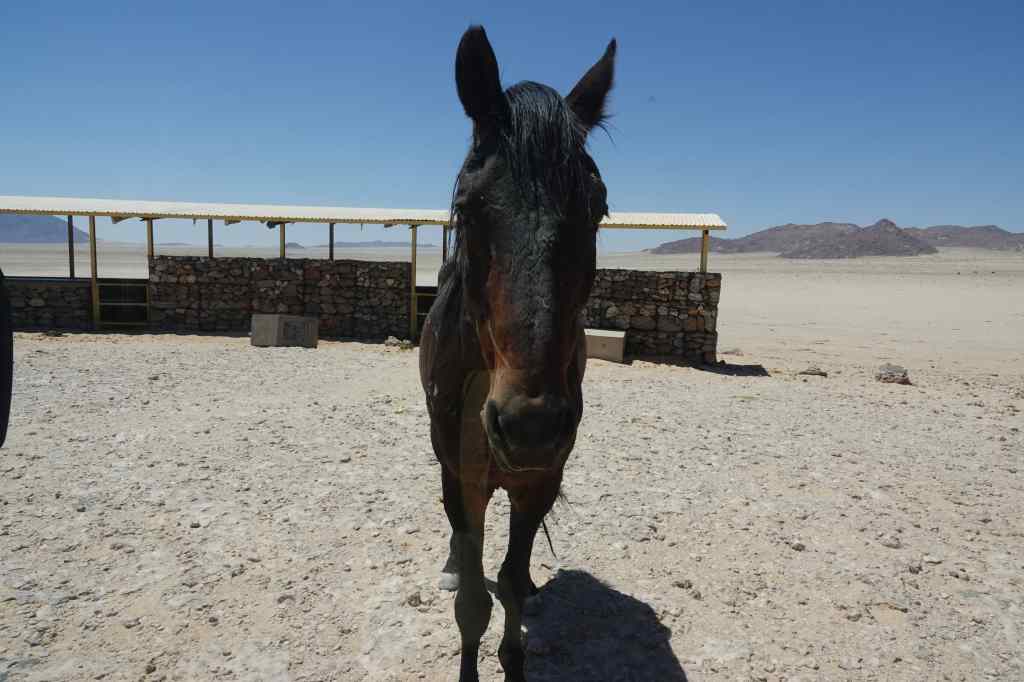
Next, I joined the straight flat and dull but fast B4 to the coast. I made one stop on route, to see a herd of wild horses – the only ones anywhere in the world to live in desert conditions. One theory is that the horses’ ancestors escaped from von Wolf’s farm over a hundred years ago.
Desert Horses! A horse poses for my shotThis horse was hungry and approached my car looking for food
After another hour I reached Luderitz, which is known for its colonial German architecture. Indeed, it had a couple of old churches and other buildings dating from its time as the centre of a mining boom just over a hundred years ago (more about this tomorrow). But today the town feels rather poor. The many unoccupied people on the streets stared at me as if they had never seen a bear before, and I felt slightly uncomfortable. Fortunately, my accommodation was in a smart area, right on the sea shore and I checked in and enjoyed the view whilst preparing two very different excursions for the next day.
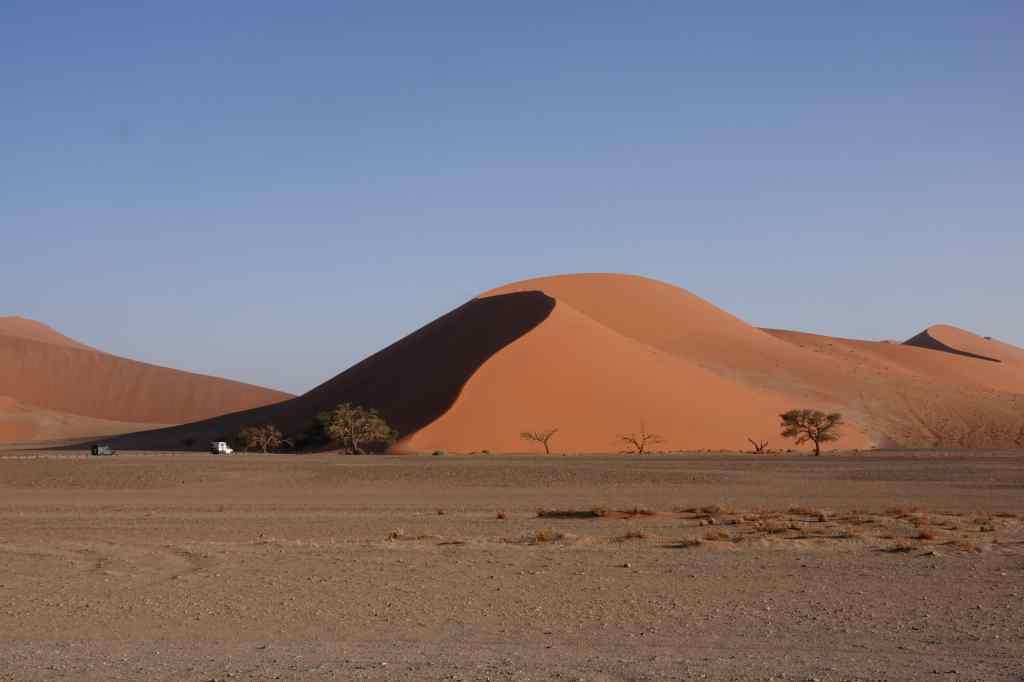
A dune on the now familiar drive down to Sossusvlei
Today my luck finally changed. When the alarm woke me at 5.30am, all was quiet outside – there was no wind. I hurried to get breakfast and then set off on the now familiar drive to Sossusvlei National Park. I drove straight to the very end, to Sossusvlei itself and found that almost all the other visitors had stopped earlier, at Dune 45 or the Dead Vlei. I had the place almost to myself and set off to climb Big Mommy dune.
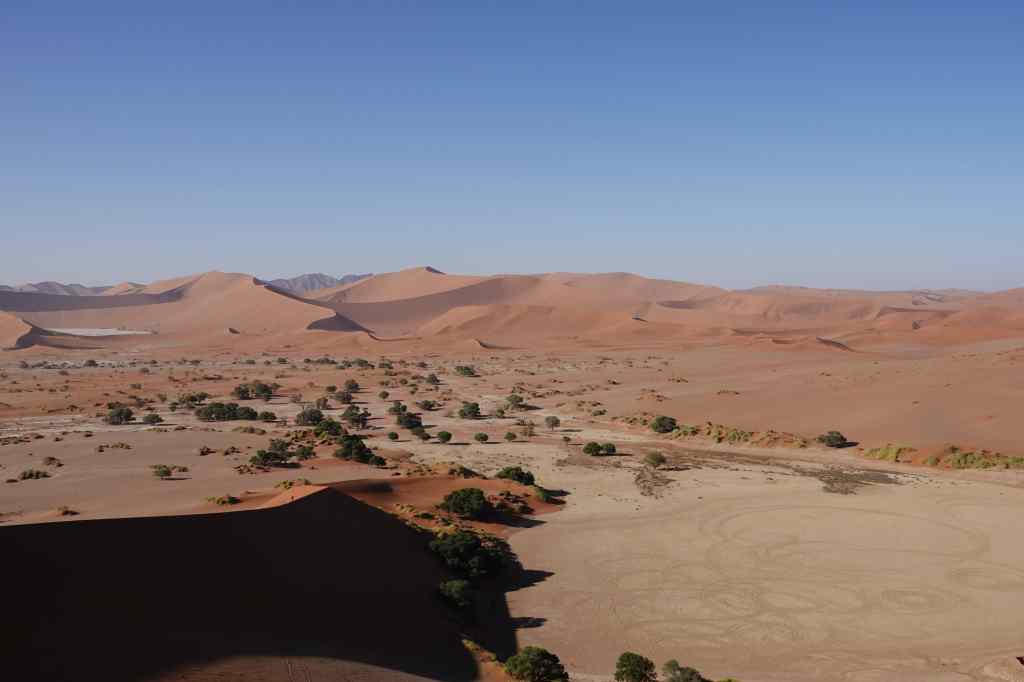
Looking back at Sossusvlei from the flanks of Big Mommy
It was hard going. The sand stretched up before me, perfectly bare and flat, and devoid of any sign of humans or other large animals having passed that way. The only marks it bore were faint traces left by snakes. For every three steps I made forward, I would slip back two. I finally made it to a pleasant sandy ridge, and lay down to catch my breath and peak over the top to see an endless sea of sand, stretching away into the distance.
Resting on a ridge on the side of Big Mommy
I looked at my watch. I had been walking an hour and was less than half way up. I was not sure the view from the top of “Big Mommy” would be any better, and if I tried to find out, I would use up the entire morning on the climb. Walking after noon would be impossibly hot.
I decided to retrace my steps to the Dead Vlei car park, where a steady stream of visitors were setting off to climb “Big Daddy”.
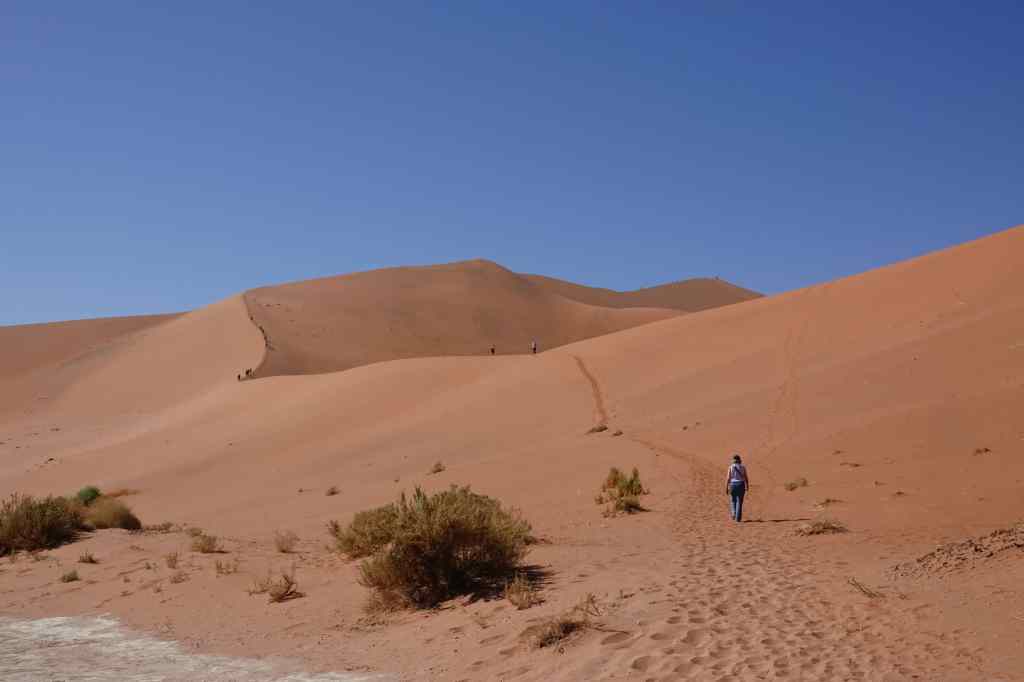
The start of the popular climb of Big Daddy
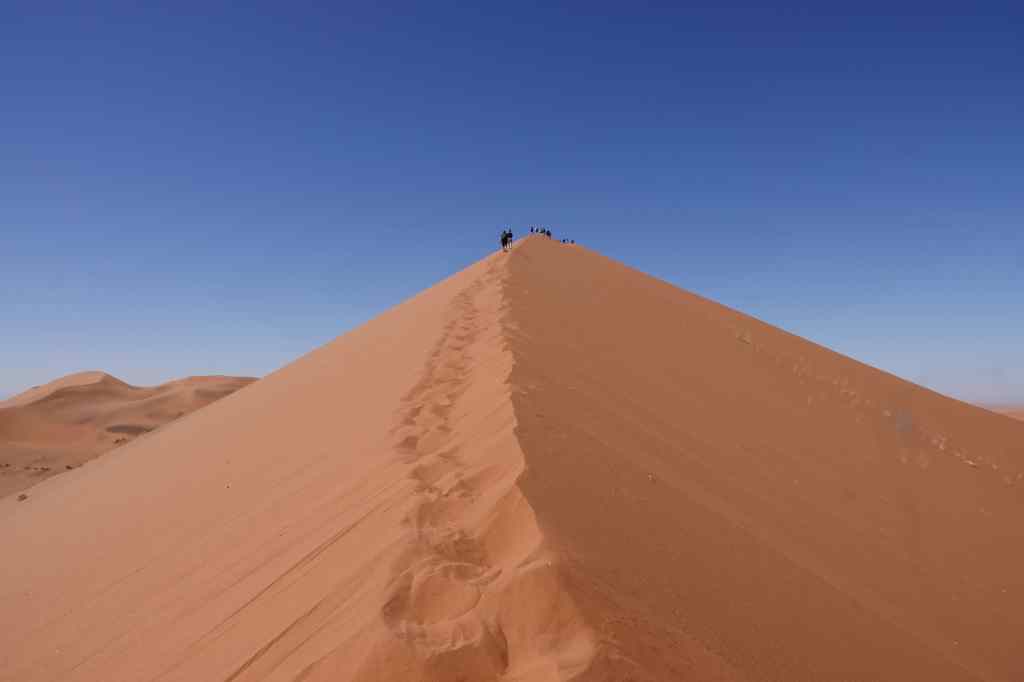
I followed in their tracks and found that this climb was much easier – the earlier guests had compacted the sand, and I could use their footprints as a sort of staircase.
A much easier pathA view from half way up Big Daddy
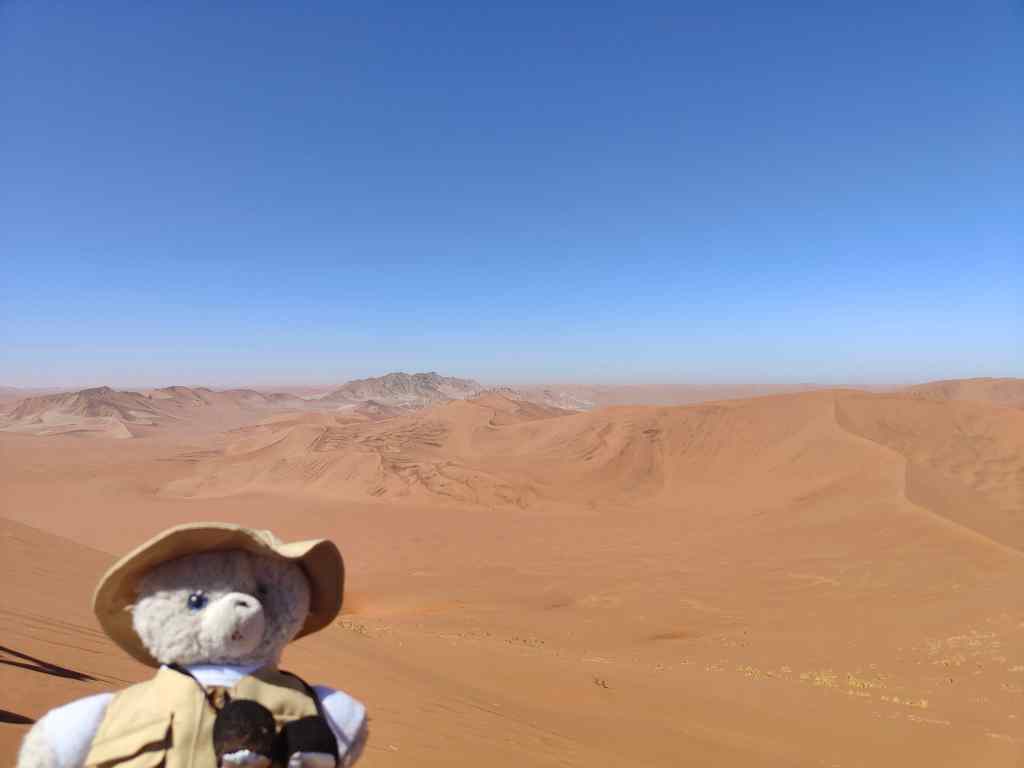
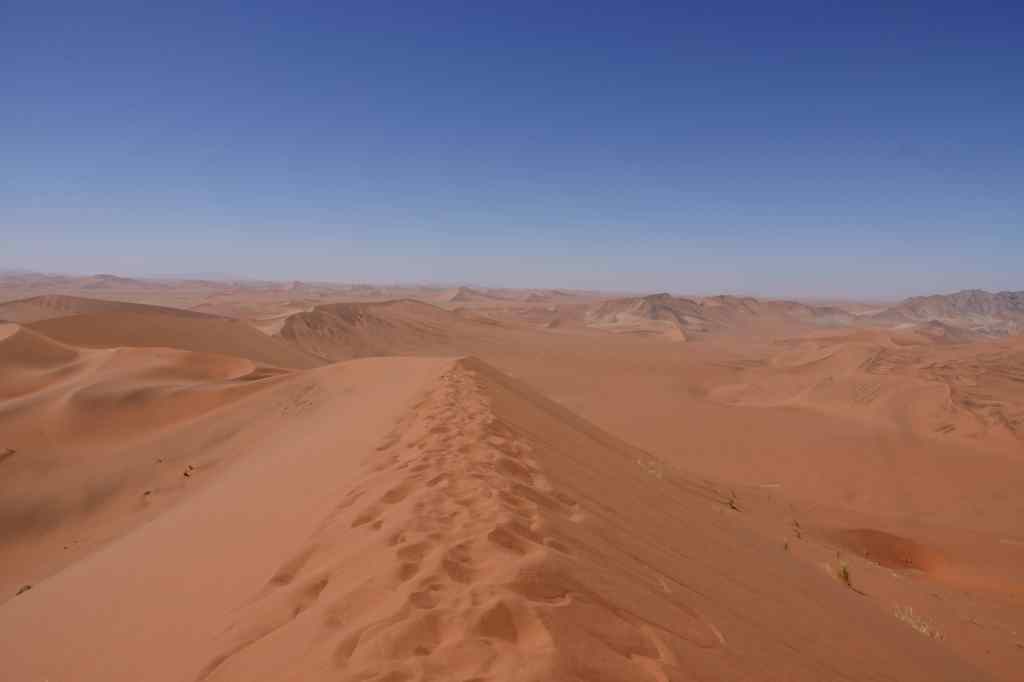
To reach the top took me just under an hour, and I was rewarded with an amazing 360 degree view – east along the river valley and the road, north to the Dead Vlei and “Big Mommy”, south to a range of mountains, and west across countless smaller dunes. In the far distance I fancied I could see the coast and the South Atlantic Ocean some 50km away – or maybe it was the combination of my imagination and a heat mirage.
On top – looking southwestLooking west from Big Daddy dune
I stayed a long time absorbing the view and recovering from my exertions. Then I made my descent, which was much quicker than the climb. I noticed some of the taller humans running straight down the steepest part of the dune, making great big strides with their legs. The soft sand swallowed each foot as it landed, and then slid downwards with the foot’s owner. The same shifting sand that had made going up so hard made going down fun…….and very quick. Even with my smaller teddy legs, I was at the bottom of the slop in five minutes, with my shoes full of sand and a big smile on my face.
The base of the dune gave a new perspective to the shrivelled trees of the Dead Vlei.
The Dead Vlei again
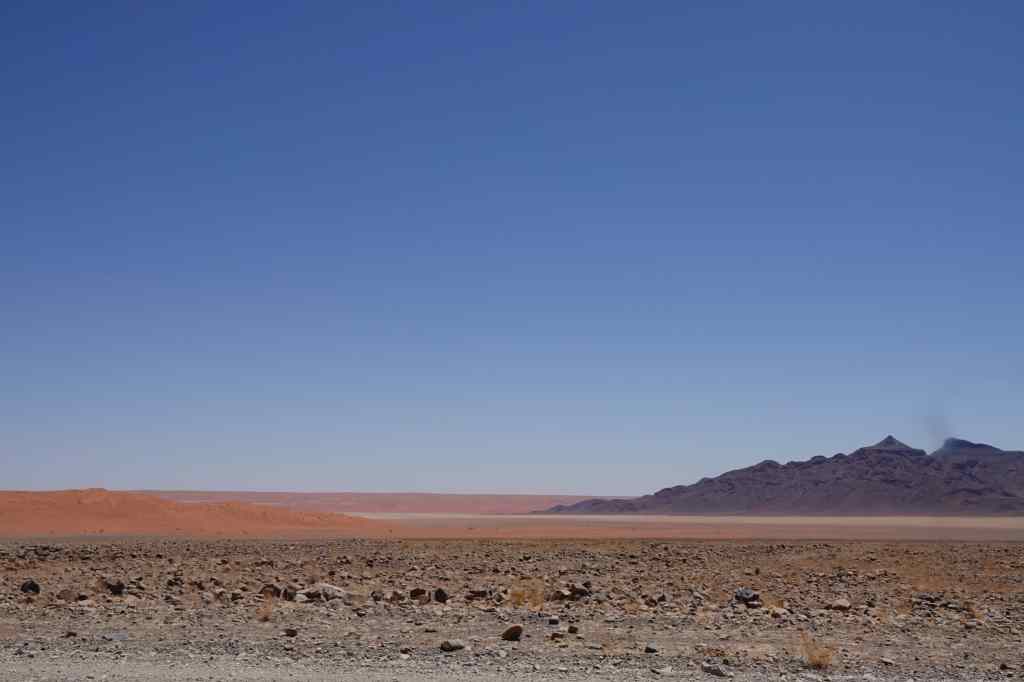
I traversed the barren empty space in the heat of the late morning to regain my car – hot, tired but happy. I drove back to the park entrance for a well-earned coffee and a cold drink, before making the roughly two hour drive to my next destination – a place called Duwisib, about two hours driving to the south. The road was spectacular – more red and yellow sand dunes, but this time alternating with black and brown rocky mountains. But after my early start and exertions on Big Daddy and Big Mommy I was too tired to stop to take many photos. More about Duwisib in my next post.
The next day I woke up early again to check the wind. It was still strong, so I went back to sleep. When I got up, I could have a leisurely breakfast and enjoy the lodge’s pool and the view from my room – a desert plain with mountains in the distance, occasionally visited by groups of Oryx.
Oryx stroll past my veranda
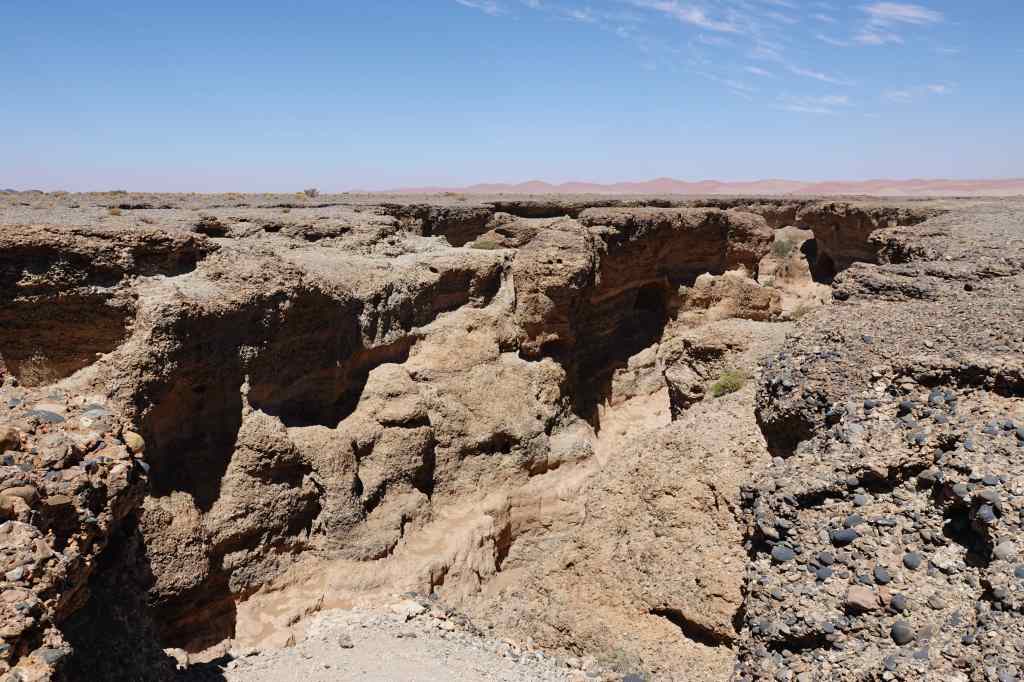
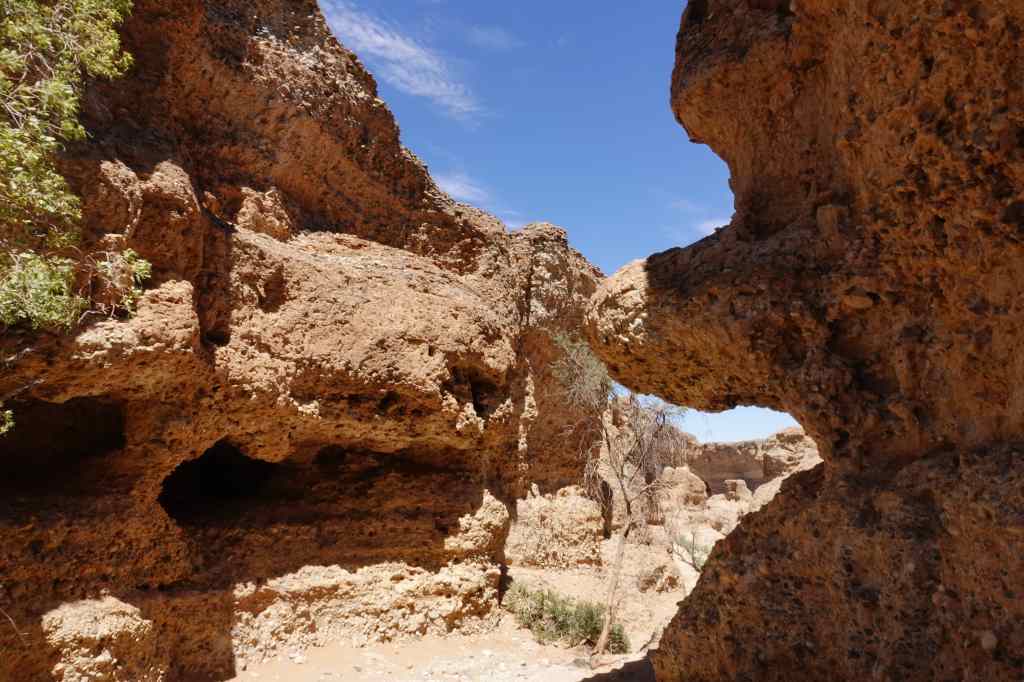
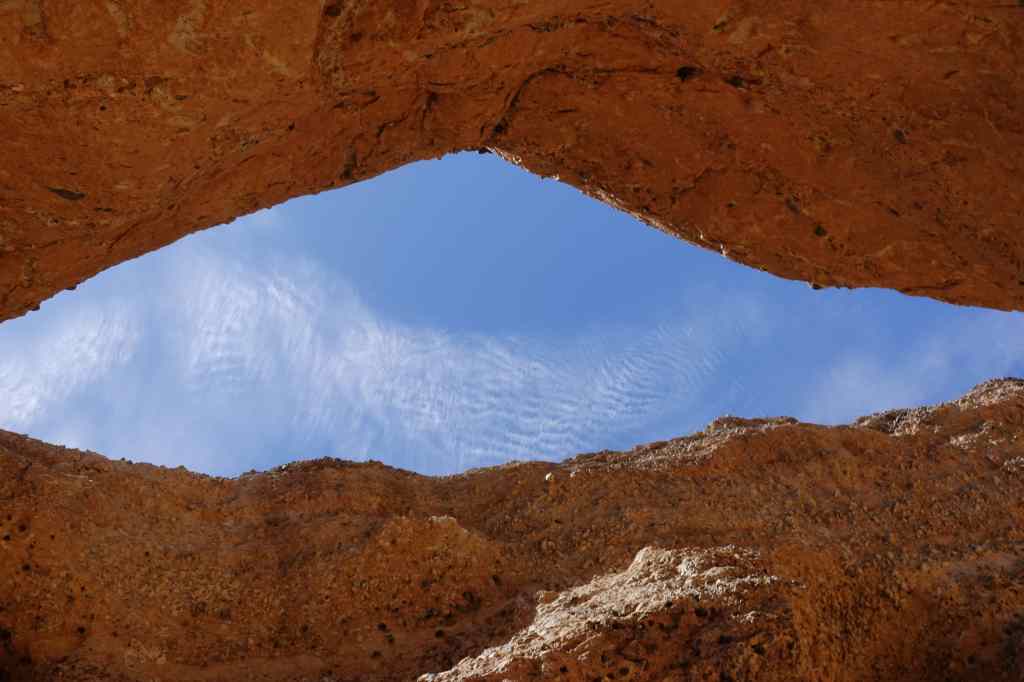
In the afternoon, I went to visit Sesriem Canyon – also in the national park. It was an interesting fissure in the ground, protected from wind and sun, so ideal to visit at that time.
Sesriem canyon – from aboveInside Sesriem CanyonA narrow path inside Sesriem CanyonLooking up
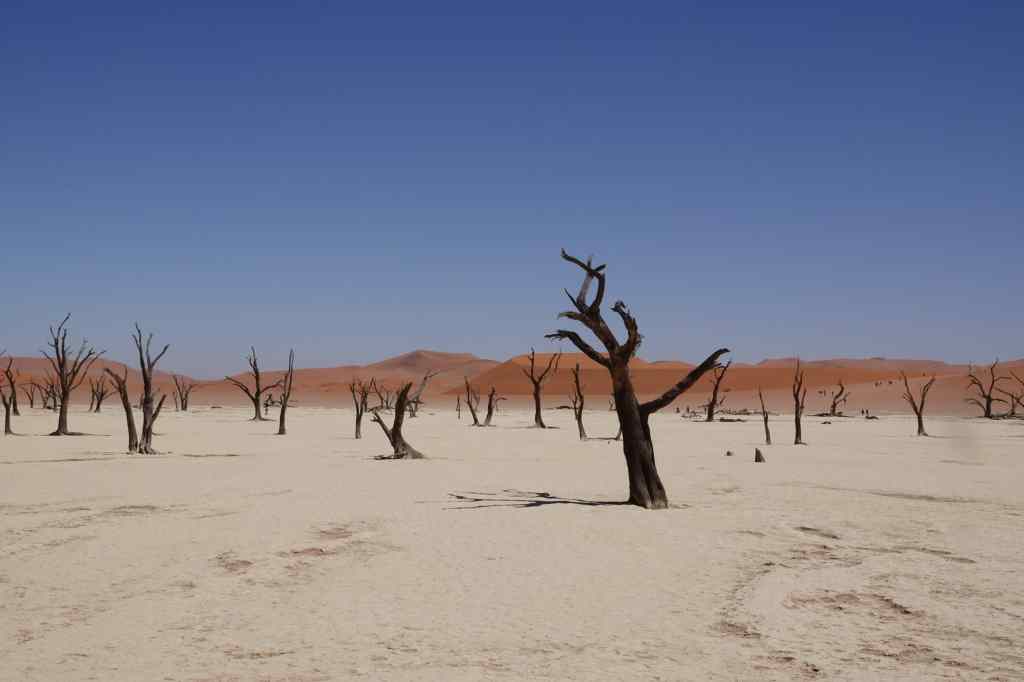
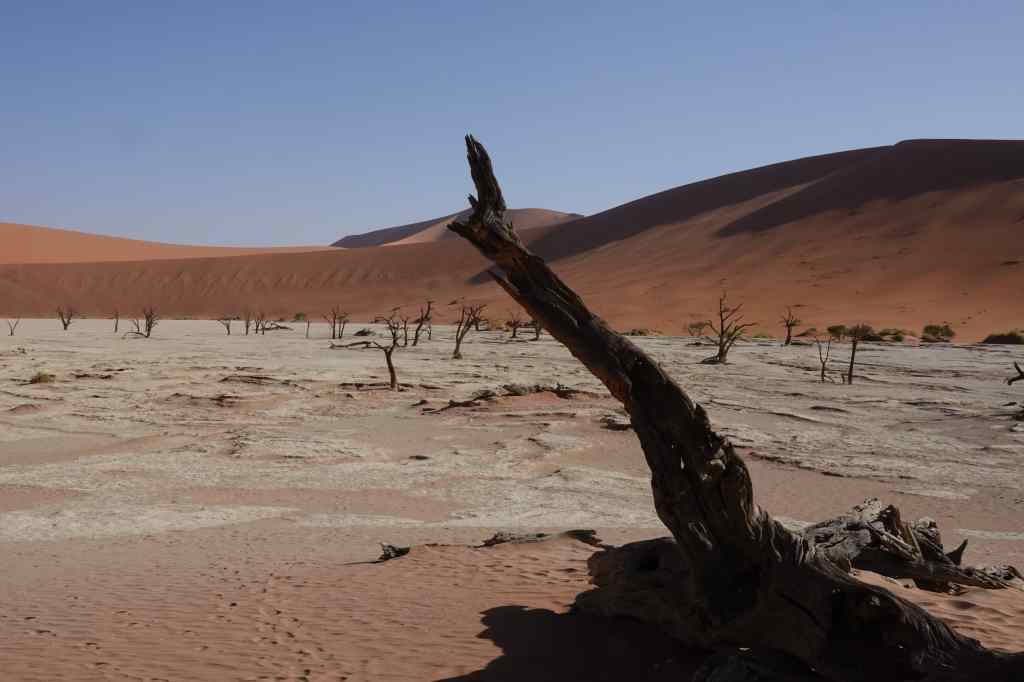
After visiting the canyon, I noticed that wind had dropped so I continued the road to the end, to visit the more famous giant dunes. I arrived first at the “Dead Vlei” – an atmospheric area of dead trees at the base of “Big Daddy” dune. All the other visitors were heading in the opposite direction, leaving the park. In Afrikaans, a “vlei” is a low-lying area of ground, sometimes filled with water, sometimes dry.
The Dead Vlei
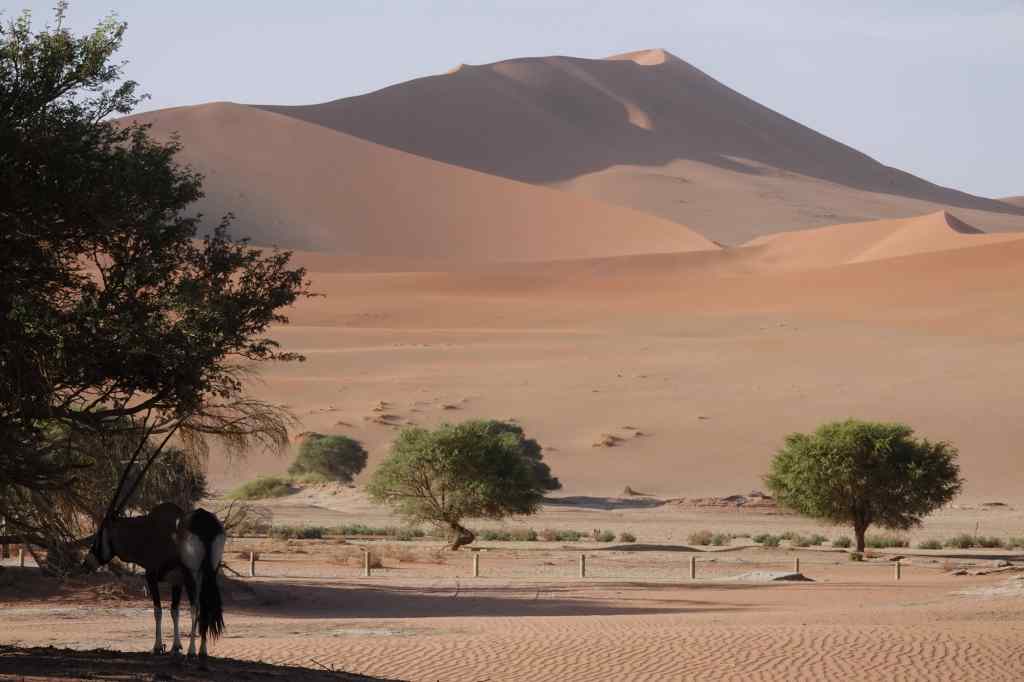
From there I continued to the very end of the road, along a sandy track that was only suitable for 4×4 vehicles, to Sossusvlei itself. I arrived at around half past five to find that everyone else had left and I was the only visitor. Ahead of me rose Big Mommy dune, but since I had to be out of the park by sunset, I did not have enough time to climb it. Instead, I enjoyed the perfect calm and the company of a solitary Oryx who had wandered this far. I resolved to hike the dunes the following day, whatever the weather.
In front of Big Mommy duneSossusvlei with Big Mommy Dune and a solitary Oryx
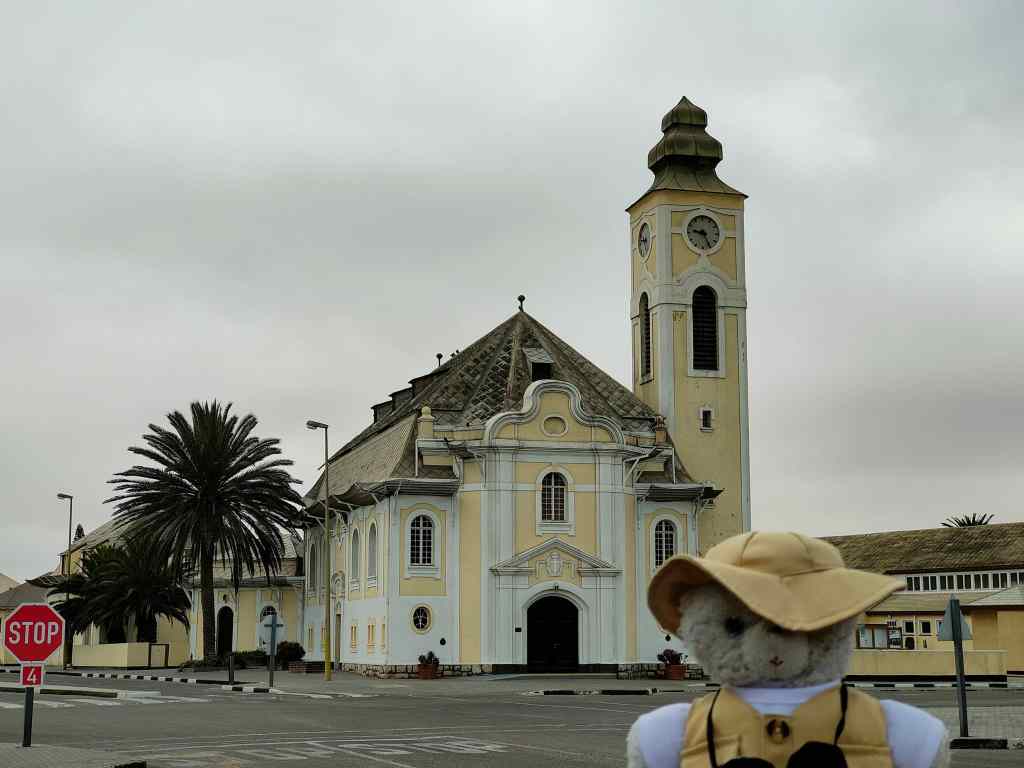
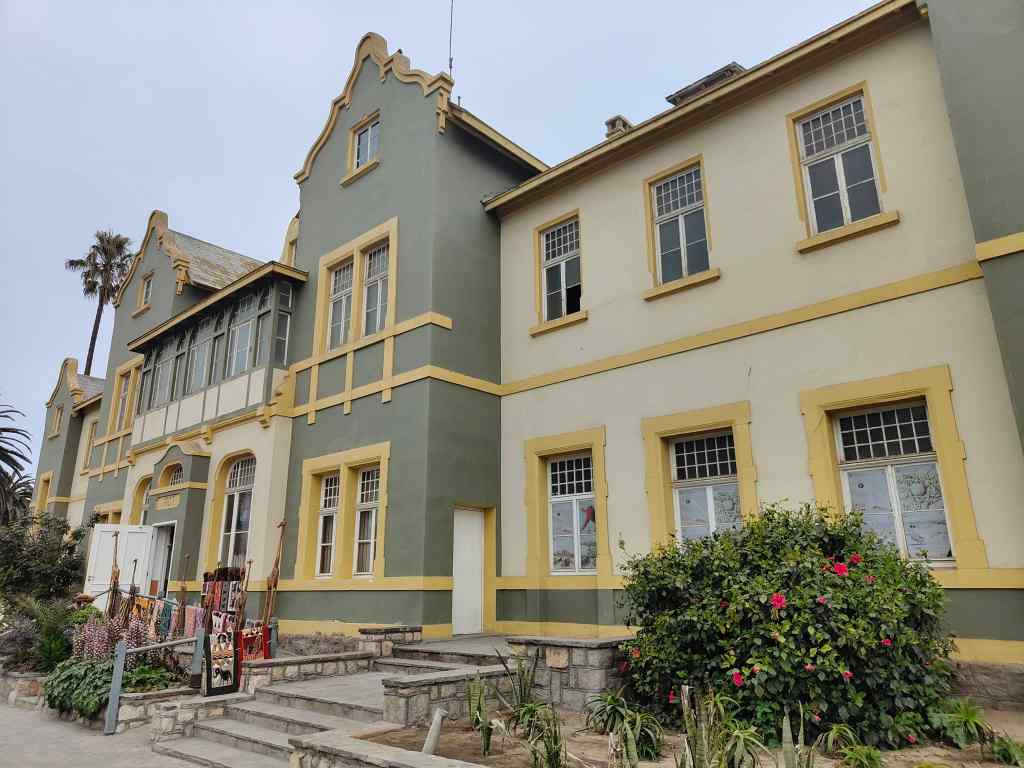
Today I explored the quaint town of Swakopmund in the morning. In December and January, it is a popular holiday getaway for people living in the capital, Windhoek, but in October it was a pleasant, sleepy town with some fine colonial German architecture, dating from the 1900s. Unlike all the other places I had visited in Namibia, the weather was overcast and even a bit chilly.
SwakopmundColonial architecture in Swakopmund
It may also be the last city in the world that still has a “Kaiser Wilhelm” Street.
The Alte Apotheke on Kaiser Wilhelm Street
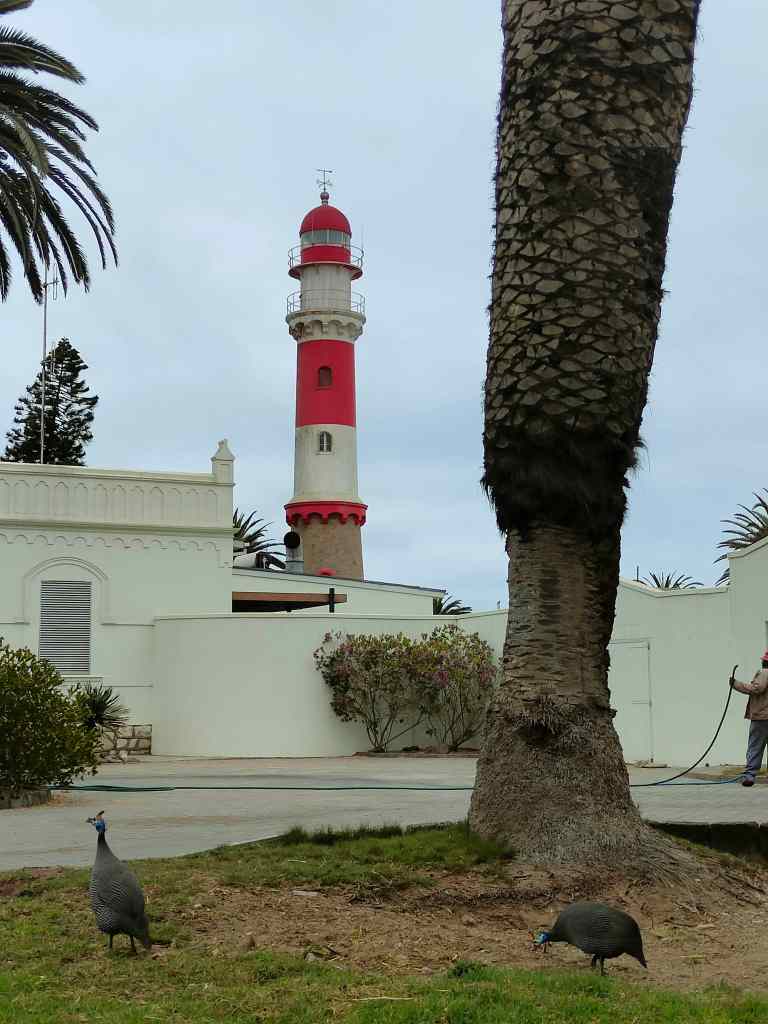
I strolled around, enjoying the sensation of walking after many days spent in the car, as well as the small-town laid-back atmosphere. Lots of guinea fowl wandered around the town’s parks, obviously feeling very safe. In most other places they would have ended up on a restaurant plate, but maybe Swakopmund’s excellent seafood keeps them safe from this fate.
Guinea fowl roaming free in the park and Swakopmund lighthouse
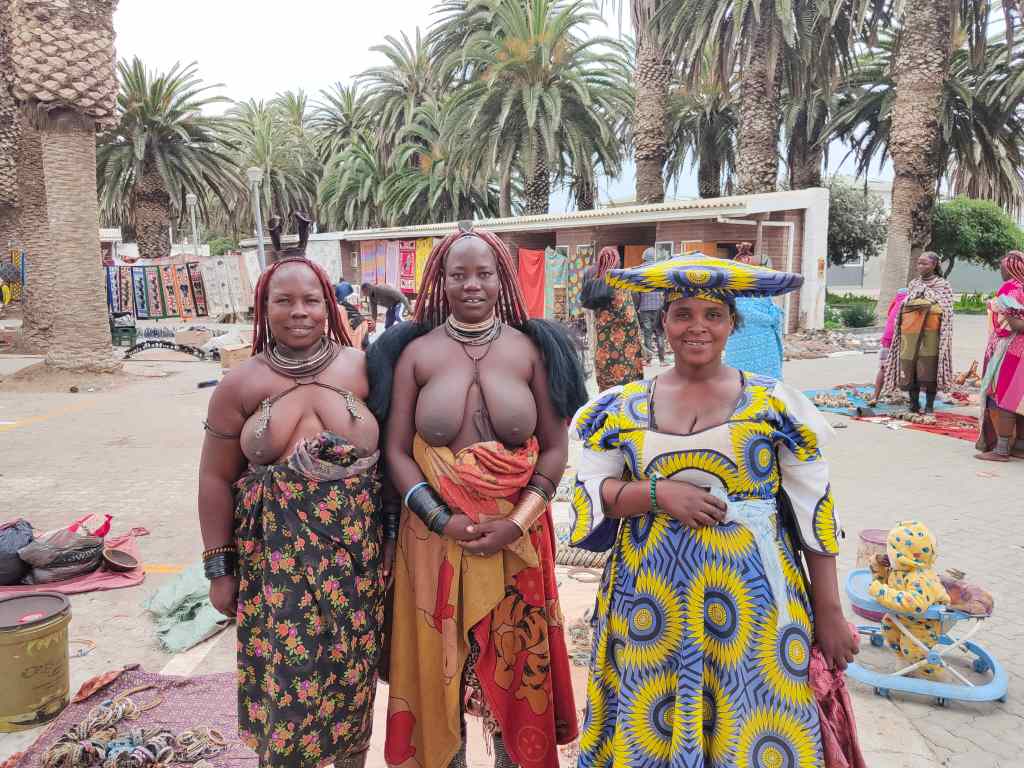
I also visited the local market where some tribeswomen posed for a photo for me.
Ladies from the local market in Swakopmund
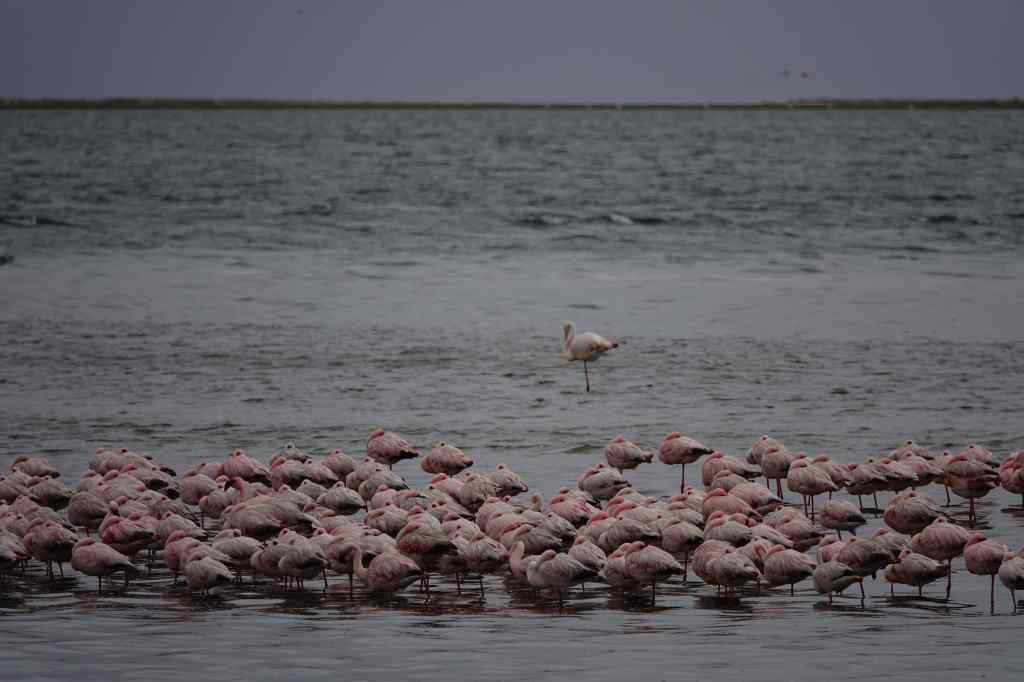
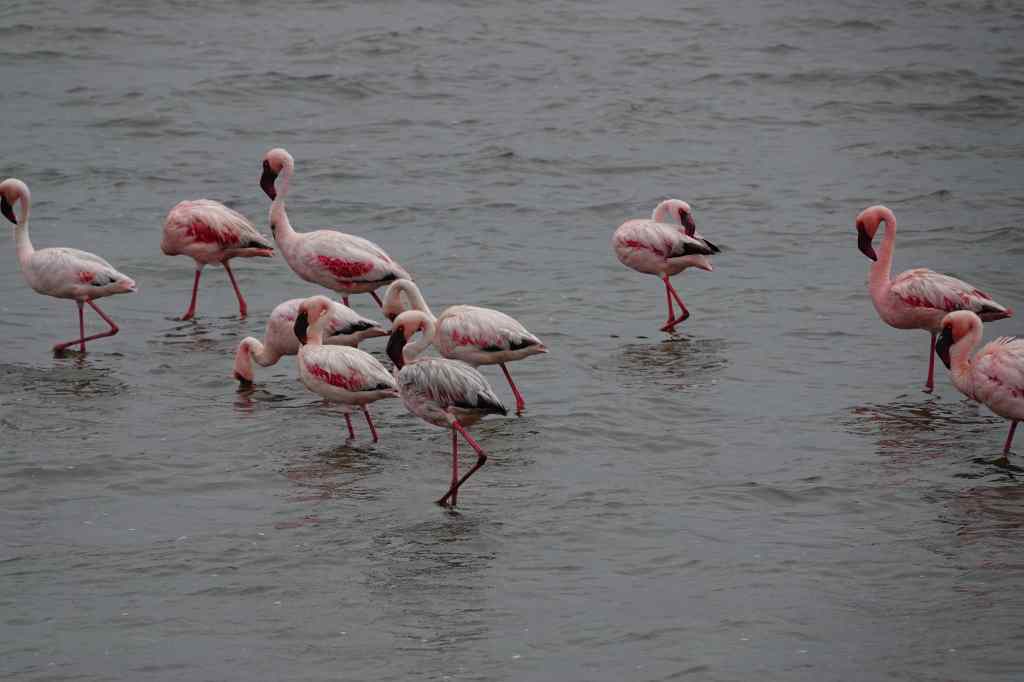
In the afternoon I had booked a tour of the area. The route went through Walvis Bay, another of Namibia’s small cities, which had a colony of flamingos wading just off its shoreline.
Flamingos at Walvis Bay
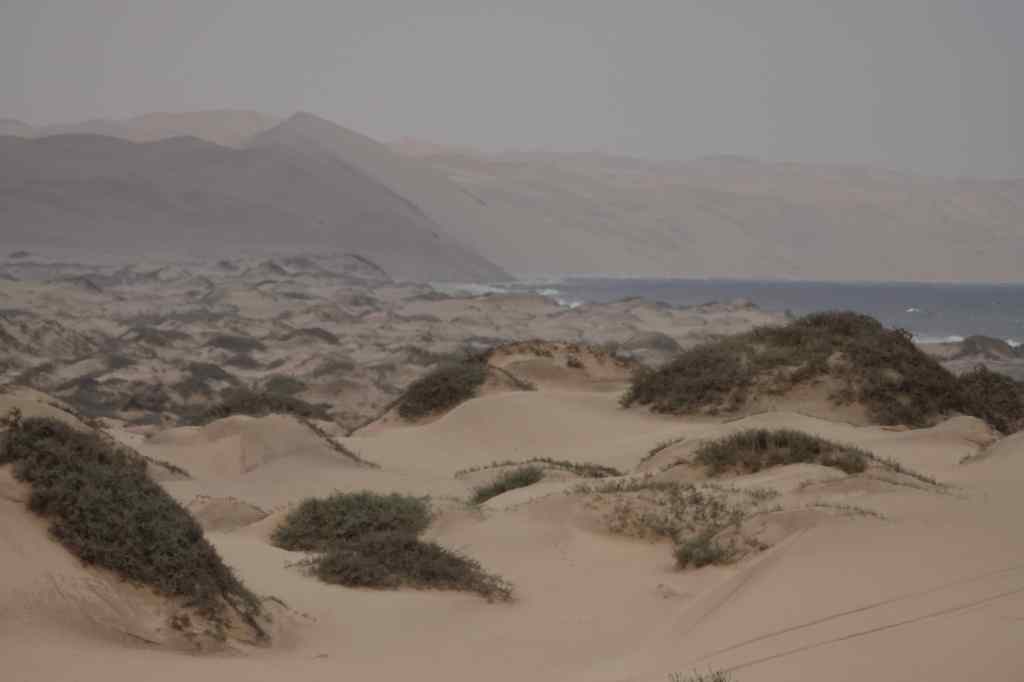
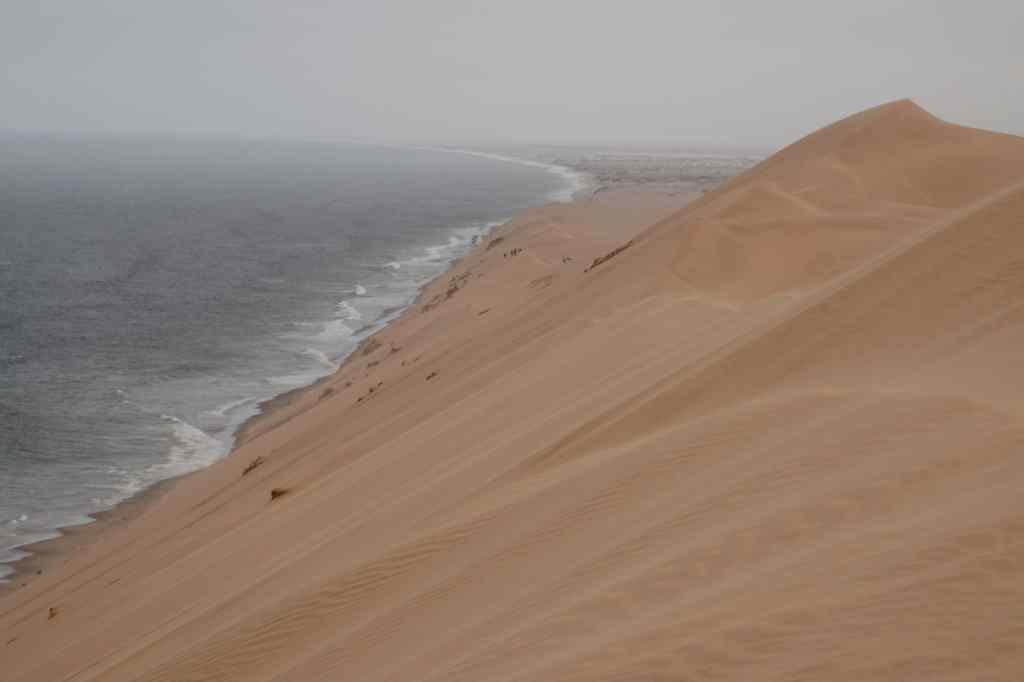
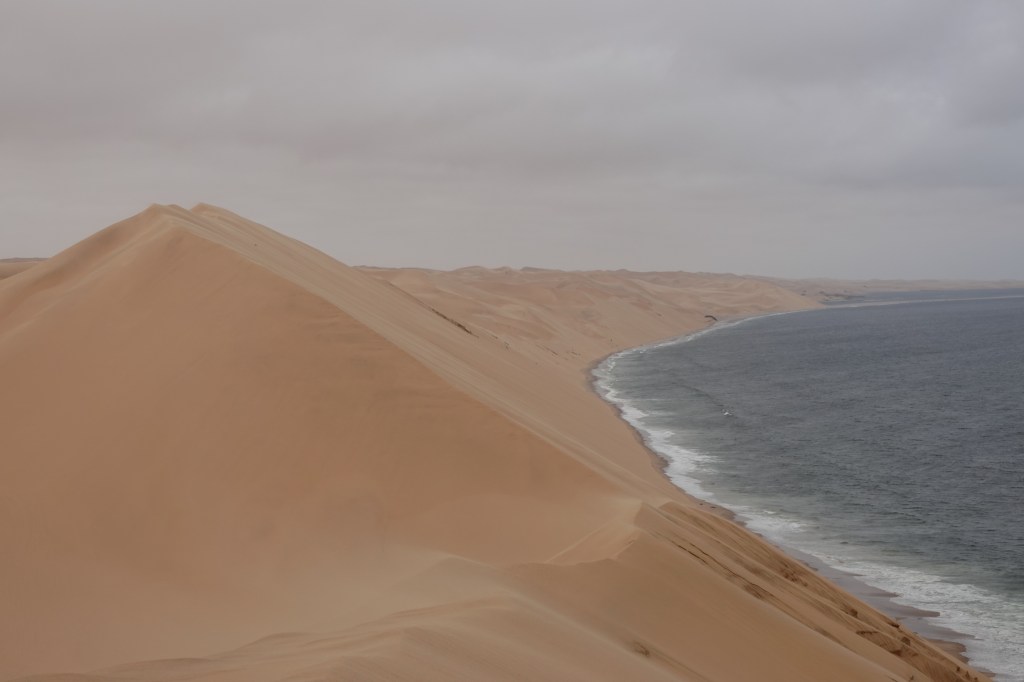
My tour continued towards Sandwich Harbour, a national park accessible only by 4×4. At first the scenery was pleasant but unremarkable, a little bit like the Skeleton Coast, but a bit sunnier; but in the distance I could see the giant dunes plunging into the sea. This was our destination.
Stuck in sand! Sandwich Harbour – the big dunes loom in the distance
Our driver took us up onto the giant dunes and showed off his skills driving on sand, up and down steep slopes.
It was great fun, and the adrenaline rush made a good change from the more sedate pace of my holiday so far. We finally ended up on a dune nicknamed “Kodak” because of its endlessly photogenic views.
The views from “Kodak” dune
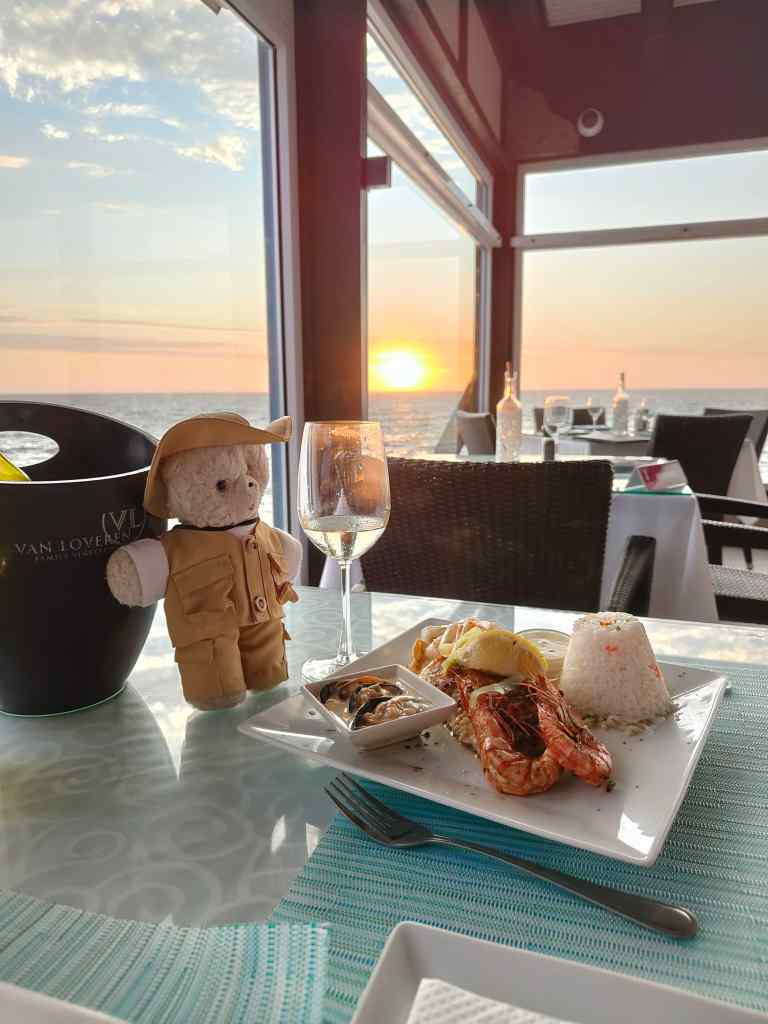
We then did some more dune driving before having a snack and then heading home. It had been a good day, and I returned to the seafood restaurant I had visited the night before to treat myself to kingclip (a local fish) and giant prawns.
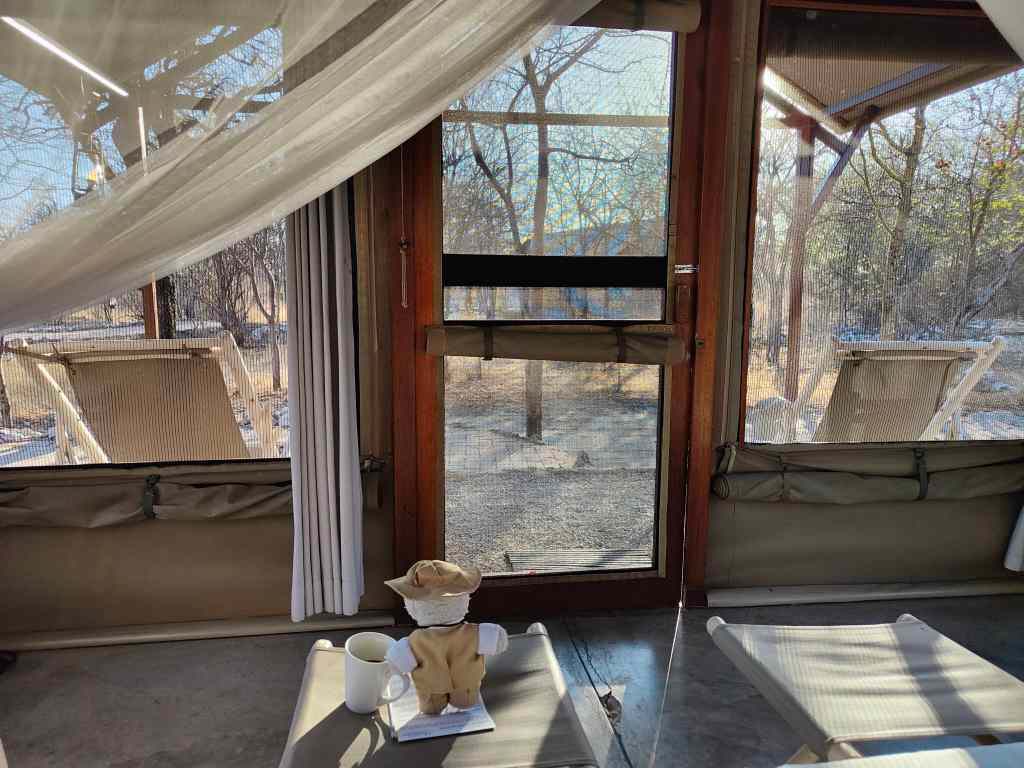
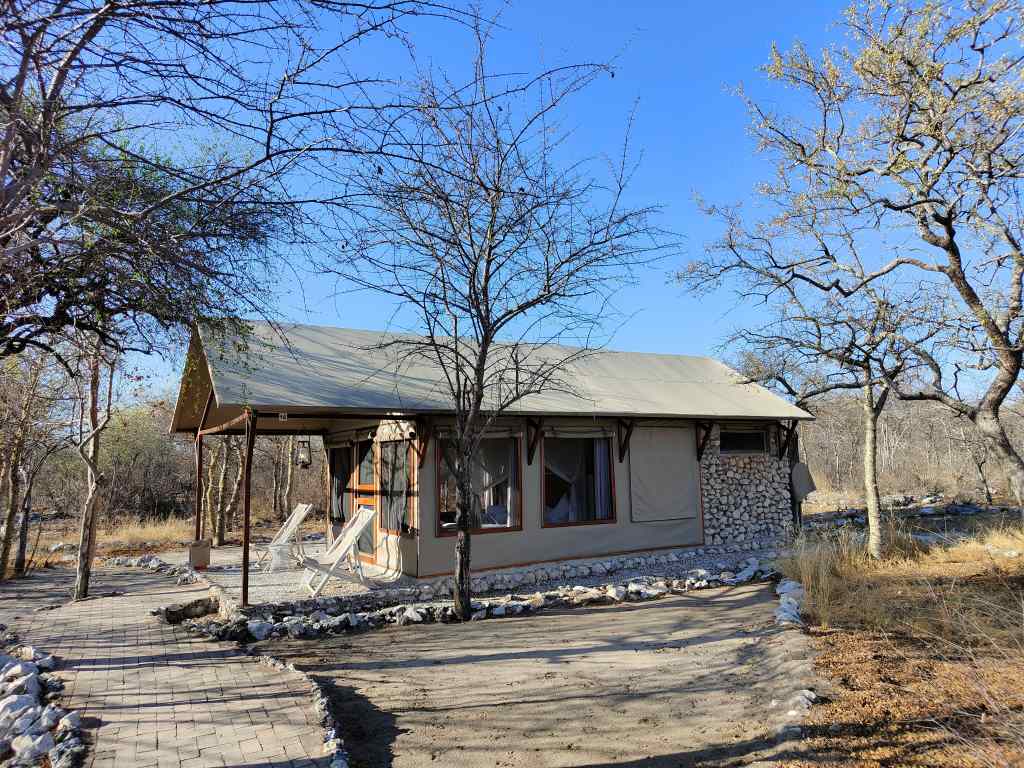
The following morning I was woken up by birds chattering in the bush outside. I opened up the flaps of my tent and sat in bed enjoying the morning air with a cup of coffee. The tent was flooded with light from all sides, and it felt like I was sitting in the open air in the middle of the bush.
The morning light flooding through my room at EtoshaThe room is part hut, part tent, with canvas sides
After breakfast I set off again to the park. There are two ways to visit Etosha – one is in your own car, making your own itinerary, and one on an organised “game drive” in a truck with other tourists and a guide. The organised tour offers better chances to see animals, since the guides know where to look and communicate their sightings to other guides by phone. But having invested in a big 4×4 I wanted to keep my independence and drive myself. Serious visitors enter the park at its 06.30 opening time to have the best chances of spotting the less easily seen game – particularly the big cats. After my three days of travelling I did not have the energy for another early start and reached the park at around 9, when some of the organised groups were already returning.
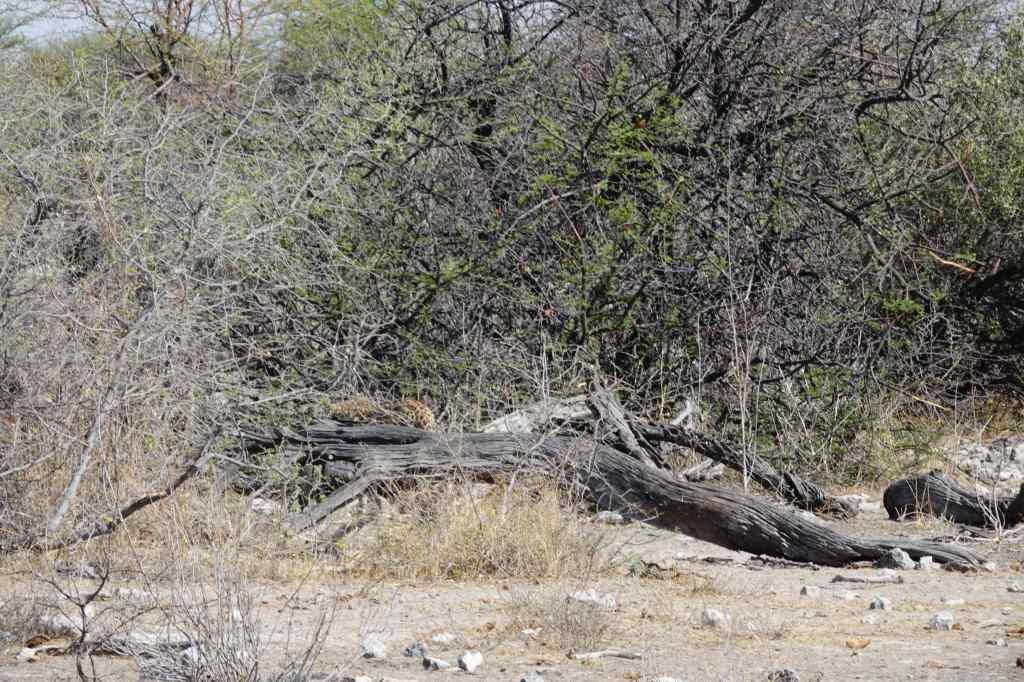
Despite my late start I was very lucky. First I spotted – very briefly – a leopard, one of the most elusive animals in Etosha National Park, but I was a little too slow to get a really good photo.
Leopard (disappearing behind the tree trunk)
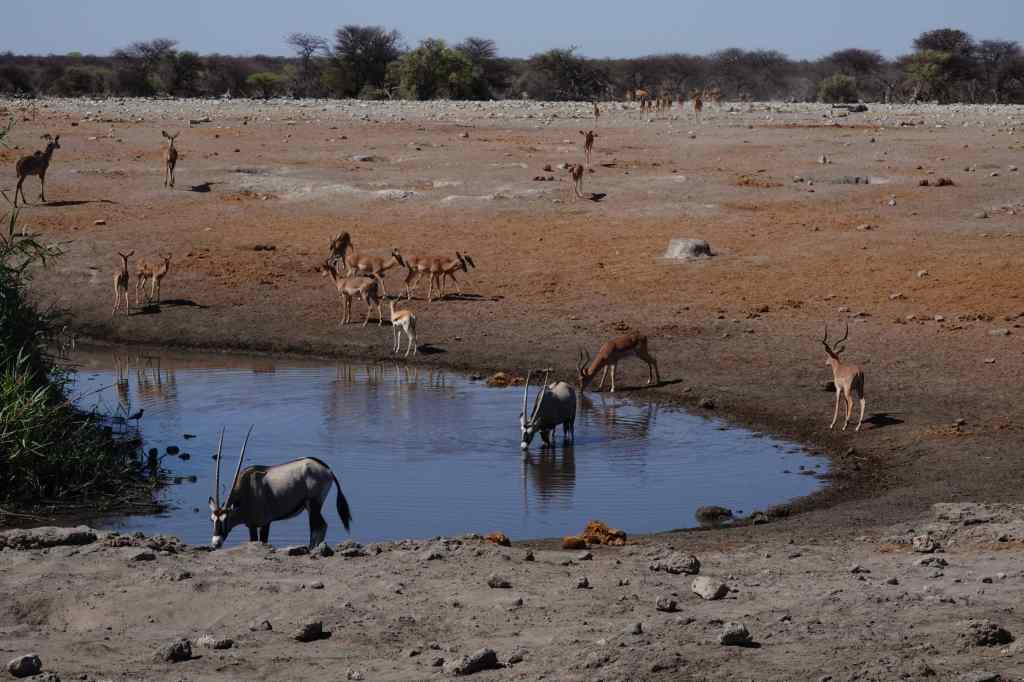
October was the end of the dry season in Etosha, and the once abundant water brought by the rains had reduced to a few waterholes where the game comes to drink. This makes for the best time for spotting wildlife. My first visit to a waterhole did not disappoint; a group of oryx and springboks were drinking, soon to be followed by zebra and some kudu.
Etosha – Oryx and Impala at the water hole
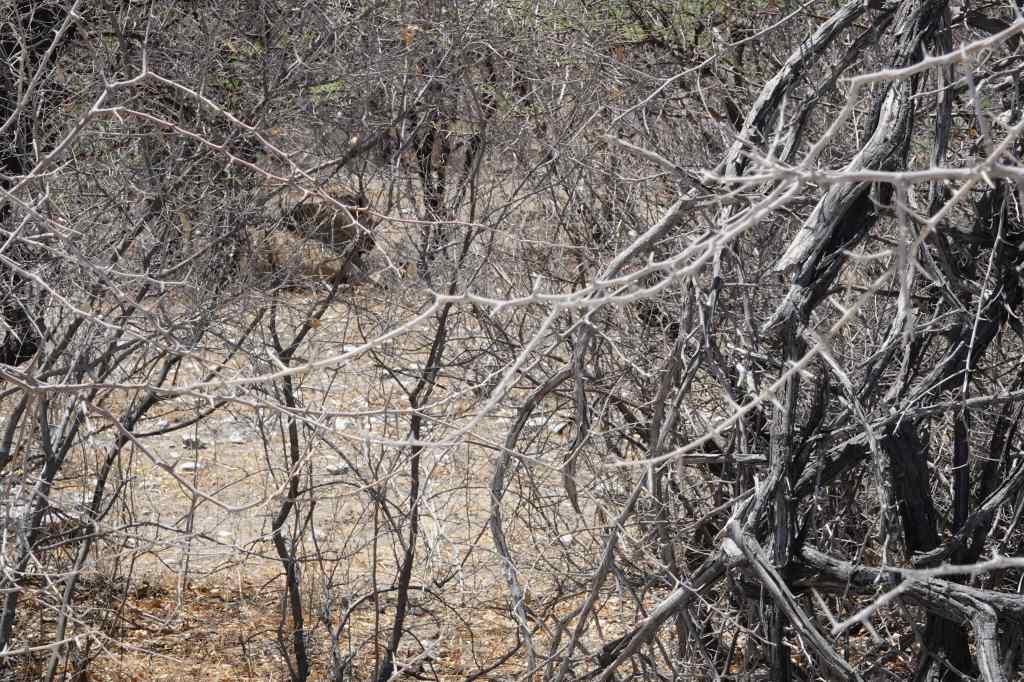
On my way to the next waterhole, I had a stroke of luck and noticed a lion, sheltering from the late morning sun under a bush. Sadly my lack of mastery of my new camera caused me to mess up my photo.
Lion hiding from the sun (top left)
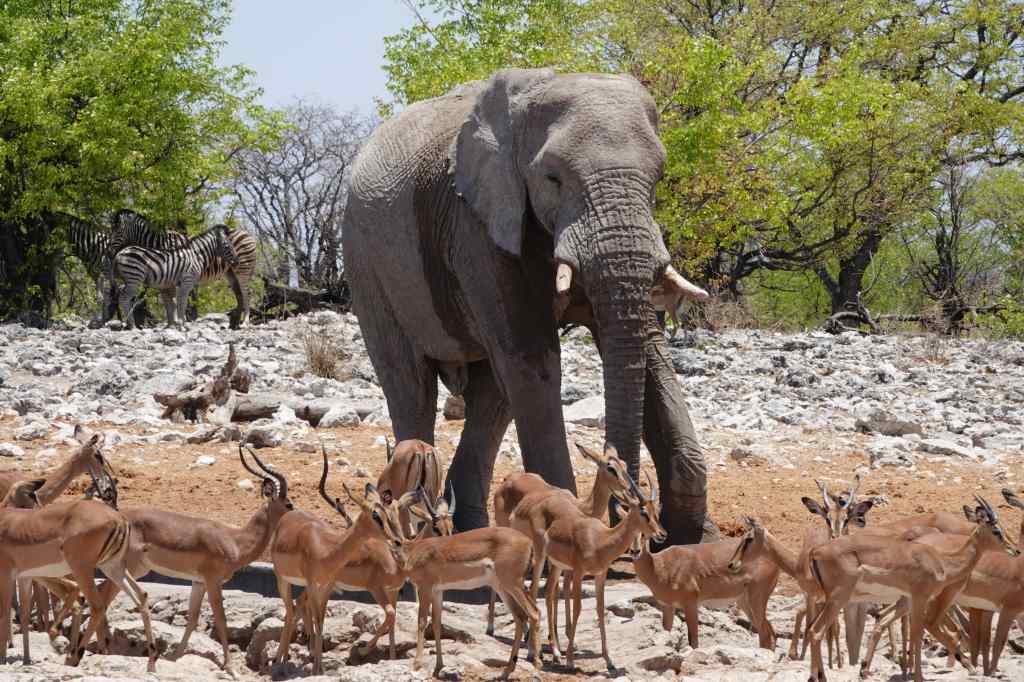
The final waterhole of my morning visit was home to a small group of elephants, who had come to drink and cool off by spraying themselves with water. Elephants seemed very common at Etosha.
Elephant and Impala at a waterhole, Etosha
Watching the giraffes drink was the most interesting. They would approach very slowly, then look around for several minutes. Then they would slowly splay their legs and lower their necks to drink. I suppose that their caution is because they is only ever vulnerable to predators in this rather awkward drinking position.
Etosha – a giraffe drinking
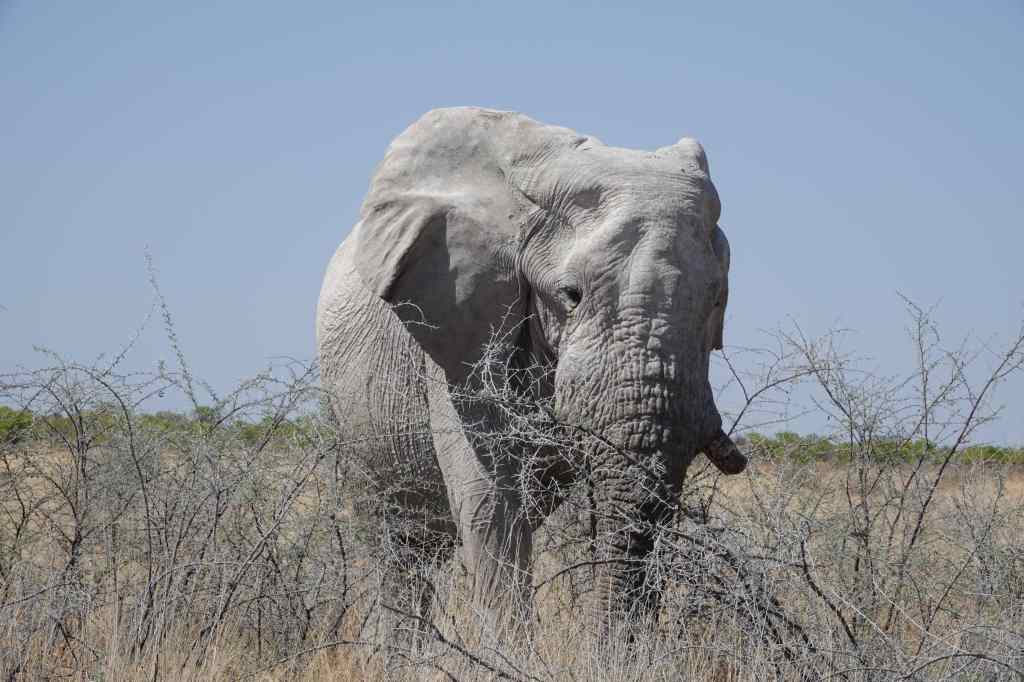
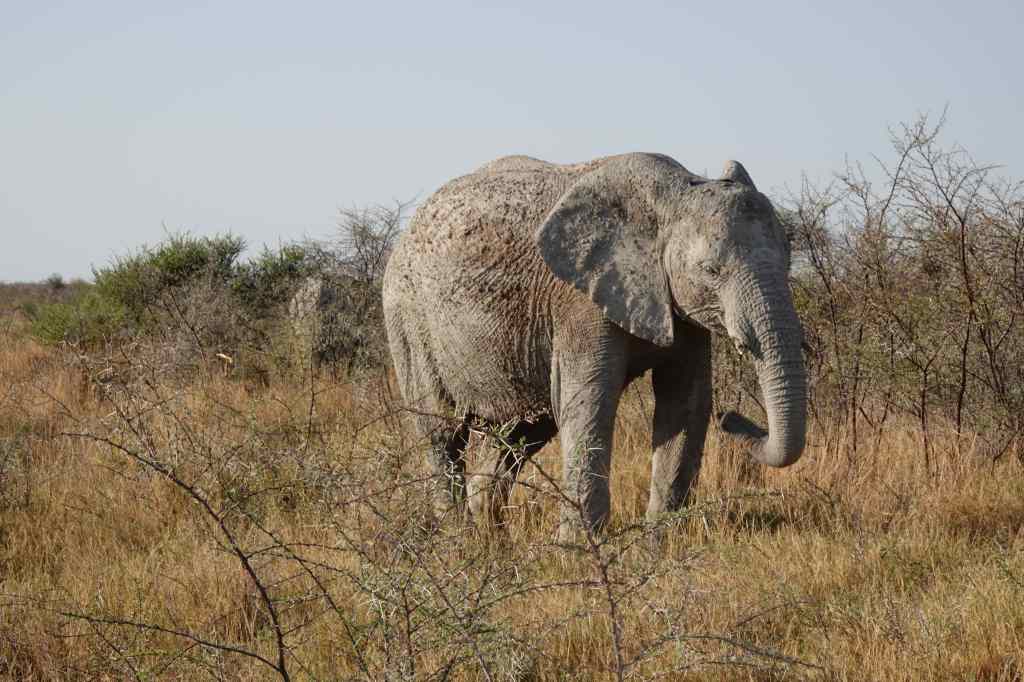
It was now one o’clock, and the hottest part of the day had arrived. This meant that animal sightings would be much harder, so I drove back to my lodge to relax by the pool. At 4pm I set off again for my evening “game drive”. I visited a couple of waterholes without luck, before setting off along a remote track. At first the landscape was empty and dry, and I began to regret my choice of route. But then I bumped into an old, grey wrinkled elephant just standing by the side of the track. He looked a bit crumbly, and like many elephants in Etosha National Park, had broken tusks (apparently a lack of minerals means that few Etosha elephants have big healthy tusks).
A solitary old elephant
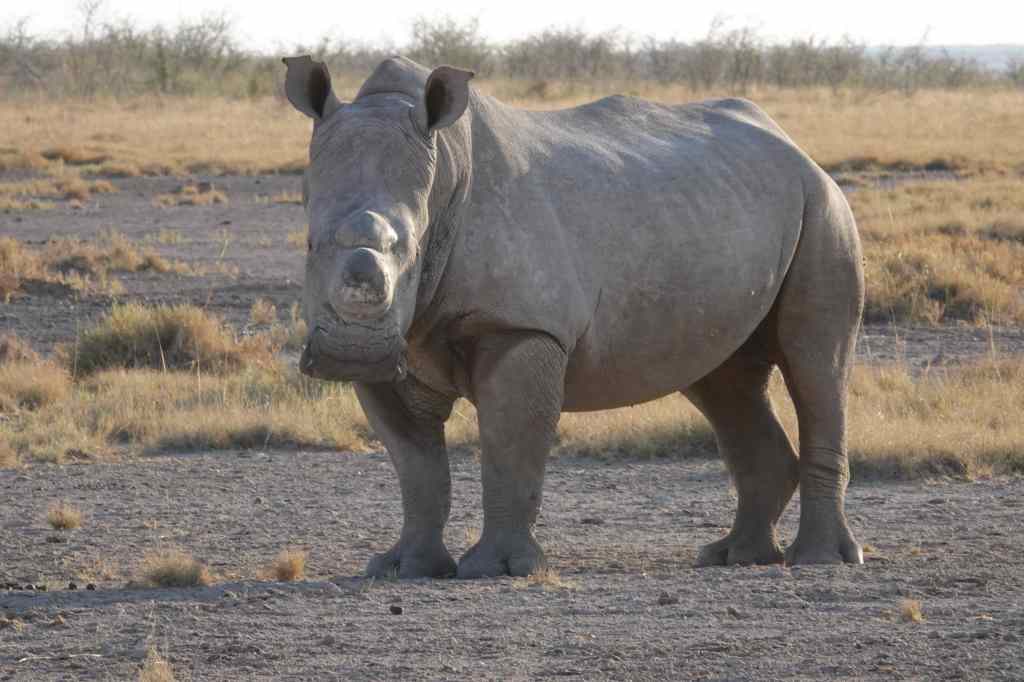
The old elephant, isolated and maybe rejected by his herd, made me feel rather sad, but transformed my feeling about my drive, which became a big adventure. I drove off onto a flat plain. In the distance, I could see the silhouettes of other lumbering elephants and tall giraffes; occasionally the track would bring me face to face with one. I’d stop to let the giraffes run away, but slow down and pass the elephants carefully – my guidebook had a whole page devoted to what you should do if an elephant charges your vehicle. I felt that I had landed on another planet, or gone back to some prehistoric time on earth, before the rise of man. I was enjoying the feeling of total detachment from the modern world when I stumbled upon the highlight of the afternoon – a rare white rhino. I stopped and we looked at each other with curiosity, whilst I took more photos.
Face to face with a white Rhino at Etosha
I noticed the sun was sinking on the horizon, so looked at my watch and checked the map. I was a long way from the entrance and I had an hour to reach the gate before it closed. I hurried off, initially pursued by the rhino. I raced the sun as it dipped down to the horizon and cast long shadows of trees over the plain and the road. I didn’t want to have to find out what happened to people that got stuck in Etosha after closing time, and made it there exactly at the 19.02, to be the very last vehicle to leave. As I drove off I heard a guard say “Right, home now!” to her colleague.
Back at my camp, I had another excellent dinner (fish this time – how did they get it here, so far inland?) and then collapsed into the bed in my tent, very happy with day’s game spotting. Out of all of the larger animals at Etosha, I had been lucky enough to see everything except the eland (Africa’s largest antelope) and the cheetah.
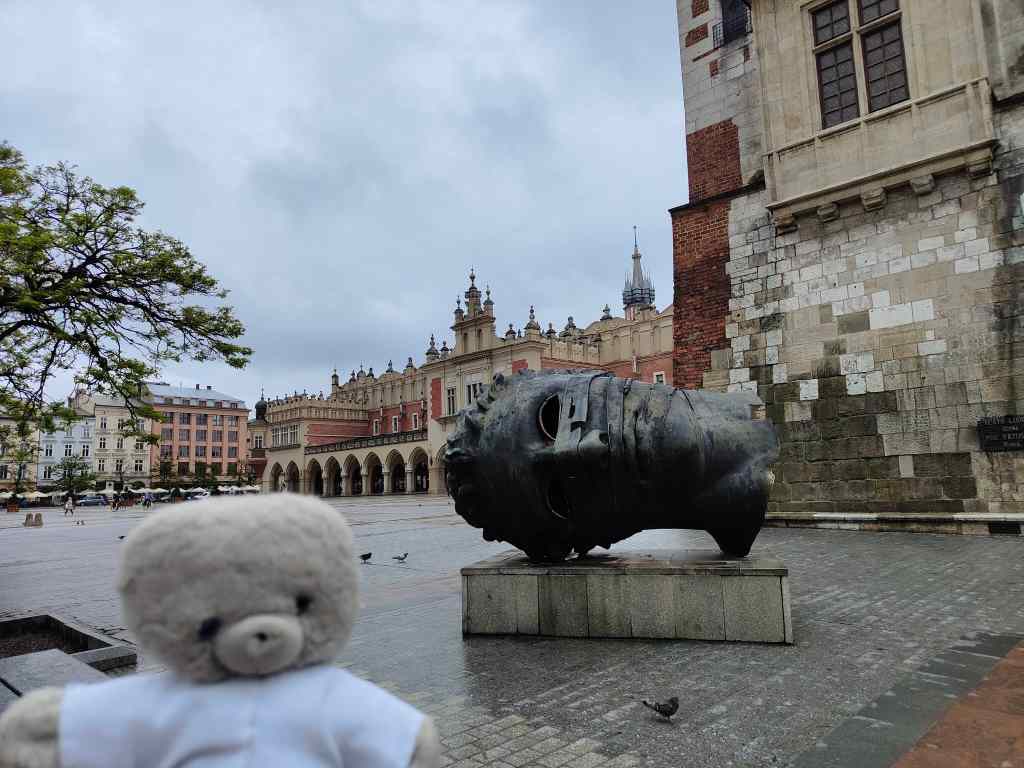
After my harrowing visit to Auschwitz, I returned to Krakow for a couple of days at the end of my trip. The weather had become cloudy, but I still enjoyed visiting the old town again.
The modern statue of “Eros Unbound” in Krakow’s main square
I visited a few of Krakow’s indoor attractions, such as the Czartoryski Museum, which houses an eclectic collection of paintings, military artifacts and sculptures. The highlight of the museum is the famous picture “Lady with an Ermine” by da Vinci. It is a beautiful painting, but my enjoyment was a bit spoilt by the constant stream of tourists taking pictures. I decided that if you cannot beat them, join them, and took my own snap.
The Lady with an Ermine by da Vinci, Czartoryski Museum
My next indoor attraction was the Pharmacy Museum, housed in a pretty old house. It was an atmospheric place, with bottles of strange drugs and herbs everywhere. It also had a few unexpected hazards for small teddies like me.
Unexpected hazard in the Pharmacy Museum, Krakow
In the afternoon I visited the famous UNESCO listed salt mine at Wieliczka, a short taxi ride to the south of Krakow. Salt has been produced at this site since neolithic times, when people took brine from salty springs and evaporated the water in the sun. In the 13th century, salt rocks were found under the ground and mining developed rapidly. Under King Casimir the Great in the 14th century, revenues from salt were thought to make up a third of the country’s budget.
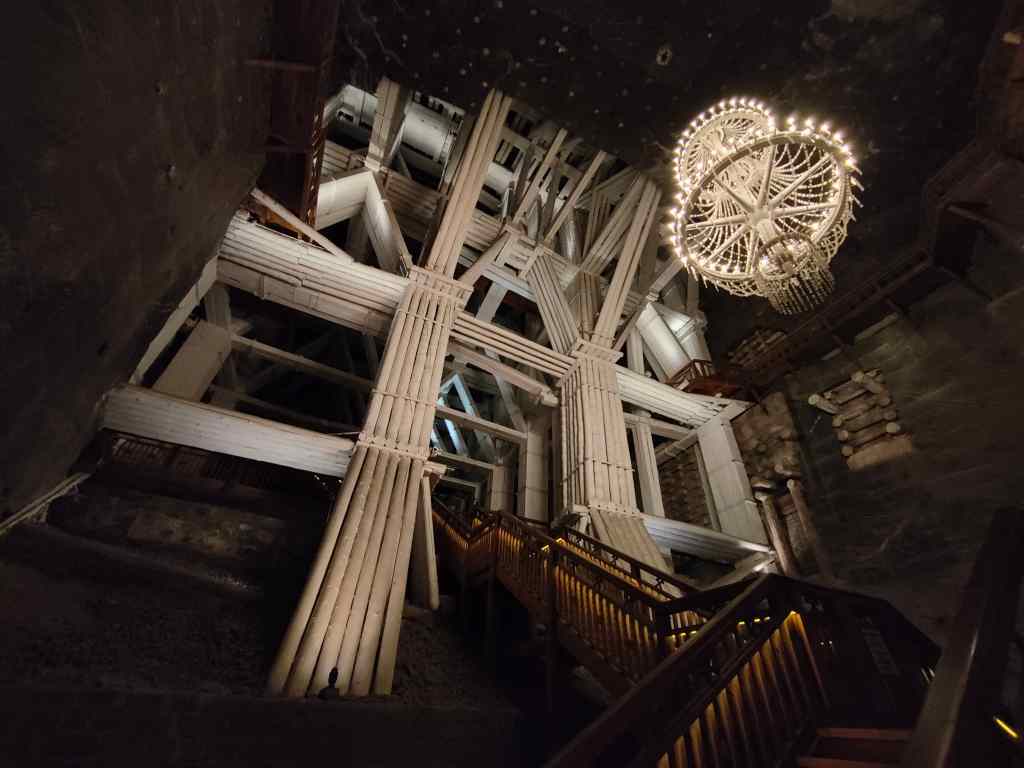
Over the centuries that followed, the mine developed to comprise 9 levels, the last one 327 metres below ground, and 245 km of passageways. Production of salt stopped in 1996, and the mine now operates as a tourist attraction, welcoming two million visitors per year. I arrived to find tourist visits were organised with an almost industrial efficiency. Groups of up to thirty people assemble at reception at the surface and are led down into the mine by a guide for the two-to-three-hour tour. A new tour sets off every ten minutes.
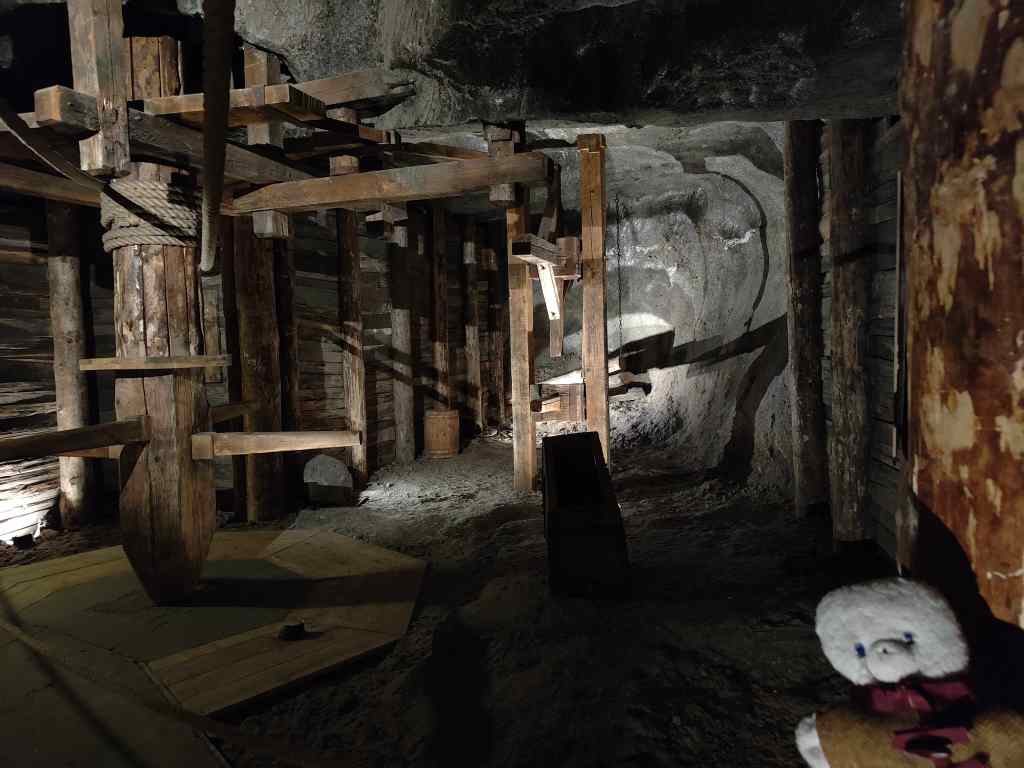
The route for visitors includes only around 2% of the total length of the mine’s galleries, reaching the fourth level underground. It was quite chilly in the mine, and I was grateful of my fur to keep me warm. We passed old mining equipment, salt lakes and huge chambers carved out by the miners.
Mine equipment, Wieliczka
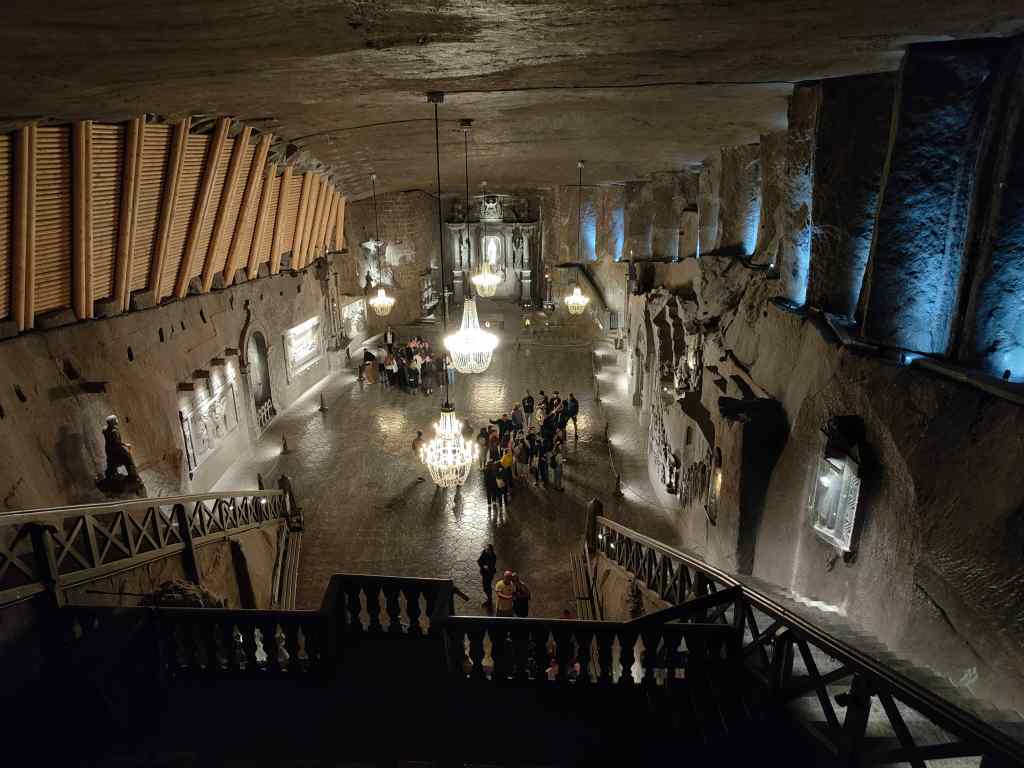
Highlight of the mine is an St Kinga’s chapel, a church, carved out of the salt rock, with many statues and bas-reliefs carved out of salt. The chapel is an active place of workshop, but only miners and their families are allowed to attend services there.
St Kinga’s chapel, Wieliczka salt mineThe altar – all the carving is from salt, and done by the minersAn exquisite bas-relief in St Kinga’s chapel
Visitors have been coming to see the mine since the 16th century, and a large underground concert hall was created where they would listen to music.
The concert hall, Wieliczka
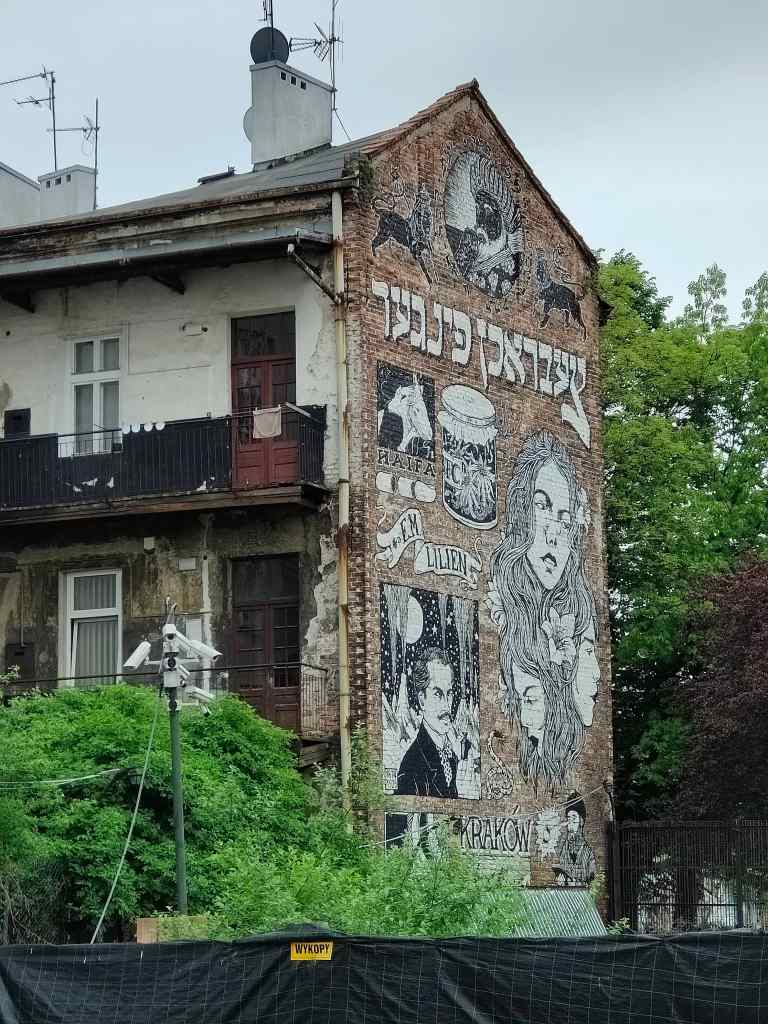
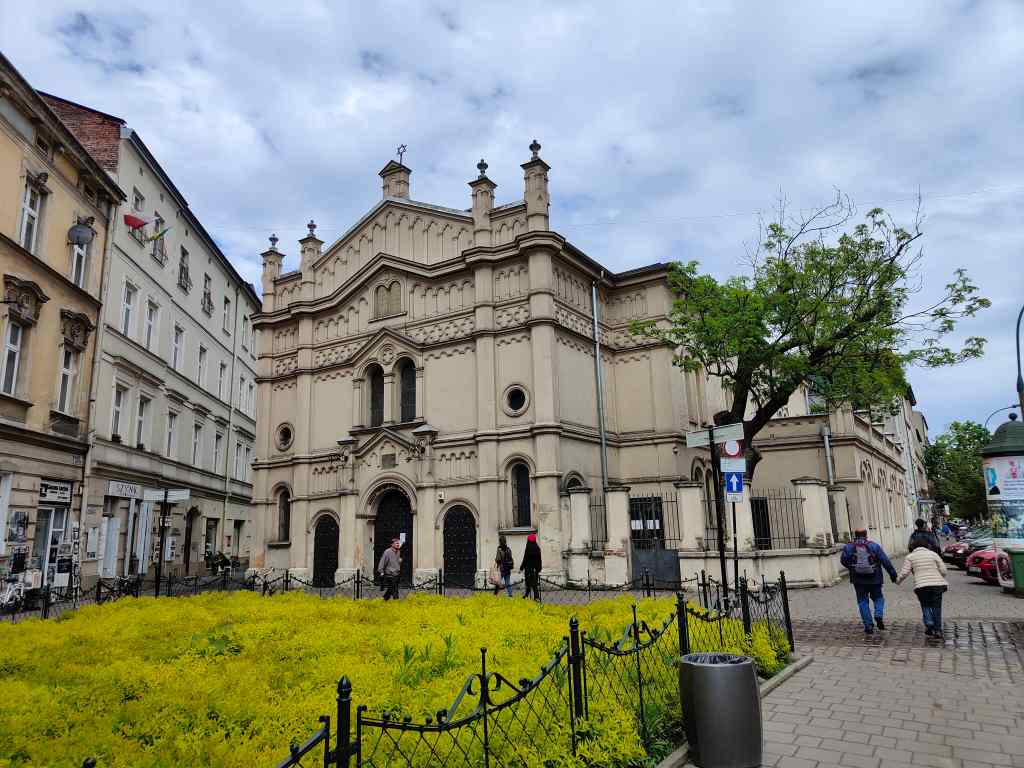
I found the mine very interesting, but was a little puzzled that it was, apparently, Poland’s most visited tourist attraction. Back at the surface, I warmed myself in the early evening sun before heading back to Krakow, where I explored the Jewish part of the city in a suburb called Kazimierz. During the second world war, this area was where the Jews were forced to live in a walled-off separate ghetto, before they were transported to concentration and then extermination camps. After the war only 3% of Poland’s Jewish population remained, but the few survivors have managed to recreate some of the character of Kazimierz, with many Jewish restaurants and a few remaining synagogues.
Mural in KazimierzOne of the surviving synagogues in Kazimierz
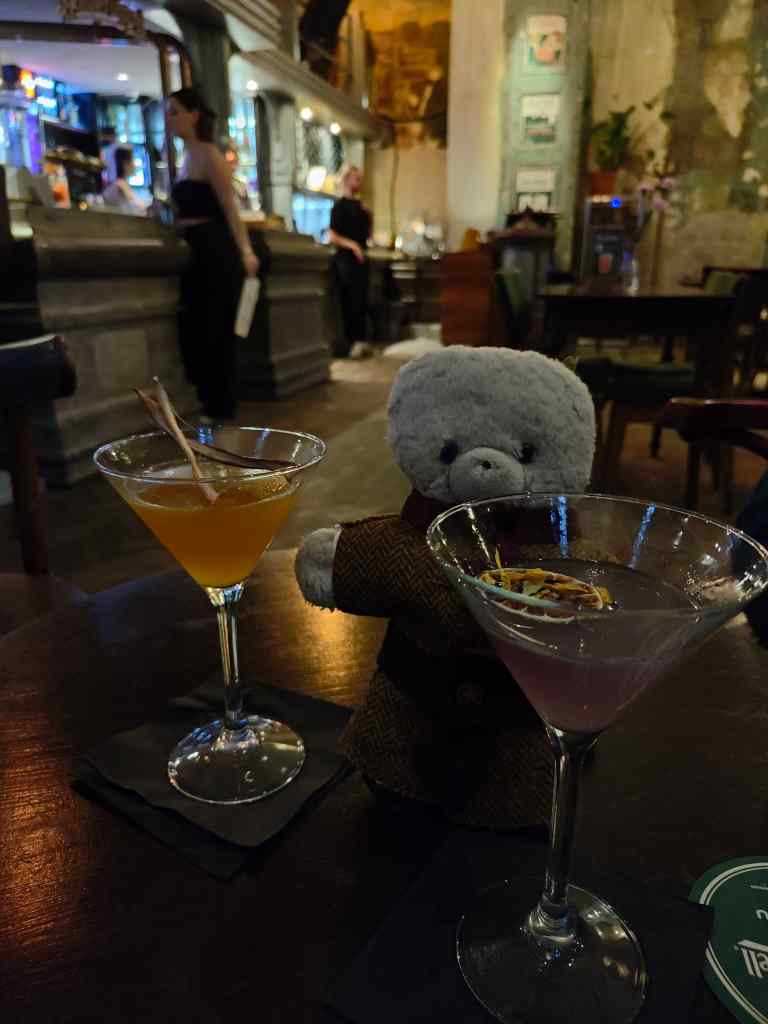
Kazimierz is also a great nightlife area, with countless cocktail bars. I spent my last night in Poland enjoying a pub crawl from one bar to the other, enjoying some excellent – and amazingly cheap – drinks.
Kazimierz night life – Last night in Poland!
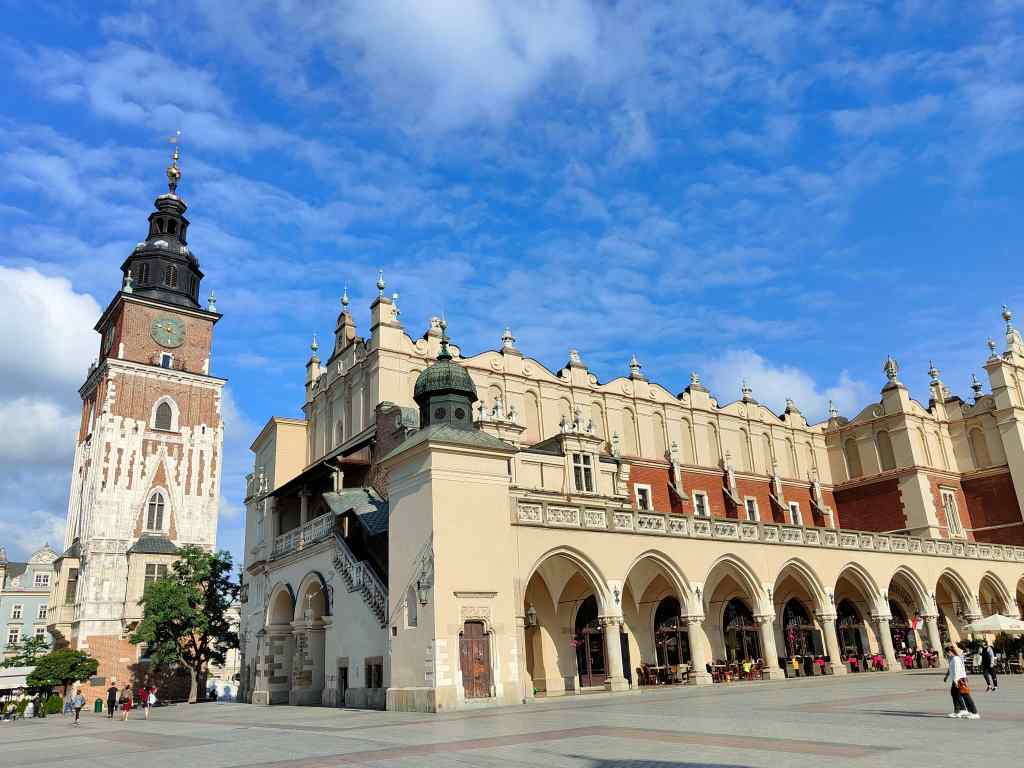
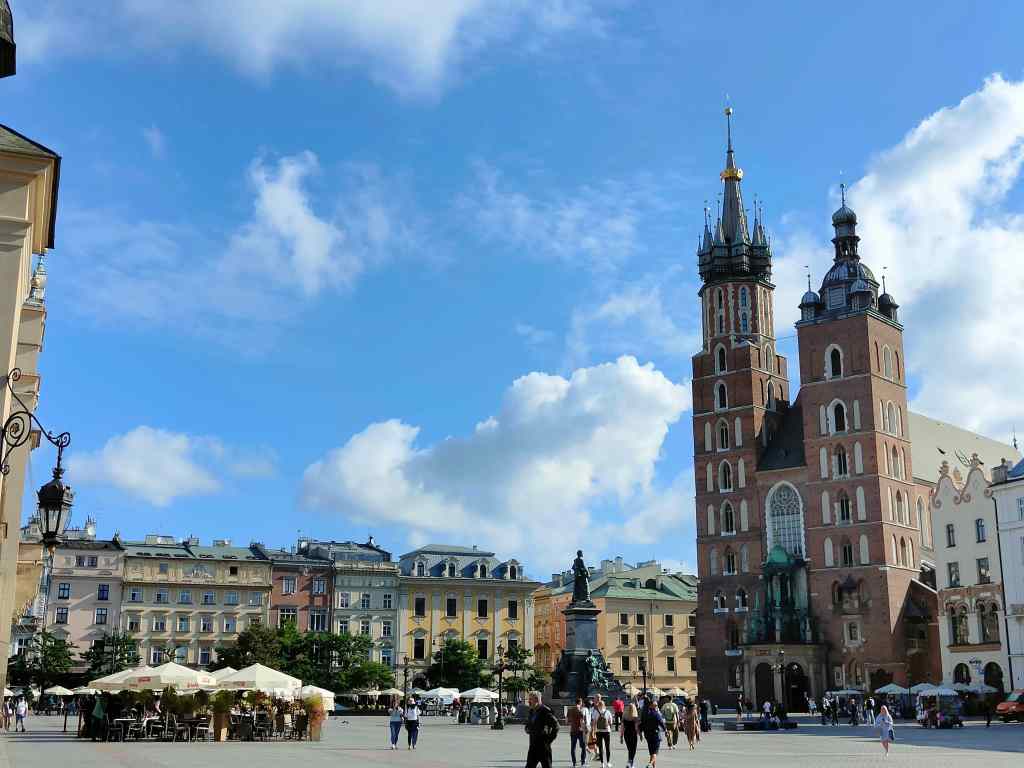
On my last morning in Krakow, before my flight back home, the sun had returned and I headed straight to the main square for some last photos and to have a cup of coffee in one of the cafés.
Last visit to the main square, Krakow
It was a good way to say goodbye to Poland, a country I had really enjoyed, with the wonderful city of Krakow and some great hiking in the nearby mountains. It is such a good value destination, and so easy to get here from London, that I think I will be back!

























 Trouspinet travels