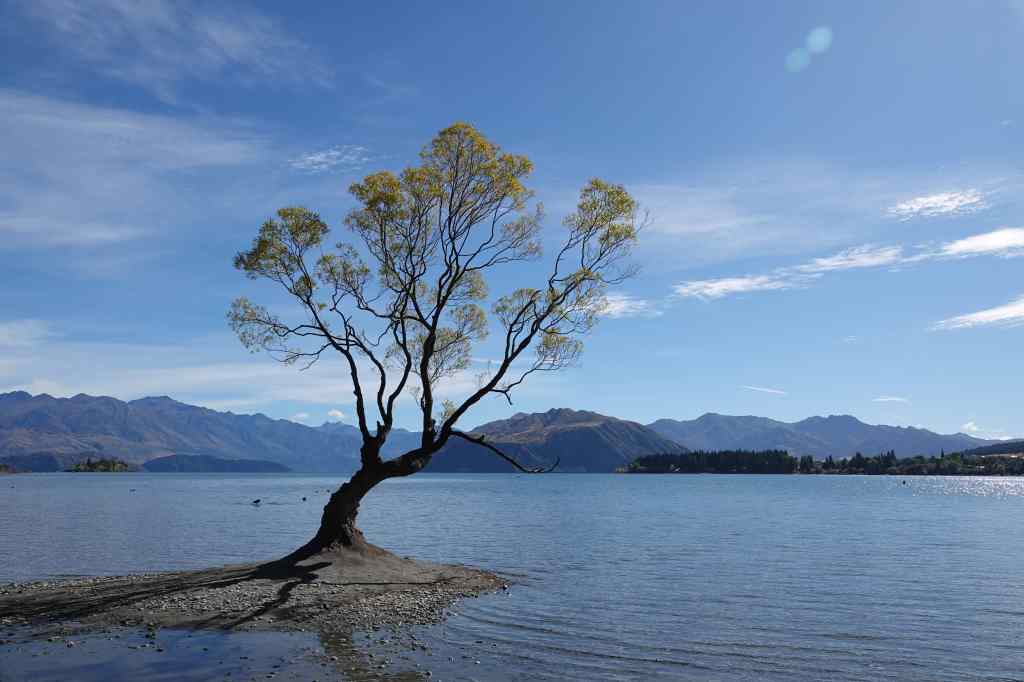
I left Wanaka in the morning, stopping briefly to photograph the now-famous “Wanaka tree”. This used to be a perfectly anonymous piece of vegetation until someone won a photographic competition with a picture of it, and since then it has been a magnet for selfie enthusiasts from all around the world. I was rather underwhelmed, but anyway here is my photo…….
The “Wanaka Tree”
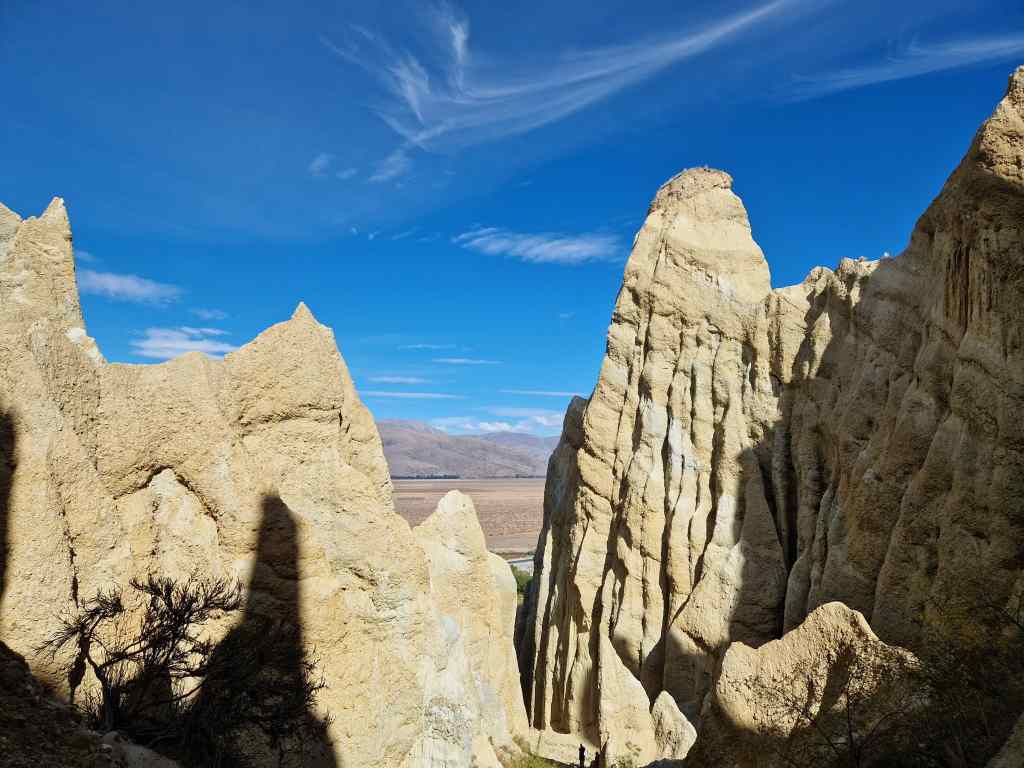
I broke the roughly two-hour drive to Mount Cook at the Clay Cliffs, an interesting geological feature located 10km along a gravel road off the main highway. Entrance was by an unmanned gate with an honesty box requesting a $10 fee – which everyone seemed to pay (try that back home!)
Approaching the Clay Cliffs……and inside the Clay Cliffs
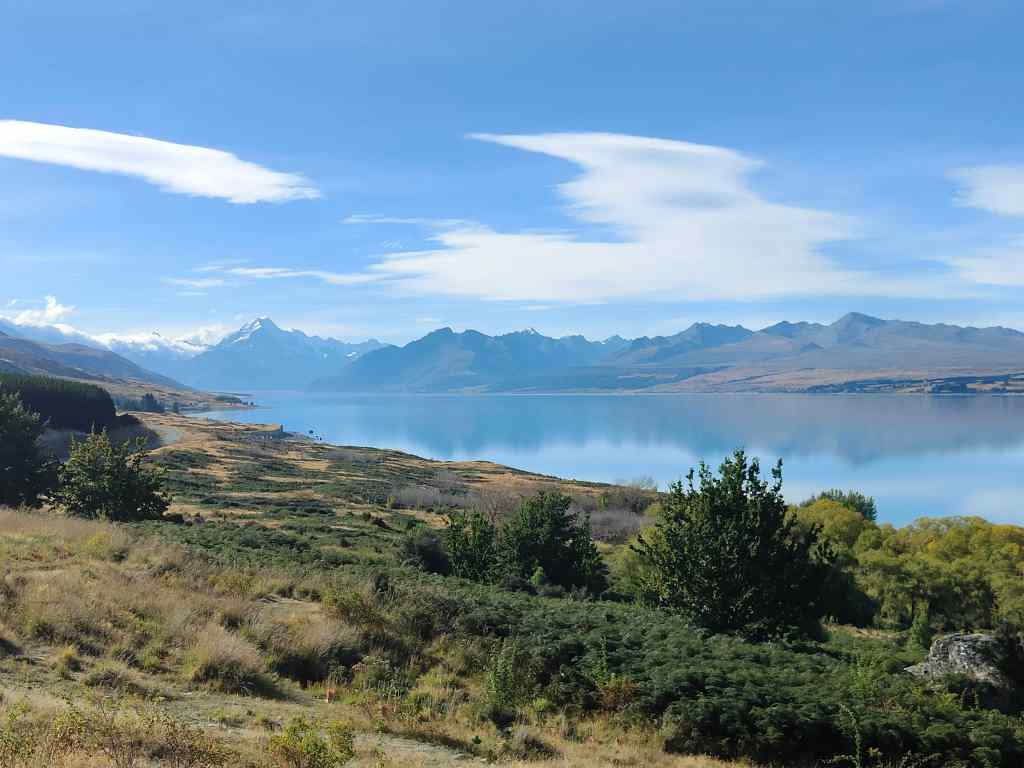
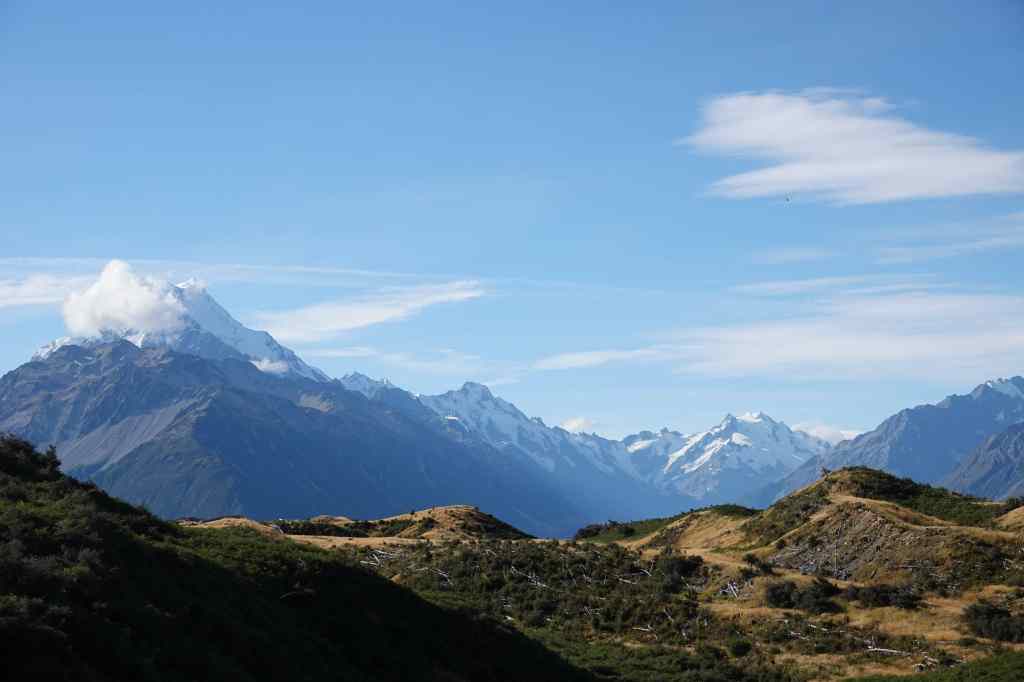
Next, I stocked up with food at the small town of Twizel before taking the road north to Mount Cook, New Zealand’s tallest mountain (3724m). As I drove along the scenic Lake Pukaki, the mountain steadily grew bigger and bigger.
Approaching Mount Cook along Lake PukakiMount Cook gets closer….
I checked into my hotel and looked forward to some interesting hiking the next day, with a forecast of sun all day. When I woke the next morning the weathermen had changed their mind, predicting sun and showers in the morning and rain in the afternoon. So I hurriedly got ready and set off along the Hooker Valley Track, a 10km walk that was supposed to give great views of Mount Cook. The promised sun was hidden by clouds and soon it began to drizzle – and later to rain. The overcast weather meant that Mount Cook remained stubbornly out of sight, but at least I could take some atmospheric photos of rainbows and mountains in the rain.
Hiking the Hooker Valley Track in the Rain
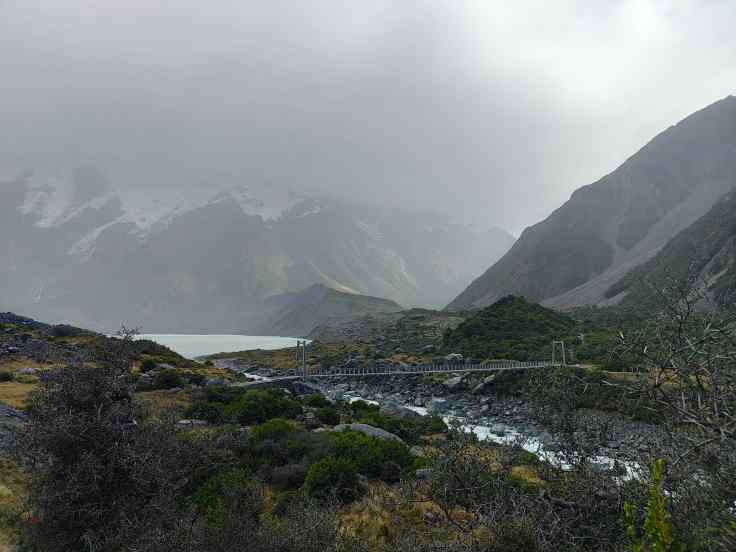
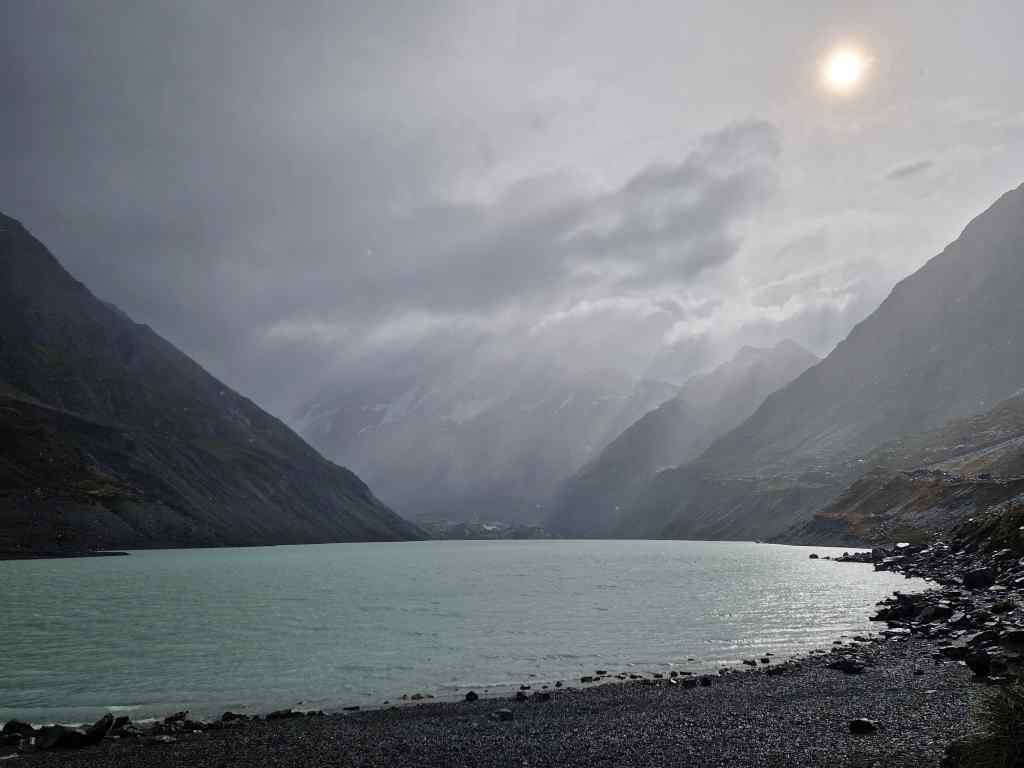
The track crossed three suspension bridges and ended at the Hooker Lake, at the end of the Hooker glacier.
Bridge on the Hooker Valley TrackHooker Lake in the Rain, no sign of Mount Cook…
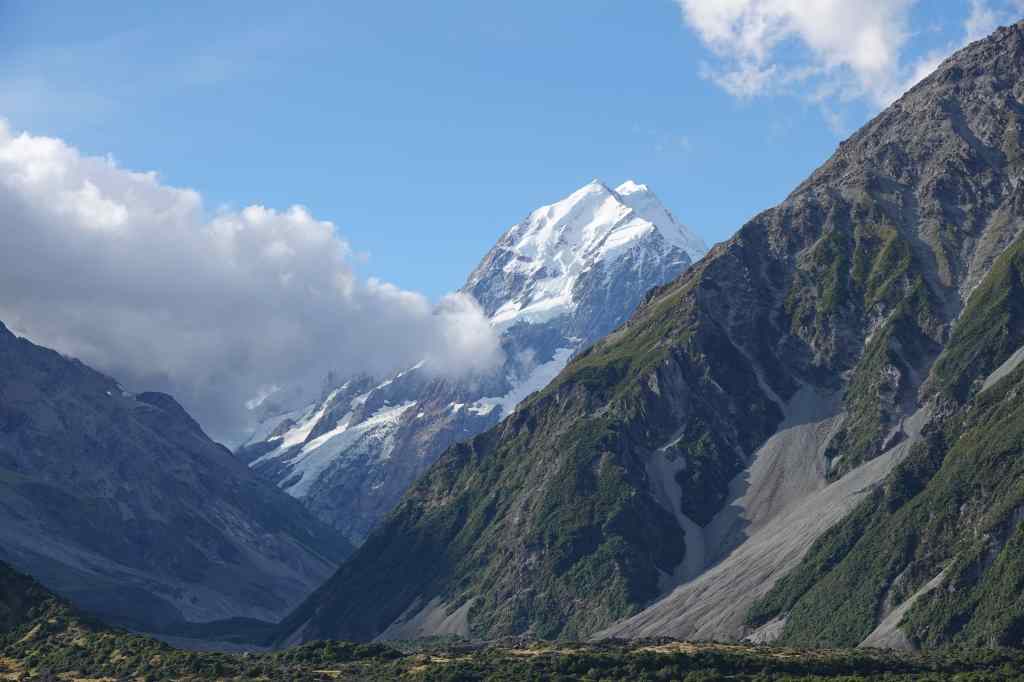
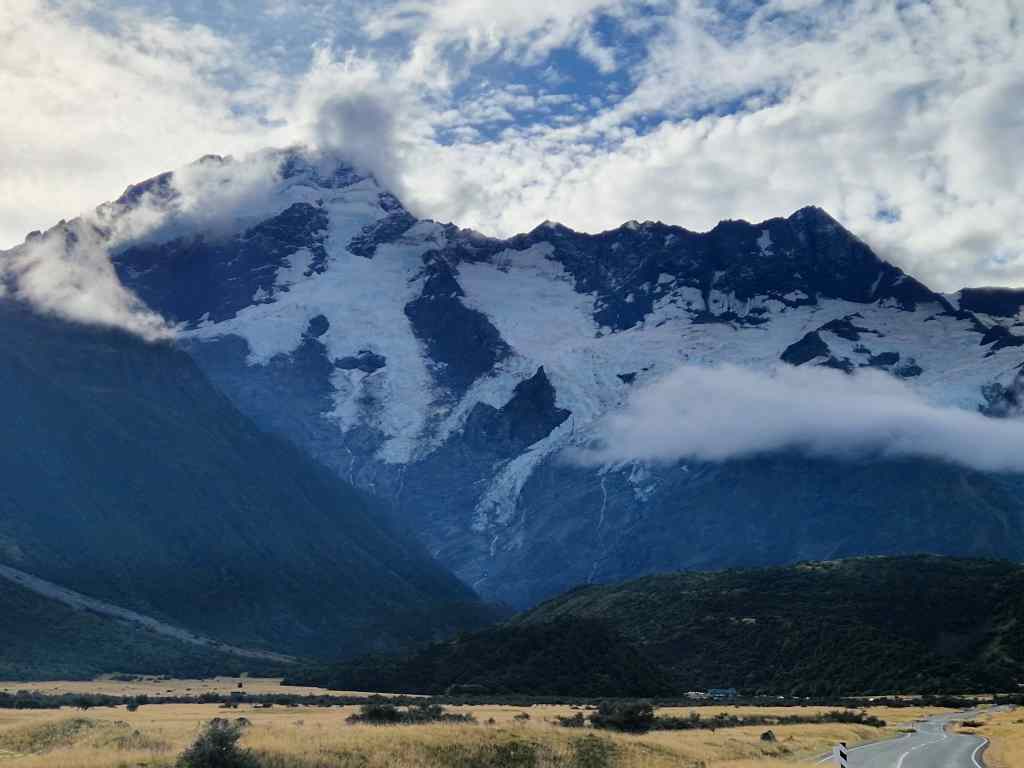
I returned along the same path, with the rain falling harder and harder, and was relieved to get back to the hotel. I spent the afternoon relaxing and writing my blog, until in the early evening I noticed that the sun had finally appeared. Being a very stubborn teddy – and determined to take some good pictures for my readers – I put on my (still wet) hiking gear again and hurried off along the same Hooker Valley Track I had walked in the morning. In the evening sun it was completely different, with magnificent views of Mount Cook.
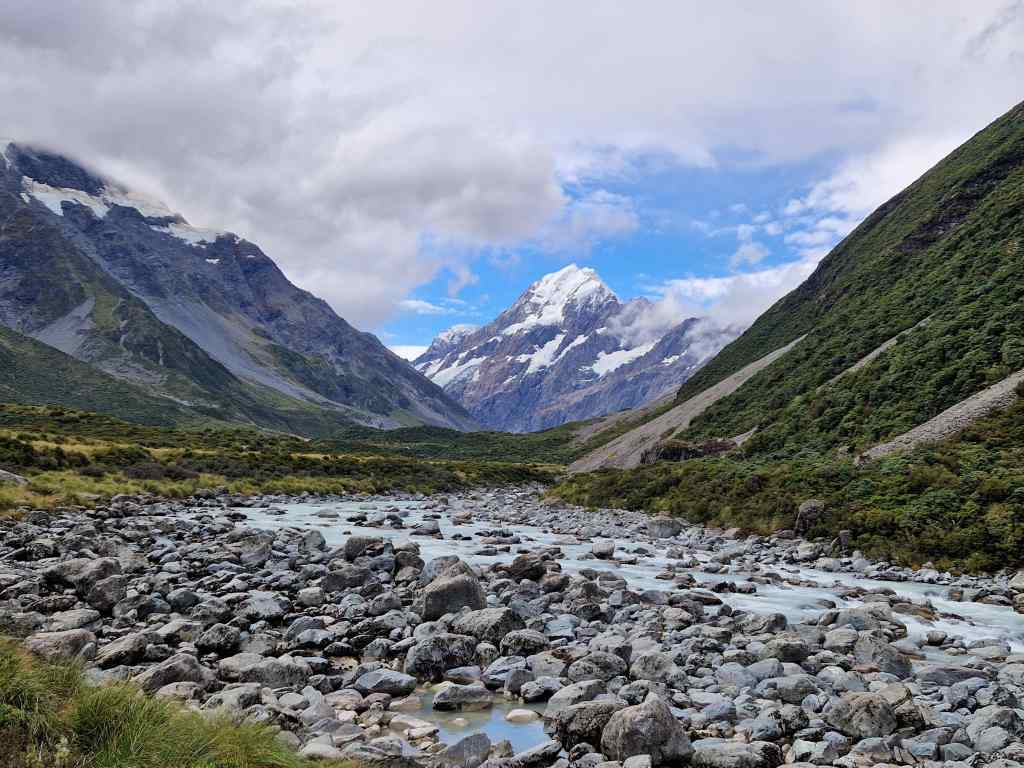
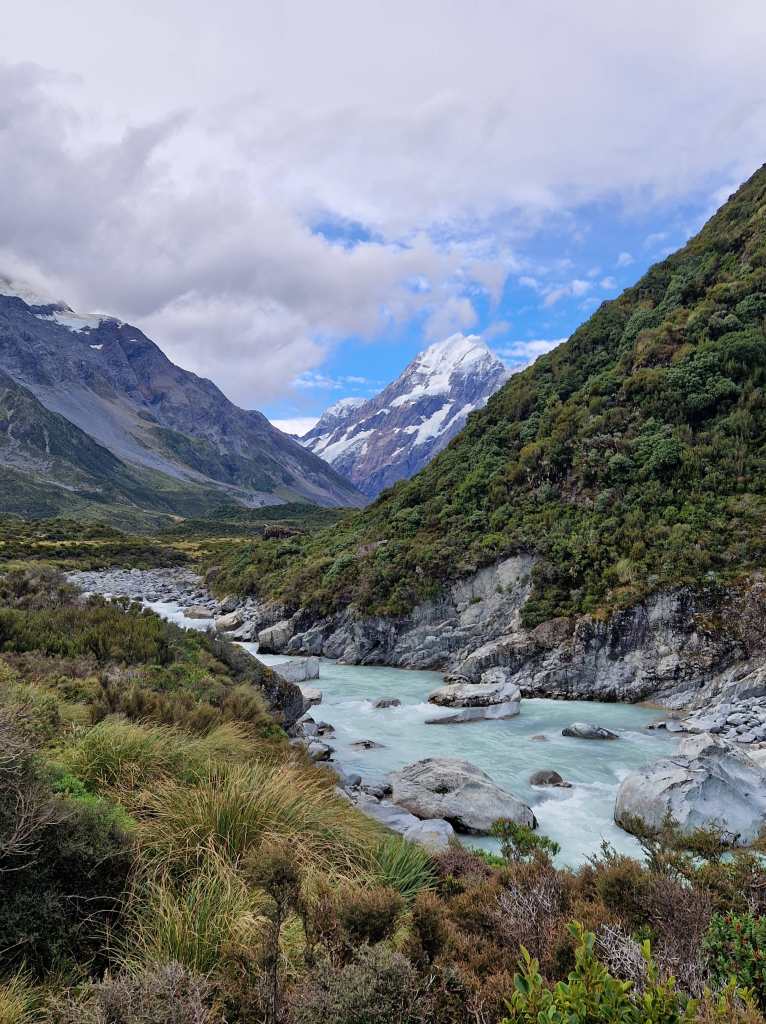
Mount Cook area scenery in the sun!The Hooker Valley Track in the sun this time, with Mount Cook visible!
I reached the Hooker Lake and took more photos, but headed back when it started to get cold.
The definitive photo of Mount Cook and Hooker Lake
Halfway back, just as my clothes had dried out, it started raining again, and once I again I reached home a rather soggy teddy bear. Still, I was happy – I had had a full experience of Mount Cook in two very different sets of weather conditions. Tomorrow I would experience New Zealand’s most iconic mountain in yet another, very different, way. Stay tuned!
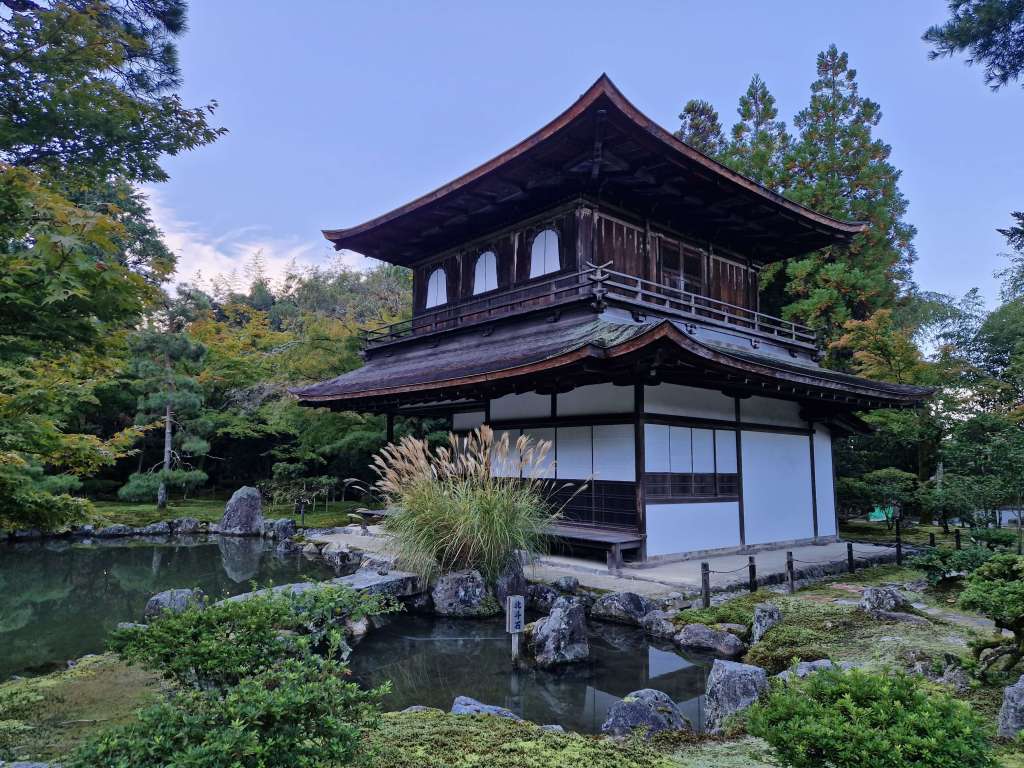
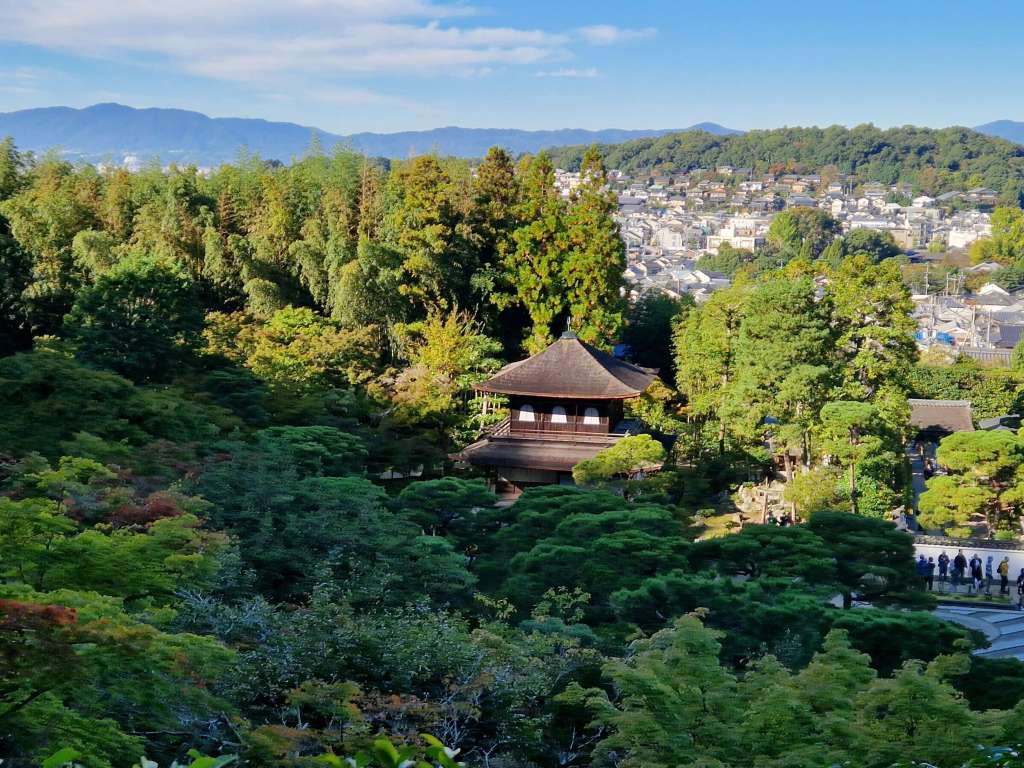
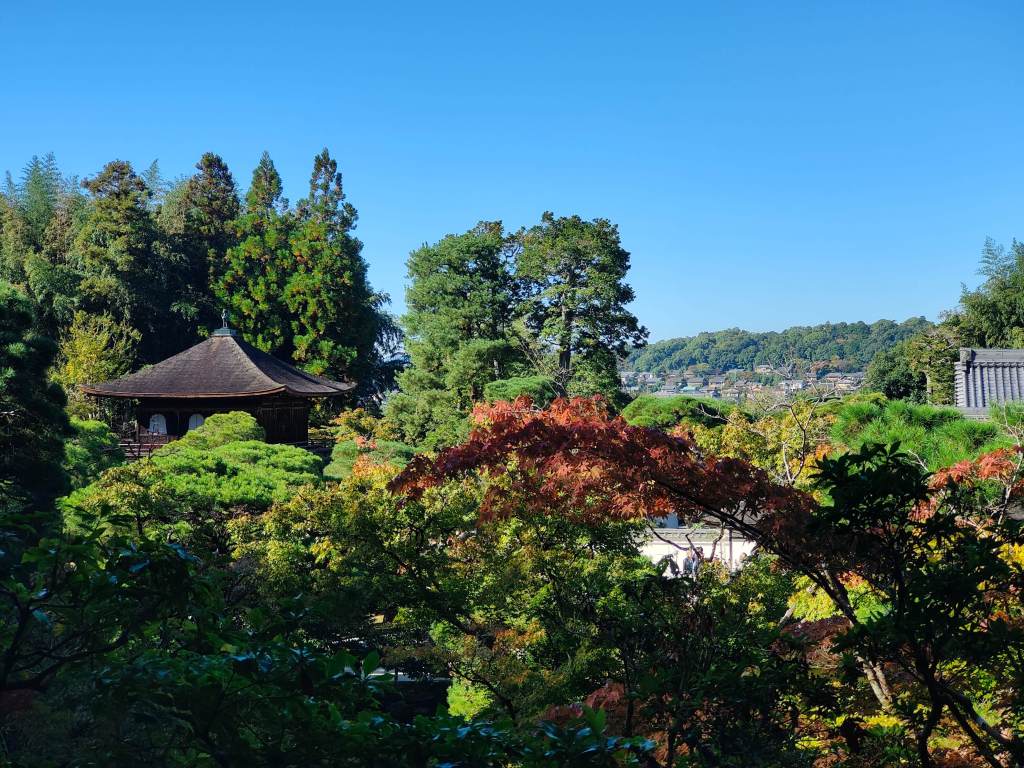
This was to be our last day in Kyoto so of course we visited……..some more temples! First was the Silver Temple or Ginkaku-ji, the last attraction on our “must see” list. This was built by the grandson of the shogun who had built the Golden Temple, which we visited yesterday. Its design matches that of the earlier building, and it too served as its builder’s retirement villa before being converted to a temple. However, Ginkaku-ji has never been silver – the name probably arose as a nickname to distinguish it from the Golden Temple. It was fairly close to our house, so we managed to arrive for its opening at 8.30, to find that we had beaten the crowds……but also that the morning sun was still hidden behind a mountain, and the temple and its garden were in shade. Unusually for Japan, this wooden structure has never burnt down, and what you see is the much restored original, dating from 1482.
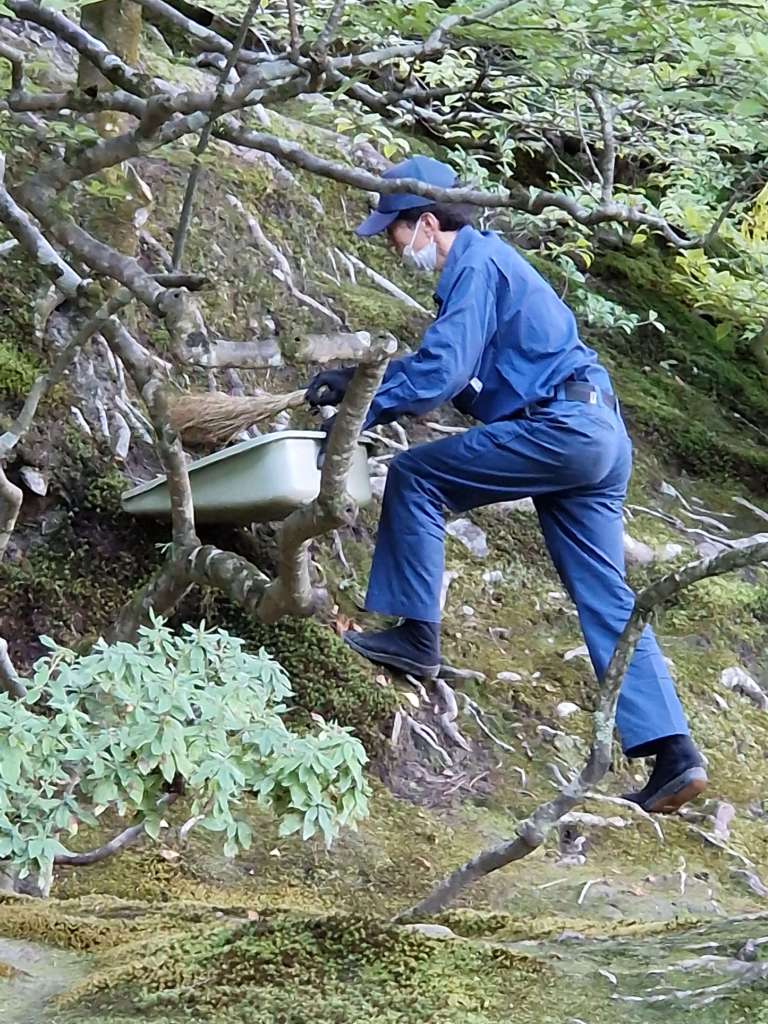
The Silver Temple, Kyoto and its garden in the early morning shadeThe Silver Temple from aboveThe gardeners here even sweep away dead leaves…a big job in autumn
We decided to wait until the sun could reveal their full beauty, which took nearly an hour.
The sun begins to reach the Silver TempleThe Silver Temple, Kyoto in all its gloryThese dry sand gardens are popular in Japanese temples
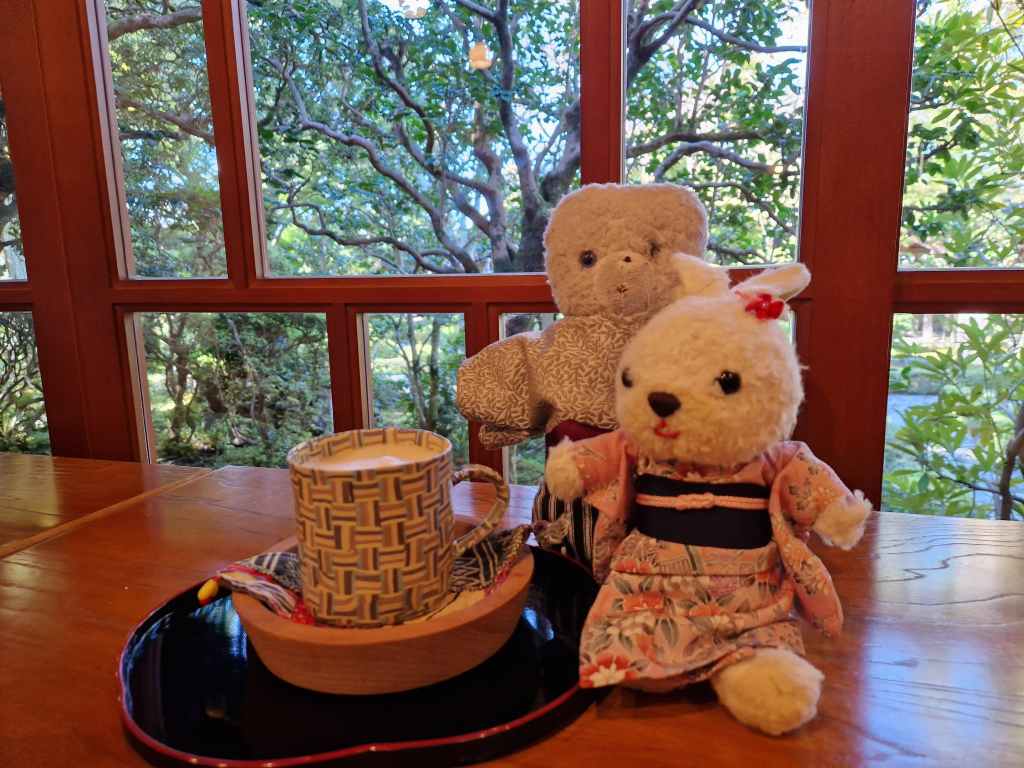
The Silver Temple lies at the start of a popular walk called the Philosopher’s Path, which runs along the side of a small canal lined with cherry trees. In spring it must be spectacular (and horribly crowded) but in autumn it was pleasant and quiet. There are a lot of temples close to the path, some well-known and quite popular and some totally off the main tourist circuit. We tried a couple of each type, enjoying the feeling of freedom of making up our plans as we went and not having to do any more crowded “must see” attractions. Even the slight disappointment of being served our weakest yet cup of latte – warm milk that may once have seen a coffee bean – did not spoil our mood.
The beautiful setting made up for the weakest ever coffee….
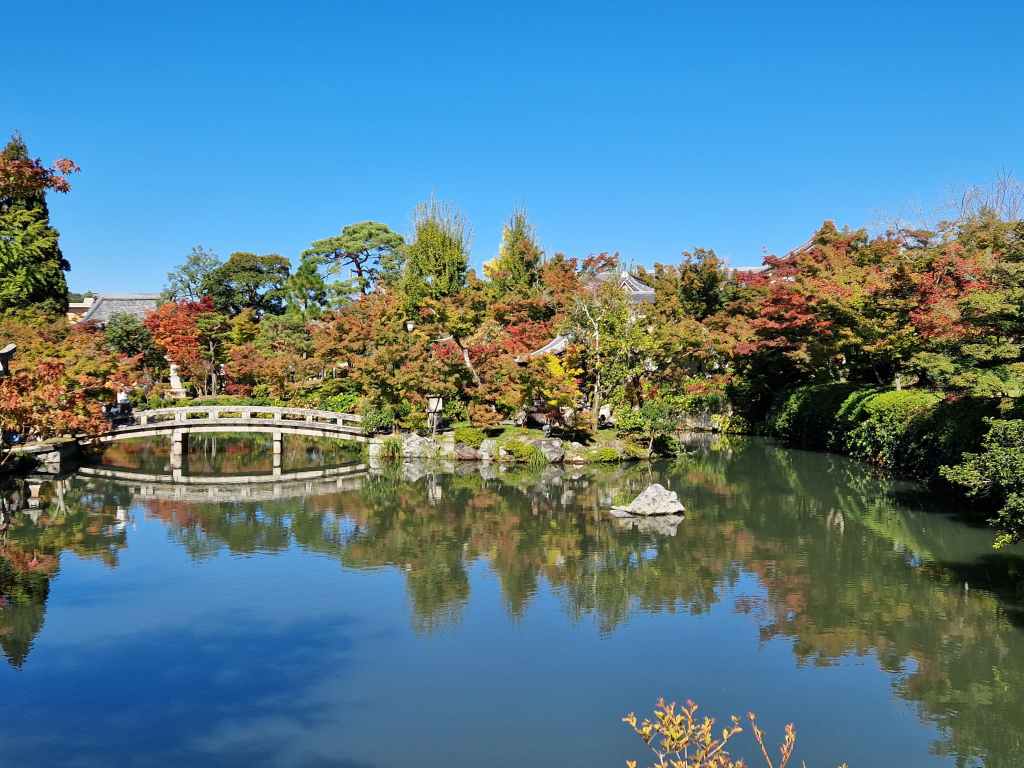
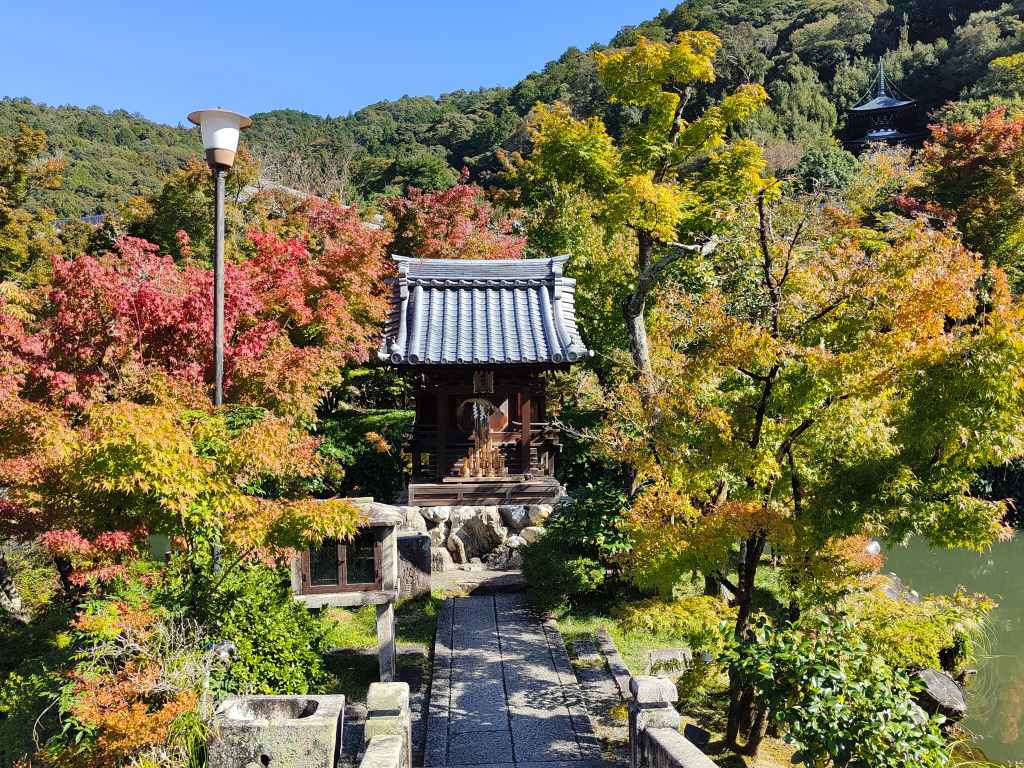
A highlight of our stroll was seeing our best yet Kyoto autumn colours at the Eikando Temple.
Eikando Temple – the best autumn colours yet of our Kyoto staySmall shrine at Eikando Temple
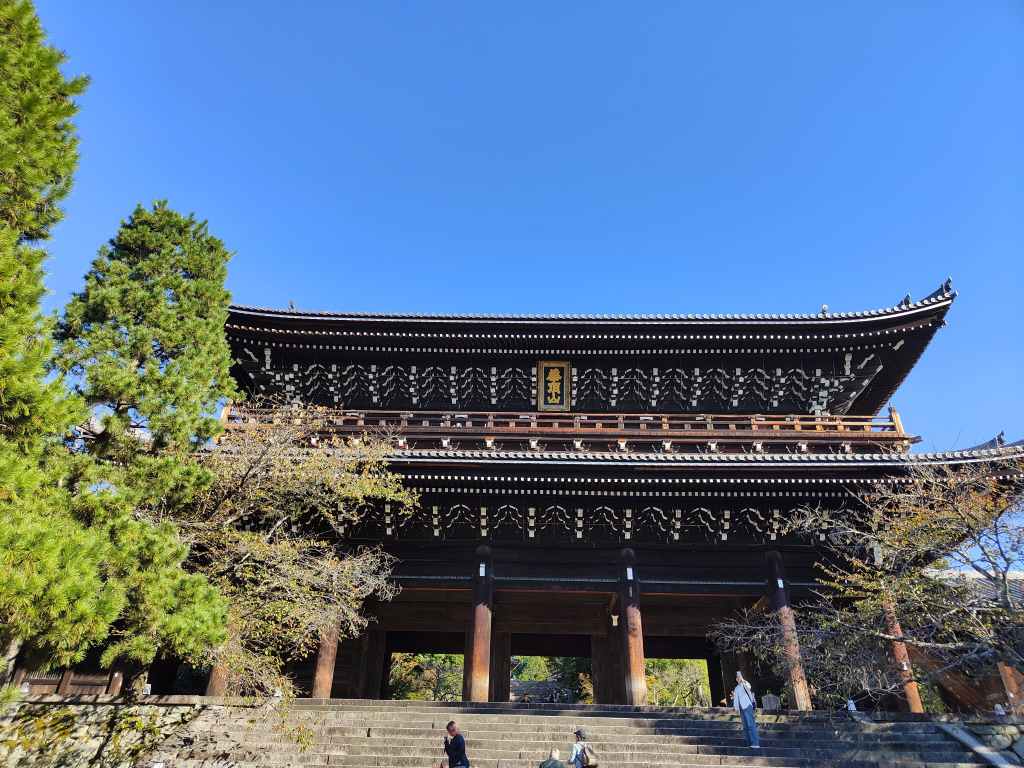
We finally ended up at the Chionin Temple, near our house, with its huge entrance gate.
Chionin Temple, Kyoto
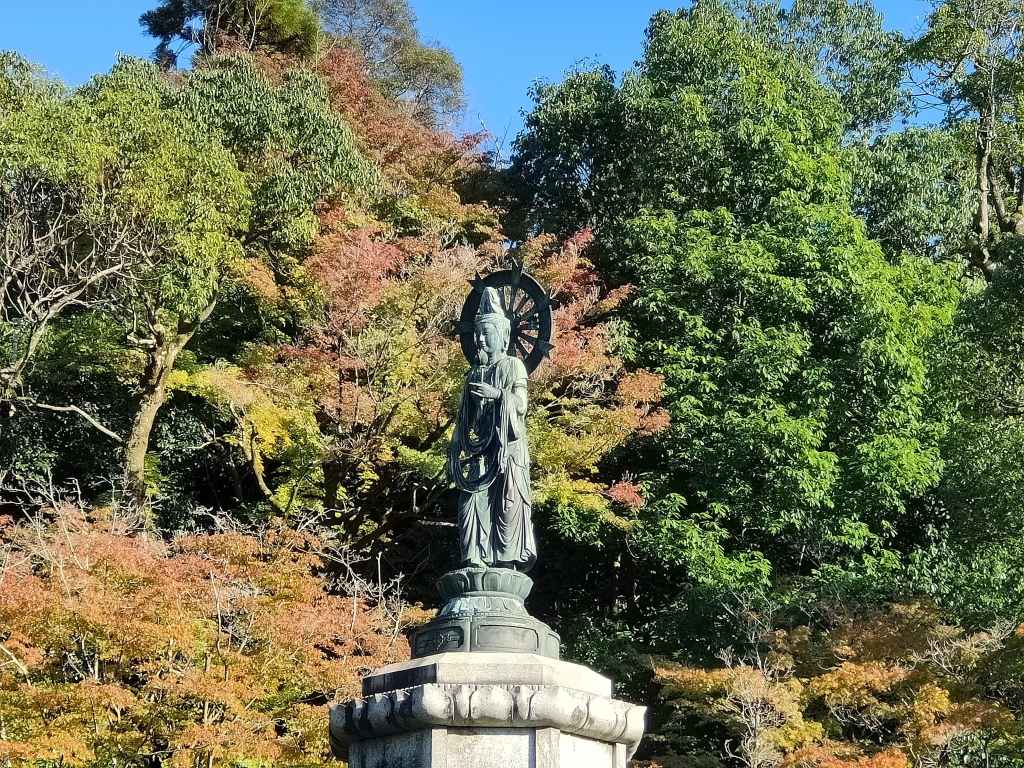
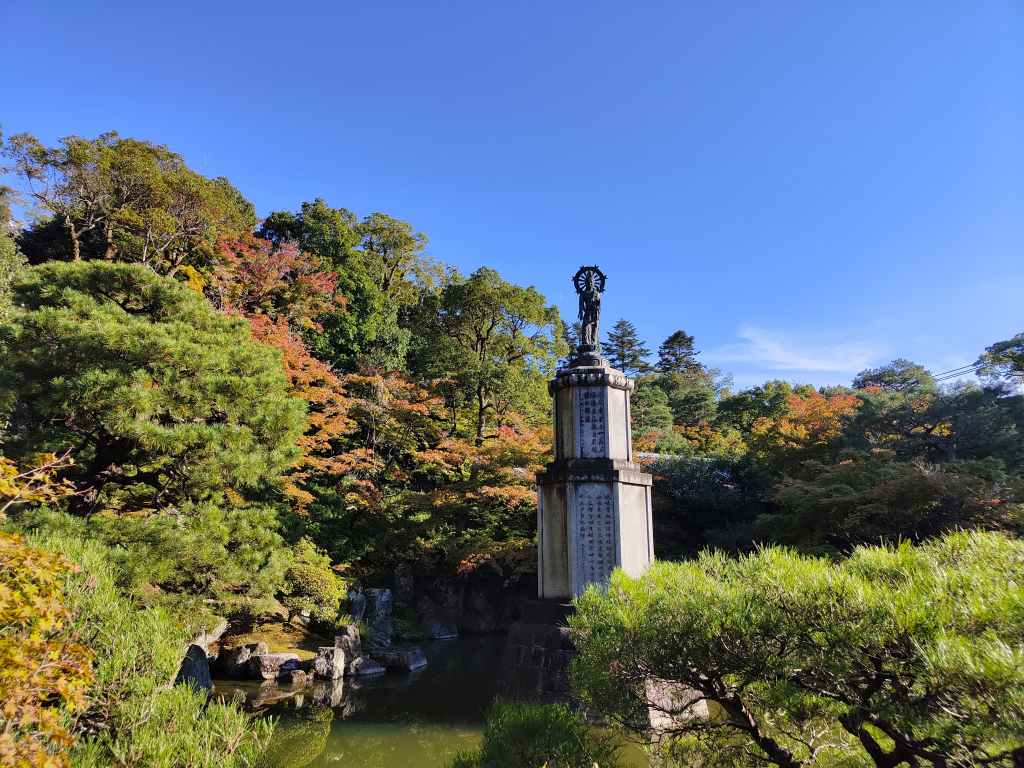
It had two gardens. The one we liked better was the Yuzen garden, which is actually modern – dating from 1954. It had probably the most evocative statue we had seen in Japan, a Buddha standing in a small lake. It was a fitting end to our visit to a city that we had finally got to like. At first we had been repelled by Kyoto’s ugly centre and crowds of other tourists. But we had now discovered that the real joy of the place is wandering around the hundreds of less-visited temples – it is a feeling unlike anything else on the planet.
A fitting farewell to Kyoto
We said a goodbye to our statue and all that it represented of the best of Kyoto, picked up our bags at our house and headed to the station to catch our Shinkansen (bullet train) to Tokyo.
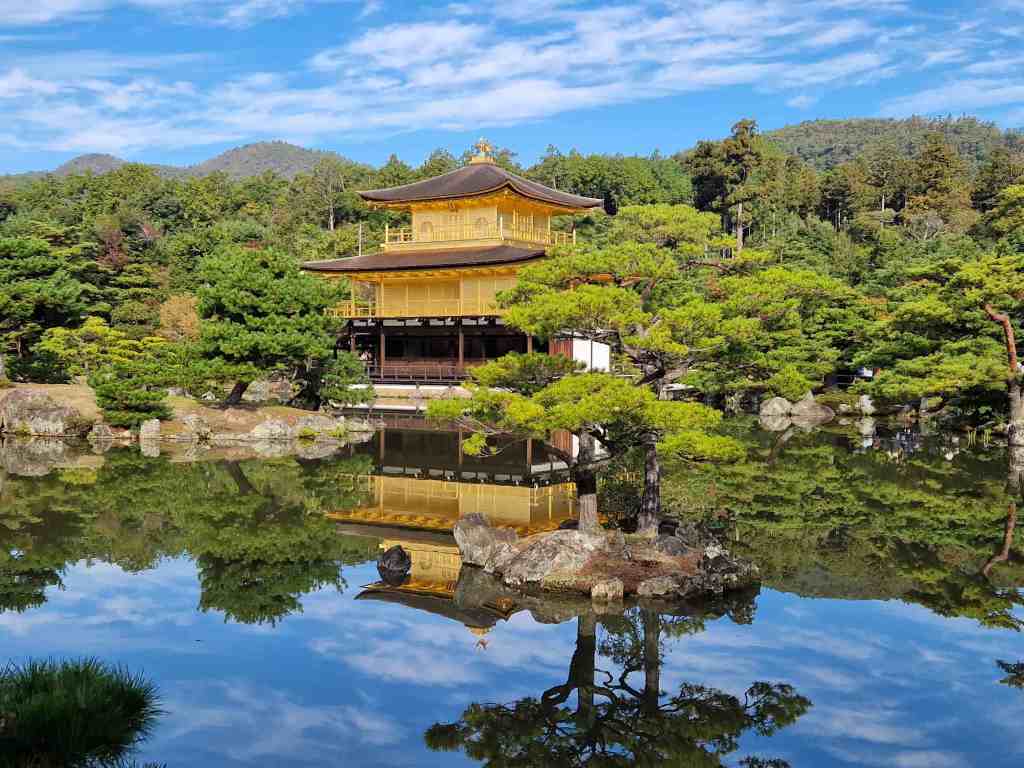
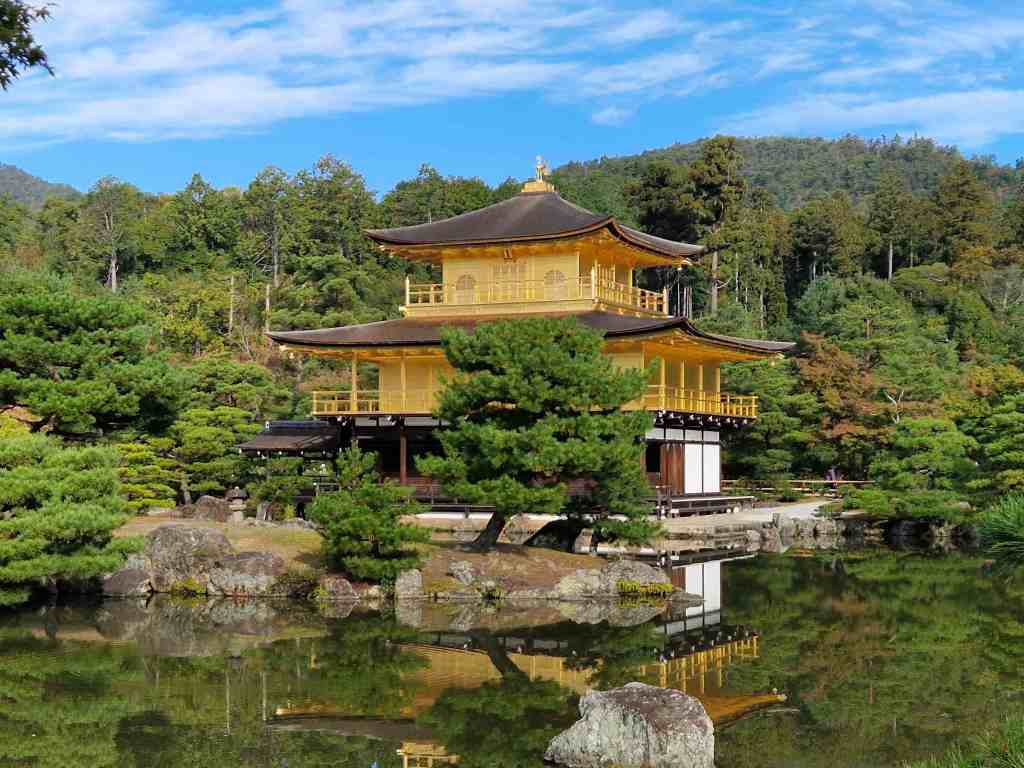
Feeling refreshed after a day’s break from visiting stuff, we woke early, and took a taxi to the Golden Temple or Kinkaku-ji, in the northern suburbs. The long ride let us appreciate the city’s geography. Kyoto sits in a valley and nearly all of the tourist attractions lie in the outer suburbs, at the foot of pretty, forested mountains. The centre is a highly developed and rather ugly urban sprawl and crossing through it is quite time consuming. We arrived for the 09.00 opening of the temple to find that there was already a large queue waiting to get in – foreign and Japanese tourists, and groups of schoolchildren. Still, the crowds were worth it, since the Golden Temple really is an unmissable sight – a temple entirely covered in gold leaf (even the gutters are gilded) sitting by a lake in a beautiful garden. We joined the throng to take one of THE essential Kyoto photos, of the temple with its reflection in the water.
The classic view of the Golden TempleA close up view of the Golden Temple
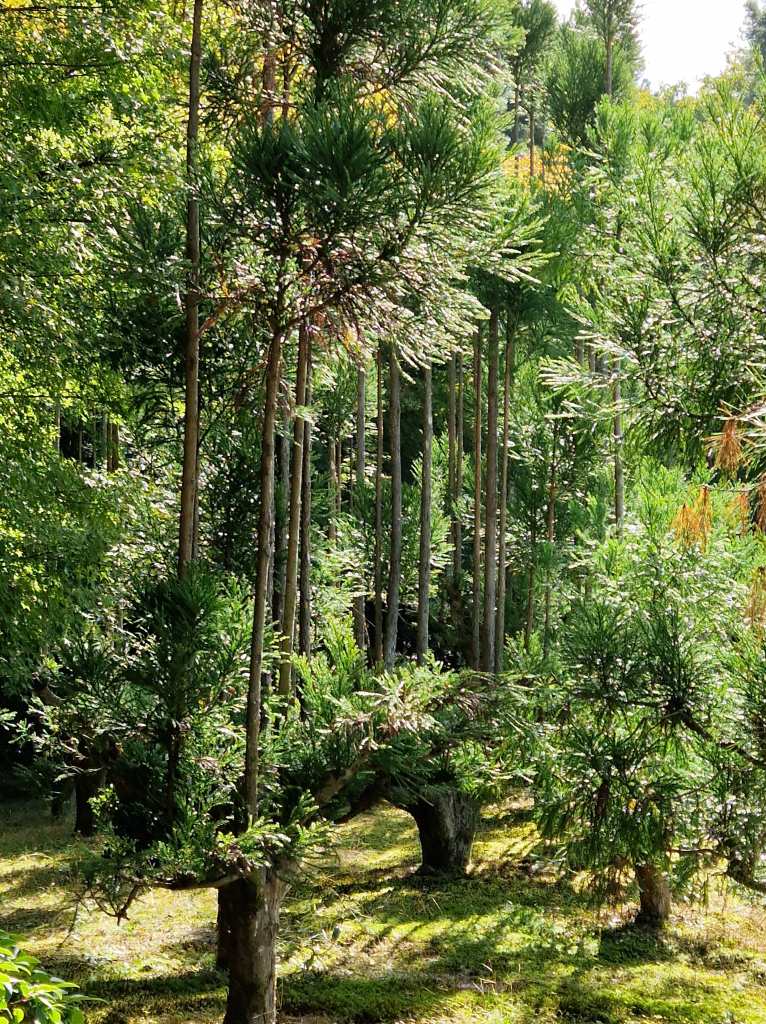
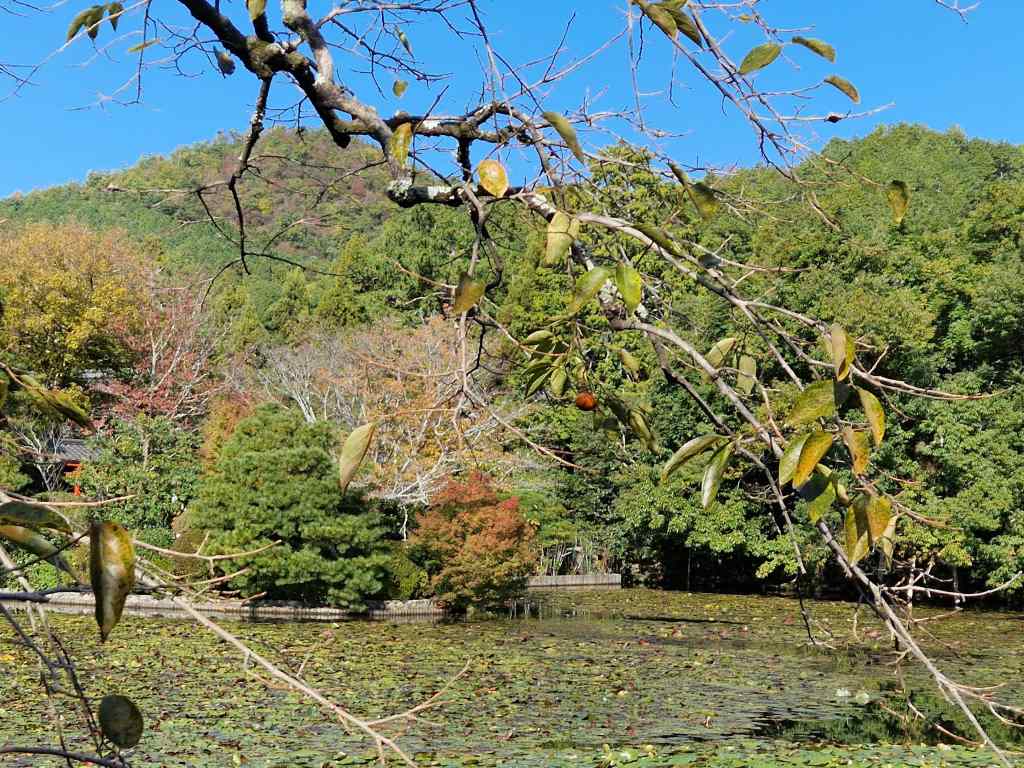
The building was originally a villa for the shogun Ashikaga Yoshimitsu and was first built in 1408. After his death, it was turned into a temple as per the terms of his will. Over the years it has burnt down and been rebuilt many times, most recently in 1950 when it was set alight by a deranged monk. The current building dates from 1955. A well-trodden path led – with a strict one-way system – past the temple, through its garden and to the exit. The visit had taken us about thirty minutes. Since we had come such a long way, we wanted to see as much as we could of this northern part of Kyoto as possible, so we took a taxi to the nearby Ryoan-ji temple. It could not compete with Kinkaku-ji’s beauty, but it was a haven of peace with a beautiful pond and some very strange pine trees, somehow made to grow like giant inverted chandeliers.
In the Ryoan-ji TemplePine Trees made to grow like chandeliers!Lake at Ryoan-ji (with the very last fruit of the season)
Next, we visited yet another temple, Ninna-ji, which was about twenty minutes away by foot. This was another beautiful, peaceful place with almost no visitors.
Building at Ninna-ji Temple
It was now midday, and we wondered what to do next. At the back exit of the complex was a sign advertising a mini-pilgrimage of 88 local temples over 10km – imitating Shikoku’s 88-temple 1200km epic trek. It was an intriguing prospect…..but we had already saturated on religious buildings for the day. We stopped in the Ninna-ji’s café to study the map and decide our next move. It was advertised as a “luxury relaxation space” but the coffee was as weak as dishwater. Still, the break was useful as Aki pointed out that Kyoto castle, a rare attraction in the city centre, could be worth visiting on the way back. I was doubtful – the castles we had visited so far were all very similar, pretty from the outside but empty and boring inside. Kyoto’s castle, being on the plain, was not even likely to have a good view. Still, the only other option seemed to be to visit yet more temples, so we gave it a go – and were very happy we did.
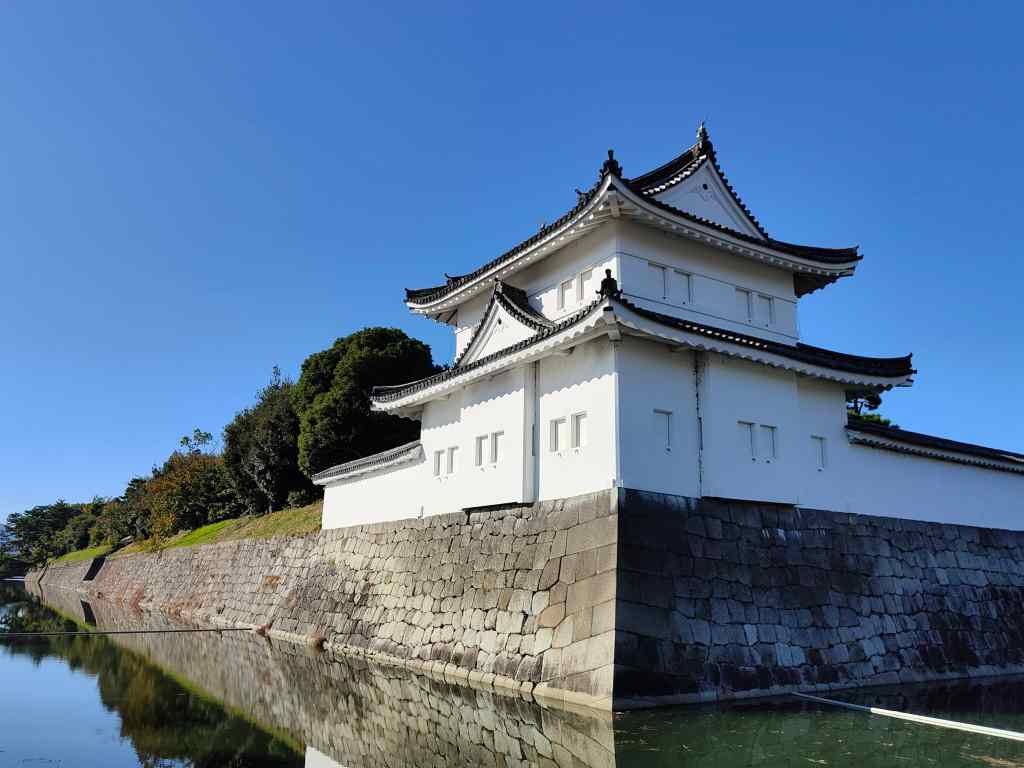
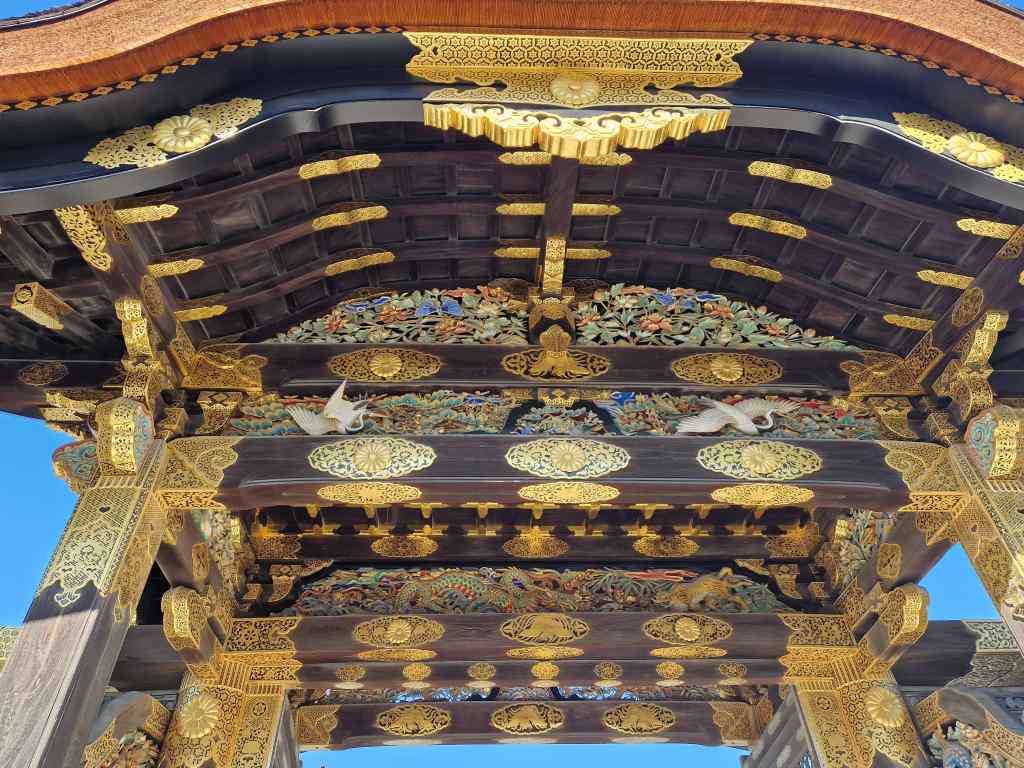
Kyoto Castle from the OutsideThe magnificent entrance gate
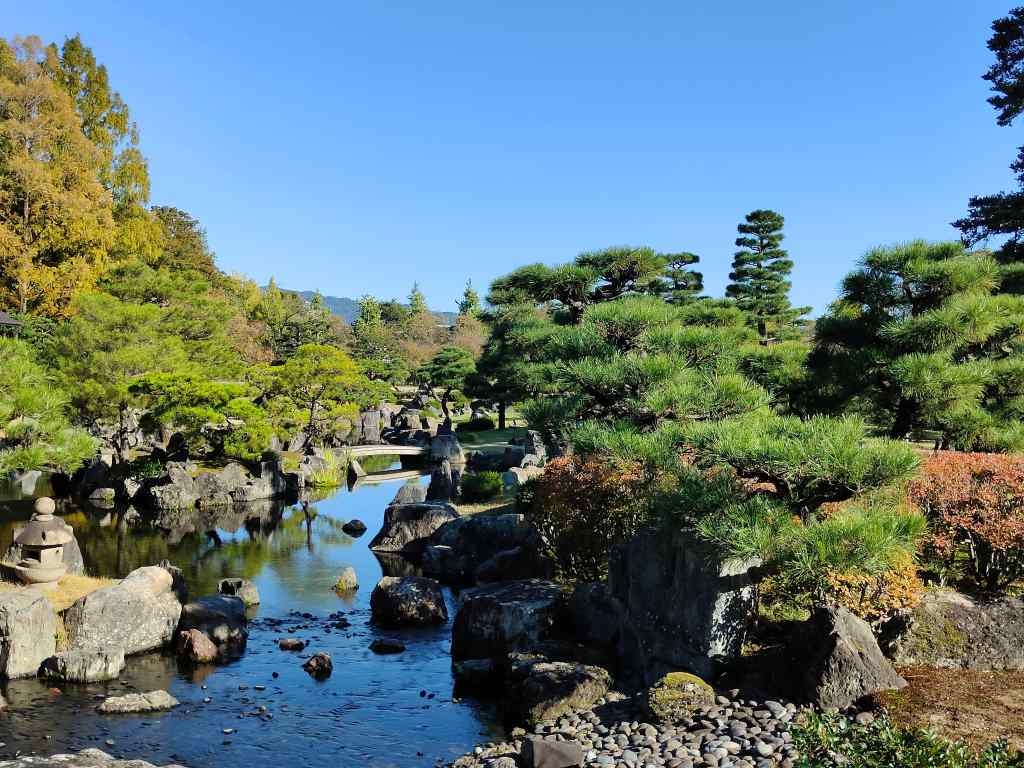
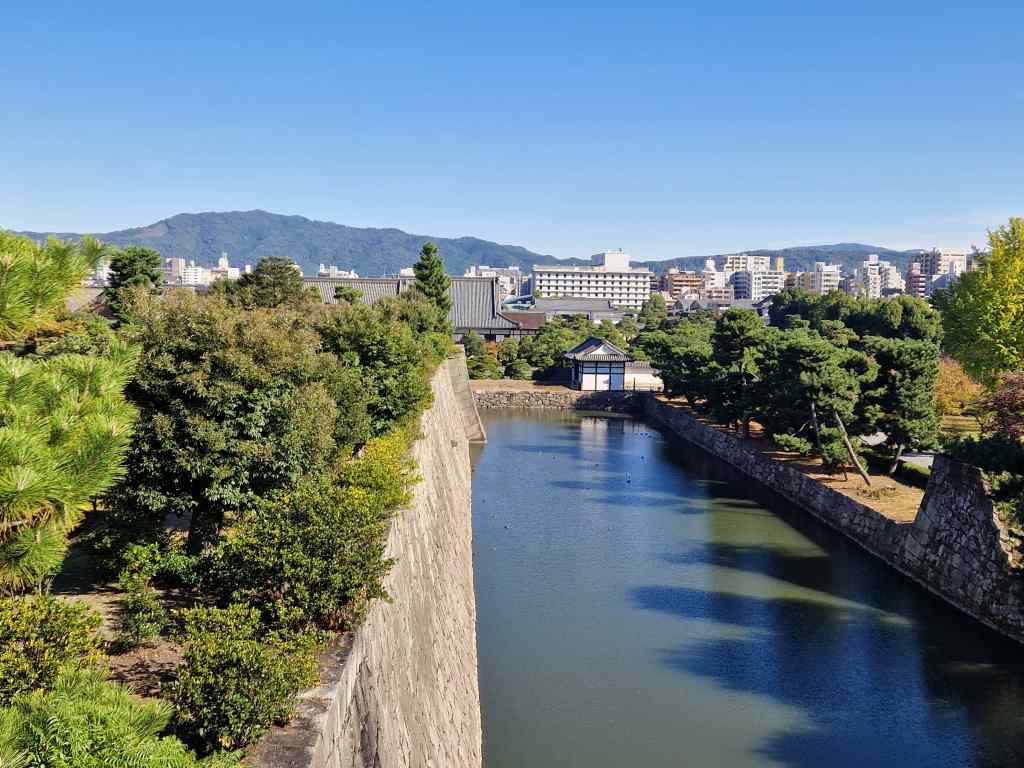
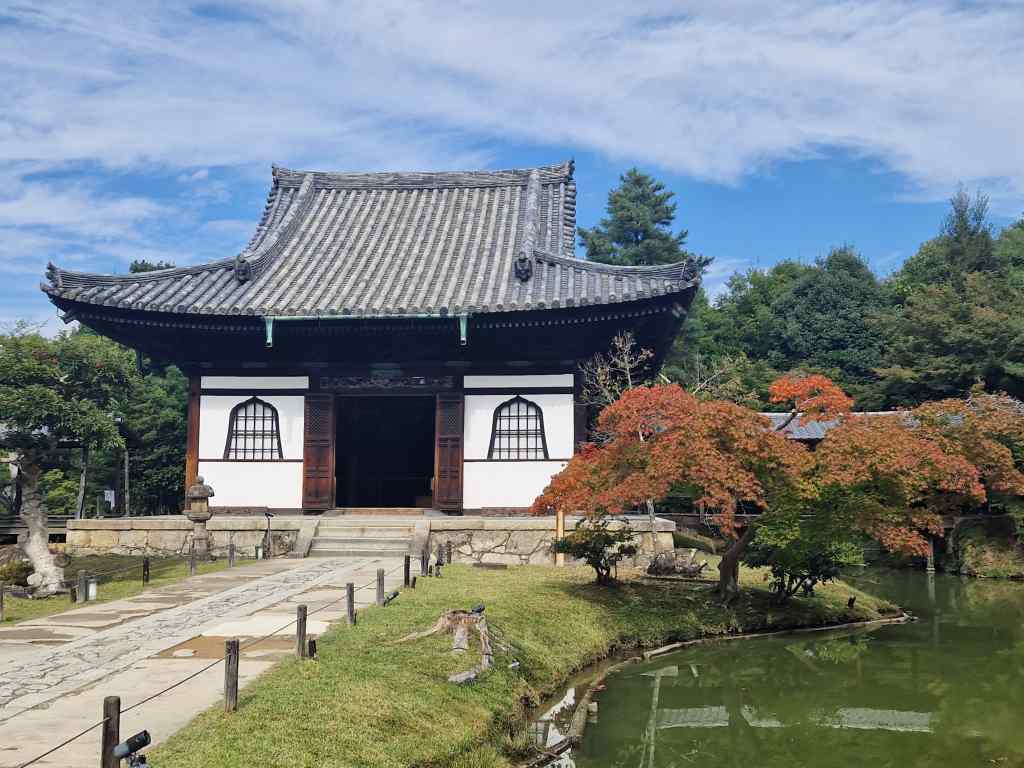
Building of the castle started in 1603 to provide the Kyoto residence of Tokugawa Ieyasu, a purpose it served until the fall of the Tokugawa shogunate, when it was briefly used as a residence of the newly reinstated emperor of Japan. The highlight of the visit was the beautiful Ninomaru Palace, located inside the defensive walls. This was a place where the shogun would receive guests or consult with officials, and consisted of a series of sumptuously decorated rooms (sadly no photos were allowed). It was so interesting that we went around twice before strolling around the palace’s garden with its inevitable tearoom. The Ninomaru Palace was one of the highlights of our stay in Kyoto – perhaps because it was not yet another temple.
Garden of Kyoto CastleThe view from the ramparts – with central Kyoto’s urban sprawl in the background
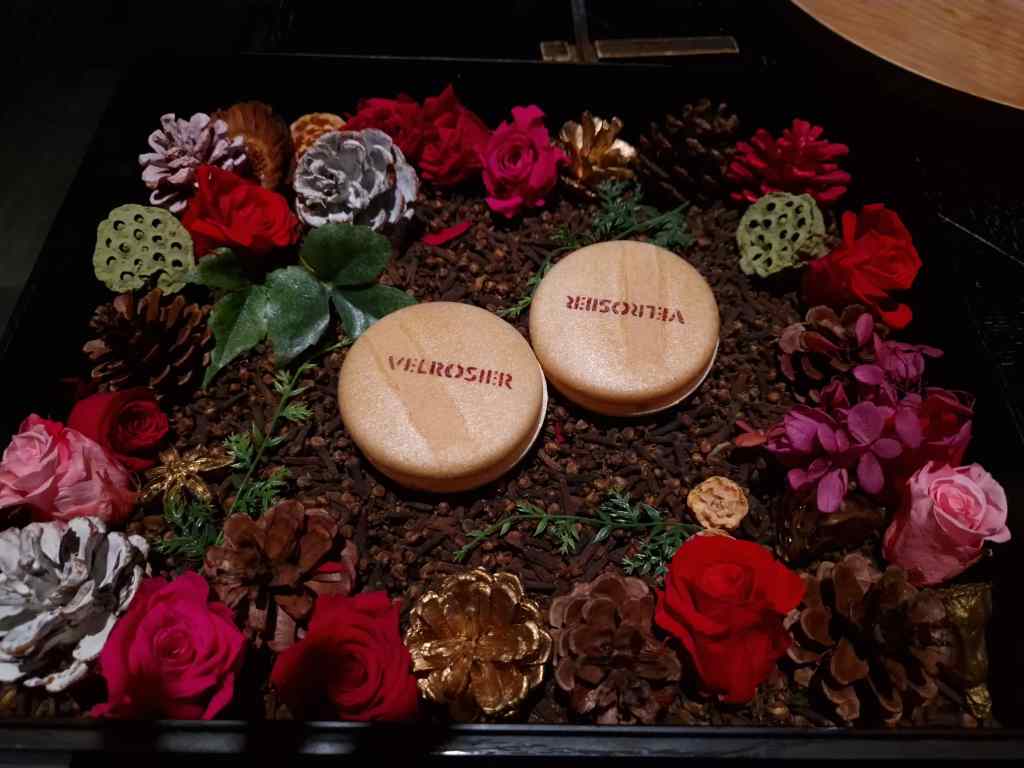
That evening we had planned another non-temple activity – dinner in Velrosier, a restaurant which had just won its second Michelin star. The food throughout our trip in Japan had been consistently excellent and very good value. Having tried lots of different types of cheap or mid-range restaurants – all very good – we wanted to try a top-end place. Japan has a lot of Michelin-rated restaurants and we wanted to see if the hype was justified. Dinner at Velrosier was probably the best meal we had ever had, beating more expensive and higher rated places we had visited in London – a two-hour feast of Chinese-inspired cooking. After similar experiences in Europe, we would usually wonder if a meal – however good – could justify the cost of top-end dining. Here, we wondered how on earth they could make a profit on what they had served us – five cooks prepared fourteen exquisite courses for only ten guests. Japan really is a foodie’s paradise.
On our first day in Kyoto we followed a well-travelled tourist route. Our first stop was the Kiyomizudera temple, one of Kyoto’s biggest and most popular, founded 1250 years ago. It was located closed to our house, and we found a little side street to get there through a different temple and then a cemetery.
The back way to Kiyomizudera
The path was pretty and quiet, but when we reached the Kiyomizudera’s gates everything changed.
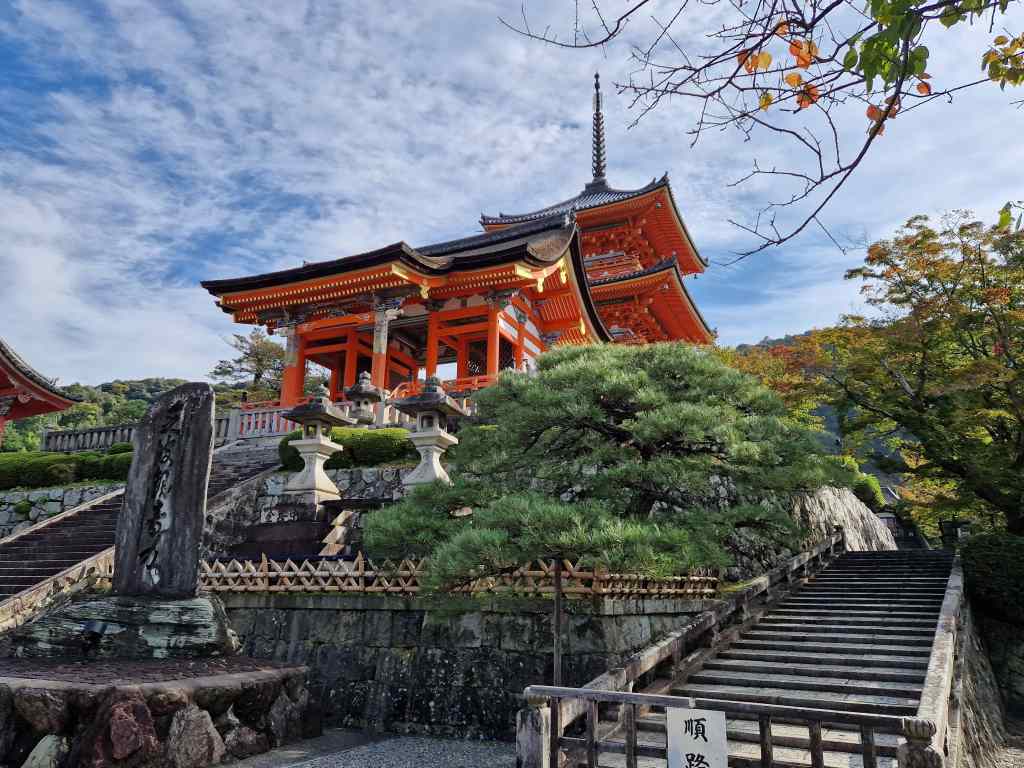
The Kiyomizudera temple’s entrance
The whole area was packed with people – tour groups, individual travellers, Westerners, Asians, Japanese. After the big empty spaces of Shikoku it was a big shock, and it was only 9.30 am. We fought our way through the crowds and made a rapid visit of the main temple and its famous wooden stage, which projects over a forest of maple trees that becomes a riot of red-coloured leaves in the fall. Normally at this time in November we would be seeing the beginning of this amazing spectacle, but sadly for us the weather had been unusually hot, and the peak season for autumn colours was still two to three weeks away.
The famous (and packed) Kiyomizudera viewing platform, taken from a safe distance
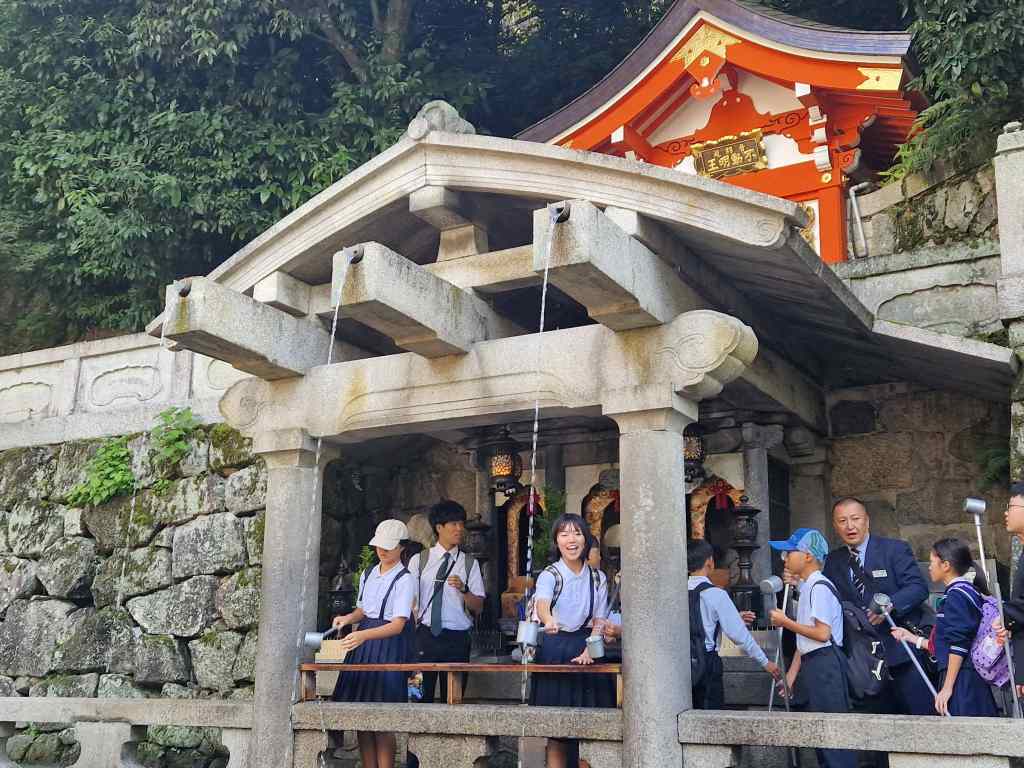
Just below the temple area there was the Otowa waterfall. It was split into three separate channels and visitors could queue up to drink water from one of them. The different streams supposedly grant the drinker longevity, love or success, with the last one being very popular with schoolchildren before their exams – as we saw.
Schoolchildren hoping for success in exams
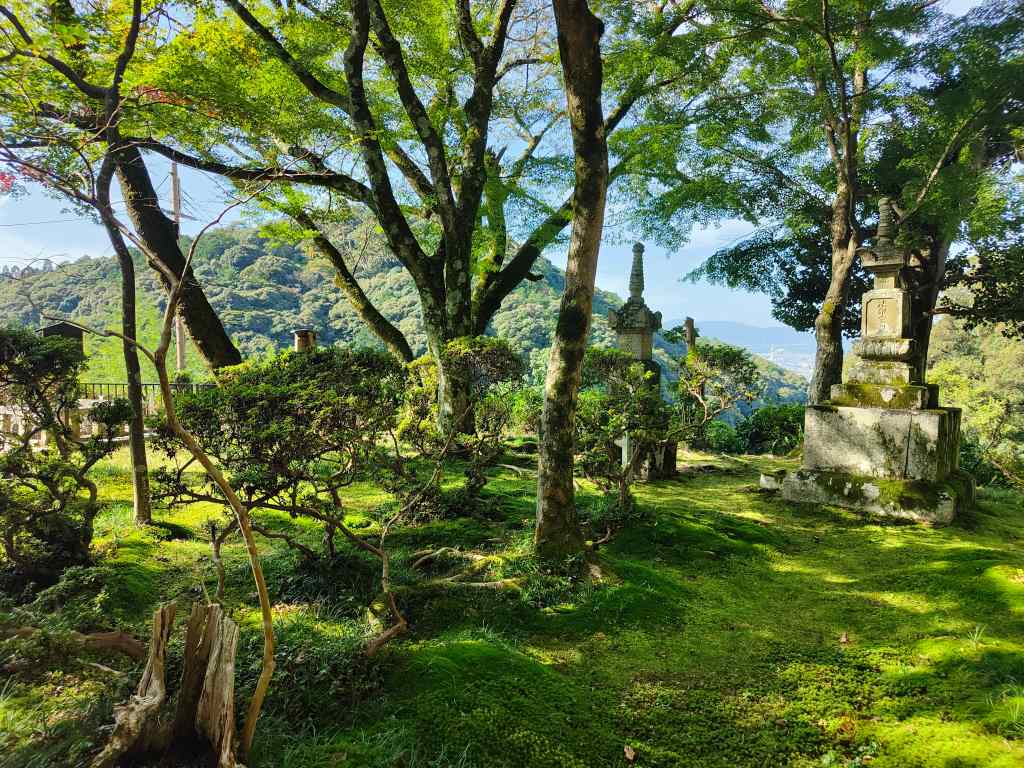
We headed away from the main temple with its crowds, and up a small hill to another, much smaller temple whose name I forget. It was extremely pretty, with a mossy garden and great views. The very few visitors paid 100 Yen (about 50c) into an honesty box to enter.
A small, forgotten temple near Kiyomizudera
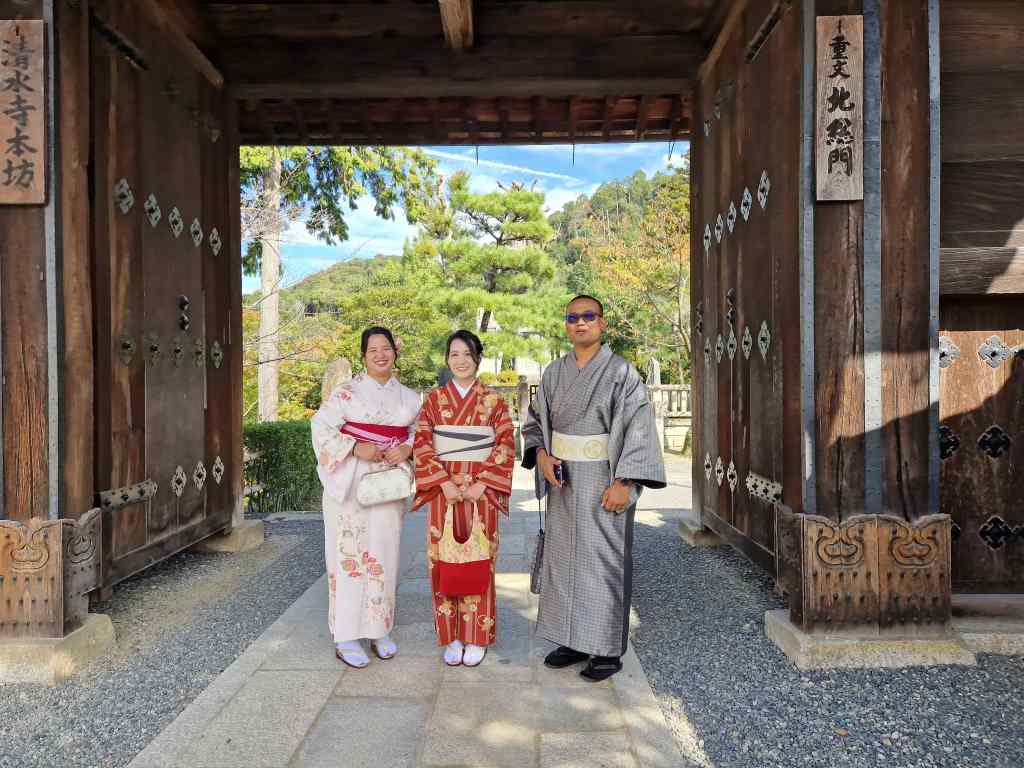
Our experience at Kiyomizudera was repeated many times during our stay in Kyoto – we would visit a famous site, and jostle with crowds of other tourists – and then walk a couple of hundred metres to a different place, which would be almost as beautiful, but empty. There are literally hundreds of such small, less-visited, temples dotted around Kyoto. We retraced our steps to Kiyomizudera, and this time took the usual route down through the popular Higashiyama area rather than the side street we had used earlier. Just as our arrival had been heaven – quiet and pretty – our return was hellishly busy. It was a narrow street lined with food stalls and souvenirs shops and crowded with tourists. Fortunately, we only had to endure this for a short stretch before we turned off, heading for the Kodaiji Temple. We met some smartly dressed Japanese people on the way – many visitors to Kyoto choose to wear traditional clothing, and there are lots of shops where you can hire kimonos.
Elegant Japanese visitors in Higashiyama
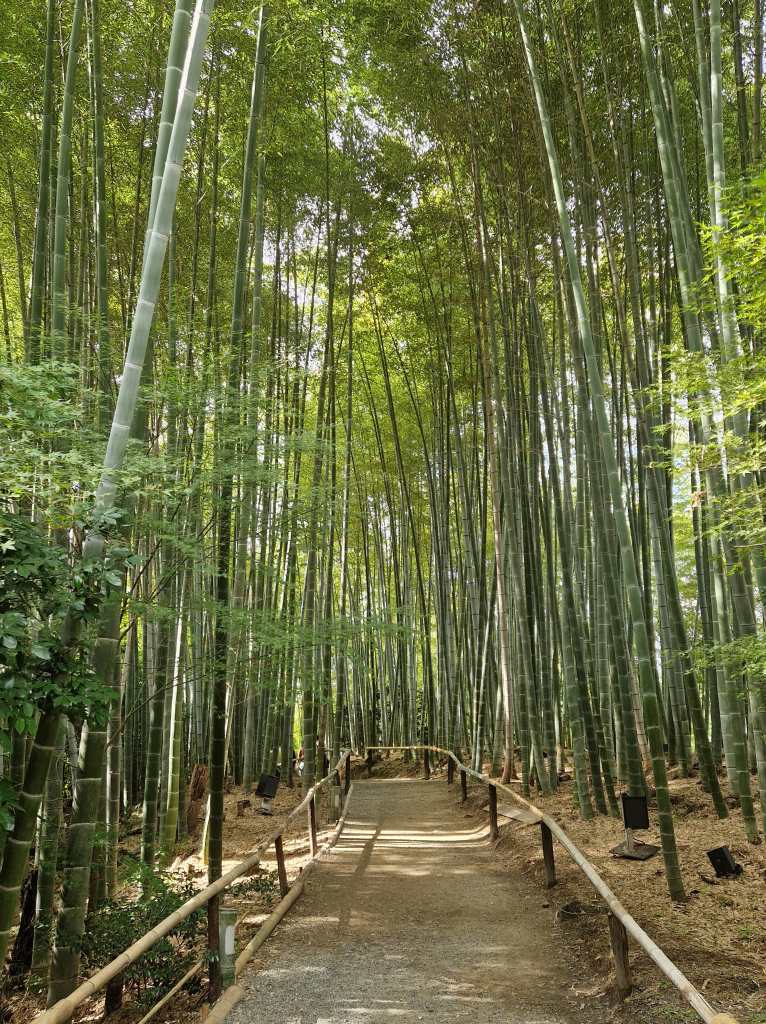
Kodaiji temple was pleasantly quiet and also very beautiful, with its own small bamboo forest.
Kodaiji Temple and its bamboo forest
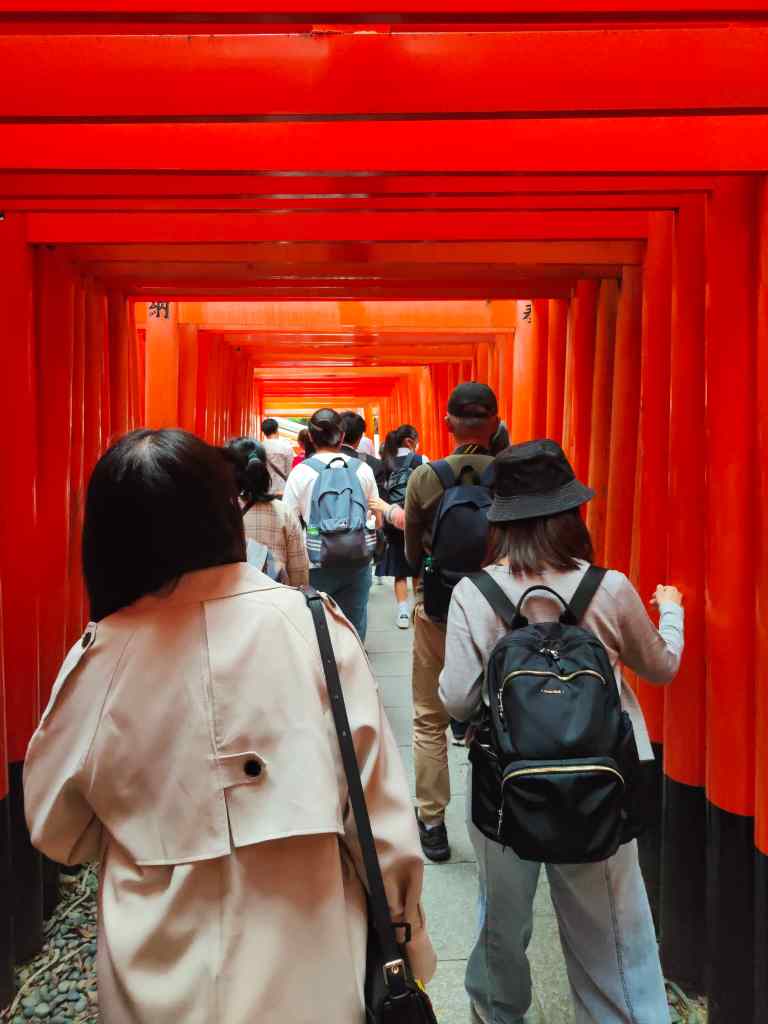
Our next destination was in the south of Kyoto – the Fushimi Inari Shrine, where hundreds of vermillion torii gates line paths that climb up a steep, forested mountain. We arrived at around 3pm, to find that this site is also on Kyoto’s “must see” list, and our “heaven and hell” experience repeated itself. This time, hell was arriving and joining the jostling crowds trying to squeeze through the first set of gates.
Hell on earth – entrance to Fushimi Inari
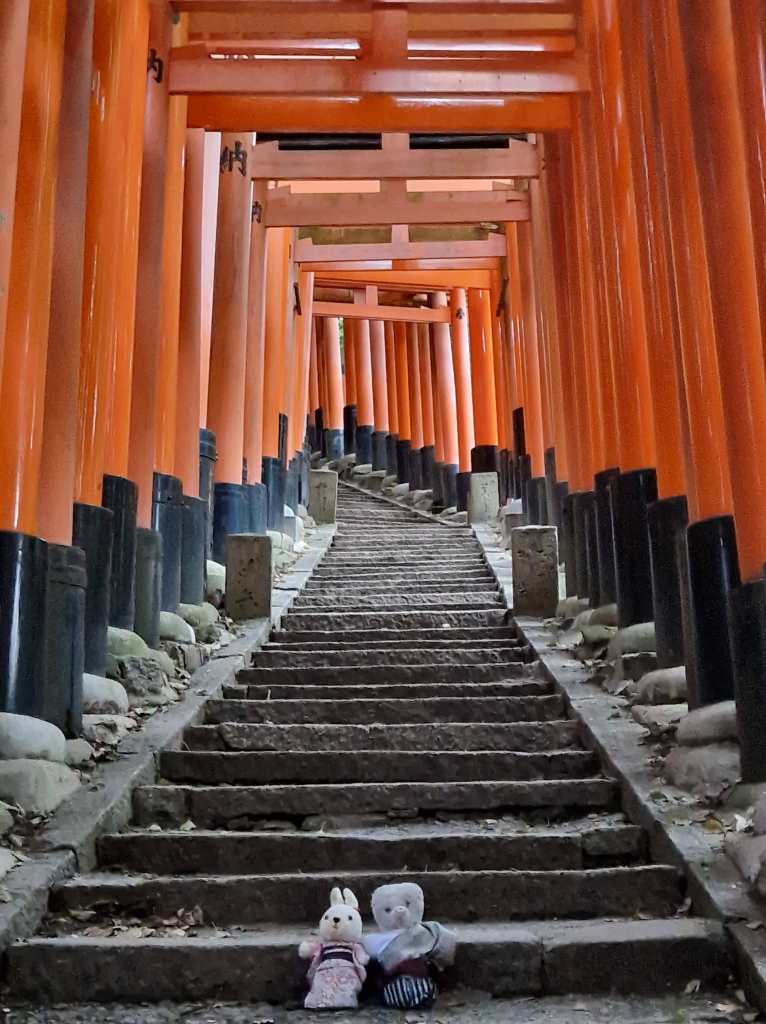
After fifteen minutes of ducking and weaving, we wondering what the big deal was – surely a set of medium-sized red torii could not be that interesting, not matter how many of them there were? Particularly if you had to spend your time trying not to be trodden on by larger human visitors rather than looking at the things you came to see. However, after a bit more walking, the path branched and became less busy. Many of the visitors only come to mill around and take selfies at the lower part of the shrine, and don’t walk very far up. Soon we could even pose for our own selfies……..
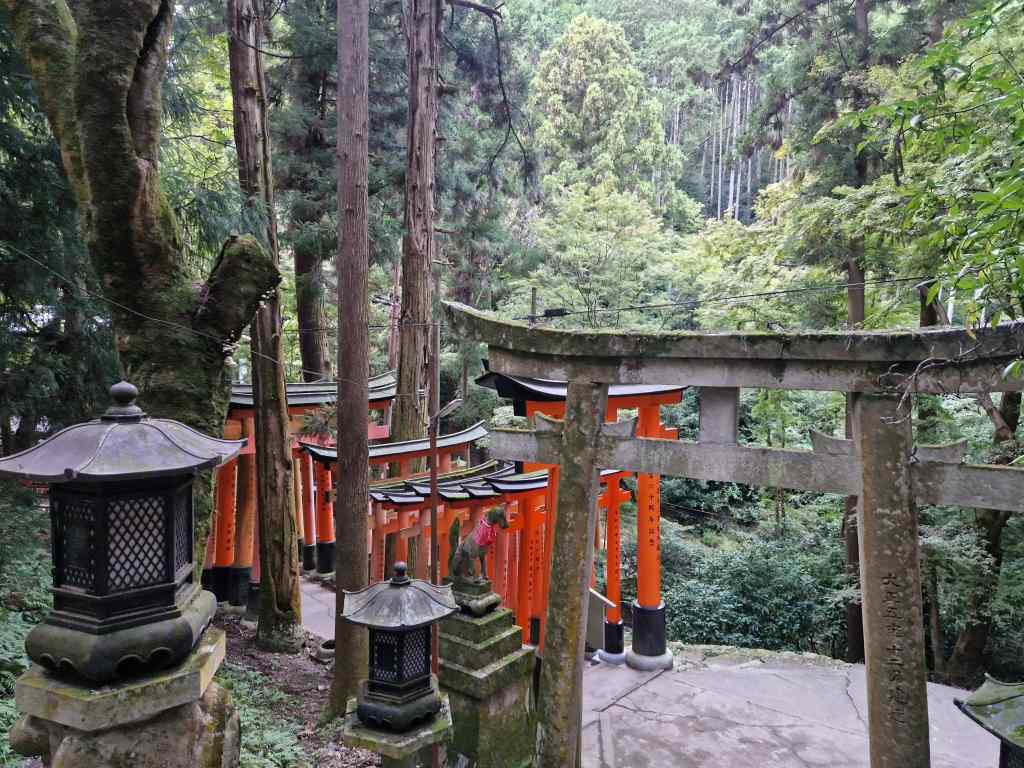
The further up we went, the more we liked the place. In addition to two main paths going up, there were many branches leading to interesting small shrines or patches of forest.
A maze of torii gates at Fushimi InariA small shrine at Fushimi Inari
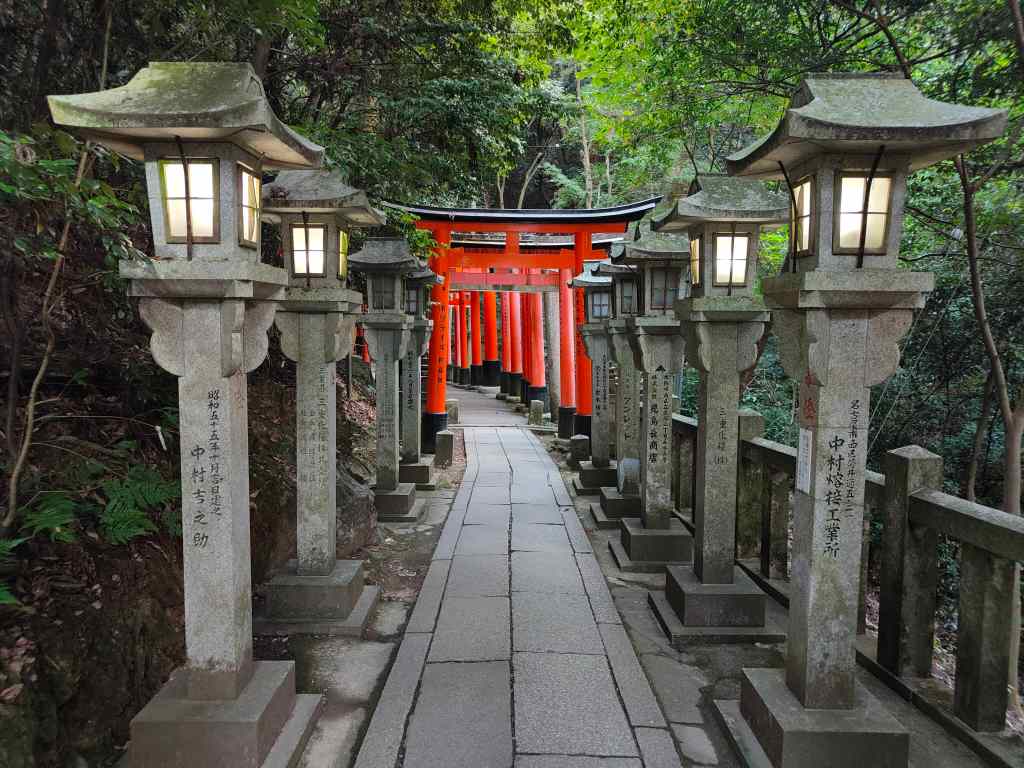
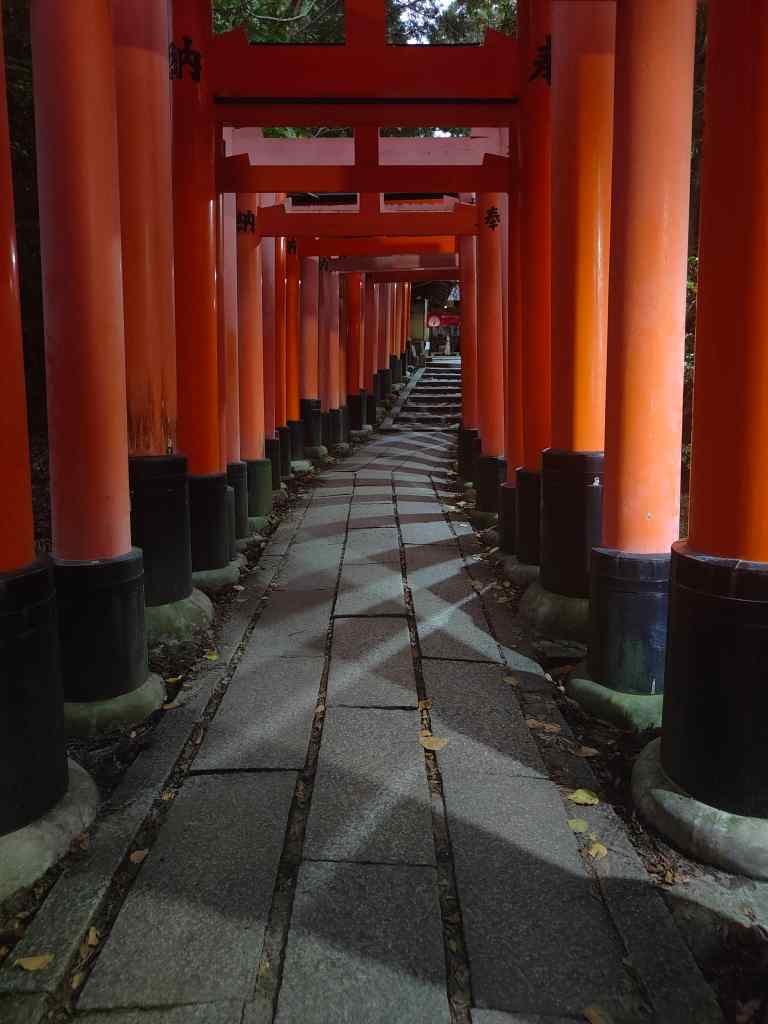
We spent about an hour making our way slowly to the top – which turned out to be not a particularly interesting part of the complex. But to make up for this slight anti-climax, nearly all the visitors suddenly disappeared and, on the way down, we had the shrine almost to ourselves as the sun sank and a few scattered lights came on, throwing shadows of the torii onto the path. It was wonderfully atmospheric….and a bit spooky.
Dusk falls at Fushimi InariShadows lengthen
We found a clearing where we could enjoy sunset over Kyoto, before continuing our descent in the dark. Surprisingly, the arrival of night saw more people coming the other way, climbing the mountain in the dark. The torii became even spookier.
Night falls at Fushimi Inari
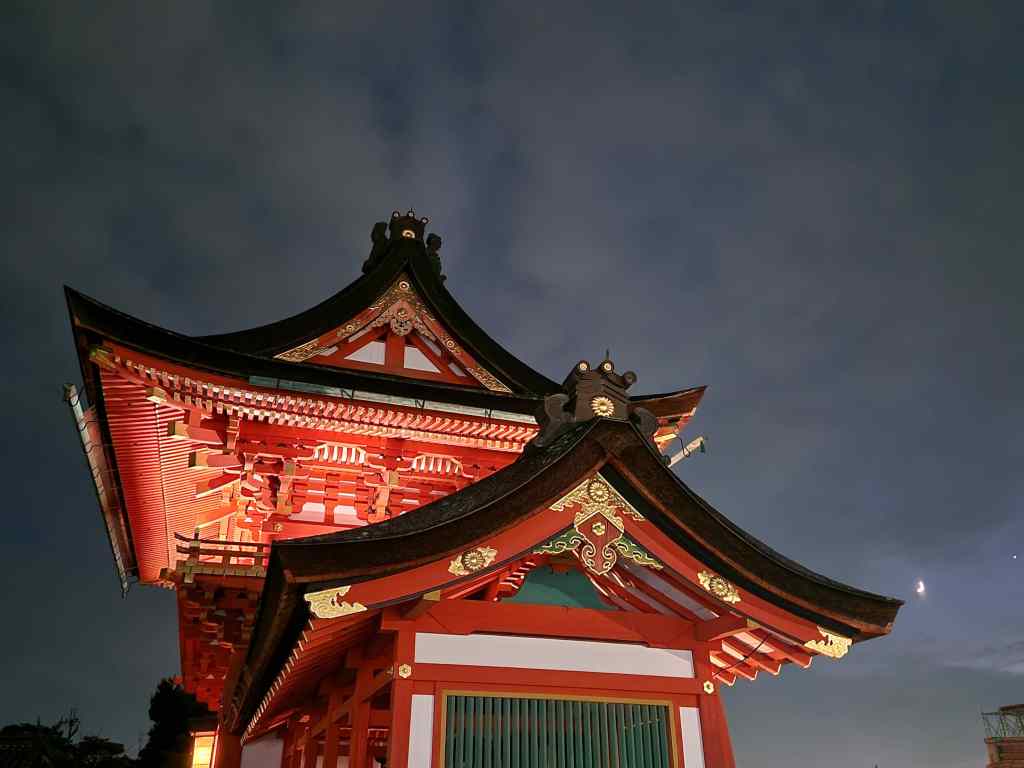
We finally arrived back at the main buildings at the entrance to the shrine, now shining bright red and white against the night sky.
Back at the main entrance to Fushimi Inari
It had been a long day, and our phones told us that we had walked seventeen kilometres on our little woolly teddy and rabbit legs, including lots of climbing. We thought we were beginning to understand Kyoto – it has some amazing “must see” places, for which you need to plan your arrival time carefully if you don’t want to be crushed by fellow tourists. And it has hundreds of smaller places, many of which are nearly as pretty, but which are almost empty. Over the next few days we would try to combine visiting both.
Next Post: Nara – in search of enlightenment and coffee













 Trouspinet travels