Pompeii – a day to remember

And these are only some of Pompeii’s less well-known sights!

Today was the last full day of my Italy trip and I devoted it to visiting Pompeii, the famous archaeological site located half an hour away from Naples on a very crowded train. I arrived as early as I could, to avoid the heat of the afternoon sun and as many of the crowds as I could. I still faced a short queue to get in, and had to squeeze pass various tour groups just after the entrance to the complex.

Pompeii has a long history and was settled by various peoples but is best known as the prosperous Roman provincial town which was buried by the eruption of nearby Mount Vesuvius in AD79. After this disaster it remained hidden under volcanic ash until the 16th century when it was rediscovered. Major excavations only started in the 18th century and were accompanied by looting of some of the site’s art works. In recent years the excavation of Pompeii has been carried out to high archaeological standards, and even today the site continues to offer up new surprises. This was actually my third visit to Pompeii; my first was 50 years ago when I was a little cub, and  I don’t recall much of it. The second was in 2000 twenty five years ago, and I remember a site which impressed by its size but not always its beauty, with lots of long, dusty and empty Roman streets laid out in a grid. But Pompeii is possibly the world’s most famous archaeological site, so I decided to make a third visit, and was very glad that I did.

I am not sure what exactly had changed since the year 2000, but this time I was enchanted by Pompeii. There seemed to be a lot more art work on display in the ruined houses, and a much bigger area to explore, including some gardens that provided a partial respite from the heat.
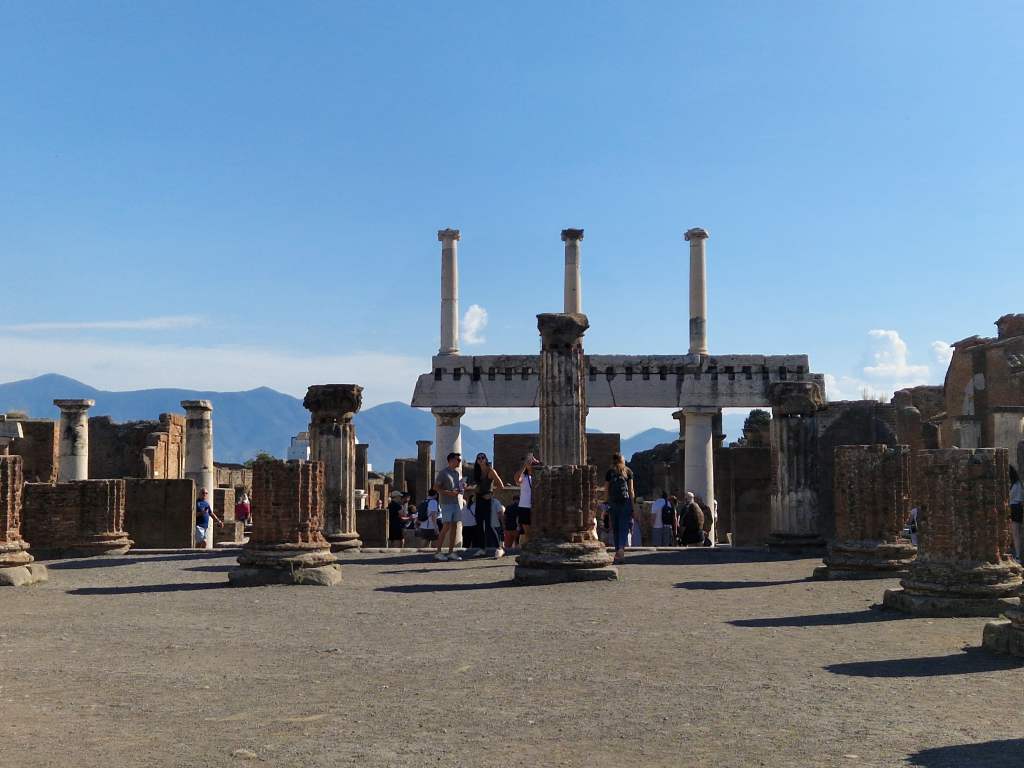
The forum – everyone’s first stop in Pompeii

My first stop was the forum. Since this is located on the only road in from the main entrance, it is also everyone else’s first stop, and it was quite crowded. But it was still very impressive, with a fine view of the ruins and Vesuvius towering in the background. I was visiting on National Monuments Day, and to celebrate this the park authorities had arranged for staff to dress up as Romans and pretend to shop or participate in ancient religious rites.
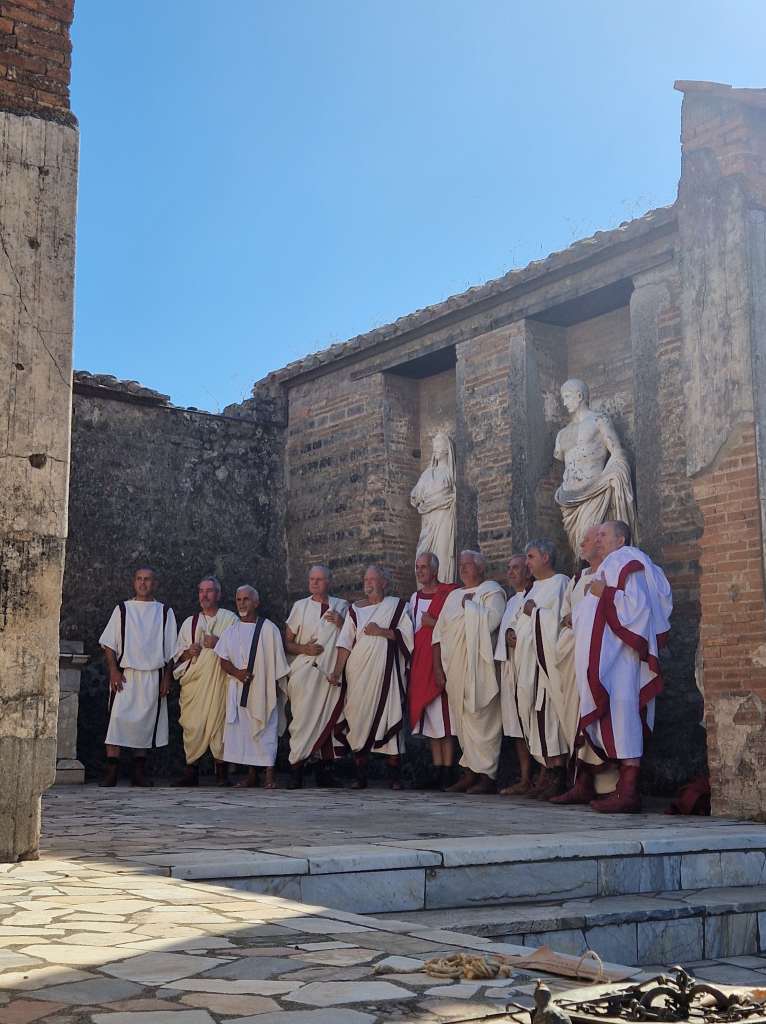
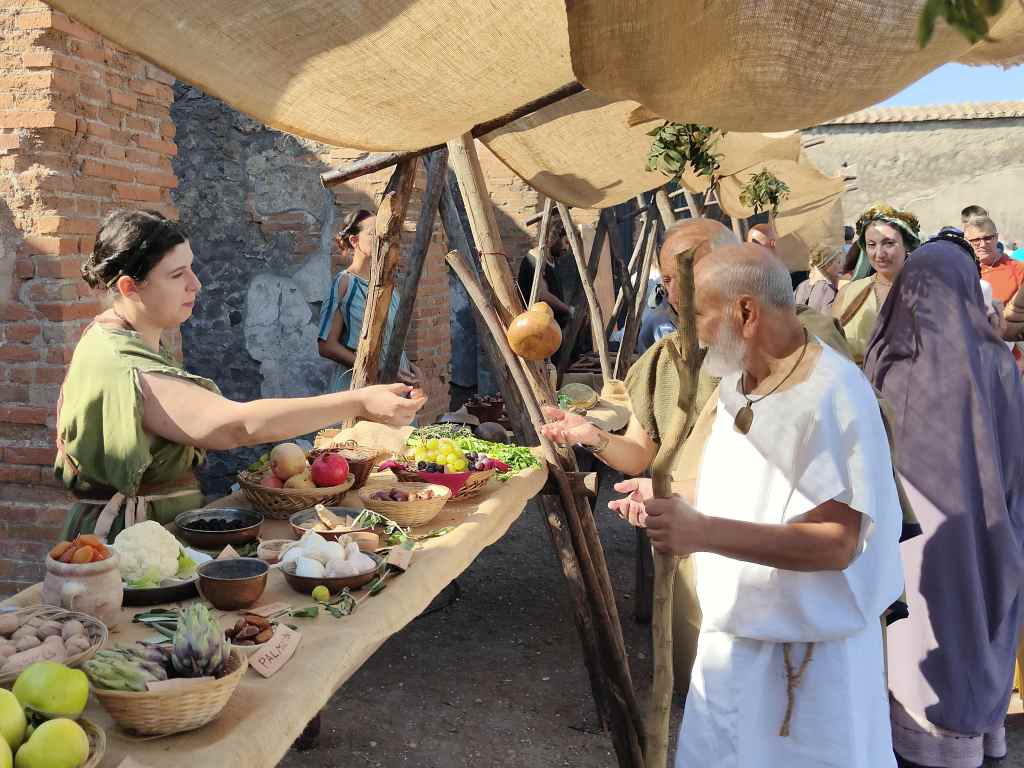
Staff put on a show for visitors

After the forum the many visitors could disperse along several different routes into the ruins and explore them at their leisure, and except for the times I bumped into a tour group visiting the same house, I found it pleasantly quiet. I used the map provided with my ticket to plan my route and try to visit as many as the highlights as possible – seeing everything is simply not possible on one visit. Places of special interest were marked by blue dots on the map – one famous example is the House of the Faun, probably the most opulent residence in the town and owned by an important family. It is named after a small but beautiful statue of a faun that stands in its entrance.

House of the Faun, Pompeii

This house is also known for a famous mosaic, showing Alexander the Great in battle with the Persian Emperor Darius. The original has been moved to the Archaeological Museum in Naples (sadly not on display though when I visited) and what you see at Pompeii now is a reproduction.
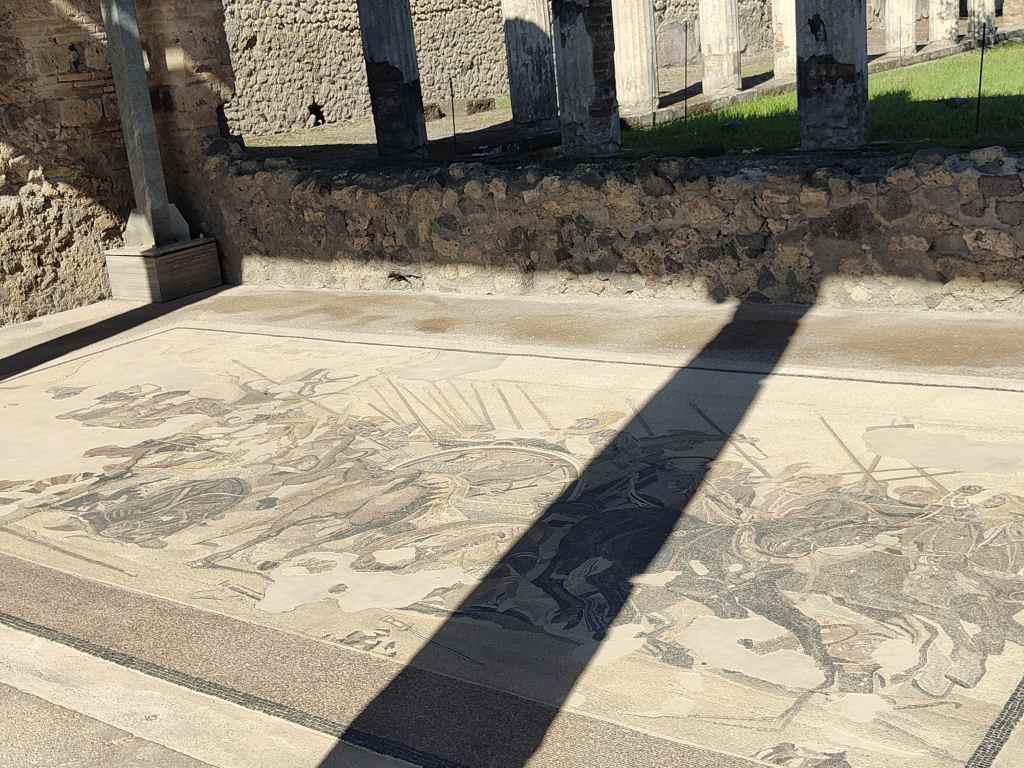
A copy of the famous Alexander mosaic in the House of the Faun

Although the Alexander mosaic is a copy, there are many other magnificent original mosaics and frescos dotted around the ruins. Some of these are well known, marked by a blue dot in the map, and attract a steady stream of visitors……..
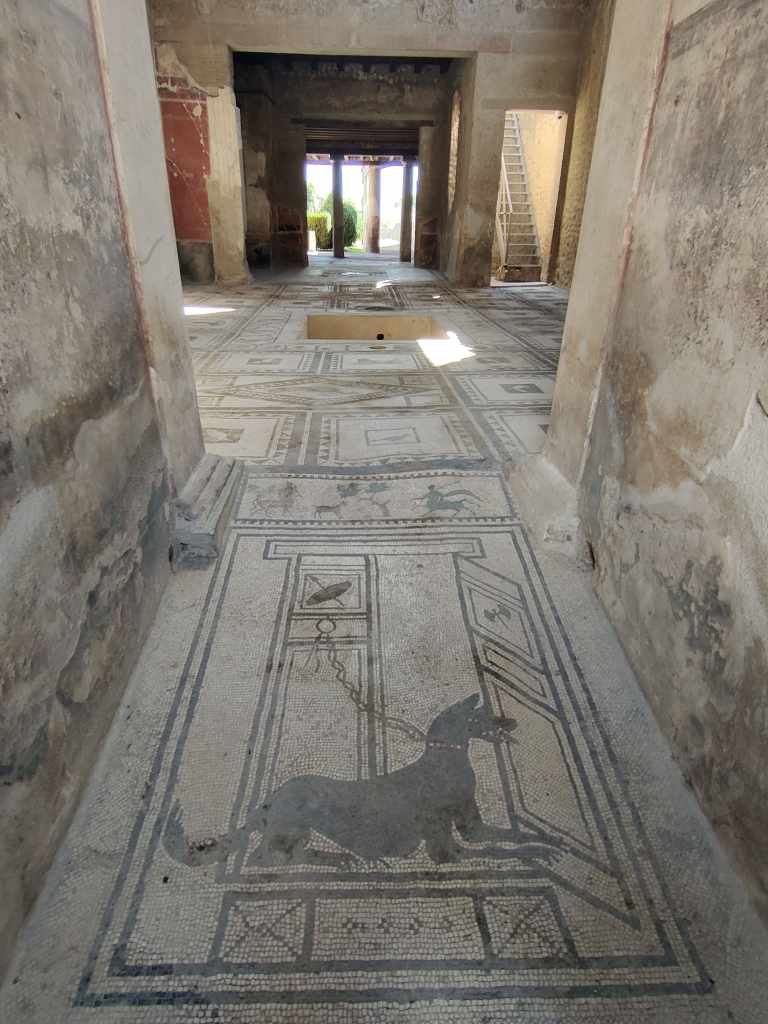
Beautiful dog mosaic, Pompeii
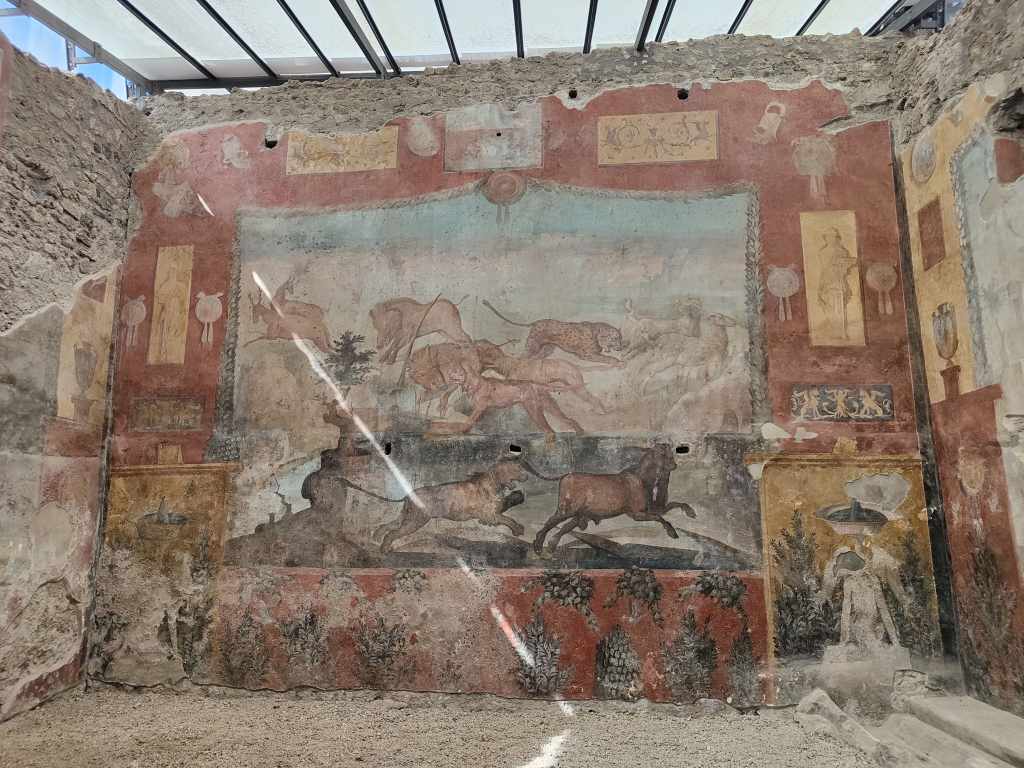
A once luxurious room in Pompeii

….but others, including a couple of my favourites, were less famous…
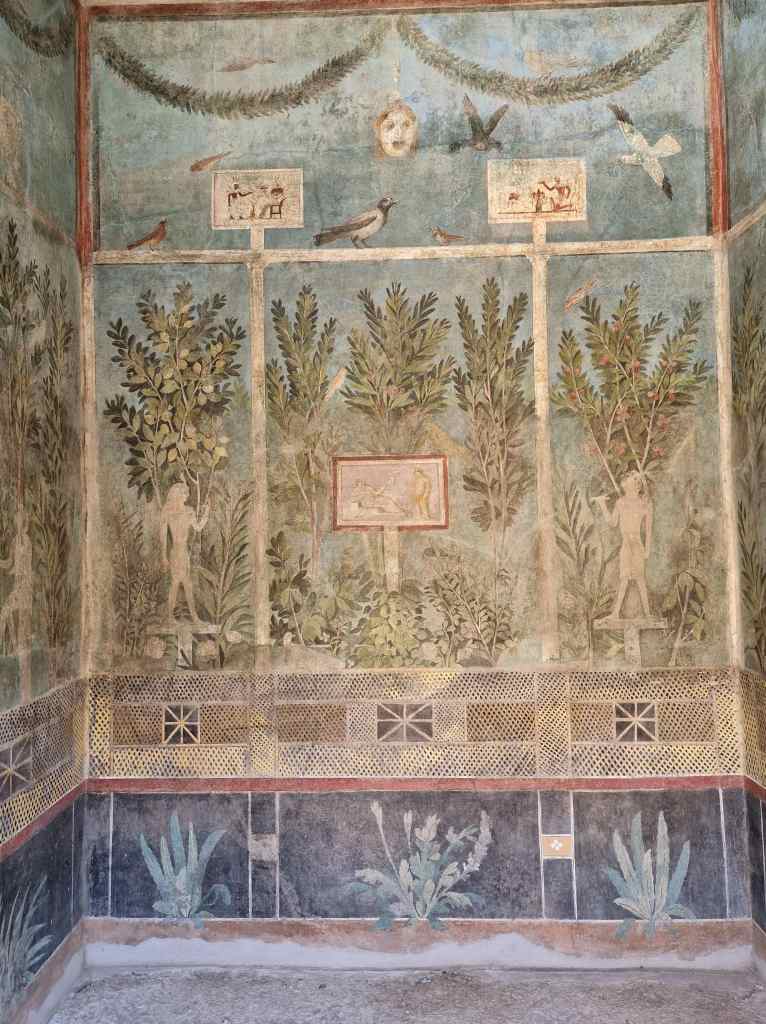
Another wonderful fresco
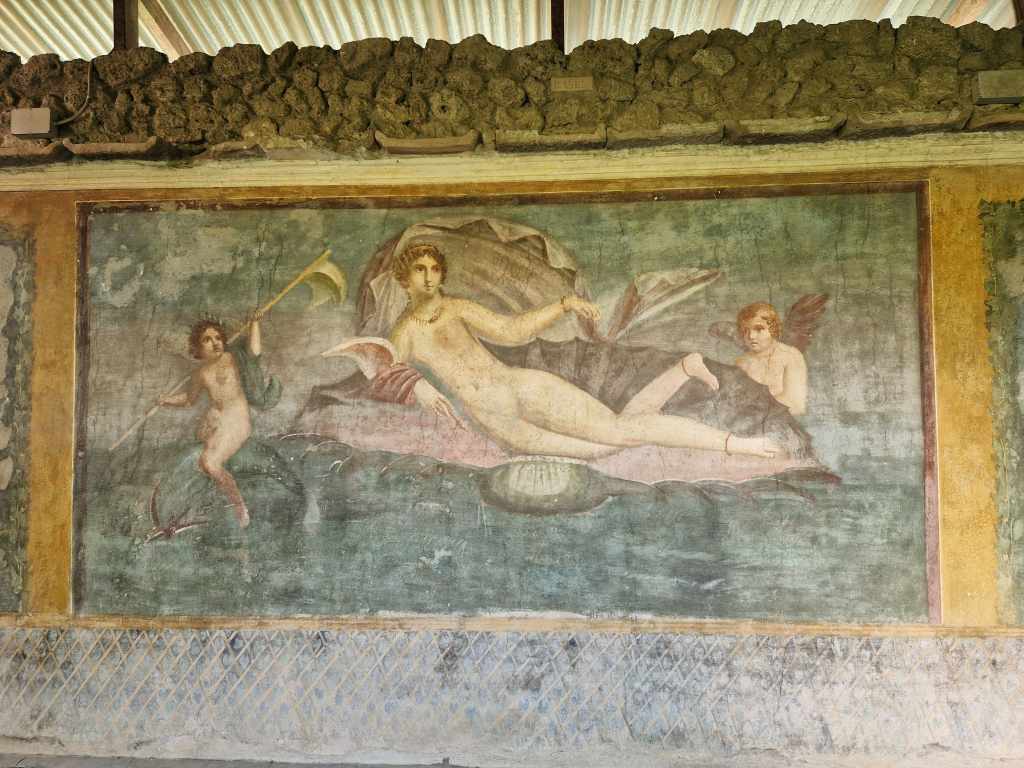
The Venus in a Shell fresco, Pompeii

Apart from houses for rich people, with their amazing artwork, Pompeii also had many buildings providing essential services like shops and bakeries. I particularly liked this bread-making shop, with its well-preserved ovens.
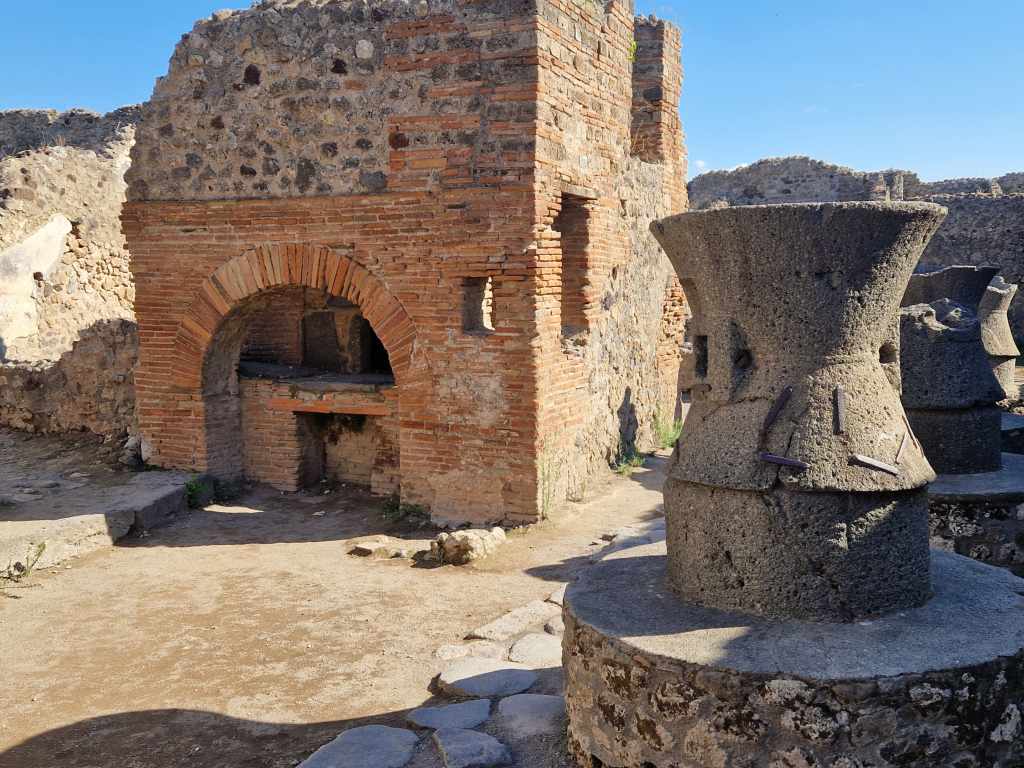
A bakery in Pompeii

There were also leisure amenities, such as two sets of extensive baths, two theatres and one amphitheatre. That a town with a population of ten to twenty thousand could have such a range of entertainment options gives some idea of how rich the Roman Empire must have been.
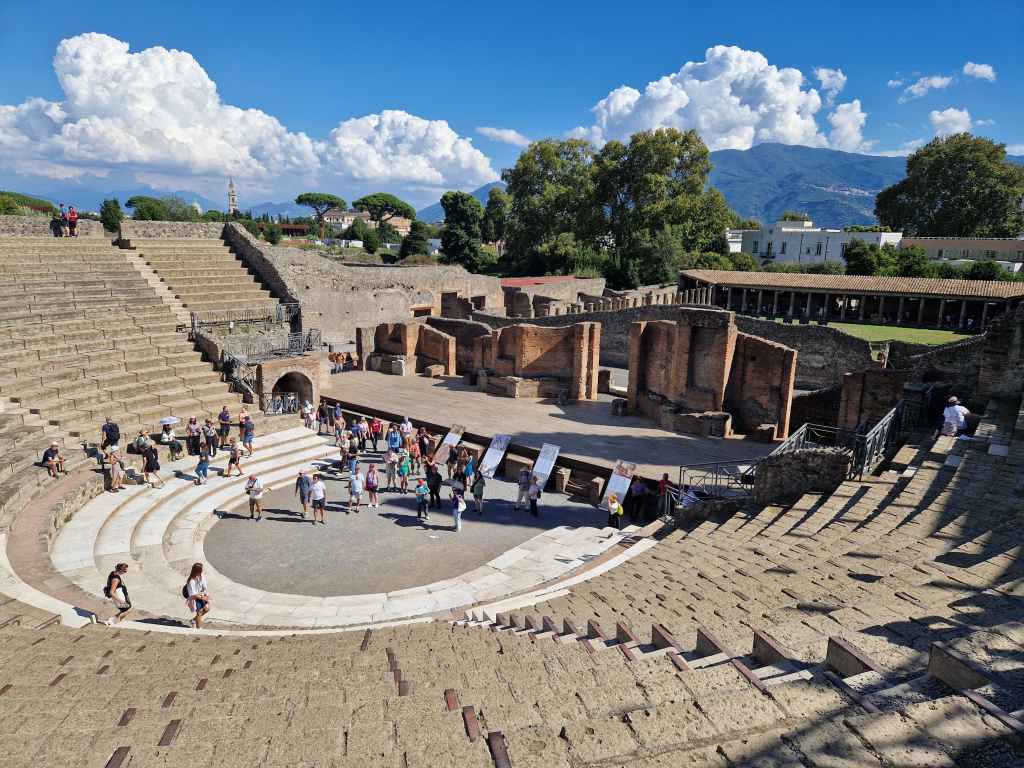
One of Pompeii’s two theatres

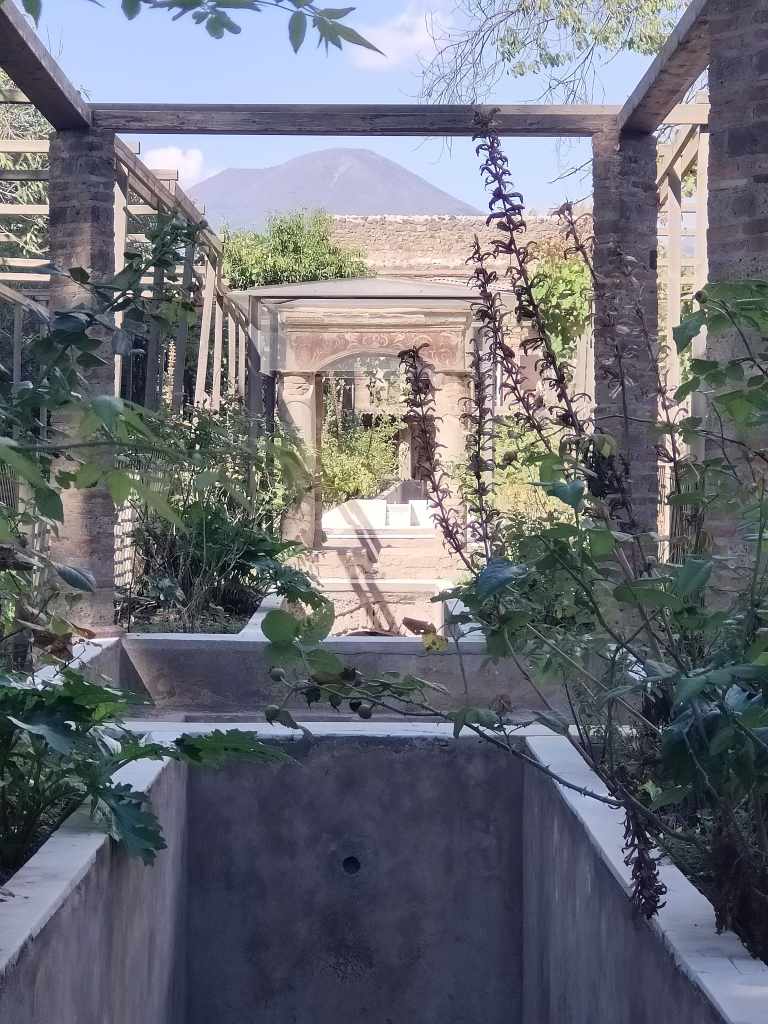
After wandering around the part of the ruins accessible with a standard ticket, I paid for a “Pompeii plus” supplement to see a couple of sites located a short way outside of the main town. The first was the Villa of Diomedes, a large property with an amazing view of the surrounding countryside and pleasant gardens.

The garden in Villa Diomedes, with Vesuvius in the background

The second was the Villa of the Mysteries, so called because it contains an exceptionally preserved and beautiful fresco of what is thought to be a woman being inducted into a religious mystery cult.

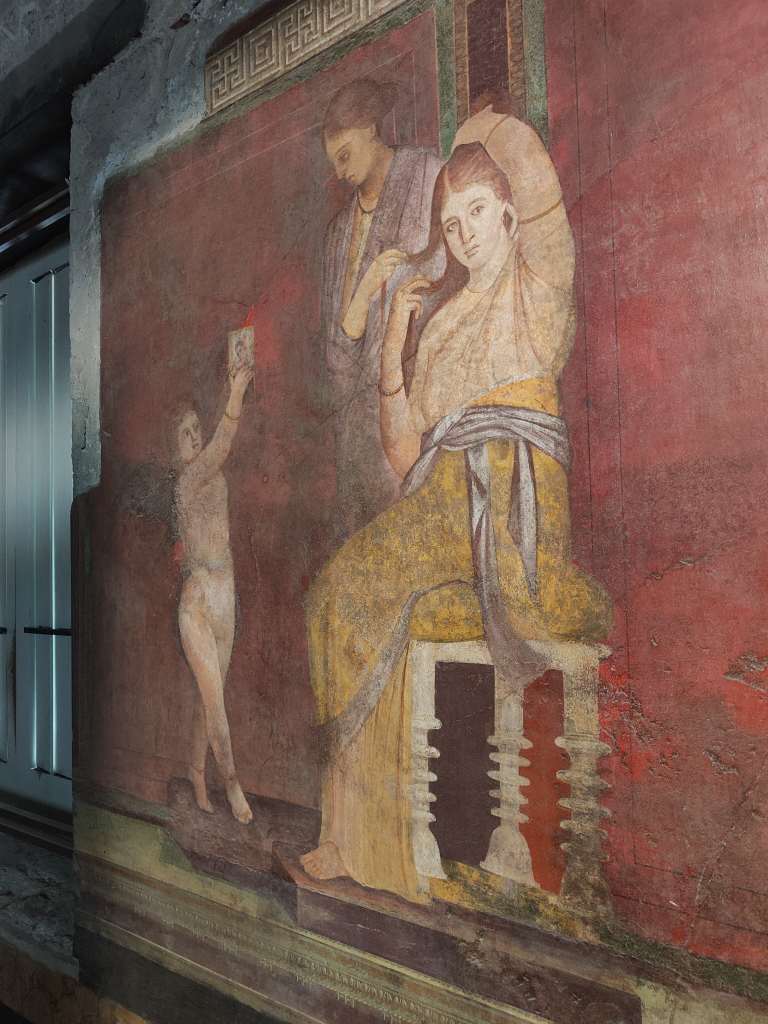
The amazing fresco in the Villa of the Mysteries

Back in the main part of the town I explored some of the greener areas – one particular highlight was the Garden of the Fugitives, which contains the casts of thirteen victims of the disaster, adults and children. These people had probably successfully fled the initial phase of the eruption and had managed to take shelter here. However, a second phase saw a cloud of blisteringly hot toxic gases sweep the city and kill all remaining survivors. Their bodies were covered by volcanic ashes, and over time the organic matter rotted away to leave a hole. During the excavations these holes are injected with plaster to make a cast of the victim. Out of respect for those that died, I won’t include a picture of them in this post, but here is the garden….

Looking down onto the Garden of the Fugitives

After five hours and 20km of walking, my little teddy legs were feeling tired, and it was time to head back to the main entrance. On the way, I visited the Sanctuary of Apollo, which had been crowded on the way in but was now deserted. I stopped to take a last, rather naughty, selfie:

A naughty selfie in the Sanctuary of Apollo

It had been an exceptional day. Pompeii seemed to have improved since my last visit twenty-five years ago – certainly more has been excavated, but there also seemed to be more mosaics and frescos on display, many of them of exceptional quality. The structural integrity of some of the Roman buildings, some standing for two thousand years, puts some of Naples’ crumbling monuments to shame. Finally, I don’t think the onsite coffee shop existed earlier, and the ability to get some caffeine and cold drinks halfway through my visit had definitely helped me keep going for so long. I hope that I will be a fit enough bear to make at least one more trip to Pompeii, in another twenty-five years’ time. Excavations continue, and it will be fascinating to see what treasures they unearth.

Well, that is all for this series of posts about South Italy. It was a great trip, with a bit of everything – the amazing and anarchic city of Naples, the scenery of the Amalfi coast, the beautiful villages and cities of Puglia, and the amazing ruins of Pompeii. I will be back, in particular to explore Naples, where there were very many things that I missed, and the surrounding area where I have yet to hike up Vesuvius, visit the ruins of Herculaneum, sail to Ischia…….the list of things to do is very long!

Previous Post: Naples
Naples – a city like no other

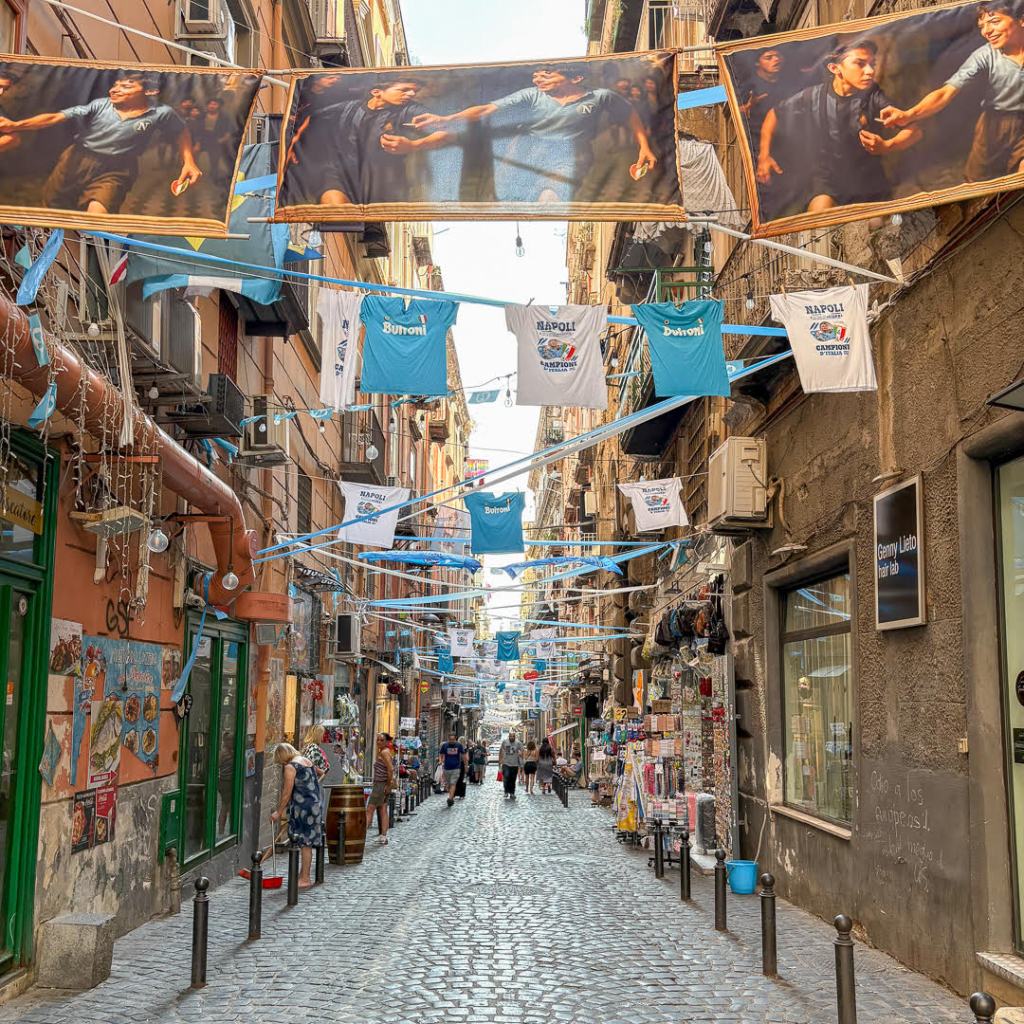
Naples, Centro Storico – courtesy of Colette Hewitt Photography

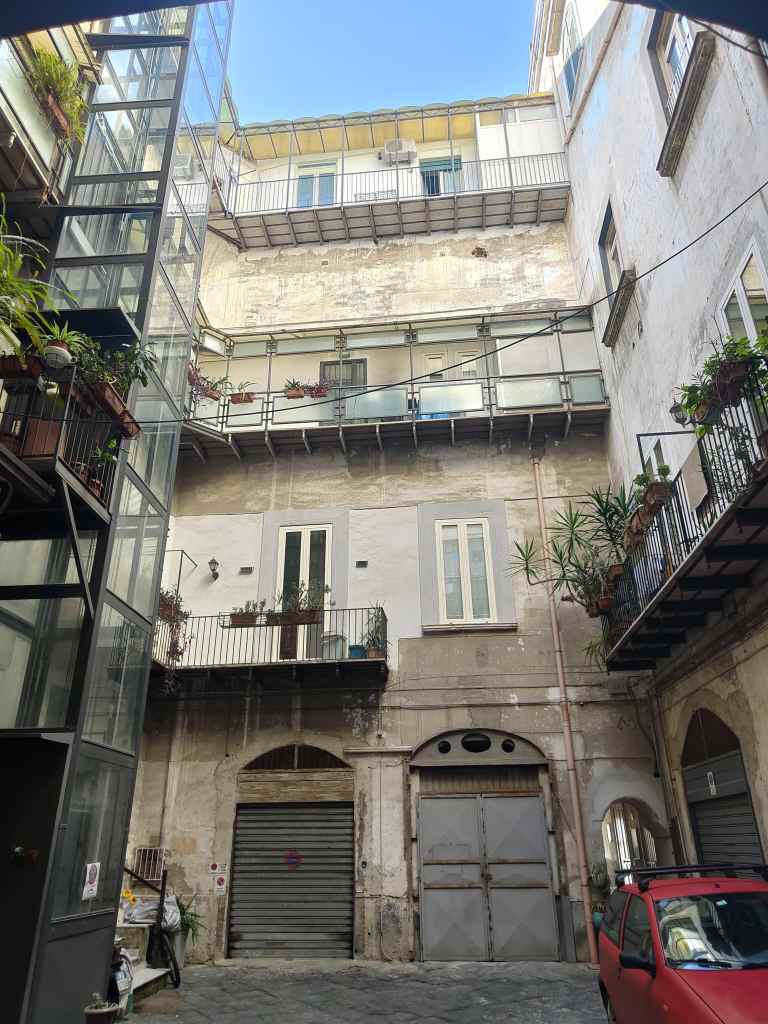
For the end of my exploration of Italy’s south, I had reserved a couple of nights in Naples. I had already spent one night here at the start of my trip, in an upmarket area near the port and the sea. This time I had chosen to stay in the centre, and my accommodation gave me a good introduction to the joys and frustrations of the city. It was a bed and breakfast establishment located in a typical Naples side street, lined with tall houses that might once have been grand, but which were now in need of refurbishment. A large wooden door opened into a rather dingy internal courtyard, from where a rickety lift took me up to the top floor of my building.

The unpromising courtyard of my B and B

At the check in, my host led me to a room which was bigger, but not as nicely furnished, as the one I had booked. I complained and was told via Google translator that my original room was occupied. After I insisted, I was told I could have my chosen room after a two-hour wait.  I was regretting my choice of accommodation until I was led up to the owner’s roof terrace for a welcome aperitif. There I enjoyed an Aperol spritz and some nibbles…and an amazing 360 degree view of Naples, a city with one of the very best settings in the whole world.

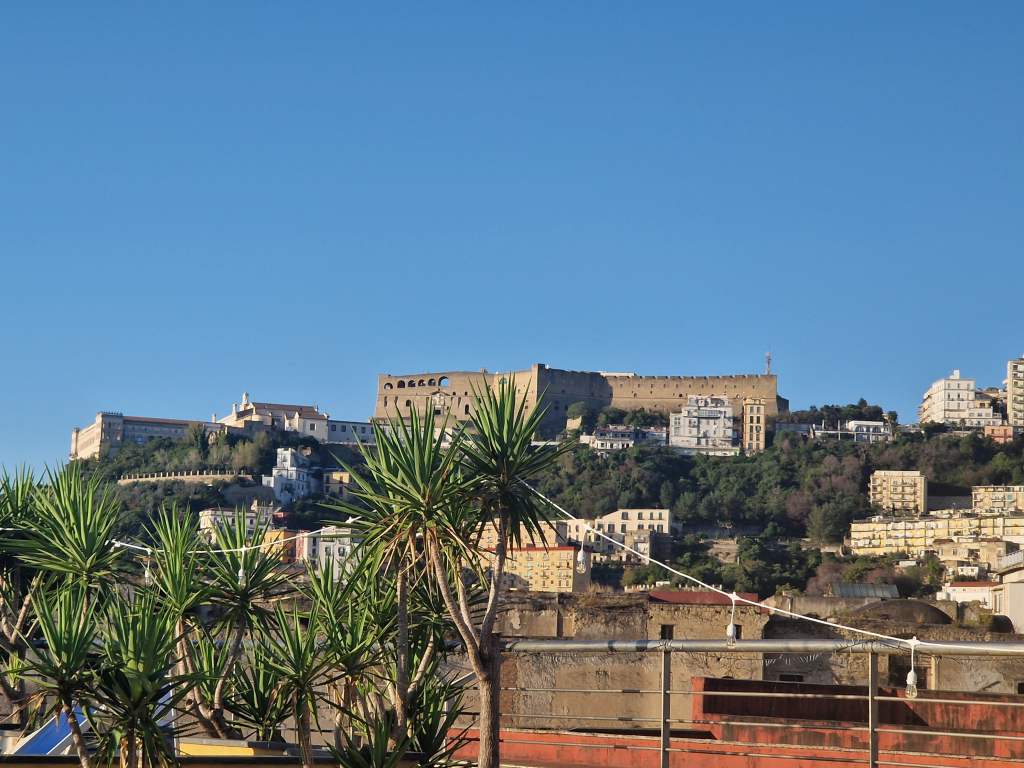
The magnificent view of Naples’ Castel St. Elmo from my terrace, looking west…
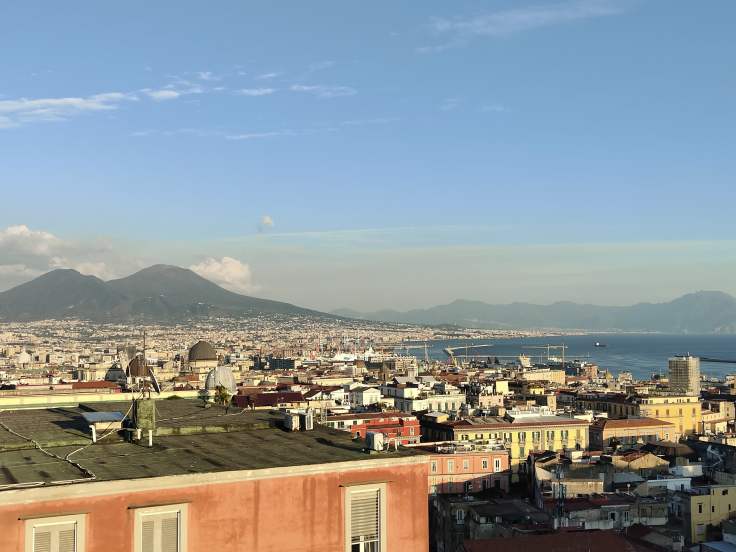
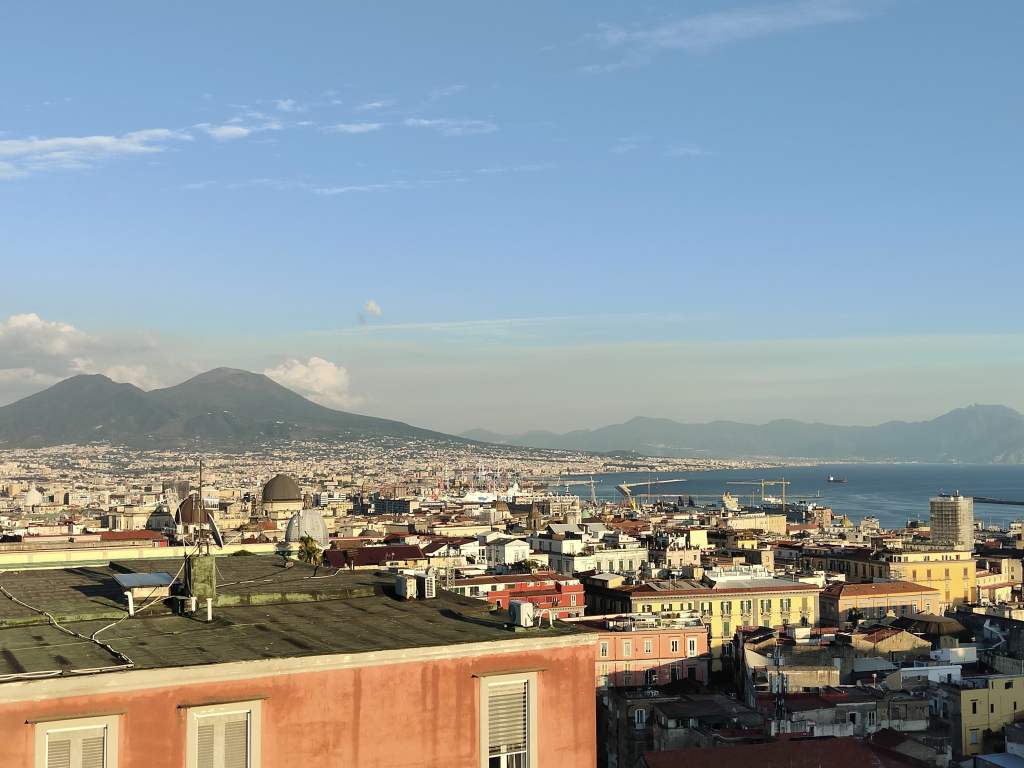
….and the view east over the Bay of Naples

After freshening up, I set off to explore. My first stop was the Naples National Archaeological Museum, which has one of the best collections of ancient art in the world. I was lucky to visit when they had a special evening opening, and the galleries were quiet and very atmospheric.

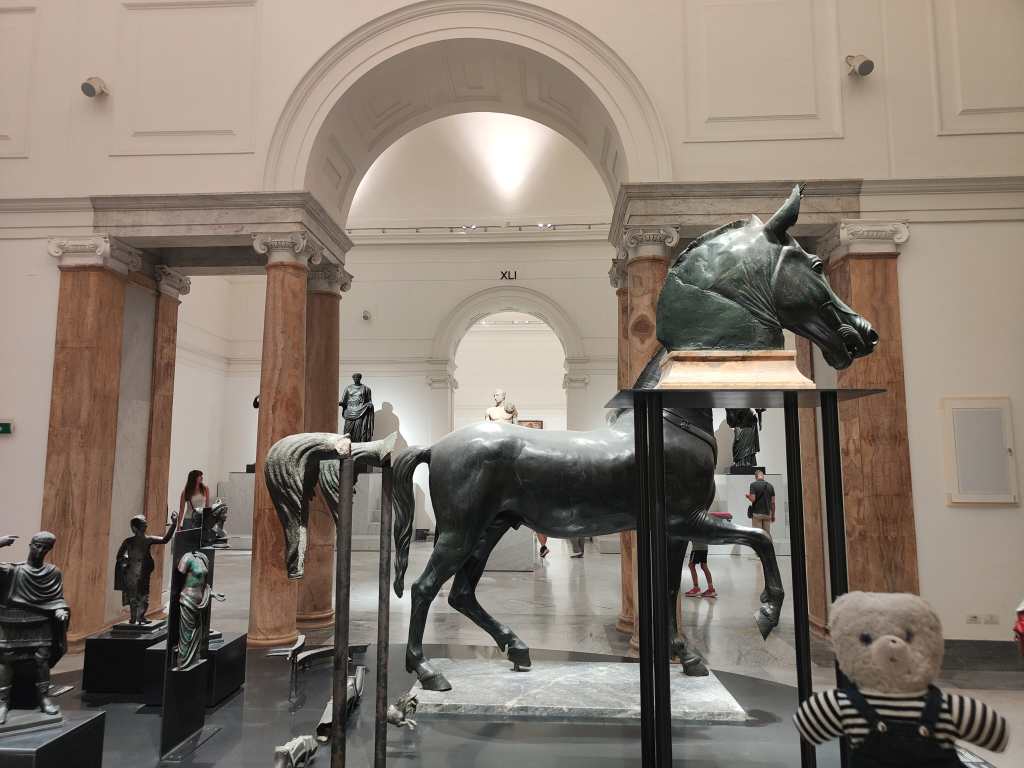
Statues from Pompeii at the entrance of the Naples National Archaeological Museum
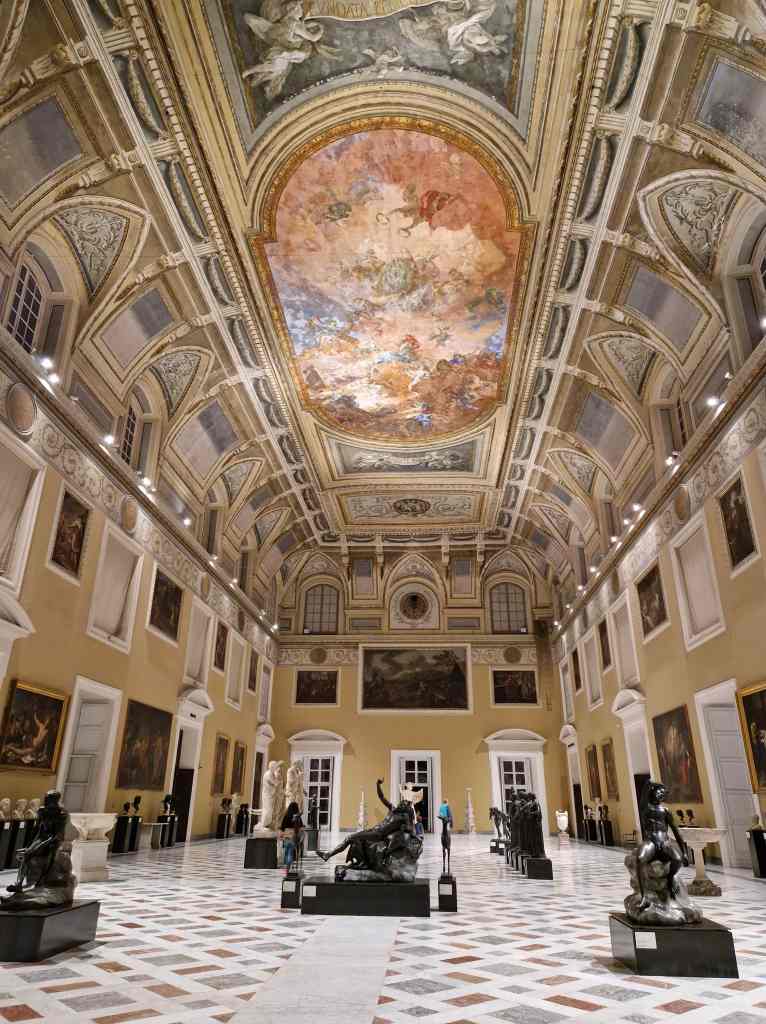
An immense display room on the second floor of the Naples National Archaeological Museum
A mosaic of an upwardly mobile Pompeian couple, Naples National Archaeological Museum

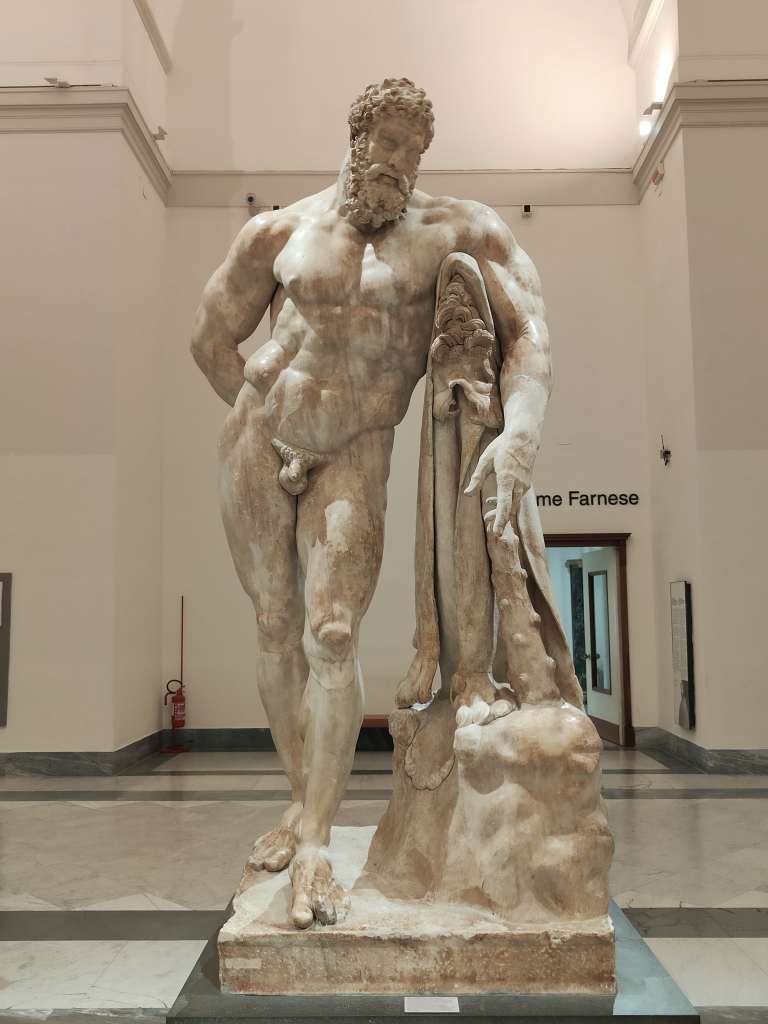
Many of the museum’s exhibits come from nearby sites like Pompeii and Herculaneum, but the museum also houses the magnificent Farnese collection, first assembled by Cardinal Alessandro Farnese (later to become Pope Paul III) in the 16th century and originally kept in his palace in Rome.

The Farnese Hercules

The museum is huge, and you could easily spend a day there, but I was a bit tired and limited myself to a couple of hours seeing the highlights. Apart from the magnificent mosaics and sculptures, there was also a fun exhibit of items that had been recovered after being stolen, together with the stories of their recovery. Some of these were quite funny, involving organised crime, disorganised crime, corrupt officials, innocent grandmas, bankrupt aristocrats or dodgy art dealers versus a special unit of the carabinieri set up to recover lost art work.

My next day was spent exploring central Naples, a chaotic, dirty, occasionally beautiful and always lively city. It is a good place to explore on foot – which is a good thing, since the traffic is terrible and the driving mad. My exploration started in the Rione Sanita district, a short walk from my accommodation. This was once where aristocracts lived, but became one of Napoli’s poorest areas with a reputation for corruption and crime. Today it is considered safe again to walk around but is still a poor, working class district, which features narrow streets lined by tall, once grand but now crumbling buildings, whose walls were covered in graffiti and from whose balconies clothes were hanging to dry. Even here though, in one Naples’ least touristy neighbourhoods, there were some stunning buildings to be seen by those brave enough to venture here.

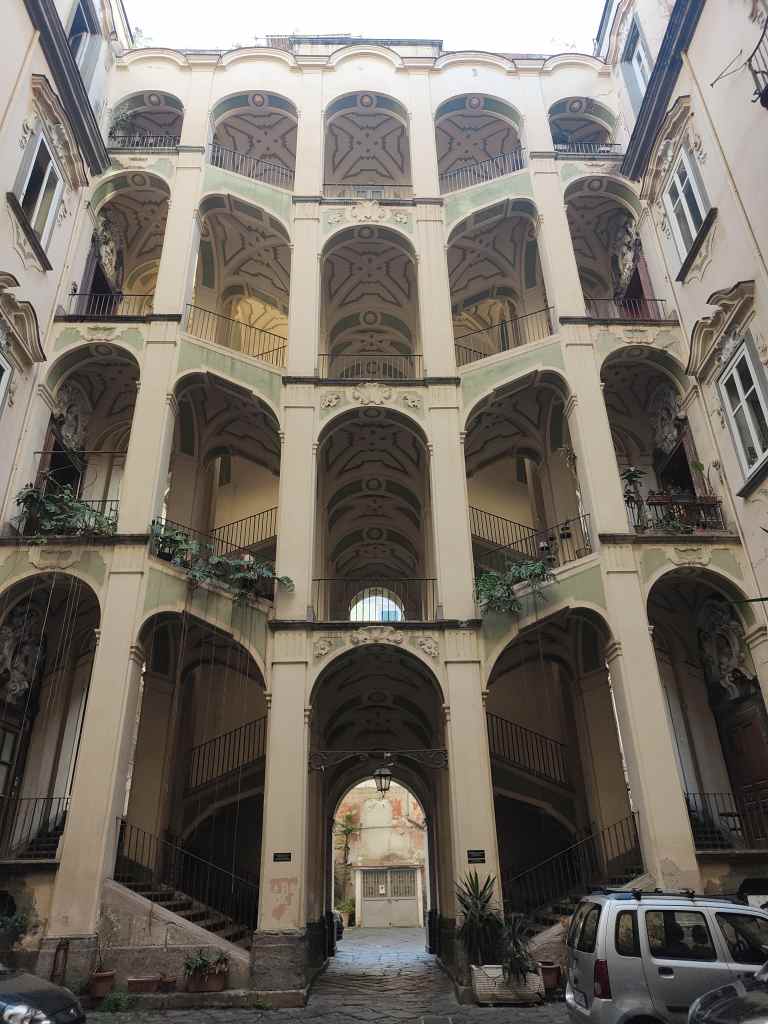
The Palazzo dello Spagnuolo seen from the street
The magnificent staircase inside, if you venture into the courtyard

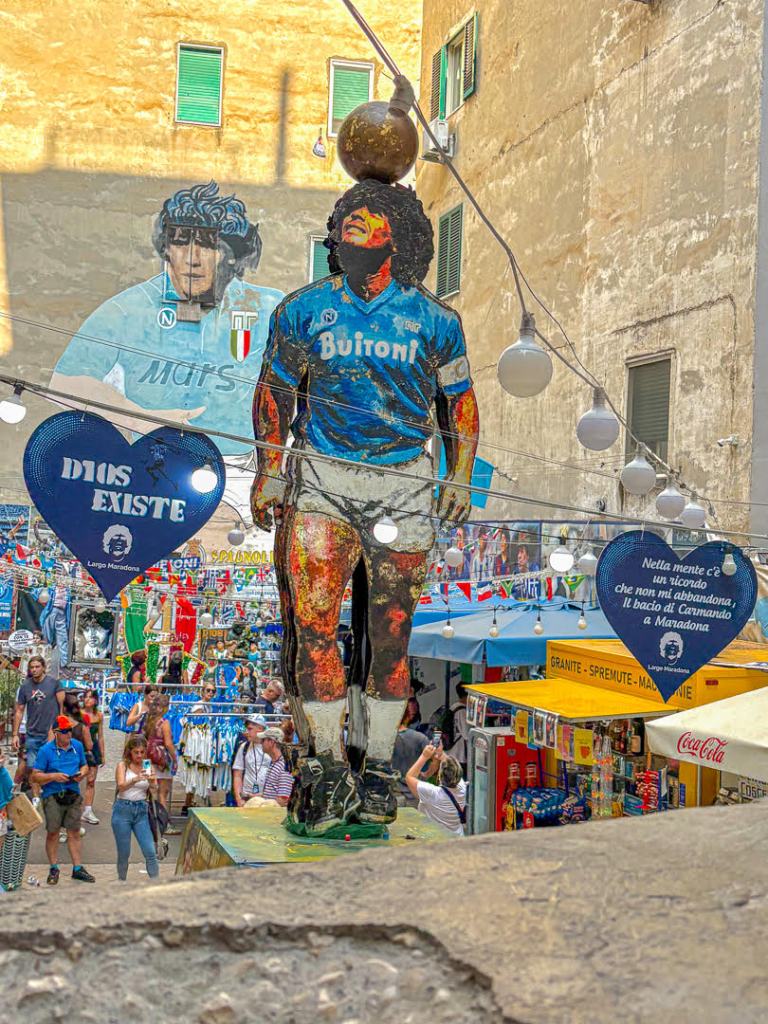
Every street seemed to have a small shrine in the wall of a house, and every small neighbourhood had a church – some dilapidated, some magnificent. Apart from Christianity, Neapolitans’ other religion is football, and every street also had a mural either devoted to the fact that Napoli had won the Italian championship four times or to the former star player Diego Maradonna, who last played for them in 1991, but is still worshiped locally.

Maradonna murual in the Centro Storico, courtesy of Colette Hewitt Photography

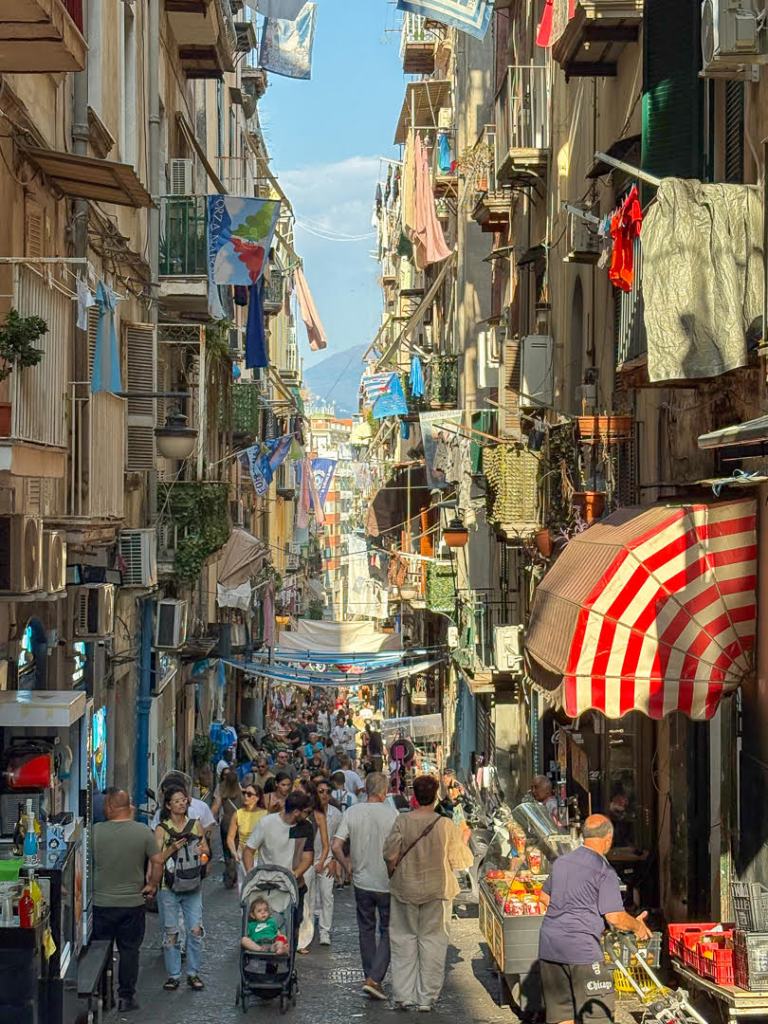
My walk then took me into Naples’ Centro Storico, the heart of the city. This was a noticeable richer area, with many more visitors. Compared to Raino Sanita, it had the same narrow streets, more old buildings, slightly less litter and graffiti, but also had cafes, restaurants and shops for tourists.

Centro Storico typical street, courtesy of Colette Hewitt Photography

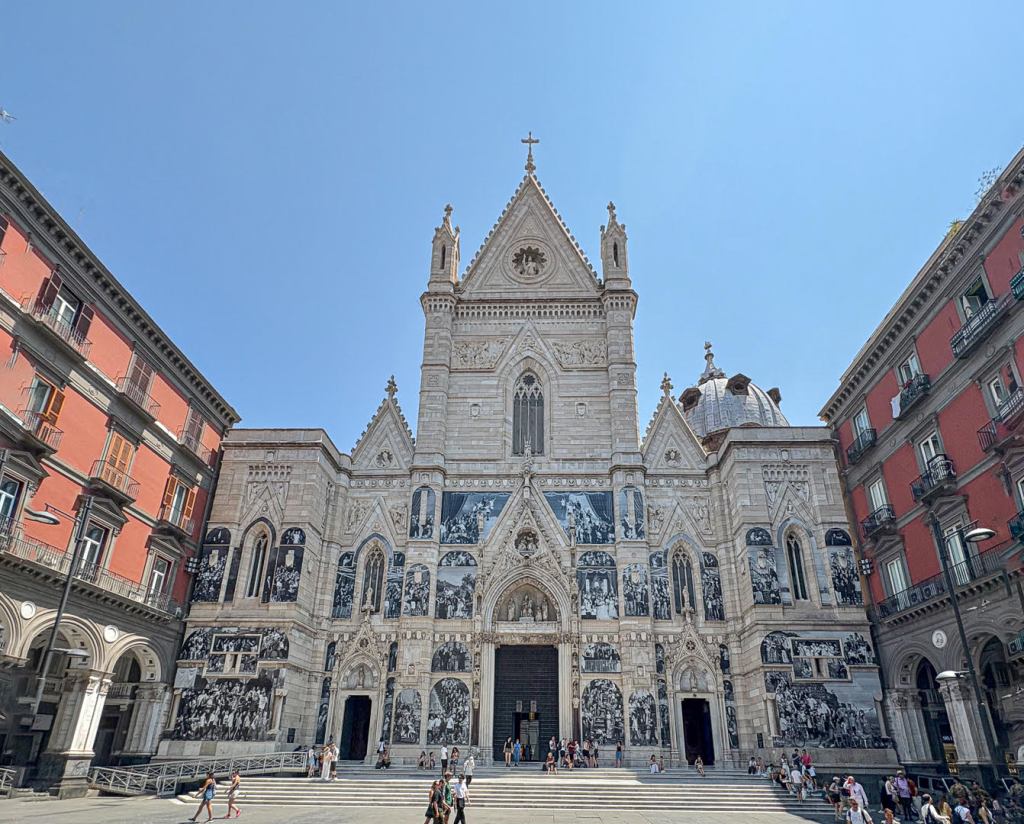
Amid all this seething, dirty and fascinating urban sprawl are many world-class tourist attractions – so many in fact that I only had time to visit a small portion of them. Best known is Naples’ Duomo, which was my next stop. It has a magnificent interior, and which houses the skull and two vials of dried blood of San Gennaro, the patron saint of the city. The latter were collected after the saint’s beheading in 305AD and the blood inside is supposed to miraculously liquefy on specific dates three times a year – a time of great celebrations amongst devotees.

Naples’ Duomo, courtesy of Colette Hewitt Photography

A short stroll further into the Centro Storico brought me to yet another beautiful church – this time a small baroque one.

Yet another beautiful church in Naples

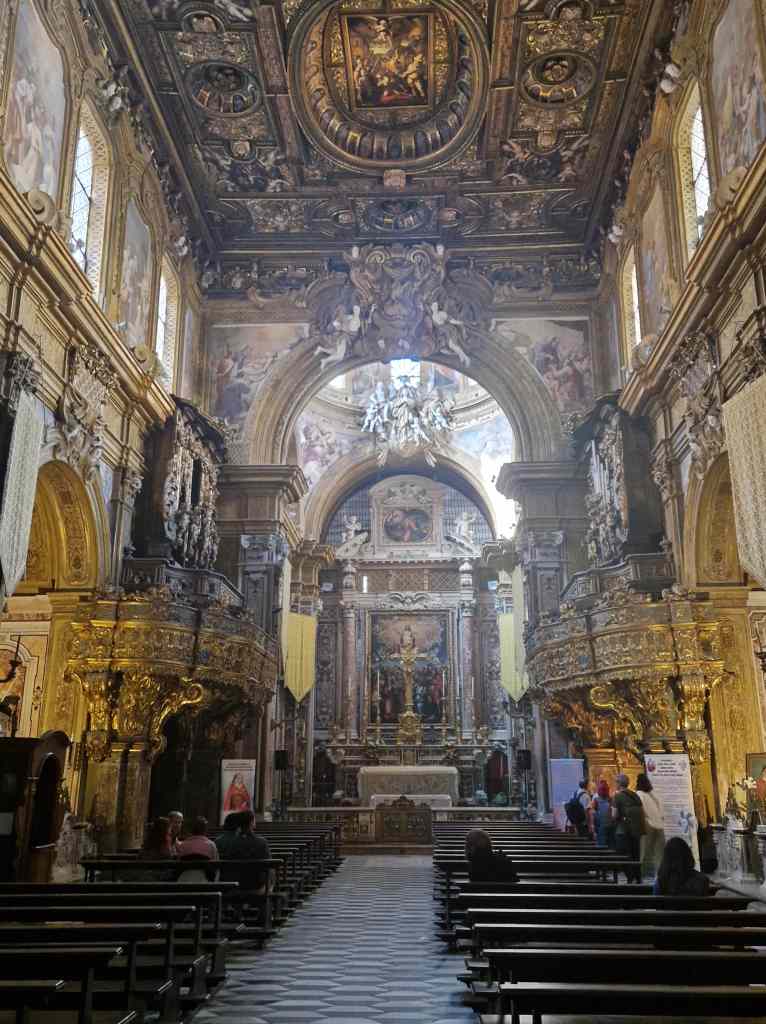
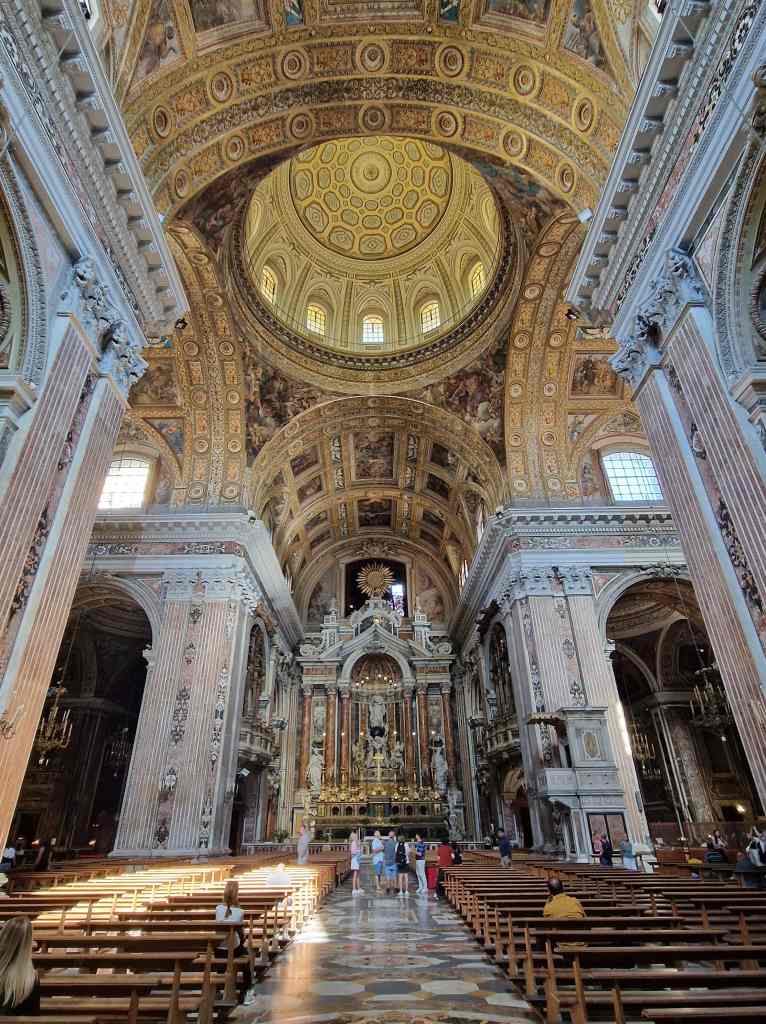
The cathedral is indeed impressive, but I found the Church of Gesu Nuovo (“New Jesus”) even better. This huge building was originally a palace, dating from 1470, but its owner fell into disgrace and it was confiscated and sold to the Jesuit order for them to convert to a church, whose construction began in 1584.

The distinctive outside of the Church of Gesu Nuovo
Inside the Church of Gesu Nuovo

Today it is  in my opinion the most beautiful church in Naples and certainly the biggest. A curious addition to the usual pictures of saints adorning the walls was an unusual twisted chunk of metal – an inscription explained that this was a bomb that fell through the church roof during WWII, but which failed to explode – something of course put down to divine intervention!

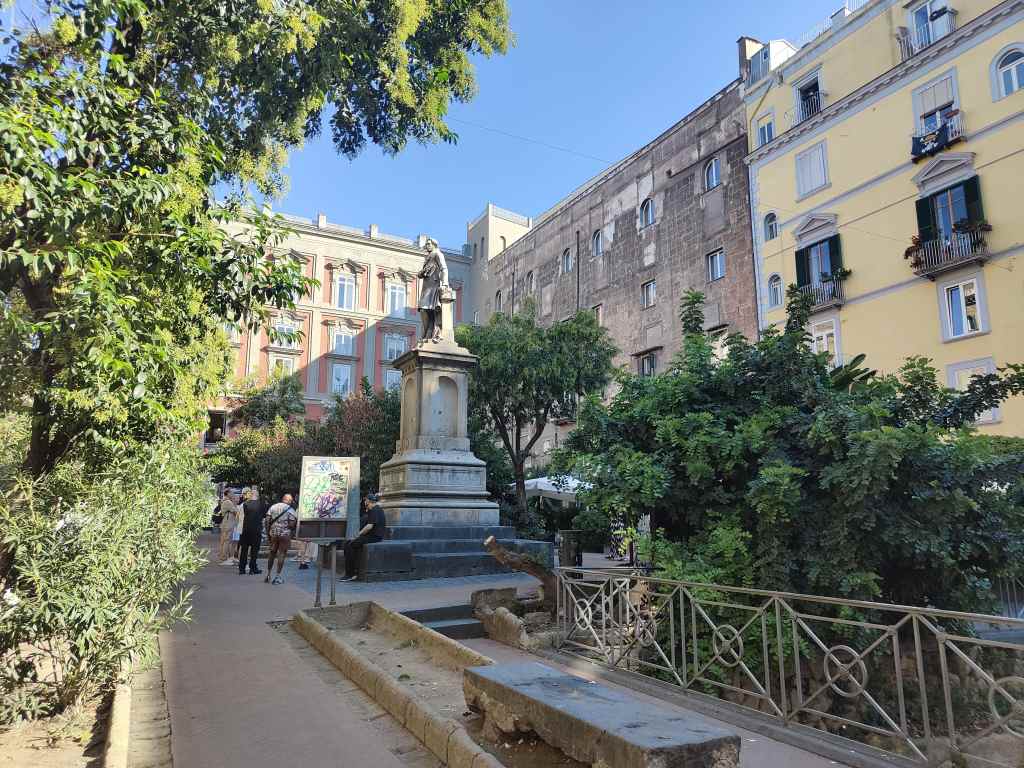
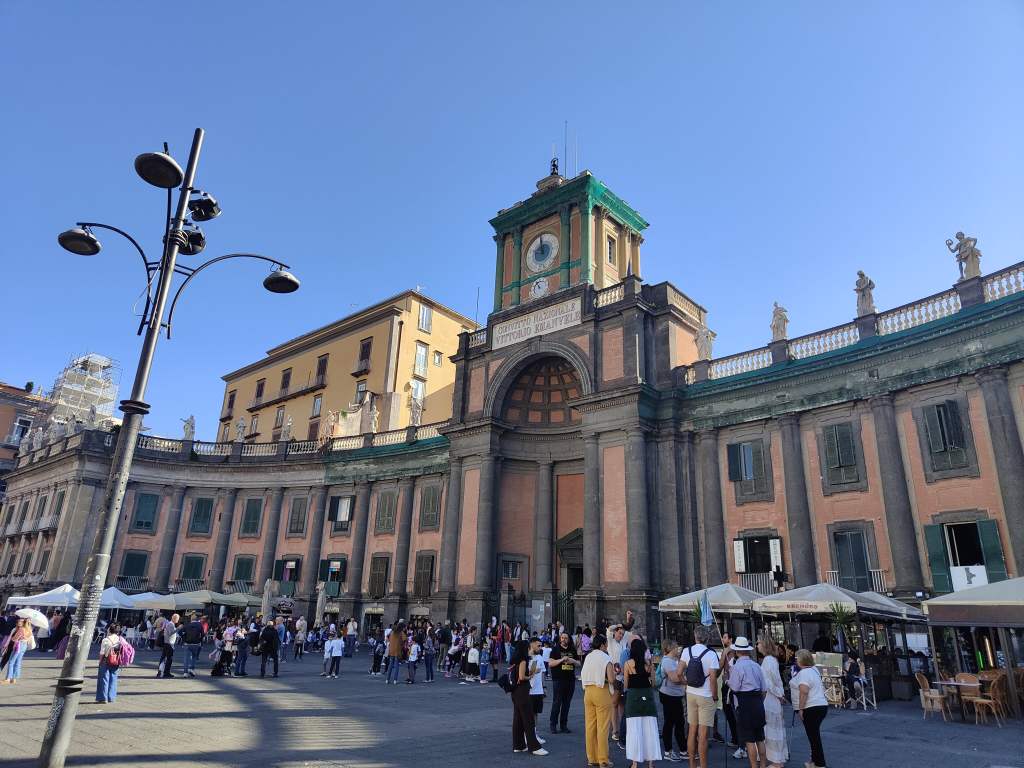
My stroll carried on past yet more interesting squares and buildings, like the Piazza Bellini and Piazza Dante.

Piazza Bellini
Piazza Dante

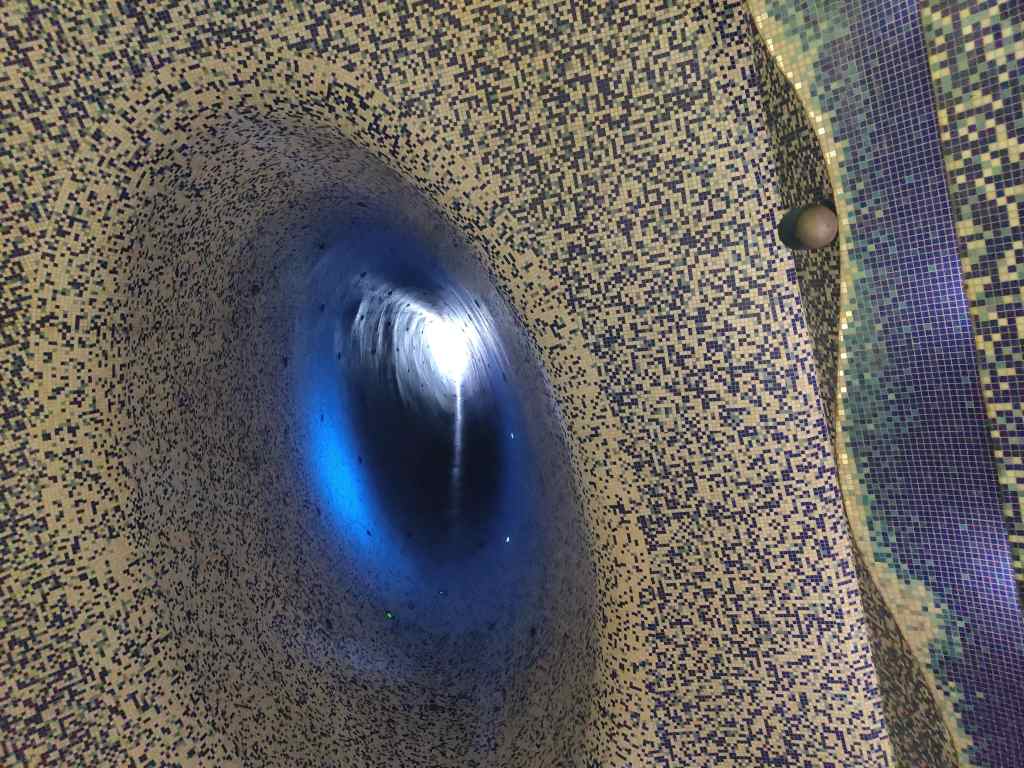
I finally ended up on Via Toledo, a main road in a more modern part of town. The metro station there is one of several in Naples that have important modern art installations, and is worth a visit even if you are not travelling anywhere.

Art installation at Toledo Metro Station, Naples

I took the metro back home and sat on my terrace enjoying the view and working on my blog as the sun set. I was hoping to see Naples’ many monuments at night, but the local authorities do not light up their buildings in the evening, so they were all hidden in darkness. This was a real shame, since I am convinced that nighttime Naples could be a spectacular sight, like Paris or Moscow – if only they would illuminate their city. To console myself I headed out for dinner in a local pizzeria, which was, as I expected, excellent and very reasonably priced. Apart from an imaginative and tasty octopus pizza and good wine, it was nice to be eating at an outside terrace in late September when I know that in London I would be shivering indoors.

A well-earned pizza after a long day’s walking around Naples

Over dinner I reflected on the last day and a half in Naples. I had found it an exceptional city, quite unlike anything I had seen elsewhere in the world – it felt like somewhere that could have been in Africa, but with European architecture. I loved its energy, crumbling historic buildings and magnificent setting on the Bay of Naples – and could forgive its chaotic traffic, noise and dirt. With some investment, Naples could rival Paris for its beauty – but for the moment I am rather glad that it remains as it is. I now had one day left to spend in the area, which I devoted to one of the world’s most famous sites – stay tuned to see which one (although I imagine many readers will already have guessed!).

Previous Post: Martina Franca and Alberobello

Next Post: Pompeii

More deepest Puglia – Martina Franca and Alberbello

Today I continued my exploration of deepest Puglia with visits to two more hilltop towns with old city centres. The first was Martina Franca, the biggest city in the area (albeit with a population of only 49,000). I found it similar to Cisternino – very picturesque with a well-defined old town which contained winding streets, churches, and a pretty main square. It was also not too busy, and was another nice place to happily lose oneself in for a couple of hours after a coffee on the main piazza.

Enjoying a cappuccino in Martina Franca’s piazza
Martina Franca’s fine piazza

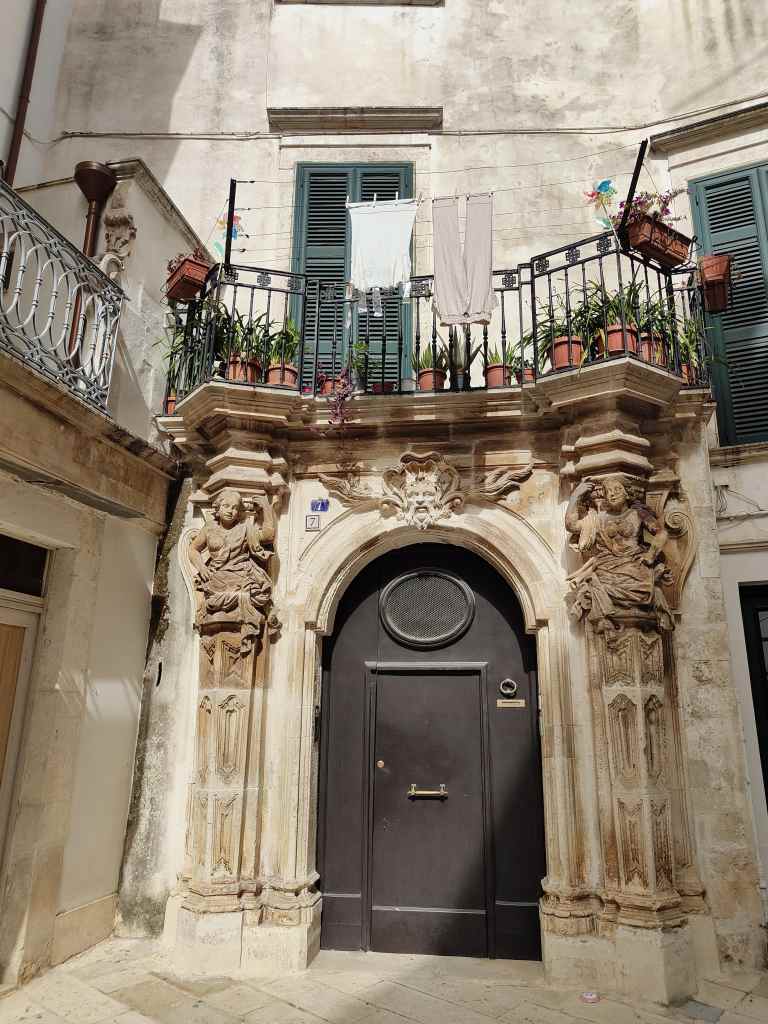
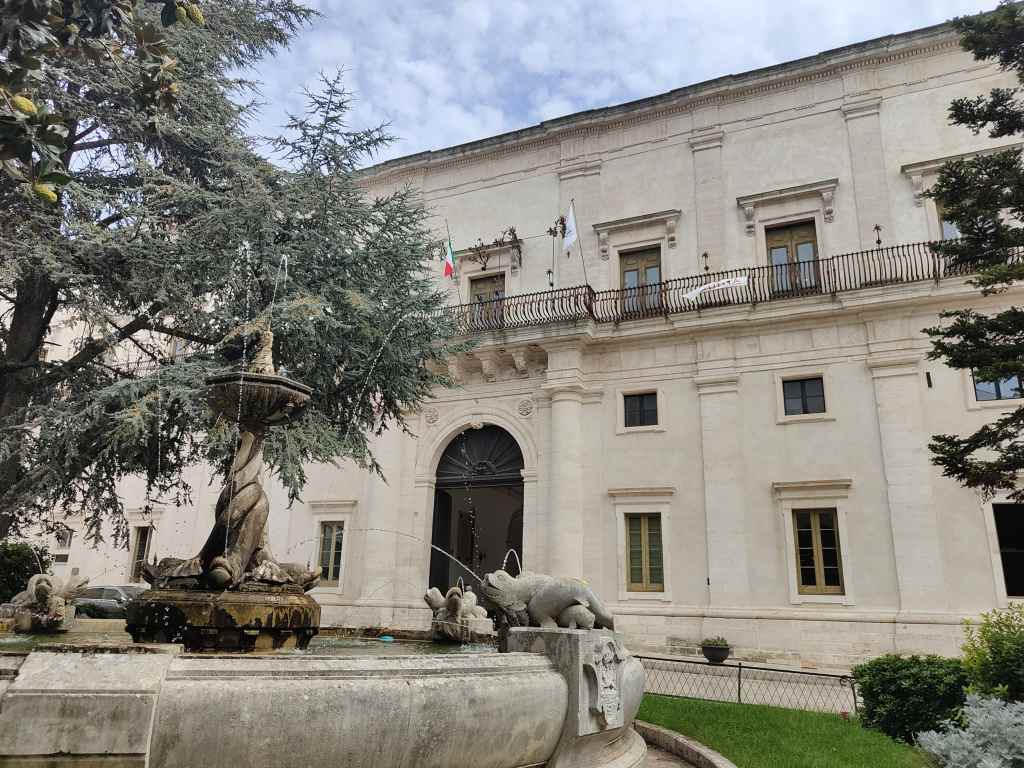
I thought that Cisternino’s small streets were more interesting, but Martina Franca had the more impressive monumental buildings, including a large church and a palace.

Building in a side street, Martina Franca
The outside of the Palazzo Ducale, Martina Franca…
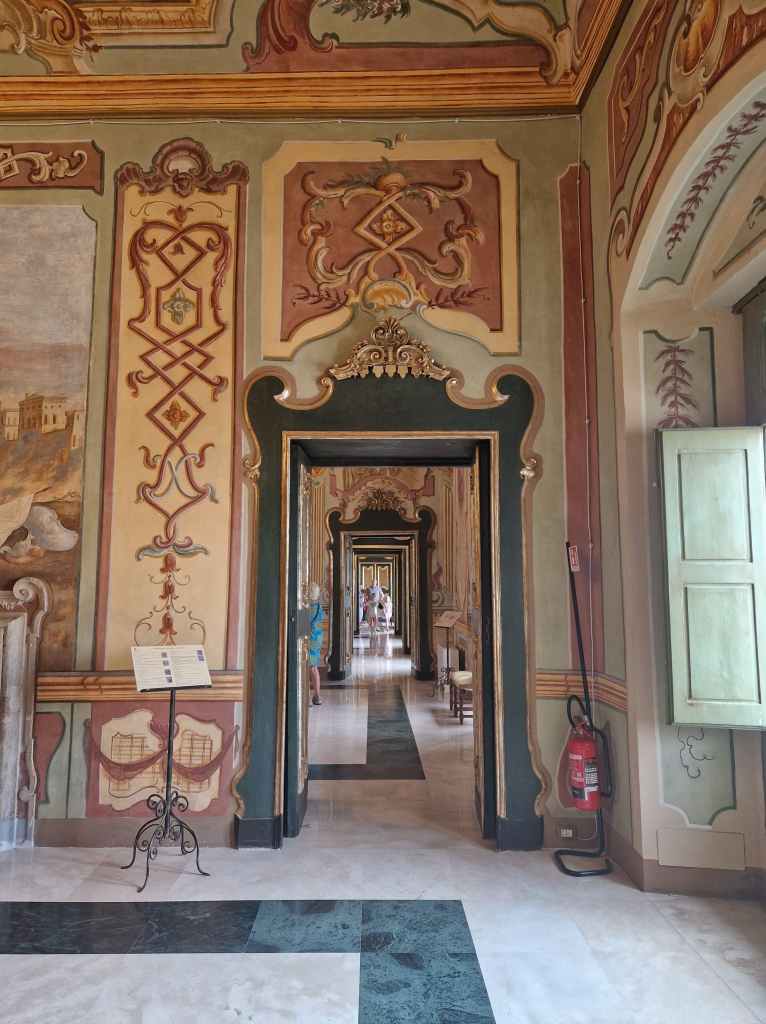
….and inside

Next, I visited yet another hilltop village – Locorotundo, which I found to be more like Ostuni. It had a picturesque hilltop old town, visible for miles around from the surrounding plains, but its centre was too small to get properly lost in, and too crowded to get a feeling of discovering something for oneself. I took a couple of photos to prove I had been there before returning to Cisternino for dinner.

A photo of Locorotondo to prove that I was there

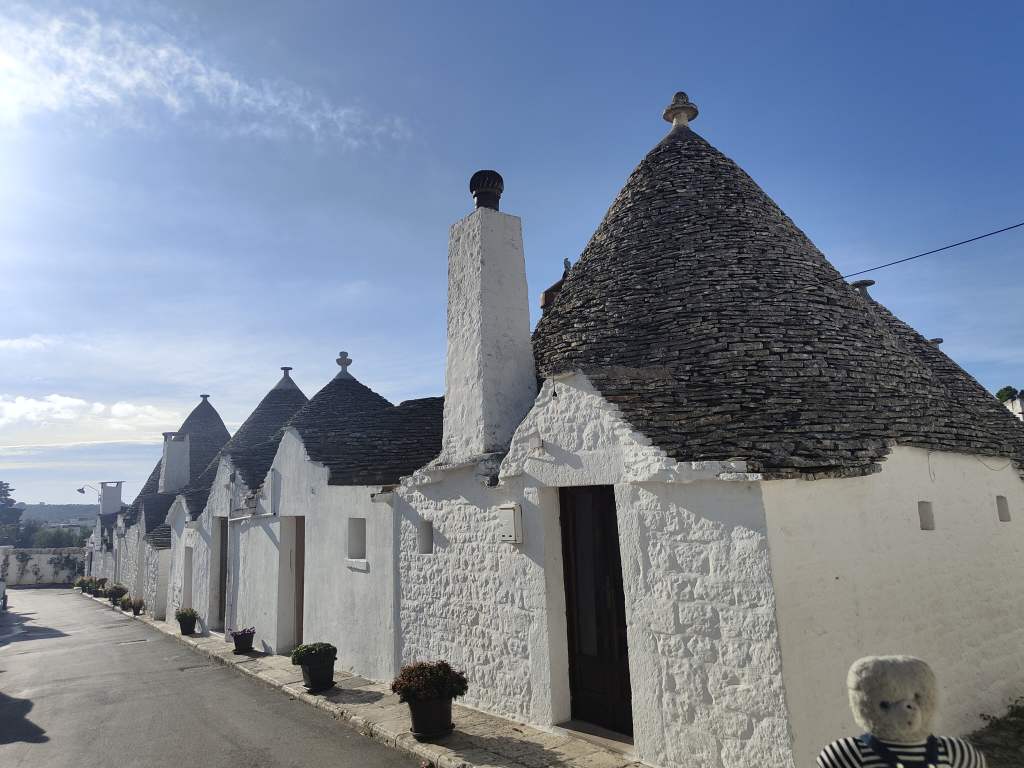
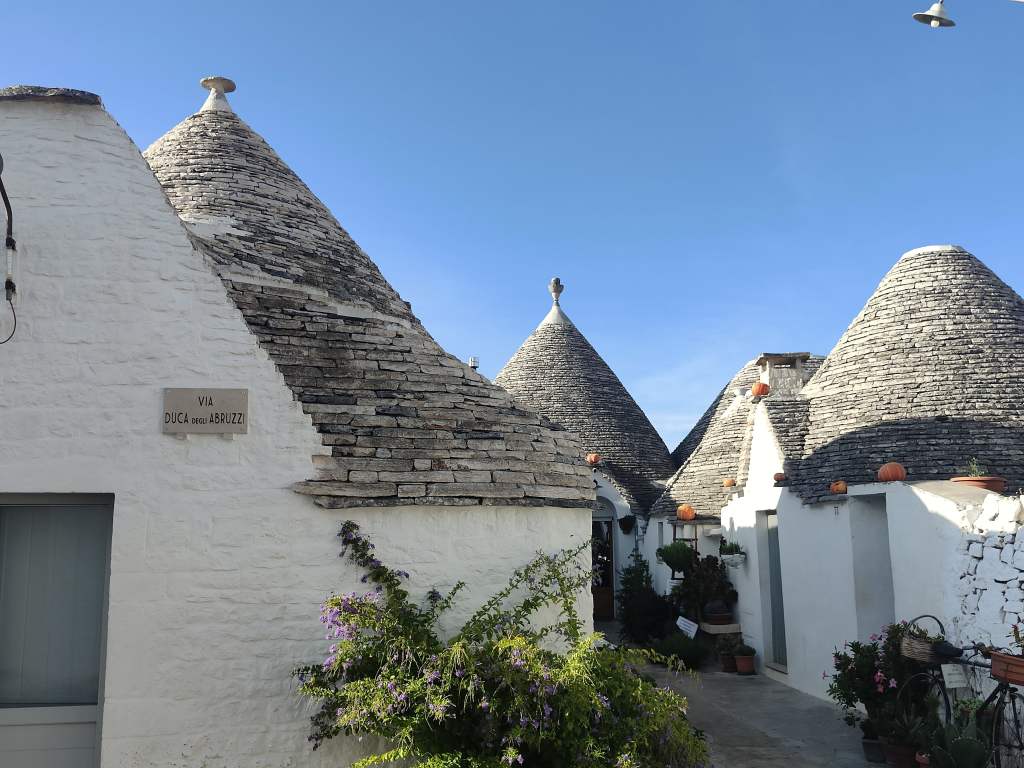
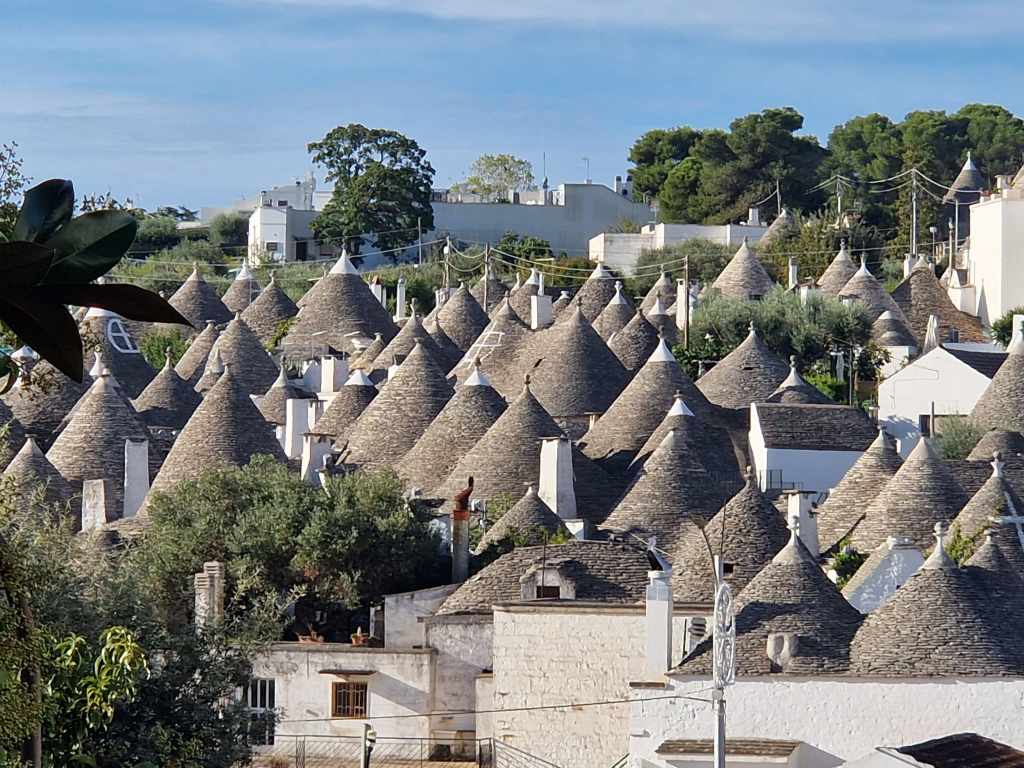
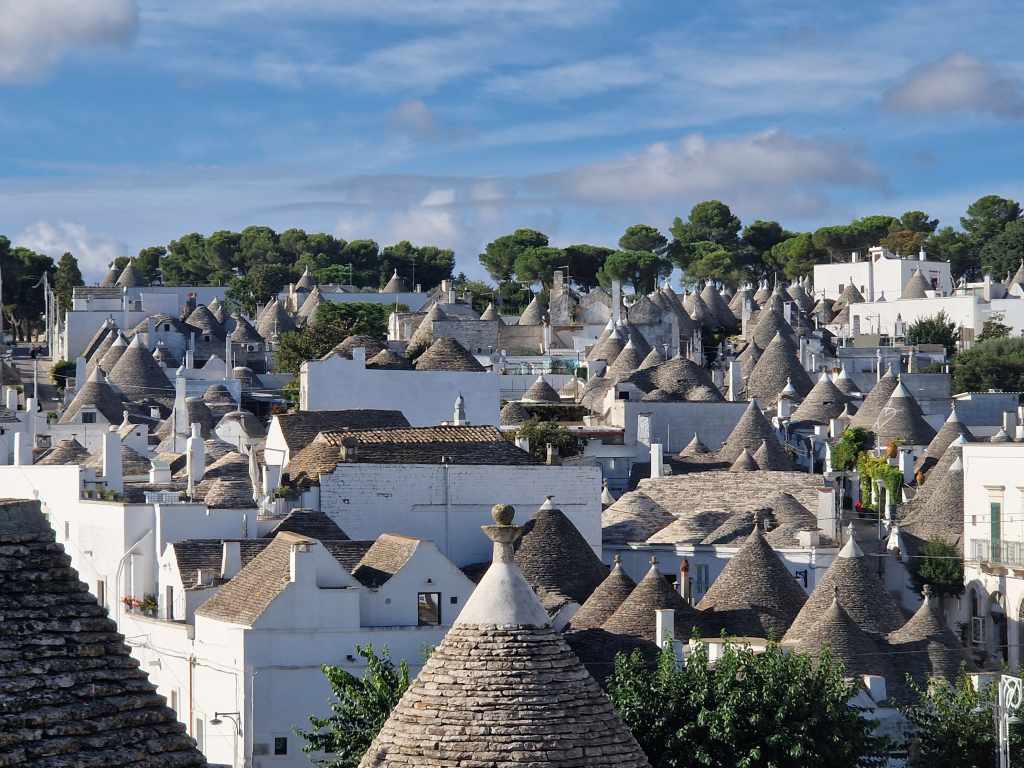
The next day I woke up early to make the four-hour trip back to Salerno to return my hire car. On the way I made a short early-morning stop at Alberobello, a small town known for its remarkable number of trulli – 1,600 apparently. These earned the town its listing as a UNESCO world heritage site, and a place on any tourist’s list of things to see in Puglia. The trulli were indeed a spectacular and strange sight, and I spent half an hour exploring them.

The first of many trulli at Alberobello

I looked at my watch, and wondered briefly whether I should not stop here longer to explore more deeply. But I had a deadline to return the hire car before the rental office in Salerno closed for its 1pm siesta break, so I decided to drive on. Leaving at that time turned out to be a good decision. On my way back to the car park, I crossed streams of other visitors heading the other way, and as I drove out of the town, I passed a veritable armada of tour buses driving in. It was clear that by 9.30 the small town would be overrun.

Hundreds of Alberobello’s trulli sit on one picturesque hillside

My drive back to Salerno proved challenging. Not because of the driving habits of local drivers, which were actually quite good, but because of the crazy rules imposed by the authorities. There were frequent road works (but no sign of anyone working) which were an excuse to limit the speed on perfectly good stretches of road to 50km/h (30 miles/hour) or even lower. It seemed that the government has bought thousands of “max 50km/h” signs that they did not know what to do with. The local drivers ignored these ridiculous limits and drove at an appropriate speed for the road conditions – often at twice or even three times the advertised limit. The rare speed cameras were well advertised in advance by signs and could also be spotted from far away by watching for when the drivers ahead braked suddenly. As a law-abiding foreign bear, I had an uncomfortable choice – obey the speed limit and cause a big queue of angry drivers to build up behind me, or drive like the locals. I won’t reveal my decision but let it be said that I arrived at Salerno in a slightly stressed condition just in time to return my car.

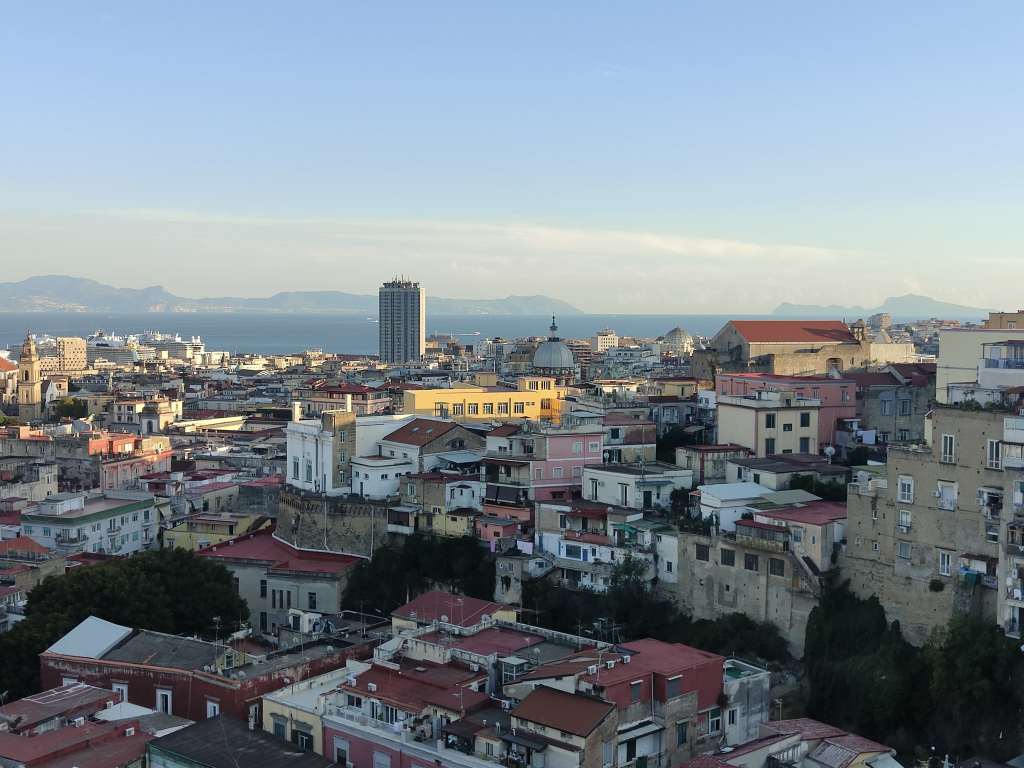
From Salerno I took the train to Naples for the last two nights of my Italian trip. I had enjoyed Puglia but thought that I had seen enough pretty villages and trulli and was yearning to experience the excitement of a big city once again. Whilst not always easy, Naples turned out to be exactly what I needed, and an exact opposite to the cute small towns of the last few days. Check out my blog tomorrow to find out more!

A teaser for my next post – the view of Naples from my accommodation!

Previous Post: Ostuni and Cisternino

Next Post: Naples
Blog at WordPress.com.

Up ↑