Teddy on Teide

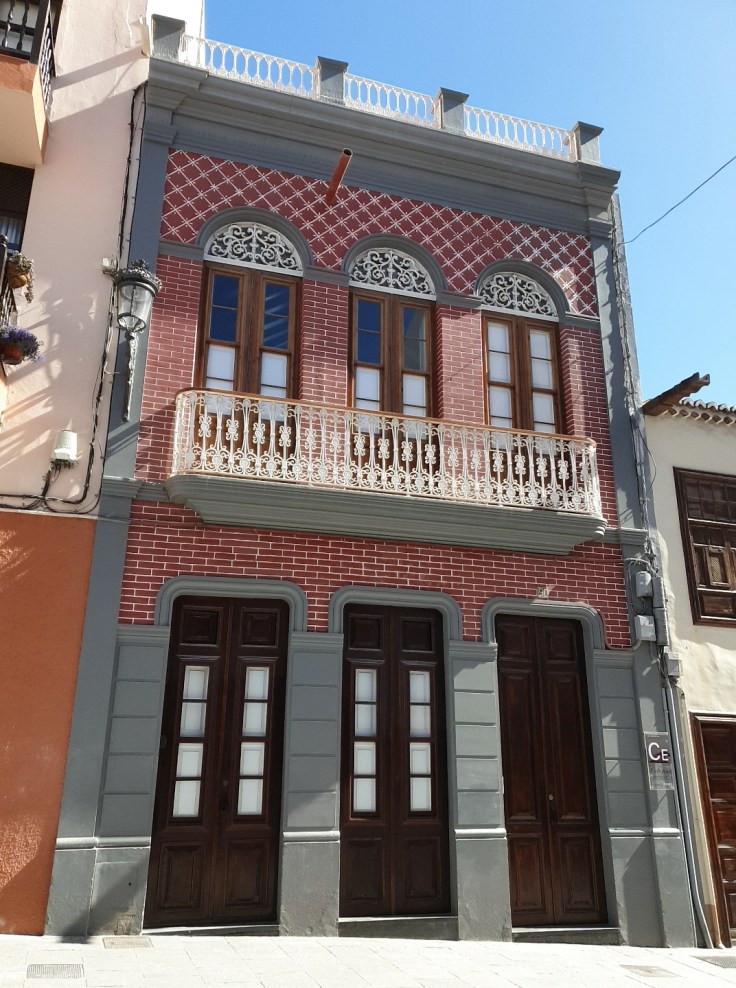
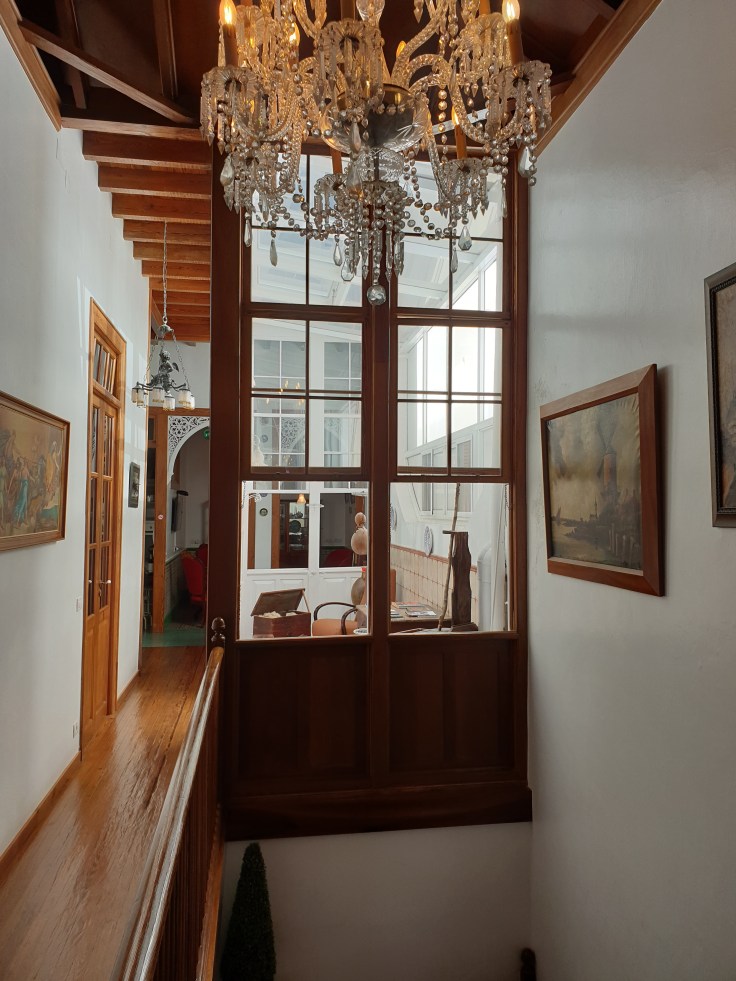
The next day I had to fly to Tenerife for the final leg of my holiday.  For some reason I couldn’t sleep in my La Gomera holiday home, so in the morning I was very tired as I drove to the airport and didn’t really enjoy the short flight. In Tenerife, baggage return and car hire were again very efficient, and I was quickly on my way to my hotel. I soon realised that Tenerife was completely different to La Palma or La Gomera – the area around the airport was heavily developed, and although they even had a motorway, it was jammed solid.  My navigator took me around busy back roads to my next destination, the town of La Orotava.  I was very relieved when I could park my car directly in front of the hotel.  I was even more happy with the hotel itself – called the Alhambra, it was a rich merchant’s house that had been designed by a well-known architect in the 1920s in Arabic style.

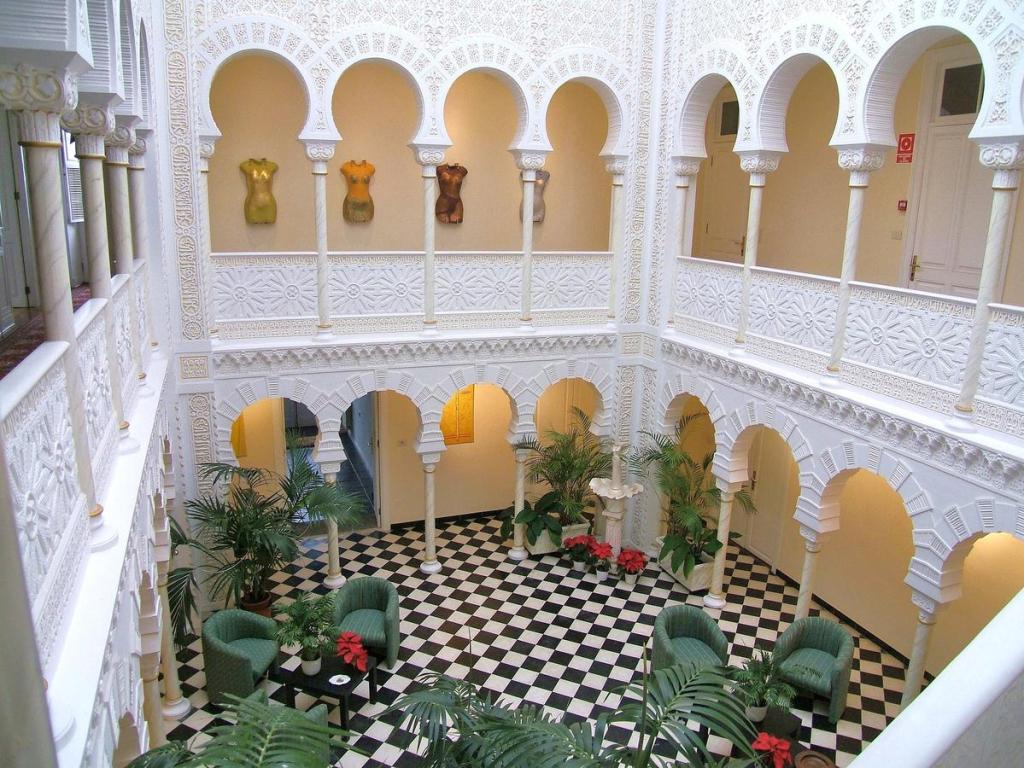
The owner of the hotel was very nice, and very enthusiastic about his property. He asked if we had a minute. I just wanted to go to my room and sleep, but it seemed rude to say no, so I listened to his passionate explanation of a large modern mural on one of the walls.  I have to admit I didn’t like the painting at all and could only understand half of his explanation in Spanish. I nodded politely occasionally. When our host finally stopped talking, I turned to head upstairs, but he stopped me and asked if I had just one more “momento”. I made a sign that I wanted to sleep, which seemed to disappoint him. The room was really nice with a great view of the town and Mount Teide. 

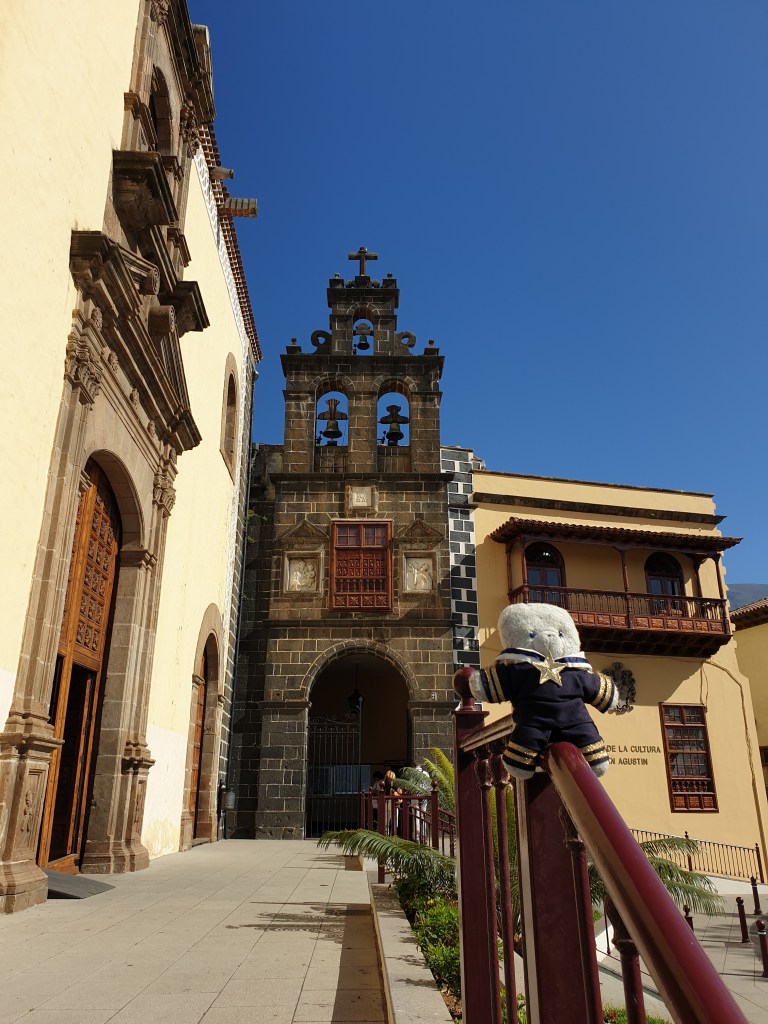
I slept for an hour and then headed out to explore La Orotava – it was a lovely colonial town dating from the 1700s, with many interesting old buildings and churches.
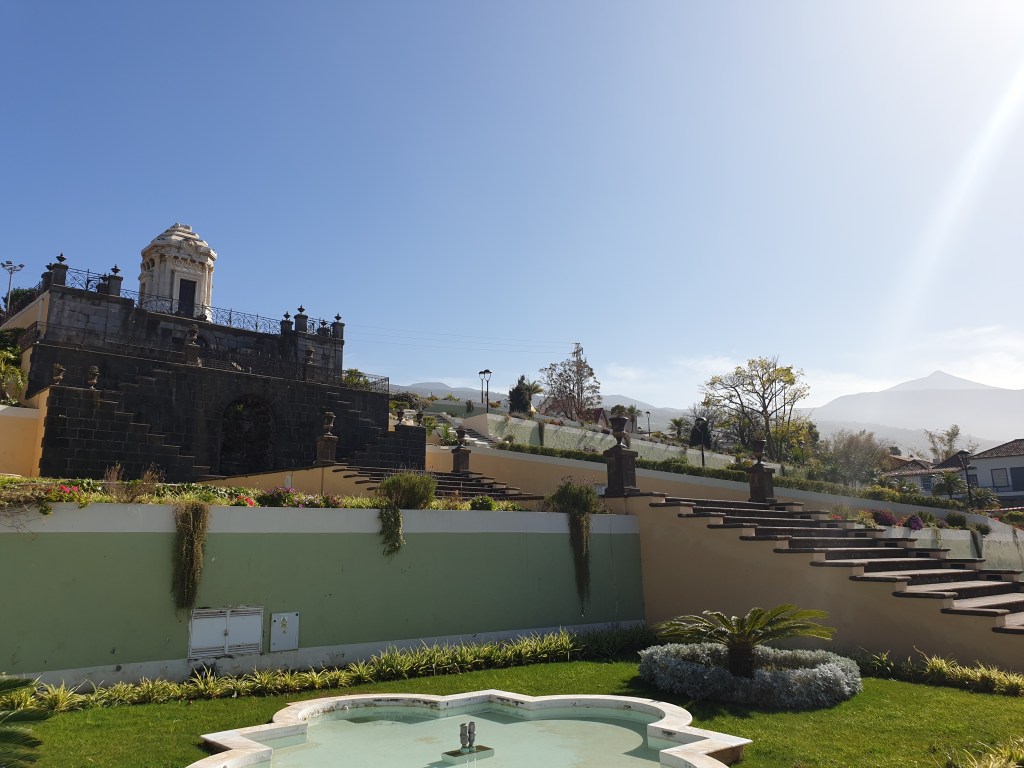
In the centre was a pretty park with a view of Mount Teide
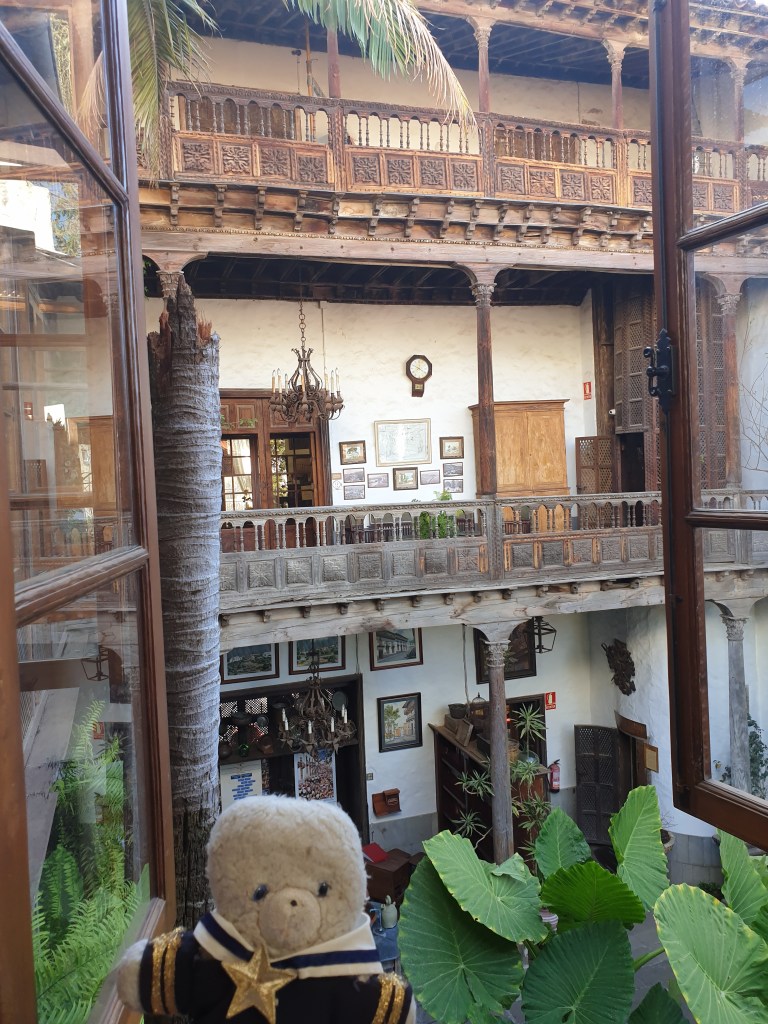
I also found the Casa de los Balcones, an iconic building for the city.  On the street side, there were pretty wooden balconies, and inside was a small museum.
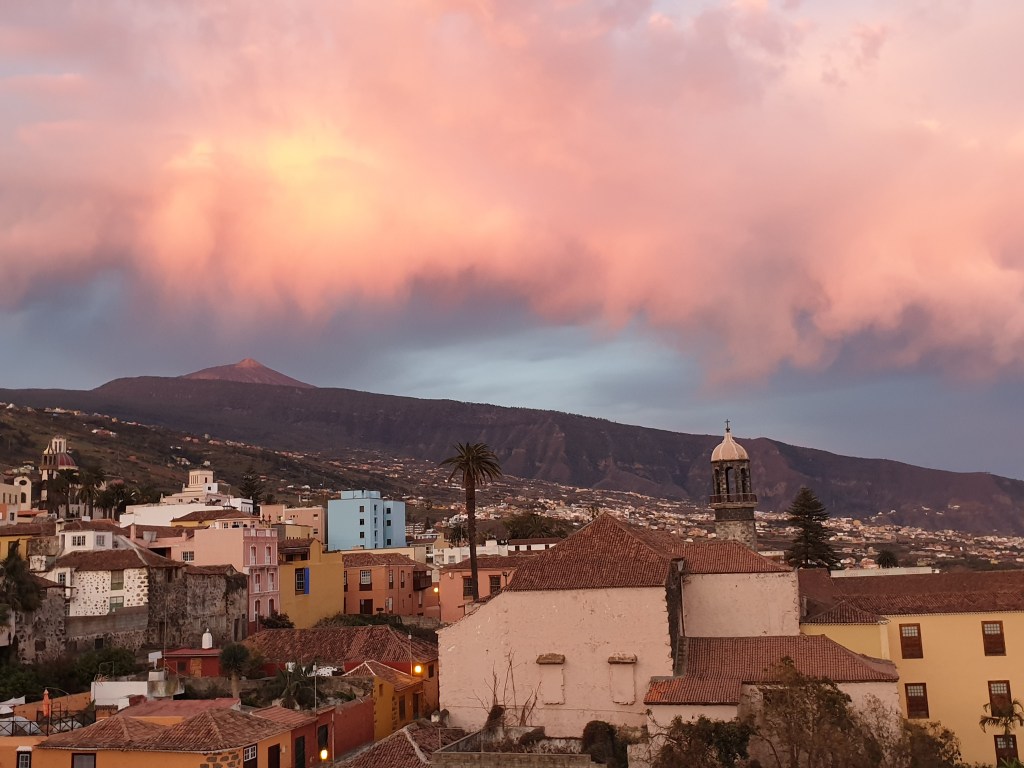
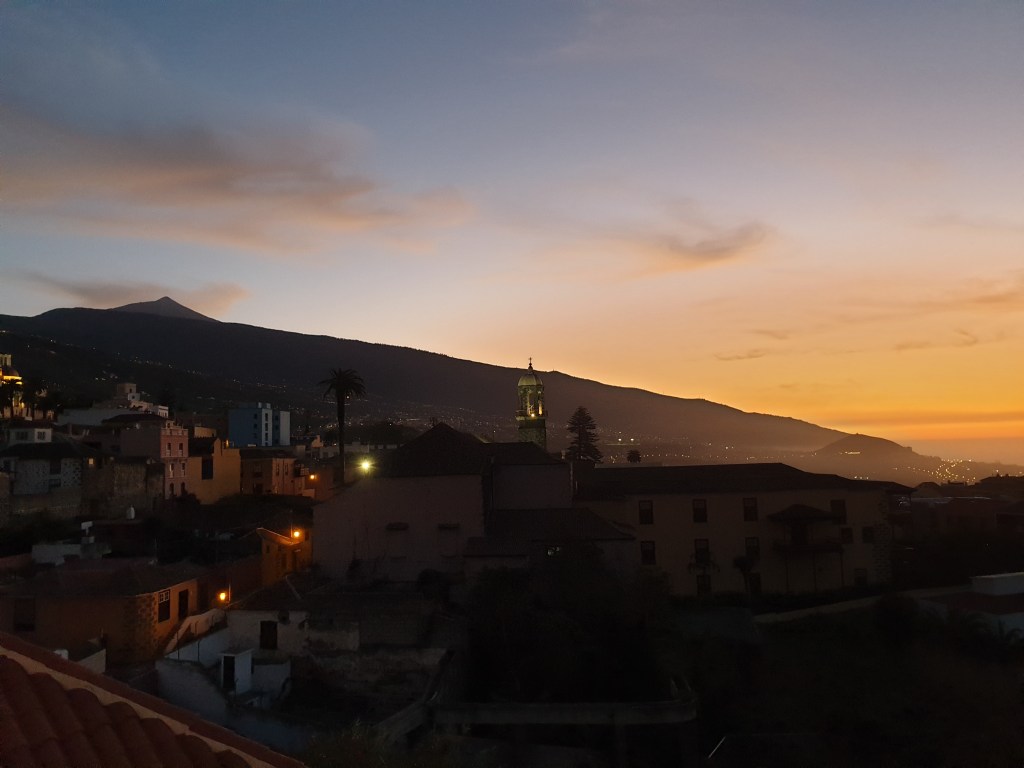
I bought ham, cheese and wine from the local supermarket and enjoyed dinner in my room, with a nice sunset view of the town with the volcano overlooking it.
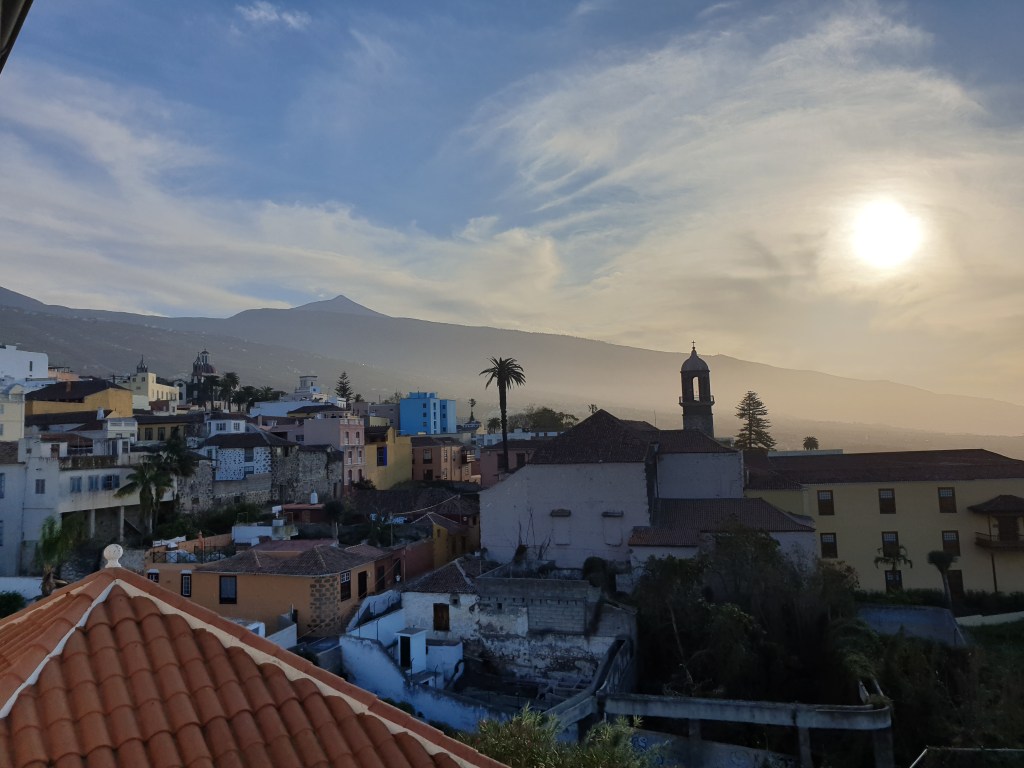
The next day I got up early because I had booked the first cable car up Mount Teide at 9am, meaning I had to leave the hotel at eight.  Fresh coffee and a lovely sunrise over the town helped me wake up.
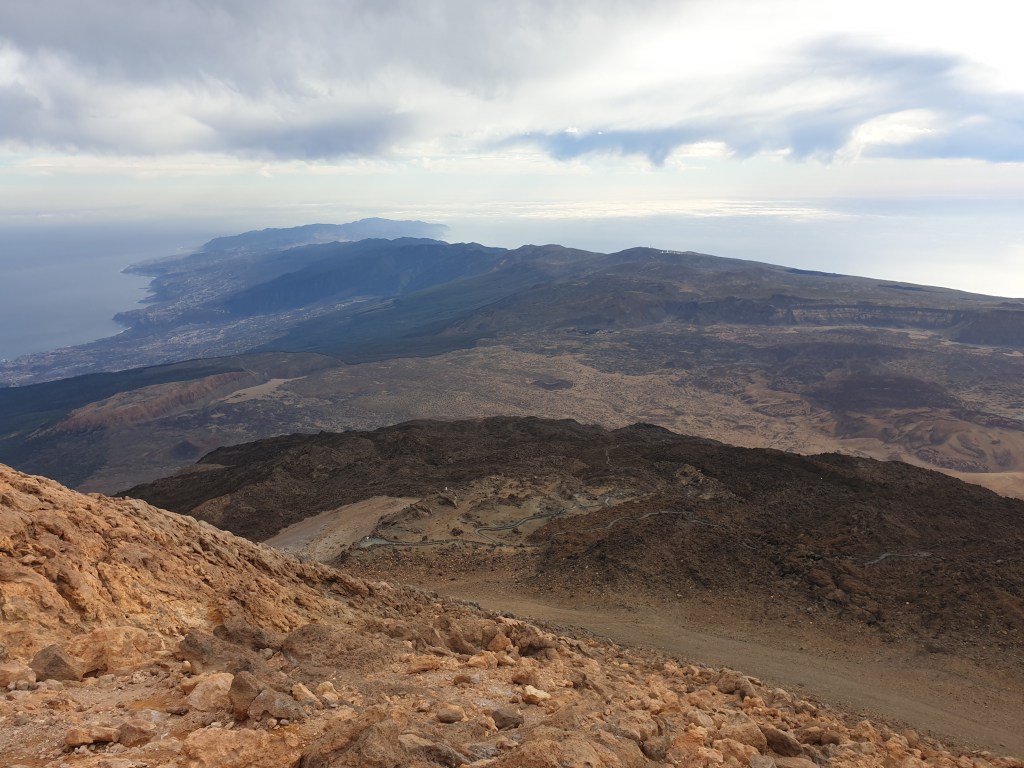
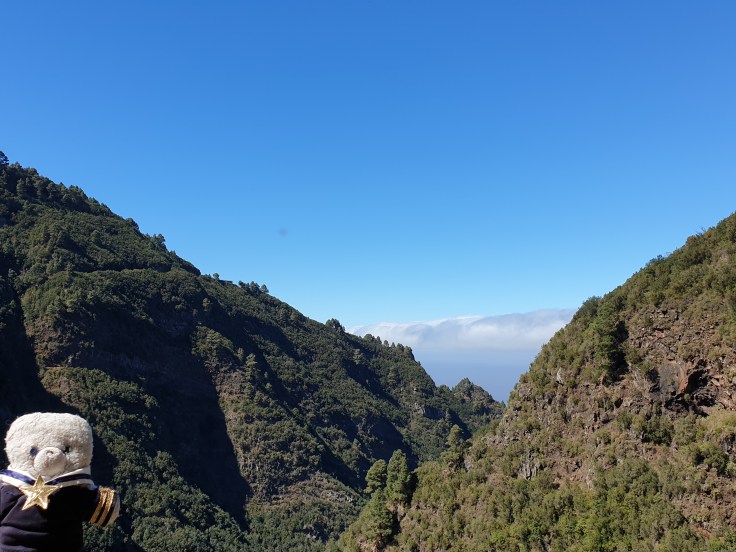
The drive to the cable car station was initially up very steep hills, and then along the plain inside the huge volcano caldera. In the centre of the caldera is the tall cone of the volcano. The cable car takes you nearly to the top, but you have to walk the last 400m.  From the upper cable car station I found the path leading up, but was stopped by a park warden who asked to see my permit and ID.  I duly handed over a print-out of my emailed permit and my driving licence. He looked at both suspiciously – I don’t suppose many teddy bears visit, and it was probably the first driving licence issued from the darkest Peruvian jungle  that he’d ever seen.  But eventually the man uttered a grunt of acceptance and allowed me through.  I was first onto the path and hurried up to get to the top first and have the views to myself.  Mount Teide is 3700m high and people used to think it was the highest mountain in Europe.  Mont Blanc and other peaks in the Alps of course are much higher, but since Teide rises up steeply straight from the sea, it looks enormous and it is understandable that people made this mistake. The air was thin and I was soon panting for breath, but I am used to high altitude from the jungles of Peru and made it to the top a few minutes ahead of the two young human climbers who passed the checkpoint after me.  At the summit the views were amazing, whichever way you looked:
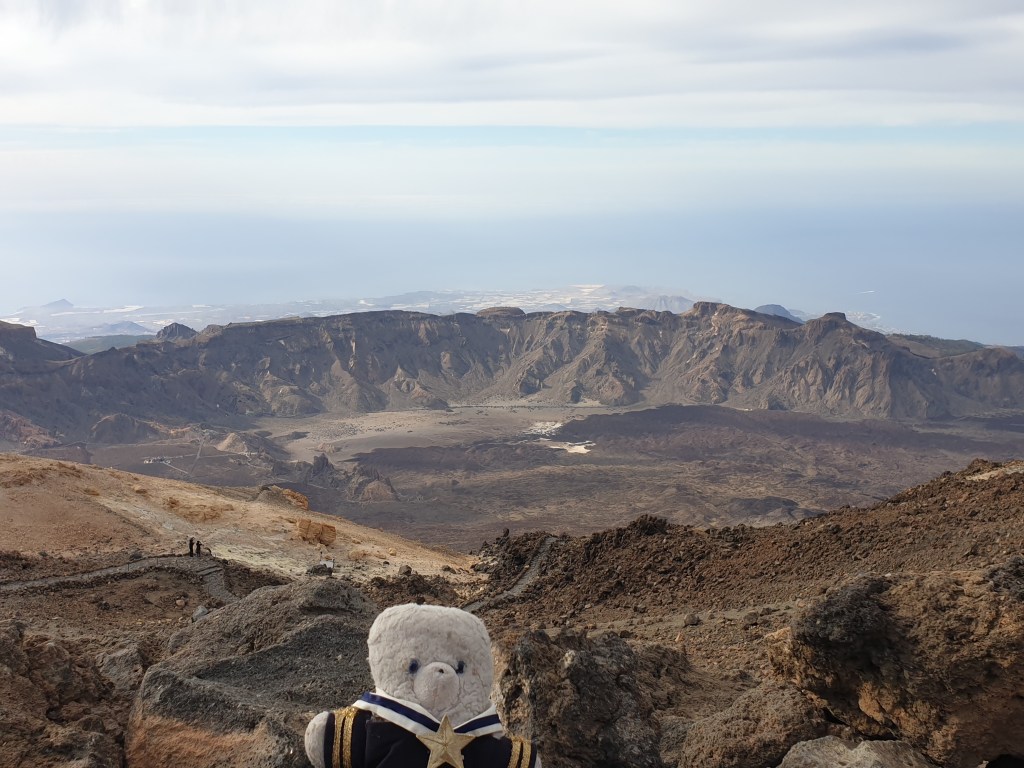
The view to the South
The view to the East

From the very summit I climbed back down to the cable car station. I passed a few other tourists, some serious hikers with proper boots and warm clothing………and some horribly unfit looking people in t-shirts, who were gasping for breath and shivering in the cold (my phone said it was +3C).  From the station I then walked part of a different route that led to the old crater, for a different perspective. 
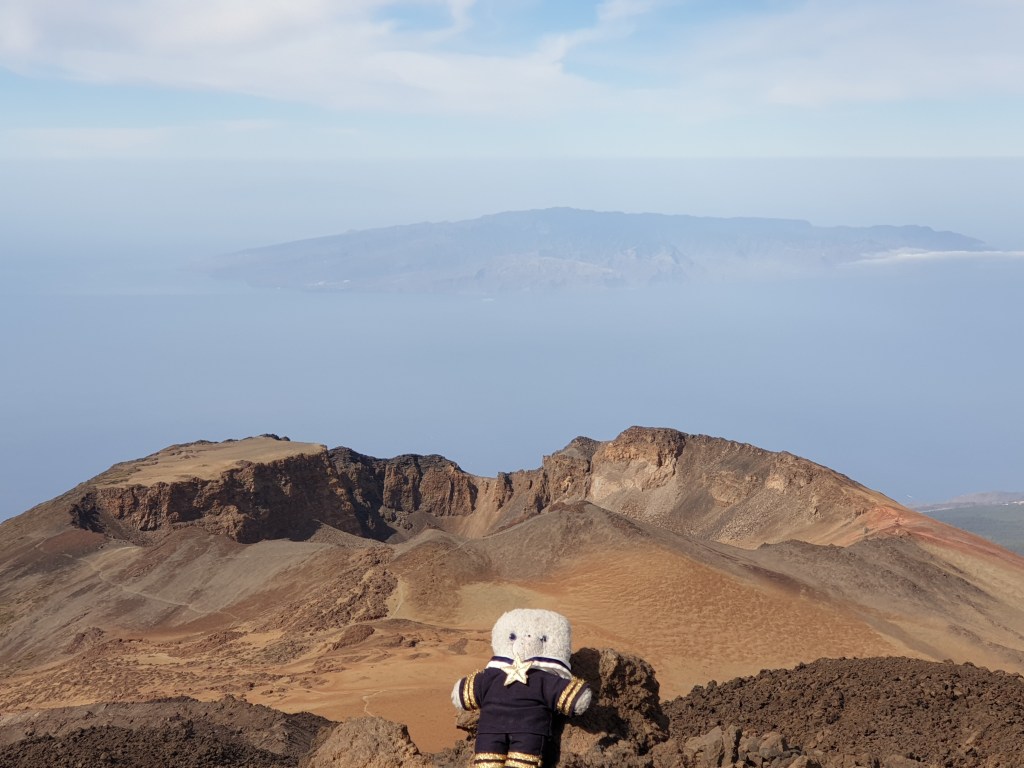
The view to the West and the old crater, La Gomera in the background

The path was initially easy but soon became very rocky. Although it was possible to walk all the way down the volcano and then back along the road to the car, I was cold and the rest of the path looked like a scramble over volcanic boulders – hard for  human, never mind a small teddy. So instead I enjoyed the view and then took the cable car back down.  Back at the base station, the car park, which had been deserted at 9am, was now packed, and there was a big queue to take the cable car up.

I drove a bit further into the Teide caldera to visit a formation of strangely shaped volcanic rocks near the visitors’ centre.  
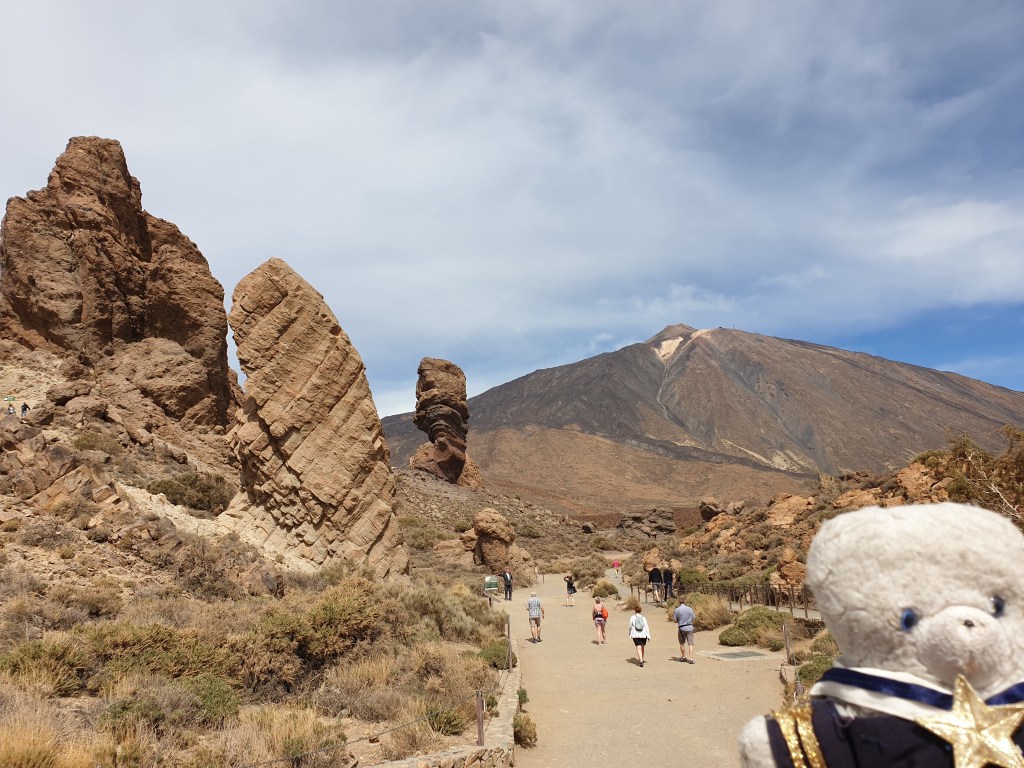
The area was swarming with tourists, and parking was difficult. After a short hike around the rocks I headed back home, admiring the lunar landscapes.   I got back to my hotel in the early afternoon.  I was feeling a bit lazy – the walks were not very long but were steep and at high altitude. So I enjoyed sitting in the hotel’s garden and listening to the happy noise of children playing in the school next door as a I dozed on a sunchair.   That night I had more cheese, ham and wine and was treated to another spectacular sunset.
Tired Teddy – Hiking on La Gomera

Today was hiking day.  I chose Ruta 18, the big circular walk around the Garajonay Park, which started from one of the miradors I had visited the day before.  On my map I judged it was about 6km, so even with some up and down walking I should be done quickly and have time to drive around the island a bit more.

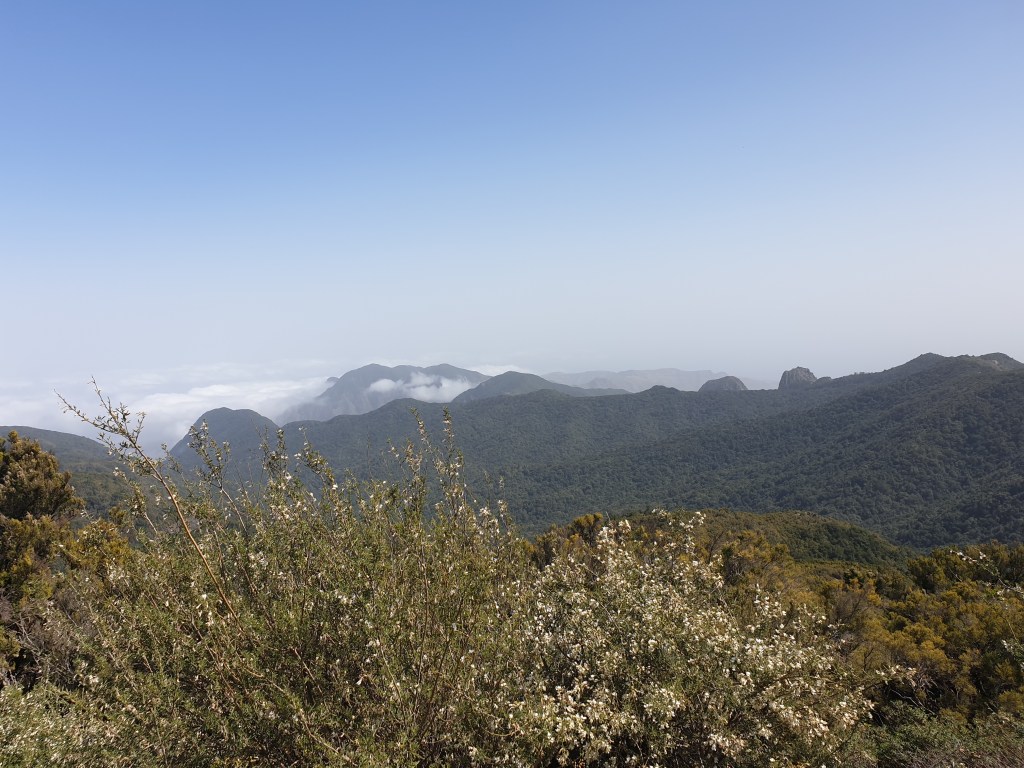
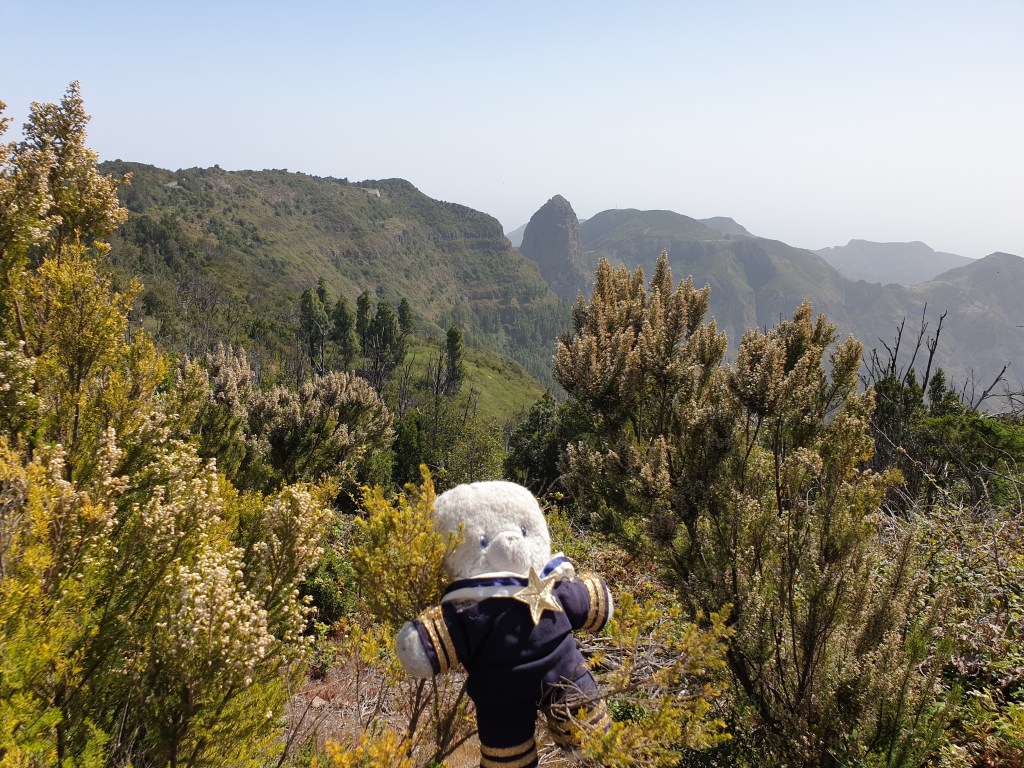
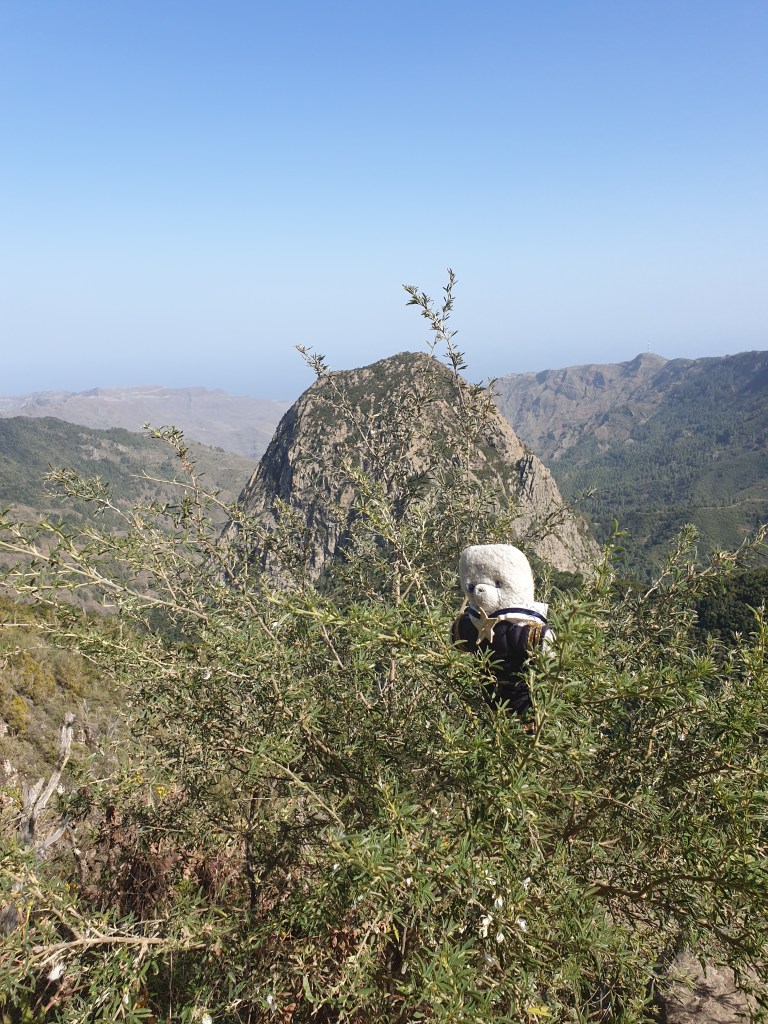
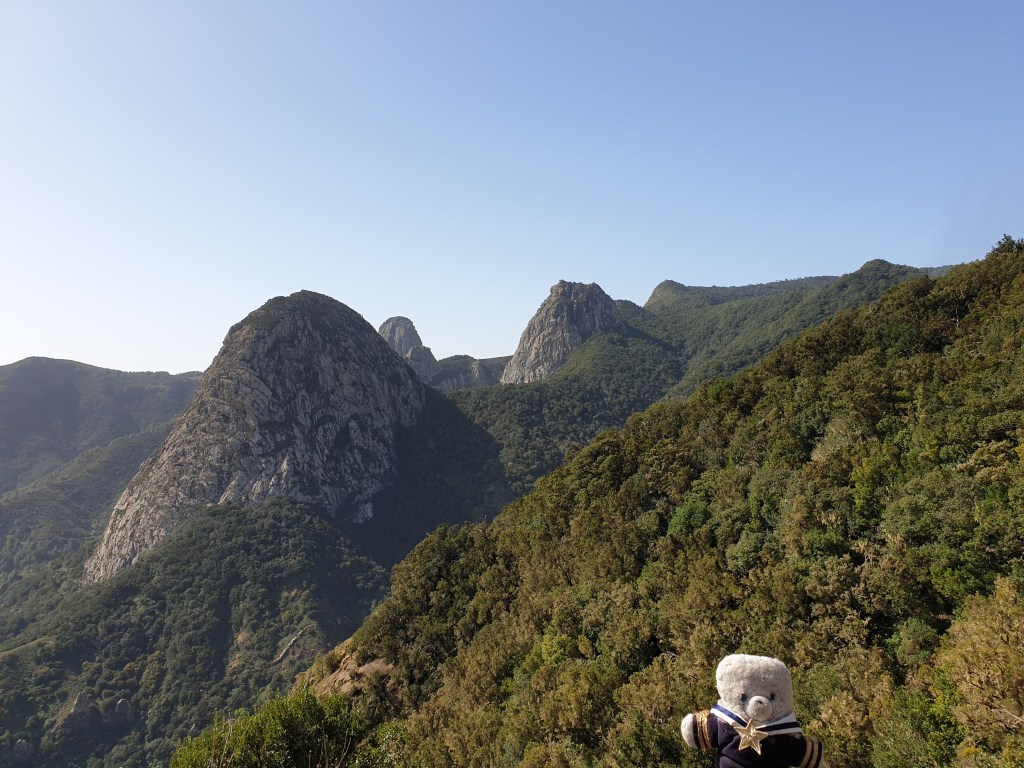
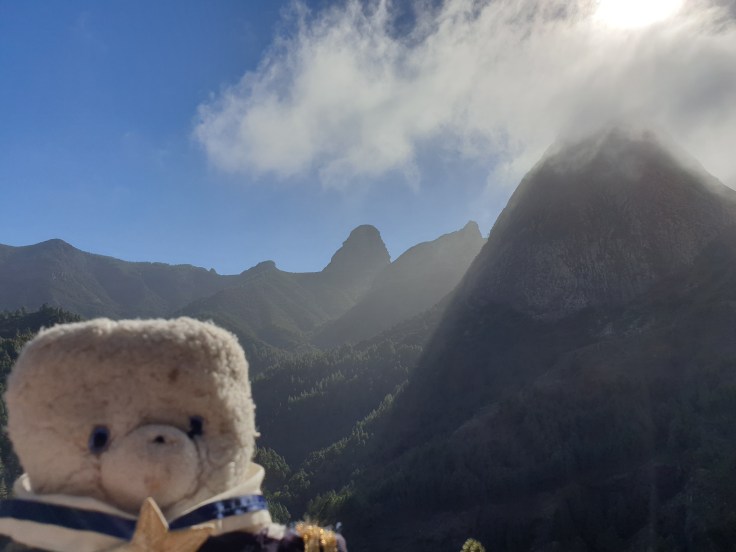
I drove up the valley road again and through the long tunnel into the park.  At the mirador, I found signposts for route 18, but was a bit surprised that they said it was 14km long and should take 7 hours…. The hike started easily enough, along the top of a mountain ridge with fine views of Los Roques in the bright sunlight…..

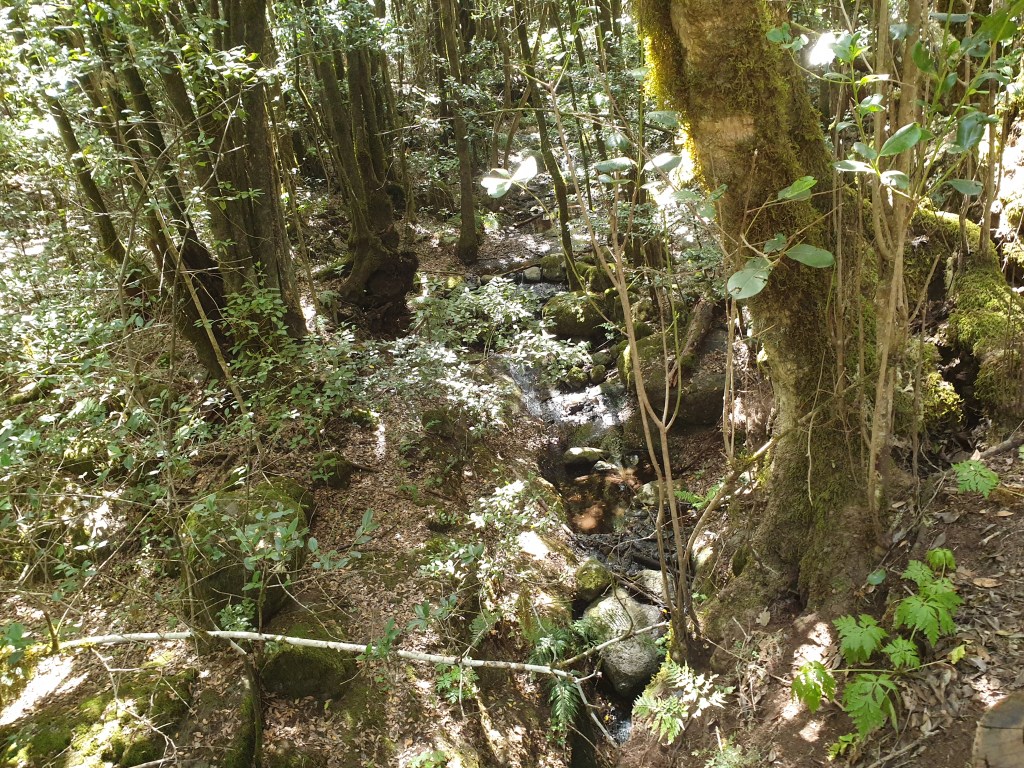
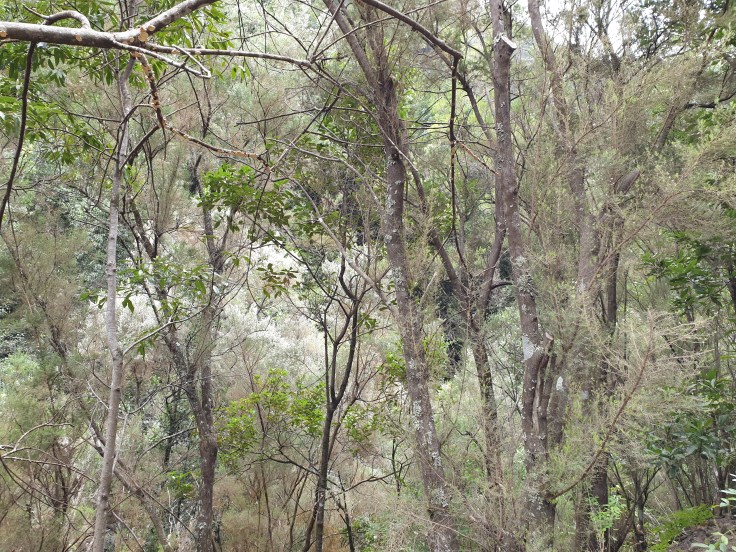
Then the path headed up a steep hill to yet more miradors with views, before diving down into a dense forest.  The cool of the forest was a pleasant change after the heat of the exposed mountain side.

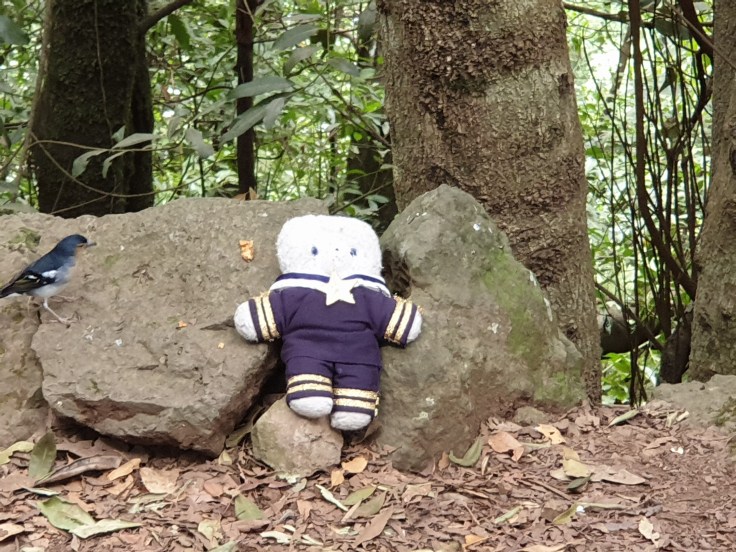
After a while there was a clearing with a tables and picnic area, where I met a little feathered friend. I offered him some biscuit crumbs.

Me with my backpack feeding my friend

Twenty minutes later,  I got to a junction with three different options.  The signs showing the path had disappeared, and I wasn’t sure which way to go.  I picked the path that seemed to be heading in the right direction, towards the main road crossing the island, and walked for about 20 minutes. It was a paved track for cars, and I was encouraged that one or two cars did indeed drive past – surely this was the way to the main road? My phone initially showed I was going the right way, but then the little blob showing my location veered away back into the heart of the national park and away from where I wanted to go. I carried on anyway, hoping the path might change direction, and was very happy when I saw a parking area up ahead. Surely a sign that I was on a main route?   My happiness was short-lived though, when I realised I was back at the picnic area where I’d fed the bird some 40 minutes ago. 

I looked at my “tedimeter” – 10km already, and I was only just over half-way through the walk. I was hot and tired. I carefully studied the maps provided on the signposts in the picnic area, realised my mistake and set off again.  At the confusing junction I took another paved track that led steeply up, and this eventually took me to the main road and finally a sign saying that I was indeed back on route 18.

The path crossed the road and led back into the forest. It went steeply up, but the knowledge that I was back on the right path and only a couple of km from the end gave me a renewed bust of energy.

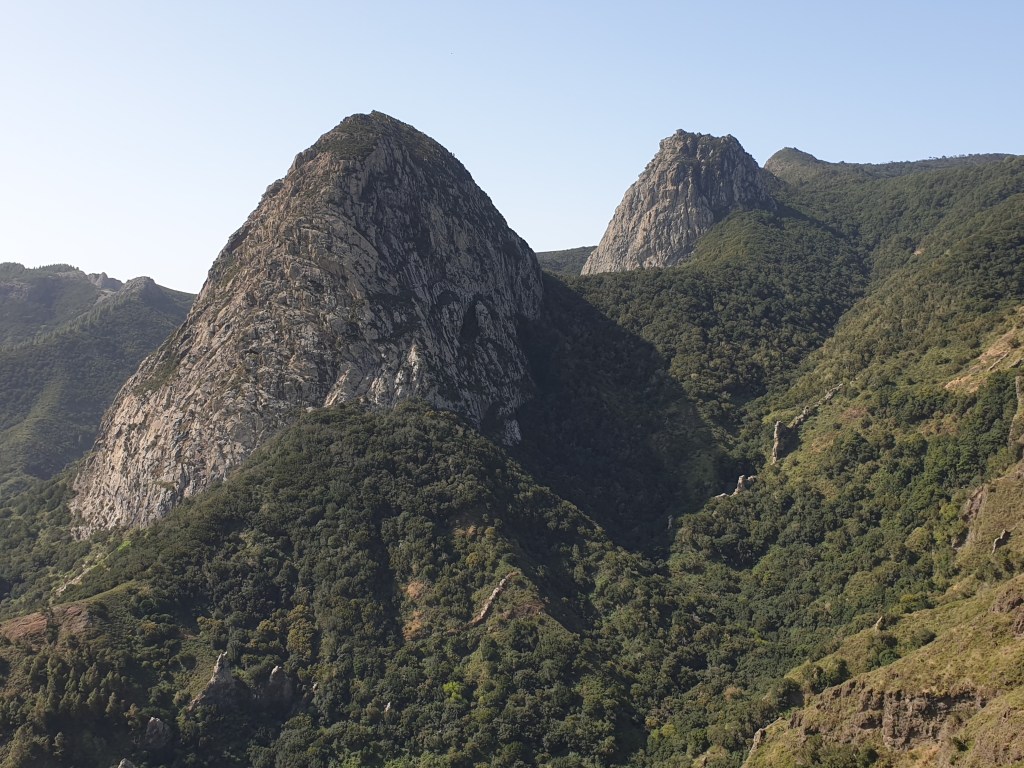
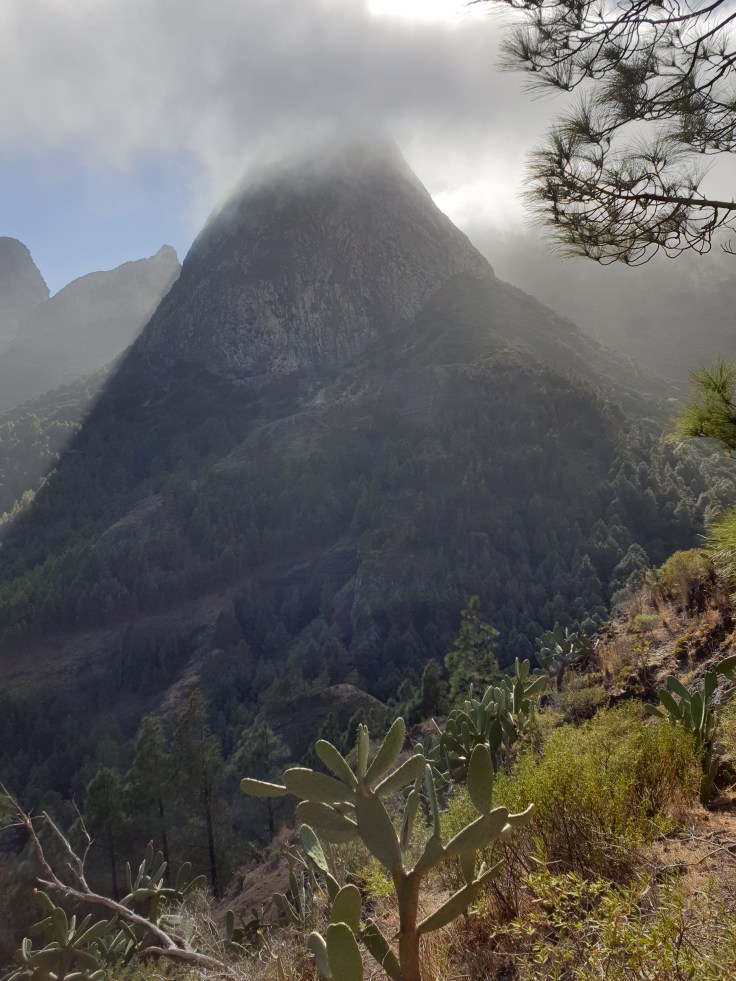
Suddenly the path opened up to the most spectacular view yet of Los Roques, so I sat down for a short break and to finish the last of my water.  

It was a fitting reward for my efforts. Back at the car my “tedimeter” said I had walked 16km – so the signs were right, 14km plus my detour.  The twists and turns and ups and downs had doubled the length compared to what my map seemed to show. It was lot more than I had expected, and I headed home for dinner a rather tired teddy bear.

La Gomera by car

I had two full days to enjoy La Gomera. Today I decided to explore the island by car and to look for good places to  hike on the next day.  The car hire company has said the car was fully insured except for damage to tyres caused by driving over rocks on the road. I soon understood why – the whole island is one steep extinct volcano that has been eroding away into the sea for the past few million years. The most visible sign of this erosion are great sweeping valleys, where rain dropping on the top of the mountains washes down to the sea.  But another sign is the frequent little piles of rock in the road from small landslides.

At first I drove up the mountain on the south side of the island – the landscapes were stark and dry.

Then I crossed through a tunnel to the east side of the island, which receives clouds blown in by the trade winds, which blow from east to west at this latitude – which is why Columbus sailed south to the Canary Islands before setting off for America.  As the clouds rise up the mountain they drop a steady supply of rain, meaning this side of the island is usually wet and supports luxuriant vegetation.  

The road took me to the Bailadero “mirador” (viewing point) which I had been targeting on my walk yesterday.  I was lucky that today there was less wind, meaning the clouds didn’t reach very far up the mountain, and the views of Los Roques were really spectacular.

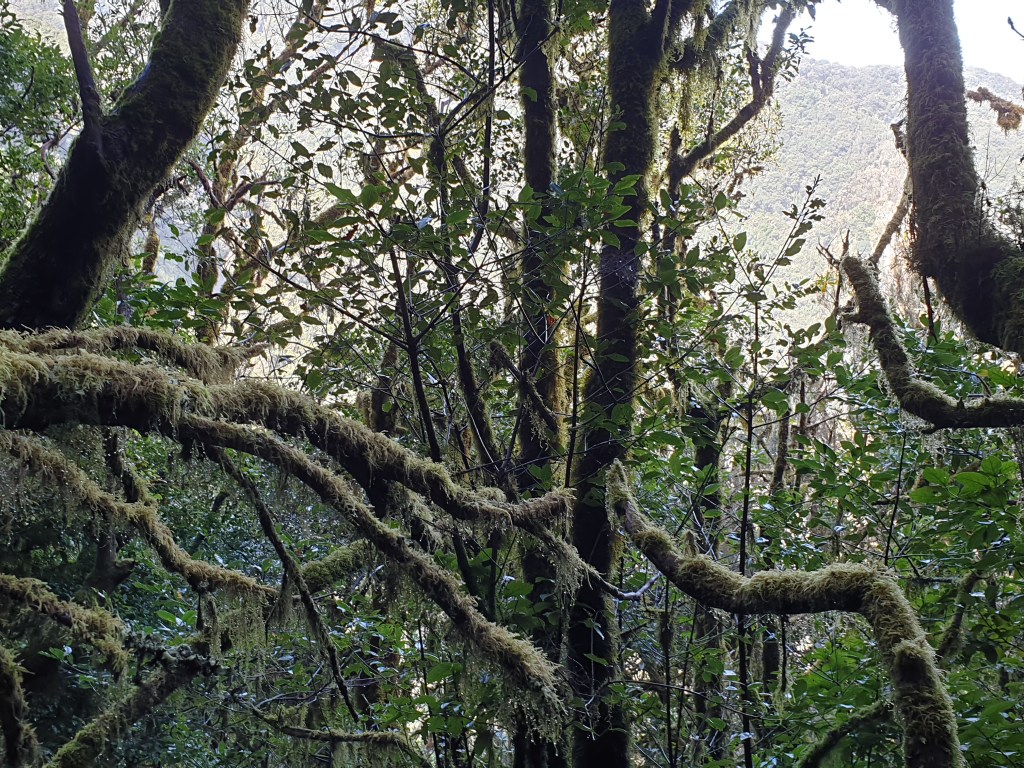
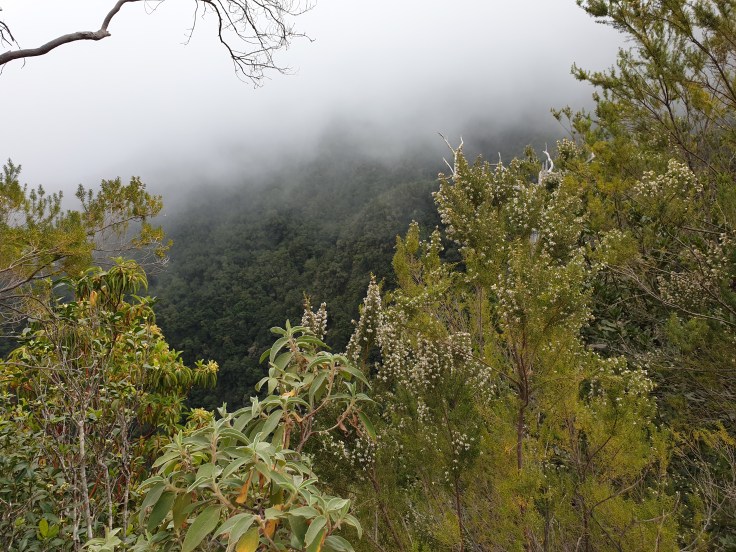
I realised that it was a good decision to turn back on yesterday’s walk, since I was still a long way away from my destination.  From the mirador there was a pretty short walk through an atmospheric forest, whose trees were covered with thick moss and whose leaves and branches were wet with moisture from the clouds. 

After that walk, the road continued up the central ridge right on top of the island.  There I found yet more “miradors” with beautiful views north, south and east.

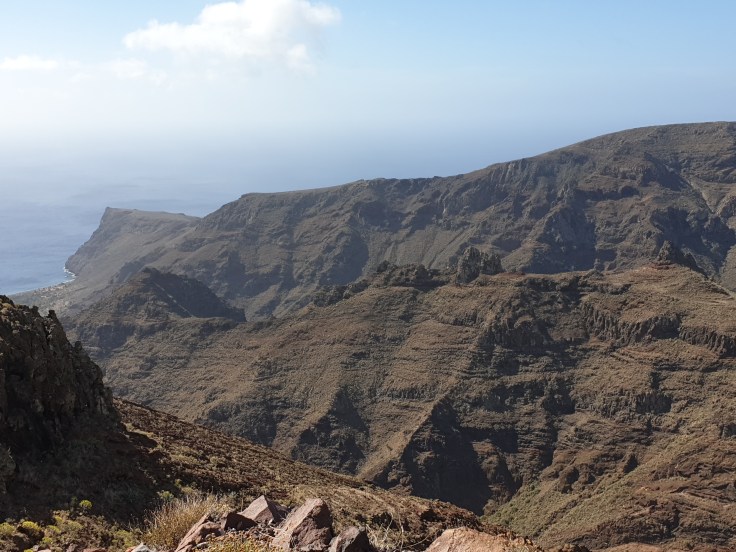
From the mountain ridge I drove to the south west corner of La Gomera, back into a bone-dry, lunar landscape of great eroding valleys.

I drove all the way down to the sea to have lunch at La Gomera’s main resort, Valle Gran Rey.  This was supposed to the richest part of the island, but still looked slightly run down.  Still, I had a nice octopus salad in a café on the seafront and after lunch ventured onto the beach for a paddle. The black sand had absorbed the heat of the sun and was very hot for little paws, so I ran to the sea…….which was very cold.  Maybe my short paddle wasn’t worth getting black sand all over my paws and in my fur, but at least I can say that if have been in the sea!

Next I drove back up to the centre of La Gomera and around the west and north of the island; the road sometimes followed the coast, and sometimes wound deep inland to worm its way around the deep valleys.  La Gomera is very beautiful, and its scenery very varied. Every few kilometres there was another mirador to admire a different island landscape.  

Although the island  is small – it’s roughly a circle with radius 5-6km – with the winding roads and frequent stops to admire the views, driving around it took a whole day and it was late afternoon by the time I got back home.  I settled down on my terrace with a glass of local wine to write my blog, and then had a very good steak from the local market for dinner.

From La Palma to La Gomera

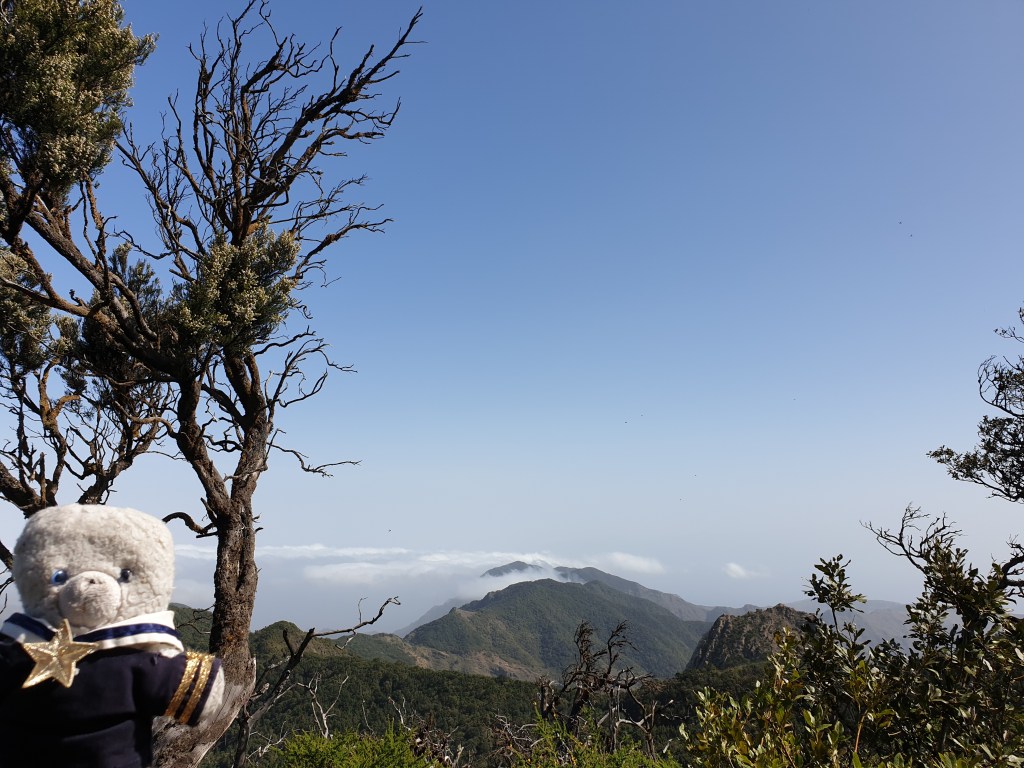
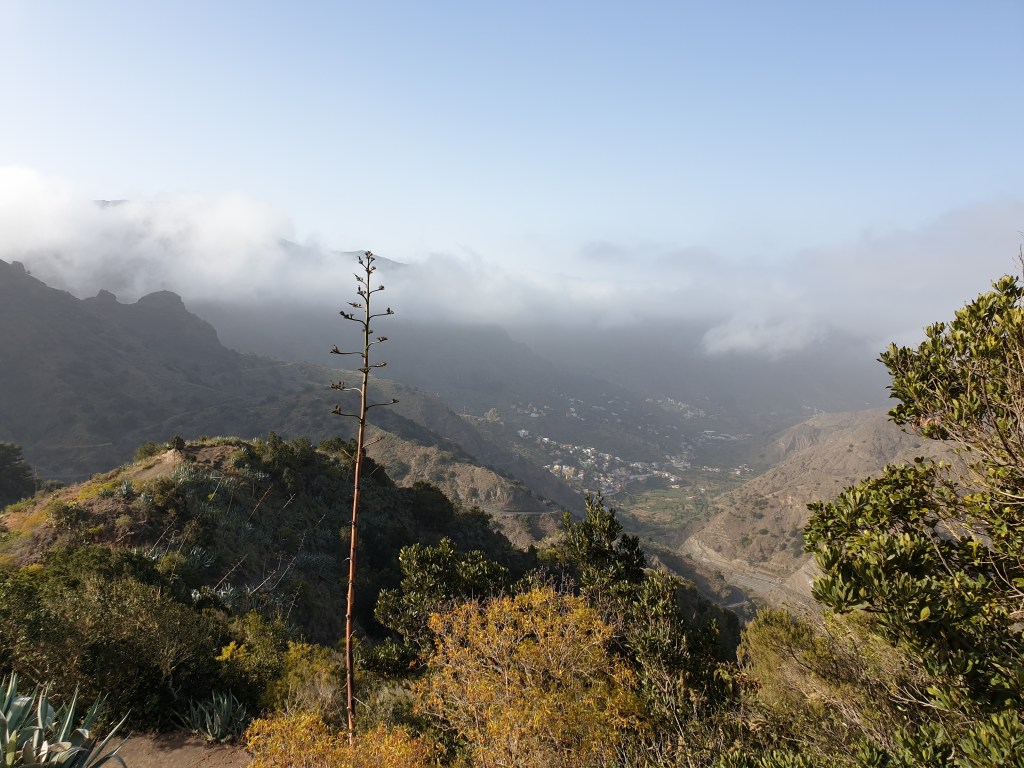
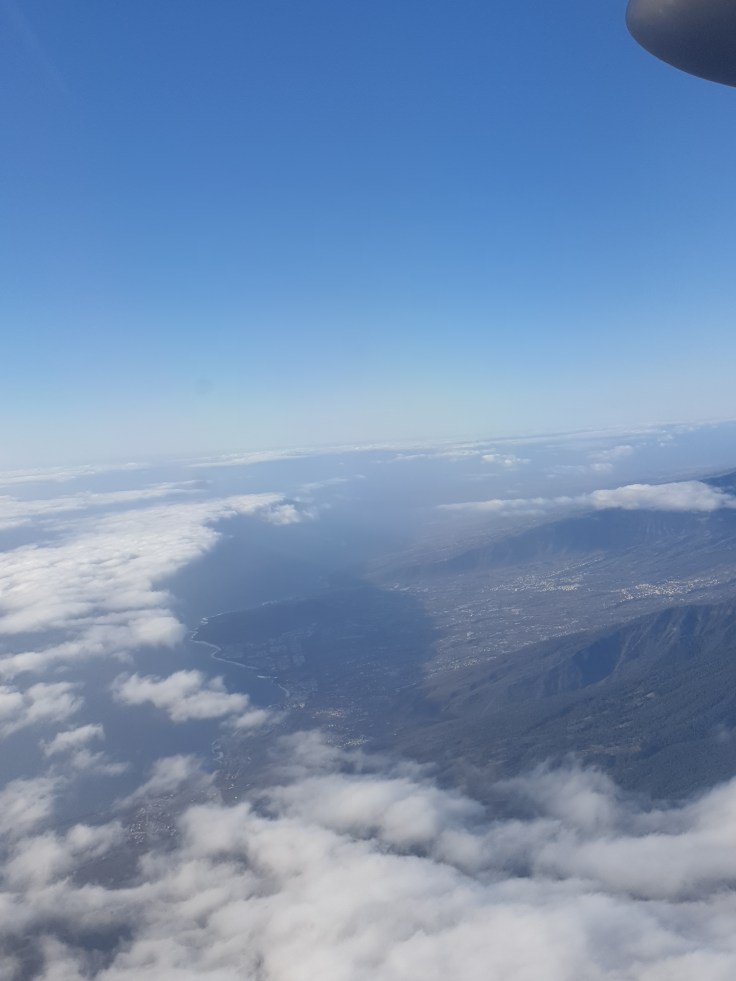
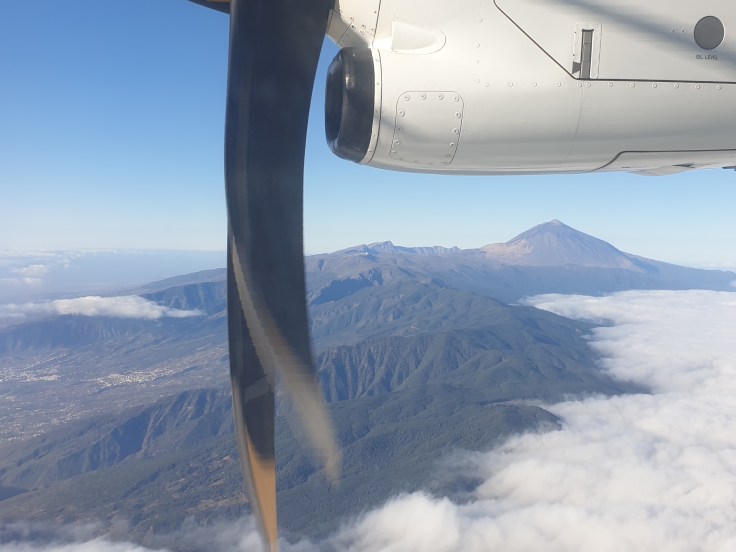
I arrived way too early at the airport – most people seemed to show up 30-40 minutes before their flights and breeze straight through check in and security.  I boarded a small plane with propellers that went to Tenerife,  where I was met on the runway by some nice people that whisked me away in a small car to another small plane for the flight to La Gomera (La Gomera is so small that you can only fly there from Tenerife).  The flights gave great views of the islands, and in particular the volcano Mount Teide towering over Tenerife.  

As we approached La Gomera I admired its rugged landscape and wondering where a plane could possibly land, but eventually behind yet another cliff there was a small patch of flat land that served as the airport.  Within 5 mins of touching down I had picked up my bags, collected my hire car and was on my way to my holiday home. The road wound its way steeply up one mountain and then down another one -all roads in La Gomera are windy and steep. I stopped occasionally to admire the views and take pictures.

Then I made a bigger stop in the main town, San Sebastian, to buy food for three days – my accommodation was out in the country and far from any restaurants or shops.  Unlike charming Santa Cruz on La Palma, San Sebastian was mostly modern and felt rather poor – so far there is very little tourism on La Gomera. I found the market where I stocked up on meat, wine and vegetables at very reasonable prices.

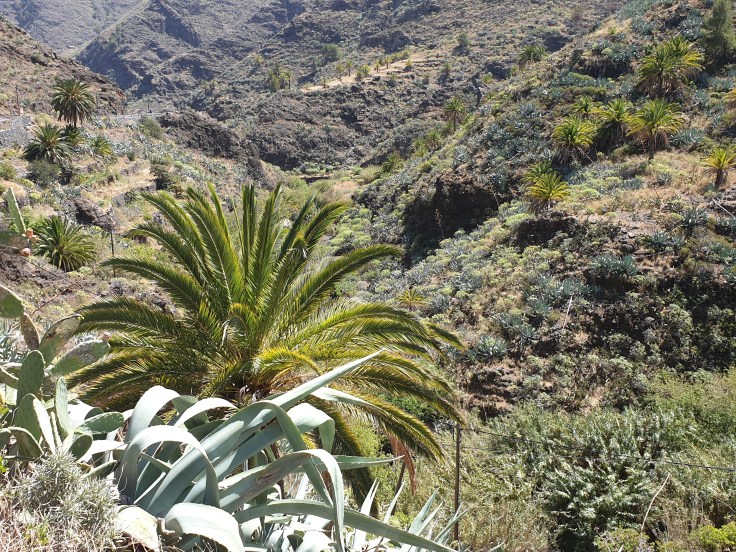
My holiday home was about 15km north of San Sebastian along – yes, that’s right – another windy road.  Initially I missed my destination and drove all the way to the end of the track, where the valley ended and gave way to steep mountains.  I wasn’t annoyed – it was only a small detour, and it allowed me to admire the beautiful scenery – the plant life was even more luxuriant than on La Palma, and you could see Los Roques,  a group of three volcanic rock  formations rising vertically from the surrounding mountains. 

Los Roques are the most famous things on La Gomera and feature in every guidebook and website about the island. I also noticed some interesting paths leading from the end of the road into the Parque Nacional de Garajonay, a large park in the centre of the island famous for its ancient forests and spectacular scenery.

I retraced my steps and found my home for the next three nights. After the wonderful huge town house in Santa Cruz, I was a bit disappointed by my choice this time.  The setting was very pretty, with a little terrace overlooking the valley, but there was just one room that served as both bedroom and kitchenette. It felt a bit cramped, even for a little teddy bear.  So, after unpacking, I returned immediately to the end of the valley to go for a short hike.  There were two paths, one signposted to Parque Nacional and the other to Bailadero, which the sign said was 3.4km away.  I chose the second path. It wasn’t shown on any maps, but Bailadero was, and from there it looked possible to circle round and return to the car via some of the island’s main walking trails. It was 4pm and I might just have time to do the complete circuit.

The path led up a very steep slope. The ascent was unrelenting and apart from the very first signpost, there were no other markings to confirm whether I was going the right way. Occasionally I came across small piles of rocks left by other walkers, which reassured me.  The path led around to the right of los Roques; clouds were blowing over the top of the mountain ridge in front of me and spilling over the top of Roque de Agando, and then evaporating in the drier air of the west of the island.  

I reached a sign saying “Parque Nacional” that marked the boundary of the park.  I had been walking an hour and thought I would easily have covered the 3.4 km to Bailadero, but the map showed that there was still quite a long way to go between the entry to the park and my destination.  The clouds were getting thicker and spilling every deeper into the valley, now completely hiding the Roque de Agando. I realised that if I carried on, I would be walking for a long time in thick mist, and I only had light clothes over my fur. I decided to go back and try again another day.  The trip back was much faster – only 30 minutes – and soon I was back on the terrace of my holiday home enjoying a glass of wine whilst I wrote the day’s blog.

A day of frustration

I woke up feeling lazy. It had been raining during the night, and heavy clouds were rolling in from the sea, so I sat at home enjoying my town house in the morning.  I wrote my blog, and also found time to go to the market, where I bought some parrot fish (something you never see in London) for my dinner.  

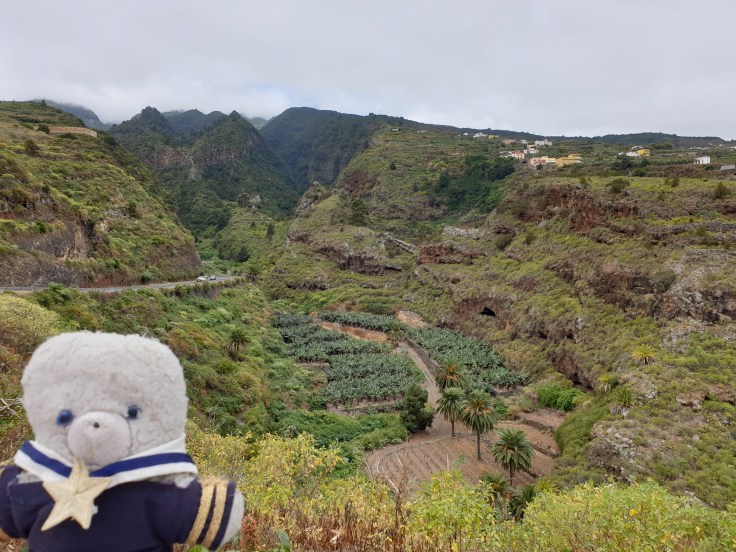
In the afternoon I was feeling a bit more energetic, so I headed out to the Parque Nacional de la Taburiente, which is located inside the caldera of the huge Cumbre Vieja volcano. The road there went through a long tunnel. On the Santa Cruz side, the weather was still cloudy – on the other side of the mountain, there was bright sunshine, and you could see the waves of cloud spilling over the mountain top and then evaporating in the drier air of the centre of the island. 

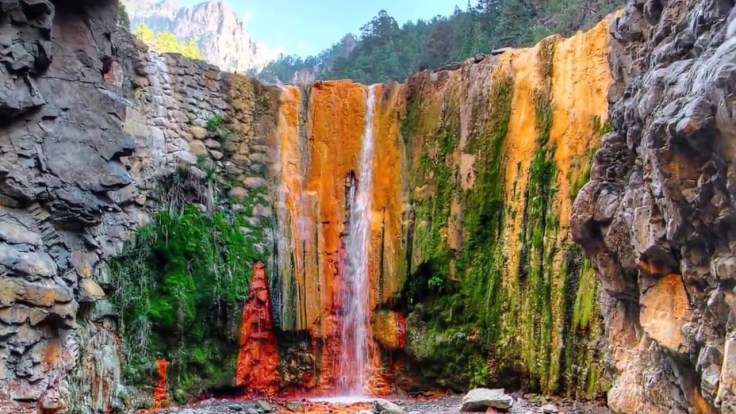
I intended to do a short walk somewhere near the main entrance to the park, but on arrival I was told that I needed a permit to enter by car, and had to go back to the visitors’ centre a few km down the road. At the visitors’ centre they said they had sold out of permits for the day (surely they could have said that at the park entrance…..?).   I looked at my map and decided to try another entrance at the west of the park. I drove through a couple of sleepy small towns and then along a narrow mountain road that initially led steeply up before descending into a dry river valley, where I found a car park.   I noticed a sign indicating a path to the Cascada de los Colores, 5.4km away, and remembered that I’d seen this waterfall mentioned on websites, which said it was one of the highlights of La Palma, and showing pretty pictures of an imposing waterfall falling over bright red and orange rocks.

La cascada de los colores as shown on the internet

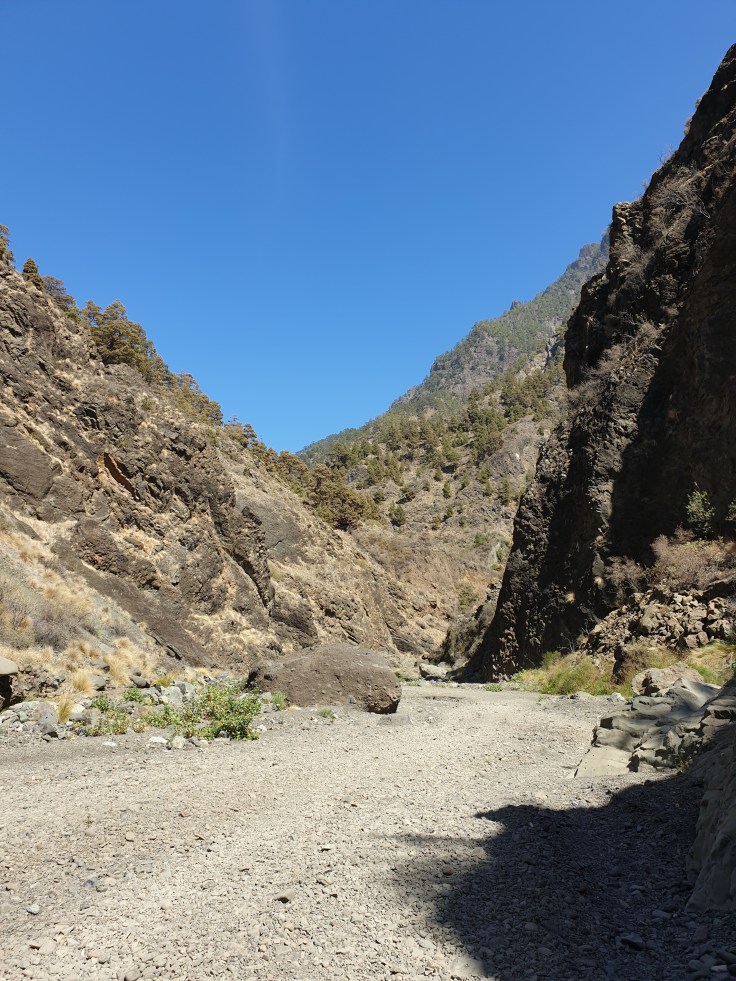
I also remembered people posting that you shouldn’t follow the path but should scramble up the riverbed instead.  So off I set, thinking that 5km should take about an hour’s walking.   Initially the riverbed was totally dry, but after a short while there was a small stream that I needed to jump across occasionally. The gorge was quite deep, so the stream must have been much bigger in the rainy season.

 There were quite a few other walkers, all coming back (it was already 3pm). I checked with one group that I was on the right path and continued onwards. After an hour’s walking I checked again – “Yes, just carry on along the river” “How much further?” “About an hour”. An hour! But this was only supposed to be 5-6km!  I was a little discouraged and thought about turning back because it was already quite late, but instead pressed on and after another 40 minutes, found a sign saying “Cascada de los Colores – 500m”.  In anticipation I hurried around the next bend in the river…….to be very disappointed. 

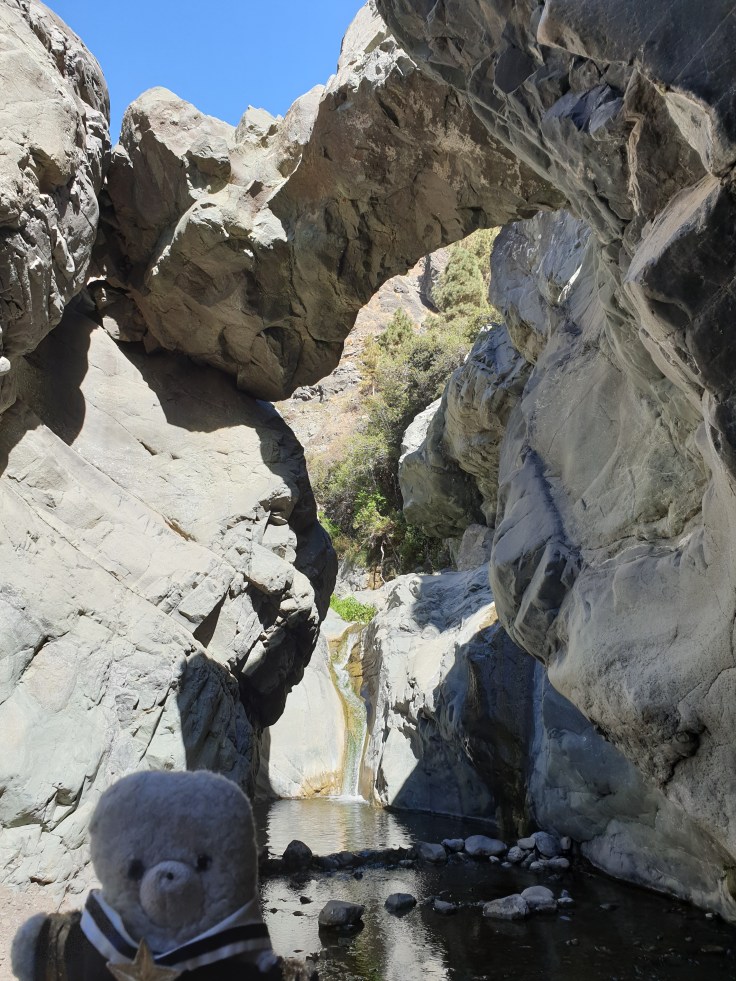
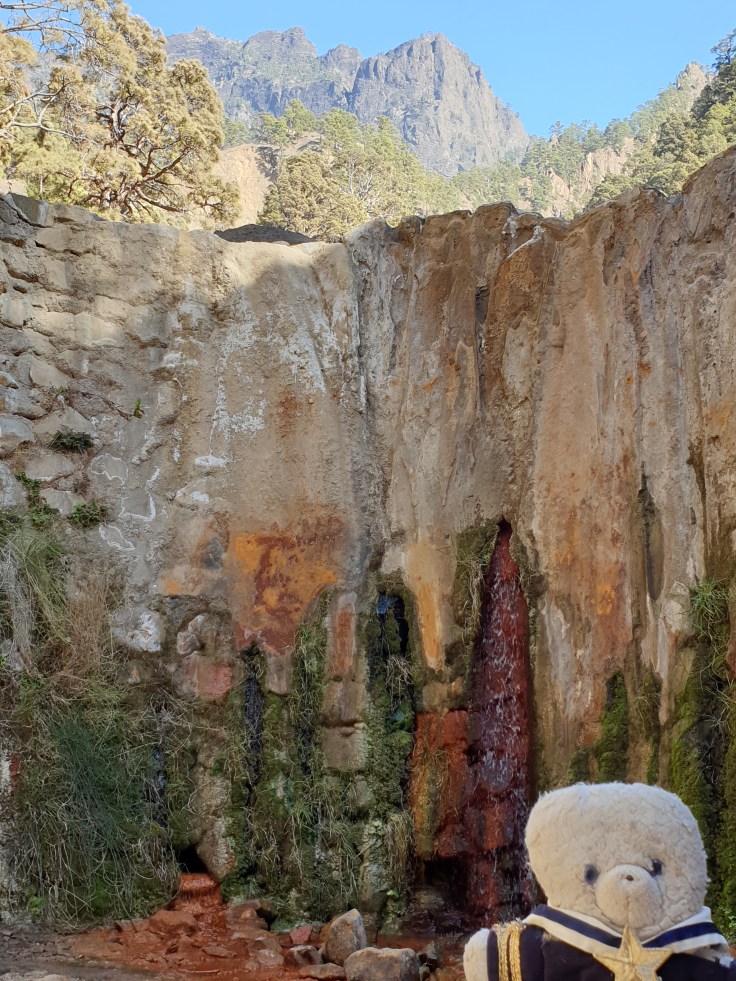
Cascada de los colores in real life

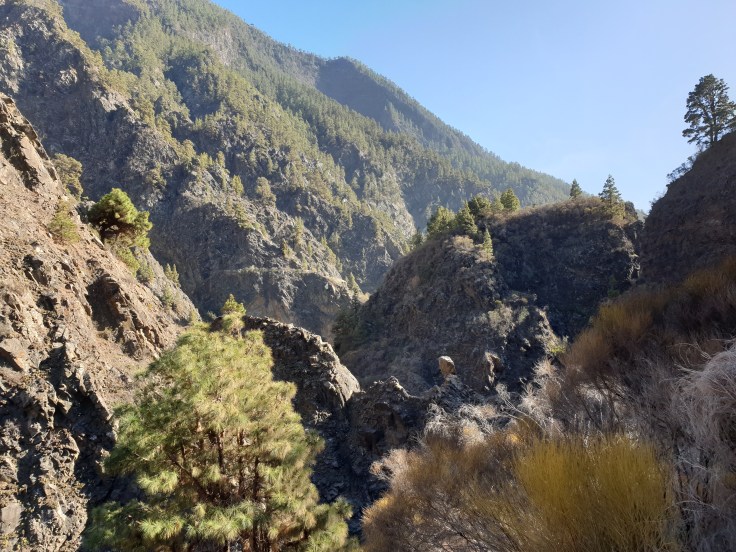
The waterfall was indeed pretty, and coloured red and orange, but it was only about 3m high. The pictures on the internet made it look big, but in real life it was dwarfed by the impressive scenery all around it.  Feeling rather short-changed, I headed back.  It was already 5pm and I was in a hurry to get home. I decided to follow the path along the side of the gorge this time, which was a good decision.  It was much easier walking on the hard rock of the path than the soft shingle of the riverbed, and the views were much better. I enjoyed the walk back much more and admired the shadows of the mountains falling across the gorge in the late afternoon sun.

I got back to my car in only an hour and drove home. At dinner, my parrot fish had an interesting and rather strong meaty taste – good to try once, but not something to buy again. I also tried another bottle of very good local wine.

 I reflected that today had not been the highlight of the holiday so far, but a nice walk all the same, giving a different perspective of la Palma.  Then it was time to pack up my bags (not so easy since my stuff had spread out through all the many rooms of my huge town house) in preparation for the flight to my next destination, the small island of  La Gomera.  In anticipation of an early start the next day, I set my alarm and settled down in bed.

Big adventure for little teddy bear

Today I planned a big tour around the island by car. To prepare for a long day, I started with my traditional café cortado in the café next door, then went to the local market to buy some fresh sea bass for dinner.  After that, I was ready, and I set off north around the coast.  It was cloudy, but the views from the road were still impressive.

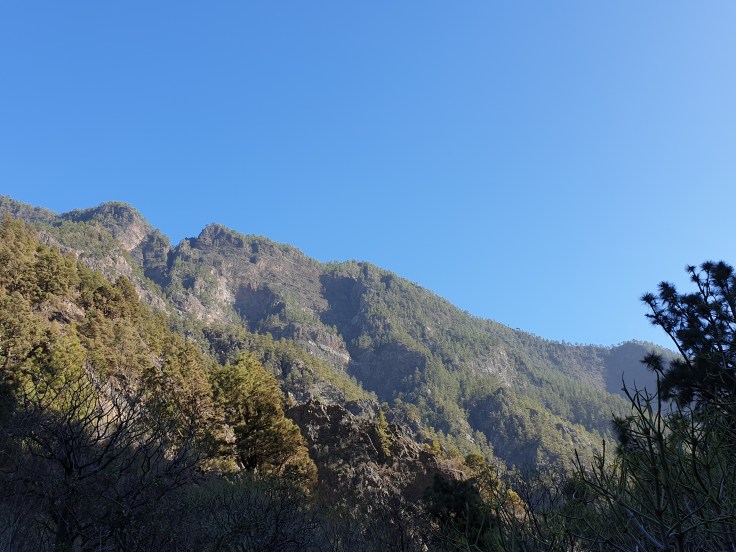
My first stop was Los Tilos, an ancient forest of laurel trees on the East coast. This type of forest was very common throughout the Mediterranean millions of years ago but now is restricted to a few spots in the Canary Islands. I headed up a steep path, pausing to admire the dense vegetation. A fine drizzle from the clouds sweeping in from the West kept the path fresh and cool.  On the way I paused to make friends with some pretty local birds and to give them a little food.  They seemed to be very comfortable with tourists, even teddy bears, and walked right up to me.

At the end of the path was a viewing platform that looked out over steep canyons. The sun had finally come out and lit up pretty flowers of many different colours, whilst a thick mist rolled in from the sea and evaporated before my eyes. After admiring and filming the view I headed back to the car – in total it was a 2-hour walk, the sort of light exercise I needed after yesterday’s heroic treck.

Next, I explored the north of La Palma by car.  I took a wrong turn somewhere, but the minor road I took was going in the right direction and was probably prettier than the main road that I occasionally glimpsed far below. 

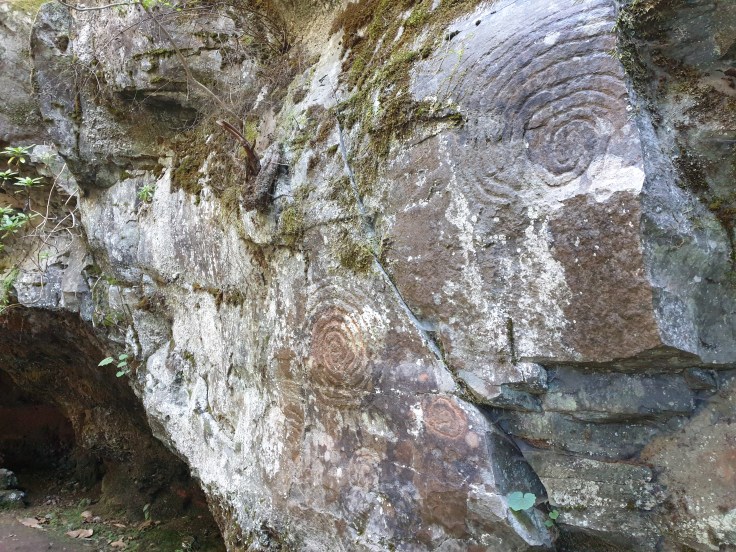
I missed the town of Barlovento completely (oh dear, missed an old church, never mind) and found myself at Zarza, and old archaeological site with ancient rock carvings.  Since I was there, I decided to visit; the carvings were simple spiral shapes in the rocks lining a river valley. It is the sort of thing archaeologists get excited about, but personally I don’t see a big difference between ancient rock carvings and modern graffiti.

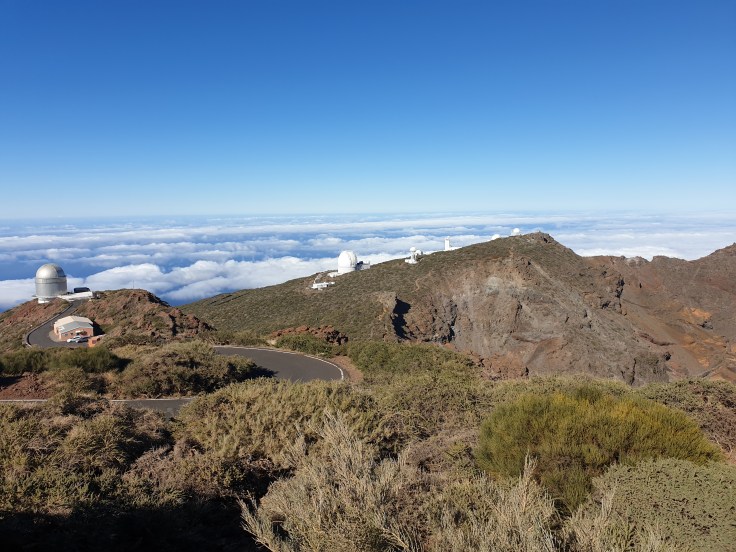
Still, it was a pretty site and nice walk. In the visitor’s centre there was an interesting relief map of the island, which helped me understand just how tall the central volcano, Cumbre Vieja, was. This inspired me to continue the road up, clinging to the side of the mountain.  Below me impressive views opened of the sea and some of the coastal towns, but the road kept climbing. Finally, I arrived at the entrance to a complex of huge telescopes – at this altitude the sky is very clear and there is no light pollution, so it is a great place for an observatory.

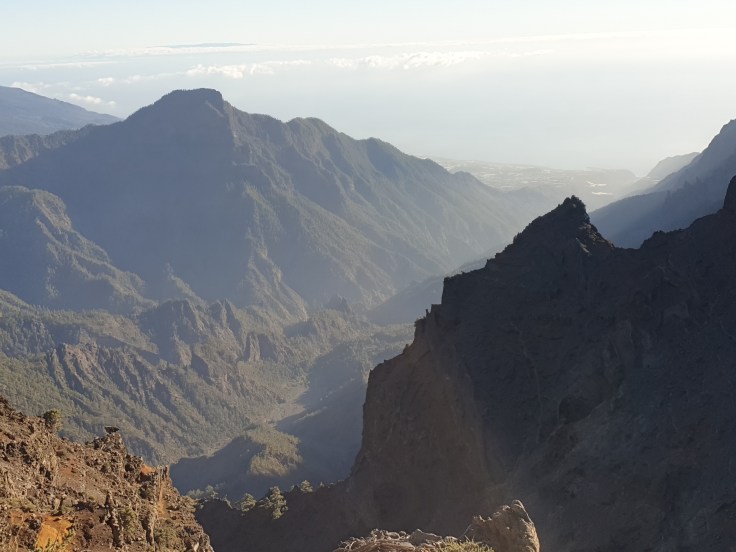
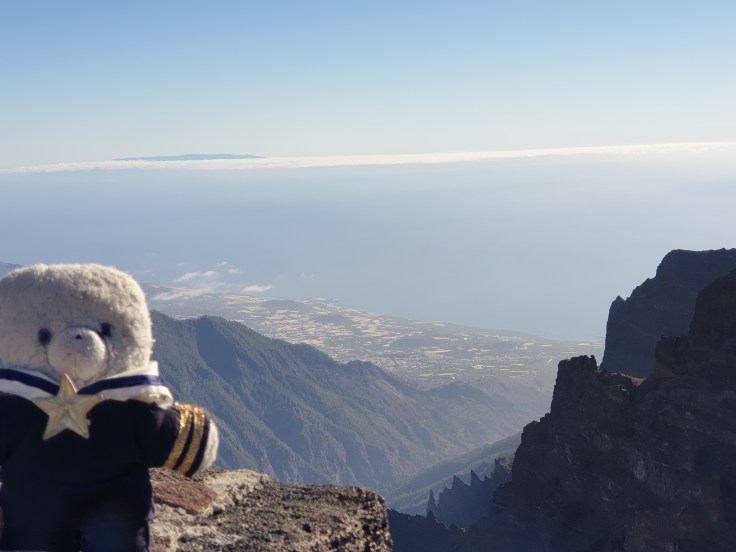
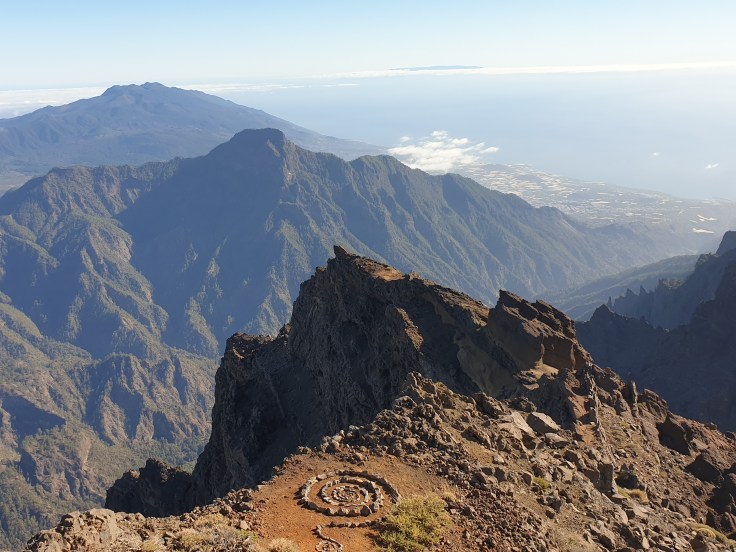
The road carried on past several large telescopes to a car park on the very top of the volcano.  Leaving the car and walking up to the edge of the cliff, I was struck by the most amazing view.  The ancient volcano was enormous, and its caldera spread for many kilometres in a huge circle. It must have been formed by an immense explosion.  The sides were so sheer and deep that it made my head spin to look down.  

A short path continued around the ridge of the caldera, where I met more feathered friends – two magnificent ravens. They were so big I didn’t dare to get too close! 

There were yet more viewing platforms, each giving a slightly different perspective of the caldera – either south down the length of the island and across the crater, or west and north towards the sea. Although I am a very well-travelled teddy bear, this view was one of the most stunning I’d ever seen – the stark volcanic rock and bright white telescopes dotted along the ridge gave the feeling of being on a different planet. Cumbre Vieja is dormant now, but not extinct. Small earthquakes occur often, and scientists think that some time in the next 10,000 years the volcano will explode again. When it does, the massive volcano walls will collapse into the sea and cause a tsunami that could submerge the east coast of the USA and south coast of Britain.
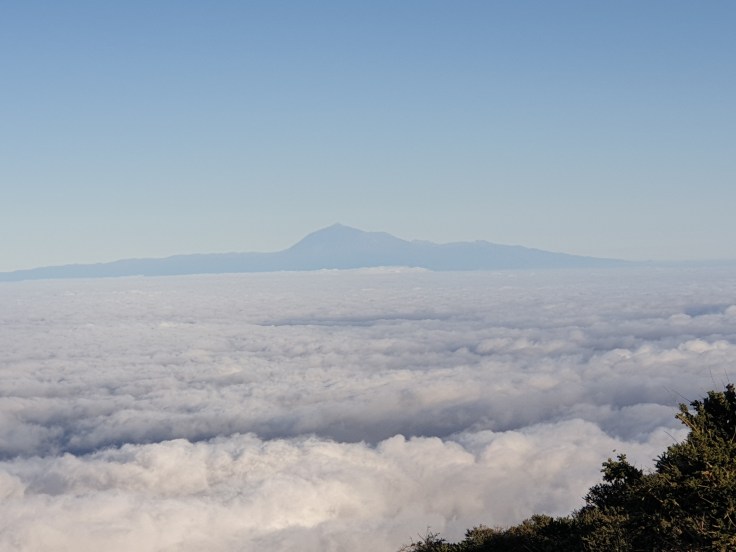
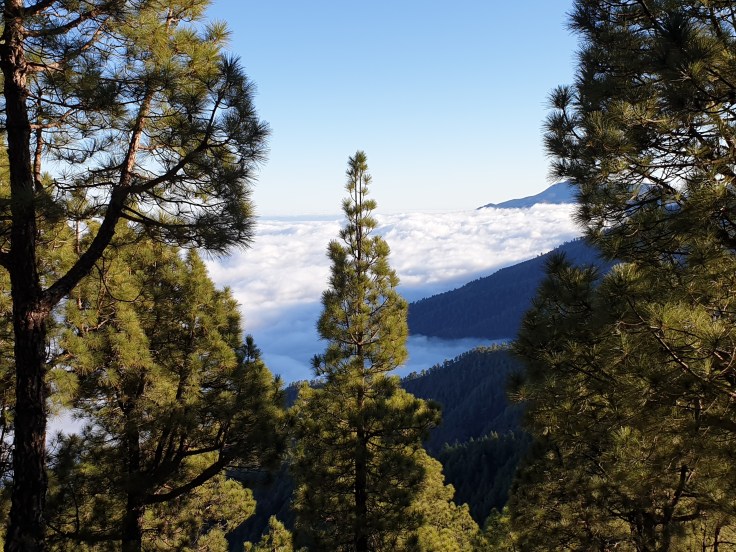
 I admired the view for a long time, but it was getting late and reluctantly I set off on the drive home. There was a direct (but very steep!) walking route all the way back to Santa Cruz that was only 20km, but the road twisted and turned and was much longer than that.  However, I was rewarded by more spectacular views – firstly of the sea, and Mount Teide on Tenerife looking up out of the clouds……..

And then of the clouds blowing in from the sea and being swallowed by a thick pine forest.

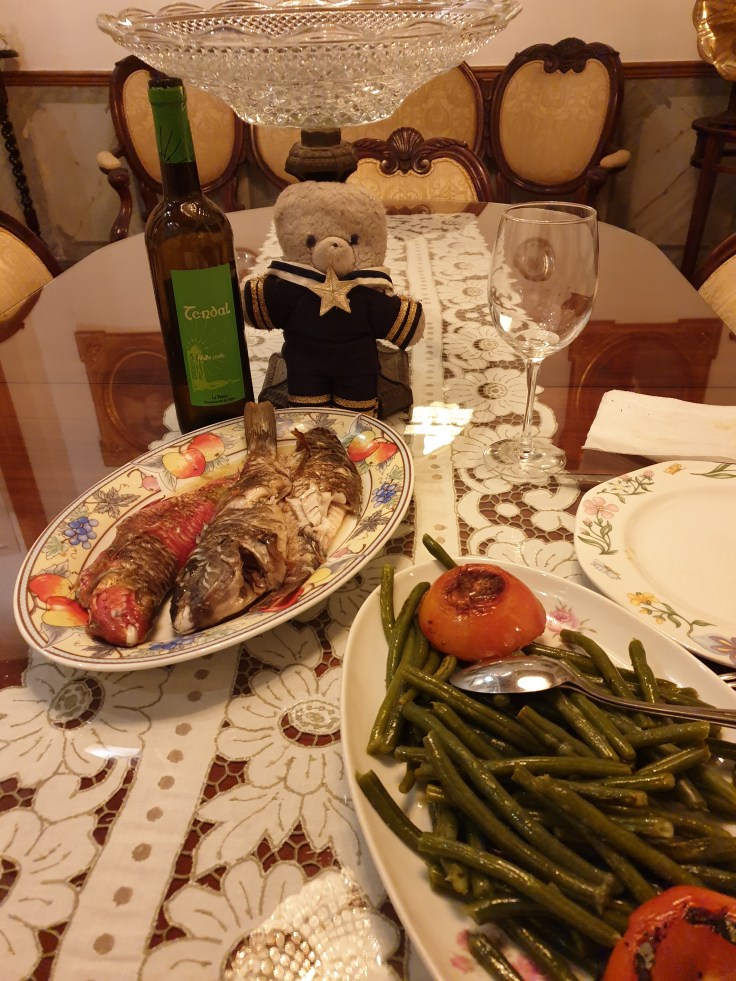
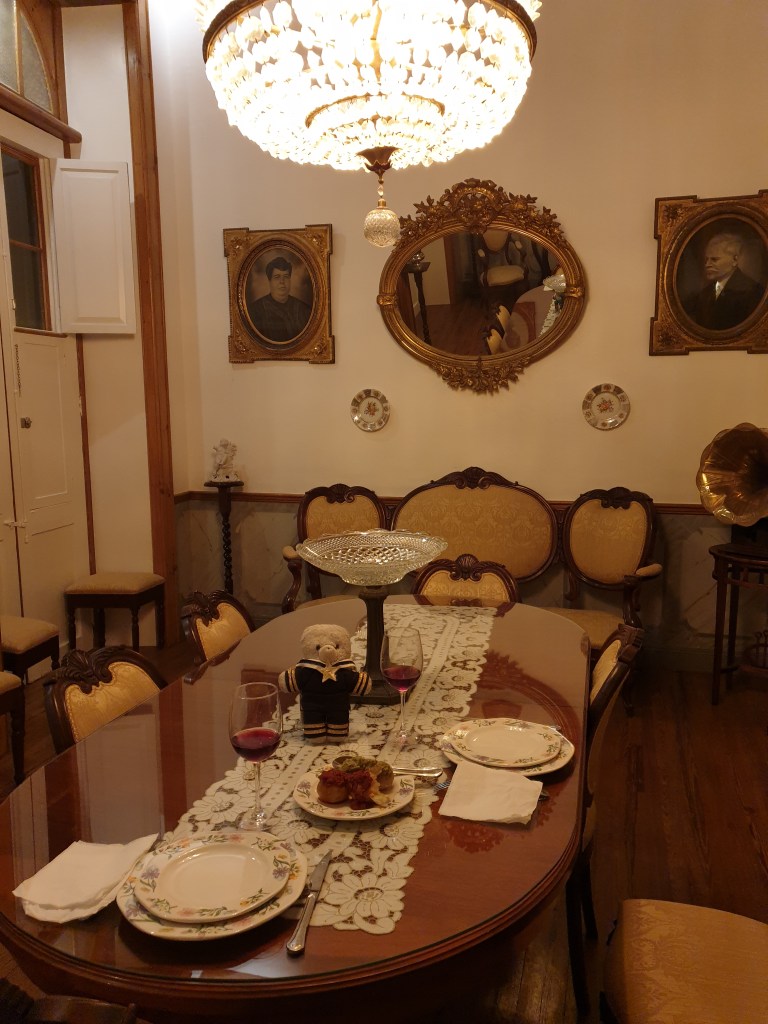
I finally got home at around 7pm after a very long and fulfilling day.  I deserved my meal of roasted sea bass washed down with a very good local white wine, in the period setting of my townhouse’s dining room!

A hike for sporty teddy bears only

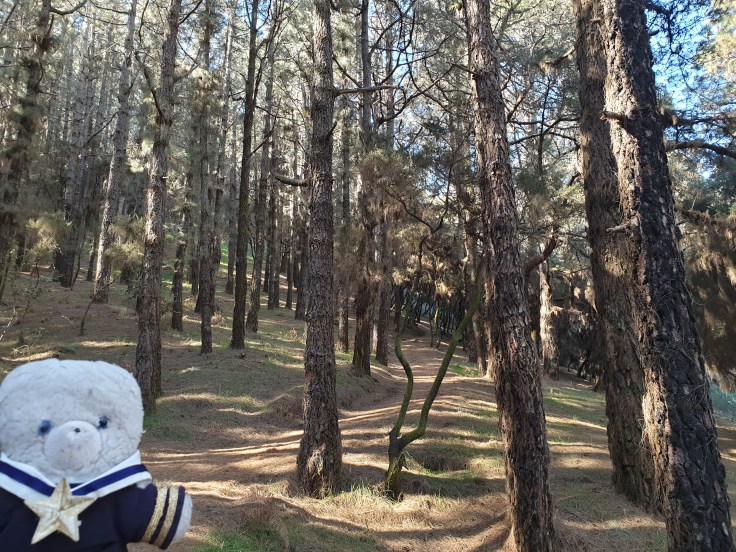
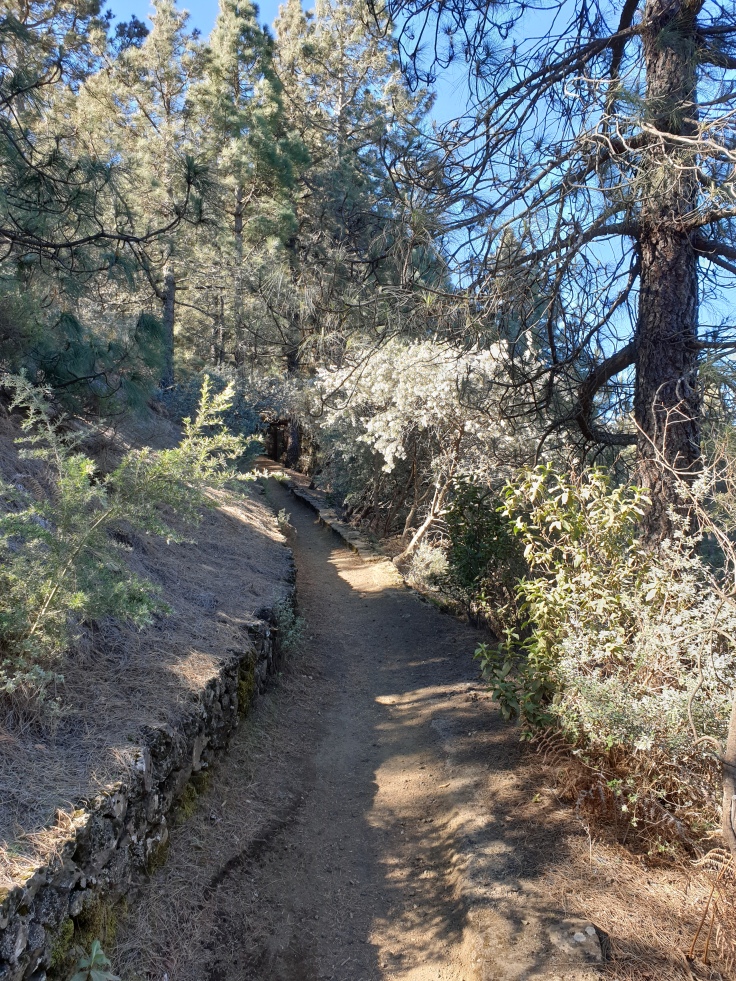
The next day I  offered myself a really nice café cortado (an expresso with a dash of milk) in the café next door, and then took at taxi to El Pilar, a place in the middle of the island that is the starting point for many walks.  I was intent on doing the famous hike “La Ruta de los Volcanes”, an 18km walk up and down a few of the smaller extinct volcanos that make up the backbone of the southern part of the island.  First the path ran through a pretty forest, where the smell of white flowers mixed with a heady scent of pine,

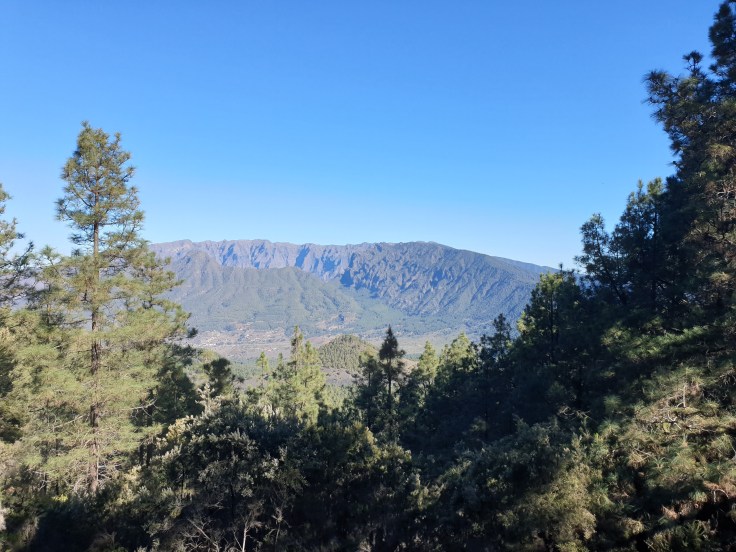
 with views to the north to the huge volcano Cumbre Vieja that makes up the bulk of the island.

Cumbre Vieja volcano – more about this tomorrow

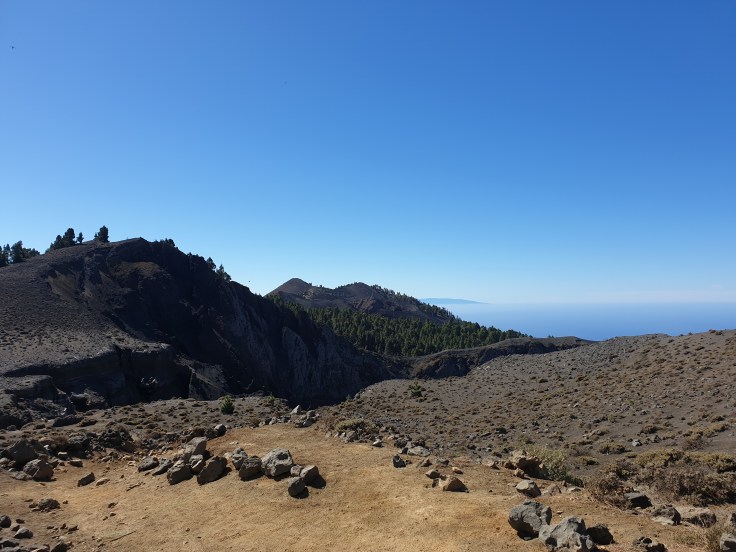
After a while the path left the shade and headed up in bright sunshine through a typically volcanic landscape –sharp red and black rocks covered in black sand, with a few small trees struggling to recolonise the land.

The terrain was striking and very austere, with the contrasts of bright blue sky, green trees and red rocks and black sand.

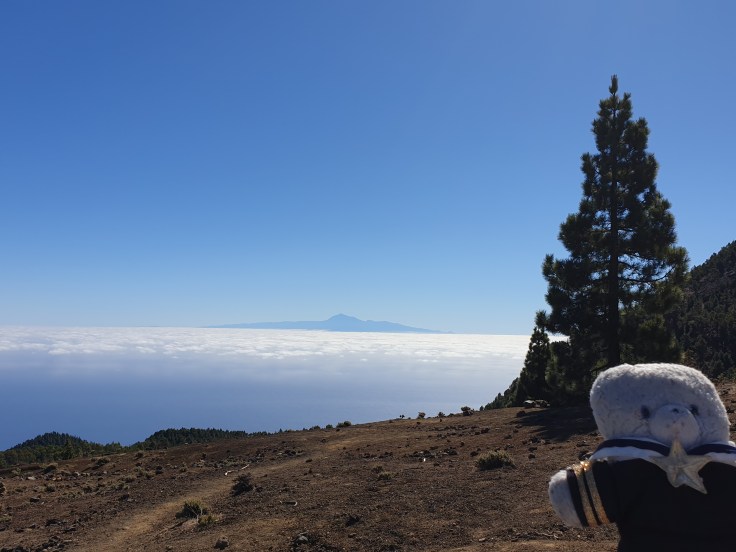
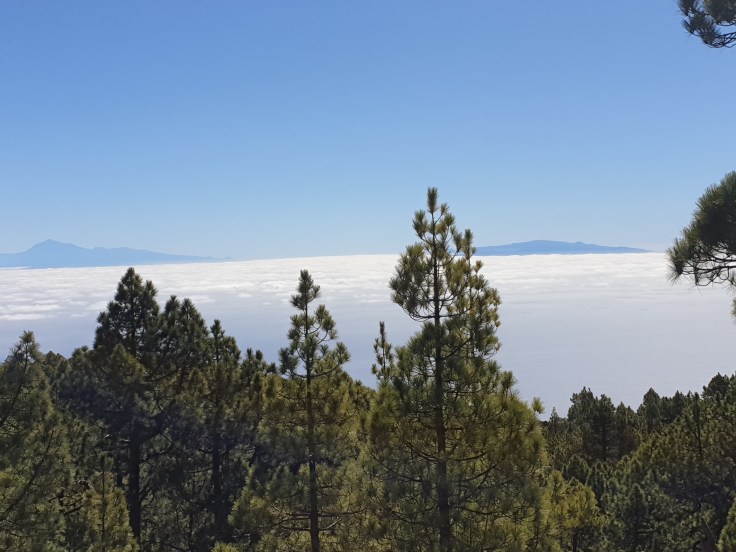
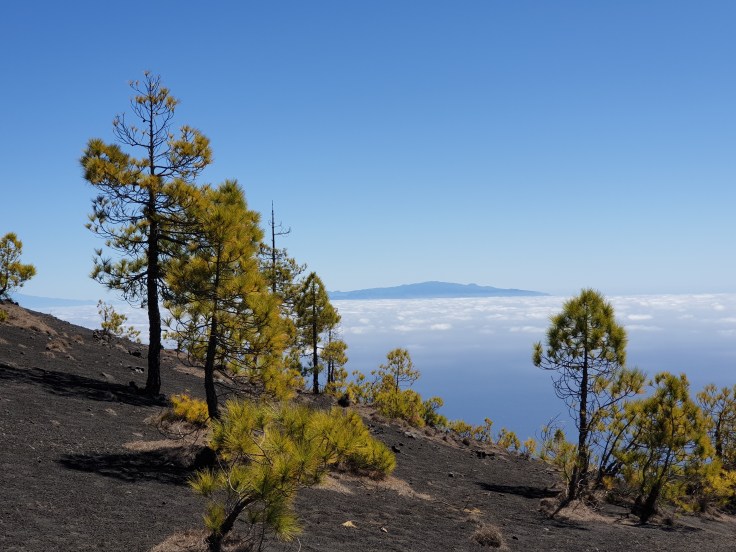
 It was hot, and after a few km I was wondering if the walk would provide a bit of variety to this imposing, but stark, landscape.  When I reached the top of the first volcano, I got my reward – a view of the east coast of La Palma.  A short way out of from the land, the sea was covered with dense, bright white fluffy clouds.  In the distance, looking as if they were floating on this cloud bank, rose two other islands – little La Gomera and larger Tenerife with its mighty volcano Teide towering over the clouds.

The path continued up and (mostly) down like this for another 10km, offering slightly different perspectives of the same impressive view along the way.

 Then it dived into a pine forest for the last few km down to the southern tip of La Palma, before arriving at Fuentecalientes, a small town on the main road running around La Palma’s coast.  I was hot and thirsty, so found a small local bar and drank two Schweppes Limon before taking a local bus back to Santa Cruz.  Walking back to the hotel from the bus station I treated myself to a huge ice cream in a cone, which started dripping down my paws in the heat of the late afternoon. 

Back home, I had a much-needed shower and short siesta.  Then I headed off for an aperitif at an outdoor café and dinner in a restaurant I’d spotted the day before. It was located in an old town house, and its walls were made with beautiful wood panelling.  In a room next door, but clearly visible and audible through big glass windows, a choir of local men with lutes, guitars and drums were practising for a concert.  

They sang beautifully and added a great atmosphere to my meal.  I ordered local seafood – cod, octopus and shrimps. Maybe due to language difficulties my main courses arrived first and my starters last – but who cares, they were all tasty. I washed down my food with some local wine. The Canary Islands have some unique grape varieties, not found anywhere else in the world, and their wine is very interesting (in the positive sense of the word).  After dinner, I walked home slowly, happy in the knowledge that my day’s walking had given me the right to a little seafood feast and  a rich Canary Island desert of “bienmesabe”(made with almonds, eggs, sugar and a little alcohol).

Escaping to the sun

After Moscow in February, something completely different – the Canary Islands in March! I needed to escape the cold weather and all the relentlessly miserable news about Coronavirus.

The first island on my trip was La Palma, also called La Isla Bonita (the beautiful island) in Spanish. I was rather dreading the early morning EasyJet flight from Gatwick, which made me get up at 05.30, but in the event, Gatwick was pleasantly well organised, and the flight was pretty comfortable. From a miserable 8C in London the plane touched down to a nice pleasant 20C and bright sunlight in Santa Cruz de la Palma.   From the airport I hired a car and drove through the countryside, admiring the strange plants and bright flowers – the Canary Islands are a botanist’s dream, with many unusual species including palm trees, cactuses, wild aloe verde, the dragon tree, and other really strange things that I thought looked like a woolly mammoth’s trunk.

This is definitively not London……

I was soon ringing on the door of the holiday house I’d booked, an old merchant’s town house in the centre of the city. 

Traditional town house at Santa Cruz de la Palma

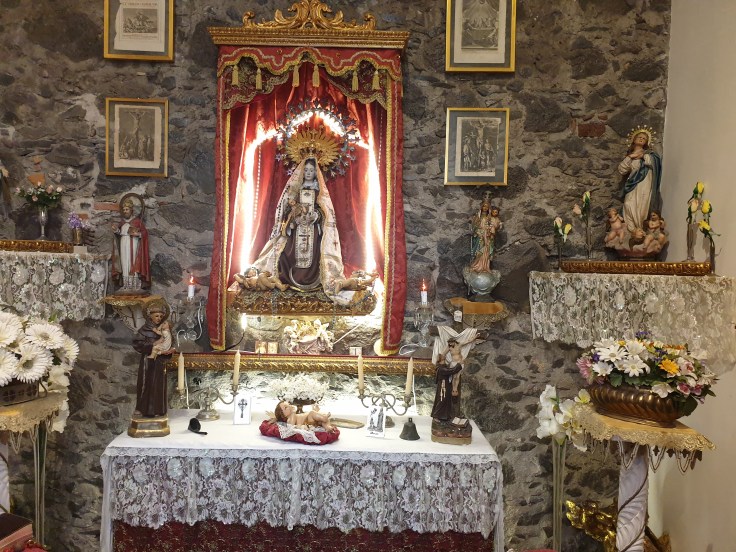
At the entrance was an old cast iron gate, then steep stairs leading up to a landing and a dining room with balcony over the street, kitchen, bathroom, a sitting area underneath a glass sunroof, and….. the house’s very own private chapel with a statue of the Virgin Mary and various images of Christ.  

Hi! this is my new home for the next couple of days

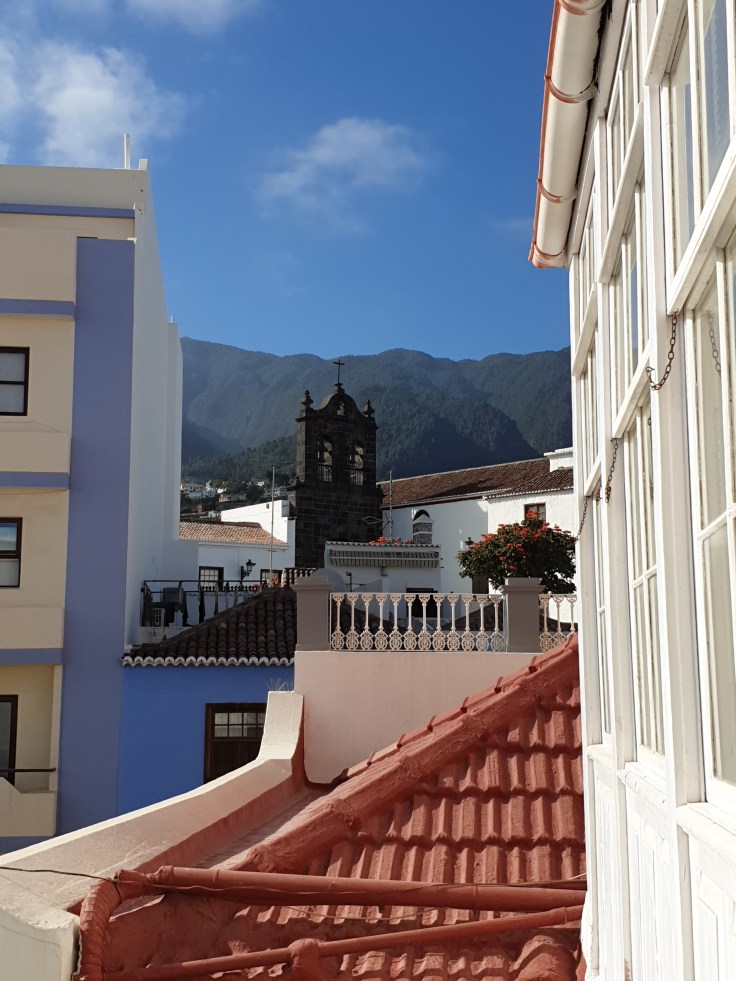
Another steep staircase up led to another bedroom, bathroom and a living room with large windows on all sides and views over the city.  Yet more stairs led to a roof terrace with a table and a couple of sun loungers, with a pretty view of a nearby church, and the mountains in the distance.

the landing

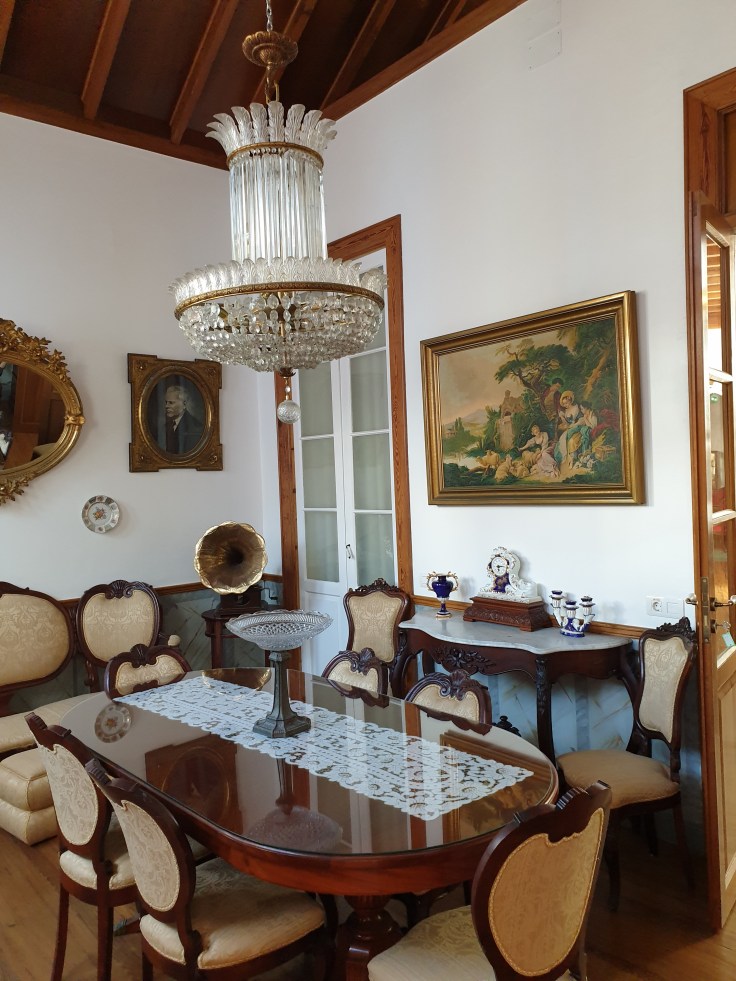
The house was decorated with portraits and old photographs of the family that had owned the place and even the christening dress of one of them. The furnishings were antique – old wooden beds, old chairs and tables, a gramophone player and an ancient radio.   There was a smell of old wood, and a sound of creaking floorboards whenever I moved.  It felt like the house described in Isabel Allende’s book, the House of the Spirits. 

the dining room
the private chapel
view from the roof top

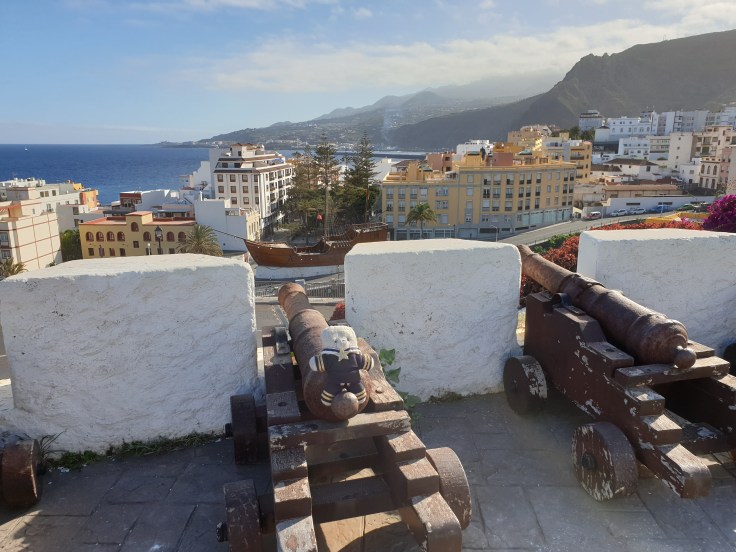
Having explored my home for the next four nights, I set off to visit the town.  Santa Cruz is a small but pleasant place. Old town houses like mine with balconies line the streets, reminding me a bit of the Middle East, but there was also a sprinkling of ugly modern holiday flat buildings. I walked East to the edge of the town. where on top of a rock bursting with brightly colours flowers, there was an old fort with nice views of the sea.

view from the old fort

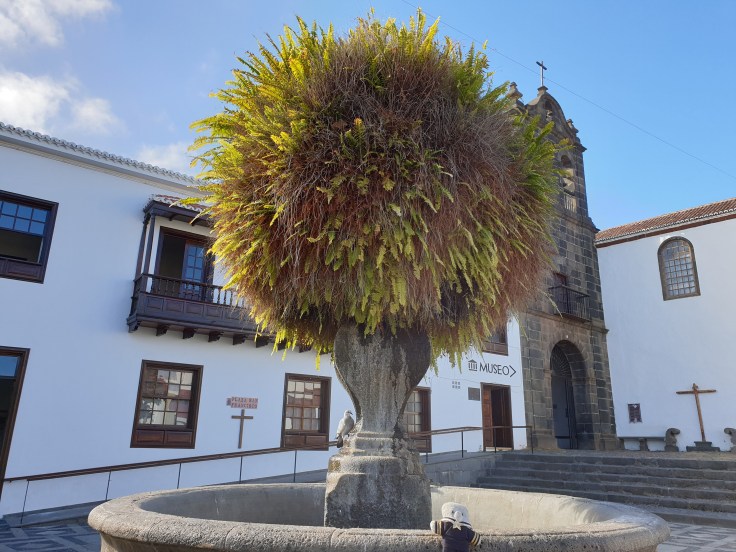
Next, I headed back into town, and found a very pretty square, lined with trees bearing bright red flowers, and with a church, a museum and a music school around its sides. In the middle was a large stone urn with a huge fern tree. Water dripped down the sides of the urn, offering a nice cool drink to some doves in the heat of the afternoon.

Pretty square, music school, church of Saint Francis

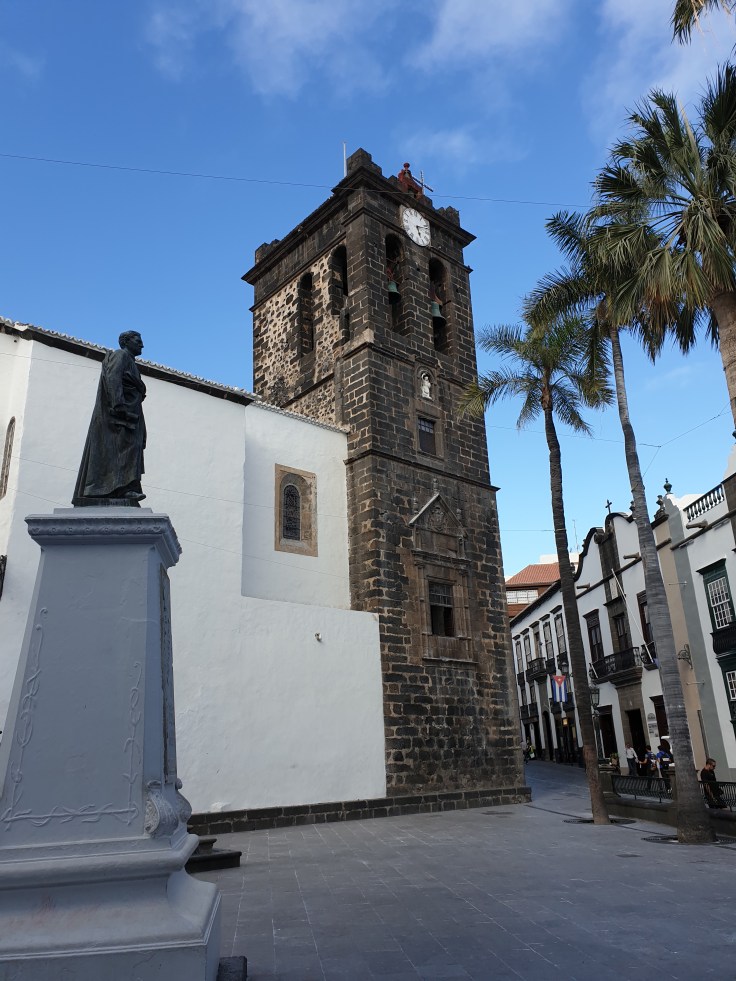
 It was siesta time. Hardly anyone was out on the street, and had the square to myself to sit and enjoy the atmosphere.  After a short rest, I continued my walk and found another pretty square in the centre of town.  This square also had its own pretty stone church and was also the location of the old town hall. 

the town hall
Church of San Salvador

In the street were the tables of bars and cafes; siesta was over, the streets were becoming livelier, and people were sitting down to beer and tapas. I continued my stroll until I reached the end of the old town, where the pretty town houses gave way to modern holiday flats.  Then I retraced my steps and offered myself an aperitif sitting outside at a café in yet another pretty square. After 6 months of the London winter, it was so nice to sit outside and feel the sun on my fur.  I was pleasantly surprised how cheap the beer and tapas were – mass tourism has yet to spoil La Palma.

When I finally I arrived home, it was dinner time. I popped into the Spar next door to buy some ham, cheese, wine and fruit that I enjoyed on my roof terrace.  A nice end to a busy first day on La Palma……..

Amman and GoodBye to Jordan

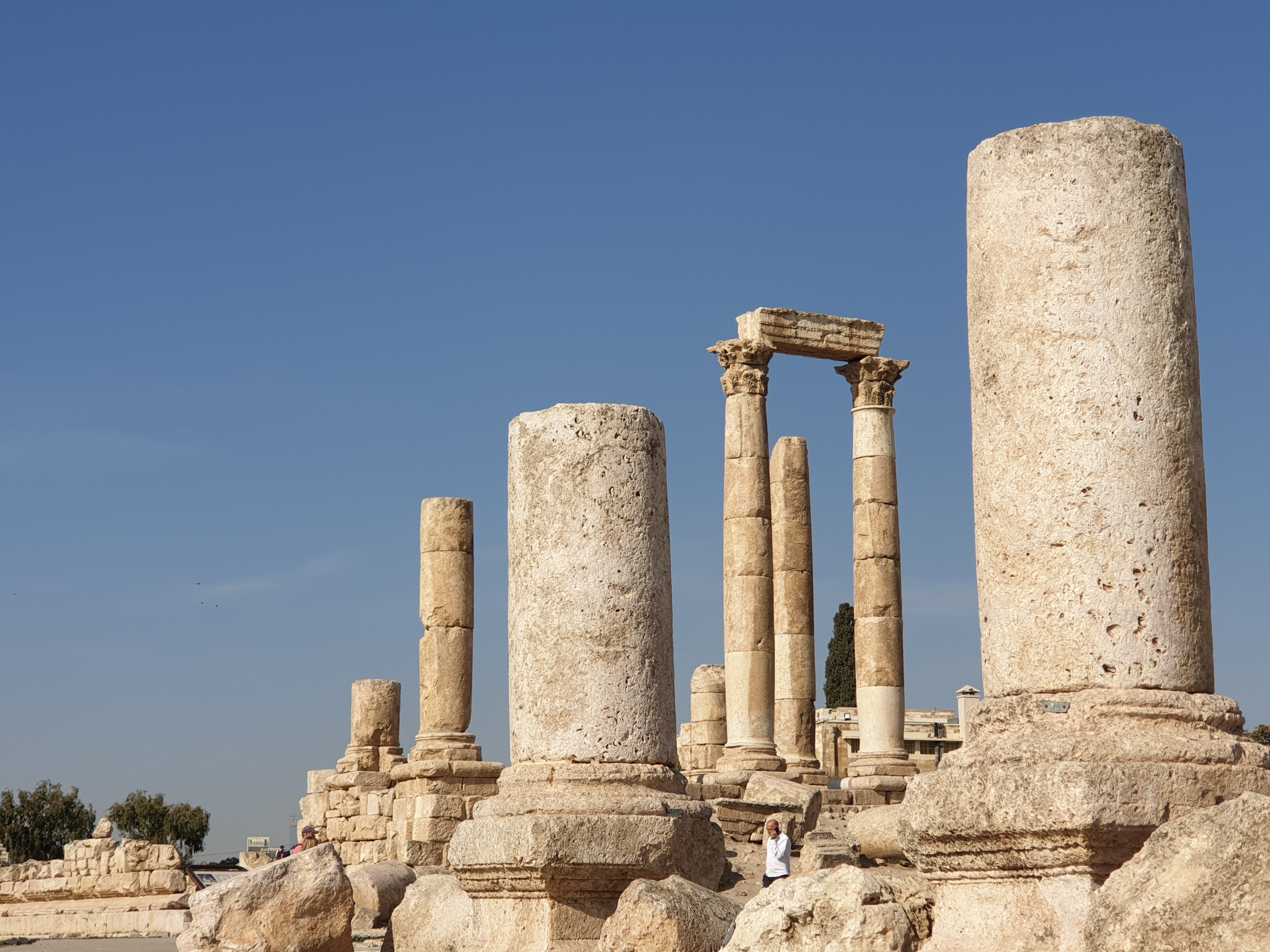
The next morning I set off to explore Amman by foot.  Amman doesn’t have a great reputation amongst travellers, but for one day I found it an interesting and very welcoming place. First I climbed the steep hill just behind the hotel to the Citadel, a hilltop with a view of all of Amman and yet more Roman ruins. After Umm Qays and Jerash, the few remaining standing columns and Byzantine church were not that impressive, but the view was nice and there was a pleasant early morning breeze. 

20191111_092607

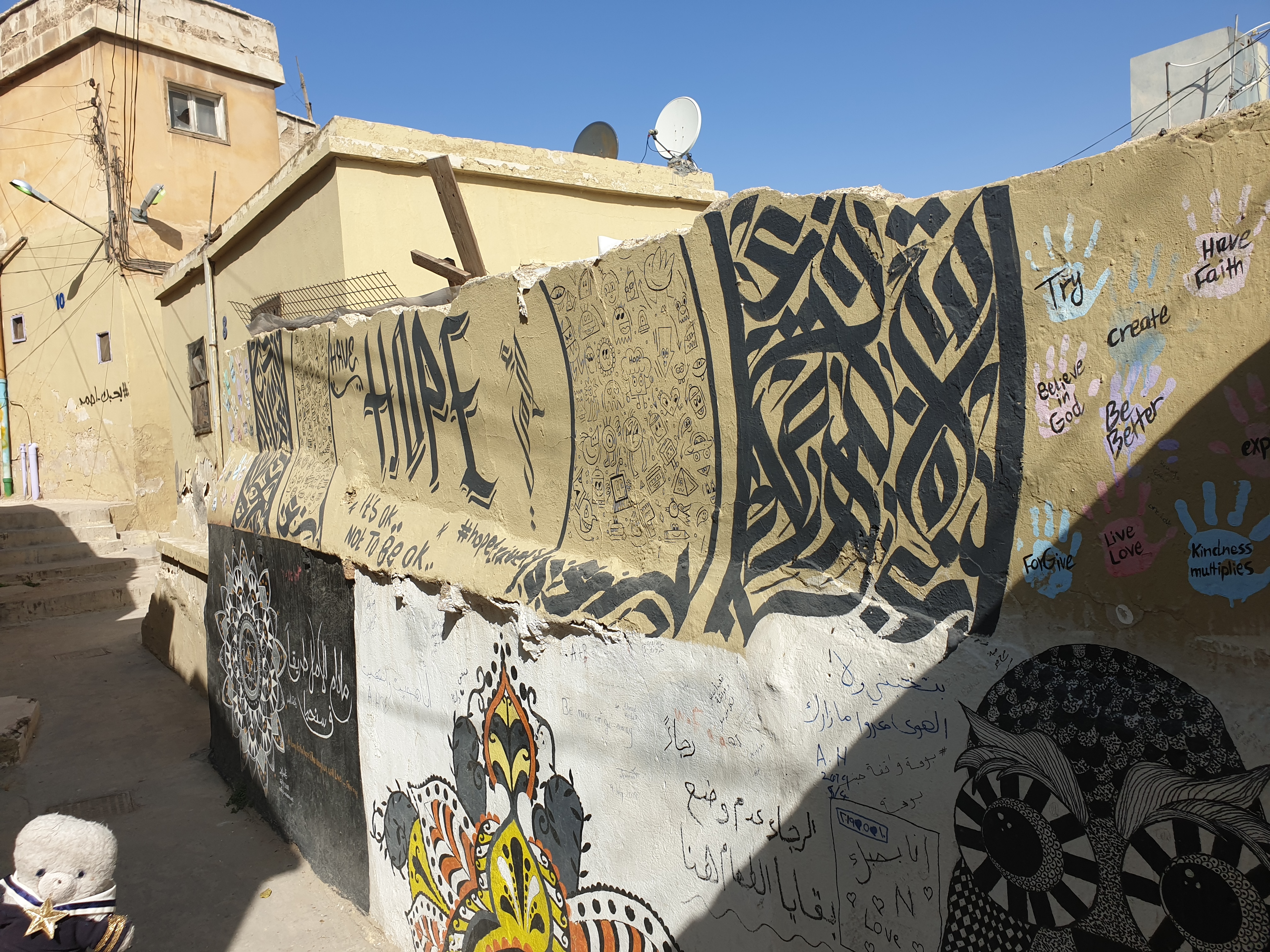
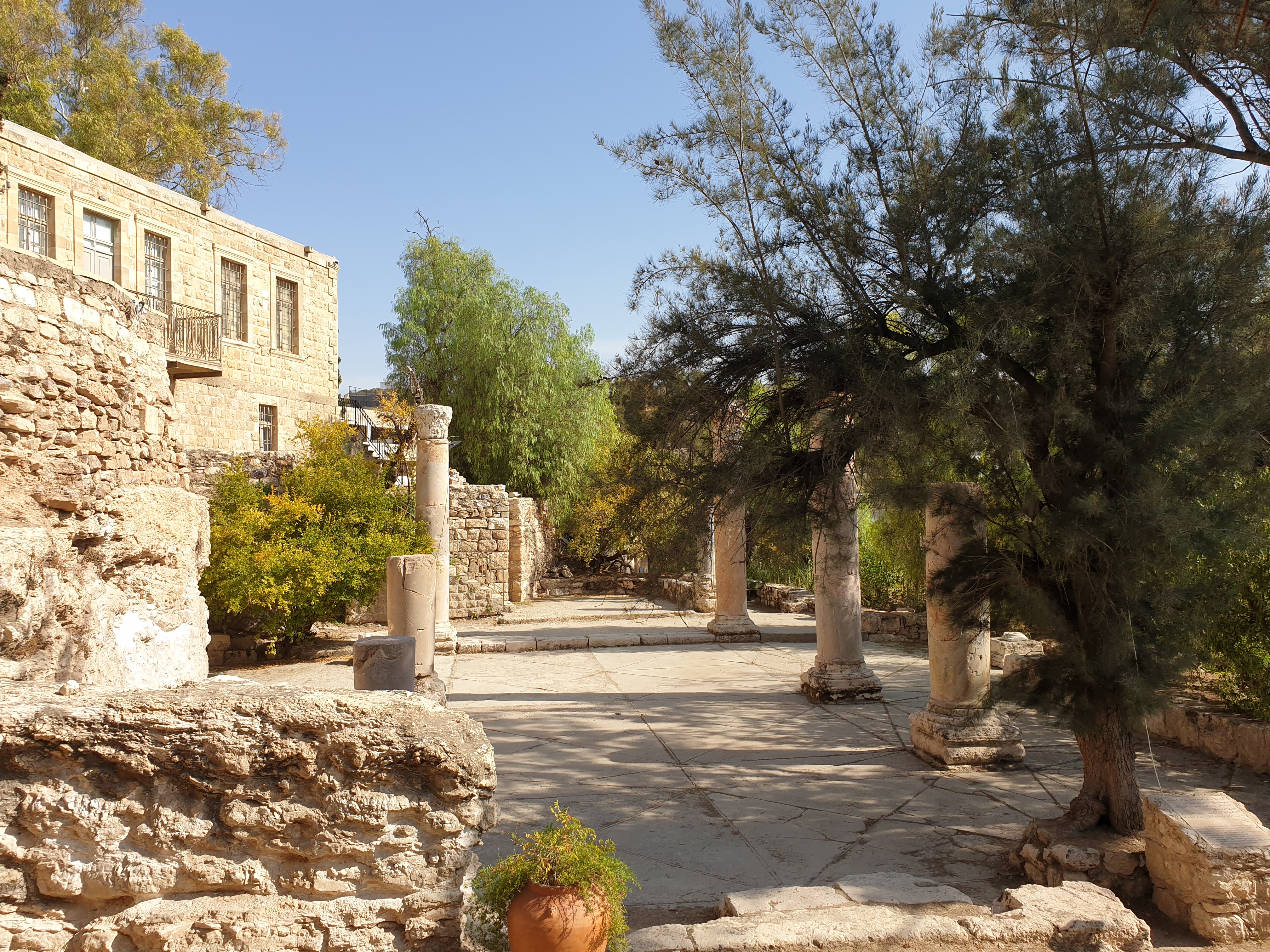
From the Citadel I strolled back down into the valley on the other side of the hill and then up more steps and another steep hill to the modern art institute called Dara Al Funun, which turned out to be an unexpected highlight of Amman.  The steps led past some cool shops and coffee houses and interesting street art, before reaching the entrance to the institute, where there were Byzantine ruins in a peaceful garden.

20191111_114844

20191111_103730

After the bustle of the city centre the place was idyllic and I sat down to enjoy the peace for a few minutes.  Then yet more steps led up to some beautiful old buildings – built in 1920s Venetian Mediterranean style according to my guidebook.  The buildings housed Jordanian modern art of various styles. I had a look around and then settled down on a beautiful shady terrace to a cold lemon juice from the café next door.  A little fountain burbled quietly in the centre and hummingbirds buzzed around the bright red flowers.  Suddenly the quiet was broken by the call to late morning prayers from the cities mosques – a magical sound that echoed around the valley.

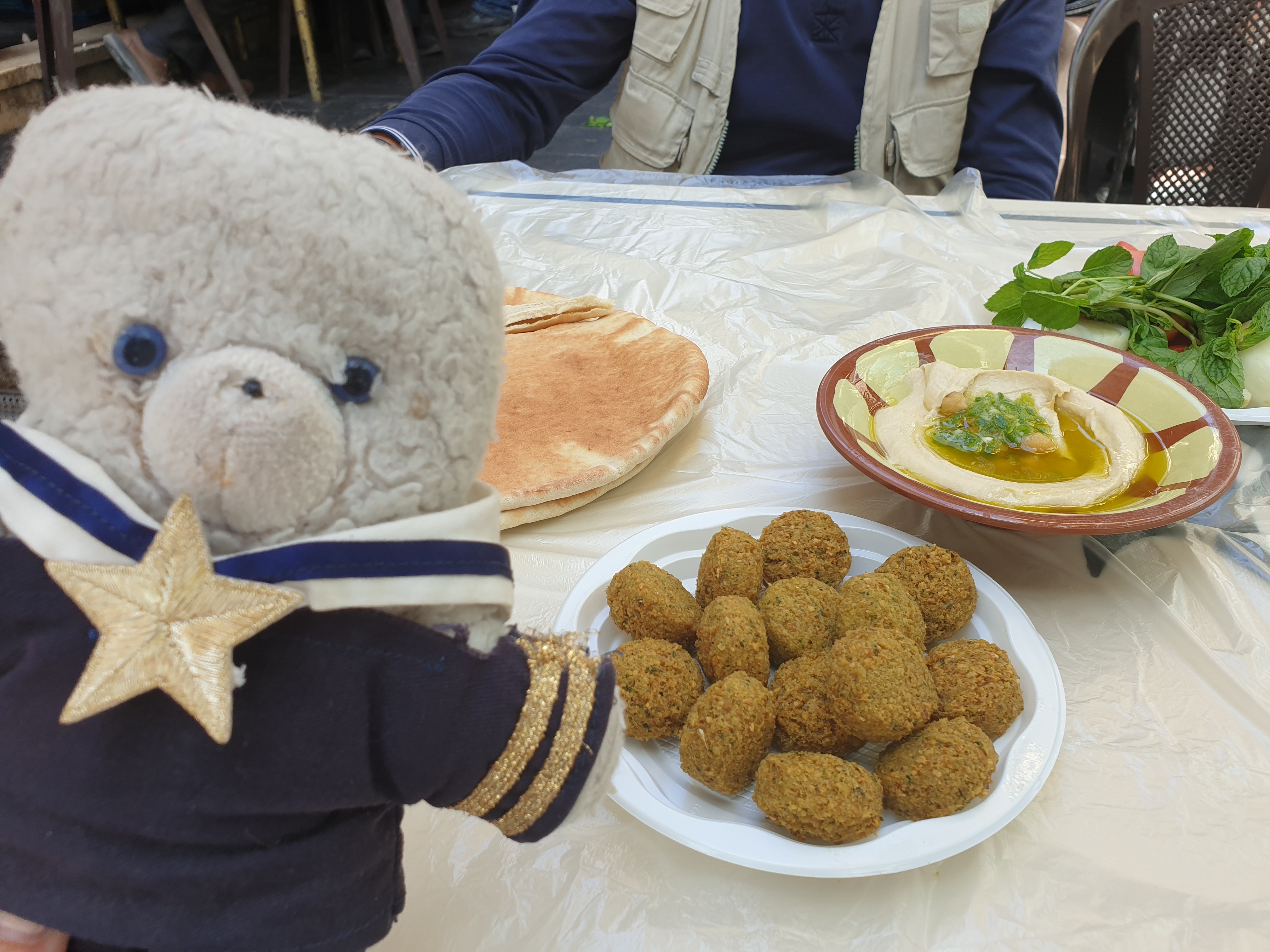
Fully refreshed, I headed back into town.  Next I visited an old traditional house in the town centre, before sitting down to lunch at Hashem restaurant.  This restaurant is a simple but famous place that specialises in traditional Jordan cooking, and is hugely popular – including with the royal family who occasionally pop in to snack there. I was lucky to get a table in the alley leading the main restaurant and could watch the crowds of Jordanians and tourists making their way in and out. I had falafel (the speciality of the restaurant), a big bowl of hummus, and mint tea, which cost $5 in total.  I don’t normally eat lunch so it was big effort to get up from table and climb yet more steps to explore Rainbow street during the day and do souvenir shopping.  

20191111_122436

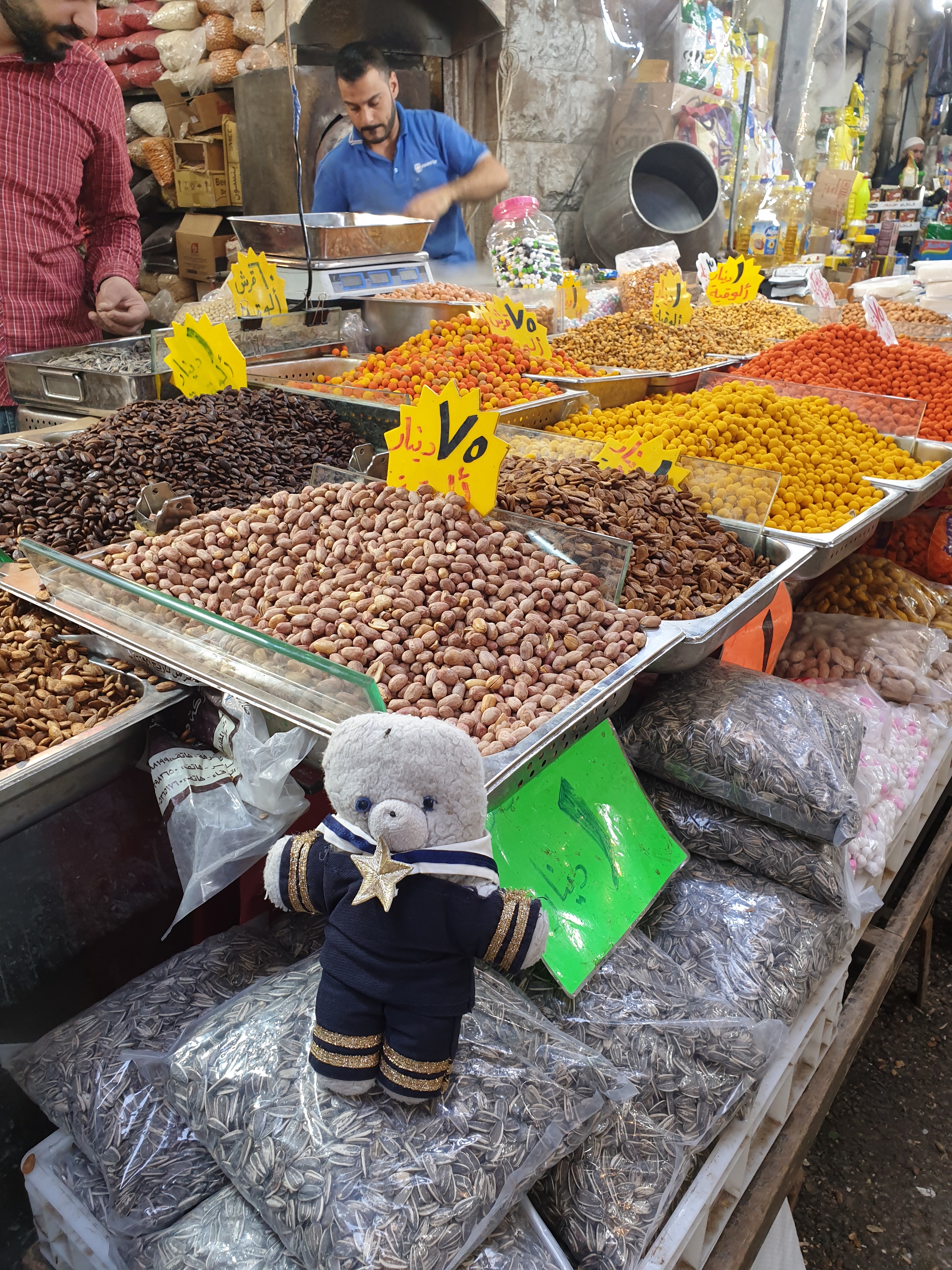
I then headed back into town and took in the atmosphere of the souks – my favourite was the fruit and vegetable souk with its brightly coloured displays of fresh produce and interesting smells of spices.

20191111_142638

 I had been walking for five hours, so next it was back to the hotel for a rest, pack my things, and order a taxi for a 5am departure the next morning.  

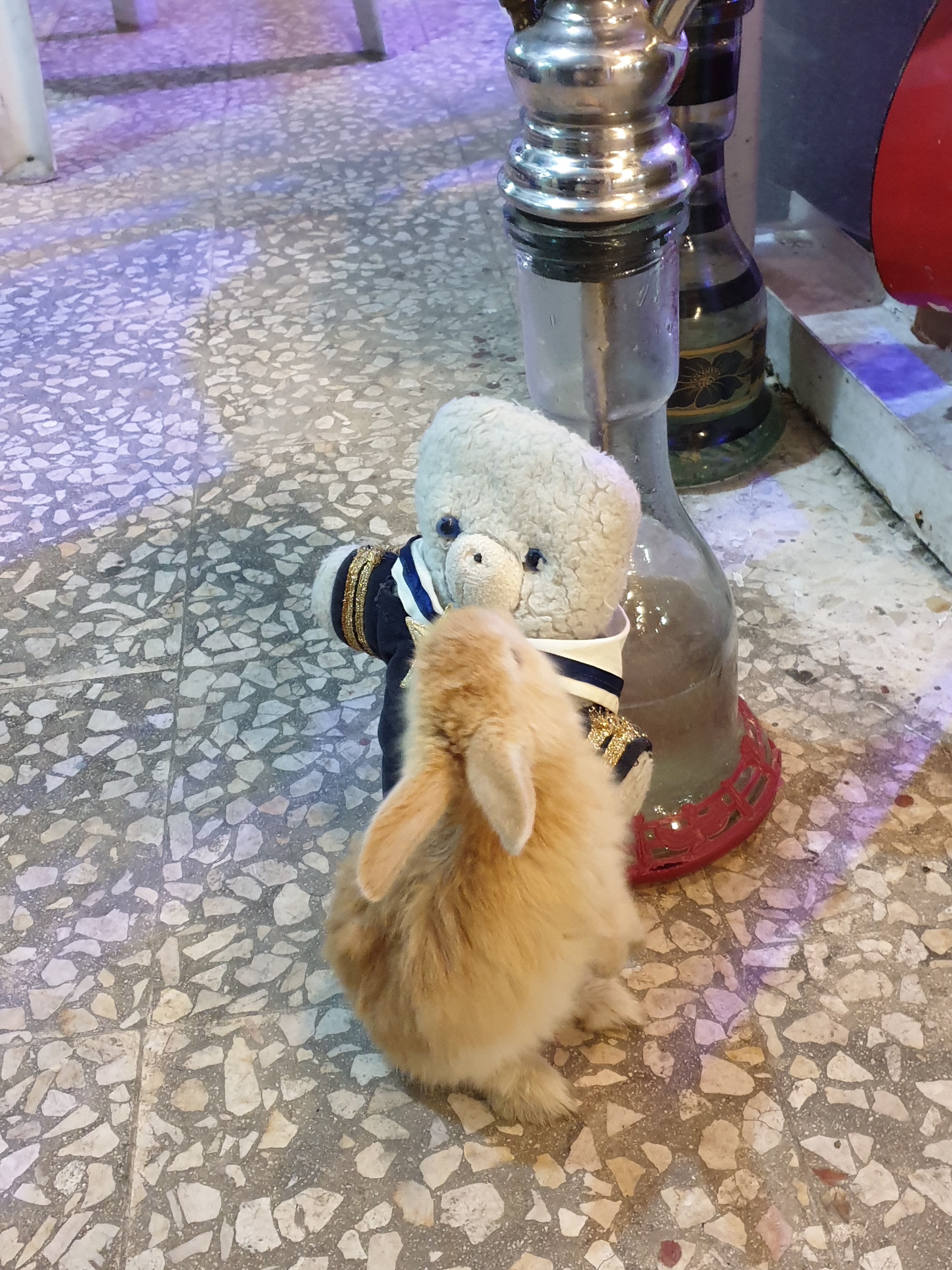
For my early evening aperitif, I found a nearby hotel with a roof terrace and enjoyed my last Jordanian sunset over the city with a cold Karakale beer. Whilst writing my blog I enjoyed listening to the call to prayers for the last time.  In the bar I met some surprising teddy-sized friends……….

Error
This video doesn’t exist


20191111_172606

I spent my last night in Jordan in a trendy bar with a beer and a final bowl of hummus. My flight back home was early next morning. I checked the London weather forecast……… 8C and rain. It didn’t seem that I arrived just over 2 weeks ago – the time had flown past.  In fifteen days, I had explored the desert in a 4×4, hiked through Petra, floated in the Dead Sea, visited some amazing Roman ruins, been scuba driving in the Red Sea and walked in the footsteps of Jesus and Moses.  My trip had taken me to the borders of Jordan with Egypt, Saudi Arabia, Palestine, Israel and Syria. But most of all I remembered the smiles and greetings of “Welcome!” from the many Jordanians I met along the way.  I hope their country remains a beacon of stability and tolerance in a troubled part of the world. 

The countdown begins…

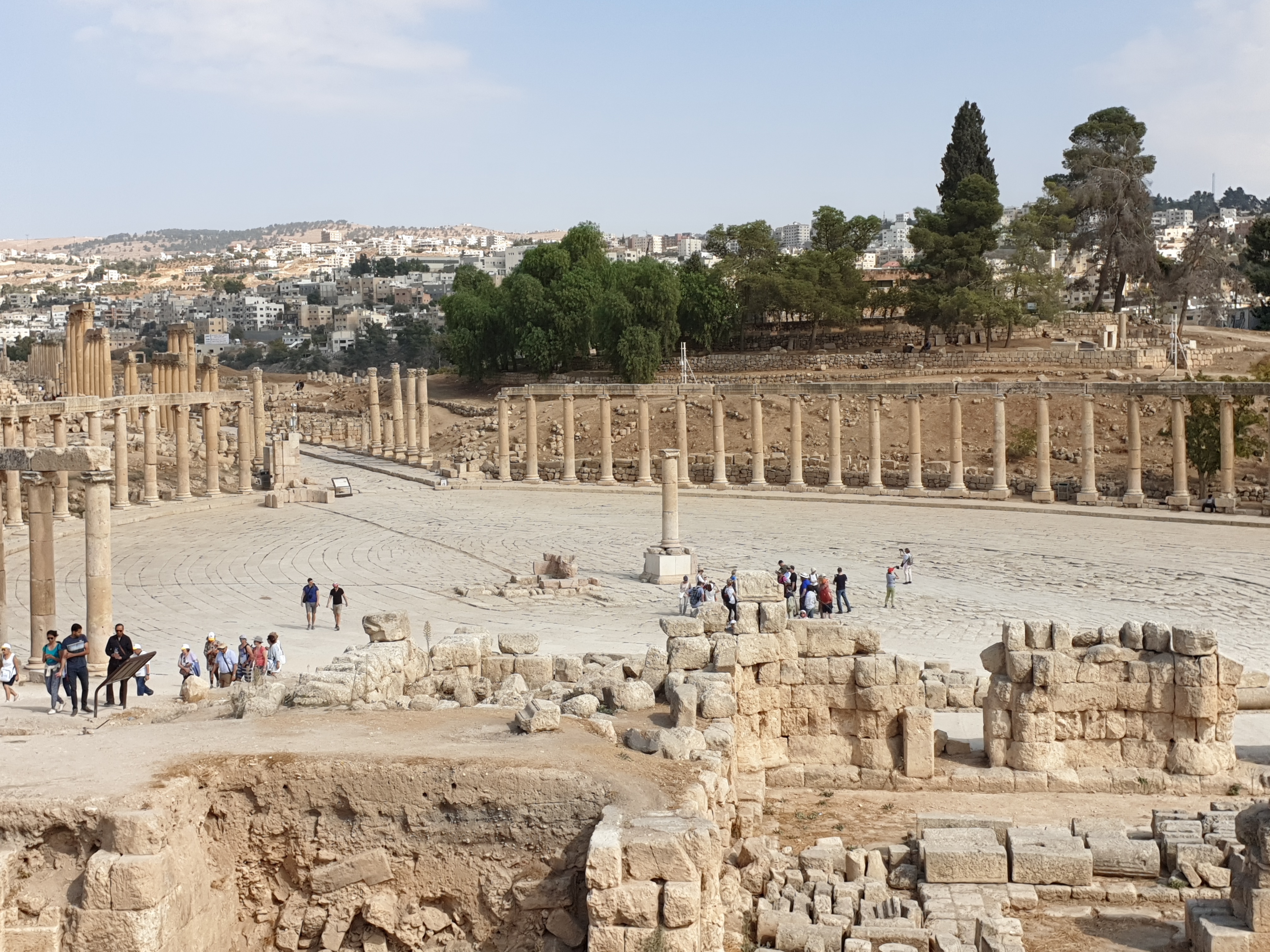
Another day, another huge Jordanian breakfast, after which I just had the energy to get up and walk to the car for the long trip back to Amman. I stopped on the way at Jerash, to visit yet more Roman ruins. Jerash is known as the Pompeii of the East and is a huge extended site with ruins that are much better preserved than at Umm Quays. I ended up driving all the way around the perimeter of the site until I finally found the parking area. Even though there had been a minor terrorist incident here a couple of days before (a madman had injured a few people with a knife), security was very relaxed and I strolled in to the usual Jordanian chorus of “Welcome!” without anyone even checking my bag.
The path in led through the impressive Hadrian’s Gate and then on to a colonnaded forum and huge temple of Zeus sitting on a small hill.

20191110_111049

20191110_112750

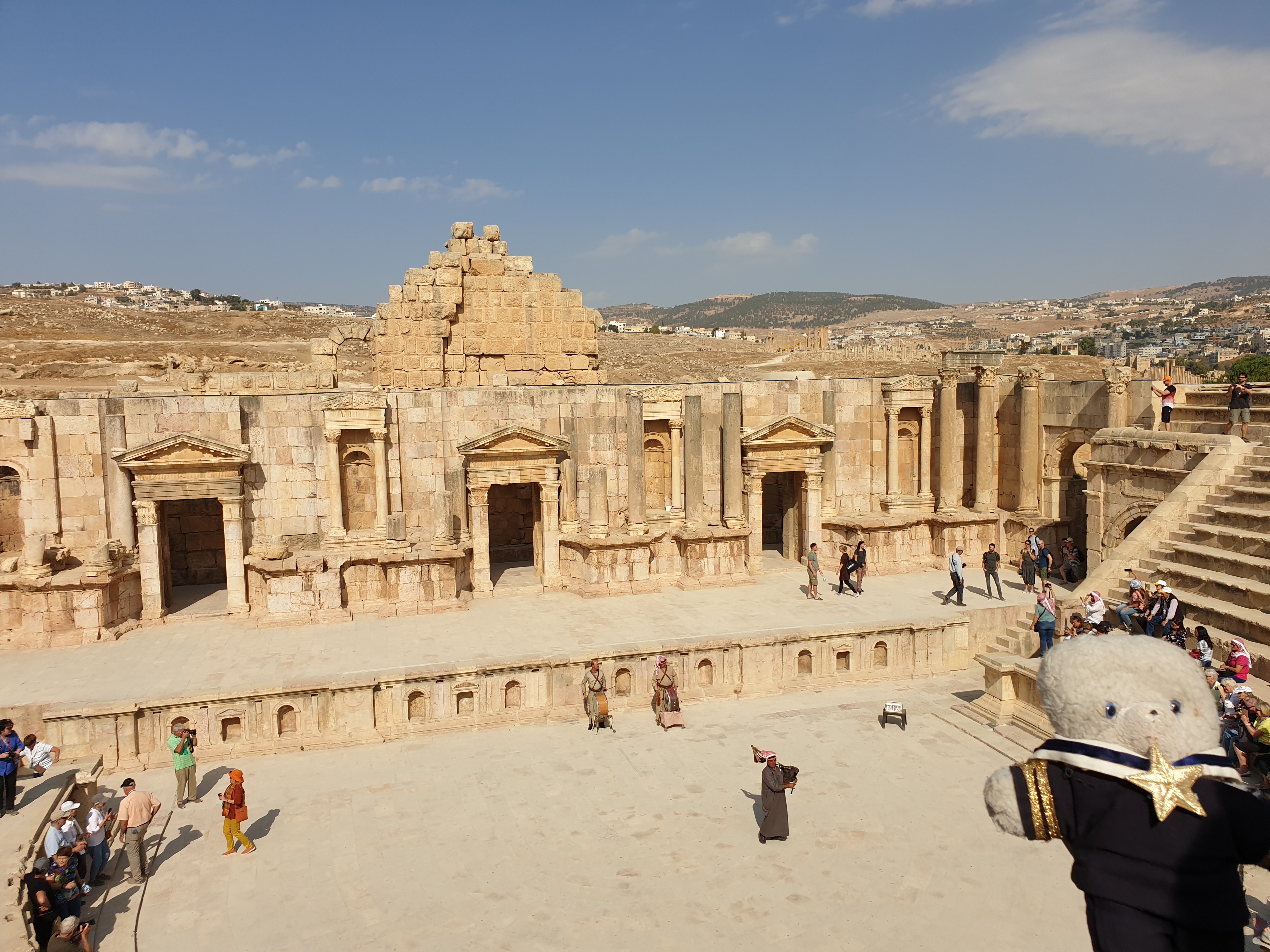
Next up was the first of two amphitheatres, where for some bizarre reason a Jordanian bagpipe band was playing. There were more tourists than at Umm Quays but the large site swallowed them up with ease and when I reached the northern areas I was completely alone and could take some good photographs.

20191110_113653

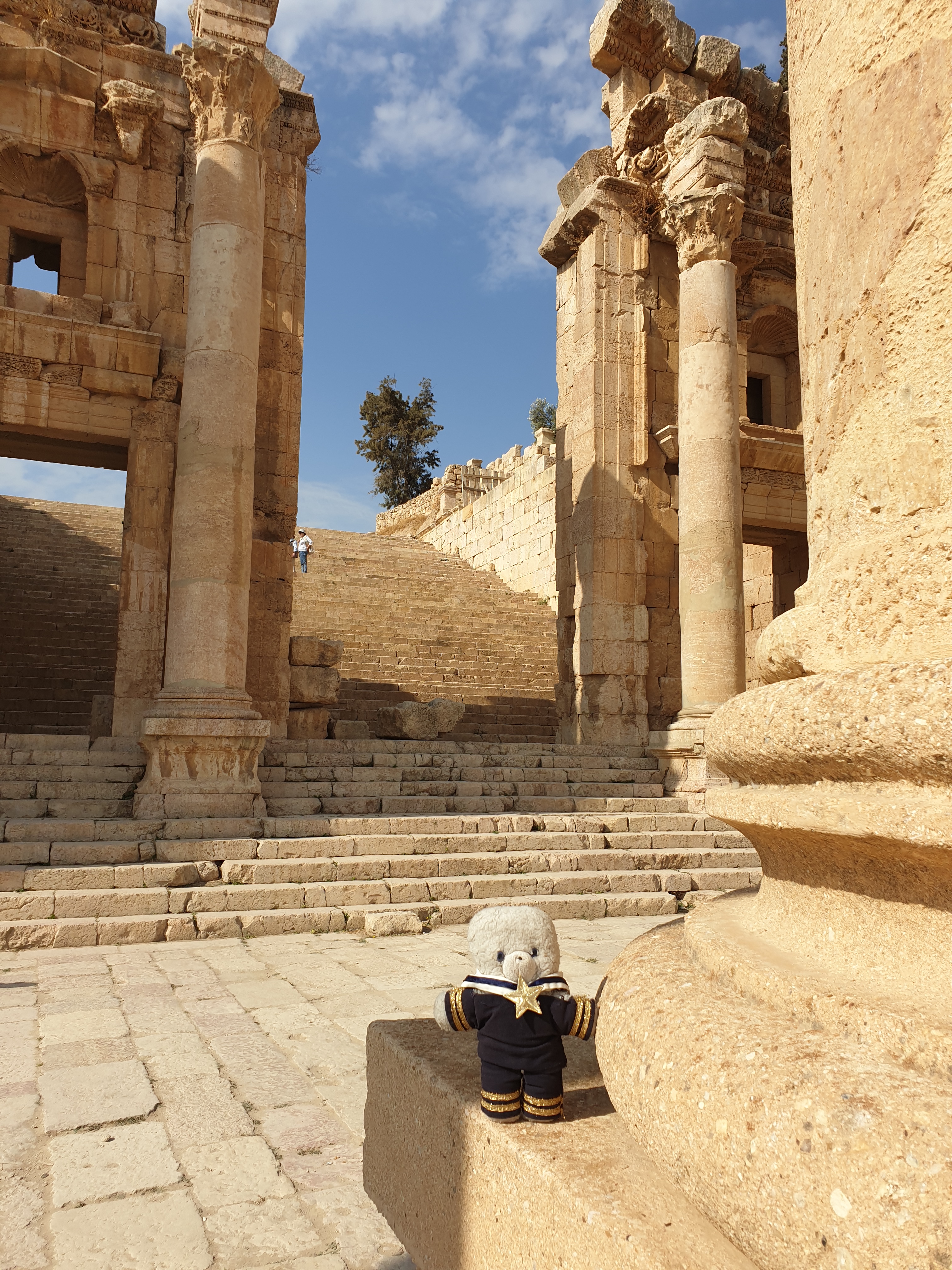
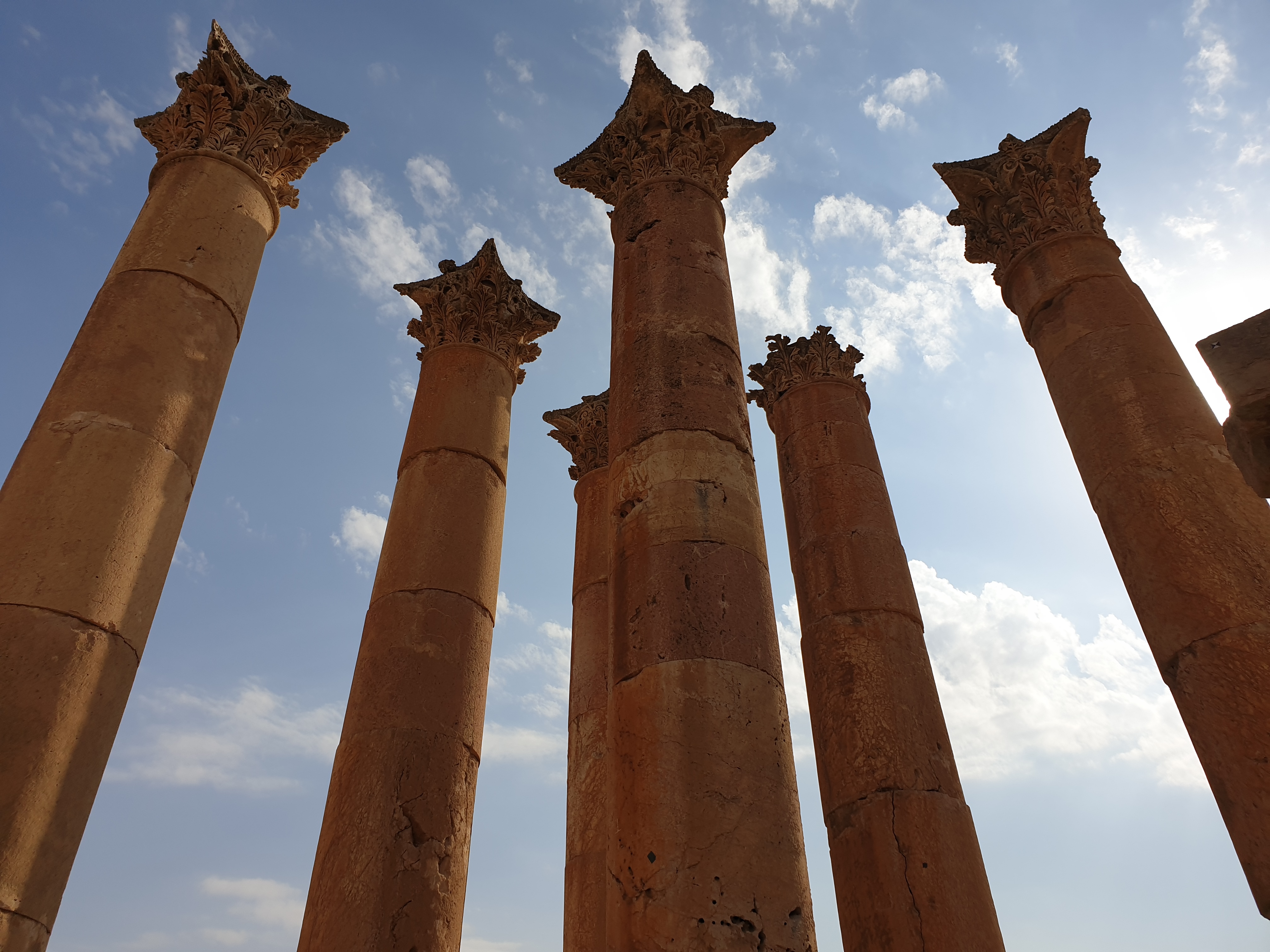
I found the second theatre and rested in the shade – the site is very exposed to the sun, but luckily it was a slightly cloudy day and not too hot. After that I visited the Temple of Artemis, one of the highlights of Jerash, but after two days I was becoming saturated by old ruins, no matter how impressive.

20191110_120108


20191110_125239
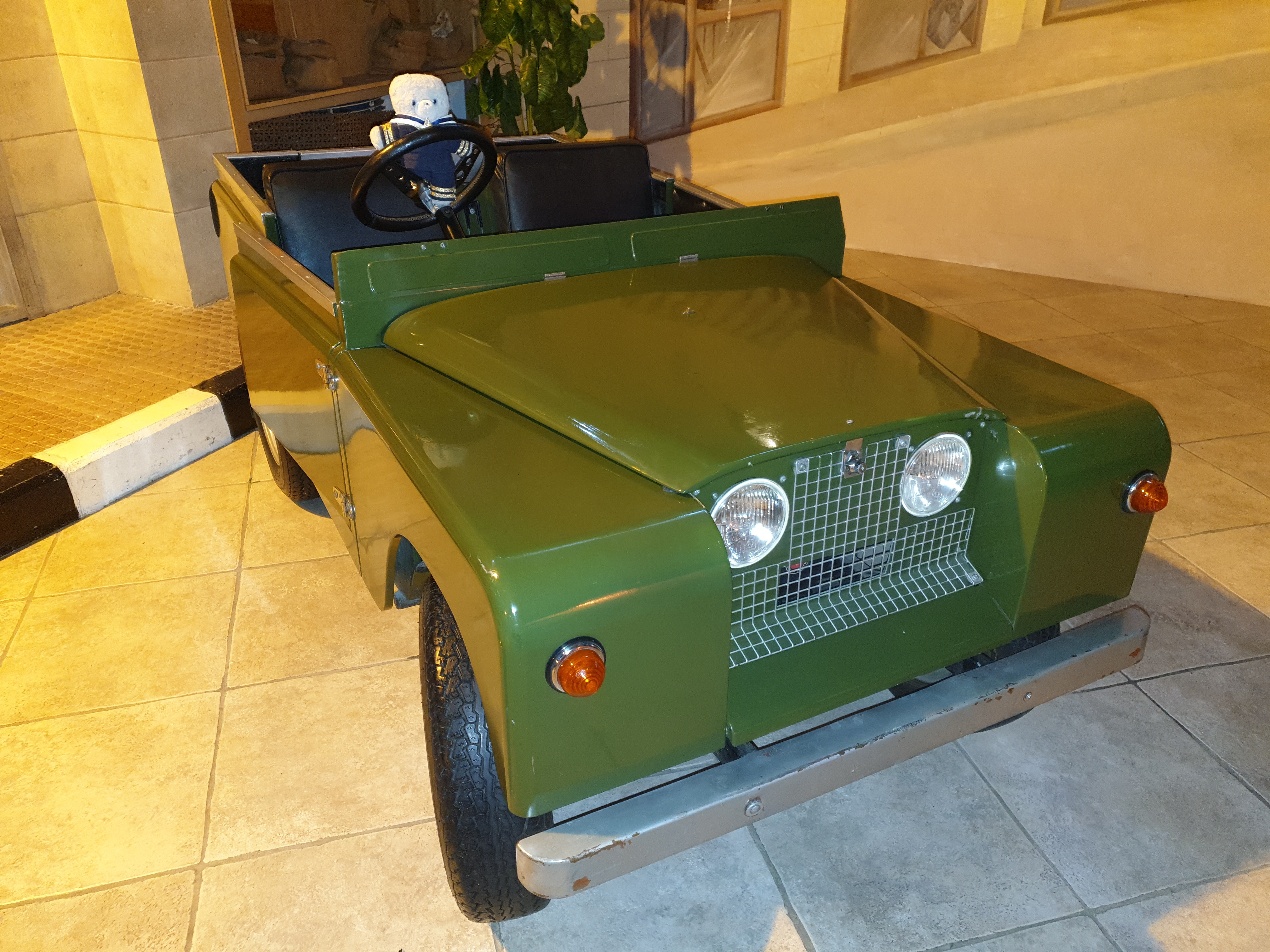
I made it back to the car in the full heat of early afternoon and continued my drive. Next stop was the Royal Automobile Museum on the outskirts of Amman. The previous king of Jordan, English-educated King Hussein, was a serious petrolhead and had built up a huge collection of luxury cars, which now form a museum. I don’t think there was a single brand of car that he did not own, but his favourites seemed to be Mercedes and various British luxury brands.

20191110_142807

I was glad that the museum also contained a teddy-bear sized exhibit.

20191110_144715

I’m not a big car enthusiast (cars are not very useful in the jungle where I live) but I still found the museum interesting because it also charted the history of King Hussein’s reign. He first mounted the throne at age 17, after his father was assassinated, and immediately had to handle the Israel/Arab/Palestine conflicts of the 1970s. There were several attempts on his life, including some that occurred whilst he was driving cars exhibited in the museum. King Hussein survived and over the years became one of the most successful rulers in the Middle East, helping his country through the Arab-Israeli conflict, and then huge influxes of Palestine, Iraqi and Syrian refugees as many neighbouring countries descended into chaos. I suppose this justifies the king of a relatively poor country (no oil!) having such extravagant taste in cars.
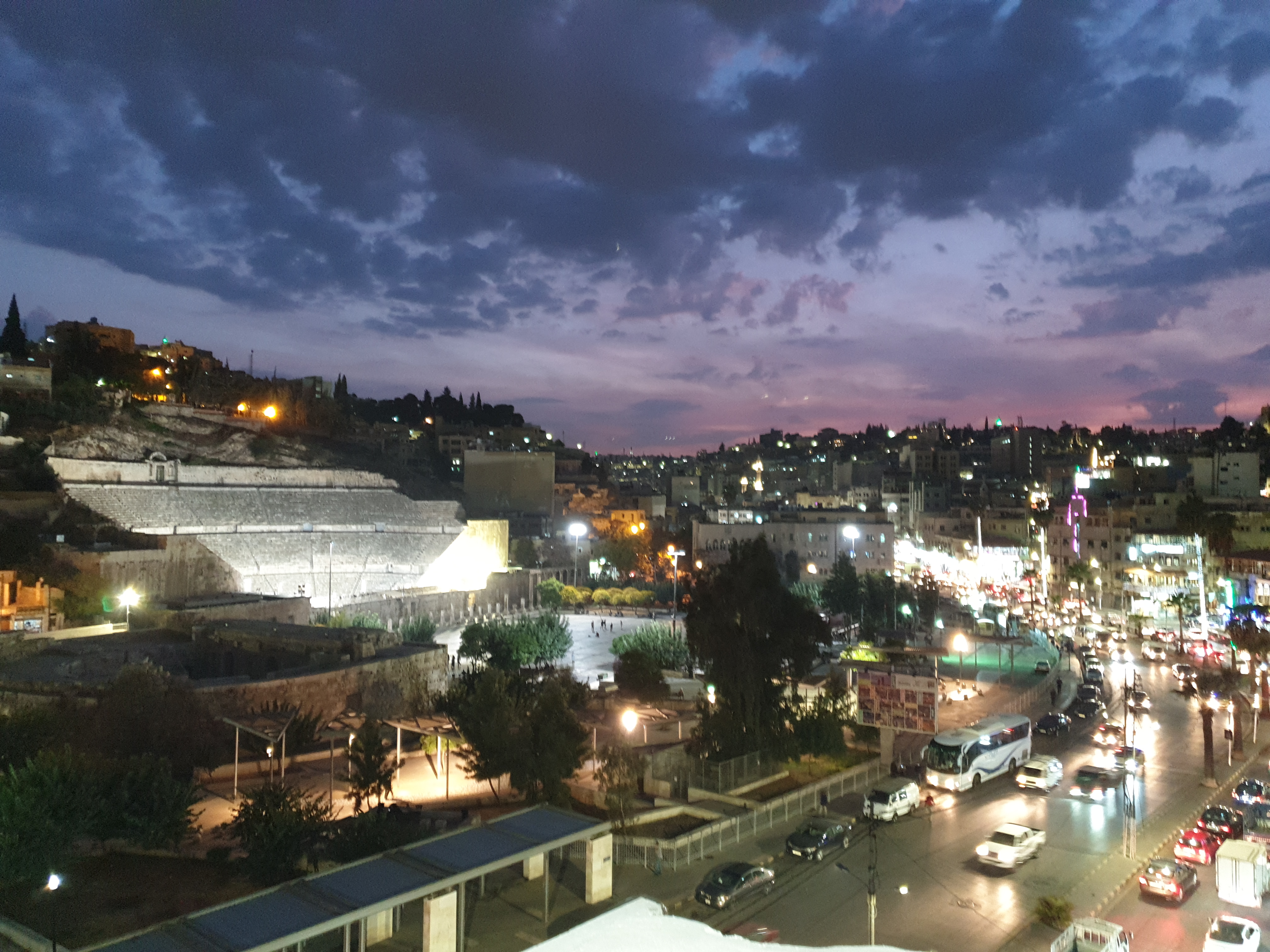
Now it was time to return my hire car. Driving south out of Amman to the airport, the traffic became denser and more aggressive. I was determined not to scratch my car in the last few km and drove slowly. At the airport the nice people at Avis forgave the thick layer of dust that had built up over the past two weeks, and the heavy duty workout that the wheels had had on the bumpy roads. I took a taxi back into Amman (and for the first time on the Jordanian roads I was scared…) and checked into a modest hotel, but with an unbeatable location next to yet another Roman theatre. I was just in time to catch the end of the sunset from the hotel’s roof terrace.

20191110_170710
At night I headed out on foot for dinner. Amman was busy with lots of small shops and restaurants and a continual flow of traffic; after the quiet of the countryside I liked rediscovering the buzz of a big city. I discovered that Amman is built on very steep hills and the walk up to “Rainbow Street” was hard work. The route rose through some steep dark backstreets and up a long flight of human-sized steps, so I was ready for dinner. I had booked the fanciest restaurant in town, which was packed, but I made a mistake by not ordering the safe chicken/rice combination and got a plate that turned out to be something like a haggis made of lamb intestines. It wasn’t the best meal I’d had in Jordan, but my motto is “nothing ventured, nothing gained” – otherwise I would not be a real vagabond teddy bear. To make up for the meal I headed up to a nearby rooftop bar (a speciality of Amman) and enjoyed a cold beer, before the walk back to the hotel and bedtime.


Blog at WordPress.com.

Up ↑