Today I started my 3-day exploration of the Westfjords. First, I discovered the remote Strandir Coast north of Holmavik. The road runs for about 60km before ending – the rest of the peninsula is accessible by boat only and houses Iceland’s (maybe Europe’s) most remote nature reserve.
The beginning of the wild Strandir Coast
I contented myself with a short drive along half the road before stopping at a hotel with a large geothermal pool. I enjoyed the views whilst floating in 38C water, before climbing out and sprinting through the cold air to try a tiny natural “hot tub” located a bit further up the mountain.
A natural hot tub
Feeling refreshed and clean, I tracked back to Holmavik to visit the Museum of Sorcery and Witchcraft. Icelanders have always been very superstitious, and in the middle ages, magic was widely practiced – mostly by men. Spells were used to protect against the extremely harsh conditions of the time, to make money, or to get even with enemies. Sorcerers could also produce magical artifacts, like the “necropants” on display in the museum. These are trousers made from the skin of a dead man, which are supposed to generate an endless supply of coins and make the wearer rich – but only if very detailed instructions are carefully followed. For a full description of this repulsive artifact see here. Magicians could also conjure fantastic creatures, like the tilberi.
The repulsive Tilberi
This horrible creature could be used to steal milk from the livestock of neighbouring farms. A full description of how to create, nurture, use and finally destroy a tilberi is found here. 22 people accused of practising witchcraft were burnt alive in the 17th century in Iceland. The museum had an interesting collection of these stories. Justice was very arbitrary in those days. One local official had four people burnt over the years for using sorcery to make his wife ill (she had a frail constitution and was often ill). Apart from having an interesting collection and intriguing witchcraft stories, the museum also served good coffee – the previous day had taught me just how rare this is in provincial Iceland, so I indulged myself.
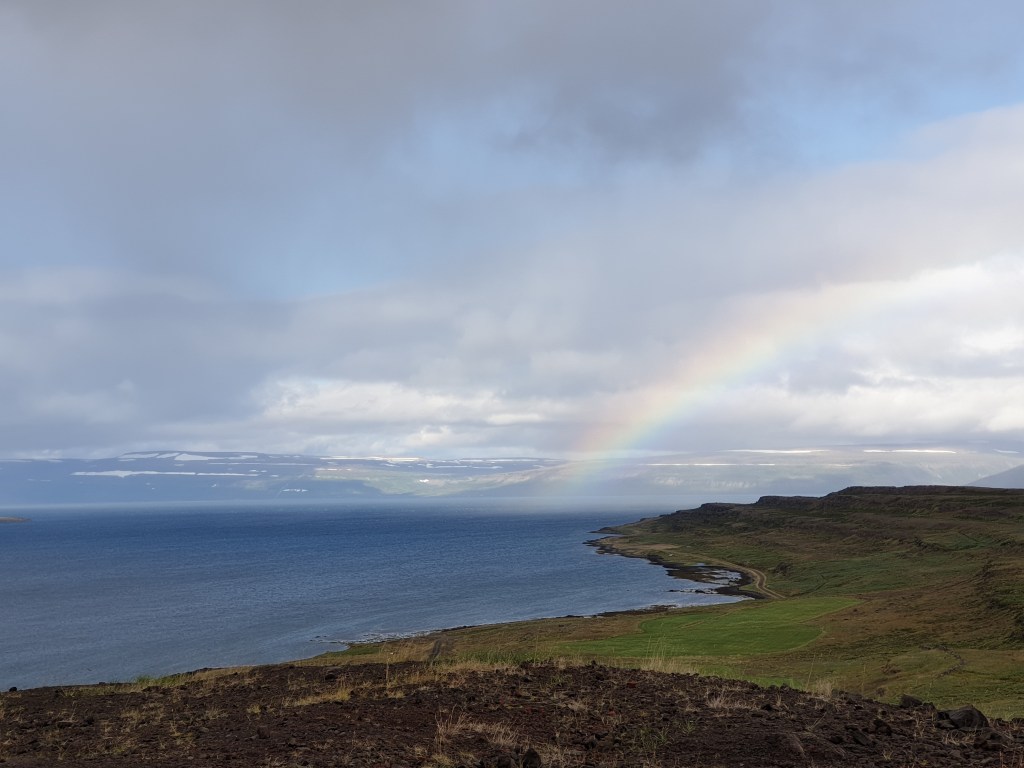
Refreshed and educated, I set off again on the 230km drive to Isafjordur, the main city in the Westfjords. The road headed over a mountain, where I was greeted by wind and rain again. I was beginning to worry that I would see a repeat of yesterday’s weather, when the road dived down into a fjord and the sky cleared. The road then hugged the coast, skirting no fewer than six huge fjords. The scenery was amazing and I stopped often to take photos of the fjords, rainbows… and even some seals.
I arrived in Isafjordur in the early evening. It is a big town by Iceland standards, with a population of 2600 and a well-stocked supermarket. I stocked up with food for a few days and headed to my holiday rental to cook dinner, very happy with my day.
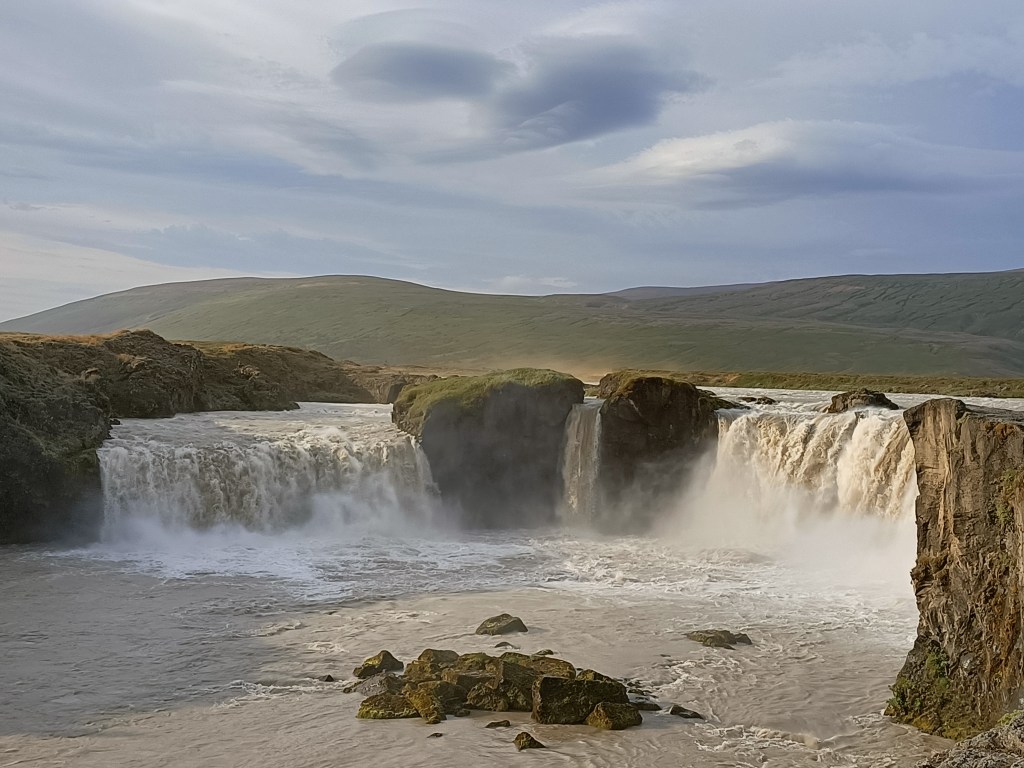
Today I faced a long drive from Myvatn, roughly half way along Iceland’s north coast, to Holmavik at the entrance to the western fjords. My map said I could drive the 500km in six and half hours, but based on past experience I knew that it would take much longer after stops were added on, so I set off early. First stop was another of Iceland’s famous waterfalls, the Godafoss or “waterfall of the gods”. Helpfully it is located right on Route 1.
The Godafoss – yet another impressive waterfall
My next stop was for petrol at the teeming metropolis of Akueyri, which is Iceland’s second biggest city… with a population of only 18,191 (according to Wikipedia). It is supposed to be an interesting place but I didn’t have time to stop. After Akueyri I opted for the long scenic detour of the Trollaskagri peninsula, which follows the coast, rather than the more direct Route 1, which stays inland. Indeed the views were quite pretty, if not exceptional by Iceland standards.
Pastoral green scenery at the east side of the Trollaskagri PeninsulaForbidding mountains in the overland road in the centre of the peninsula
As noon approached, I really fancied a coffee and looked in vain for somewhere to stop. Lonely planet recommended a couple of places but they were both closed (in the peak of the tourist season….). “Surely there will be somewhere in the next town” I kept on telling myself………but each settlement was a tiny windswept village, often without any shops at all. The weather changed, and it became overcast, with rain showers. My mood dropped. Finally at a place Hosfos I found a petrol station with a big shop attached…..and a café! However, their only coffee come not form a machine but a large thermos flask that had been filled with cheap filter coffee, which had been brewed long ago. I paid for a coffee and was given a paper cup to fill myself from the flask. Undrinkable. I searched on google for cafés near my location. The only place indicated within 100km was in an unlikely place – the tiny village of Holar, about 10km off the main road. Remembering that Holar (but not its café) was also mentioned in Lonely Planet, I decided to give it a go.
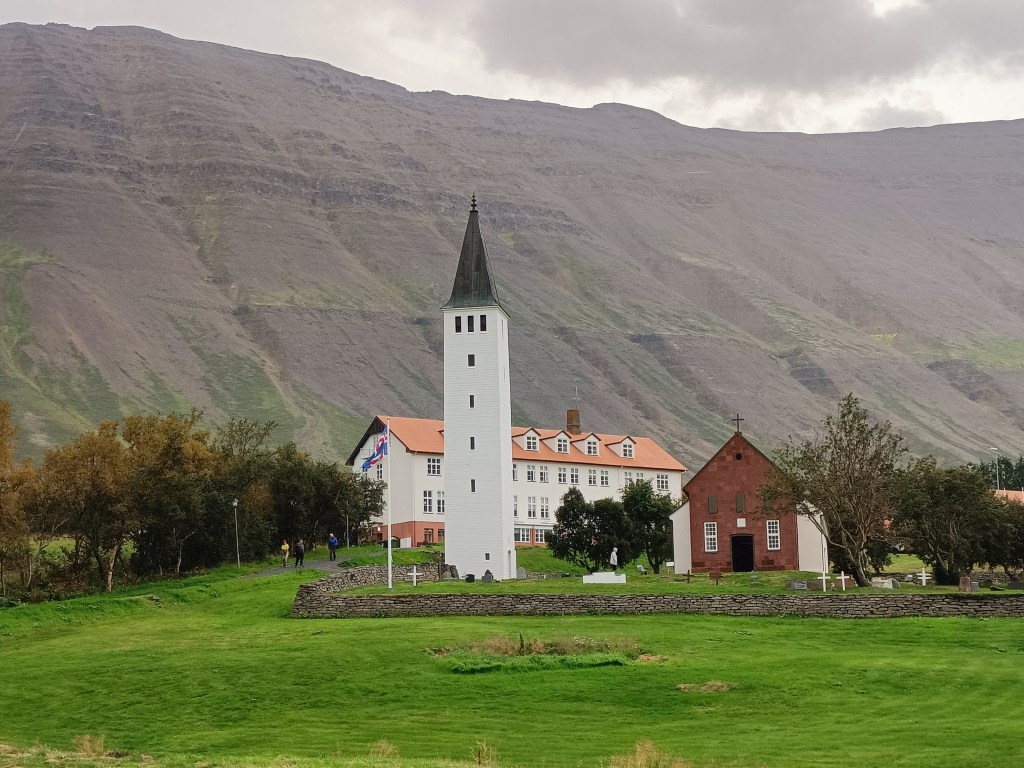
Despite the rain and clouds, Holar turned out to be a pretty little village nestling at the foot of tall mountains. Although tiny today, Holar was an important religious centre in the past and was a bishopric from 1106 to 1798. The see of Holar was restored in 1909 and there is a Bishop of Holar to this day. Holar had a pretty church (technically a cathedral even) dating from 1760 and some traditional old buildings with turf roofs. Continuing its tradition of being a centre of learning, Holar also has a (admittedly small) university teaching agriculture and tourism.
Holar cathedral with the university behind it
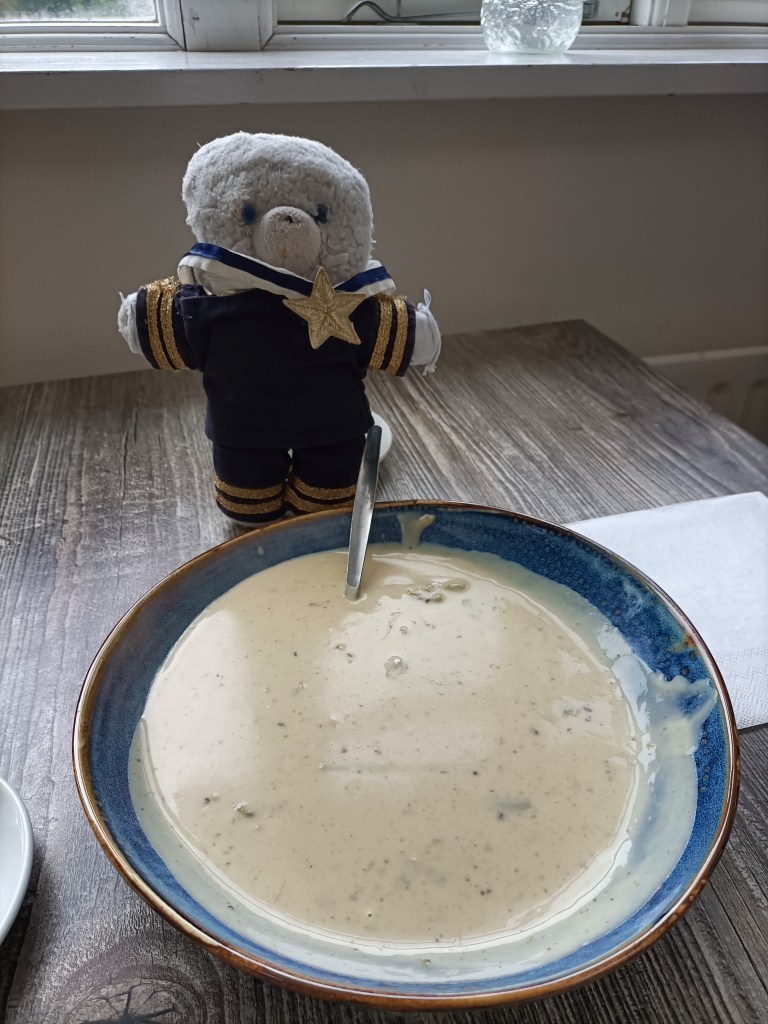
I could see a café attached the university buildings, but the lights inside were off. I tried the door in desperation…………and it opened! Inside was a small counter…….with a coffee machine. I rang a bell for service and a friendly Icelander served me expresso. He also recommended his asparagus and mushroom soup, made with mushrooms from the mountains around Holar – it was delicious!
Soup and coffee – saved!
The café in Holar was a lucky find because the next stretch of road was very boring and would have been hard to do without refreshment. The road rejoined the main Route 1, and ran, flat, monotonous and grey for mile after mile. Even Lonely Planet could not suggest anything worth stopping for in this dull, remote bit of the country. To make things worse, my car started to struggle against the ferocious headwind, and an array of warning lights appeared on my dashboard. I stopped to check the owner’s manual but found only Icelandic text. A search of the web (internet connection seems to be available almost everywhere around Iceland) suggested that the warnings were not critical and that I could carry on, but I had an uncomfortable feeling – breaking down here would be worse than inconvenient, since there were no garages for miles.
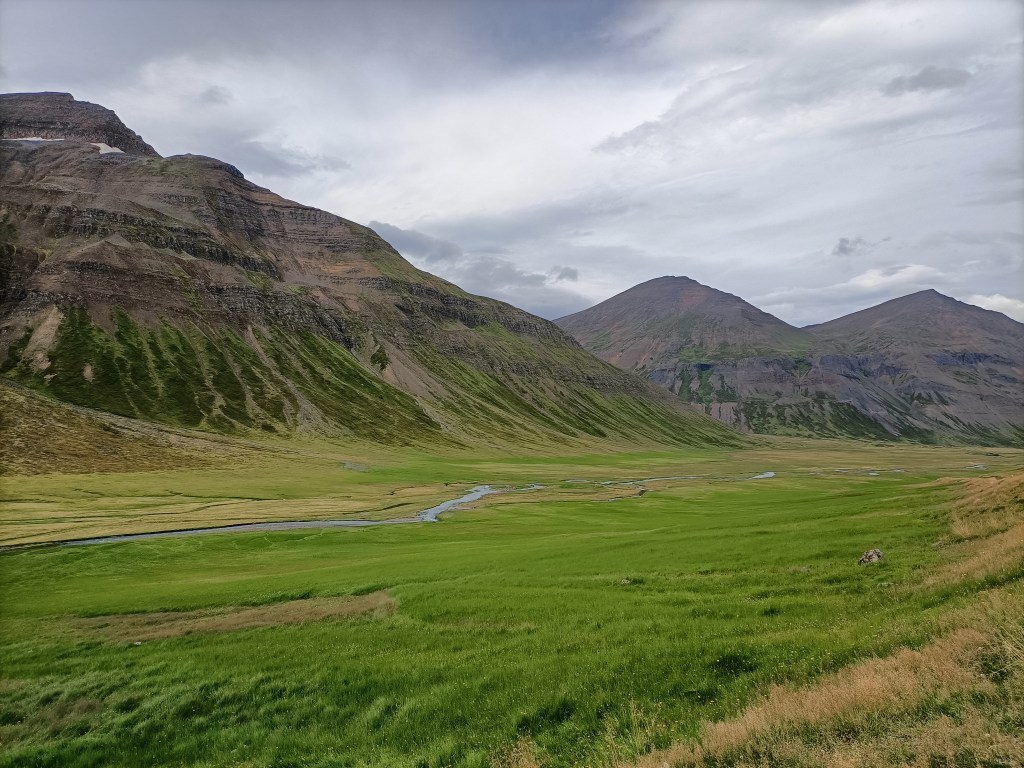
As I left Route 1 for Route 68 going to the Westfjords, the weather improved, and my warning lights suddenly disappeared. I even stopped to take some photos.
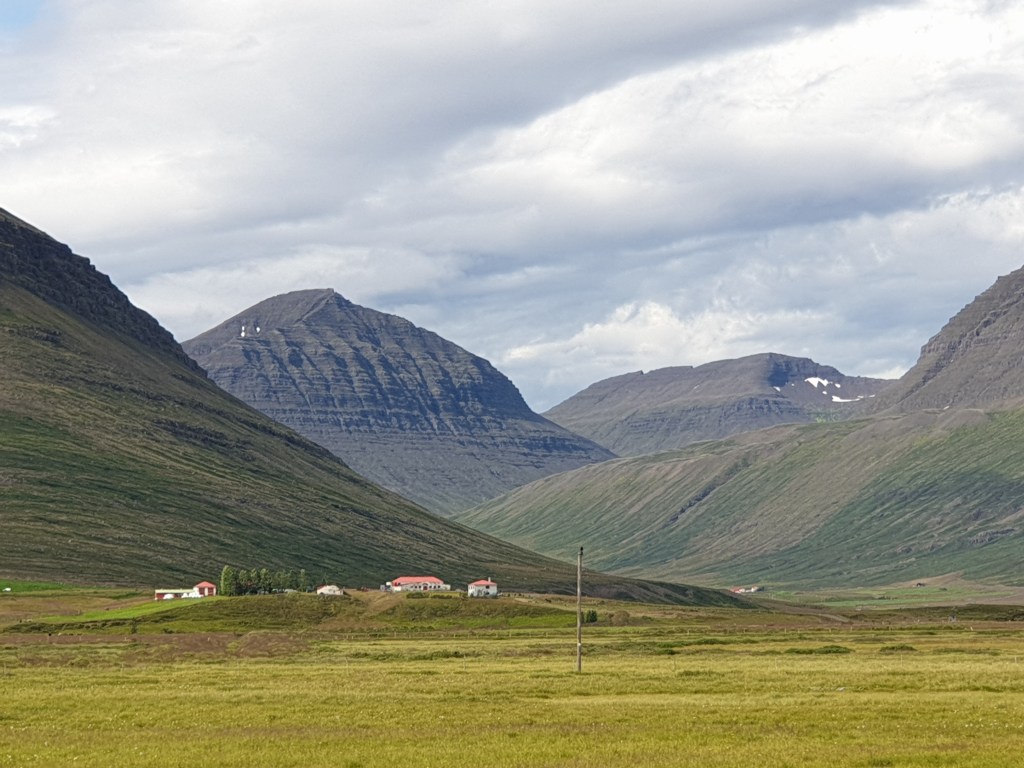
Scenery at the start of the Westfjords
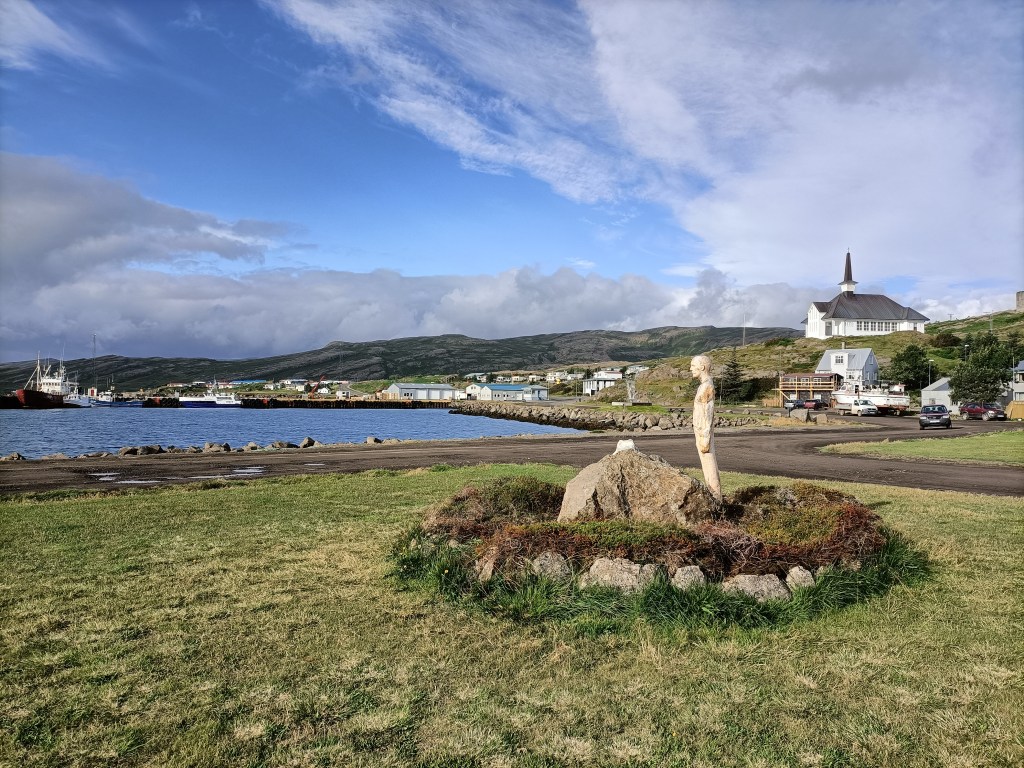
I finally made it to Holmavik at around 6pm – I had been on the road for nearly nine hours. It was a tiny place, and was functional rather than pretty – but at least I had arrived. The town had a shop, self-service petrol pump, a small port harbouring fishing boats, a pile of what looked like abandoned freight containers, a couple of guesthouses, a museum, and a cold wind howling along the main street.
Holmavik
Fortunately my accommodation was very good – unlike most of the places I had stayed so far, it had old furniture and looked like it might once have been someone’s home. And best of all it had a cosy living room with a comfortable sofa and view of the sea. I cooked the cod I bought in the local shop and celebrated the end of a long, difficult day with a glass of whisky.
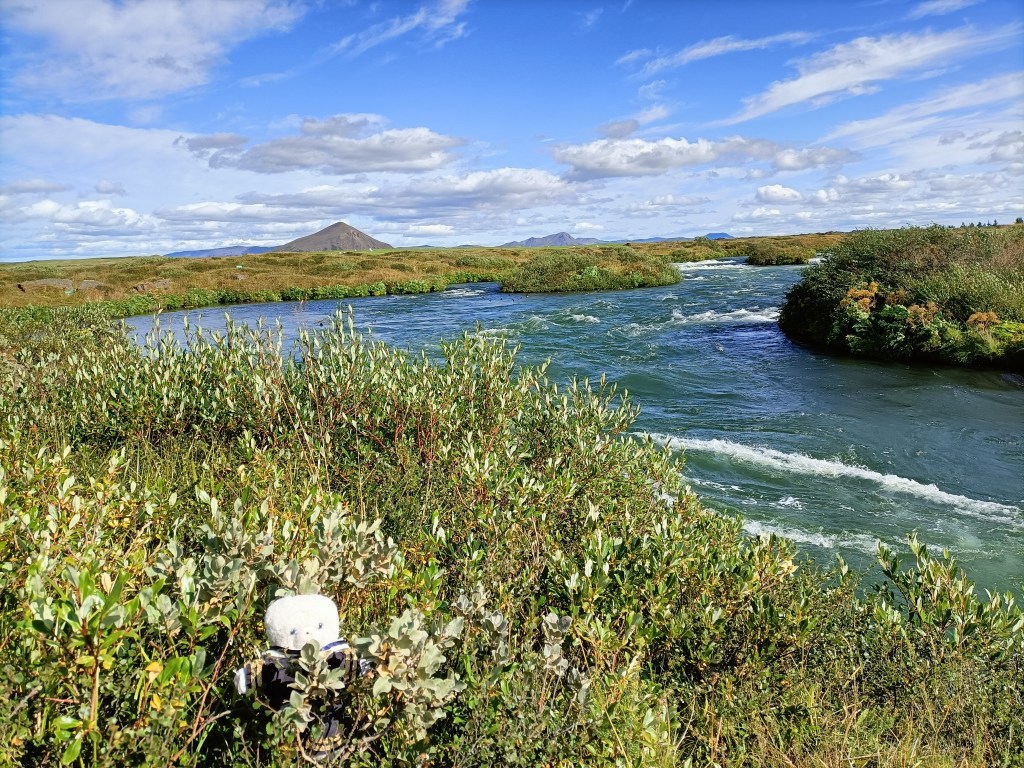
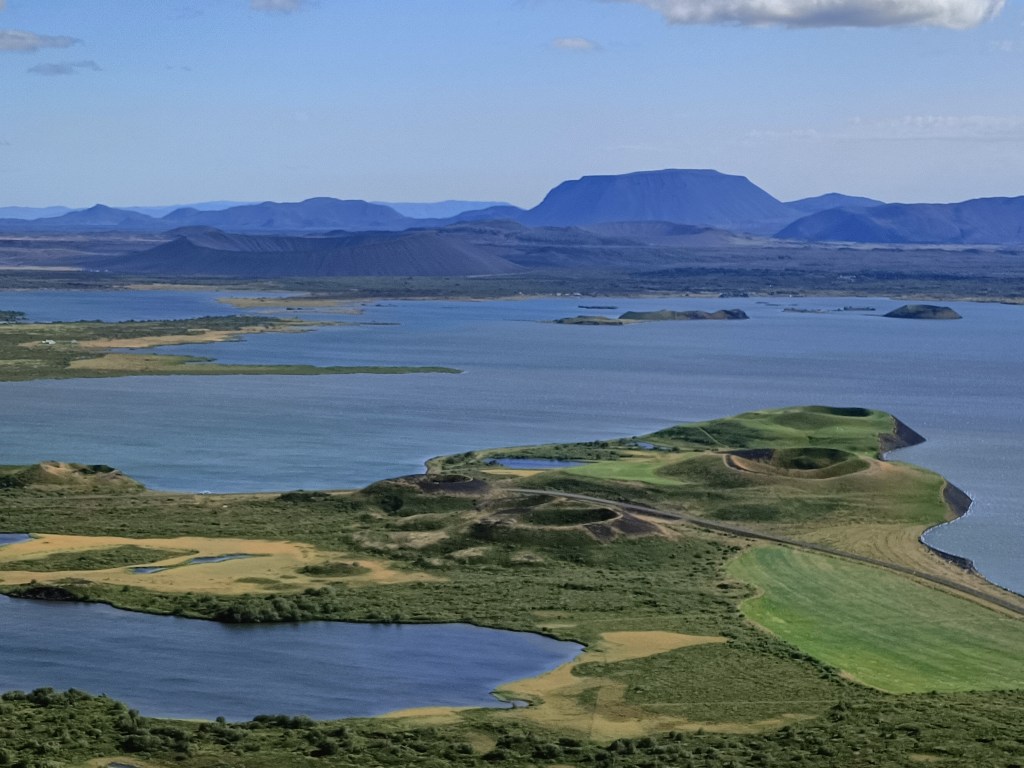
After two long and very busy days, I resolved to take it easier today and left late to explore Myvatn, a large, shallow lake formed by a volcanic eruption 2000 years ago. The lake is lush and green, with lots of small islands, bubbling rivers entering or leaving the lake, and lots of bird life. It is surrounding by many interesting volcanic structures. My only plan for today was to drive around the lake clockwise and see what I would find.
Myvatn lake
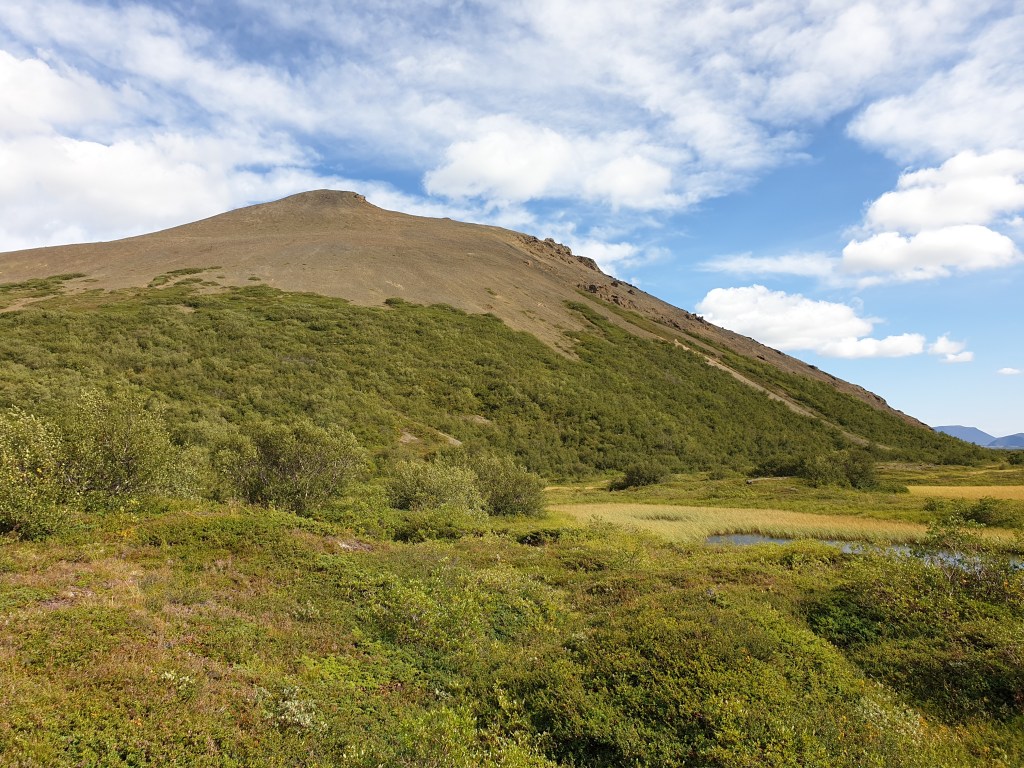
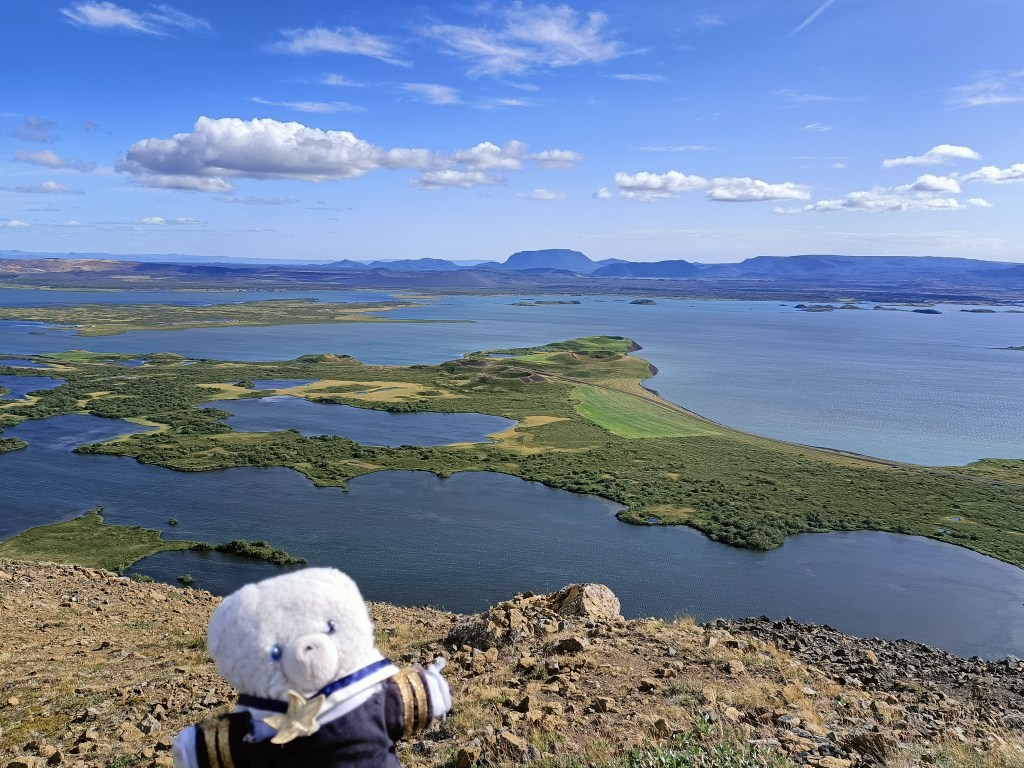
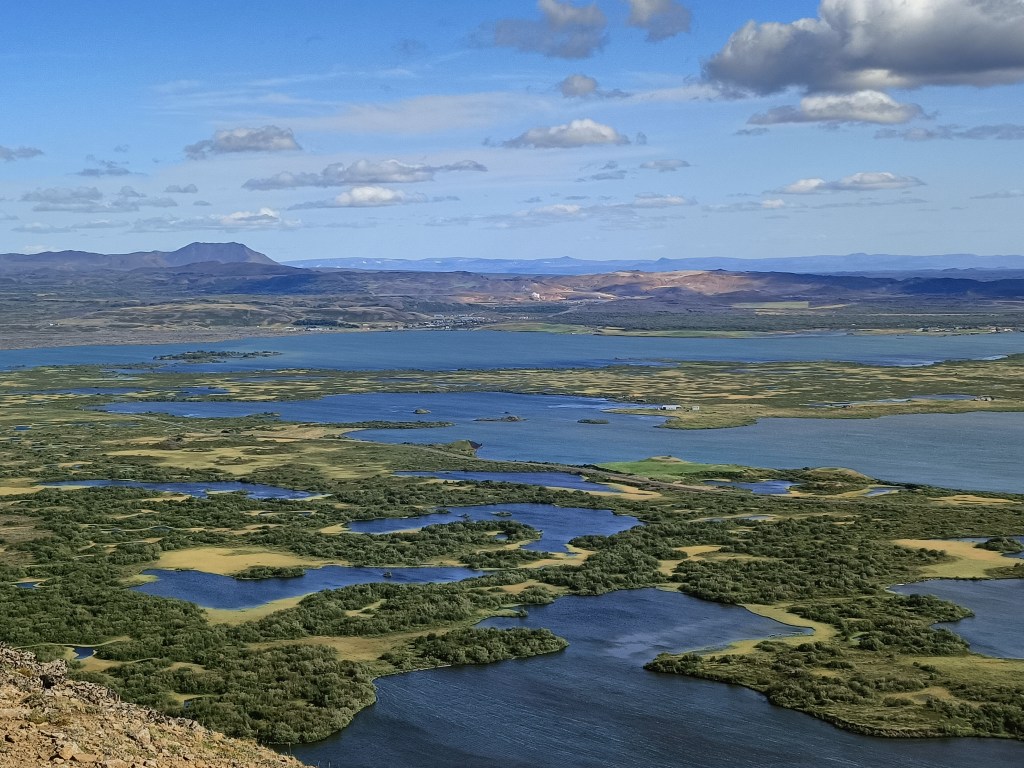
My first stop was to climb the small mountain called Vindbelgjarfall, on the western side of the lake. It was a steep but short walk, and from the summit there were fantastic views across the lake. I found a little hollow in the mountain to shelter from the strong wind and enjoyed my sandwich lunch whilst taking lots of pictures.
Vindbelgjarfall The view from the summitAnother view from the summitYet another view from the summit – this time with “pseudo-craters” (more about these later)
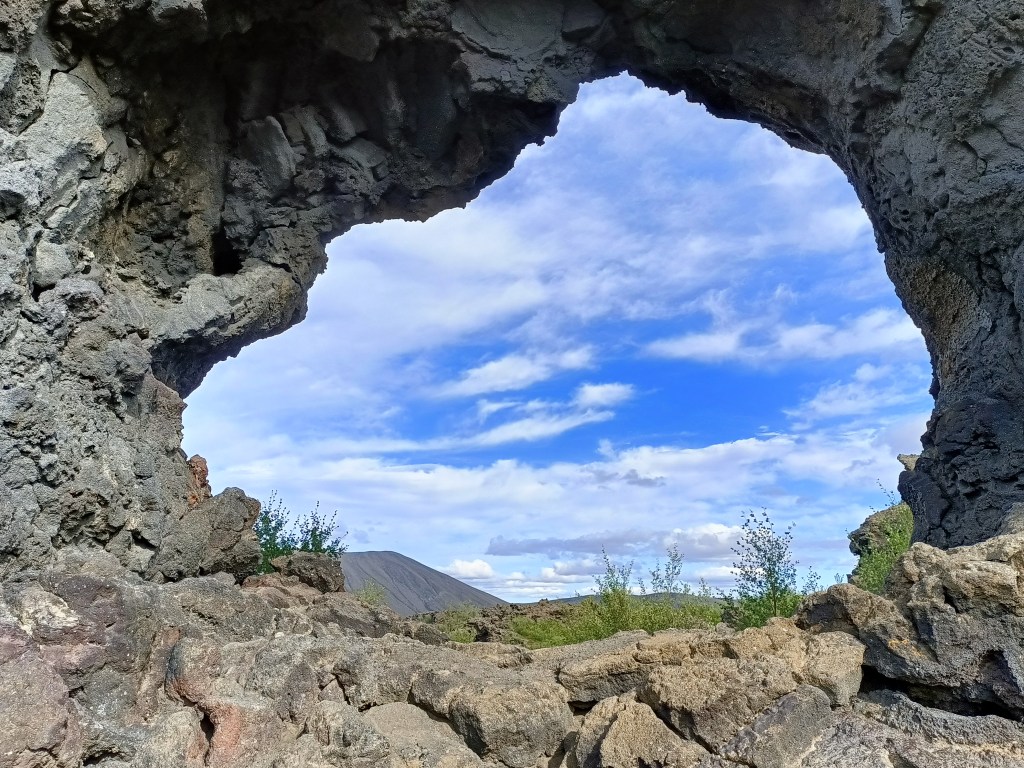
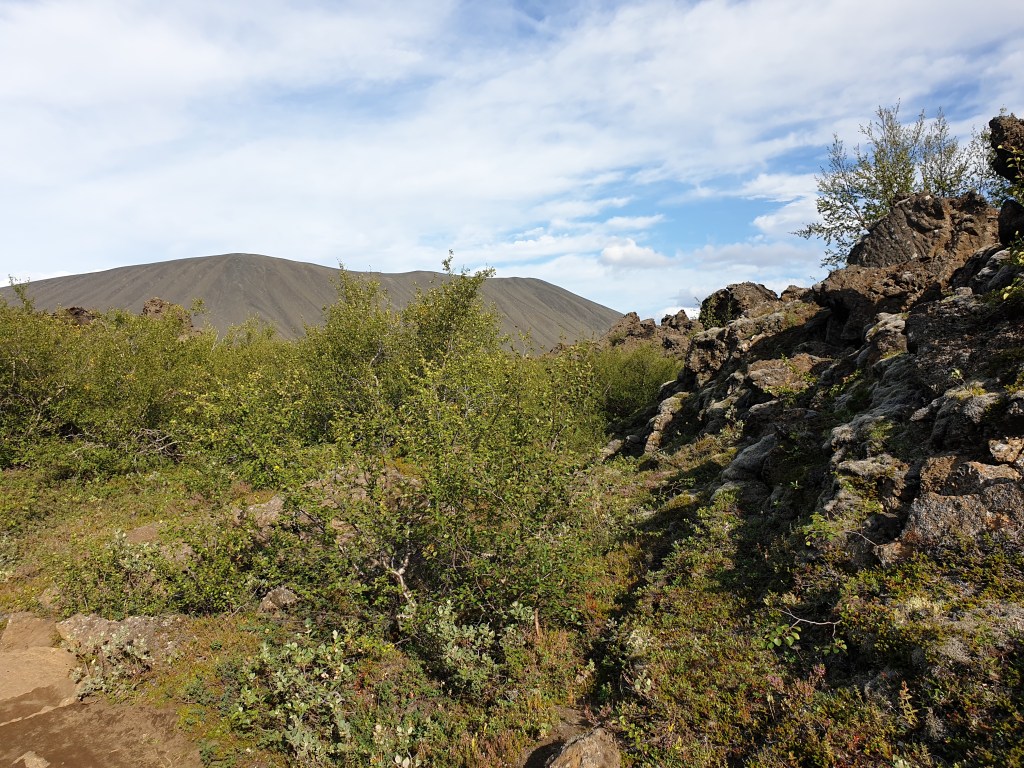
Next stop was Dimmuborgir, on the east side of the lake. Here the lava from the eruption had made many strange shapes. I stopped for a coffee in the café at the entrance to the site and noticed an interesting item on the menu – “lava bread”. This is bread made by placing dough and yeast underground, where the cooking is done by geothermal heat. I resolved to set off on a short walk and to buy some bread when I returned. After wandering around a bit on the many marked paths, I spotted a path leading to the volcanic cone of Hverfjall, about 2km away. The path up to the foot of the volcano was very pretty, with lots of flowers and strange lava forms.
An arch of lava at Dimmuborgir, with Hverfjall in the distanceOn the way to Hverfjall….
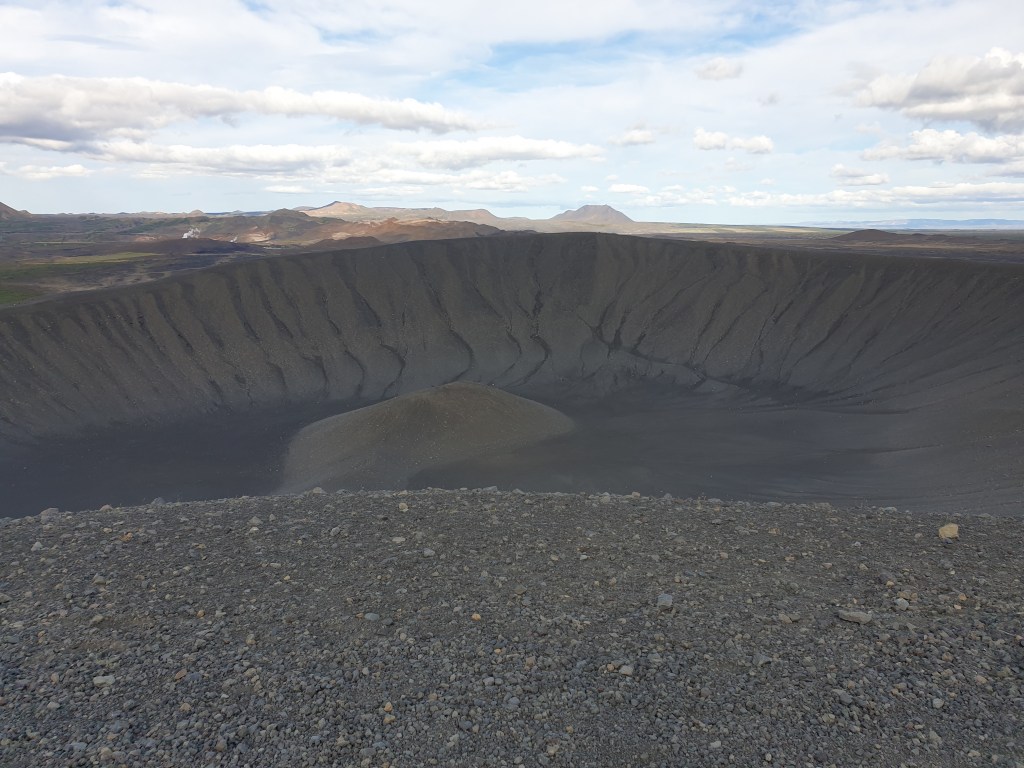
In contrast, the climb up was extremely hard and monotonous – the soft grey ash that formed the cone gave way under foot, and for every two steps up, I slid one step back. When I finally reached the top, the view was only average – the crater had no water, and resembled a giant grey ashtray. The view of the surrounding area was good, but not as good as I had experienced in my morning climb of Vindbelgjarfall.
….and on its rather disappointing summit
Remembering that the café closed at 5pm – even in peak tourist season many things close really early in Iceland – I hurried back, only to find that they had sold out of “lava bread”. I guess it probably tastes exactly like normally bread, but who knows…….
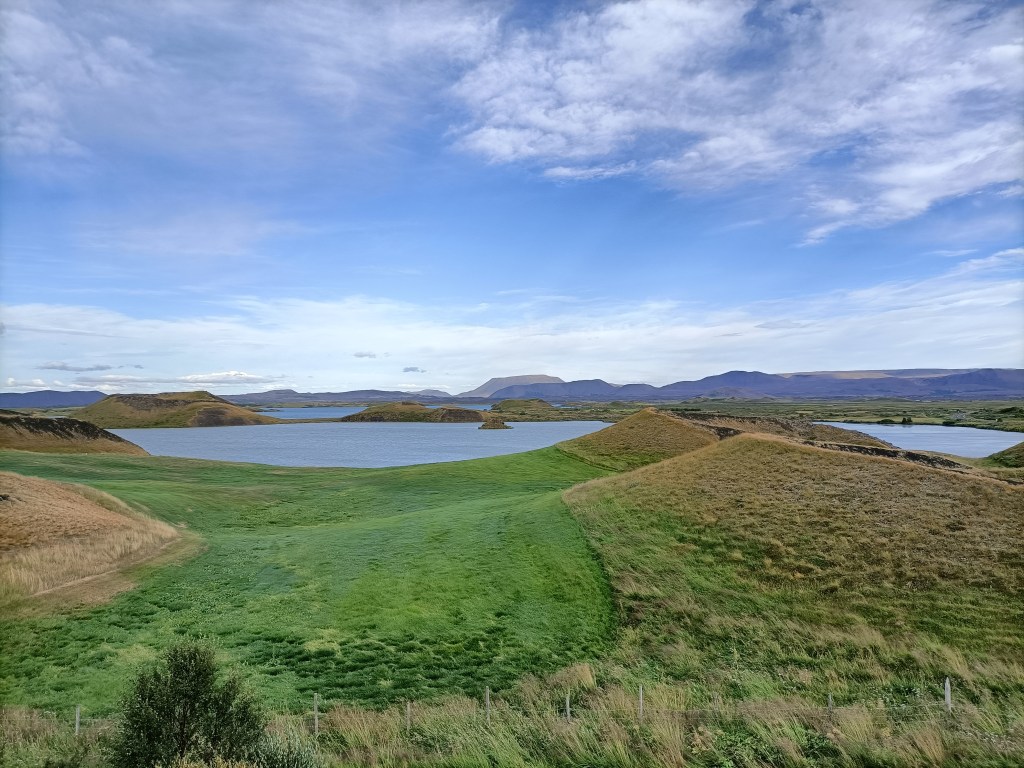
I regained my car and continued my drive, this time to the southern shore of the lake. Here the main attraction are the many small “pseudo-craters” – structures that formed when lava flowed over an expanse of water. The water boiled, and the steam created exploded through the solidifying lava to leave lots of small craters.
Pseudo-craters at the southern end of the lake
It was time to go back to my rental cottage. For some reason I feel sleepy here all the time – maybe it is the fresh air, maybe the big variations in temperature during the day, or maybe a subtle effect of volcanic gases. I had dinner and slept well.
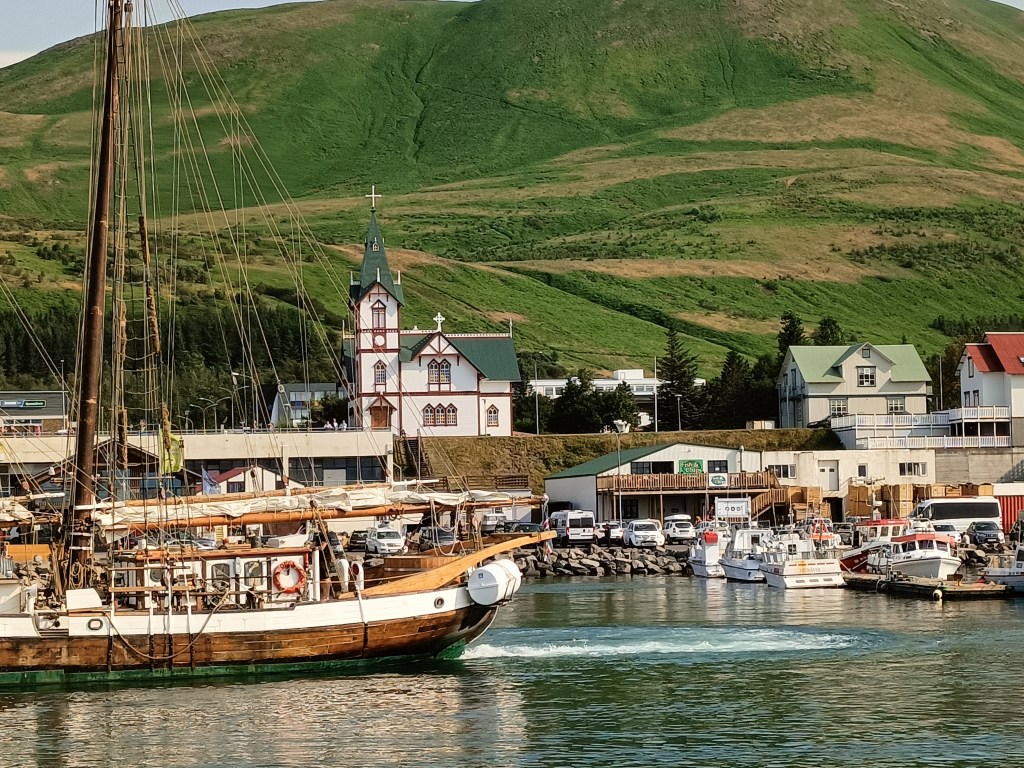
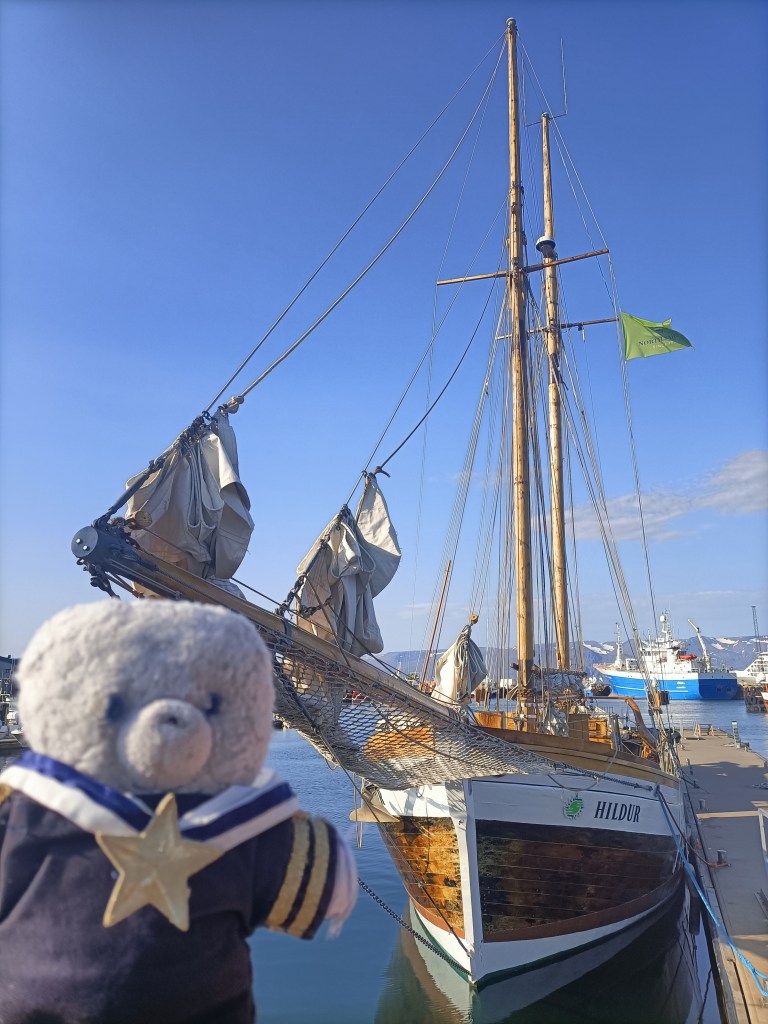
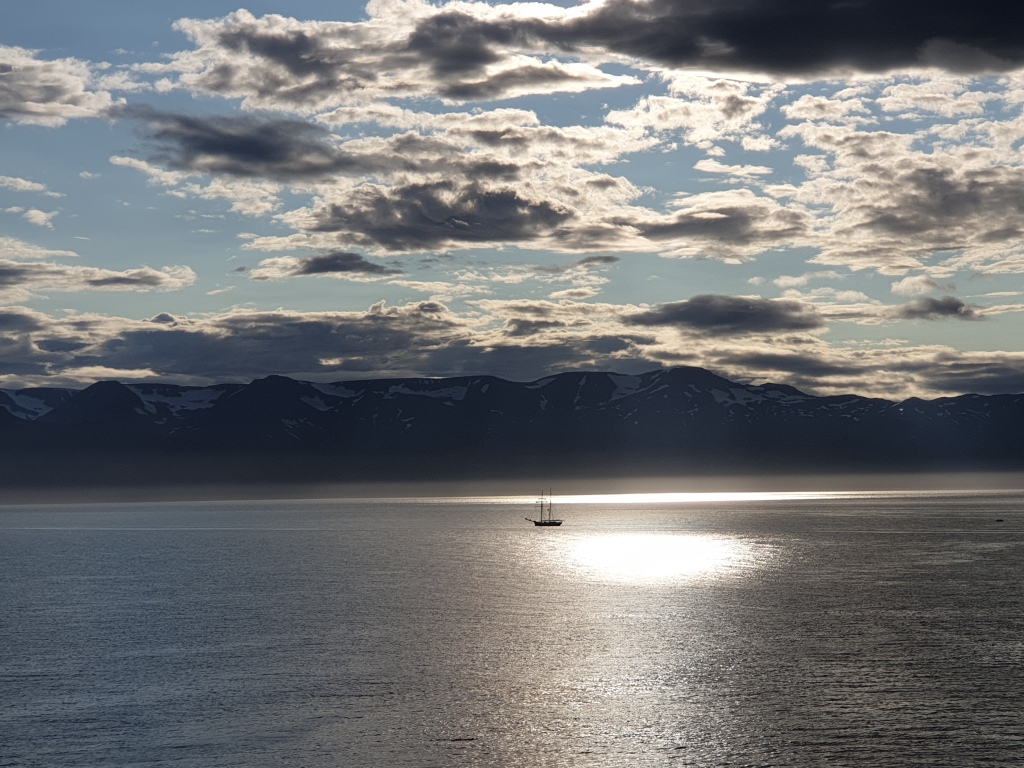
Today was busy. First, I set off in brilliant sunshine for a whale watching trip from Husavik, about 30 minutes drive away. My vessel was a pretty wooden boat called Hildur, that had sails as well as an engine.
Husavik, a pretty town and Iceland’s whale-watching centreMy boat – the Hildur
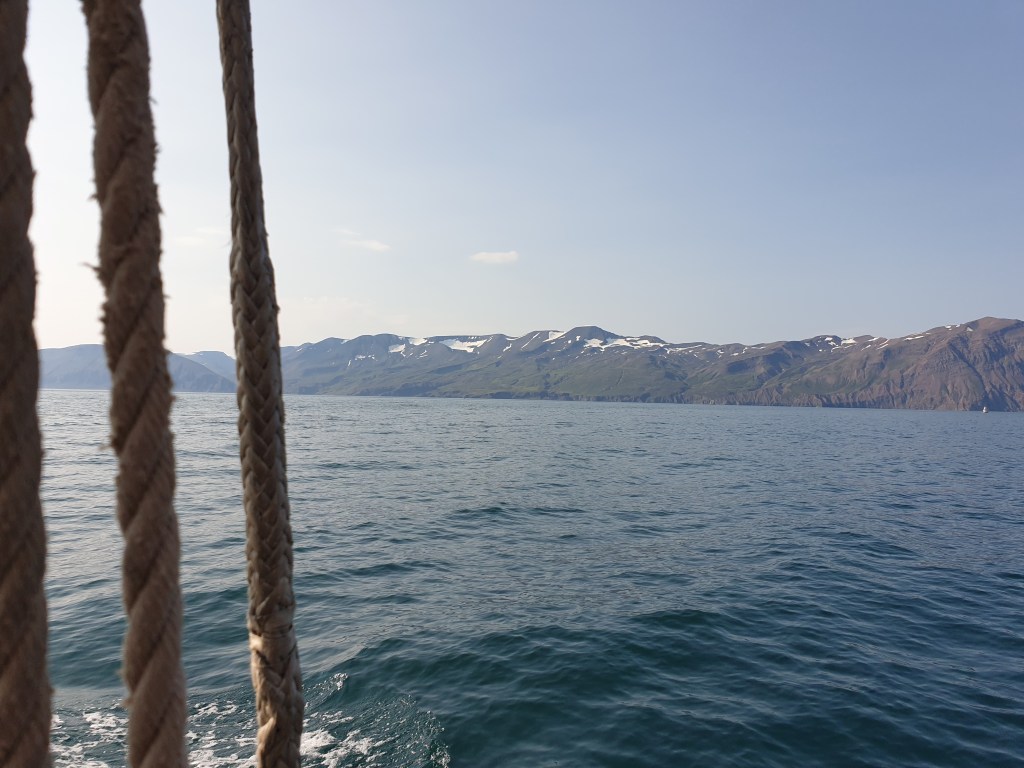
Husavik is Iceland’s whale watching capital, and the four companies that provide excursions all had websites showing encounters with large humpback whales – sometimes with the whale jumping out of the water. One company boasted a whale sighting rate of 99.6%. Once we had boarded, our guide told us ten species of whale have been seen from Husavik, including the blue whale, the biggest living animal. However, as regards actually seeing anything on our trip she was more downbeat, stressing that this was a matter of chance and where the whales happened to be feeding that particular day. And so it proved – we sailed for two hours towards the mouth of the fjord, and only saw a few birds. Whilst there was a great view of the mountains from the sea, and I saw my first ever guillemot, that wasn’t what I had come for!
Pretty mountains….but no whales
It had been hot – T-shirt weather – in Husavik, but on the sea it was cold. I put on extra clothing but was still shivering – the lack of the excitement of a whale-sighting didn’t help. The boat had just turned around to head back to port when the guide announced that their sister ship had spotted something. We hurried to join them, and finally got a glimpse of a black whale’s back, and its dorsal and tail fins. It was a minke whale, one of the smallest and most common species – the same type of whale that had recently become stuck in the River Thames only a few miles from home in London. But all the same, it was a whale, so the trip could be considered a partial success. We watched it for a while as it surfaced and dived, reemerging in a new spot each time. Its appearances were so fleeting that I gave up trying to film and just enjoyed watching.
Back on land, it was hot. The strong variations in temperature, from hot to cold to hot again had made me very tired. I ate my sandwich lunch sitting the grass of the square next to the church, and then dosed off in the sun. I felt better after my snooze, went to grab a coffee from a nearby restaurant, and then headed off to my next destination – a volcanic area called Krafla that was the site of major eruptions in the 1970s and 80s. Krafla is located just next to the major tourist centre of Myvatn, which I will visit tomorrow. The road went past a large geothermal power plant, which supplies all the electricity in the region. My first stop was an impressive volcanic crater, filled with brilliant blue water.
The Viti volcanic crater (“Viti” means “hell” in Icelandic)
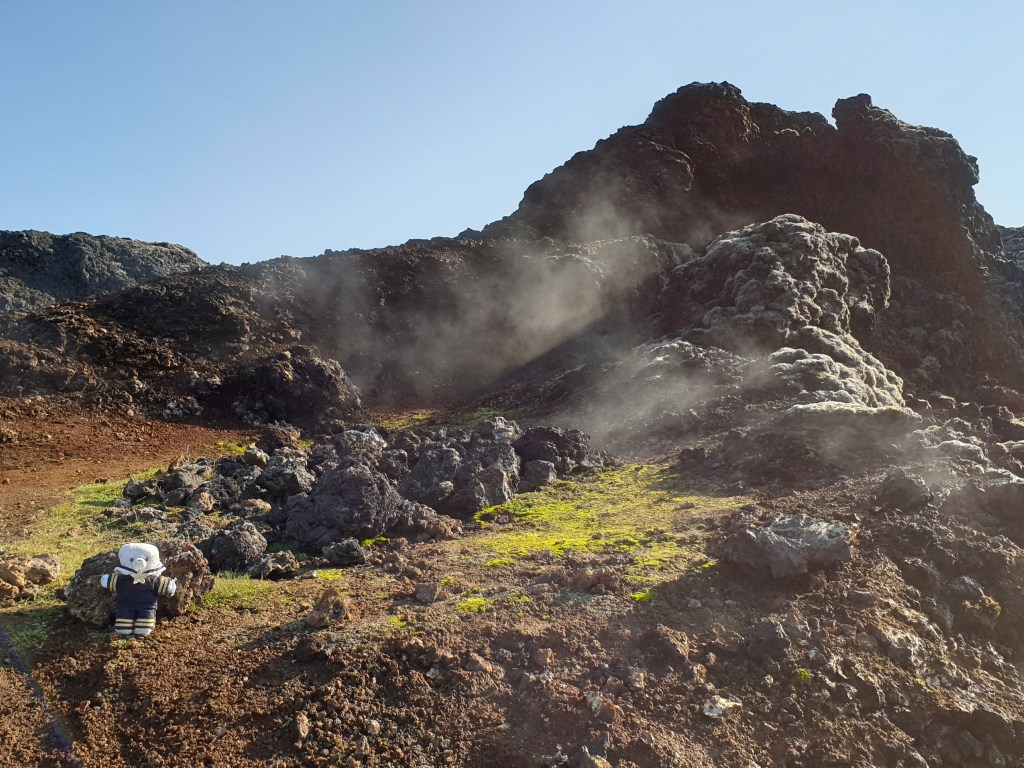
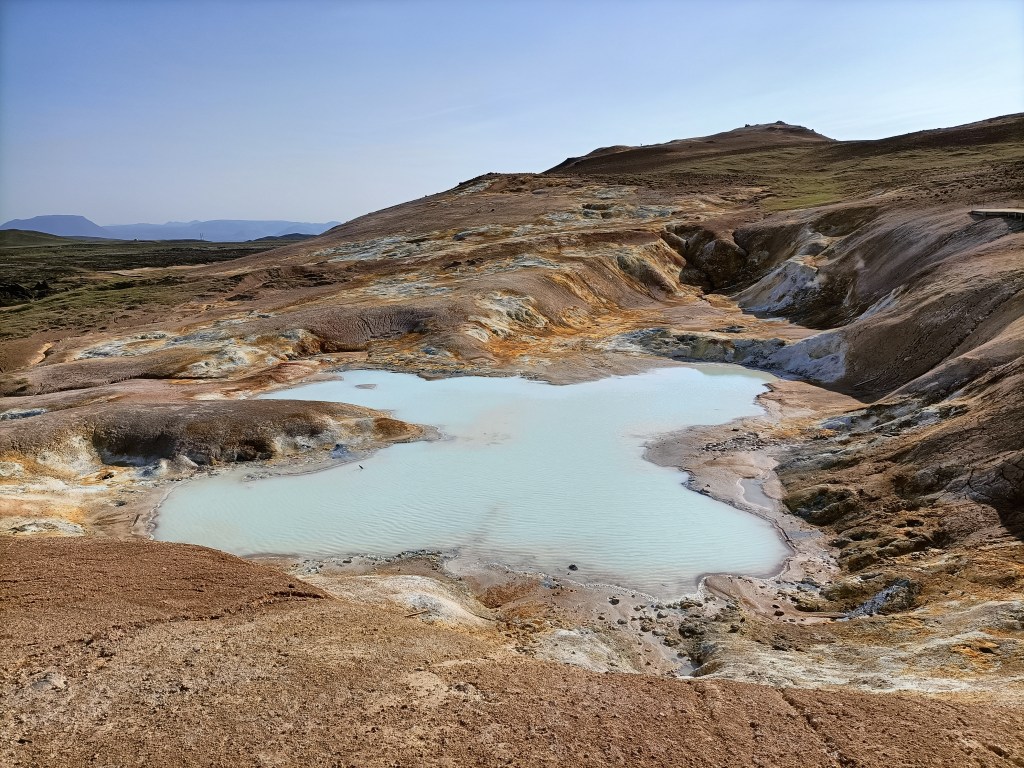
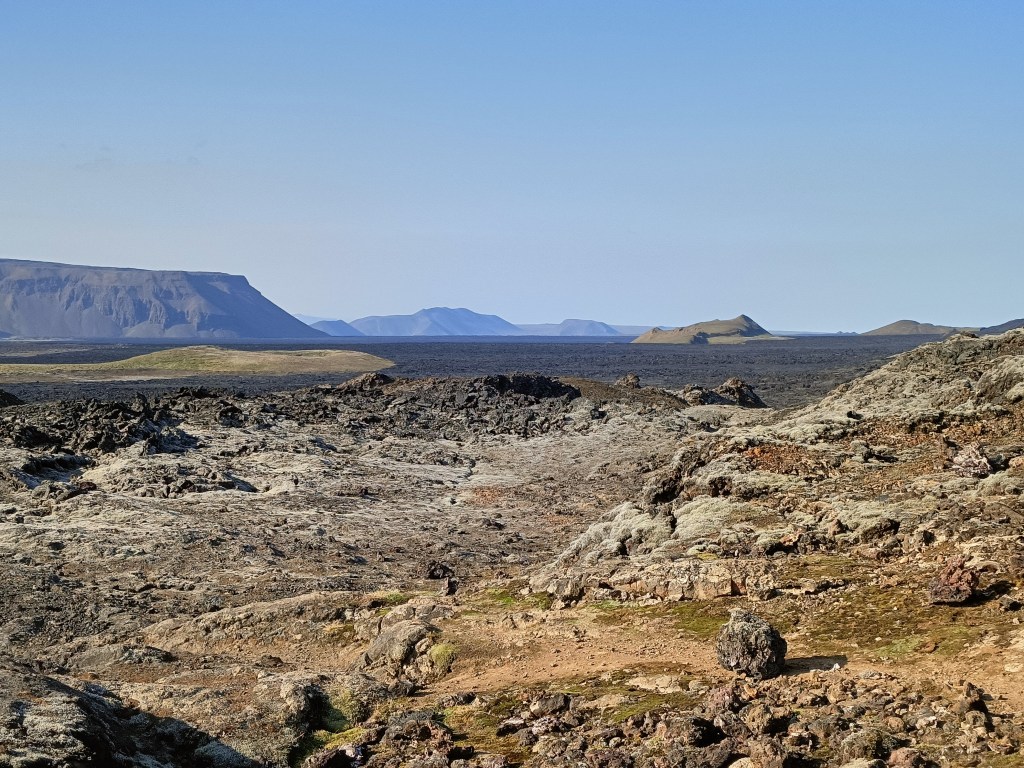
Next, I backtracked a couple of kilometres to Leihrnjukur, the site of the 1970s eruptions. The area is still volcanically active to this day. A path led through the eerie landscape of sulphurous pools and volcanic vents belching steam, with a huge lava field from the eruption stretching away into the distance. It was important to stay on the path – in places, a narrow crust of earth covers areas of boiling hot water, and it is quite possible for people to fall through and be boiled alive. Toxic volcanic gases can also be a hazard in this area. Maybe because of this, there were very few tourists visiting this area and for most of my hike I was completely alone.
As close as I dare go – a steaming vent at Leihrnjukur A volcanic pool The lava fields stretch for miles
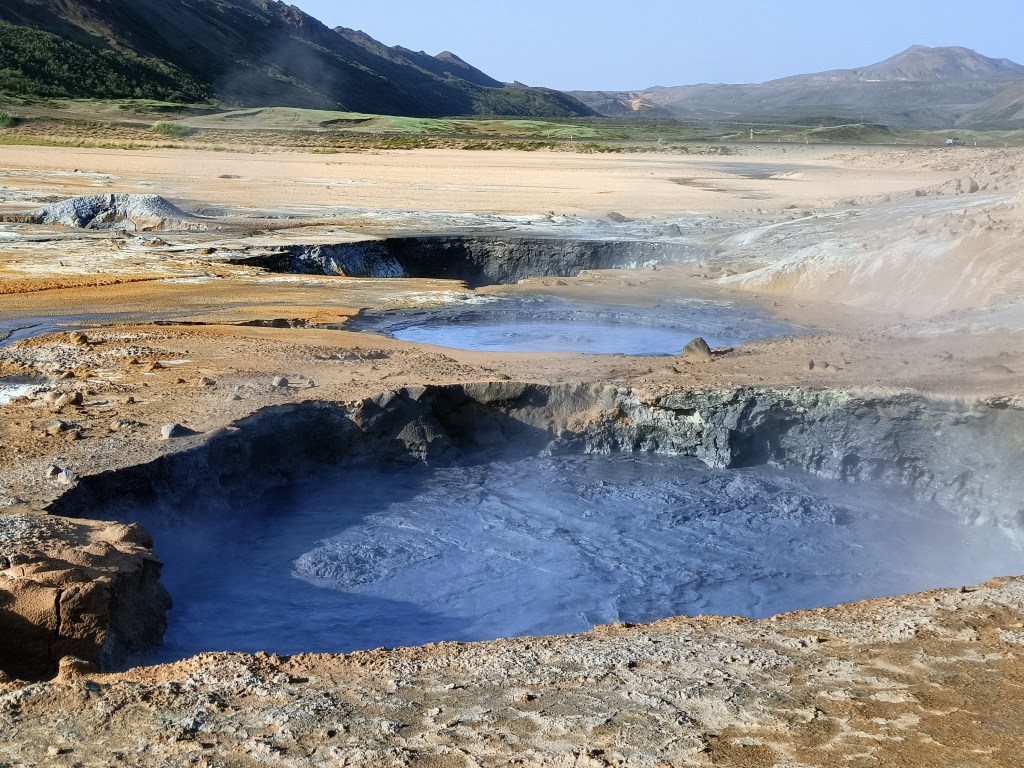
My next stop was to admire yet more volcanic activity at Hverir – a series of boiling mud pools and steaming vents located a little further down the valley. This area was much more popular with tourists than the previous two, and people competed to be photographed next to the biggest and smelliest vents.
Bubbling mud pools at HverirLike the planet Mars….
My final stop was Myvatn’s Nature Baths. Here, they have made a large hollow in the ground and filled it with hot water taken directly from the boreholes of the nearby geothermal power plant. The water is a brilliant blue colour, due to suspended silica that scatters blue light – the baths are very much like the Blue Lagoon near Reykjavik, but less well known. The water arriving from the power plant is a scalding, pressurised 130C and is allowed to cool in a large storage lagoon before being pumped to the baths, which are a pleasant 38-42C. I spent a happy hour wallowing in the water, admiring the views over the volcanic plain to the mountains in the far distance.
The Myvatn Natural Baths
The baths stay open until midnight and I thought about staying until the sunset at 9pm, but decided that spending three hours lazing in hot water was a bit too decadent. Besides, I was now hungry, so I headed home and had an excellent dinner of fresh Icelandic cod after another busy and varied day.
Today I made the long drive to the north coast of Iceland. I left early and drove back over the pretty mountain pass to Egilstadir, and then my route lead straight across Iceland’s interior. At first the road went through green rolling hills, like the countryside I had seen before – with the inevitable waterfalls.
Yet another waterfall just off Route 1
Then the landscape turned grey and barren, and it looked like I had arrived on the moon or another planet.
The Lunar Landscape of Iceland’s interior
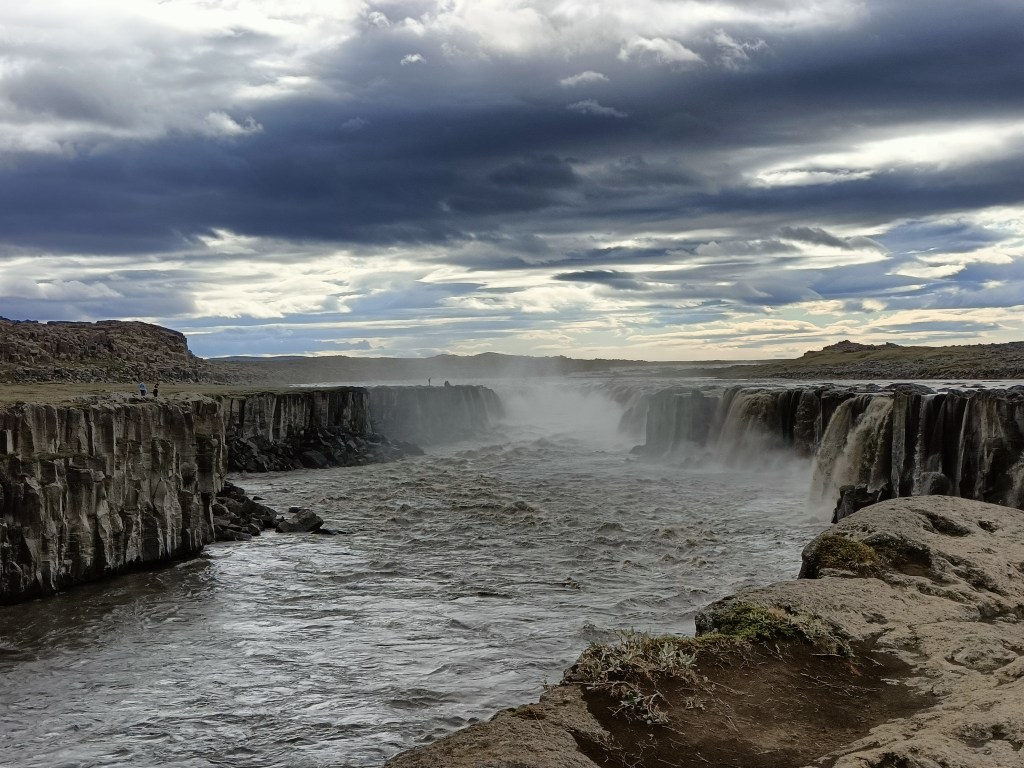
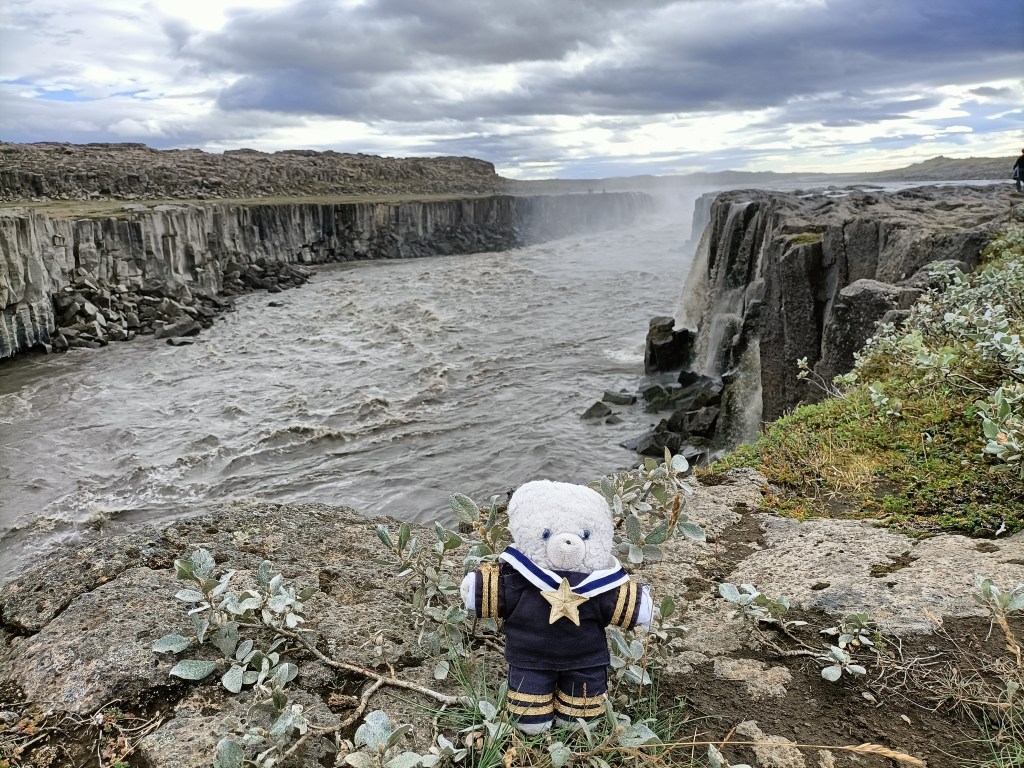
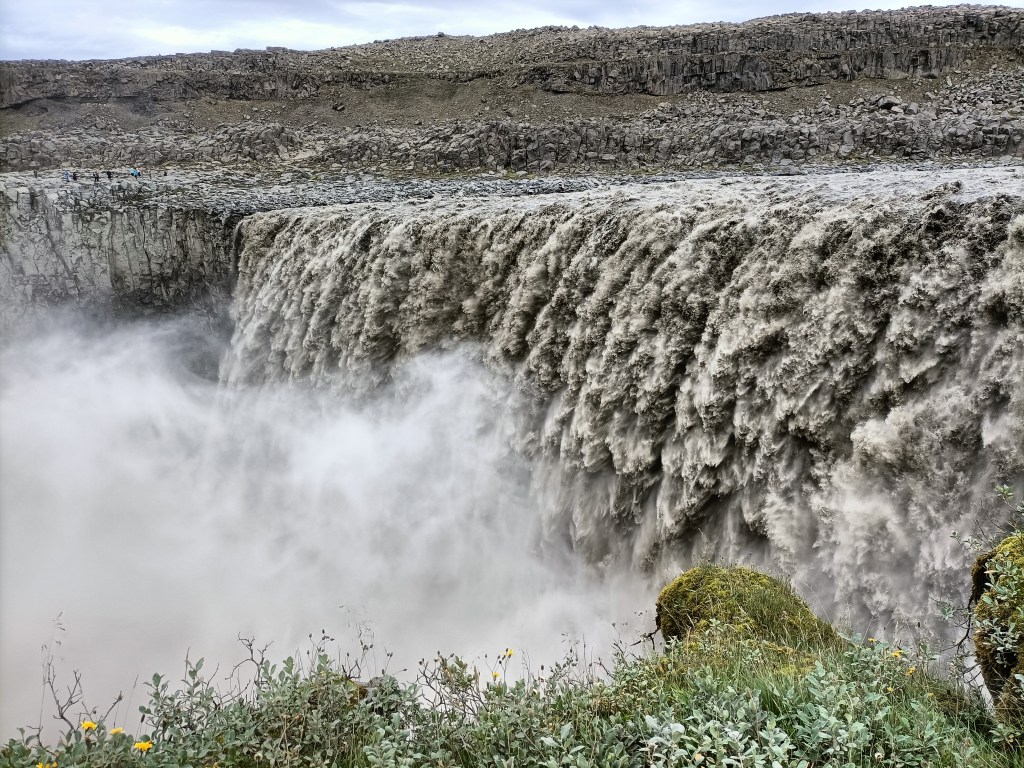
I drove for about two more hours along these straight, empty roads, before reaching my first destination for today – the waterfalls Selfoss and Dettifoss. These are not the highest waterfalls in Iceland but still impress through the power of the huge volume of water hurtling through the steep river canyon. I made the short walk to the smaller Selfoss first………
Selfoss waterfall (the “smaller” one)
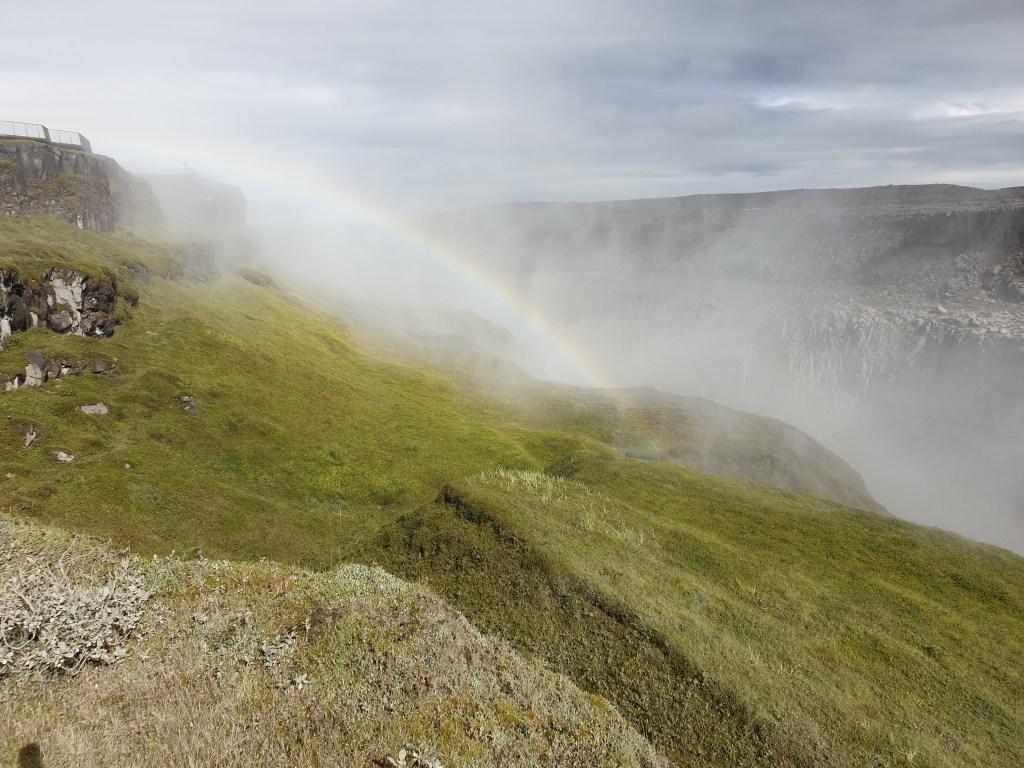
…..before standing in awe in front of mighty Dettifoss. It was a great stop for my lunch sandwiches, and when the sun periodically appeared, the waterfall’s spray made a pretty rainbow.
Dettifoss was just one of things to see in the “Jokulsargljufur” area, a long canyon formed long ago by a volcanic eruption under the Vatnajokull glacier in the centre of Iceland (which I visited earlier on my trip in the South). The melted glacier water surged down the valley in a cataclysmic flood, and carved out the canyon in a matter of days. I followed the canyon by a new road leading along its west side, and stopped for another walk to explore further. I saw weird volcanic lava shapes that looked like sleeping monsters (Icelanders would call them trolls), a lave cave (formed when the outside of a lava river solidifies but the inside keeps flowing) and pretty mountain flowers, with purple heather.
A sleeping trollA Lave Tube (nicknamed the “chapel”)Rolling countryside with arctic flowersI found the river again!
Further down the road, I explored the last part of the canyon, a huge horseshoe-shaped ridge surrounding a lush forest covering the floor of the old, now dry, river bed.
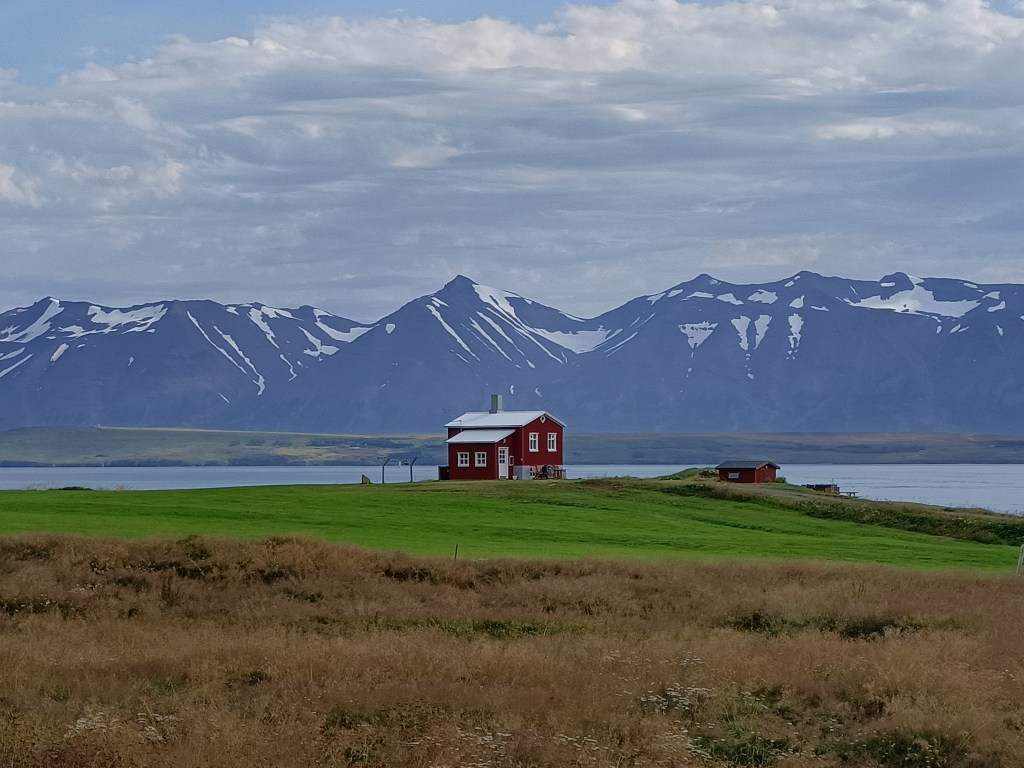
It was now later in the day, and my remaining route took me through the town of Husavik (my destination for tomorrow) where I stocked up on food and took photos of the mountains lining the other side of fjord.
Views over the bay from Husavik
I finally found my rental cottage in the evening evening, and cooked myself Icelandic lamb for dinner. It had been a very long but very fulfilling day.
Today was a quiet day spent driving from the south to the east coasts. I left Hofn in the rain and followed Route 1 around the south-eastern coast of Iceland. The road would probably have been very pretty, had it been possible to see the mountains looming behind the clouds. I took a few pictures in the breaks between rain showers.
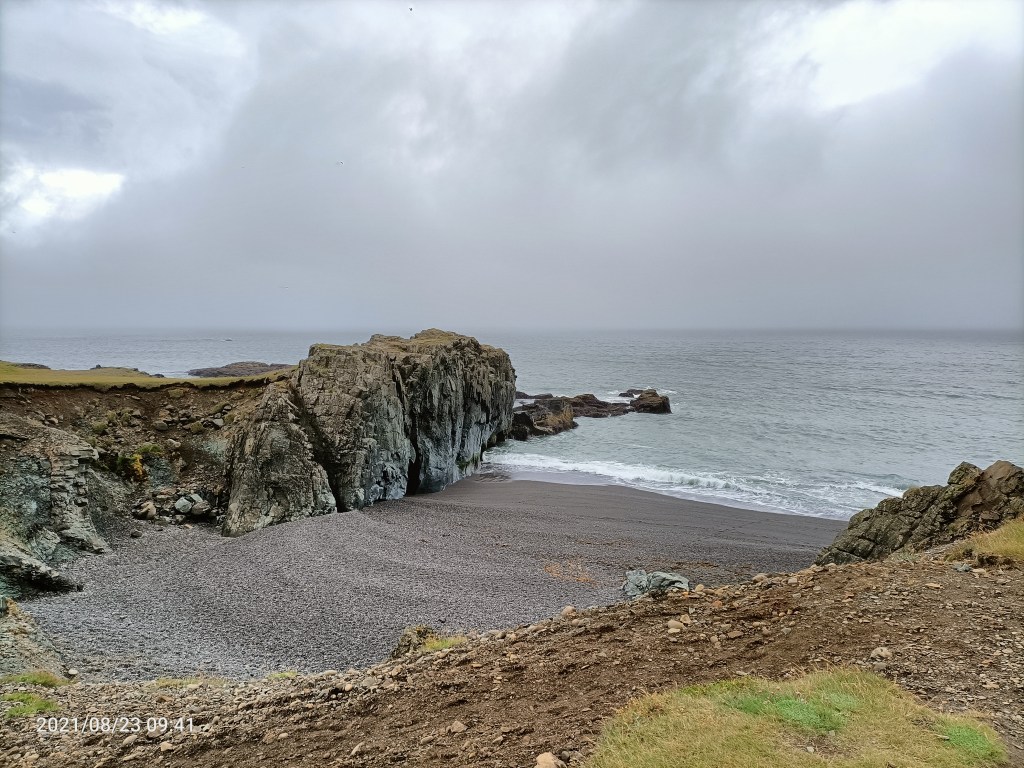
A beach in South East Iceland – between showers
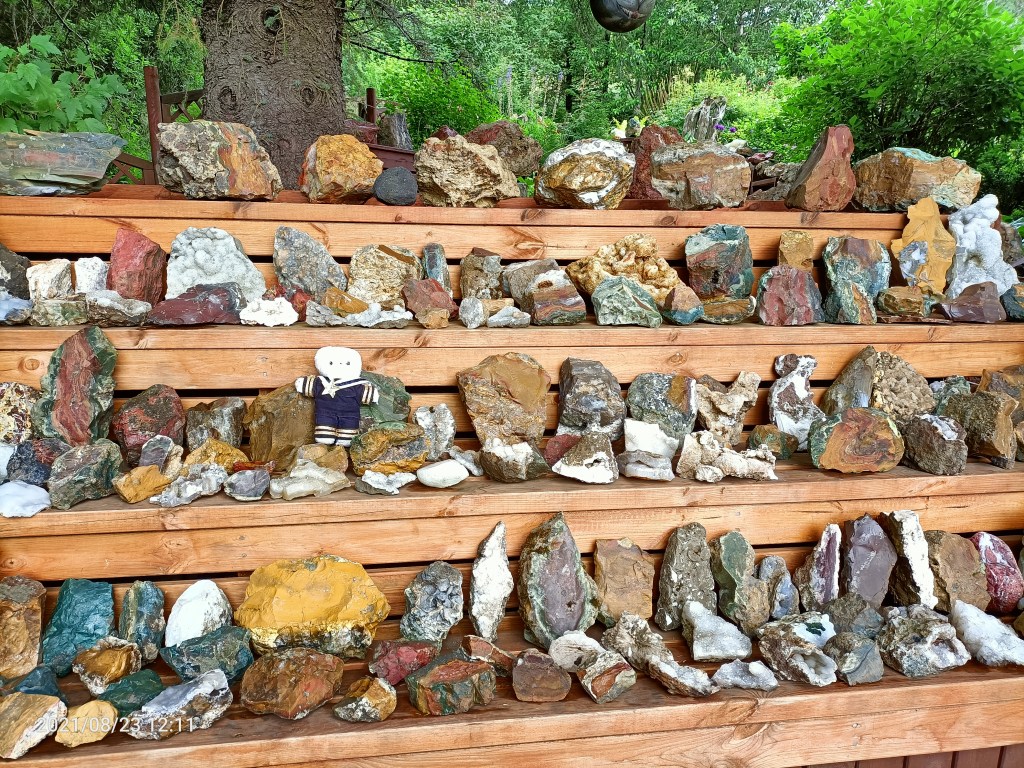
My one stop on in the morning was a cute museum in the tiny village of Stodvarfjodur, which showcased the huge number of local rocks and minerals collected by one woman – Petra Sveinsdottir. She became fascinated by mineralogy at an early age, and whenever she had free time, she would set off into the mountains to collect more samples, sometimes coming back with 40kg of rocks in her backpack. Interesting specimens that were too large to carry had their location marked so that Petra could come back in winter with a sledge to collect them. It was an interesting museum, even if I got the impression that Petra had collected the same ten types of rocks hundreds of times.
Petra’s rock museum
The road continued to snake around the fjords of the east coast of Iceland until it headed inland to Egilstadir. Now it was even sunny!
A typical Icelandic view on the way to Egilstadir
There, I left Route 1 to head to the small town of Seydisfjordur, located at the head of a fjord on the eastern end of Iceland. The road to get there crossed a beautiful mountain pass, before descending steeply to the bottom of the valley, with yet more waterfalls.
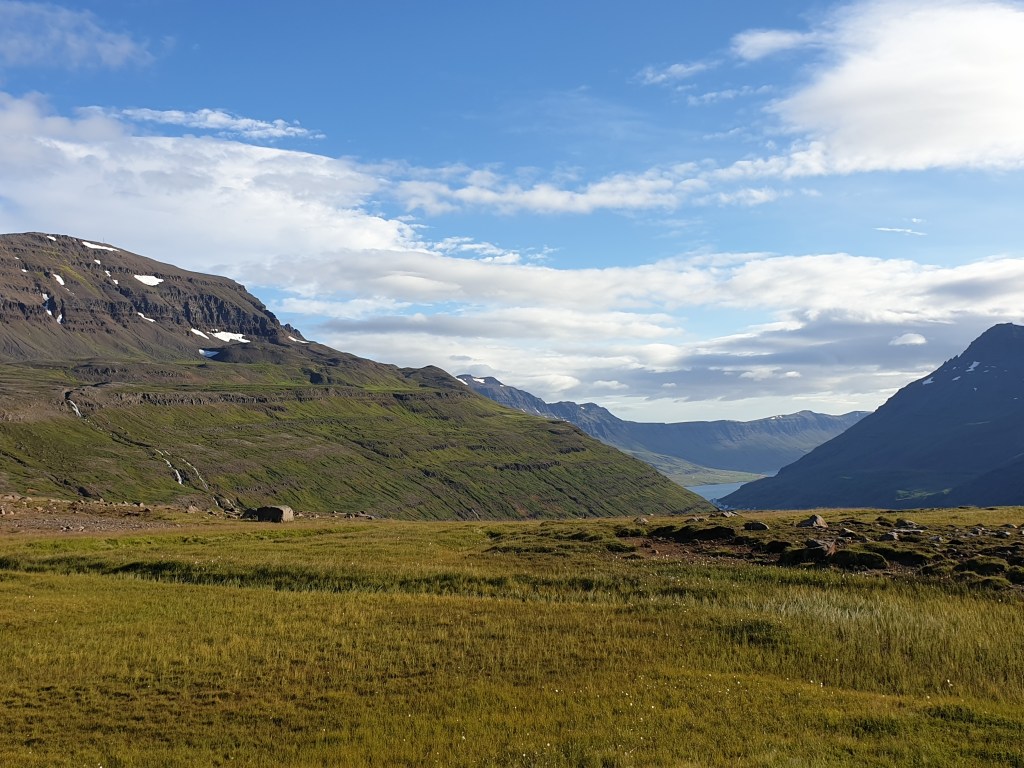
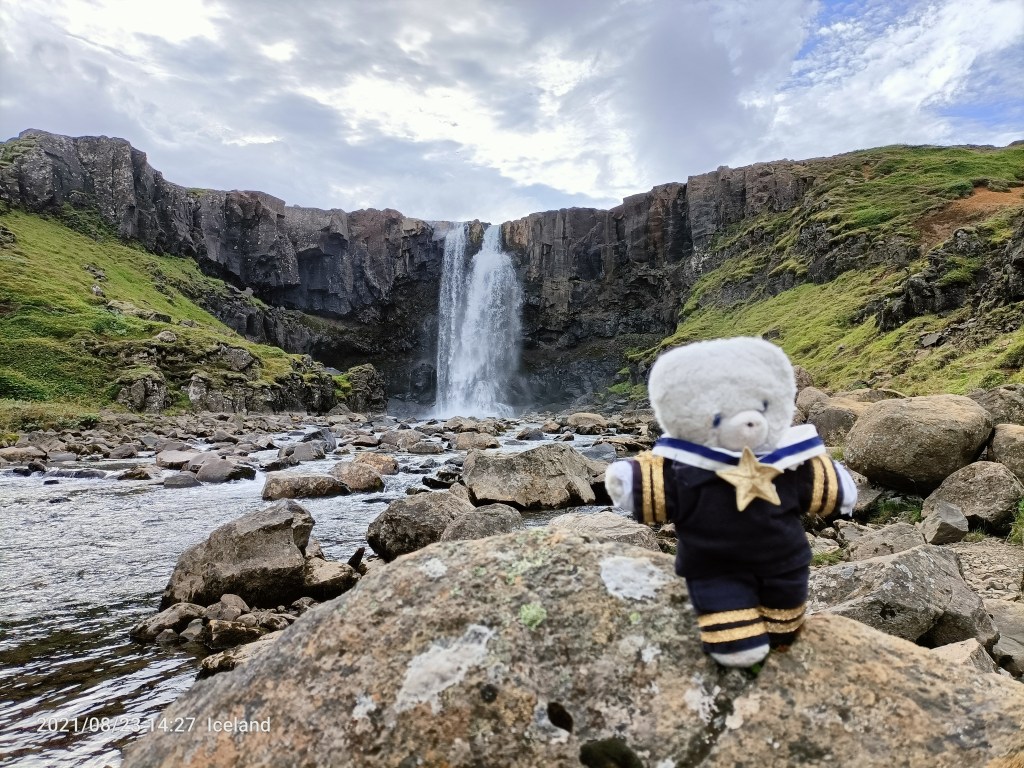
View from the pass travelling to Seydisfjordur Yet another waterfall – this one is called the Gufufoss
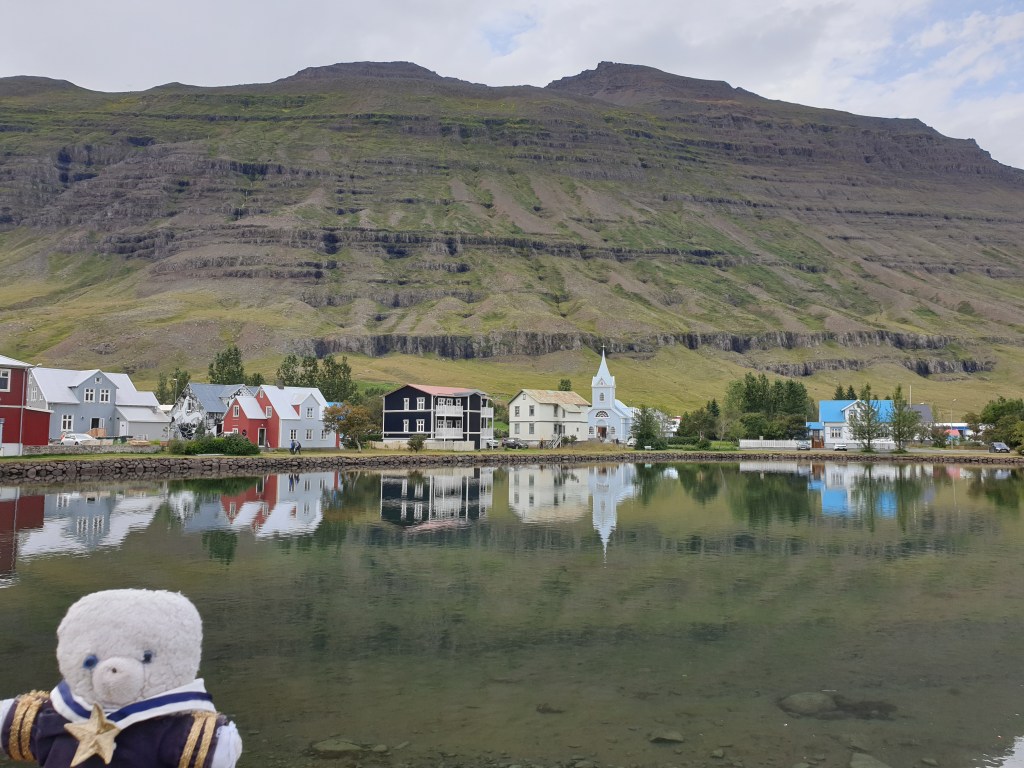
Seydisfjordur is a small, pretty town consisting mostly of old traditional wood buildings. It has had a long and varied history – the fjord was colonized by the Vikings in the 11th century, became a centre of the herring and whaling industries in the 19th century, and then a British and American military base during WWII. Now that the fishing industry is gone, the town is home to many artists, and has a relaxed feel to it.
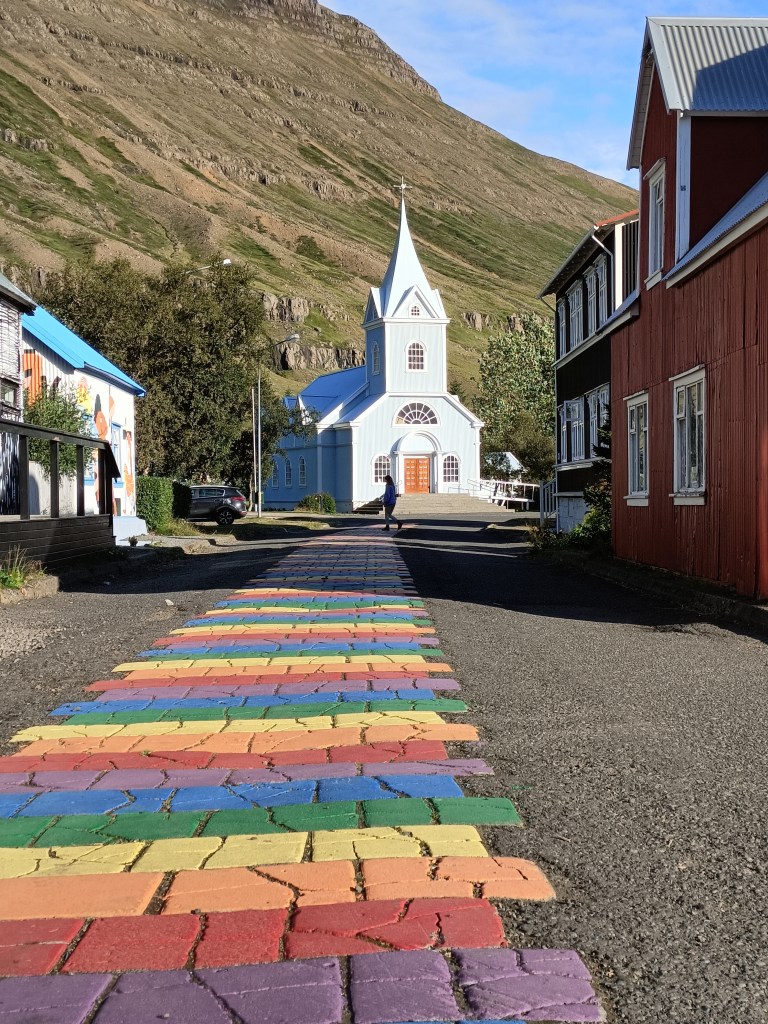
Seydisfjordur nestles next to a lagoon, at the foot of steep mountainsThe “Rainbow Street” leading to the church
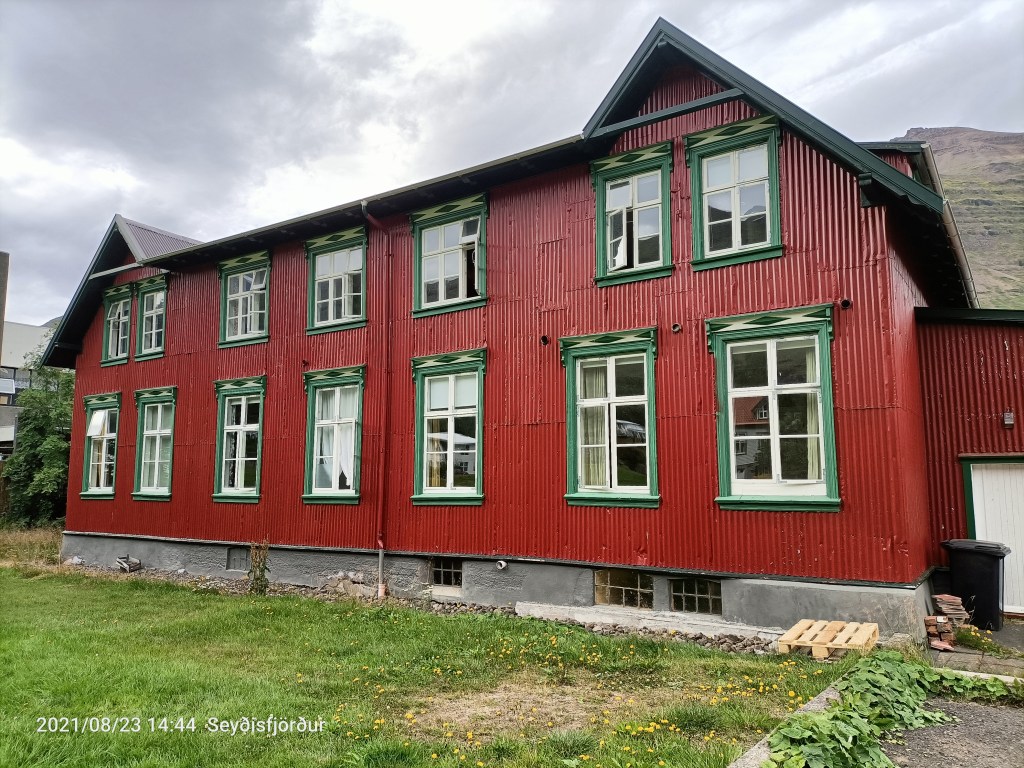
I had booked a private room in a hostel, which turned out to be surprisingly good. It was located in one of the many pretty 19th century buildings.
My hostel
I arrived in mid-afternoon and set off to explore the town. The weather had changed dramatically, and after shivering in the rain in Hofn the day before, I now stripped down to a T-shirt to enjoy sun and 20C temperatures. I booked a restaurant for that evening and headed back to my hotel to relax and write my blog.
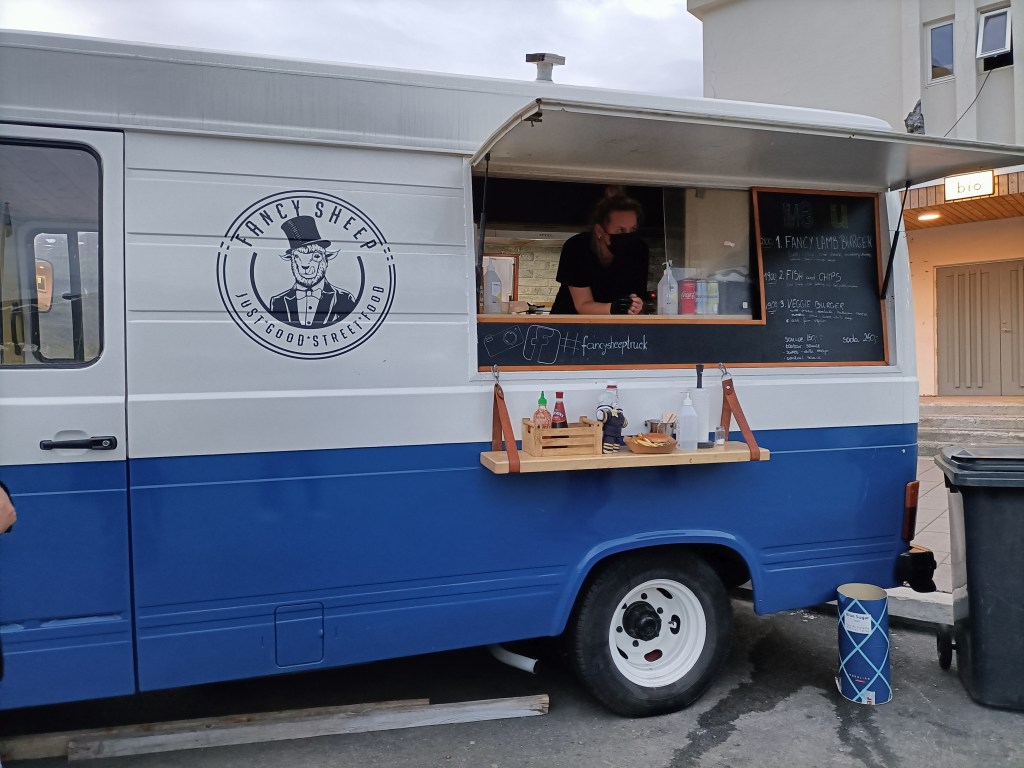
That evening, it was warm enough to eat outside without a coat. The restaurant’s food was good, but the portions turned out to be tapas-sized, and I was still hungry after dinner. Another stroll around town provided a solution to my hunger – a van called “The Fancy Sheep” serving burgers and fish ‘n chips. I enjoyed a very good lamb burger – it was now 10pm, but it was still warm and light, so I ate outside again, admiring the valley, before heading back to my hostel for bed.
The “Fancy Sheep” (you can see me just under the window collecting my burger)
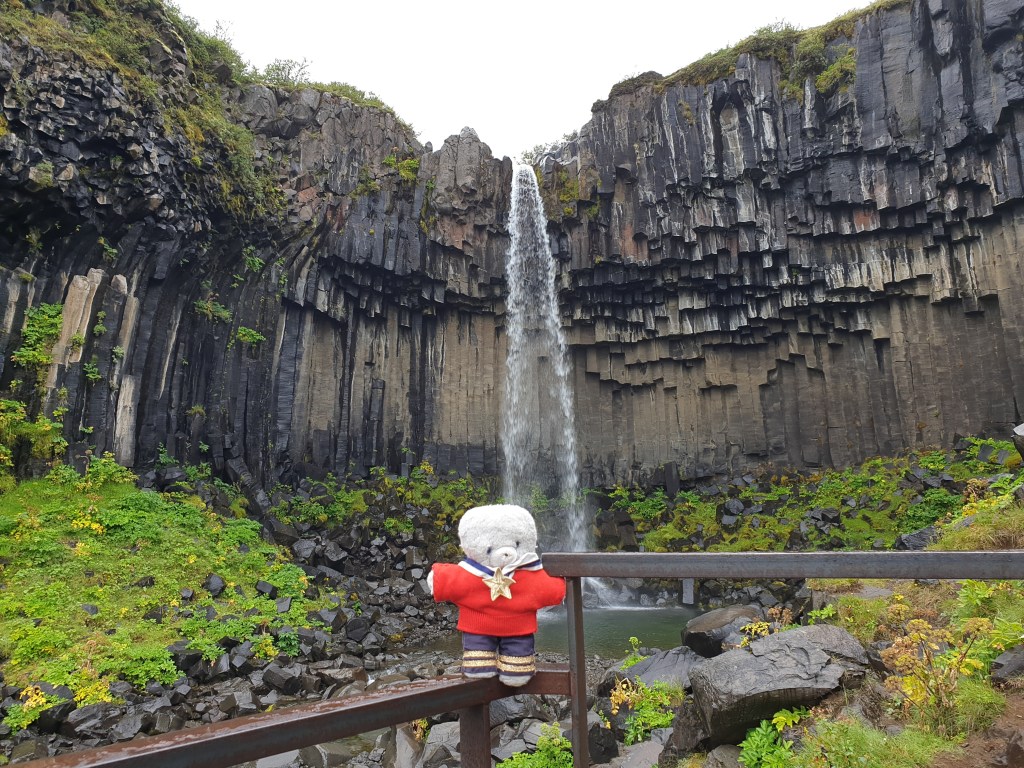
I woke up early the next day to see heavy mist through the window. I set off for the short walk to the Svartifoss, or Black Waterfall, in the national park. The Svartifoss is smaller than the other waterfalls I had seen in Iceland but had an interesting setting – it tumbled down over hexagonal black basalt columns.
Svartifoss
I took some photos and then continued my walk, with views over the mountains and out to the glaciers.
The view from my walk
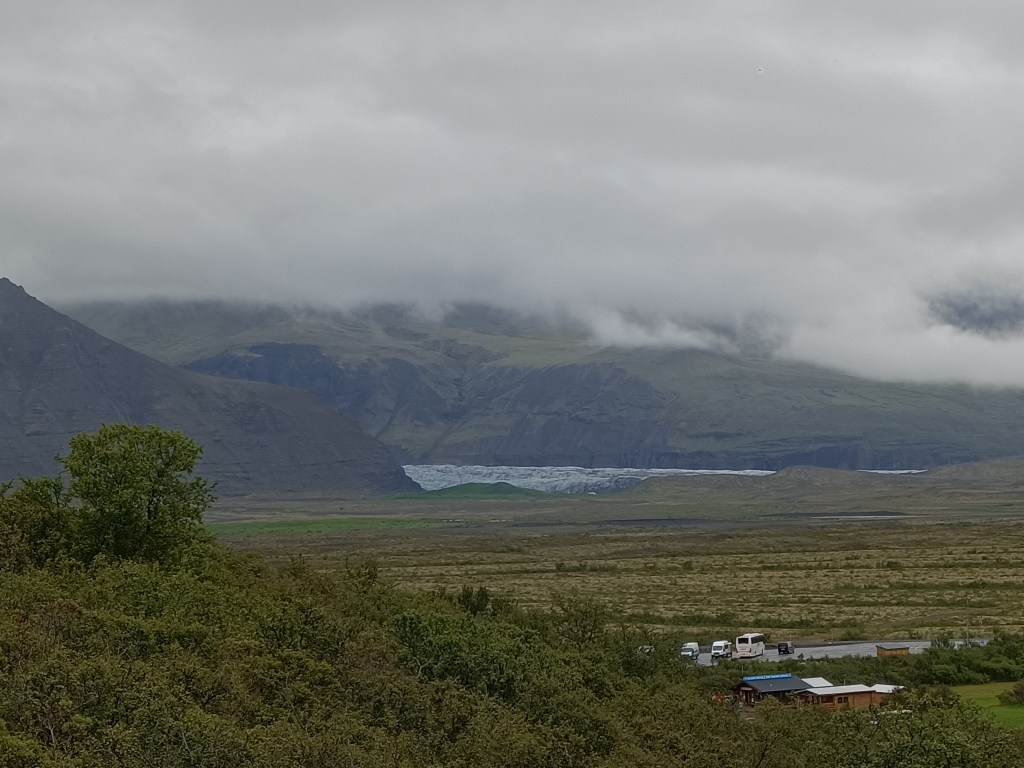
The park is huge, with hiking trails that over 20km long, but although the mist had lifted, the tops of the mountains were still hidden in clouds, so I decided to head back to the visitor centre and continue my drive down Route 1. I drove past many more “arms” of the mighty Vatnajokull glacier; the sun had now emerged, making the view much more impressive.
Arms of the Vatnajokull glacier, as seen from Route 1
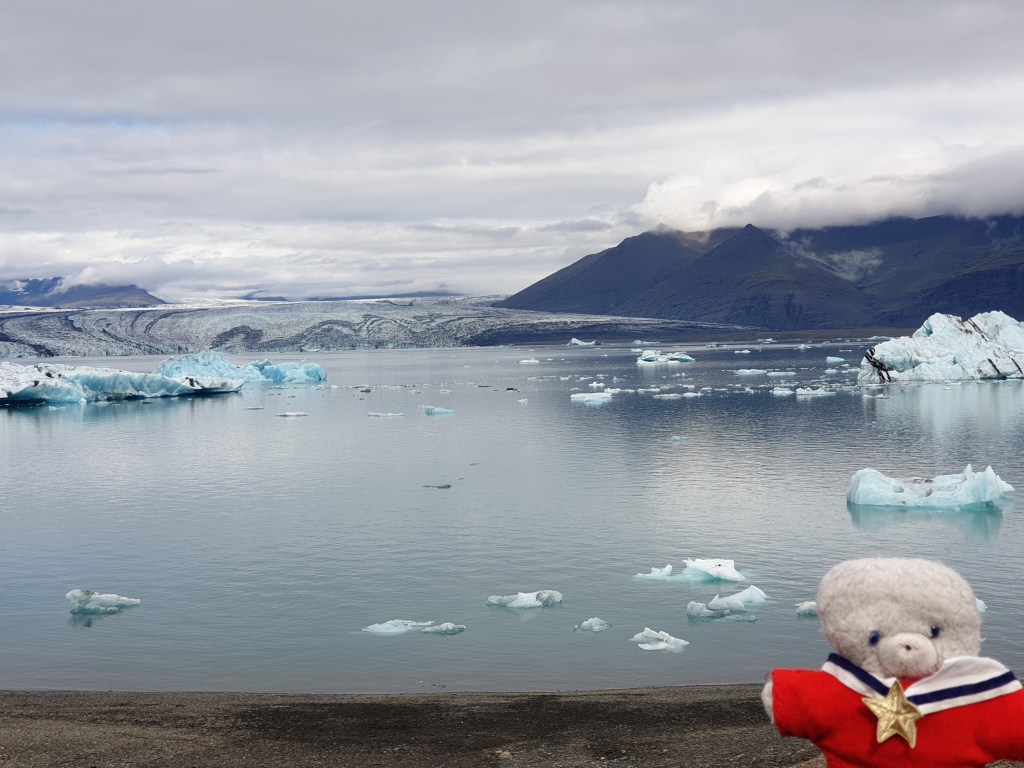
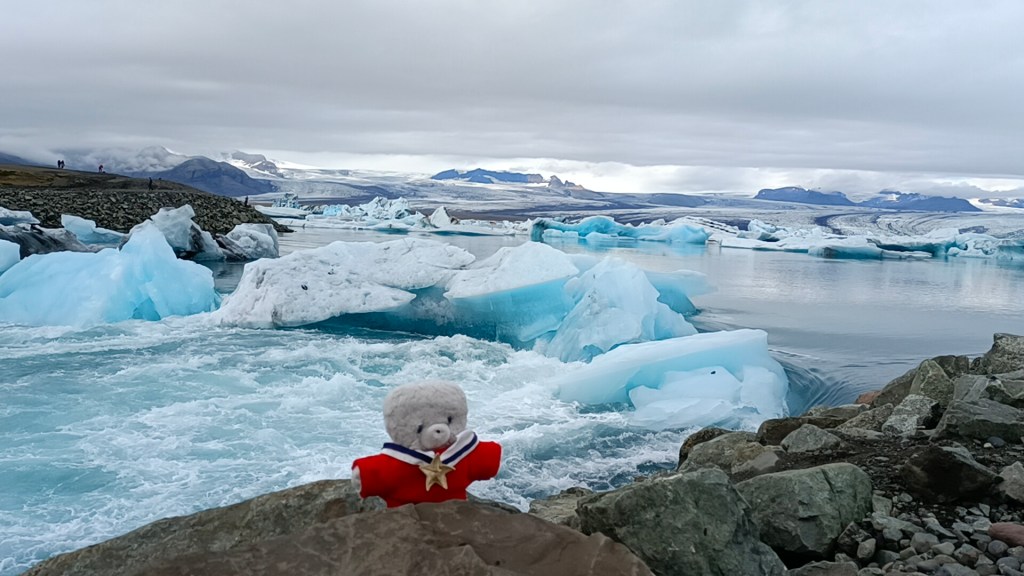
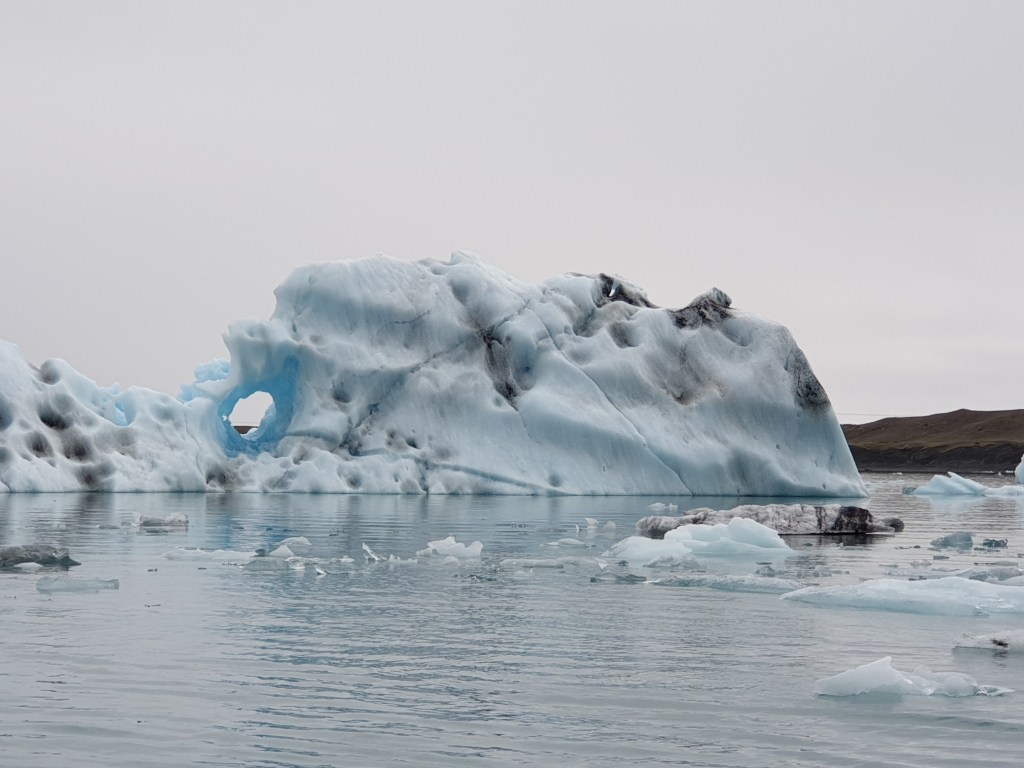
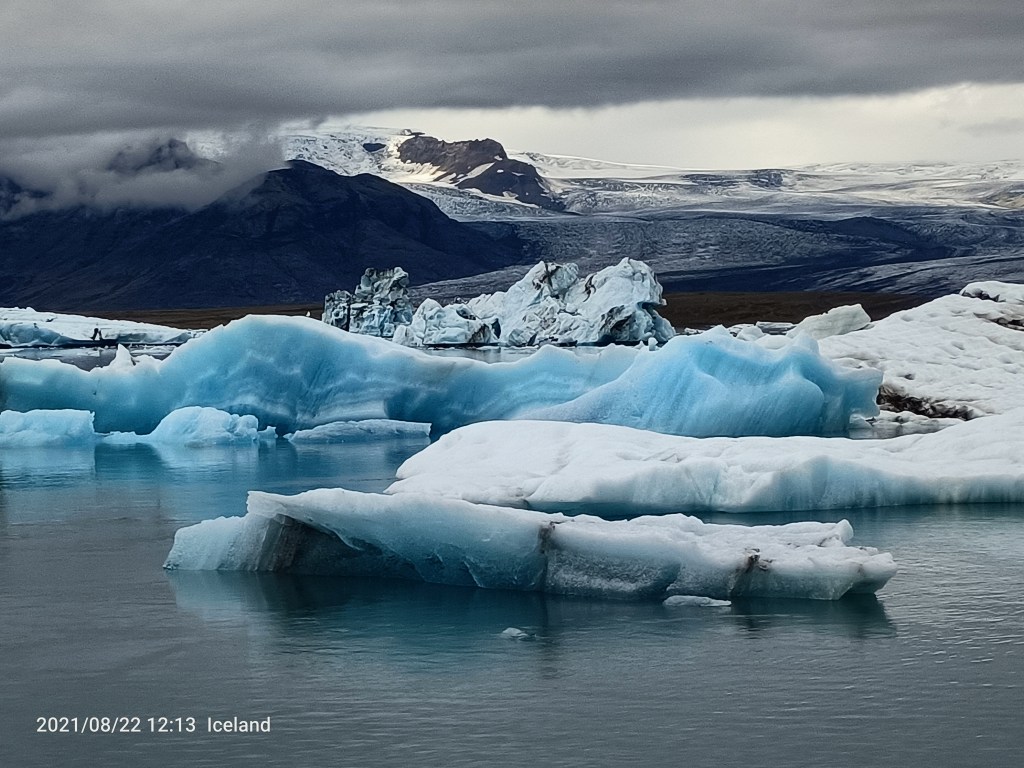
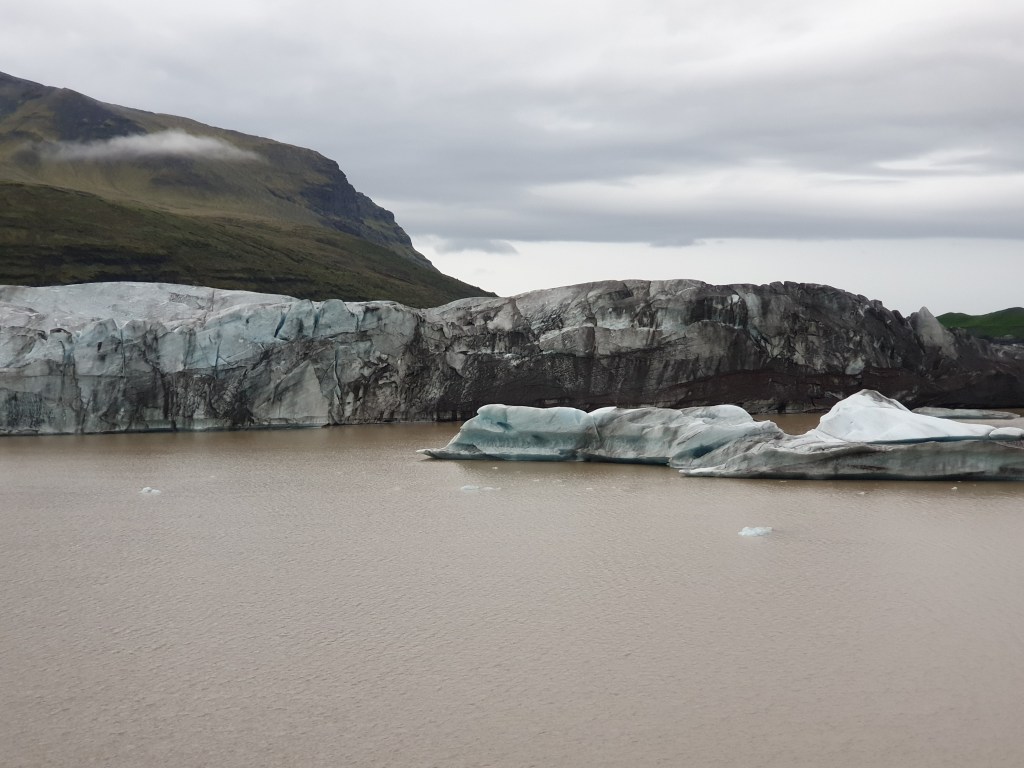
After an hour’s driving I found one of Iceland’s highlights – the Jokulsarlon lagoon. In the early 20th century, the glacier here used to stretch all the way to the sea, but over the years it retreated up the mountainside leaving behind a large lake, connected to the sea by a short river. Mini-icebergs break off the glacier and float in the freezing water, slowly melting and all the time drifting slowly seaward. The larger icebergs would get stuck in the shallows of the river, and would sit there, with the water rushing past them. Eventually they would lose enough bulk to float onwards and out to sea, where the salt water would speed up their disappearance. Some icebergs ended up washed back onto the black sand of the beach – nicked the Diamond Beach by locals. There, the waves would play with them, washing them one way and another, rolling and shrinking them. It was a splendid and unique sight, unlike anything I had ever seen before, and I spent an hour watching the spectacle and trying to film the seals that live in the lake. I was really lucky that the clouds had lifted a bit, allowing the sun to occasionally bring out the wonderful colours.
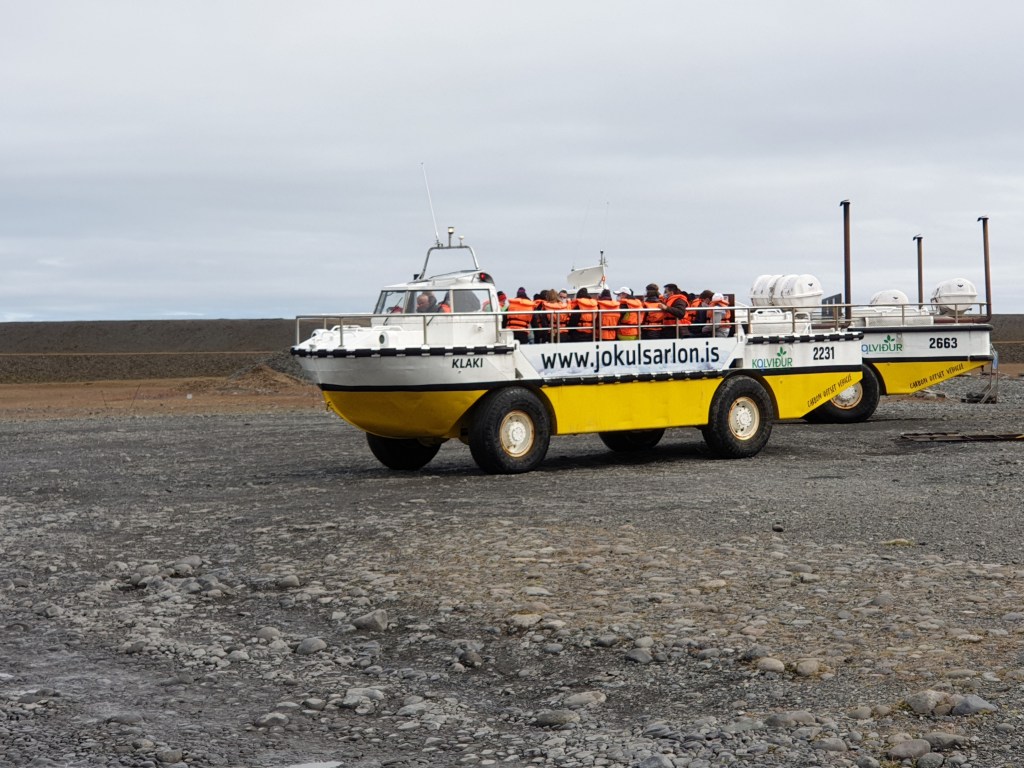
The guide explained that the water in the icebergs had been trapped in the glacier for a thousand years, and that the black strips you could see in some icebergs was layers of volcanic ash from eruptions hundreds of years ago during the ice’s long journey to the sea. The bright blue areas of the icebergs were made of ice that had been underwater until recently, but which had flipped to the surface as the iceberg melted and became unstable. Once exposed to the air and sun, the ice turns to snow and turns white.
After the boat trip I continued my drive to my next hotel, in the village of Hofn. I stopped off briefly for a soak in some geothermal hot tubs. It was relaxing to sit in the hot water, with nothing to do but admire the mountains in the distance.
Hot tubs….an Icelandic way to relax after a busy day
Hofn looked like it could have been a pretty, small fishing village, but by the time I arrived the rain had returned, and everything was a dull grey colour. I checked in and this time was very pleased with my hotel. It I had a large communal sitting room with a view of the sea, which inspired me to sit and write my blog. After an hour’s writing I decided that I deserved to eat out for change – the speciality of the town was freshly-caught langoustine, which sounded very tempting. Unfortunately, I set out rather late by Iceland standards (7.30pm) and each restaurant had a queue of hungry, wet, tourists outside, who were being informed that they would need to wait an hour for a table. I returned to the hotel and ate the last of the food I had bought in the supermarket back near Reykjavik. I would have preferred to have eaten out, but at least I had a change from smoked fish……smoked lamb! Although it was very good, I resolved to book a table in a restaurant in advance at my next destination.
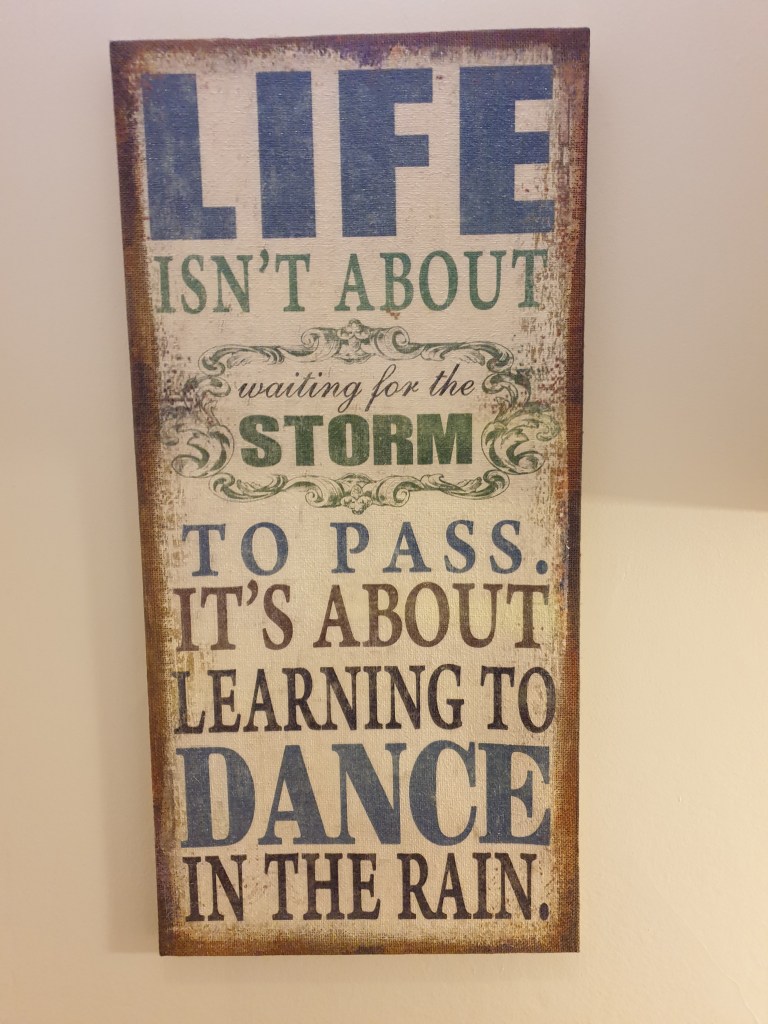
A poster in my hotel – rather appropriate for this holiday
Today I picked up my hire car and left Reykjavik on Iceland’s road “1” – the circular road that goes all around the country. My destination was a tiny place called Skaftafell, at the entrance to the National Park of Vatnajokull. It should have been about four hours’ driving, but on the way I kept getting distracted by interesting detours
First were the Seljalandsfoss waterfalls, which were located just off Route 1. I found them really impressive but did not realise that by Iceland standards they were only of average height and size.
Seljalandsfoss waterfalls
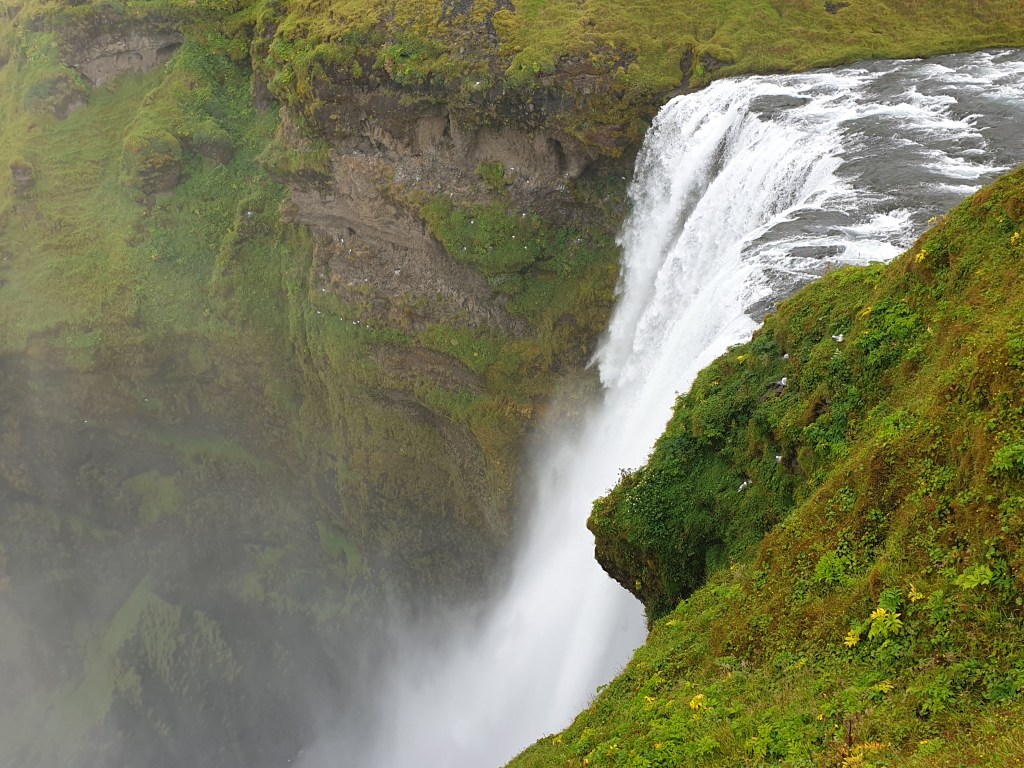
Next was a much bigger waterfall called Skogafoss. This was a step up in terms of size and power, with a broad river thundering over a sheer cliff to fall 60m in a great misty spray.
Mighty Skogaoss
By now it had started to rain, and I hesitated about taking the steps up the mountain to get a view of the waterfall from the top. In the end I decided to go, and was rewarded by a great view…….
The view from the top of Skogafoss
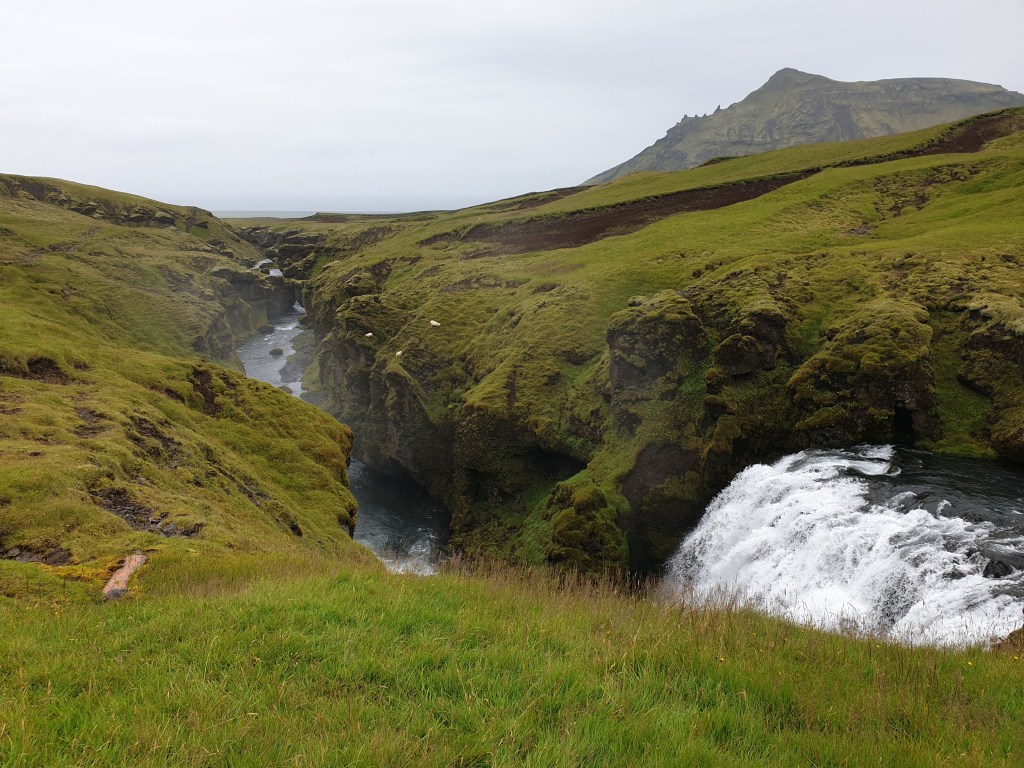
………and a path that followed the river up the mountain. The path was beautiful, and I couldn’t resit continuing until I reached another waterfall…..and then another……..and then another and then another.
The fourth and final waterfall I found….only 17 more to go
By this time I had been walking for an hour. To my surprise found that I still had a strong phone signal, so I googled “Skogafoss” to see how far the path continued. I found out that I had just started of one of Iceland’s most famous walks, the 23.4km Fimmvorduhals trek from Skoga to Porsmork. If I continued I would see another 17 waterfalls, before traversing a barren volcanic landscape between two glaciers and then descending through alpine meadows to the village of Porsmork. I knew that I had neither the time nor the equipment (I was even still wearing my city shoes, and had left my waterproofs in the car) to continue my exploration, so reluctantly I turned back to the car park. My regret at not being able to go any further was soon gone as it started to rain, lightly at first and then more and more heavily. I made it back to the car just in time, with my coat soaking wet, but my shirt still dry.
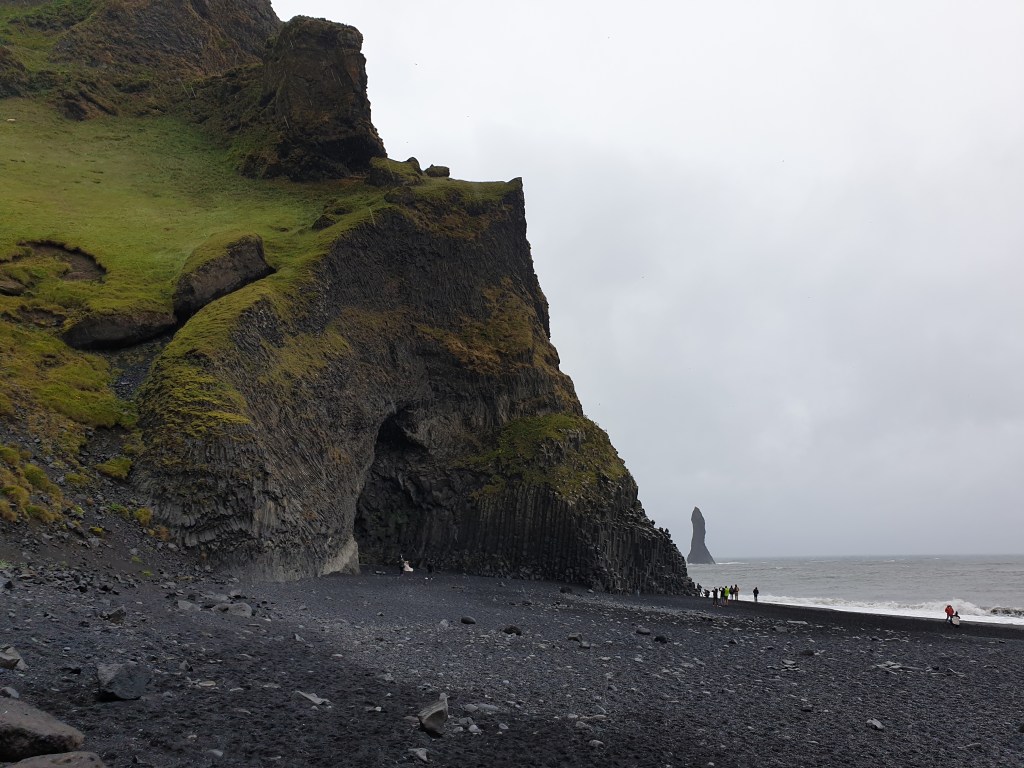
Back on the road, the rain came down more and more heavily and was driven against the car by a strong wind. Despite the weather I decided to make one more stop, at a place called the Black Beach. I parked my car and was immediately blown towards the sea.
The Black Beach – the little white dot in the cave is the bride!
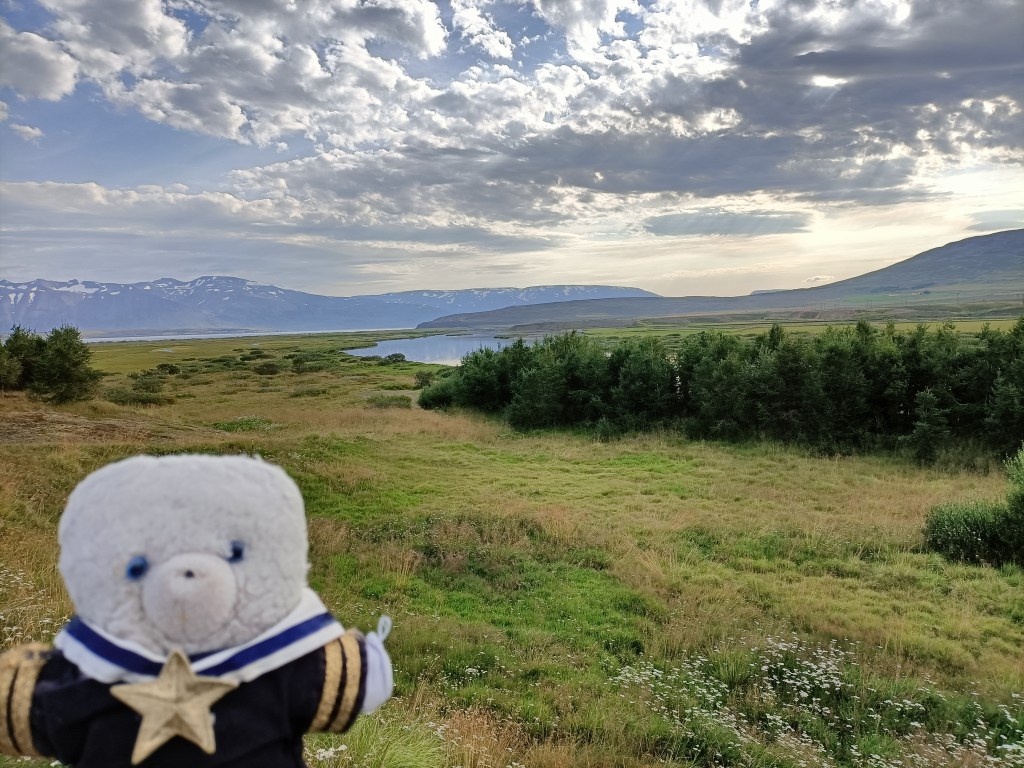
To my amazement a couple were having their wedding photos taken in the wind and the rain. In Reykjavik, a local told me that Icelanders never change their plans just because of the weather, and here was living proof of what he had claimed. I took two quick pictures of the hexagonal basalt columns surrounding the cave that the beach is famous for and battled back to the car against a ferocious headwind, that even humans struggled to walk against, never mind a small teddy bear made of fluff.
I set off along route 1 again, with the wind howling and wind beating down. The road went through a very long flat plain, with thick green moss the only vegetation. Heavy grey rain clouds surrounded me on all sides, reaching right down to the ground. I felt like I was driving along the bottom of the sea, with a storm raging above me on the surface.
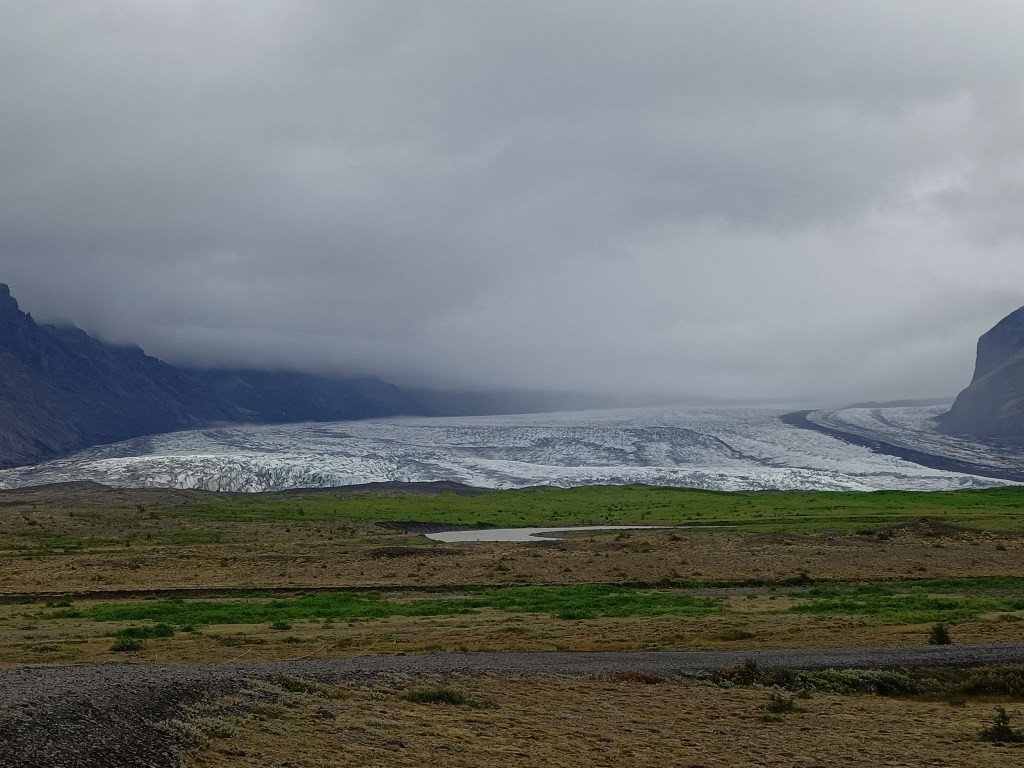
Finally, the rain eased off, and I could see glimpses of mountains through the clouds. When the mountains were joined by the edges of the huge Vatnajokull glacier, I knew I was nearing my destination of Skaftafell. The glacier is the biggest in Europe, covering a big chunk of Eastern Iceland. It has many different “arms” that flow down from the mountain towards the sea; Skaftafell is located between two of these arms.
The mighty Vatnajokull glacier emerges from the clouds
I checked into my hotel. As Lonely Planet had warned, my horribly expensive room turned out to be very basic – there are very few accommodation options in this part of Iceland, and demand from tourists is high. I sat down to write my blog. When I had finished, it was eight o’clock and the clouds had lifted. It was still light, so I decided to take a quick walk to base of the glacier – the weather forecast for the next day was still not good, and if I didn’t see the glacier now, I might never see it. It was a lot further than I had expected, but after an hour I arrived at the base of glacier, where a lake had formed from melting ice, and where there was a memorial plaque to two walkers who had gone missing in the area twenty years ago. Small icebergs floated quietly on the icy water. I was alone, and with the light of the sun setting behind the remaining clouds, the atmosphere was very special – but sadly not something my phone’s camera could completely capture.
The glacial lake at the end of my walkDusk falls over the Vatnajokull glacier
I got back to my hotel at around ten, tired but very happy with my impromptu evening walk. Wishing to avoid the hotel’s expensive restaurant, I had a dinner in my room – smoked fish for the third evening in a row! Then I collapsed into bed and slept soundly.
After a few months back at home in London, I am back on the road again. This time I have chosen a country that has long been on my “to visit” list – Iceland. What’s more, it is on the UK government’s “green list” – meaning that it is a little easier to comply with all the Covid rules imposed on travelling bears. At least it is on the green list today…….when I am due to return to the UK, who knows what list it will be on.
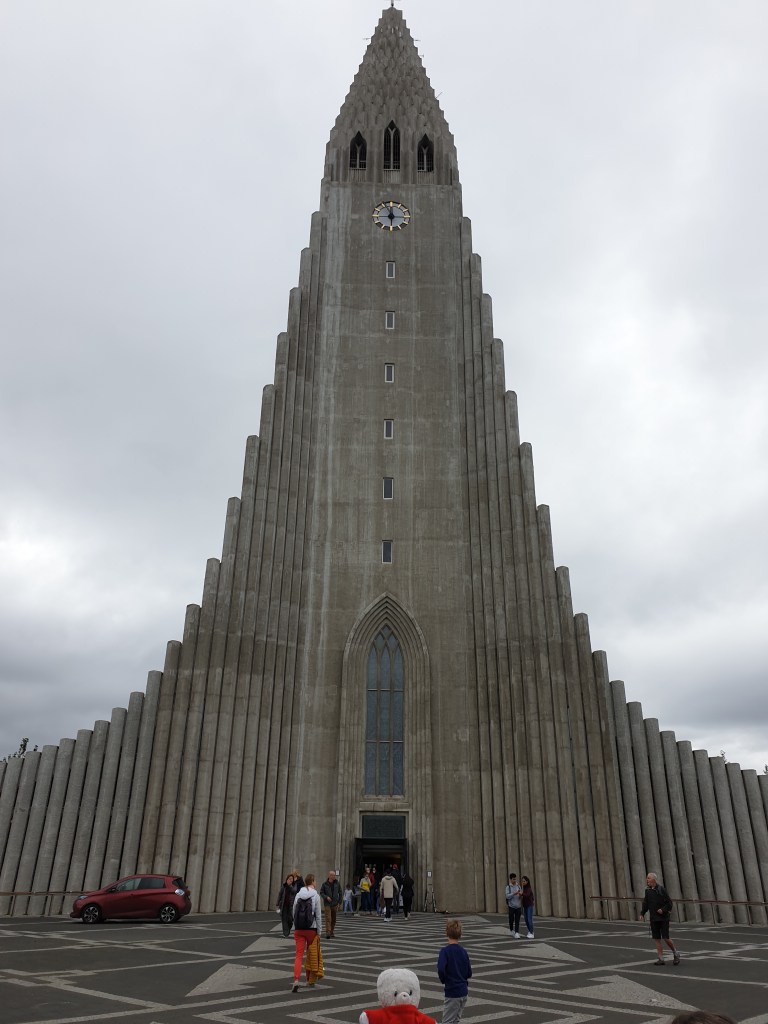
My journey started with a very early morning start for an 07.45 flight to Keflavik airport. On arrival I breezed through immigration and Covid controls and then sat on a rather long and boring bus trip from the airport into Reykjavik, the capital. I dropped by bags at the hotel – it was too early to check in – and set off immediately to explore the city. First stop was the impressive Hallgrimskirkja, which is visible from all over the city and provided a useful landmark since it is very close to my hotel.
Hallgrimskirkja Church, a key landmark
My overwhelming first impression of the city was – it is small. The population of Reykjavik is only 122,000 (all of Iceland has only 400,000 people). The atmosphere of central Reykjavik is like that of a small seaside town. There is a faint smell of sea air, and lots of tourist shops, bars and cafes with seating on the pavement. There are also lots of art galleries, and many of the houses are adorned with interesting murals.
Reykjavik has lots of interesting street art
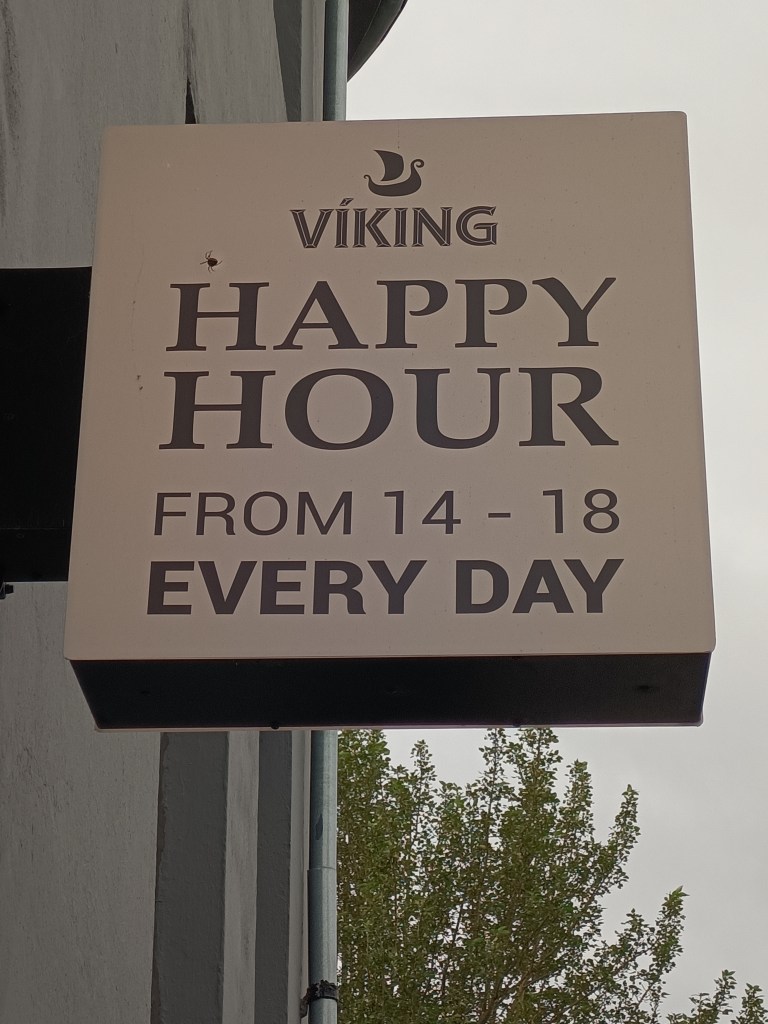
I stopped for a well-needed and rather good and little cappuccino, calculating that it cost 4€. Yes, Iceland is expensive, with most things costing roughly 50% more than Paris or London. Suitably woken up by the caffeine of the cappuccino (and its cost!), I explored further. It was a very short stroll to reach the “downtown”, where I found a collection of bars. Most of these offered happy hours, some starting as early as 14.00 hours. Like most Nordic states, alcohol is very expensive in Iceland and happy hour is the only time when alcoholic drinks are affordable.
The earliest start to a Happy Hour I have ever seen.
Many offer a second happy hour at around 10-11pm until midnight. Reykjavik is a party city and a popular pass time for both locals and tourists alike is the pub crawl, which usually ends early in the morning at one of the hot dogs stands downtown.
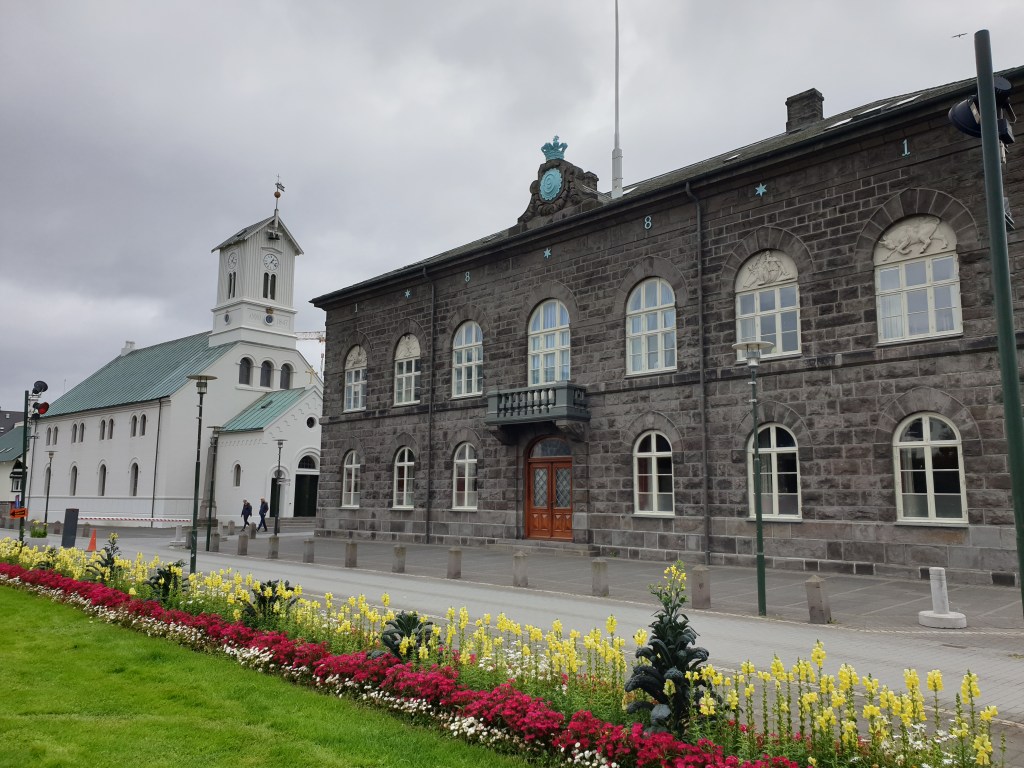
After crossing the area where the bars were concentrated I discovered “old” Reykjavik, an area where pretty old wooden houses are concentrated. It was nice but so small that I had walked right through it before I realised I was there. The old town also had a nice lake and central square which houses the parliament building.
A square in Old Reykjavik
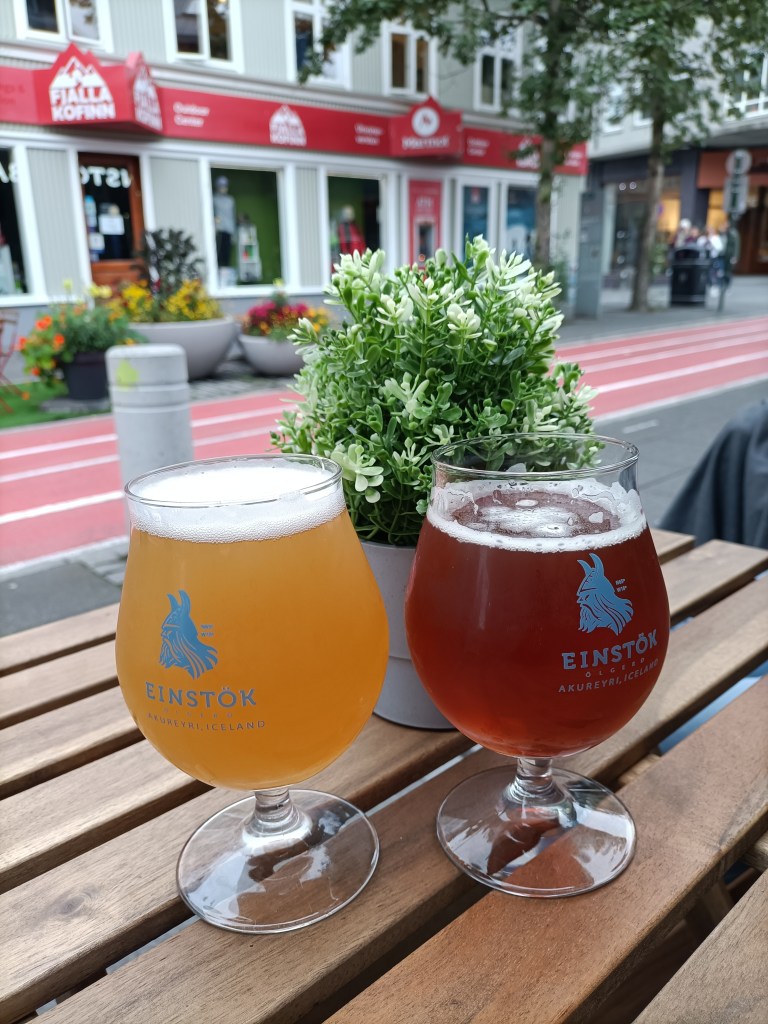
After that, I visited the harbour area which had an odd mix of fishing boats and whale watching excursion boats. Finally I headed back to Laugavegur street and sat down at one of the bars. I ordered “happy hour” beers whilst watching people go by.
Happy Hour on Laugavegur Street
This is the main street in central Reykjavik and people walk, jog, cycle, skateboard or scooter along it all day long. I saw one person walking backwards– I suppose he was trying to add some variety to the ritual of walking along this unavoidable thoroughfare. After my beer, I bought some food to cook in my hotel and had a dinner of scrambled eggs with some excellent smoked fish.
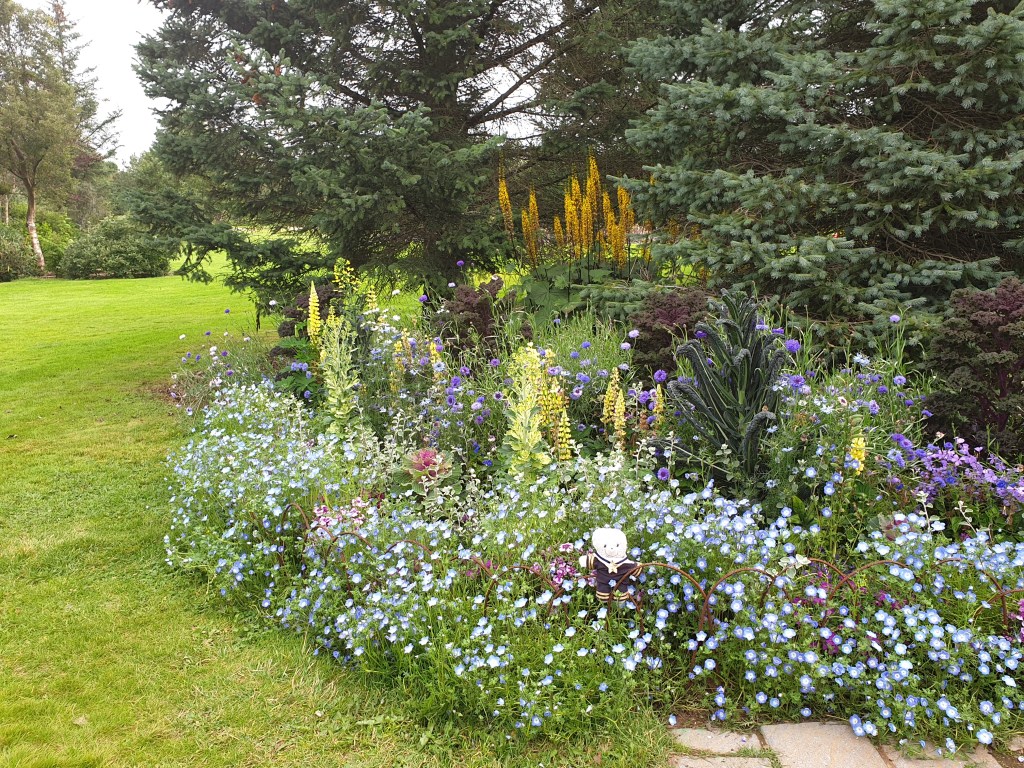
The next day I woke up and thought hard about what to do. British Airways had cancelled my original flight, meaning that I had had to arrive a day earlier and now had an extra day in Reykjavik. I wasn’t sure how to spend my time – there were lots of excursions on offer to visit Iceland’s spectacular scenery, but they were all very expensive and tomorrow I would have my own car to explore the countryside at my leisure. I had also planned to go whale watching later in my trip, and had been told that from the north coast of Iceland I had better chance of seeing large whales. So I decided to do something typically Icelandic – go swimming in hot pools heated by thermal water. On the way to the baths, I visited some rather pretty botanical gardens with some unique arctic plants
The Botanic Gardens
Next I went in search of the swimming pool. Although the pool complex was very large finding it proved surprisingly hard, and I ended up making two circuits of a large Reykjavik park before I found it. Fortunately the pool was well worth the effort, with a huge 50m open air basin filled with pleasantly warm water. A large play pool with slides kept the local kids out of the way as a I completed a healthy workout in the warm water, and then crawled out of the pool to soak in one hot tub with 40C salt water, before trying a second hot tub with fresh water. It was a typically Icelandic experience and I left feeling very clean, and with a pleasant post-exercise burn in my legs and arms.
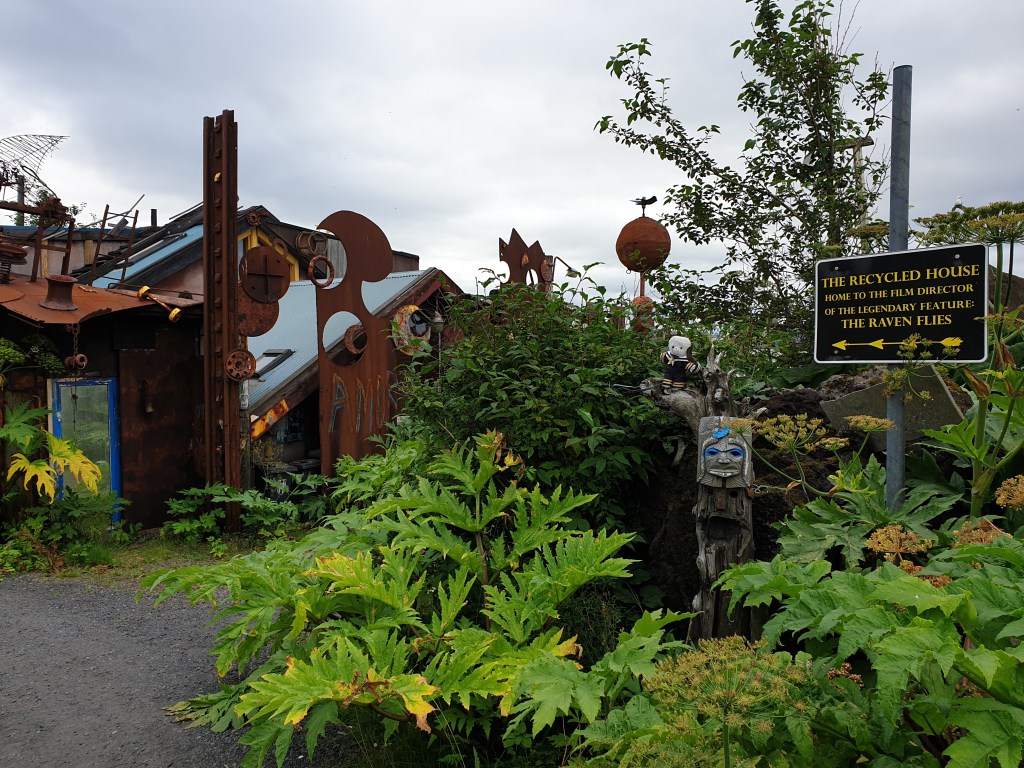
After that I walked to a little-known museum devoted to the Icelandic sculptor Sigurjón Ólafsson Museum. On the way I found a very strange house, apparently owned by an Icelandic film director. The grounds seemed to be open to the public but were very spooky, straight out of an American horror movie like the “Texas Chainsaw Massacre”.
A weird house on the outskirts of Reykjavik
I took some photos and hurried on to the museum. I was impressed by the sculptor’s work, and it occurred to me that if he had lived in New York, he would probably have been rich and famous, with his pieces shown in major museums rather than his lonely studio on the outskirts of Reykjavik.
Still, he had inspirational setting to work in, with views back to the centre of the city in one direction……….
The view back towards the city….
And in the other direction, out to the countryside beyond they city, which looked wild and mountainous. It was a foretaste of things to come.
I still had two more full days and a morning left of my holiday in Andalusia. I had thought about using one day to take the car and explore the nature reserve of La Donana, which has wild flamingos, boar and lynx – but a great laziness came over me. I simply liked Seville too much, and spent all my time here.
I had breakfast on my terrace, listening to the church bells in the cool morning air………
Then I would visit something before the heat of the afternoon set in and before the tourist crowds arrived. Seville’s Golden Age was in the 1500s, just after the rediscovery of the Americas, when all Spanish trade with its new colonies passed through here. In the 1600s Seville lost its monopoly on trade, its river silted up to make navigation harder for ships, and Cadiz became the new centre of trade with the Americas. Still, the Golden Age left Seville with a very large historic centre and many beautiful buildings.
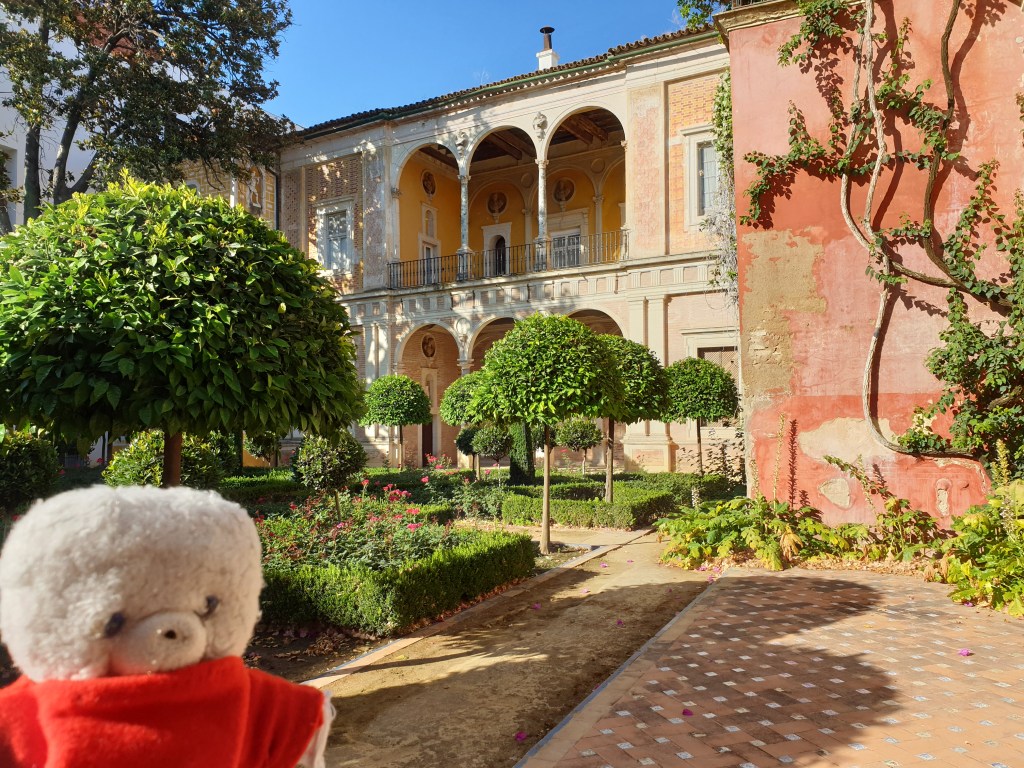
One day I visited the Casa de Pilatos, a typical mansion in the old town……..
The Casa de Pilatos
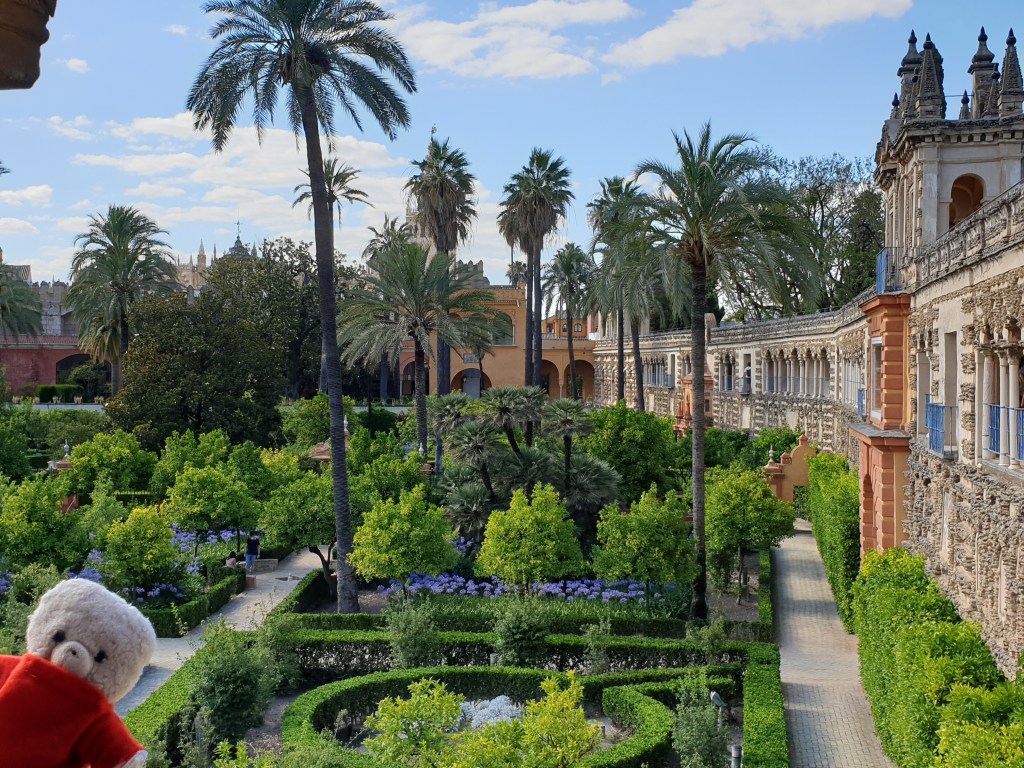
And on the other I went back to the Alcazar gardens….
A return to the Alcazar gardens
After a morning of sight-seeing I would find a shady terrace for tapas for lunch – the choice of places was huge.
Fans preparing for one of Spain’s matches in the Euro 2021 competition. It was noon…..and the match didn’t start until 5pm
After that I did like the Sevillanos and went back to my flat for a siesta and to write my blog during the heat of the afternoon. Refreshed, I would then head out in the late afternoon for more sightseeing………
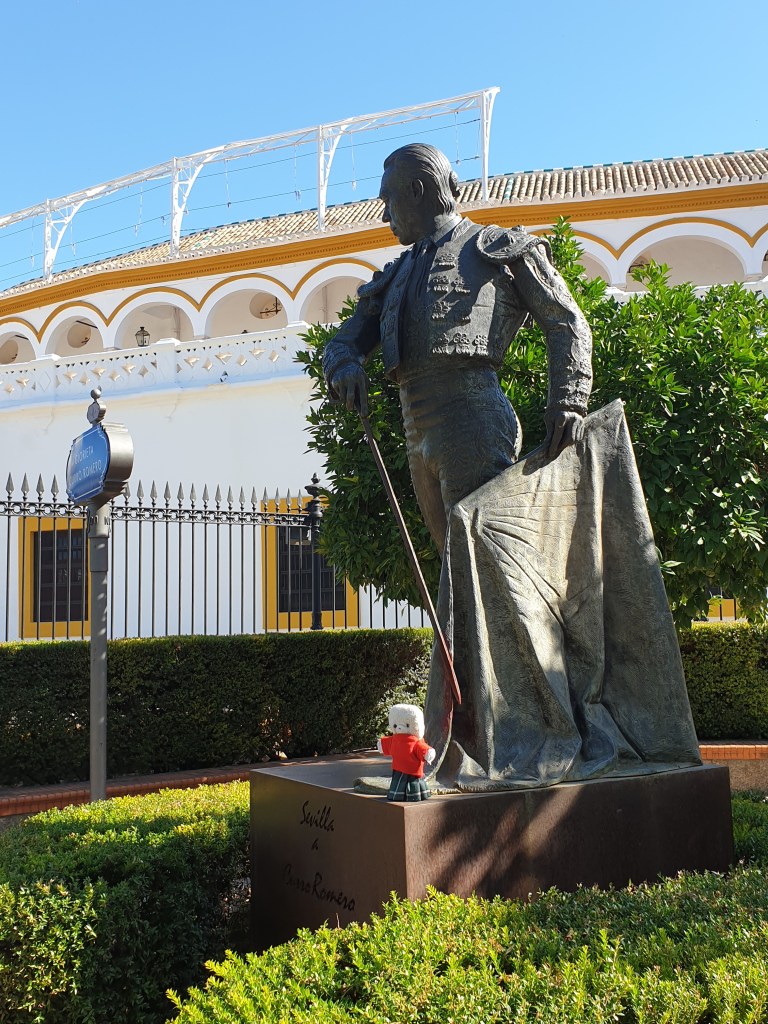
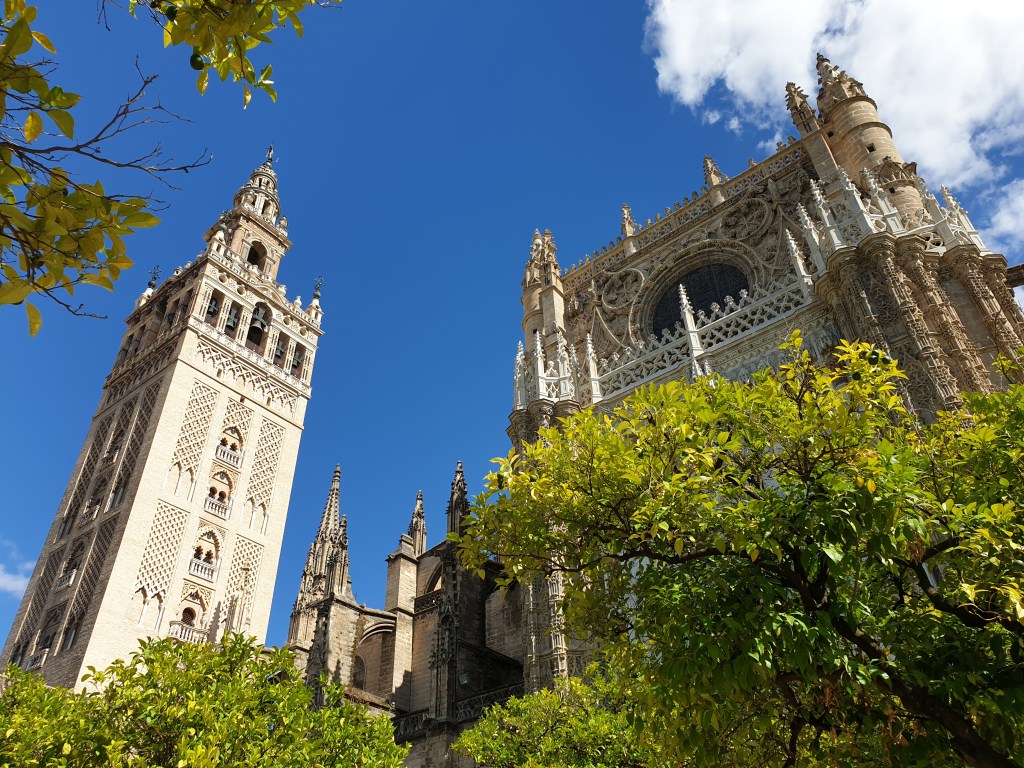
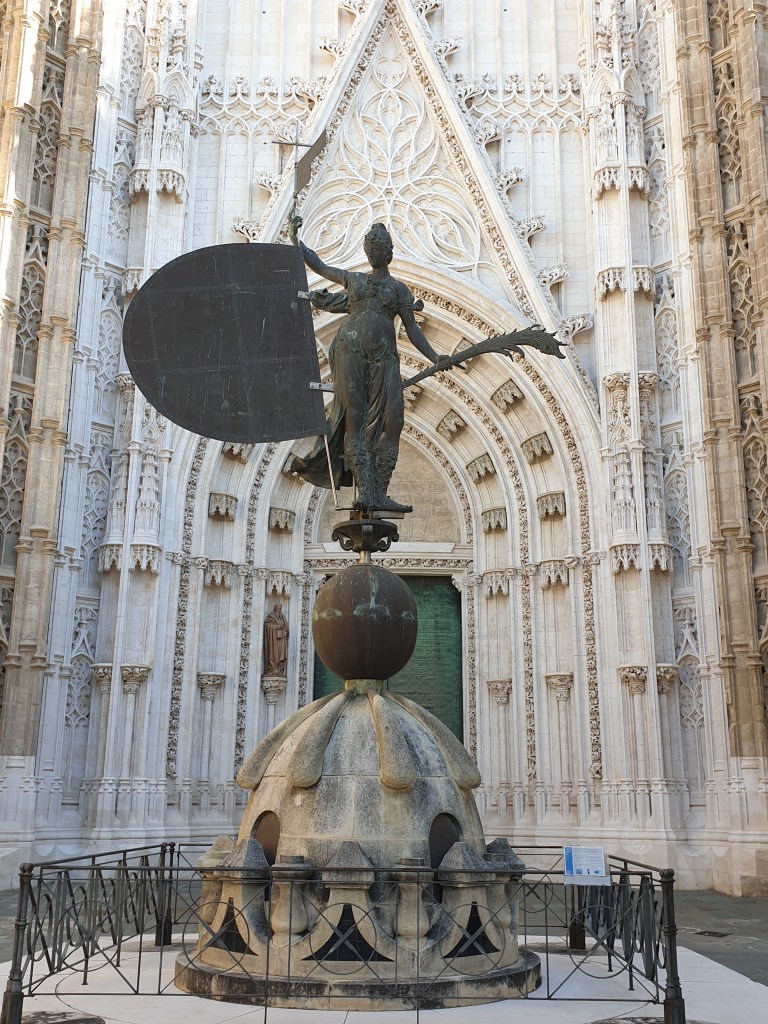
The bullring – pretty, whatever your opinion of bull-fightingAnother view of Seville CathedralThe original “El Giraldillo” weather vane – the one now on top of La Giralda is a copy.
…..and then buy ham, wine and cheese for dinner on my terrace. I didn’t do much, in the classic tourist sense of visiting things – but I felt great. Time ceased to have importance, and the first day blended into the second without me noticing. I was getting to really like Seville, and think I could have spent another week there doing very little.
I remembered just in time that for my return to the UK I had to do a Covid test here (day 1) and then book yet more tests in the UK (three more tests!!) and fill in a bunch of forms online. The form-filling was day 2’s afternoon activity in the cool of my flat.
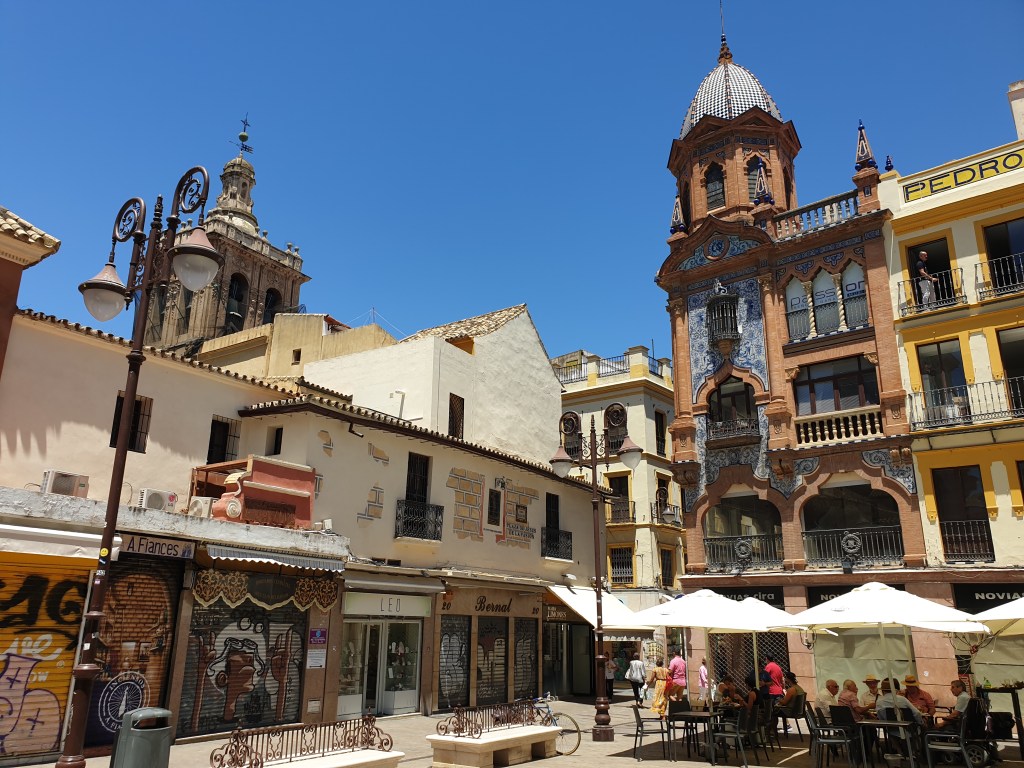
On the third day I was due to leave. I spent the morning pottering around Seville’s old Santa Cruz quarter and could feel the heat already – the last two days had been fairly cool, but today they forecast temperatures would reach 34C in the afternoon and that it would stay hot for the next few days. It was definitely time to go, and I drove back to Malaga airport in the cool of my car’s aircon. I made a quick stop in Osuna, yet another pretty old Spanish town.
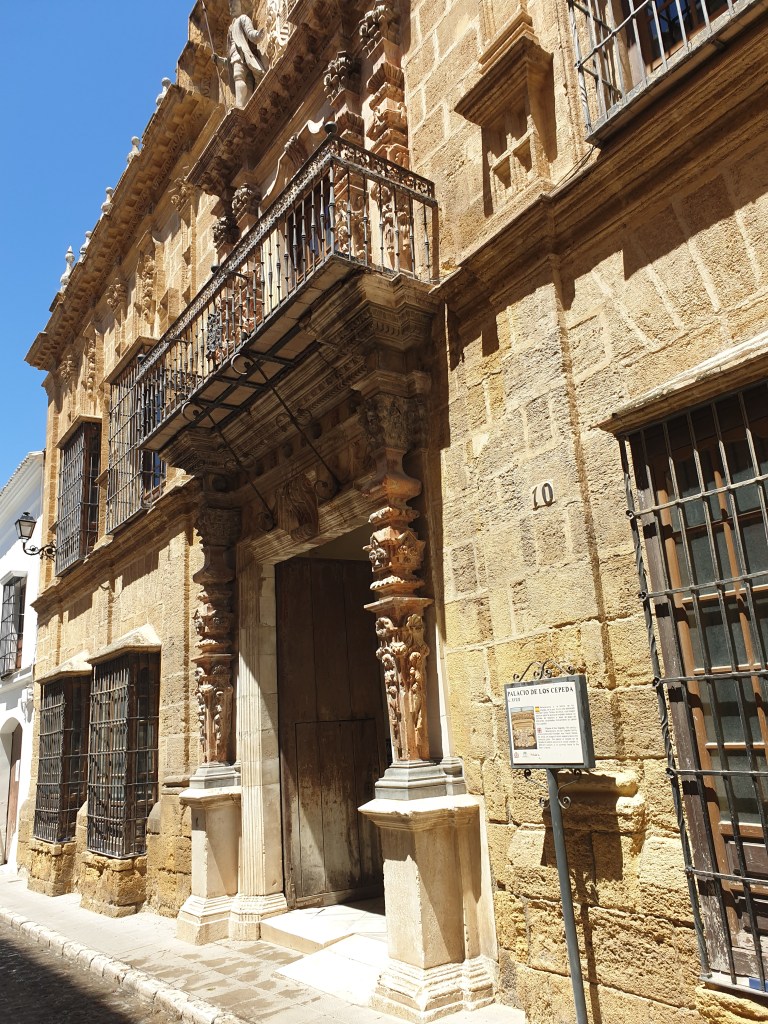
The “Duke’s House” in Osuna
That’s all for now!
I will be back to Andalusia– in the autumn or spring next time, when it pleasantly warm, and in some happy future where there is no Covid and no face masks. Next time I will visit Jerez and La Donana, maybe head across the Portuguese border to the Algarve – if I don’t get waylaid again by the charms of Seville and spend all my time there!



















 Trouspinet travels