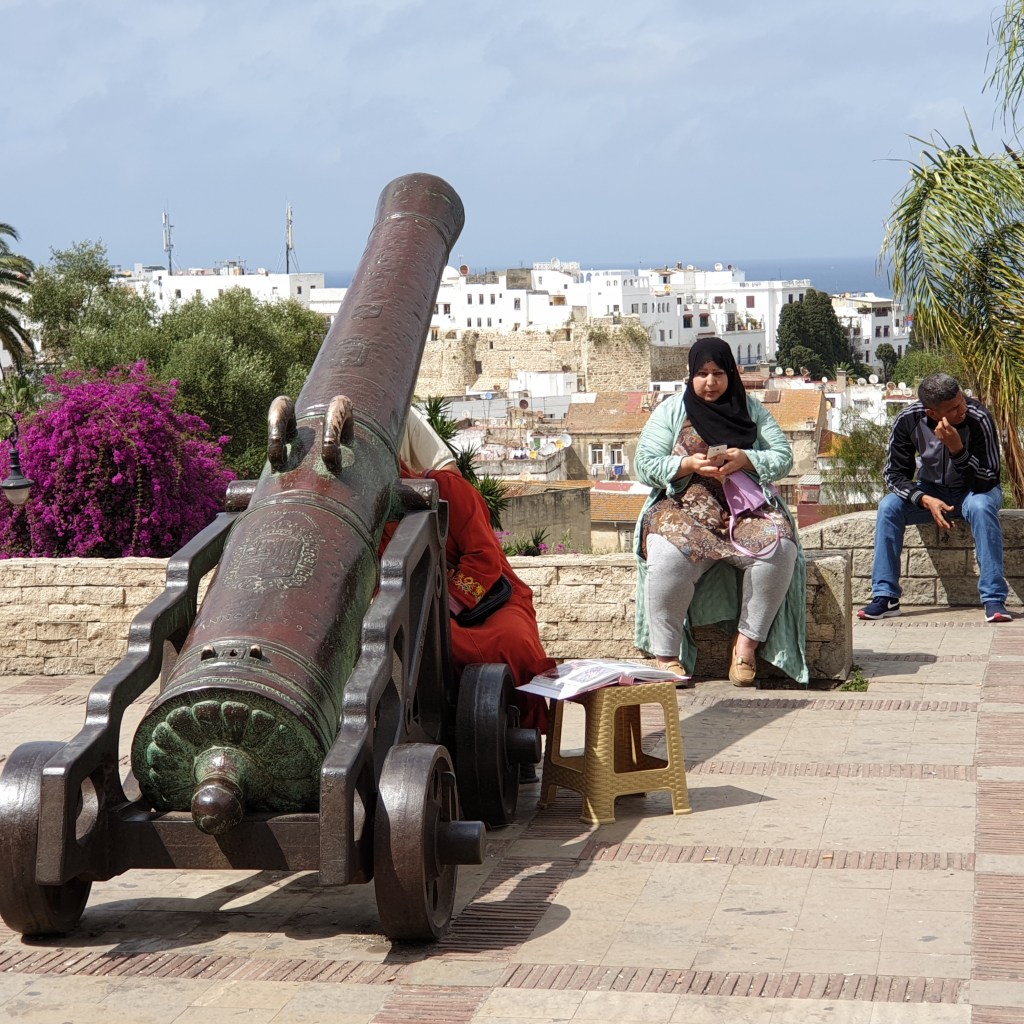
The Tea Train and the Well-Travelled Trousers

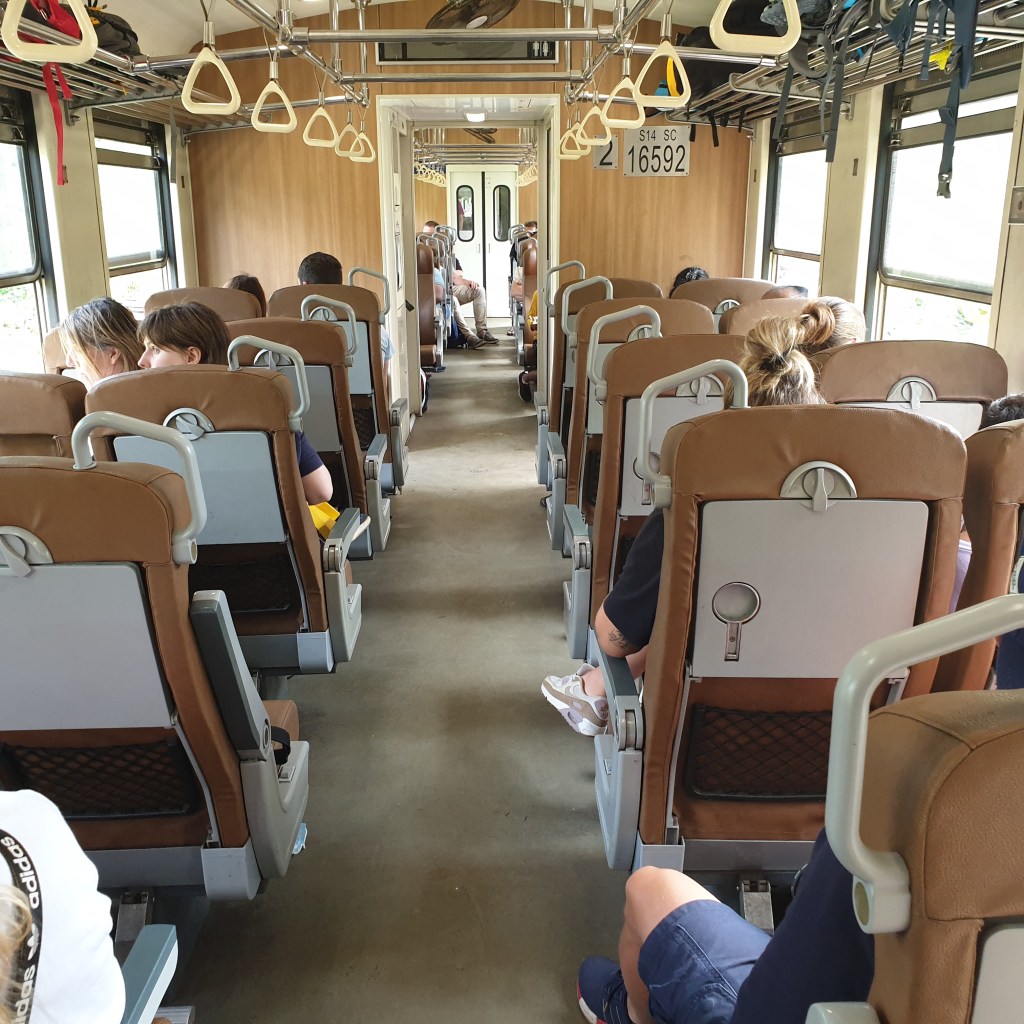
Today, I took the train from Ella back to Nuwara Eliya – a route renowned as one of the most scenic in the world. The train arrived on time – something not guaranteed in Sri Lanka – and I got on to find my reserved seat in second class (someone had told me that second class was better than the air conditioned first class, since you could open the windows). Usually, the reserved seats sell out long in advance to tourists, but with Sri Lanka’s current problems my compartment wasn’t even full.
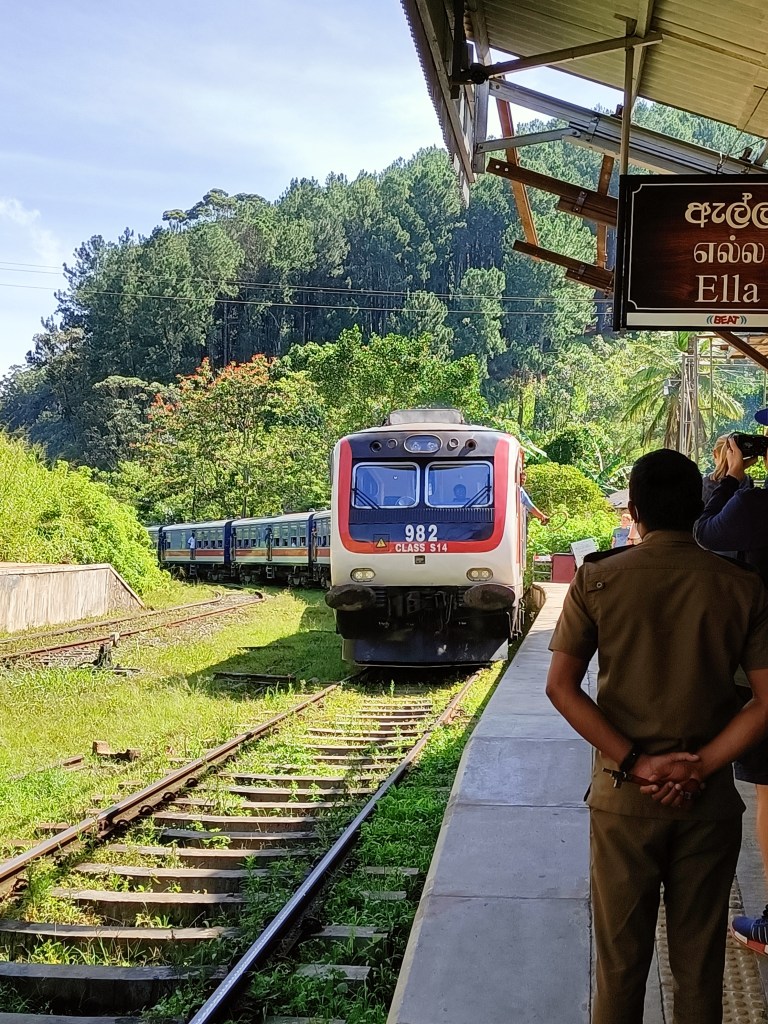
The train arrives
Reserved Second Class

My guide also got on, but his ticket was for unreserved second class, meaning that he had no guarantee of a seat.  I could see through the rear door of my compartment that this was a completely different travel experience. I hoped he had got a place in the melee of people boarding at Ella. Our driver headed off in the van to be able to meet us at the other end of our trip.
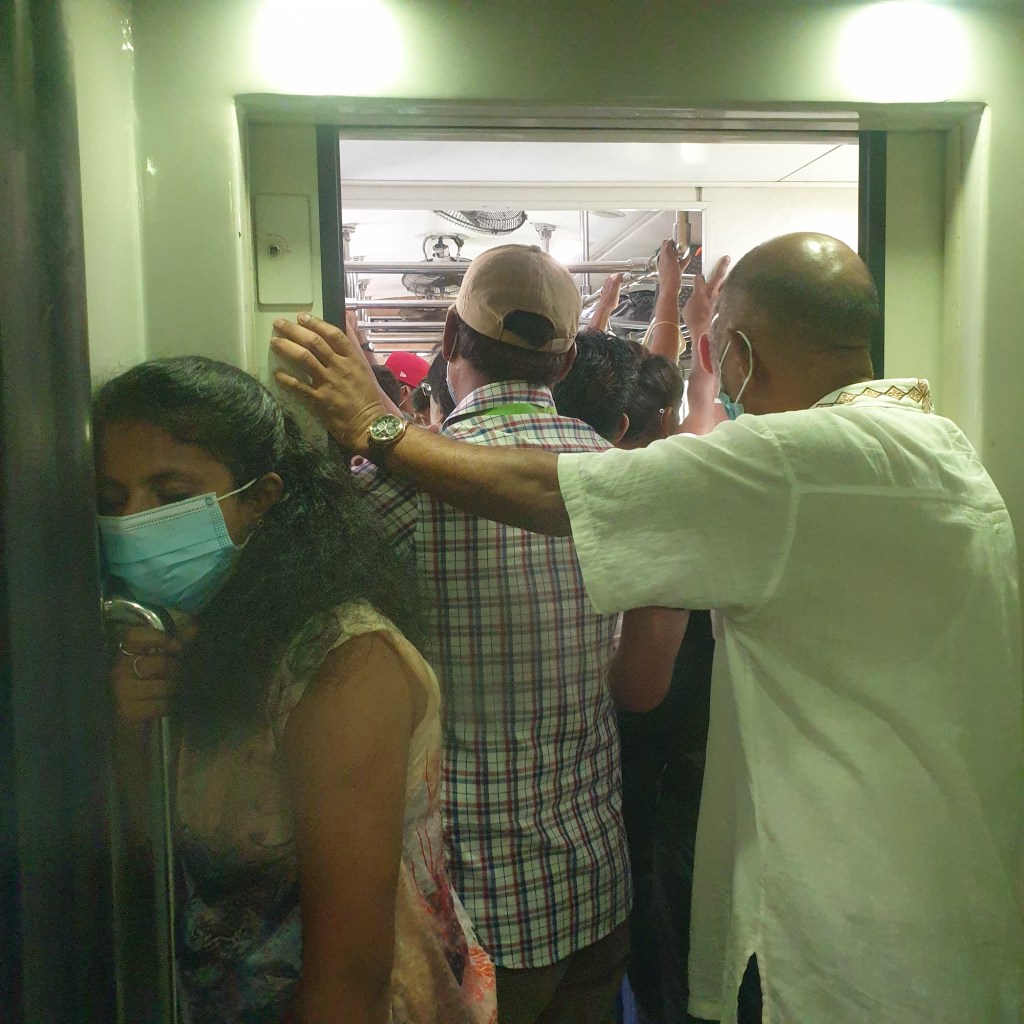
Unreserved Second Class

We set off in bright sunshine, and the views lived up to my expectations. In the area around Ella, the scenery was wild and mountainous.
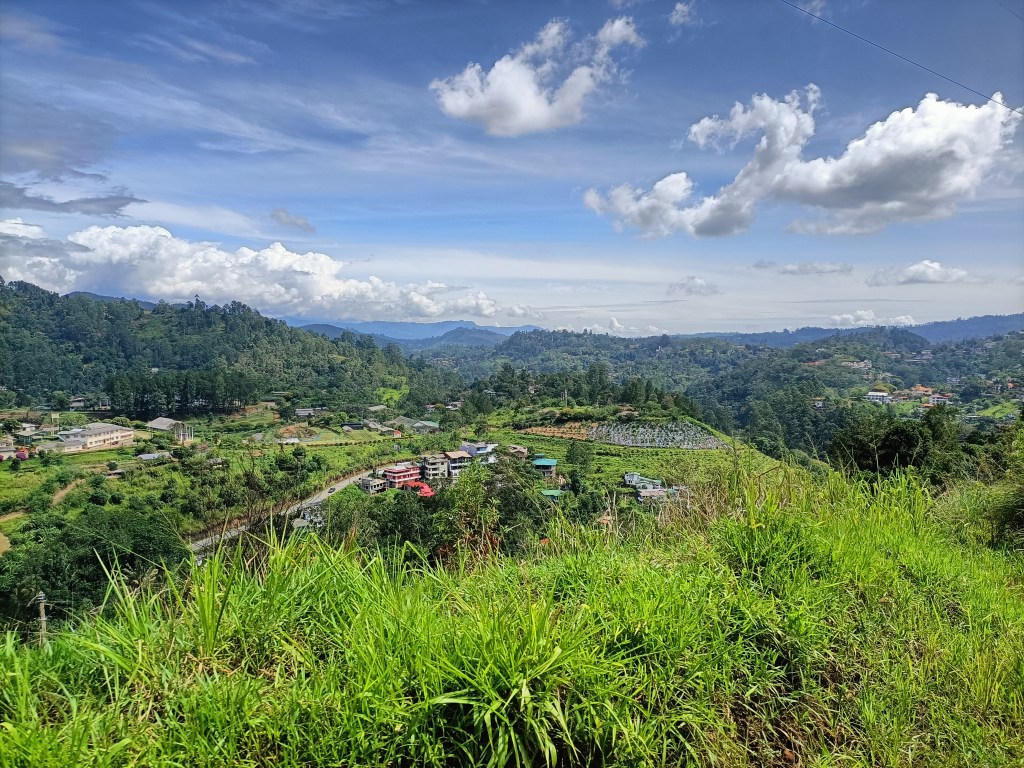
Scenery near Ella

It was very pleasant leaning out of my window and either watching the scenery go by or observing the frenetic activity at each station as passengers with unreserved tickets fought to get on the train first in the rush for a possible free seat. The train doors are left open for the whole trip, and more adventurous passengers held on to the hand rails and leaned out of the open door for an even better view.
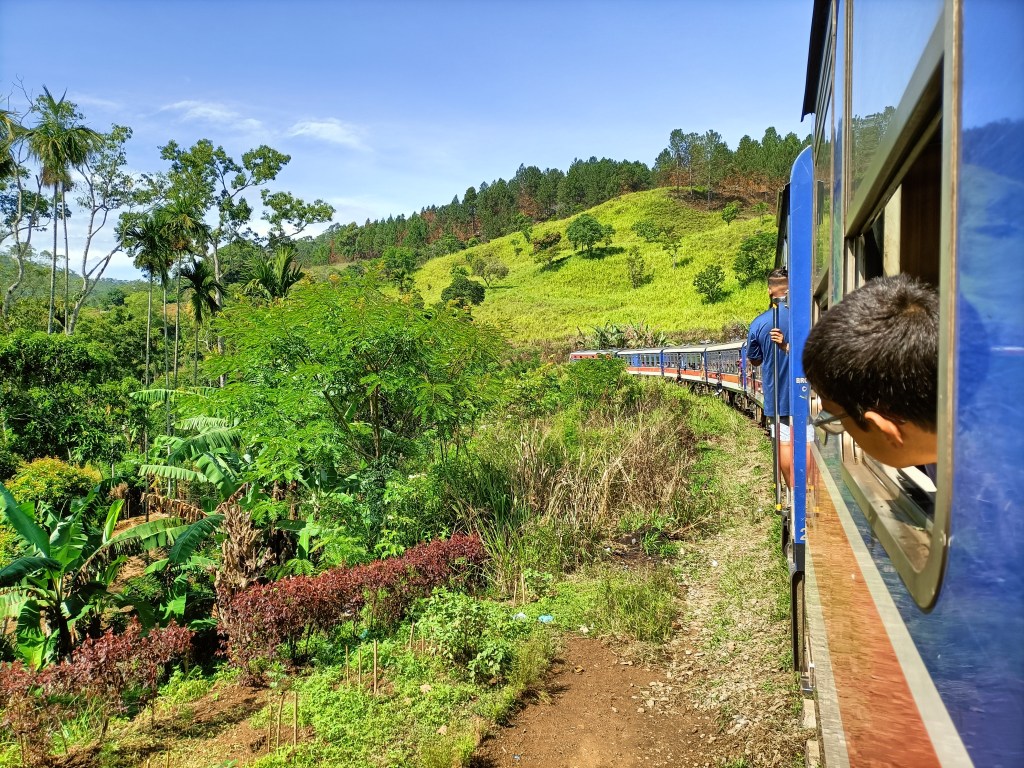
Enjoying the view

As the train progressed, the mountains and forest gave way to nice orderly rows of tea plants and rolling, green hills. It also started to get cloudy – it seems that we had already received our ration of precious blue sky for the day.

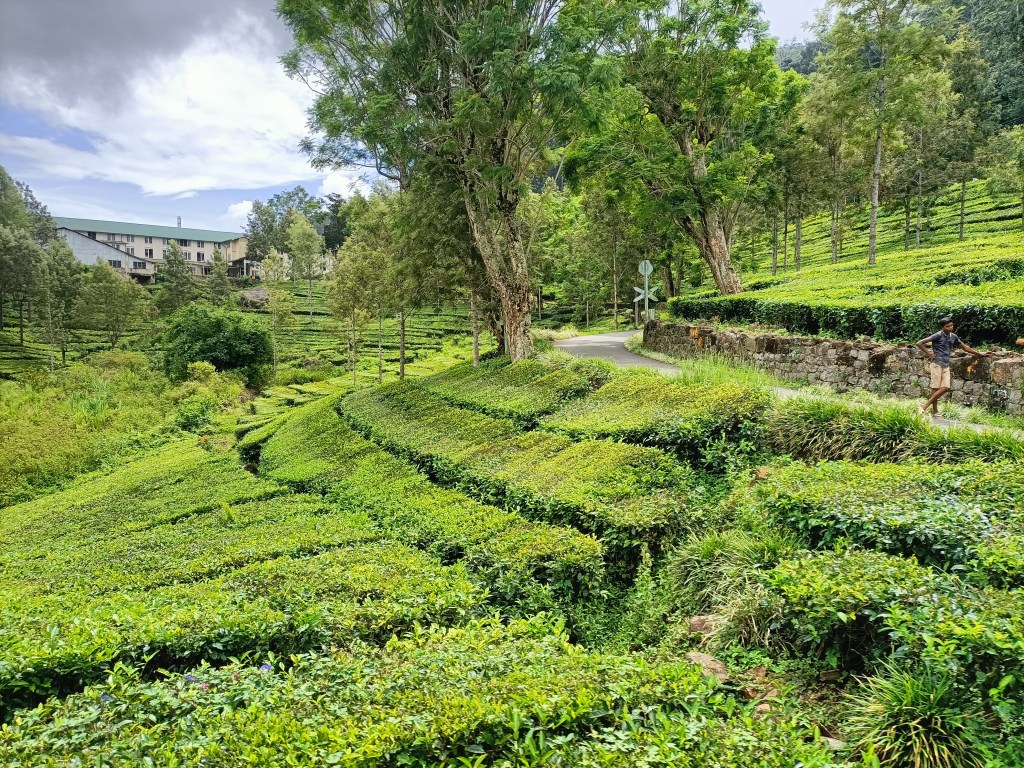
Rolling hills covered with tea plantations
The clouds arrive

The train arrived at Nanu Oya, a small town close to the popular tourist destination of Nuwara Eliya.  On arrival, I got a big surprise when my guide informed me that my parcel had arrived. Initially I was puzzled, but then I remembered that I had left some trousers in the hotel at Polonnaruwa. I’d asked the hotel to send them to Kandy, but they had arrived after we had left and I assumed I would never see them again. It turned out that my guide had been in touch with the Kandy hotel to get them redirected here and that they had arrived in the morning. My guide took me to the station master’s office – a wonderful old-fashioned office room – to meet the station manager and collect my well-travelled trousers.

The station master….and my vagabond trousers!

Sure enough, our driver was also there to meet us at the station, and we drove to my lodgings for the night – the Hill Club.
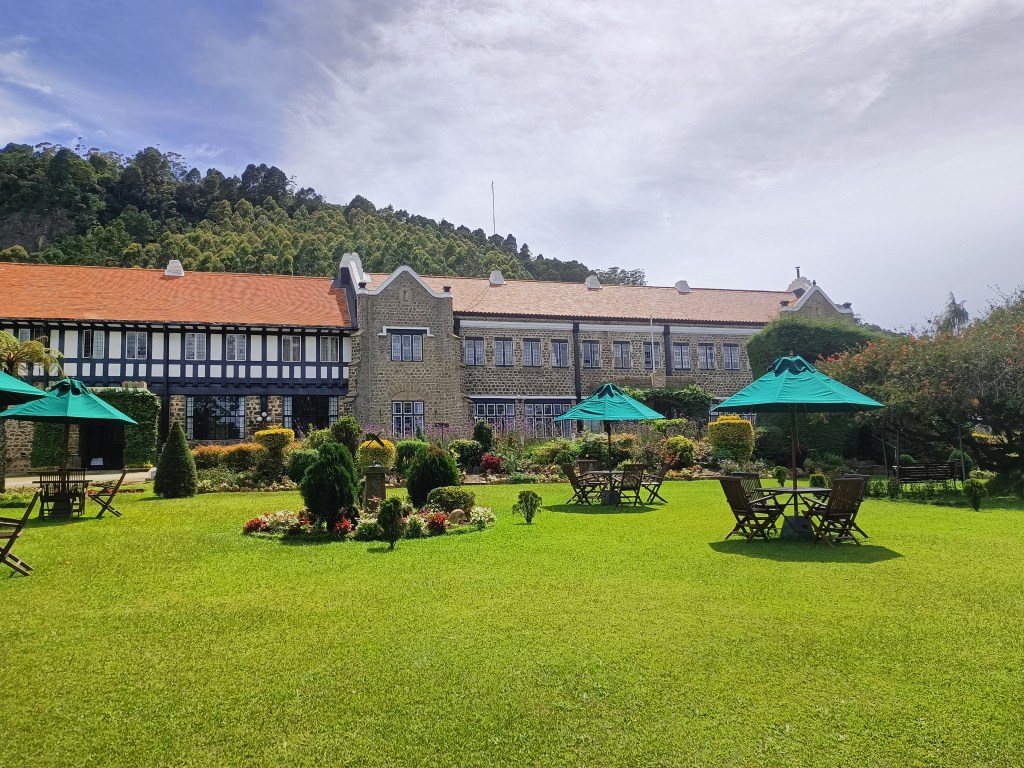
The Hill Club

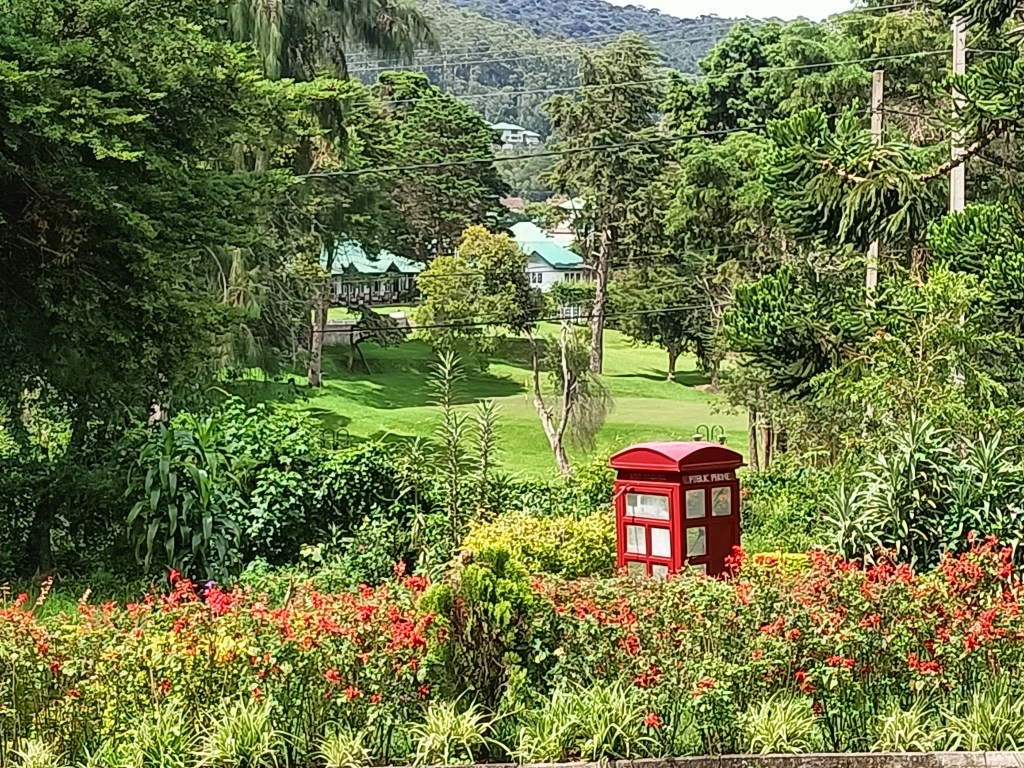
This wonderful institution is a relic of British Colonial rule, when British men (not women) could join a private club in the hills to get away from the heat of the coast. The club has now been enthusiastically embraced by a new generation of Sri Lankan club members, who have kept most of the old traditions, which include a jacket and tie dress code after 6pm, providing hotel water bottles for the beds, and a daily ceremony raising and saluting the Sri Lankan flag whilst listening to the national anthem.  One less good tradition – a side door for lady guests, who were not allowed to use the main door – had thankfully been scrapped.

The club is popular with its members at weekends but rents out spare rooms to travellers when it is less busy. I arrived on a Sunday and it turned out that I was the only guest. I had the whole of the huge building to myself, including the comfortable reading room……..
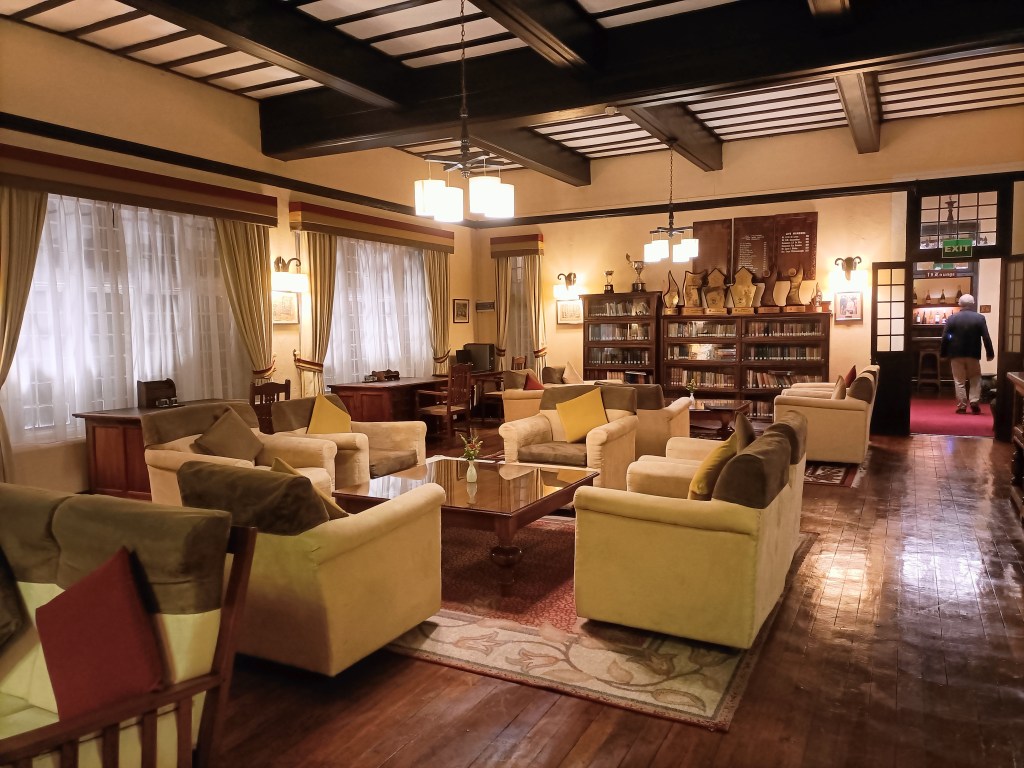
The reading room

……bar, two snooker rooms and dining room……..
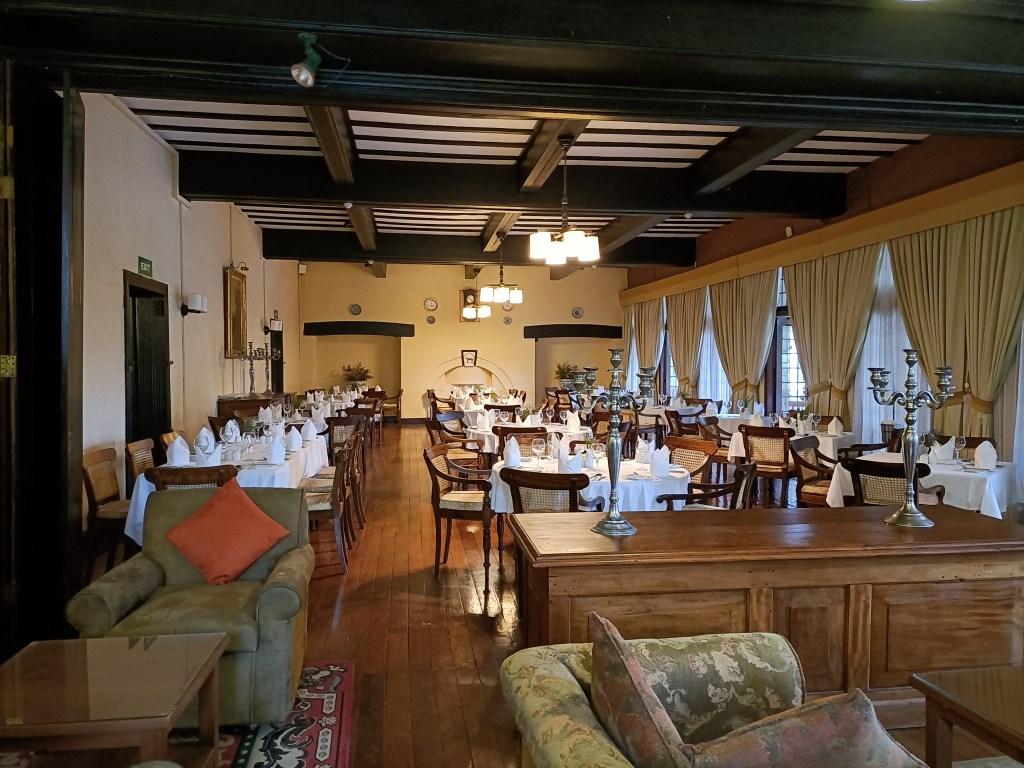
The dining room

There was even a gym. The manager looked surprised when I said that I wanted to use it and I soon found out why. It had a musty smell, like it had not been used in a long time, and after a few km on the treadmill I was soaking in sweat from the near 100% humidity.  I decided that visiting the bar and ordering a cocktail was a much better idea, and I enjoyed drinking it siting by an open fire in the club’s dining room.

Better than the gym!

I then had a hearty western-style dinner of fish and chips (the menu had many traditional British offerings as well as Sri Lankan food) before retiring for the night and the company of my hot water bottle in my bed.
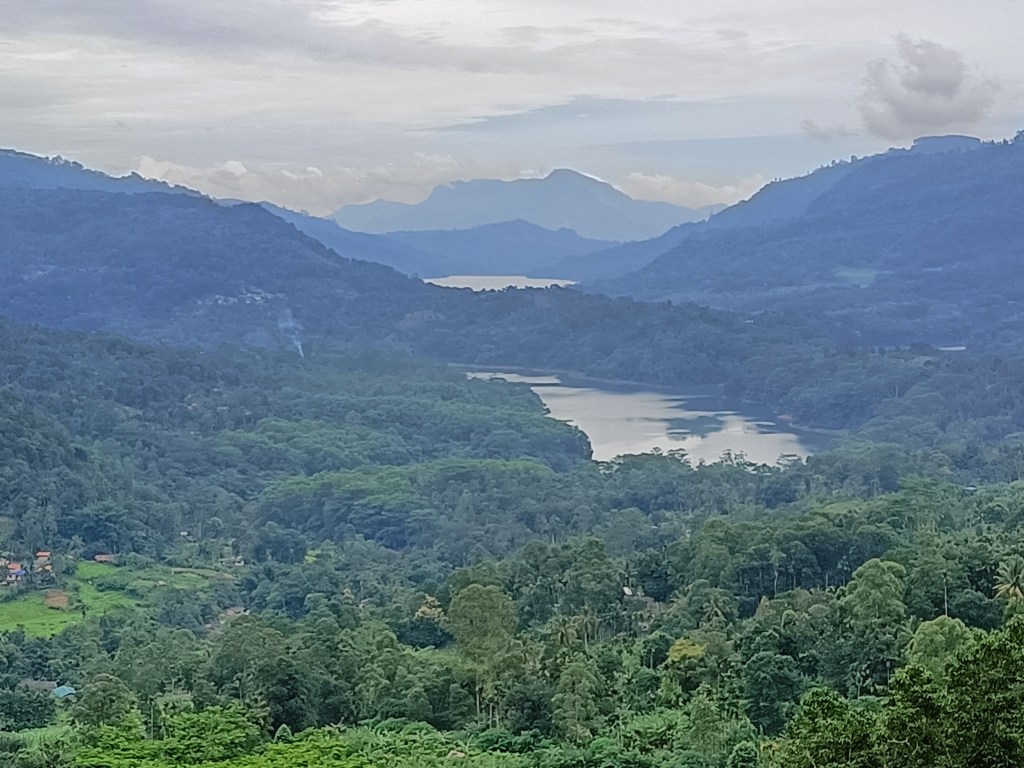
Ella and the Phony Farmer

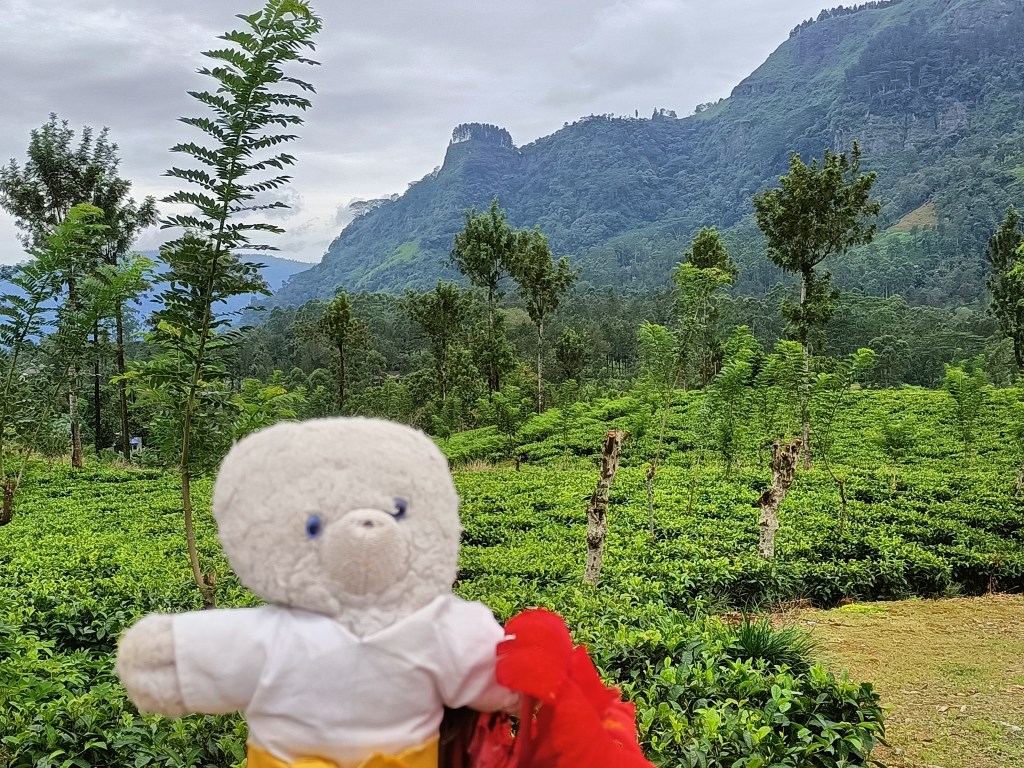
Today I headed off to the “Hill Country” – the mountains that cover the centre of Sri Lanka. The road wound steadily upwards, and after a few kilometres I saw the first of Sri Lanka’s famous tea plantations. It was a very scenic route, with distant mountains looking over rows and rows of bright green tea plants, and lots of waterfalls.

Tea plantations and mountains on the road from Kandy

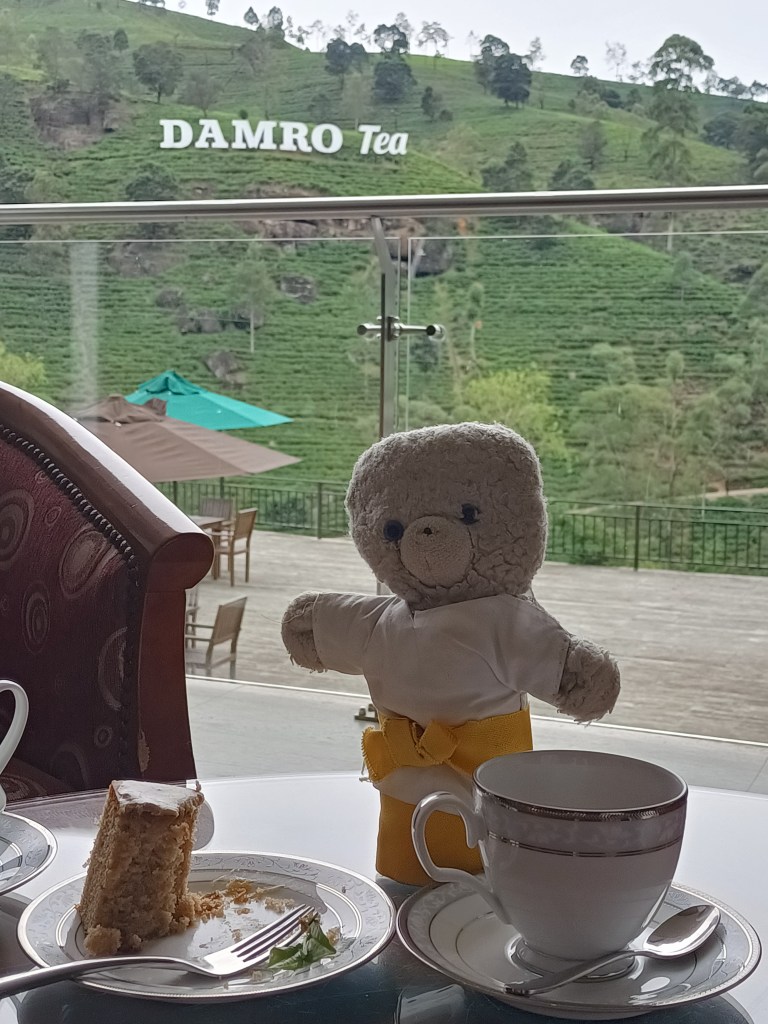
Of course I stopped at one of the plantations to learn how tea is made and the differences between white, black and green tea……and to try some of the finished product for myself.

Trying the local products

The road led on to Nuwara Eliya, nicknamed “Little England” because of its old colonial buildings. It was a popular destination for the colonial British to escape the heat of the coast. Since I was going to return here to stay for a couple of nights I only stopped to take a couple of photos.

Could be England….

We continued to my final destination, the small town of Ella. Driving on the narrow windy roads, with the local buses, motorcycles and animals was slow, and I got a little bored. We stopped for fuel at a town near Ella. This stop proved more difficult than the earlier ones, and the police gave our guide a long interrogation before asking us to park our van and wait. The guide sent the driver off to get a document that had been requested in order to get some diesel and explained to me that the police here were particularly careful. Nearby Ella was a rare town with a lot of foreign tourists, and local drivers had been paying backpackers to sit in their car so that they could claim they were a tourist vehicle. This had made other local people understandably angry.  We waited ten minutes before we were allowed to drive up to the pump to get our ration of 20 litres.

The fuel shortages seemed to be more acute in this town

The driver, the guide and I were all glad when we finally reached Ella in the early evening. I had booked a guest house which was on a hill a little outside the town, and which was supposed to have an amazing view over the mountains. However, the afternoon had seen thick clouds return and for the moment nothing was visible.  At least it hadn’t rained.

When I woke up the next morning, the clouds had mostly gone, and I enjoyed one of the best ever views I have had from a hotel room.
The best ever view from a hotel room?

I had breakfast and set off on a short walk up to Ella Rock,  which promised an even better view of the surrounding area. The guest house owner gave me very detailed instructions, which included sending me twenty photos of the route on WhatsApp.  Finally he advised me to refuse the services of guides loitering on the route, but that if I got lost I could ask local farmers and they would point me in the right direction.

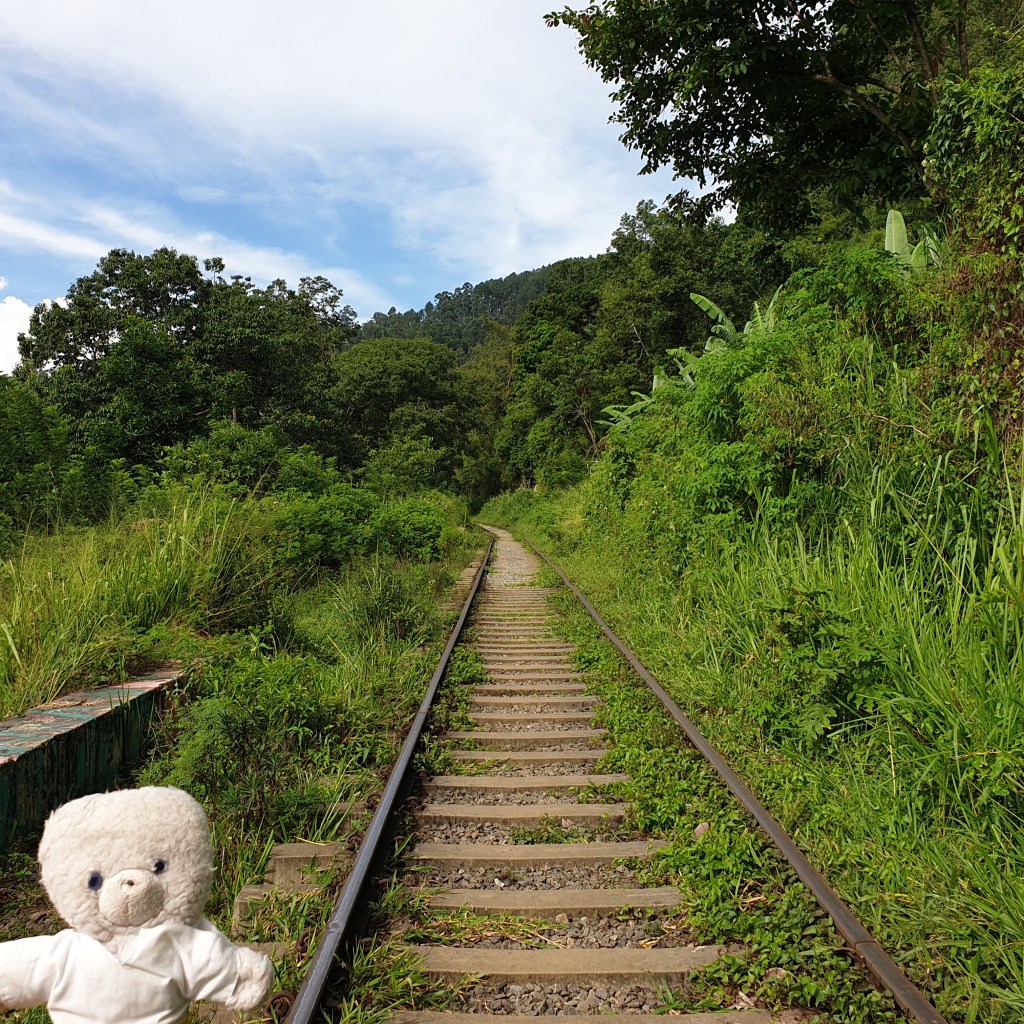
The path followed a railway line. At times, I had to walk on the track itself and was a little worried that a train would arrive suddenly. But I had no other choice, and anyway lots of local people seemed to be walking on the line quite happily.  When a train did arrive, I could see why walking on the track wasn’t dangerous – it could be heard from a long way off, went very slowly, and sounded a warning horn at all bends.  

Walking along – and on – the railway line

My WhatsApp photos told me to leave the railway and head along a path through fields. I stopped again to check the way, and immediately a small wiry man, who I thought might have been following me for a while, offered to show me the way. I hesitated, and he said “I no guide, I farmer”. I should have said no, but instead I followed him up the path. Rather than just tell me the way, he insisted on accompanying me.  The route he took suddenly became flat and I scratched my head – the guest house owner’s directions described a continuous steep slope.  Seeing me stop, the “farmer” said “I know way” and when I continued to look doubtful, “I not guide, I farmer”. He produced an identity card very similar to the one I had seen my guide use to obtain petrol. Under his photo, it said “FARMER”. Hmmm. In English, with no Sinhalese. I smelt a rat and told the “farmer” I would find my own way. With remarkable speed, he straightened his back and held out his arm flat with his palm upturned – the position of someone expecting to receive money.  I gave him a 500 rupee (1.5$) note to get rid of him and ignoring his protestations (“Not enough! One more! Rude bear!”) continued along the path he had been following. Sure enough, it led to a dead end, and I had to retrace my steps to find an alternative way up.  I reached the top, where I found the true path with a steady stream of (mostly Sri Lankan) visitors going up or down – my “farmer” had taken me on a detour, presumably to make his services harder to reject.

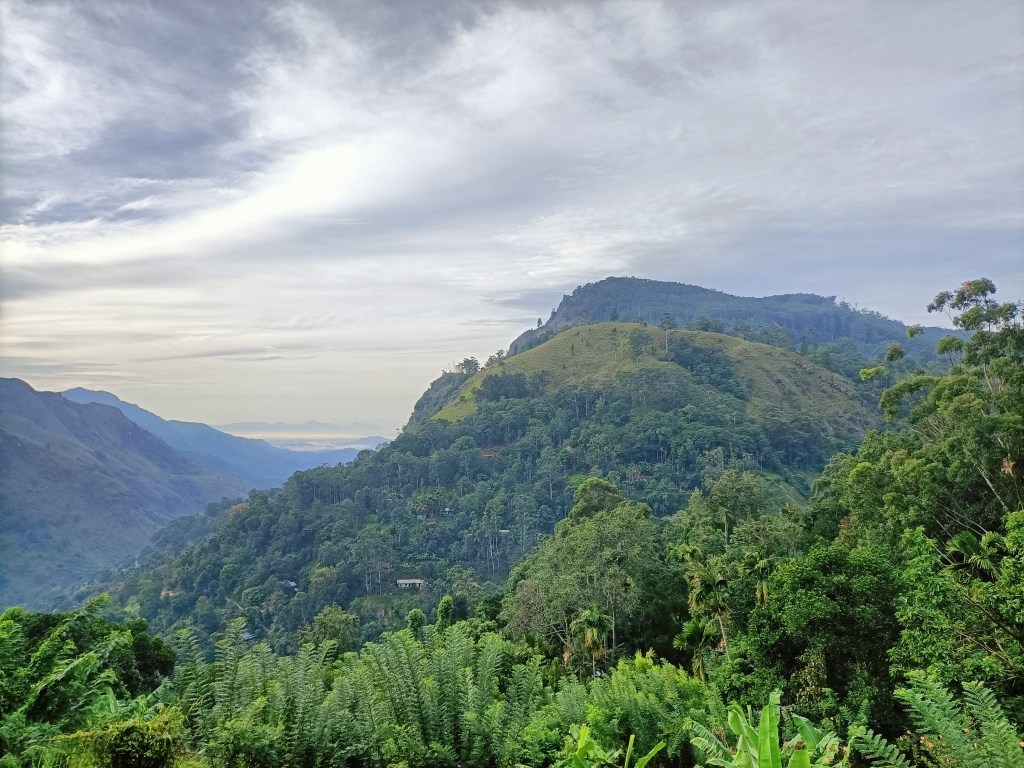
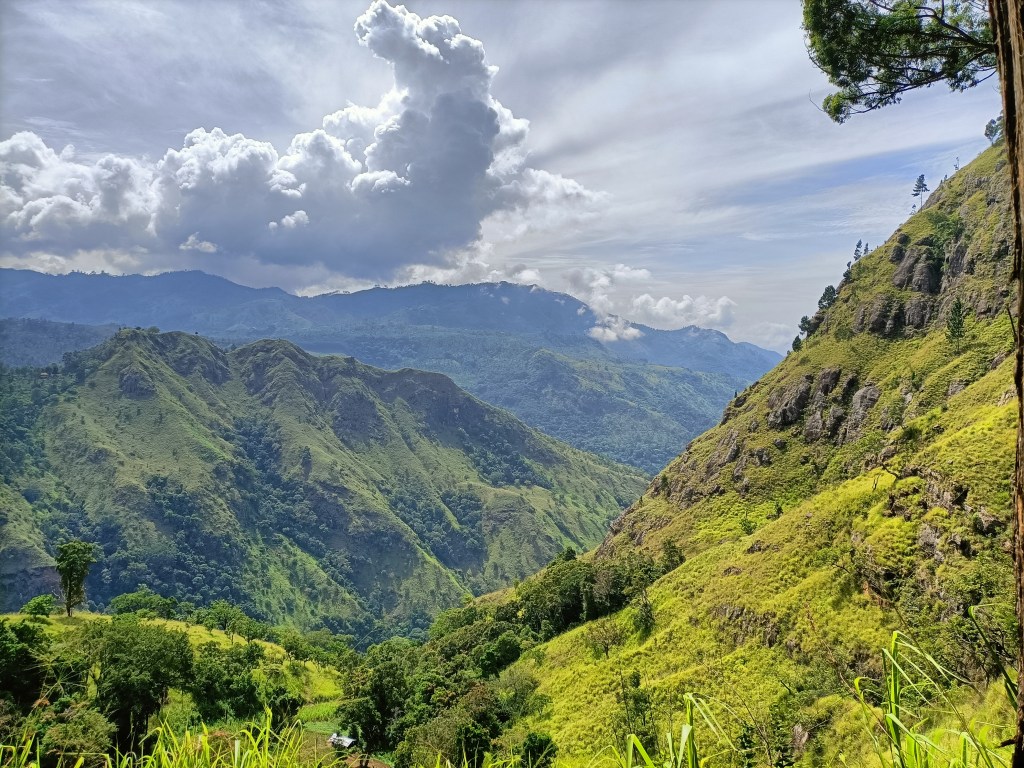
At the top, there were a couple of drinks stalls (someone had the energy to carry drinks all the way up) and a spectacular view, enhanced by wisps of cloud that occasionally blew in from the lower down in the valley. It was well worth my slightly extended walk.

Worth the walk – the view from Ella Rock

I felt the weather changing, so I headed back.  Just as I got to the guest house, yet another storm broke and I sat watching torrential rain for the rest of the afternoon. When it finally stopped, I grabbed a tuk-tuk to head into the small town of Ella. It was a pleasant and lively place, similar to many other popular traveller destinations I had visited in the past. Its one main road was flanked by a series of guest houses, bars, restaurants and spas. I offered myself a massage before having dinner and a beer in the appropriately named Chill bar.

Kandy – the heart of Sri Lanka

Today I transferred to Kandy, Sri Lanka’s geographical, cultural and religious centre. Kandy was the capital of Sri Lanka from 1592 until 1815, when the last Sri Lankan kingdom was finally conquered by the British.

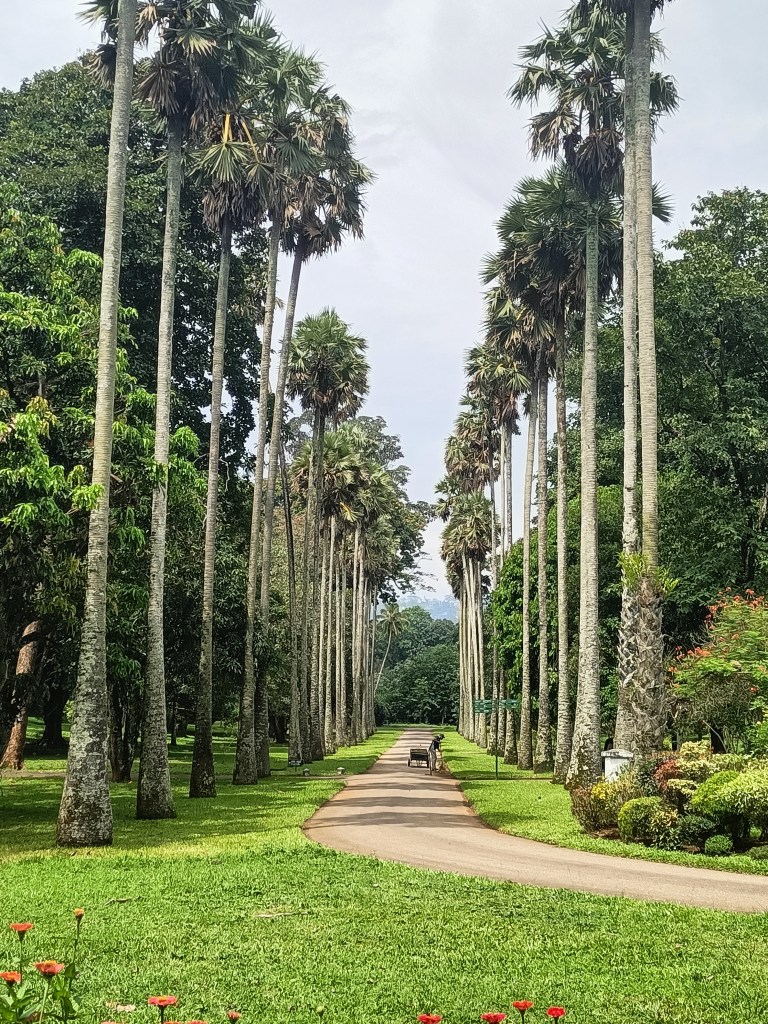
My first stop was the botanical gardens, located a little outside of the centre of town. They are some of the best gardens in Asia and I was pleasantly surprised that for once, it was not raining. The gardeners seemed to like planting impressive long alleys of straight, tall trees……

Magnificent palm trees stand to attention!

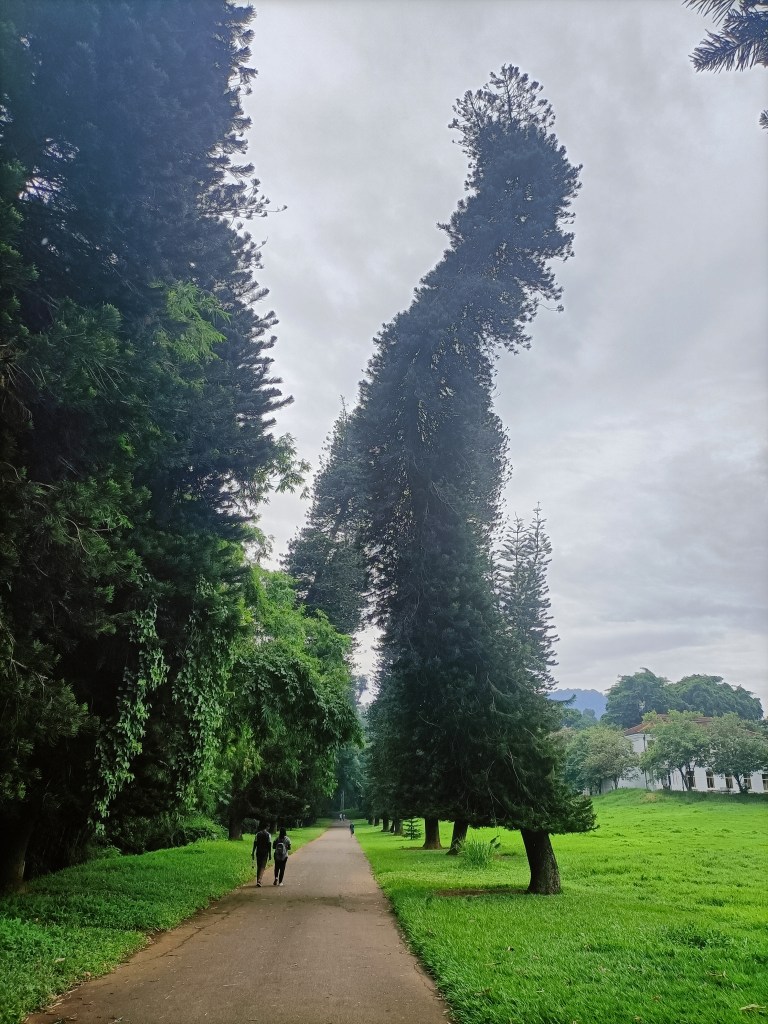
….or in some cases, not so straight trees.

…but these pines look like they had too much to drink

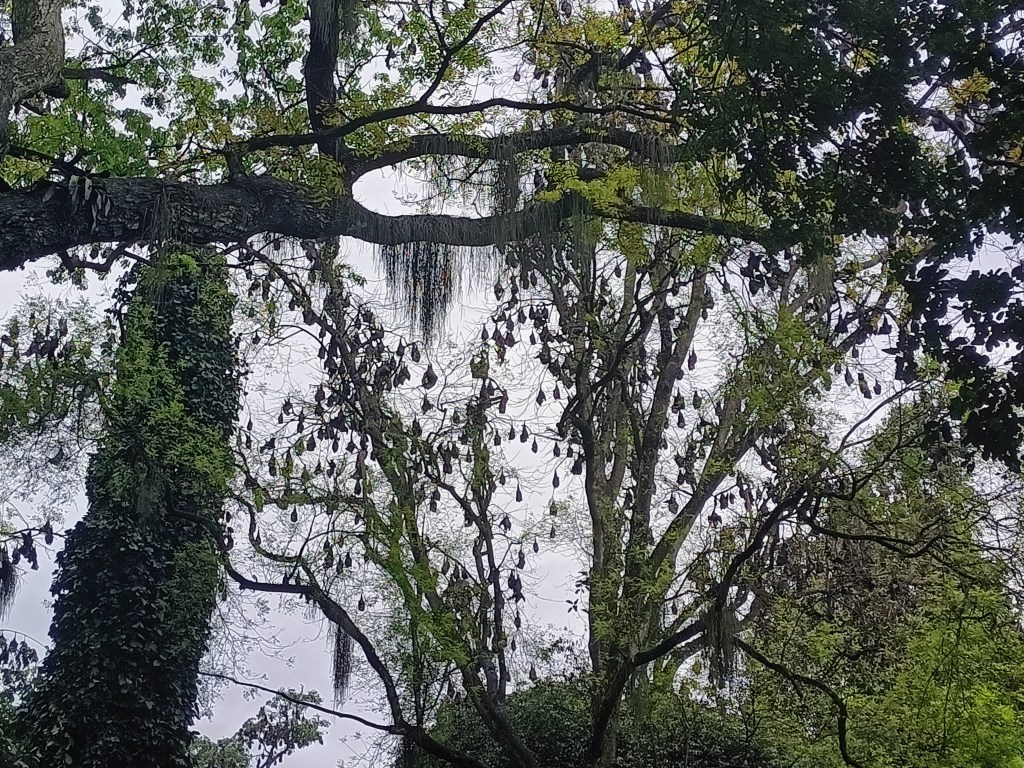
Some corners of the gardens had a huge populations of fruit bats. Enterprising garden workers would ask tourists for a few rupees, and would then shake the trees to unleash a crowd of screeching animals.

Just how many bats can roost on one tree?

There was also an area for trees ceremonially planted by world rulers and celebrities visiting Sri Lanka, including many members of the British royal family, Yuri Gagarin and even Crown Prince Nicolay of Russia (who planted a tree a few years before he became the last Russian tsar).

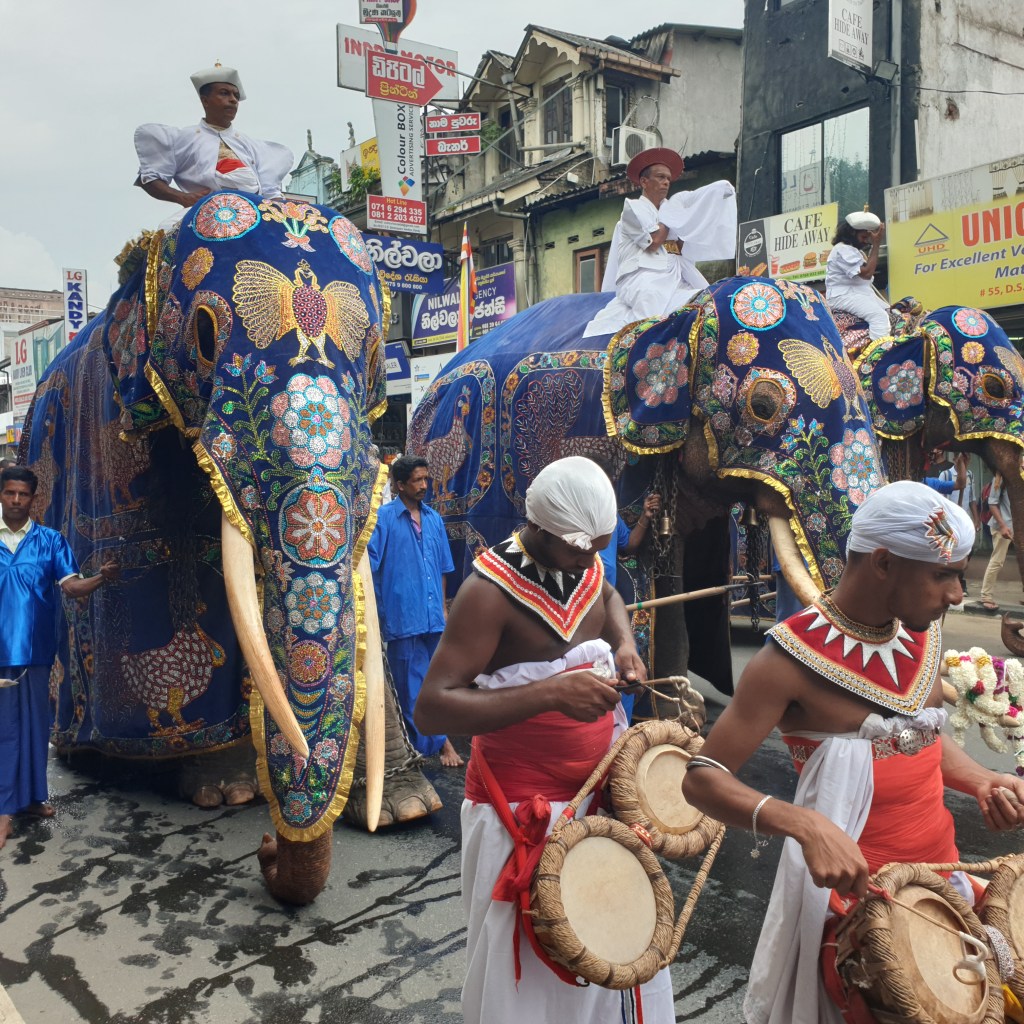
My driver and I then went to my hotel but encountered a big traffic jam. It had an unusual cause – the road had been blocked for a procession of Sri Lankan drummers and three elephants. It was a practice procession for Kandy’s big religious festival called Esala Perahera, which celebrates the sacred Buddha tooth relic which is kept in Kandy.  I knew that I would miss the main festival by a few days, so I jumped out of the car and ran to get some photos.

Preparing for Esala Perahera

My lodging turned out to be a very nice boutique hotel located in the centre.   I had a quick rest before heading out to a performance of Sri Lankan dance. It was rather touristy (unusually, there were more foreigners than Sri Lankans) but still entertaining and included many different forms of dance, following by fire eating and fire walking.

Next I started my visit to Kandy’s main attraction – the Temple of the Sacred Tooth Relic. This shrine houses a tooth said to have been taken from Buddha’s funeral pyre and smuggled to Sri Lanka in 483 BCE. It was located in successive Sri Lankan capitals including Anuradhapura and Polonnaruwa – before ending up in Kandy. The tooth was seized by the Portuguese in the 16th century and burnt, only for the Sri Lankans to reveal that the burnt tooth was a replica, and that the real one had been hidden for safe keeping. The complex was built over many years, from 1687 to 1782, and also housed the royal place.

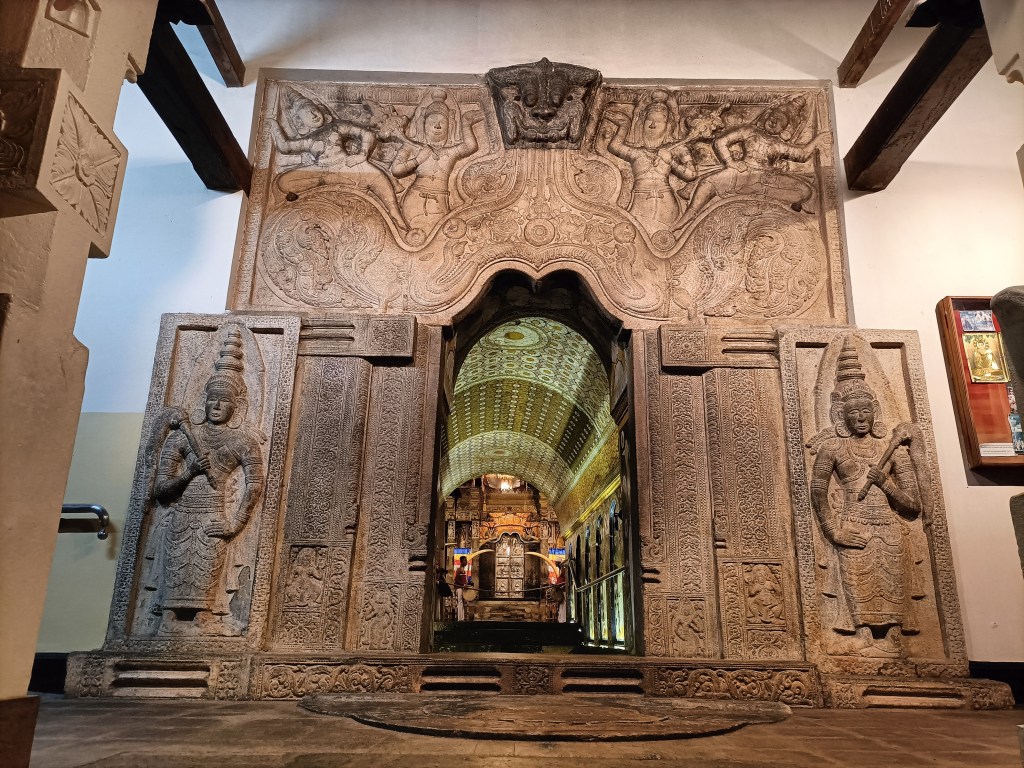
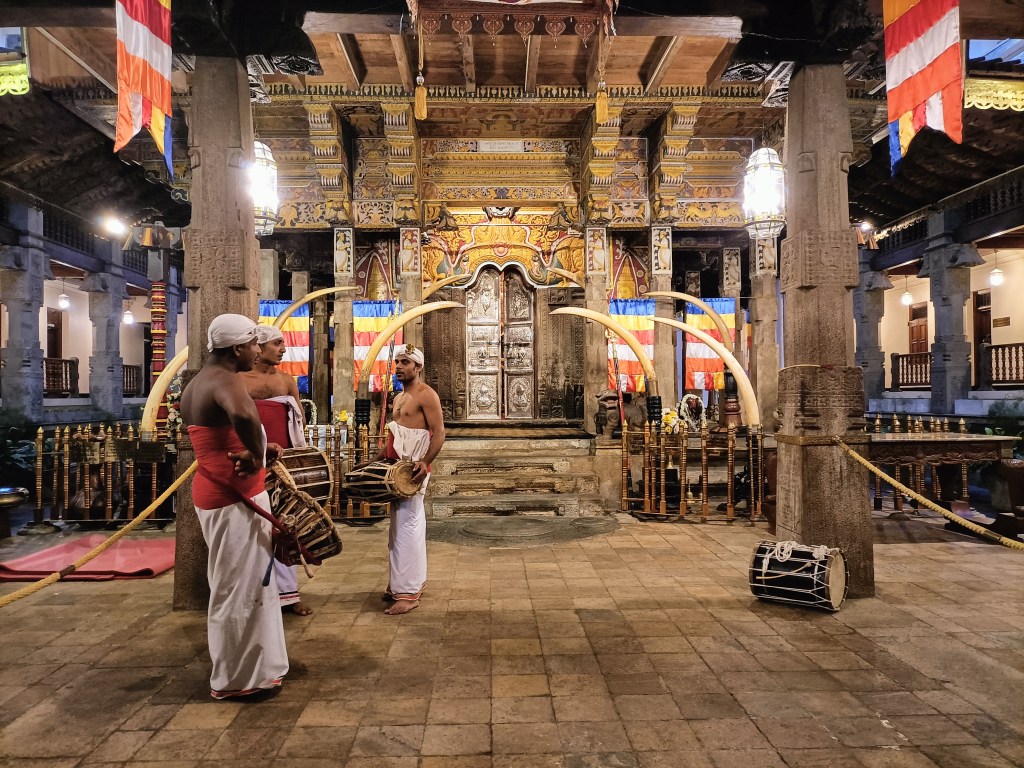
Today the temple remains a very active centre of worship, and I made sure to visit at the time of evening Puja (prayers or offering). It was a very atmospheric experience, which lasted an hour and a half. I entered through an ornate doorway and brightly painted corridor, and then I waited with local worshippers and a few other tourist outside a shrine on the ground floor of the complex as drummers welcomed priests who entered and left an inner sanctum. 

The entrance to the temple
Drummers await priests at the first shrine on the ground floor

Then I queued to visit the tooth relic itself on the second floor.  Worshippers filed past a small window, through which can be seen the silver caskets in which the tooth is housed (seven caskets of decreasing size, sitting inside each other like a Russian doll). They then retire behind a long table where they place offering of flowers.

A glimpse of the silver casket housing the sacred tooth (not easy to photo!)

After placing my offering, I strolled around the rest of the complex, including parts of the former royal palace. The night air was filled with the sound of services being started in the neighbouring temples, of which there are many. The air was pleasantly cool, with a smell of incense and flowers.

The temple complex seen from the outside, after my visit

I continued my stroll back to my hotel and bought some take away vegetable dosas (an Indian dish a bit like a crepe) to eat on my balcony overlooking the city. It had been a very nice day, and in the hotel I enjoyed regaining some of my basic creature comforts – electricity, internet and hot water. Even better, it had not rained today!

The “Bear” Necessities of Life

Today I set off to explore one of Sri Lanka’s most famous highlights – Sigiriya rock, a set of ruins built on and around a striking volcanic rock that towers above the surrounding plains. There is some debate as to whether the site used to be a monastery or a palace, with most historians opting for the latter. In this version, Sigiriya rock was the impregnable palace of King Kasyapa, and was built in around 480 CE.  The site was occupied until the 14th century , then abandoned and only rediscovered in 1898.

Sigiriya Rock

Many people climb the rock to see the sunrise, but I didn’t want to get up at 5am. After the previous days rain and clouds, I doubted that I would see the sun. Instead, I took it easy, had my breakfast at 8, and only reached Sigiriya rock at 9. I paid the entry fee for foreign visitors of $30 – extremely high by Sri Lankan standards – and walked through some pretty gardens with lily ponds to reach the base of the rock. On the way there I saw a big monitor lizard and a hornbill (a type of bird).

A lily pond at the entrance to Sigiriya Rock

The metal steps leading up to the top of the rock have been improved and climbing up is no longer the terrifying experience it was a few years ago. I was soon at a platform half-way up where a huge pair of sculpted lion paws emerge from the rock, flanking the passage leading further up.

The path up, through giant lion’s paws

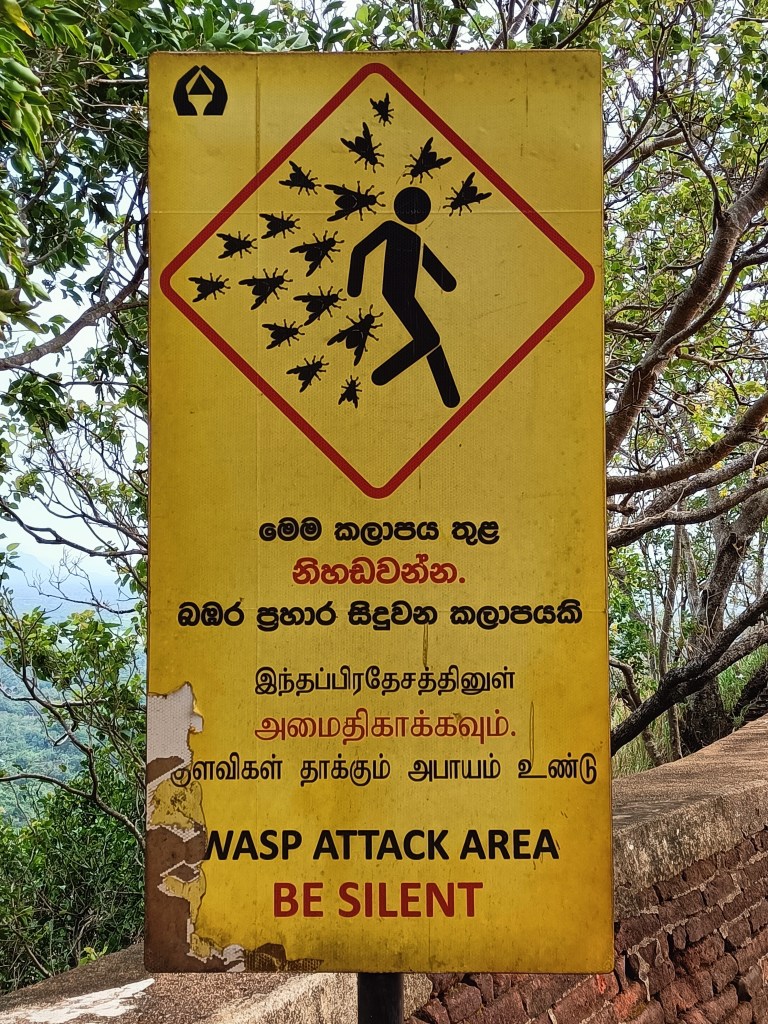
Some people think that there was originally a huge lion head sculpted into the rock, covering the entire face of the cliff. This must have been a magnificent sight, but it has long since collapsed, leaving sheer cliffs that are the home for an unusual travel hazard….

Unusual travel hazards

In 2012, many tourists were stung by angry wasps and ended up in hospital. With my thick fur, I wasn’t so worried, but I still climbed in silence as the signs instructed me.

You can see the wasps’ nests to the left of the cliff

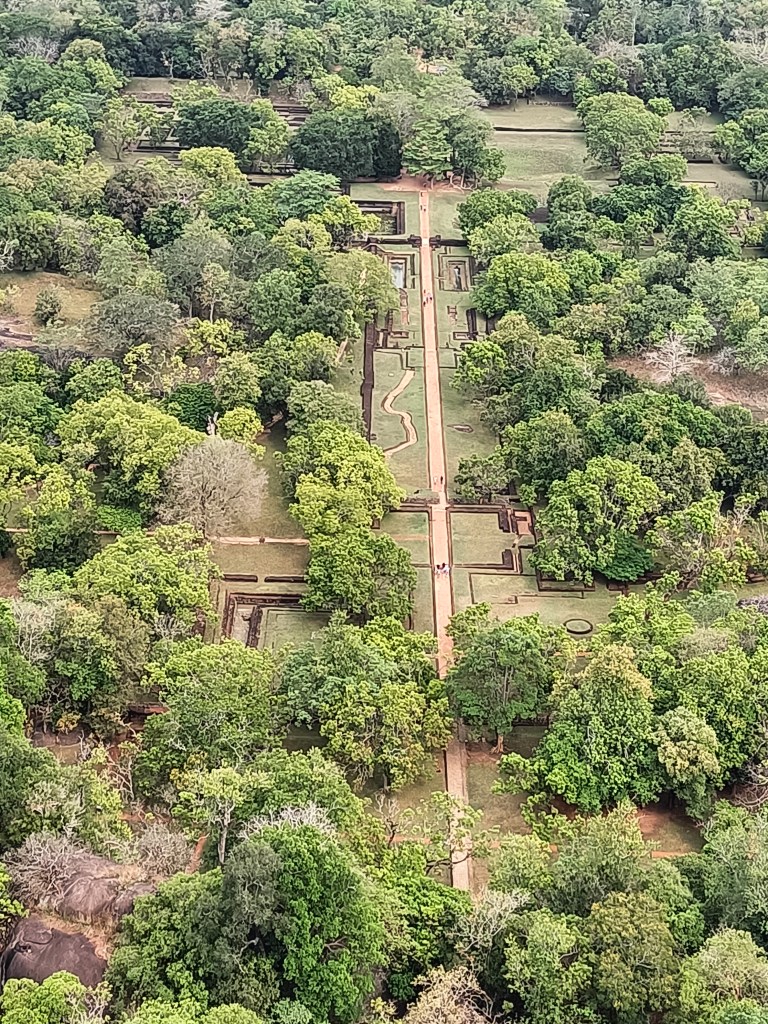
At the top, the palace ruins were exactly that – ruins, with little left standing – but the views of the surrounding countryside were spectacular. 

On top of Sigi Rock – the views are more interesting than the ruins

On the way down I visited a sheltered gallery which has paintings of many half-naked Sri Lankan women – all with improbably large breasts and thin waists. It is not known whether exactly when they were painted or who they represent – possible they were the king’s concubines. They were in an excellent state of preservation, but taking photos was not allowed. 

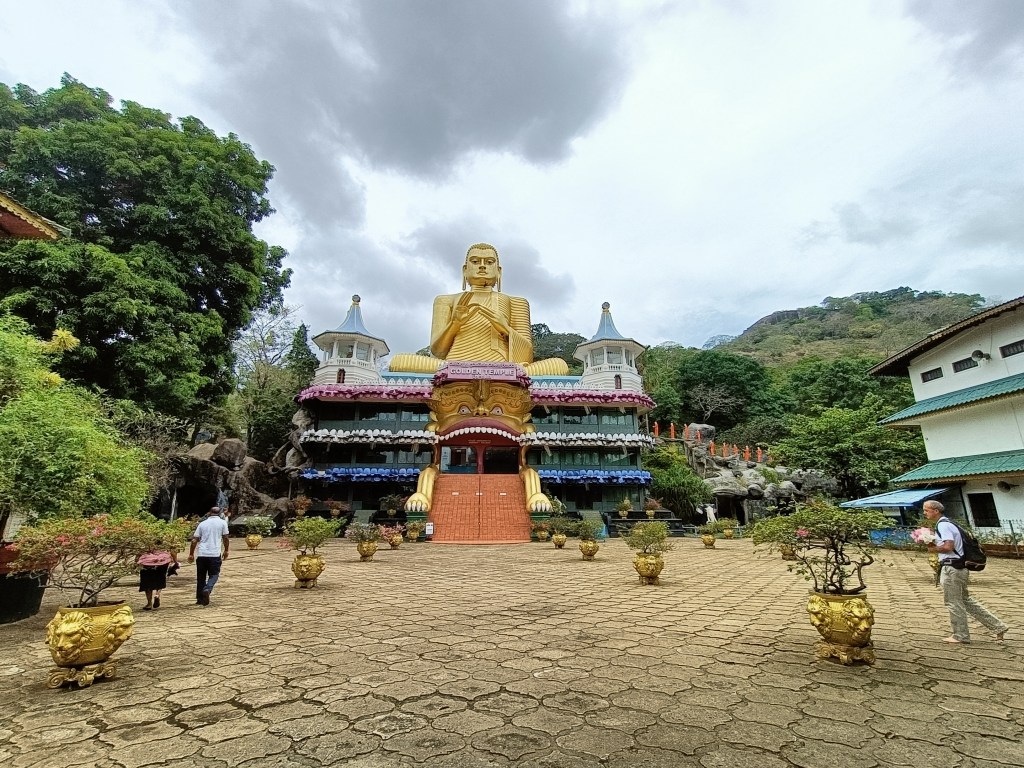
I completed my descent and found that it was still only 10.30. I was soaked in sweat, not from physical exertion but from the very high humidity after last night’s storm, so I went back to the hotel and had a shower, a change of clothes and short rest. I asked my driver to take me to nearby Dambulla, a site of worship dating back 2000 years, but now most famous for its caves which house over 150 more recent, but still stunning, Buddha images.  On my way I took time to visit an interesting modern temple with a giant golden Buddha.

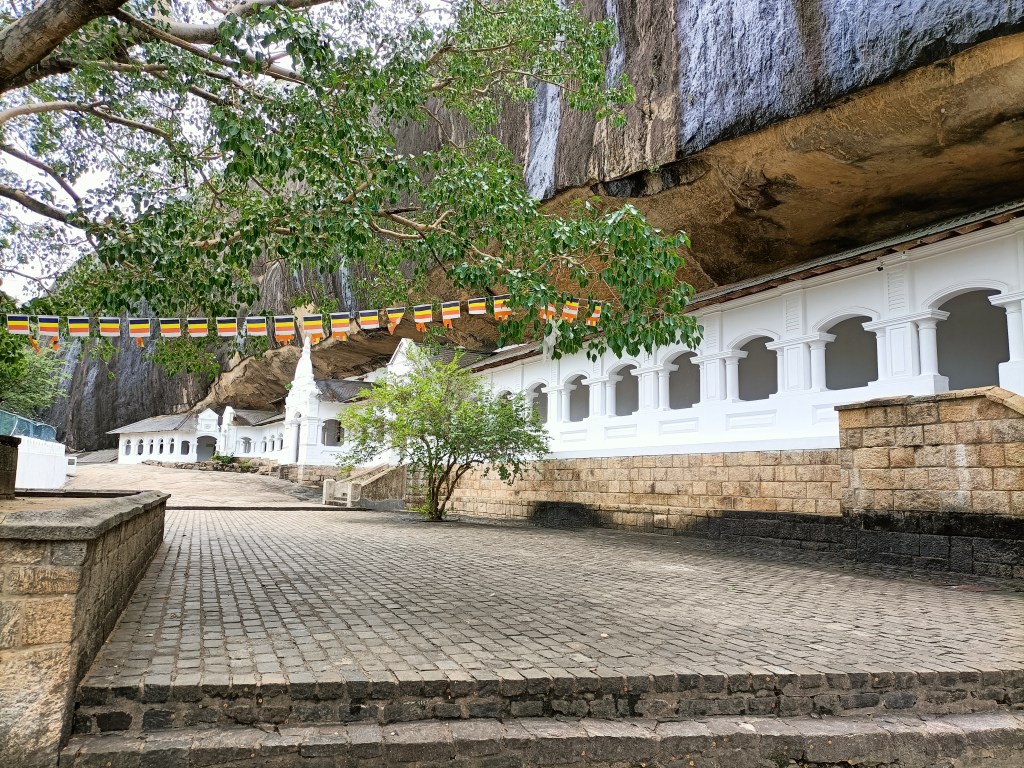
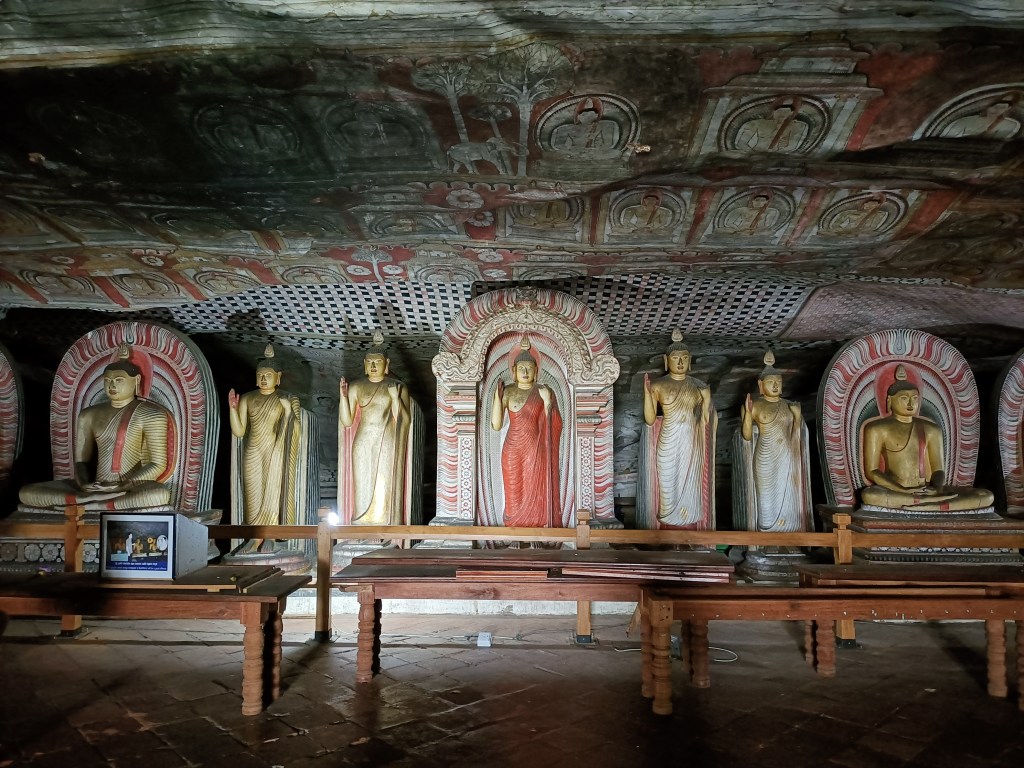
Then I climbed up to the site of the cave temple. I hired a guide who explained that the first rock paintings dated from the 1st century, and then gave me the dates for each of the most impressive Buddha statues, which ranged from 14th to 18th century. The more recent additions blended in perfectly with the older statues to give a remarkably consistent feeling to each of the five caves.

The exterior of the cave temples
Stunning Buddha images….
…and one king who got in on the act.

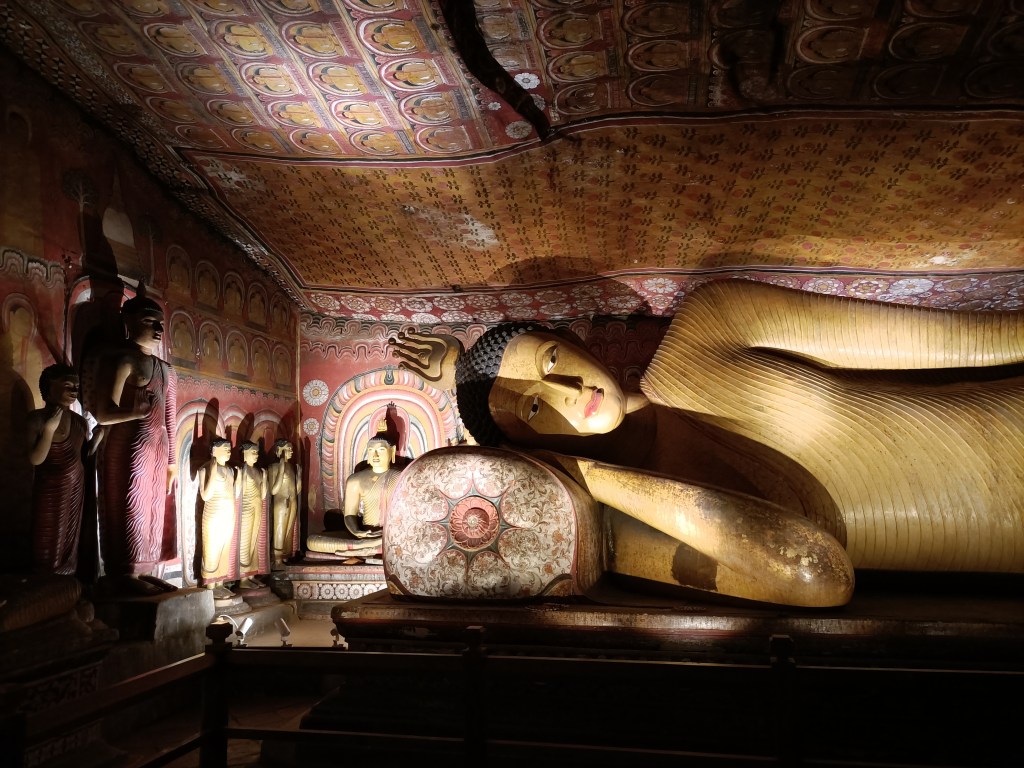
The quality of the work was breath-taking – when I first saw this reclining Buddha I thought that his pillow must be made from fabric, but on closer inspection it was expertly-carved stone.

Believe it or not, the Buddha’s pillow is carved stone

The coolness of the caves, near-absence of other visitors and stunning lighting made the caves a memorable experience. I took lots of photos, and then put away my phone to stand still and take in the special atmosphere.

On the way back to Sigiriya, another heavy thunderstorm broke, and I arrived at my hotel in the early afternoon to find that there was yet again no power. I sat reading and writing my blog whilst looking at the relentless rain. After a while I got bored – I needed internet access to publish my text and plan the next steps of my trip, but even when the electricity worked, the guest house rarely had working wifi. I solved my problem by asking my driver to take me to a five-star hotel resort located in a nature reserve in the jungle a bit outside of Sigiriya. The reserve is home to the slender loris, a cute-looking nocturnal monkey with huge, baby-like eyes. The hotel offered a tour to try to spot the shy creatures, but my guidebook said they were only visible when it was dry, so I thought chances of seeing anything were very slim. The persistent rain was getting on my nerves a bit – it was supposed to be dry season in this part of Sri Lanka! Every single day had seen a violent storm break in the mid or late afternoon, and pouring rain all evening after that. It meant that all my sight-seeing had to be crammed into the morning.

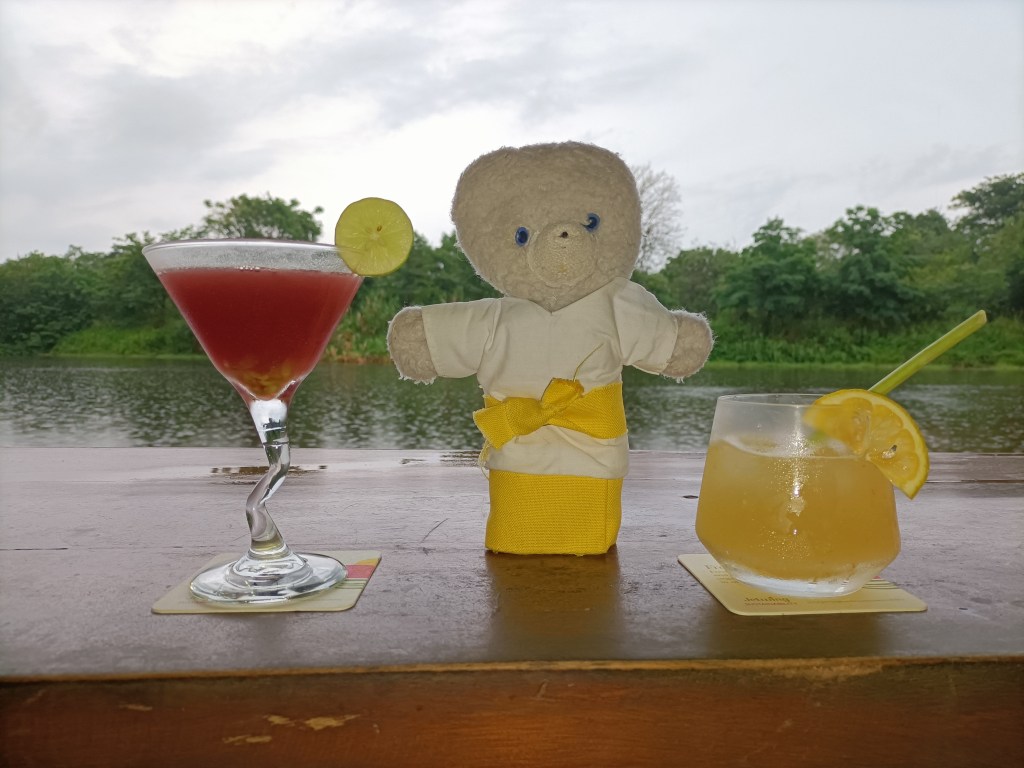
Instead of hunting for the loris, I sat by a pretty lake (which apparently was home to wild crocodiles), drank cocktails, posted my blog, and did my planning.

In weather like this you need a good drink

It is nice to try to help poorer guest house owners by staying with them, but when the weather is bad you cannot beat the comfort of a luxury hotel. I also stayed for dinner – the presentation of my curry was lavish, but the content and taste were the same as the cheap place I had visited last night. The price was fifteen times higher though.

After dinner my driver took me back to my modest guest house, to which electricity had still not returned. I undressed and brushed my teeth by the light of my phone, before fumbling around in the dark to plug in my computer and phones – ready for the moment during the night when power might return. Supporting small family businesses is good, but for me the bear necessities of life include electricity and internet.

Elephants Galore!

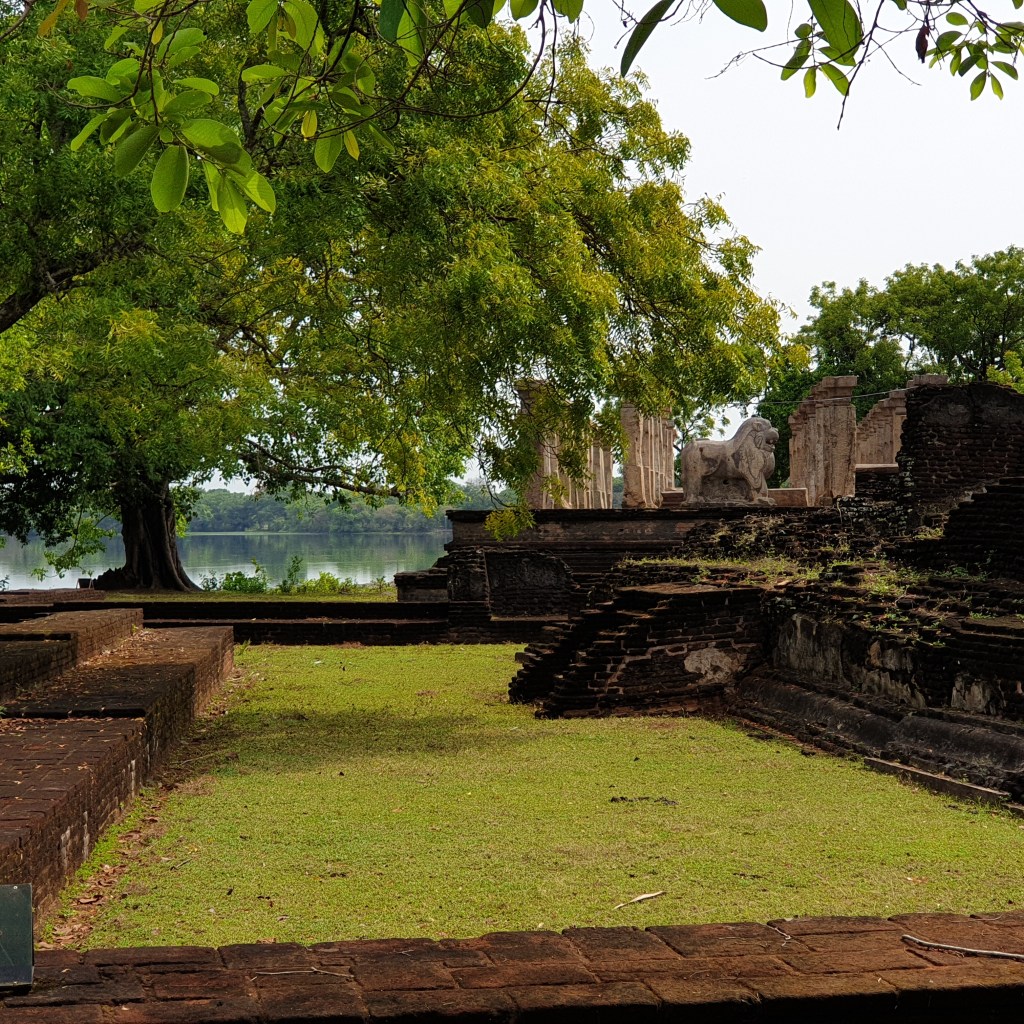
Today I had another al fresco breakfast and then explored one last set of ruins – the Southern Island Group – that were just next to my hotel.  This group gets very few visitors, and apart from some staff from the Archaeological Society and some cows, I was completely alone.  These ruins are free to visit, and are less well preserved than in the main site, but make up for this with the peaceful lakeside location.  My favourite was the king’s audience chamber, with its throne in the form of a lion.

The King’s Audience Chamber

Now it was time to leave Polonnaruwa to make the short drive to Sigiriya.  On the way we passed some semi-wild giant monitor lizards. An enterprising local feeds them fish and up to twelve giant lizards are attracted out of the jungle to get their free food; he then gets money from passing tourists if they stop to take photos – as I did.

I didn’t want to get too close. About 1 metre long…..excluding the tongue.

In Sigiriya, I had booked a simple guest house, which turned out to be hidden in the jungle. It was the sort of place whose owners have suffered badly during recent years – first Covid, and now the economic and fuel crisis meant that for three years very few tourists have visited Sri Lanka. In the midday sun it was pleasant relaxing outside, and I felt good about supporting a small local business.

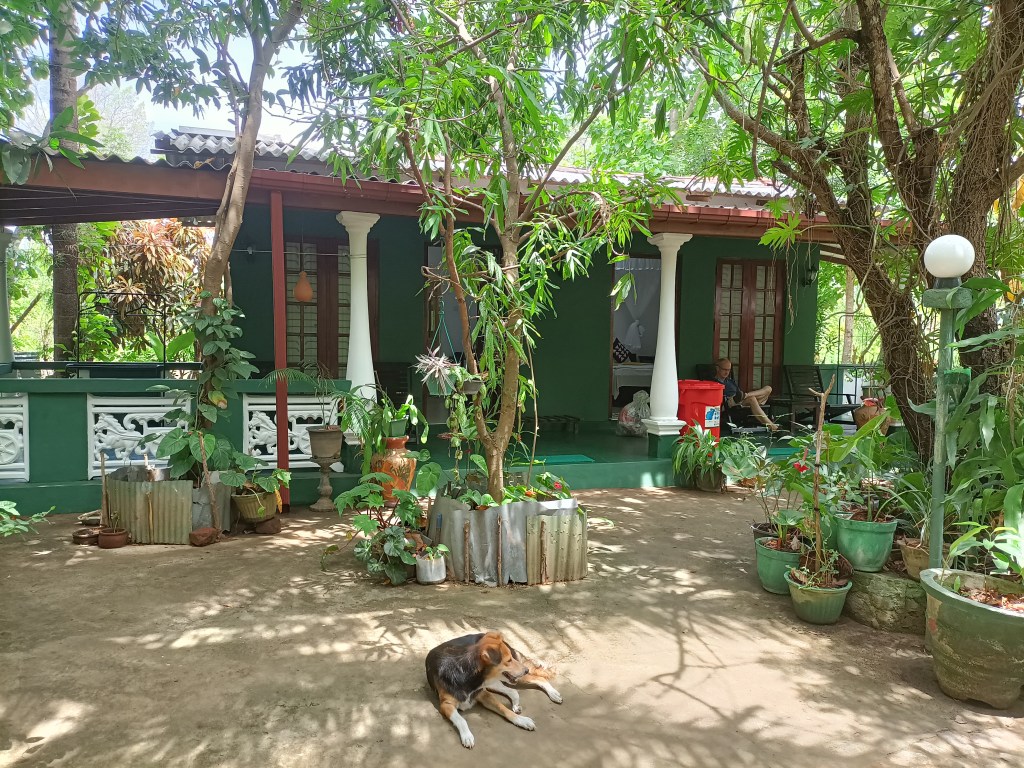
In the day, a good place to chill for dogs, humans and teddies…

Soon though I was on my way again. I had booked a safari in nearby Kaudallah national park.  Lots of wild elephants live in the surrounding jungle, but in dry season (which this was supposed to be….although it had rained heavily every day) they are attracted to a large lake as other sources of water dry up – an event known as “the Gathering”.  A jeep came to fetch me with a new guide – a safari specialist.  After the park entrance, we drove for about a kilometre along a track through thick jungle, which eventually opened out onto the lake.  Sure enough, we soon saw a family of elephants……..and five other jeeps. Fortunately for us, the drop in tourist numbers meant that we did not have too much human company and each jeep’s group could enjoy filming elephants more or less undisturbed by the others. I took lots of pictures and videos, especially of this family, which had a cute week-old baby elephant.

A few of the hundreds of photos and videos I took, starring a cute baby elephant.

The herds consist only of females and children; male elephants leave the group and live alone once they reach adolescence.  We enjoyed watching elephants spraying dirt on to their skin, elephants wading into the lake to drink….and this couple doing something strange to the grass with their feet and trunks.

Strange Elephant behaviour

We also saw lots of different types of birds – too hard to photograph with the zoom of my phone camera though.  We continued our drive around the lake, and met up with a much bigger group of around 25 elephants.

A large herd of about 25 elephants….and a darkening sky

As you can see from the photograph, the sky was now getting very dark. Sure enough, heavy tropical rain began to fall and my guide rushed to secure the waterproof flaps on the jeep’s roof and sides.  We drove back in another tropical thunderstorm, and arrived in the early evening to find our hotel bathed in darkness – the electricity had been cut due to the fuel shortages. Most places in Sri Lanka have two power cuts per day, each lasting roughly two hours. There is a web site that can be used to check when the outages should happen, but I did not find it to be very accurate.  Top end hotels have back up generators, and use them, so the power cuts are not problem there. Mid-range hotels like the one I had booked in Nilaveli have generators too but some choose to use them only in the evening, when light is needed; fuel is too expensive to justify using for the afternoon. Cheaper hotels either have no generator or no fuel to run one with. The basic amenities of our simple guesthouse seemed very pleasant during the light of day, with power available to charge our phones and computers. As night fell, sitting in the dark in the jungle listening to the incessant rain was much less appealing.  The hotel owner gave me a lift to a nearby restaurant (with generator) and I spent the rest of the evening there. I took my time over dinner (another curry feast) – there was nothing else to do.

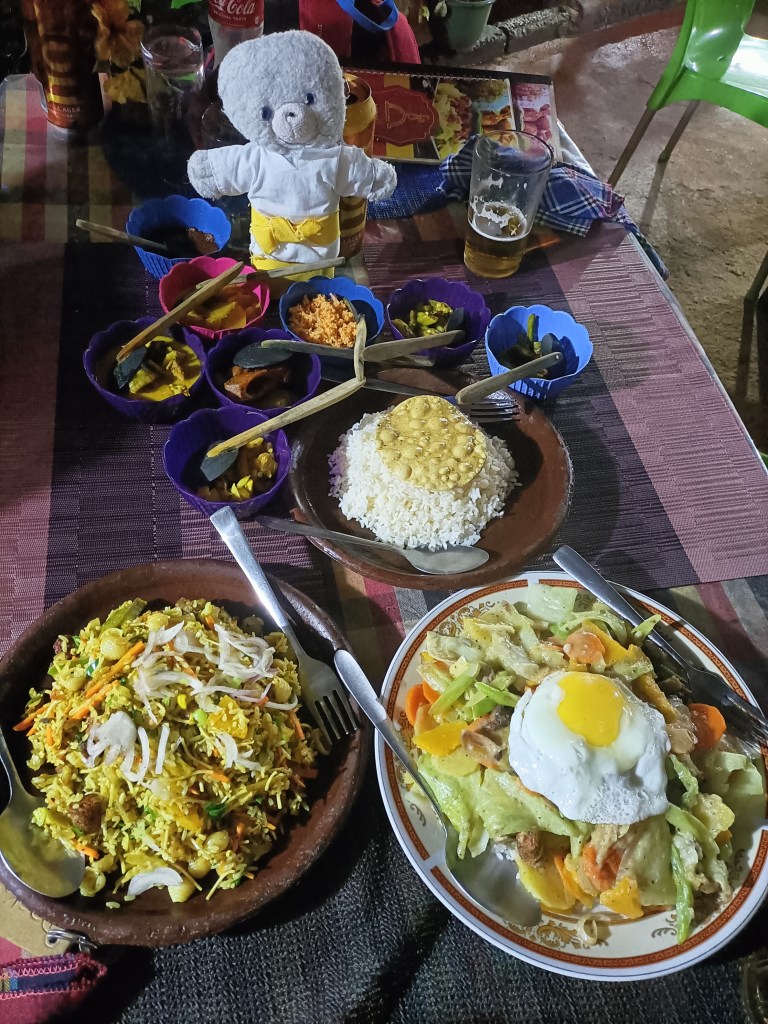
When all else fails…food!

A Bodyguard for my Breakfast

I arrived late in the afternoon in Polonnaruwa, where I had booked a room at the Ekho Lake hotel, an establishment dating from British colonial times where Queen Elisabeth II once stayed.  The hotel staff let me have a sneak preview of her suite, complete with its golden bathtub. The hotel is located on a beautiful, perfectly still lake and I enjoyed watching many different birds (kingfishers, eagles, herons) trying to catch fish.

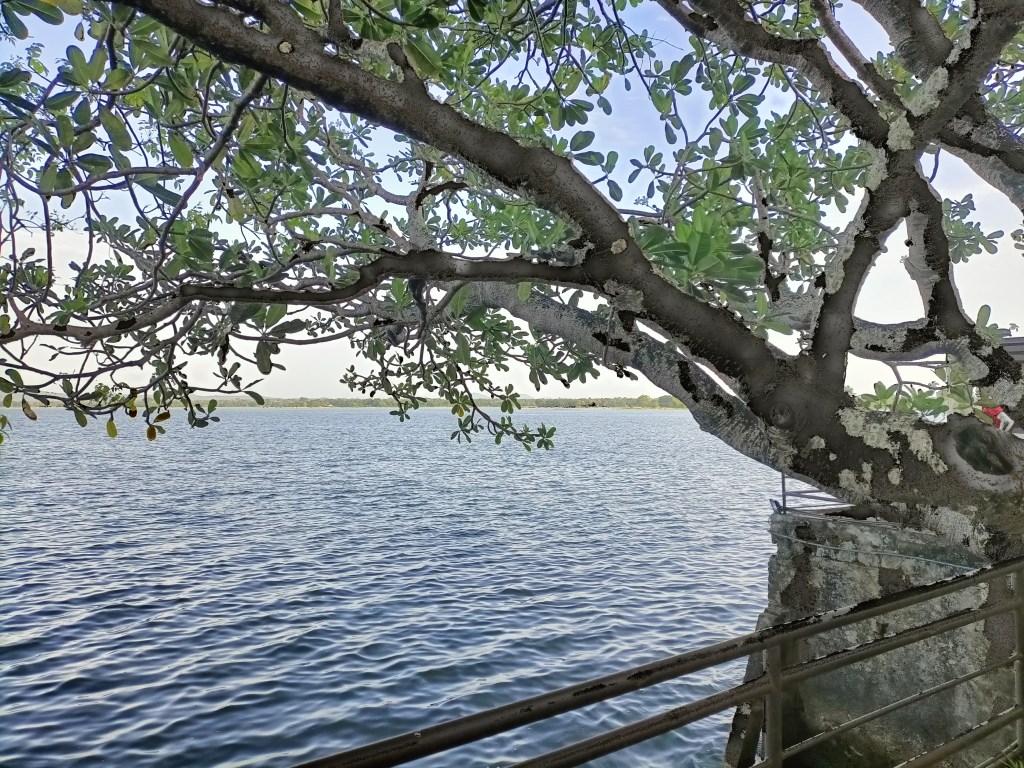
The view from the hotel

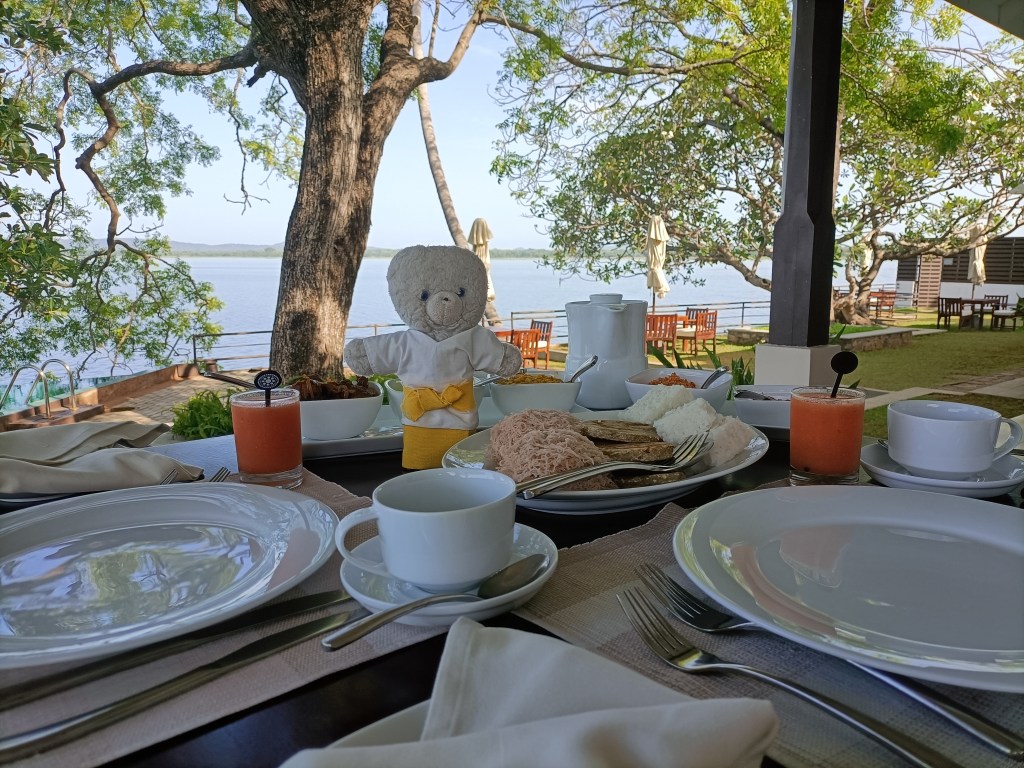
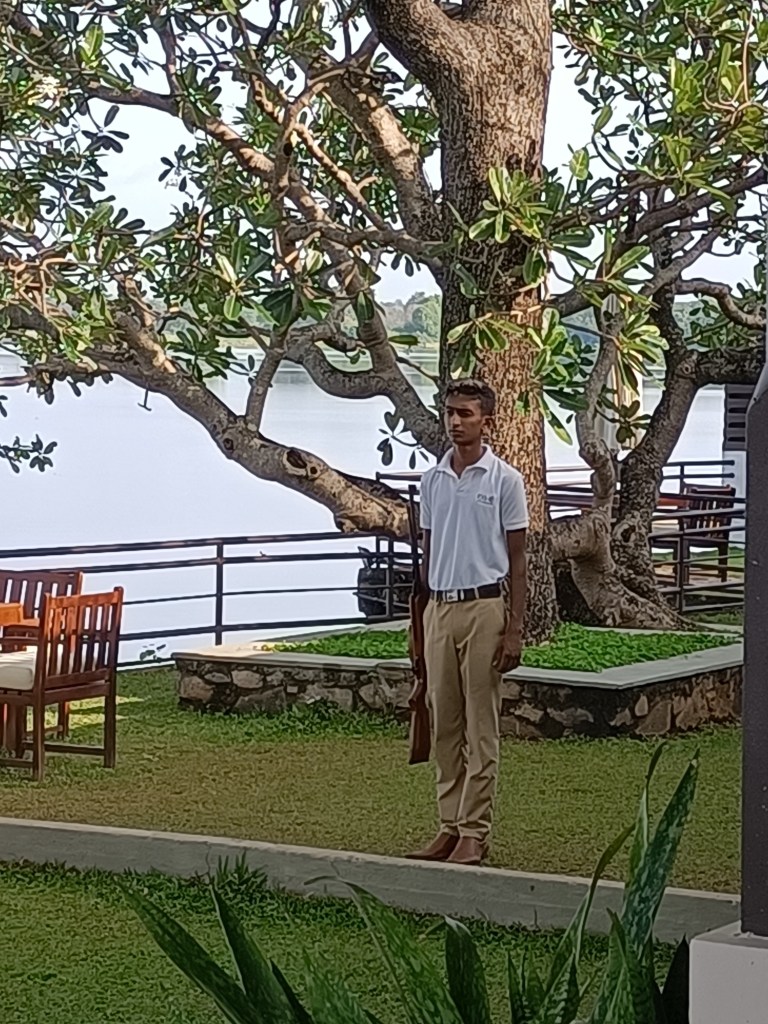
I had a curry dinner, which in true Sri Lankan style was accompanied by a dazzling array of vegetable side dishes. Next morning, I continued my observation of the lake and glimpsed an Indian otter. I asked for breakfast to be set up outside my room, which the staff did with enthusiasm (there were a lot of staff and not many guests).  Sri Lankan breakfast closely resembled dinner – chicken curry, rice, and a big selection of side dishes.  The array of food attracted the attention of a local monkey, and I got the services of a dedicated waiter with a gun to stand nearby to scare him off (the waiter explained that the gun was empty and just meant to scare the monkey).

A “light” breakfast al fresco
Guarding our breakfast against monkeys…the service in the hotel was excellent

It took me so long to eat the huge volume of food that I set off to explore Polonnaruwa a bit later than I had planned. Immediately after I had left the sanctuary of the hotel, I was approached by all sorts of people offering to sell me souvenirs, be my guide, or give me a tuk-tuk ride. Some of them were very persistent and followed me all the way to the Archaeological Museum, an obligatory stop to buy tickets to the famous Polonnaruwa ruins. This was the first time I had encountered such persistent sales pressure in Sri Lanka, and after many days of only meeting helpful and friendly people, came as a shock.

From the museum I hired a bicycle and set off to explore and leave my unwelcome pursuers far behind.  Polonnaruwa was the capital of Sri Lanka from 1070 until around 1200 and over the years successive kings added more temples and palaces to a huge site located near the city’s lake. This civilisation reached its peak under King Parakramabahu in 1153-86 (not easy to say after a few drinks) after which it went into rapid decline and the site was abandoned.

I started my visit by cycling to the very northernmost end of the complex, about 3km away from the main entrance.  There I found a lonely building housing a huge headless Buddha figure – and a solitary guardian from the Archaeological office who gratefully showed us around. Even in normal times, very few tourists make it this far away from the main gate.

The “Image House” – a remote ruin

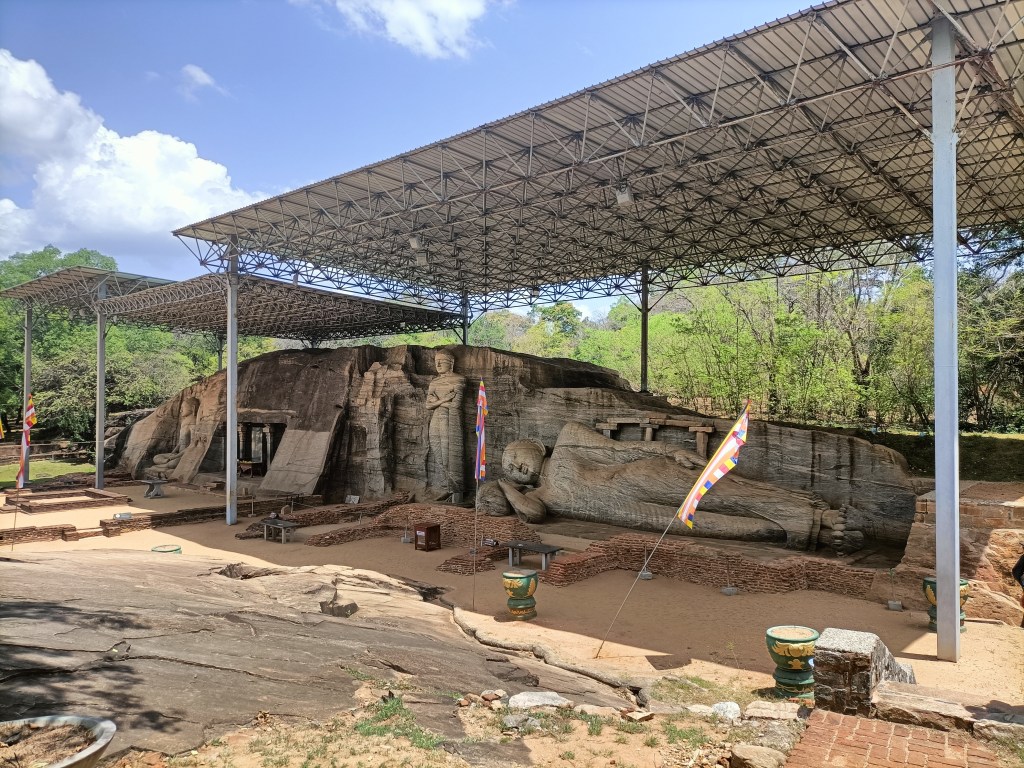
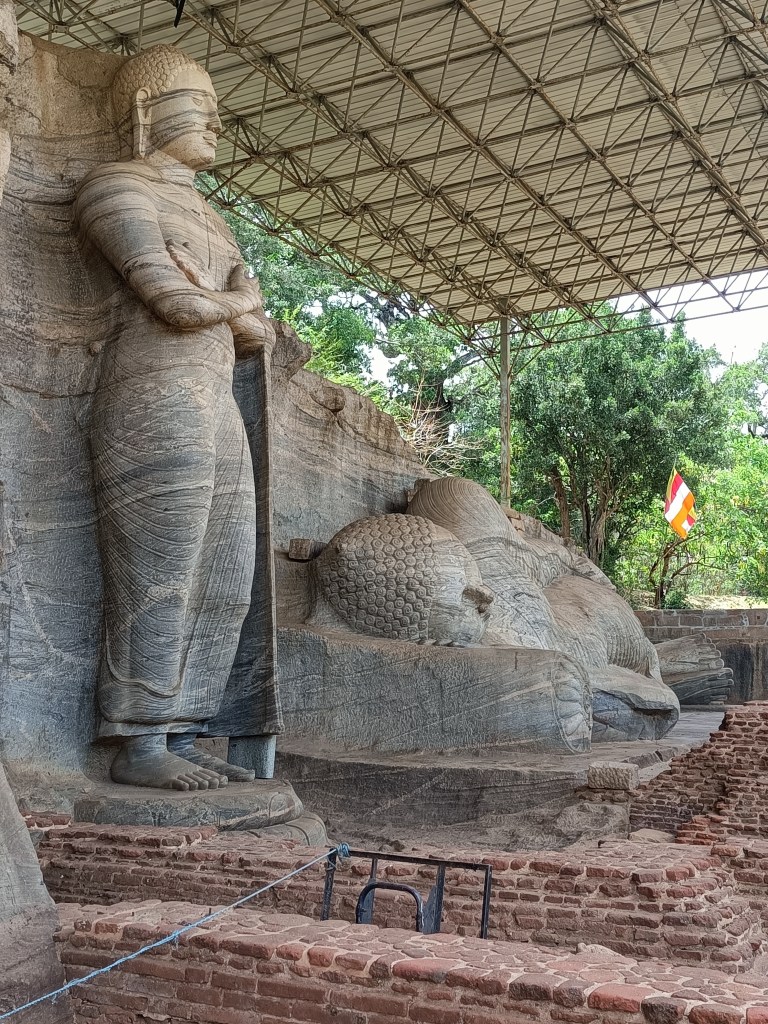
From there I retraced my route to one of the park’s highlights – the carved stone Buddhas of Gal Vihara. When I arrived, there were a few cars and even a minibus in the nearby car park, so I ordered a cold drink from one of the small drinks stalls and waited for everyone to go – I have become used to visiting Sri Lanka’s treasures all by myself!  The three large Buddhas, carved out of a single huge granite rock, did not disappoint. They represent the high point of Sri Lankan art at this period and conveyed a sense of calm and peace. They had sat there silently for 900 hundred years, and I could easily imagine them continuing their meditation for many millennia.

The peaceful Buddhas of Gal Vihara

From Gal Vihara, I walked to the next highlight – the shrine of Lankatidaka, whose layout was a bit like a western cathedral, with a long aisle leading to another huge Buddha statue.

Lankatidaka – probably my favourite ruin

I reclaimed my bike from the drinks stall and headed to Rankot Vihara, a huge central stupa…….

Rankot Vihara

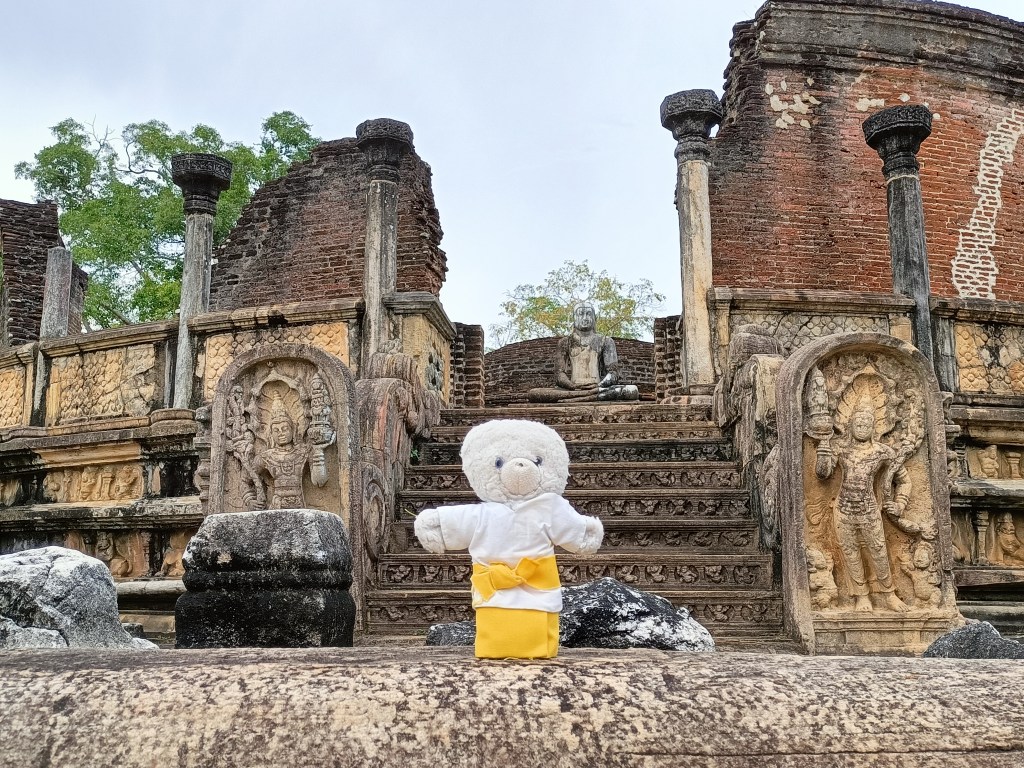
And then to the “Quadrangle”, a collection of ruins crammed into a small square area.

Atmospheric ruins in the Quadrangle

It was very hot (partly due to my late start) and I had developed a small routine for visiting each ruin – have a drink at the nearest drinks stall and leave my bike with the shopkeepers for safe keeping. My final visit of the day was to the Archaeological Museum – listed as a highlight by my guidebook, but actually rather disappointing compared to what you can see cycling around the archaeological park.

Soaked in sweat, I returned my bicycle and headed back to my hotel for a shower. Shortly after I arrived, the usual Sri Lankan thunderstorm broke, and I spent the next couple of hours enjoying my room before heading off to dinner.  This time I chose to eat in a local guest house whose owner gave cooking lessons and was treated to another curry feast.

Guest houses are much less formal than hotels, and a good place to meet and share news with fellow travellers – like here

I had enjoyed Polonnaruwa a lot. The ruins are better preserved than Anuradhapura (as you would expect, being 1000 years younger) and very impressive – but I think out of the two exceptional sites, I preferred the latter because it remains an active centre of worship.

Three in One

In today’s blog I will cover three days of my trip.  The first day started with me having breakfast and then waiting for my driver to show up. I had sent him a text earlier in the morning to check all arrangements were still in place but was met by a long silence. After an hour, he replied that all was good except that there would be a different driver and vehicle. I was rather annoyed by this but decided to wait to see who and what turned up.

In the event a van arrived similar to the one I had booked, but with two people rather than one – a driver and a guide – and an almost empty fuel tank. I checked the vehicle and accepted it on condition that they install seat belts in the rear seats where I would be sitting.

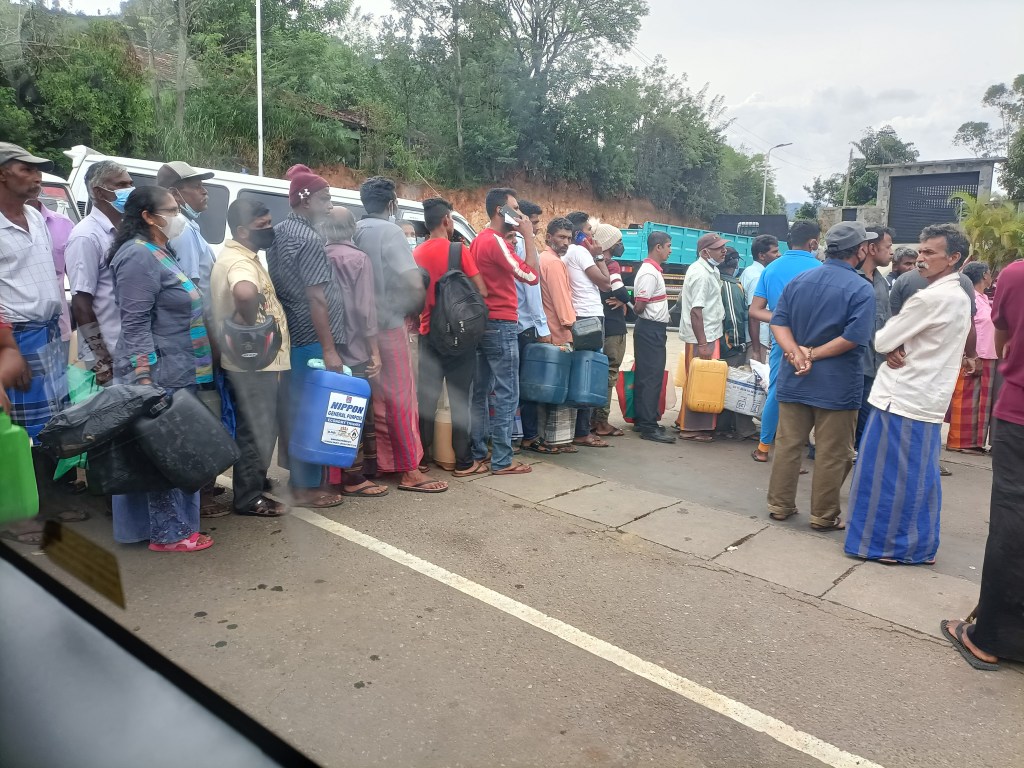
We set off to a resort on the East Coast of Sri Lanka, but first I deepened my experience of the Sri Lankan ritual of “looking for fuel”.  I learnt that there were three types of petrol stations.  The first (the most common) were completely deserted – no fuel and no hope of any fuel showing up.  The second type were where fuel was expected to arrive in the next few days, and were easily spotted because of the huge queues of vehicles – petrol vehicles on one side of the road, diesel on the other. These queues would often cause traffic jams that blocked main roads for the few vehicles which could move.  The third type of station, which was very rare, was one which had received fuel and which was now selling it.  These could be spotted by the even larger queues and crowds, but also the presence of police.

The driver spent an hour driving around Anuradhapura looking for a station of the third type.  When he finally succeeded, my guide got out and introduced himself to the station owner and the most senior police officer.  There is an understanding in Sri Lanka that tourist vehicles get priority and can jump the queue.  The station owner asked the guide to open the van door to prove that he was transporting tourists……and got a shock when he saw a teddy bear rather than a human tourist. He scratched his head, but decided that foreign bears also counted as tourists. He asked me to get out of the van to prove to the waiting crowd that priority was indeed being given to a tourist, and not just one of his friends.

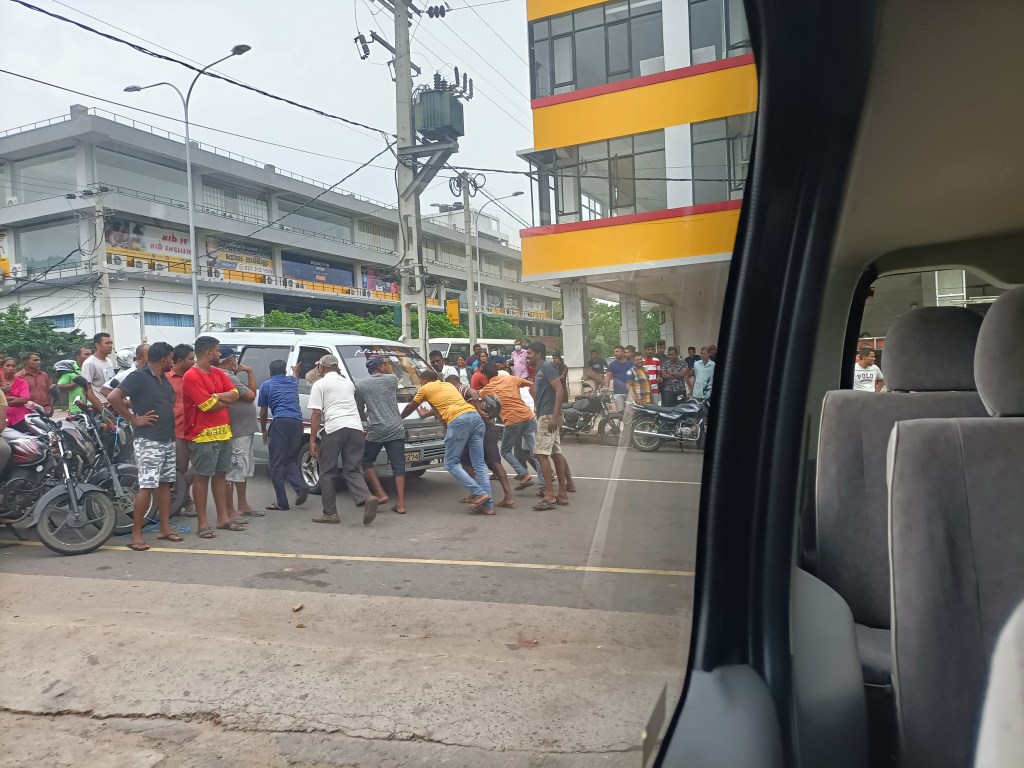
Someone unsuccessfully trying to jump the queue at a petrol station

It was a rather uncomfortable experience standing waiting for our vehicle to be filled. I felt sorry for the Sri Lankans who had been queuing for days, and also slightly worried that the large crowd could get angry seeing me being served first. But we got our diesel without any incidents and were soon on our way with a full tank.

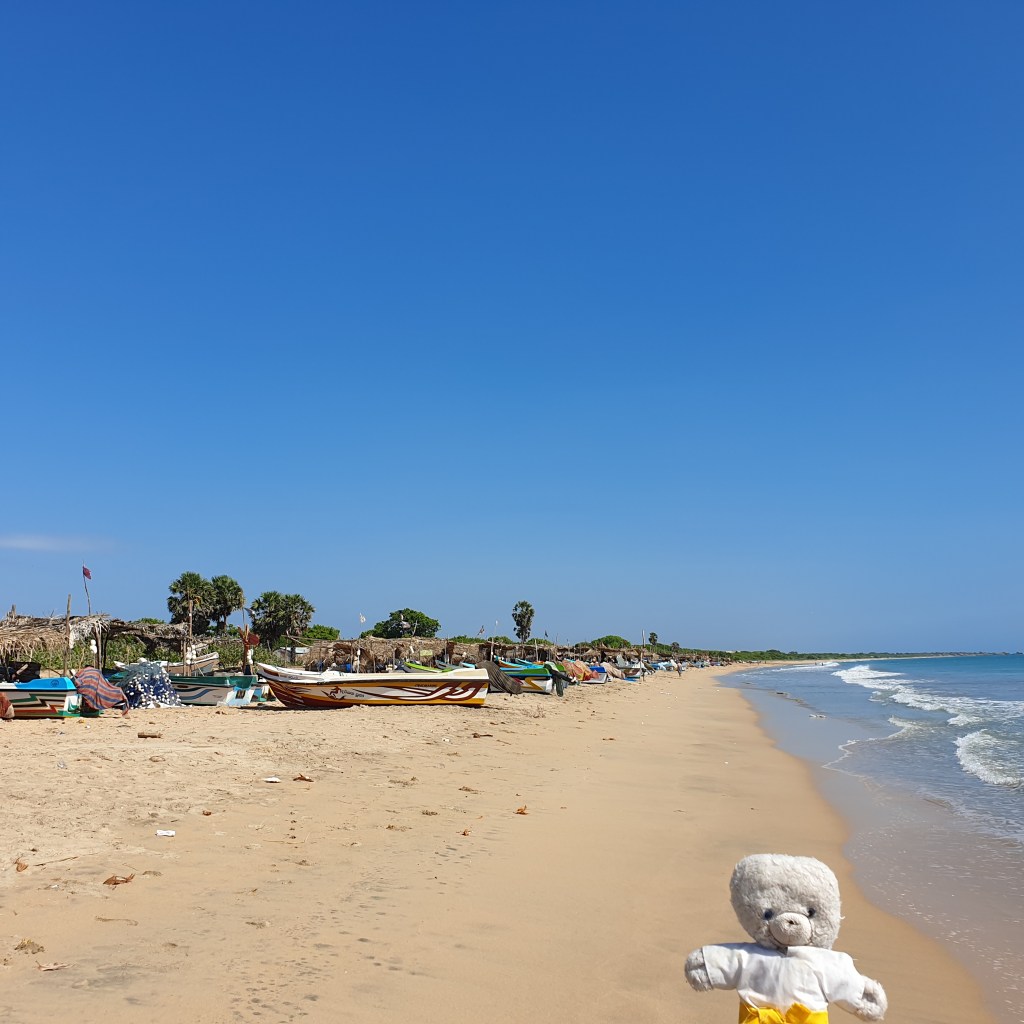
We arrived at a place called Nilaveli on the East Coast, where I had booked a hotel.  It was a lovely place, and I spent a day and half lazing by the pool, swimming in the warm sea, or strolling up and down the beach.

A small fishing village near to my hotel

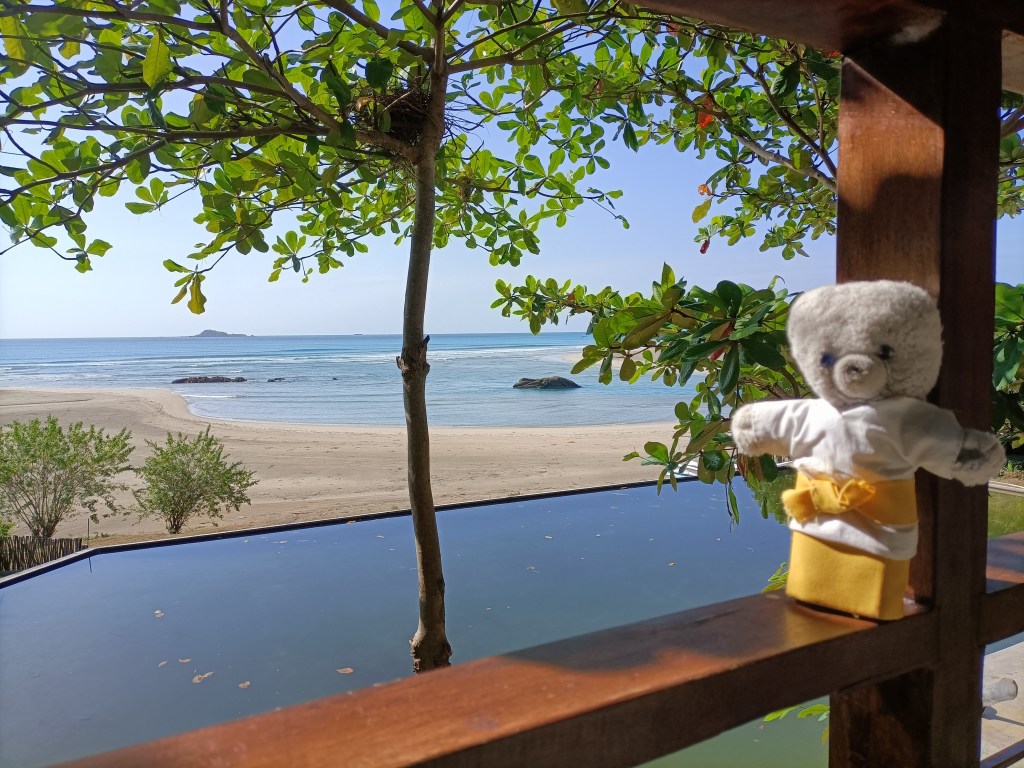
I also enjoyed sitting on my balcony, admiring the view and watching the fishing boats pass.  Directly in front of my chair was a crow’s nest. The two owners initially made a lot of noise to try to scare me off, but when they had understood I was not a threat, they left me alone to concentrate on chasing off marauding monkeys. 

The view from my balcony and my crow friends’ nest

As was to be expected, the restaurant served excellent sea food. On my first night I had a big bowl of sea crabs and on the second I had this fine big fish, straight from the sea.

All for me!

After a day and a half of relaxation, my driver and guide turned up after breakfast on my third day at Nilaveli. The guide told me that the driver had been unable to find seat belts in the area around Nilaveli, so had gone all the way to Colombo, a five hour drive away, to find them. I look nervously at the van’s fuel gauge, but saw that it was still nearly full. The driver had made the trip by bus – he must have spent nearly the entire time travelling whilst I was enjoying the beach.

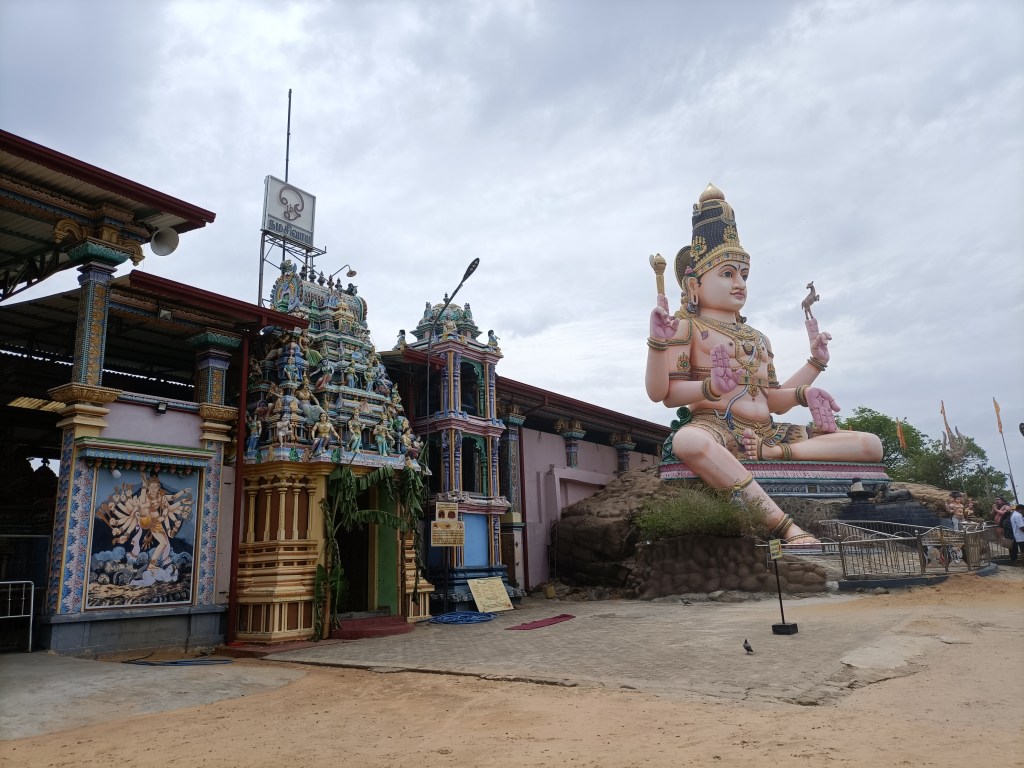
We set off to see the small east coast city of Trincomalee. It has a huge and strategic harbour, which meant that it had been fought over many times in its history, and occupied by the Portuguese, Dutch and British. On a long peninsula leading from the main town, there is an old fort, built by the Portuguese in 1622, and now a base for the Sri Lankan marines. At the very top of the peninsula is the Hindu temple Sri Thirukoneswaram Kovil, which was my first stop for the day.

The exuberant exterior of the Sri Thirukoneswaram Kovil temple

I was lucky, because I arrived just in time for “Puja” or prayers – a colourful and noisy celebration of life accompanied by drums, bells and some sort of loud wind instrument. Photography was not allowed inside the temple, so unfortunately, I cannot share this experience with you, but instead I wandered around the outside taking pictures and admiring the view of the Indian Ocean.  After the visit, I enjoyed some excellent fresh fruit juice in a shop with a view overlooking Trinco’s harbour.

Passion fruit juice with a view of Trincomalee harbour

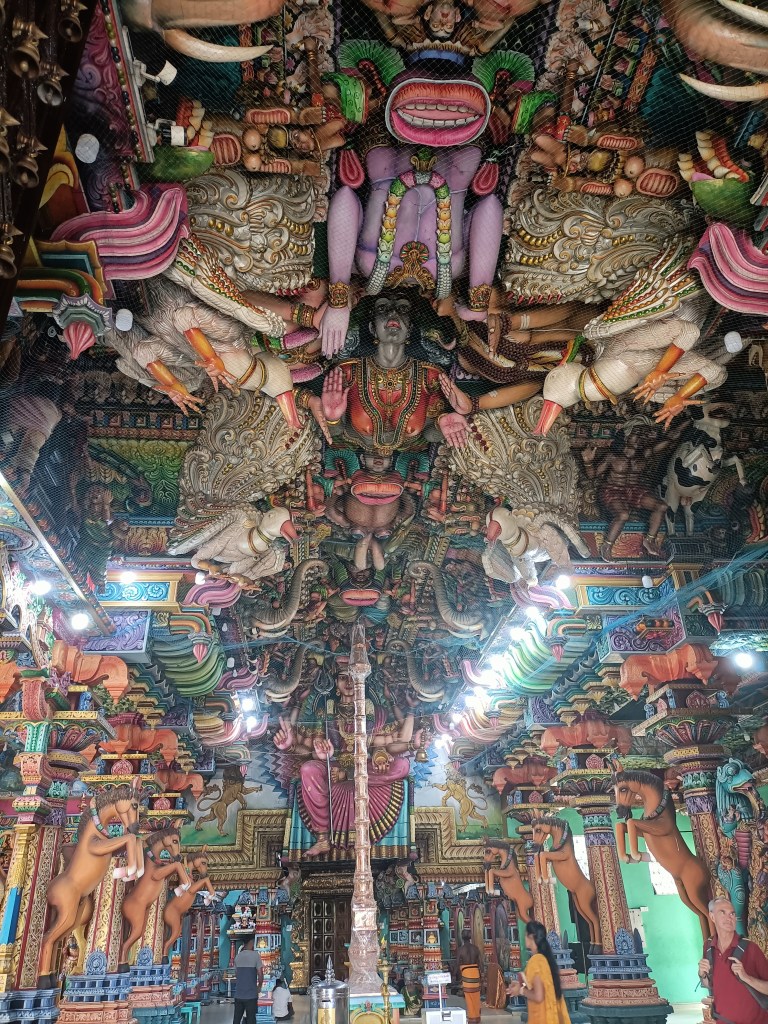
My other stop in Trinco was another Hindu temple – Kali Kovil, which is noted for its extravagant and bizarre internal carvings. At first, I thought someone had slipped some psychedelic drugs into my fruit juice – there were all kinds of animals and gods, a large squid eating a slightly smaller fish, and strange women (goddesses? demons? witches?) with an extra set of huge lips protruding from their bellies.

Am I dreaming? – the inside of the Kali Kovil temple

After the surreal experience of the temple, we set off again. My guide and driver again set off in pursuit of diesel, even though the tank was ¾ full. The only place supplying fuel was the government bus depot, but this time having a foreigner in the car was not enough – my guide was lacking a special fuel permit issued by the government to tourist drivers.  My intended route involved a long detour down the east coast, passing some interesting looking settlements, but my guide begged me instead to go directly to Polonnaruwa, my next destination. He said that the whole area was desperately short of diesel, and that he was afraid of running out. I was annoyed at yet another change of plans. I thought that we had enough fuel for several days, and that guide should have got his government permit before we started the trip. What’s more my detour only added 60km – if we had to be this careful about distances, the whole trip was going to be continually stressful.  Still, I didn’t want to run out of fuel either and reluctantly agreed to take the short route, telling my guide that first thing Monday he needed to apply for the government fuel permit.

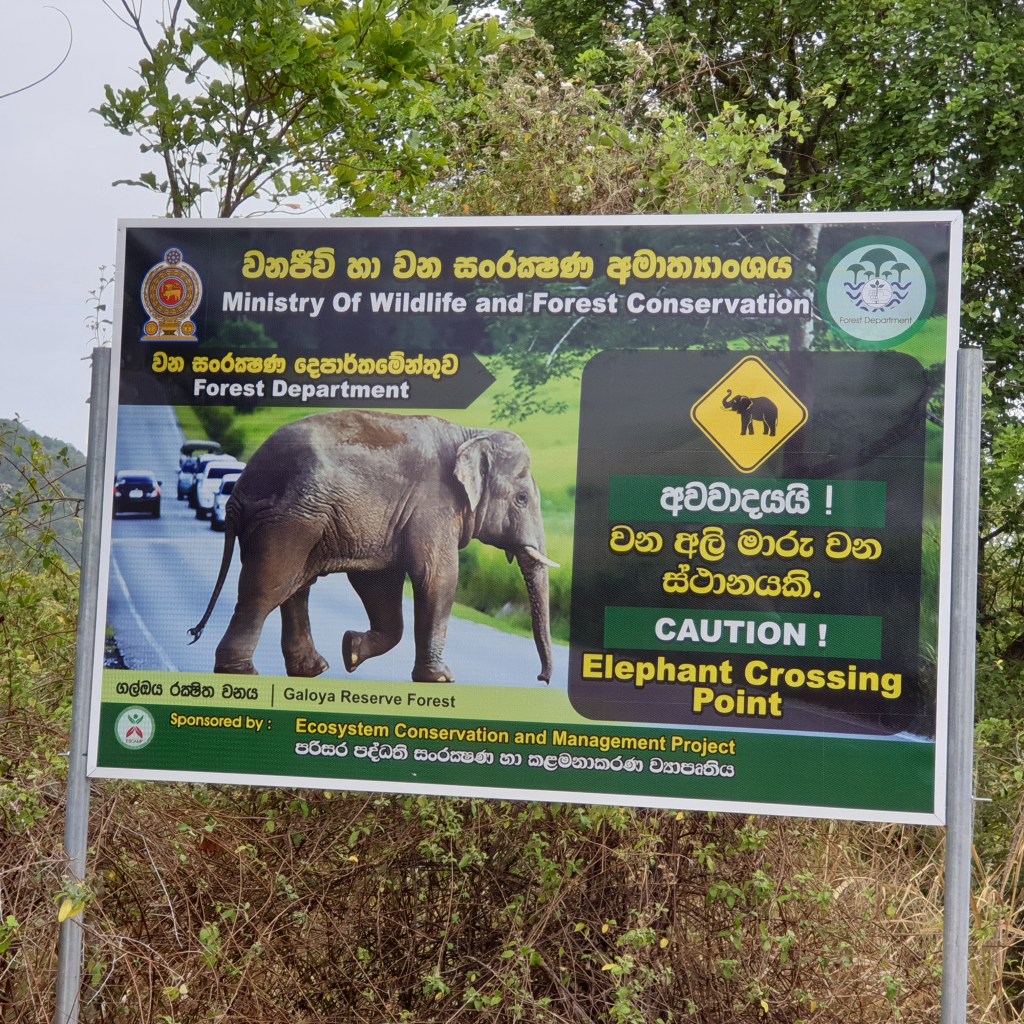
The direct route – one of the main highways crossing Sri Lanka – turned out to be interesting, passing a huge reservoir where elephants often gather and several times I saw elephant footprints or dung at the side of the road.

Sri Lanka’s roads have unusual hazards

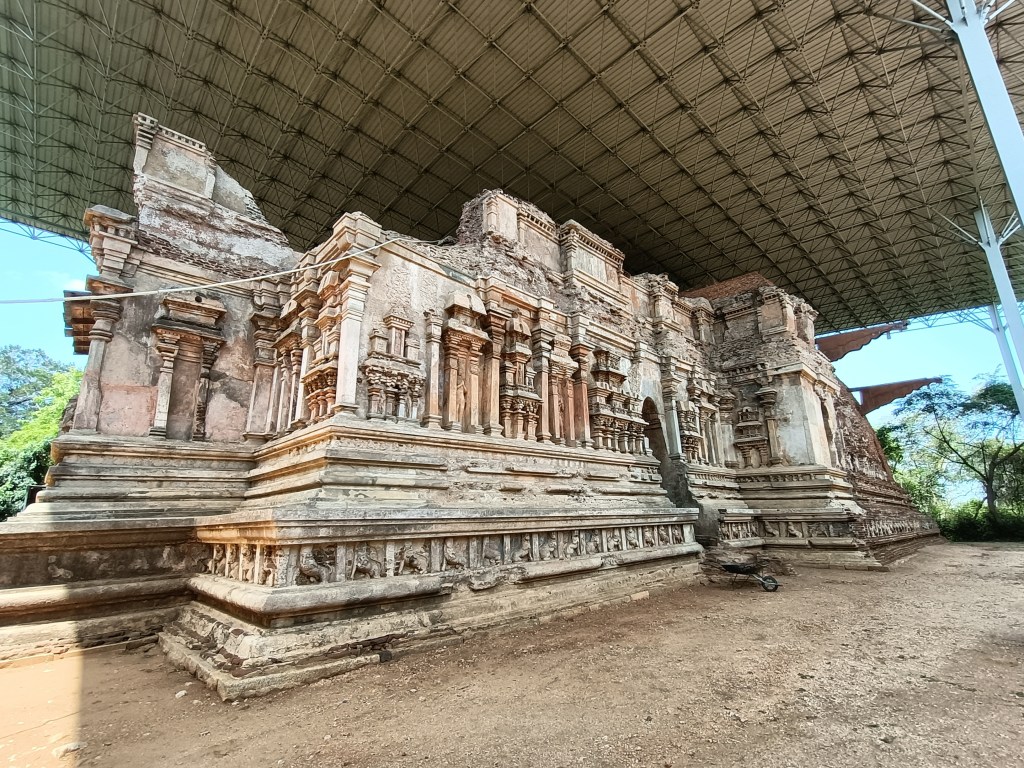
The road went close to the site of a ruined temple complex, and I insisted on a smaller detour (only 30km) to visit it.  I was lucky – the site was amazing, with ruins dating from the 7th century and no one there except me, my guide and my driver. I spent over an hour wandering around and filming before setting off on the final short stretch of road to Polonnaruwa, an ancient capital of Sri Lanka and one of the country’s highlights.

The highlight of the day – all alone at a deserted temple

Arriving in the town, the driver insisted on hunting for diesel, and this time we were lucky – we found a station selling fuel almost immediately, and this time having a tourist teddy bear as passenger was enough to get some.  I reached my hotel in the early evening, very satisfied with my day – lots of interesting sites and ending up a full tank of diesel. What more could you want?

A tale of two trees

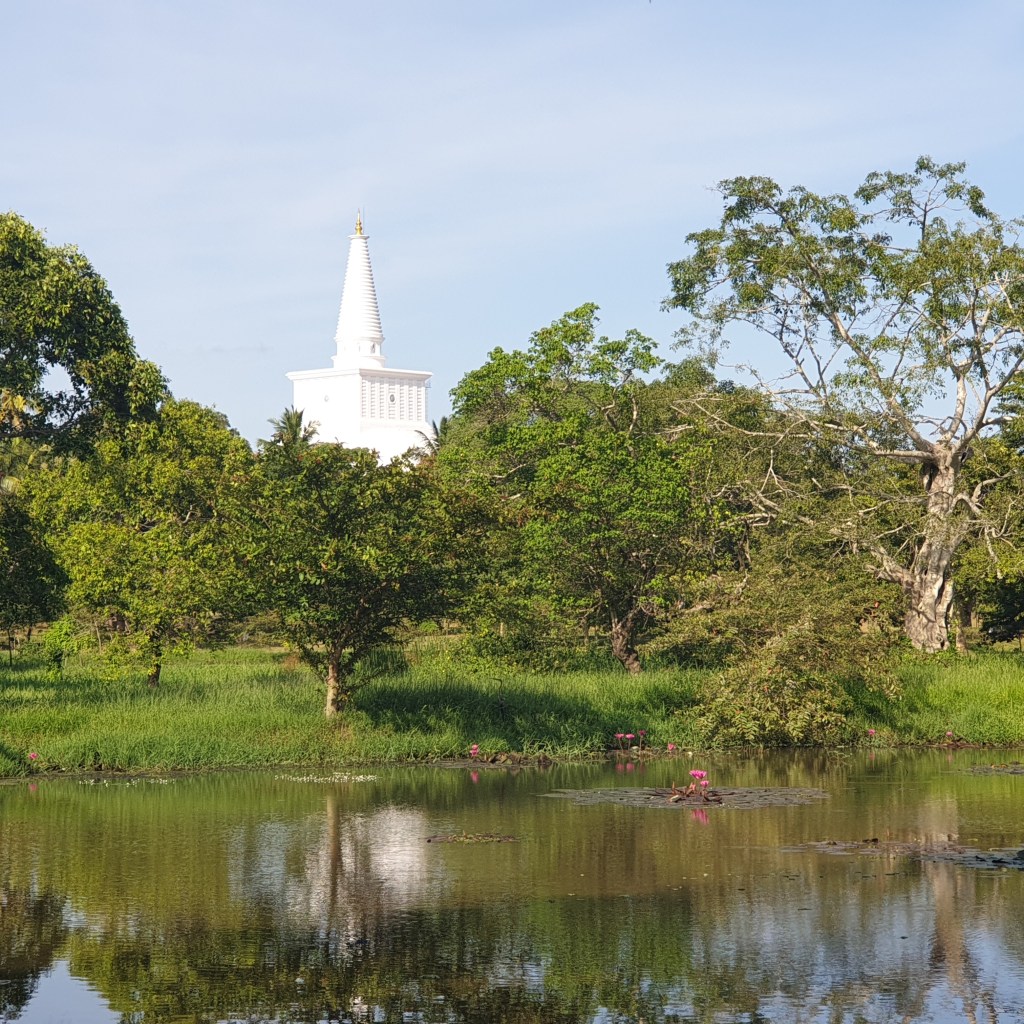
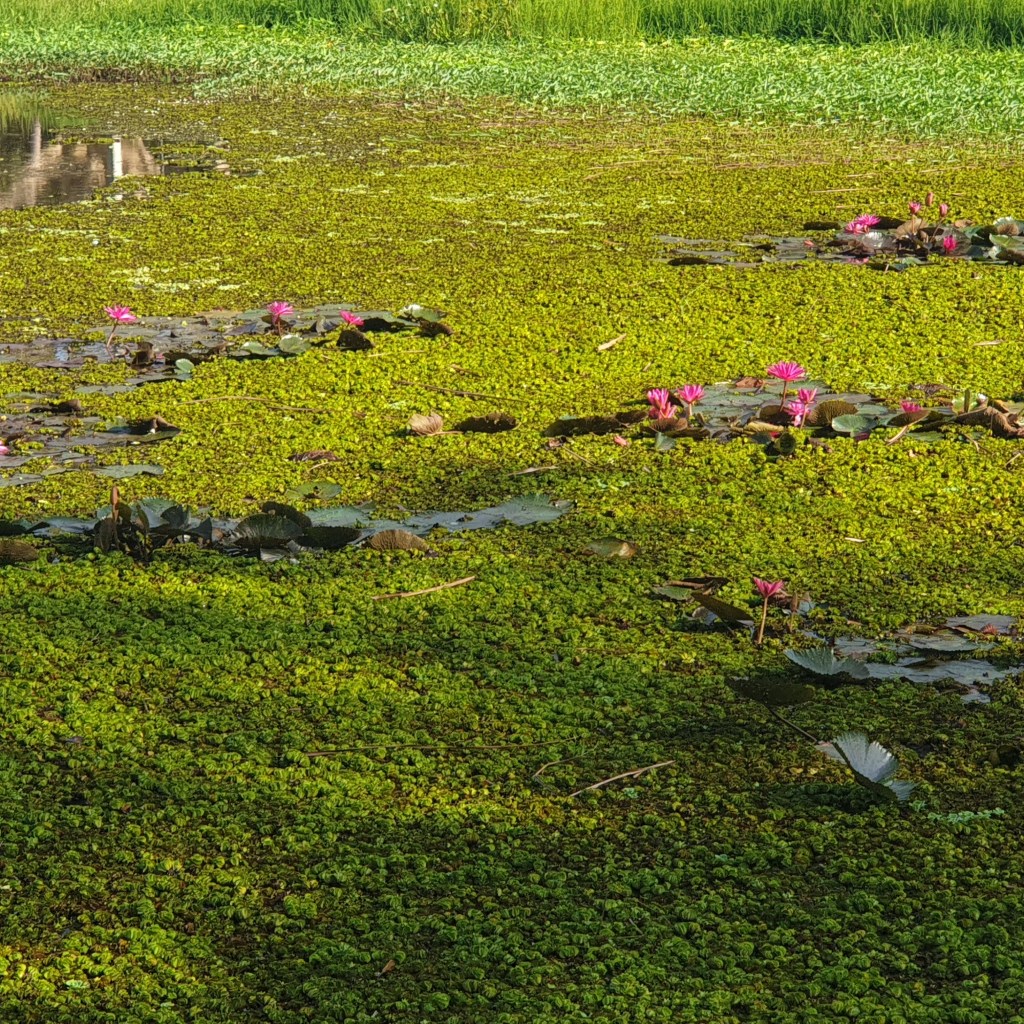
I got up early again – it is so much nicer cycling in the cool of the morning – and set off to see the remaining sites that I had not had time for yesterday.  First up was the Sri Maha Bodhi, the world’s oldest documented tree. It sits in the geometric centre of Anuradhapura and is surrounded by very large parking area to accommodate crowds of pilgrims at festivals. Today it was quiet, the car parks were empty, and I could leave my bike very close to the entrance. I stopped to admire a beautiful lake with lilies and many birds, with a brilliant white stupa reflecting off the water.

A little piece of heaven in Sri Lanka

The Sri Maha Bodhi is a bo (or bodhi, or sacred fig) tree grown from a cutting brought from India, possibly by the daughter of Emperor Asoka in the third century BCE; some legends say that it was derived from the very tree under which Buddha attained enlightenment.  Whatever the truth, written records of the tree being tended stretch back over 2000 years.

Sri Maha Bodhi
The world’s oldest documented tree

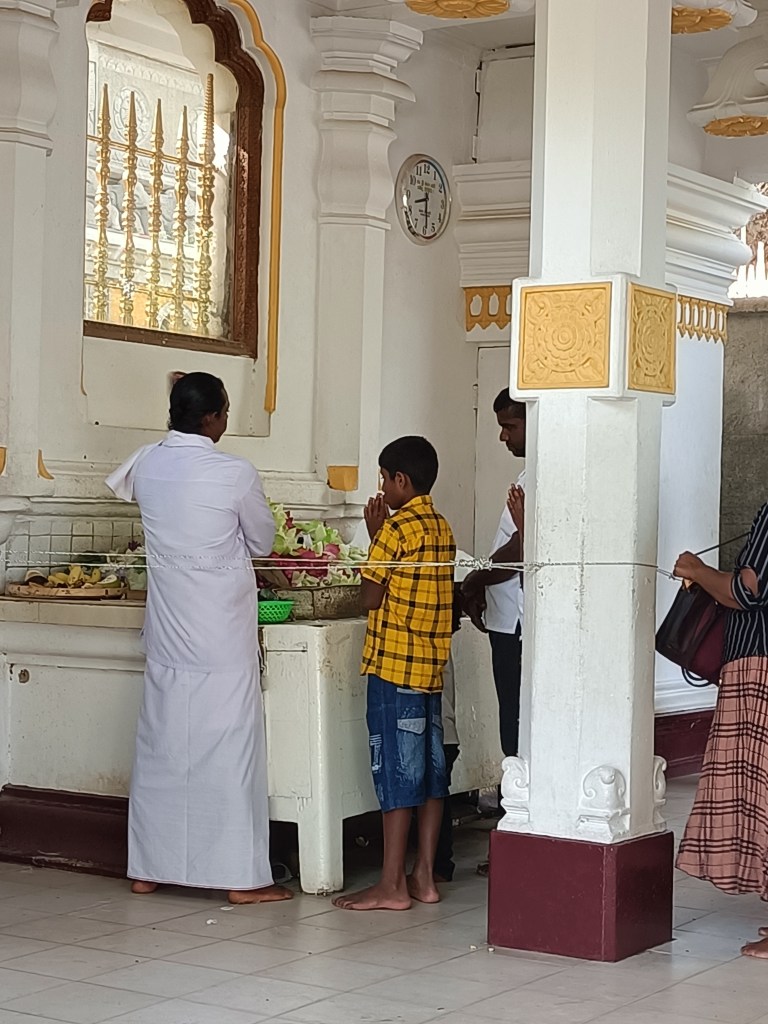
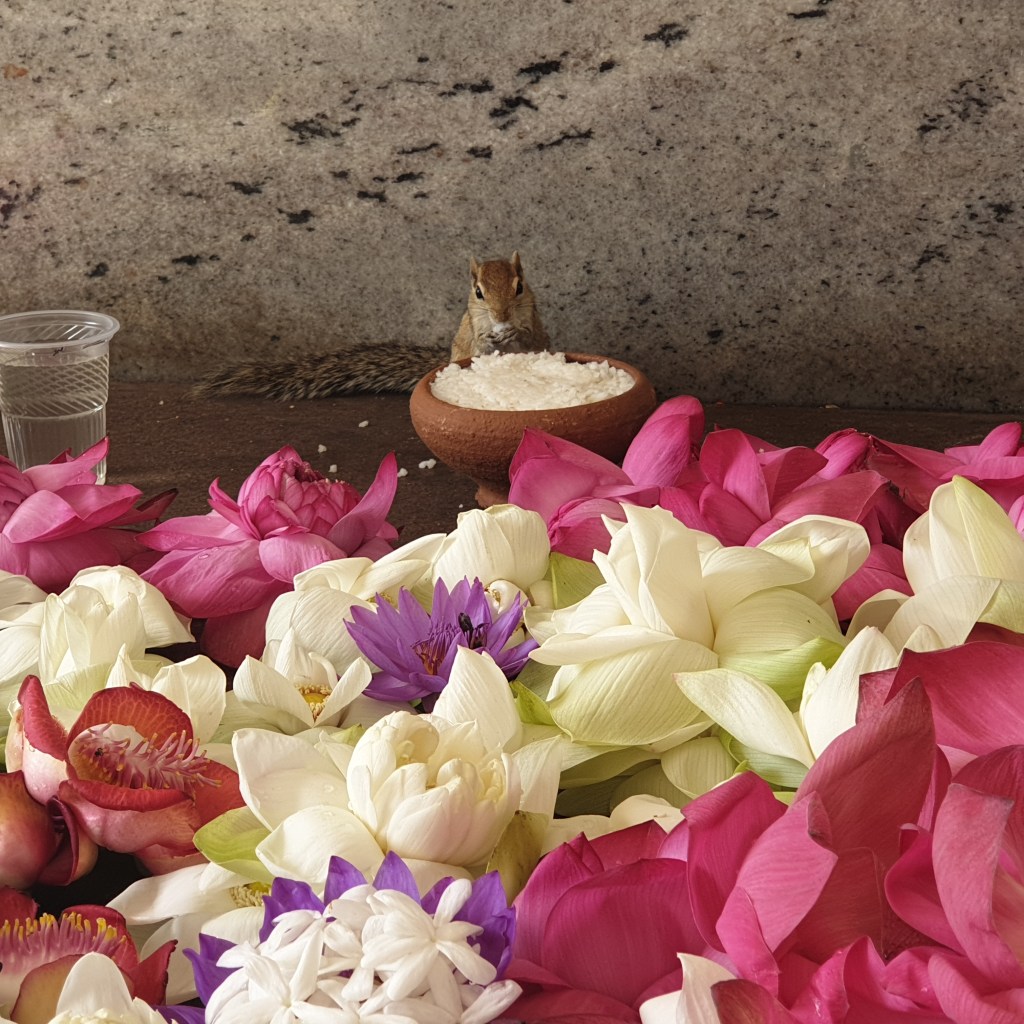
The usual routine was needed to enter an inner courtyard housing the tree with its shrine – shoes and hat off, and security check (the shrine was the site of a bloody terrorist attack by Tamil separatists during the Sri Lankan civil war). The tree itself was a normal looking fig tree with its branches supported by golden scaffolding, but the surrounding shrine had a very special feeling to it. Pilgrims streamed in, bringing offerings of flowers or rice.  Someone gave me some flowers to make my own offering, and like the other visitors I placed them to make an appealing pattern.

Making offerings at the shrine…..
…and a temple thief taking offerings….

Other pilgrims and local worshipers sat on the ground, praying with beautiful chants, which were half-way between singing and talking. The combination of the cool morning air, the chanting, and the strong smell of flowers gave a deep feeling of peace, and I sat down and closed my eyes to enjoy it.

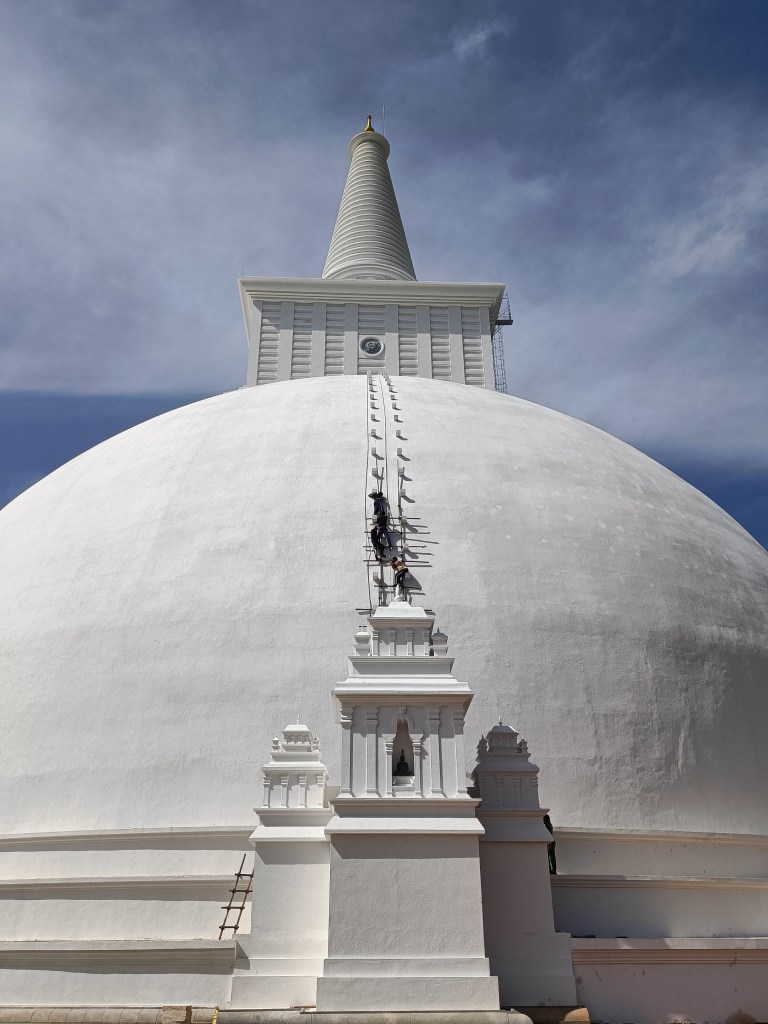
Eventually it was time to move on, and my next stop was the huge Sandahiru Seya stupa, which can be seen from almost anywhere around Anuradaphura. It was started in 2010 and construction was only just finishing, so it was not yet recommended in any of the guidebooks. I found its perfect shape and brilliant white colour very beautiful and watched the workers completing the final bits of work.

Finishing the construction of Anuradhapura’s latest stupa

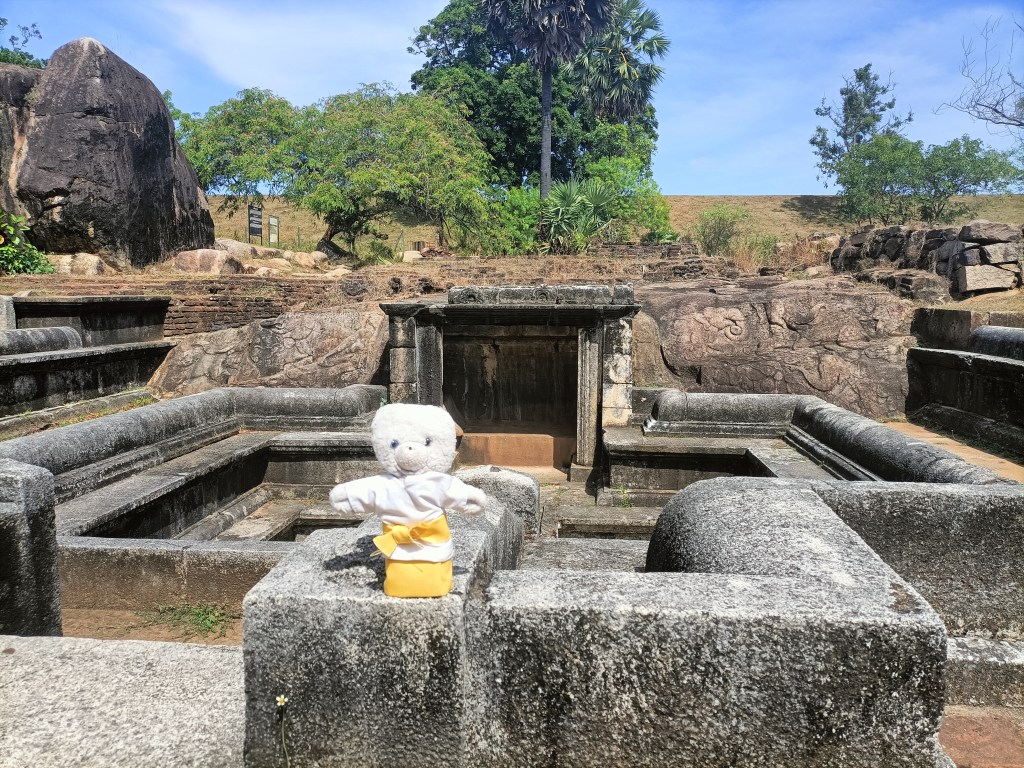
From there I headed to another less-visited site – the former royal gardens, that are over 2000 years old. They were poorly signposted, but I eventually found them at a the bottom of a steep slope leading down from the embankment of an artificial lake. I found some carved stone structures in an advanced state of decay that were once water basins. There were no signs at the site and little text about the site in Lonely Planet, but I had the luck to overhear the explanation of the guide escorting a group of western tourists (the first I had seen that day).  I learnt that a system of channels led from the lake above to irrigate the garden and also produce an artificial waterfall over carefully placed huge-boulders. With the added explanation the site came to life, and I could imagine the royal family bathing in luxury all those years ago.

The Royal Gardens. 2000 years ago, water cascaded over the boulder to the left into a pool where I am standing.

Next stop was Vessagiriya, a little-visited cave monastery that was founded over 2000 years ago, possibly by the Indian prince who introduced Buddhism to Sri Lanka.  The guardian of the site attached himself to us – the only visitors – and gave an excellent guided tour. He pointed out the huge boulders that had been brought here and raised onto small supporting stones to form some of the caves – how this was done remains a mystery. He also showed us a line of small holes in a rock, and explained that builders would fill these holes with burning oil, and then suddenly cool the rock with water to make the boulder splinter along the line.  

Our guide, and one of the mysterious boulders balancing on smaller stones

My final destination was the rock temple of Isurumuniya, set beside a particularly beautiful pond with lotus flowers. This temple is also ancient, originally dating from around 300BCE. 

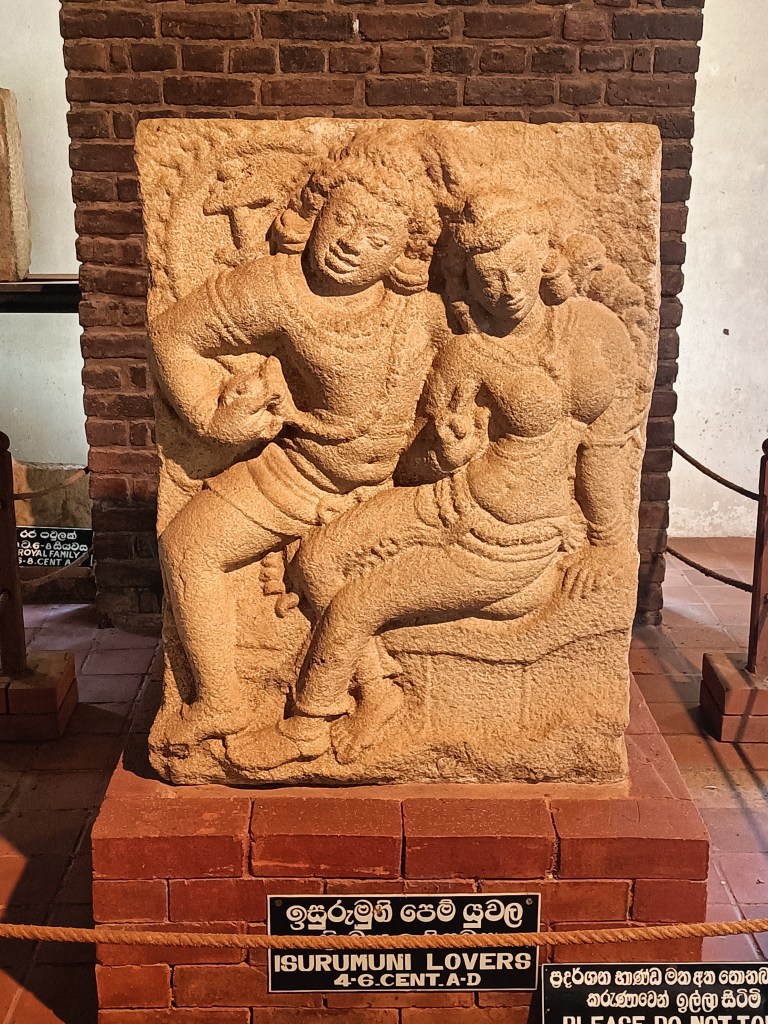
Next to it stood a museum of ancient carvings, including one called “the Lovers” showing a prince who gave up his right to be king in order to marry a girl from a humble background.

Ancient Lovers

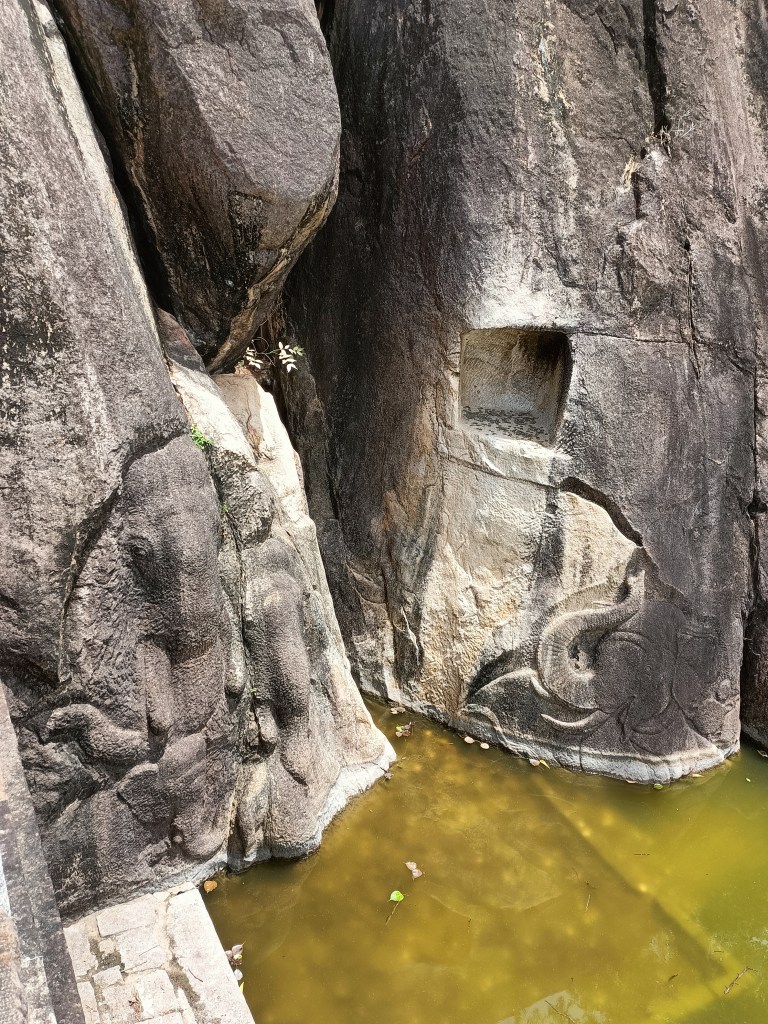
The top of the temple gave a nice view over the area, with the stupa of Sandahiru Seya prominent as usual, and of the pretty elephant carvings in the stone by the pool.

Carved Elephants

It was now midday and the sun made the walk around this temple with bare paws particularly hard (I had forgotten to pack socks again).  I concluded it was time to retreat to home to cool off in my guest house’s air conditioning.

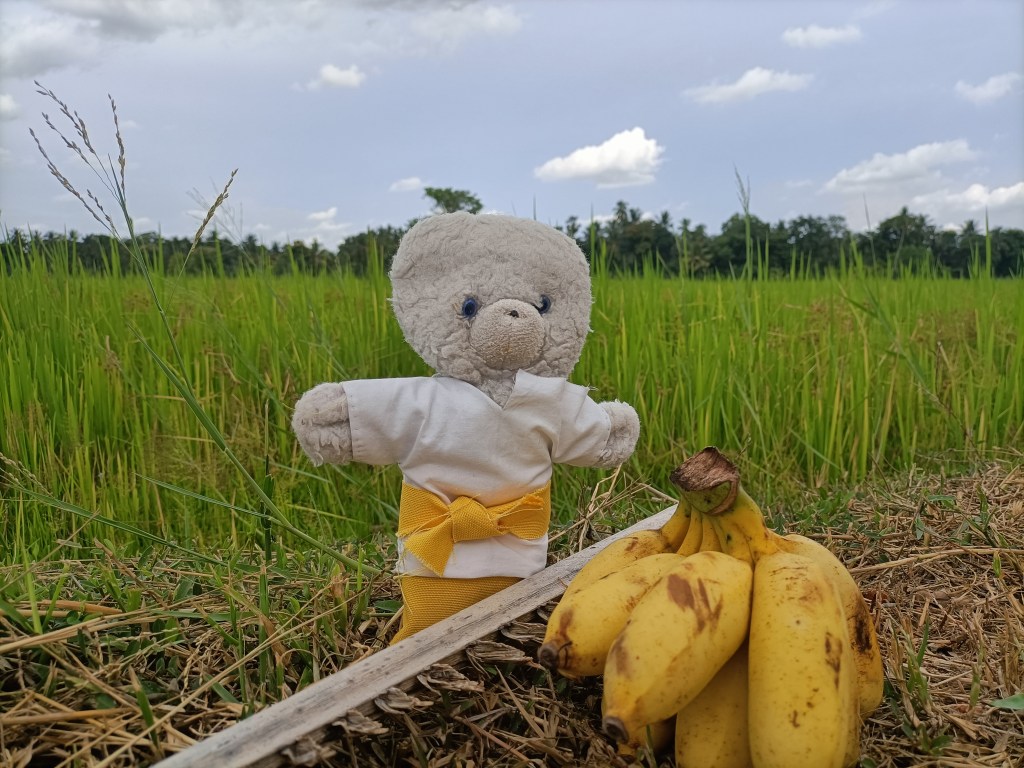
After a couple of hours, I set off and had a short picnic lunch of bananas in one of the rice fields.

Lunch in the rice fields

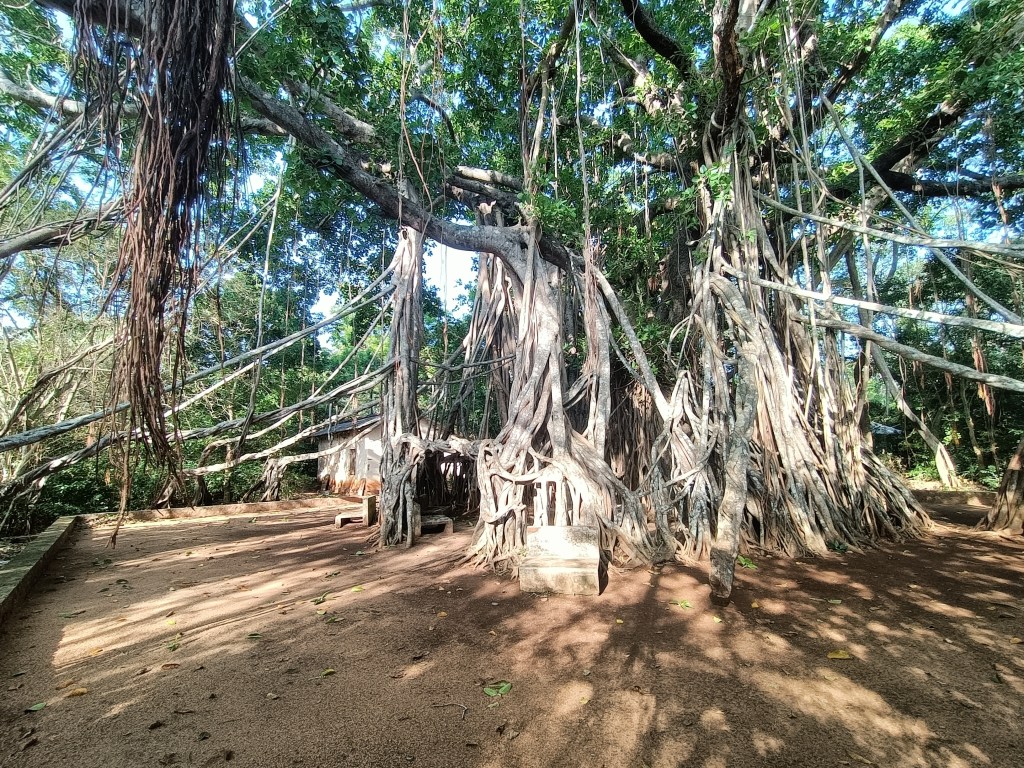
A tuk-tuk driver spotted me and offered me a ride to see a “special tree”. Intrigued, I accepted his offer and after a short drive he showed me probably the biggest tree I have ever seen – a sprawling banyan with a huge mother tree and several almost equally impressive daughter trees sprouting from massive aerial roots.

Part of the giant banyan tree (I could not fit all of it into the photo)

Next, I had intended to return to the Sri Maha Bodhi to soak up more of the special atmosphere there, but dark clouds had gathered, and I could hear thunder in the distance. I retreated to my guest house just in time to avoid this……

You can only find rain like this in the tropics

It was supposed to be the dry season in Anuradhapura, but I was unlucky. I stayed at the guest house for the rest of the afternoon and worked on my blog. You never know in Sri Lanka when you will have electricity and an internet connection.

Sri Lanka – into the unknown

For this trip I decided to use my post-Covid freedom to go somewhere a bit more exotic than my previous few trips, and a bit further from my home in the UK. Somewhere where the temperatures are more predictable and where I can learn some lessons about energy rationing (might be useful in the winter back home in London…).  Despite the advice of friends and family urging me to cancel, I went to SRI LANKA. As you already know, Sri Lanka is an island south of India, and which is been beset by economic problems and social unrest. Its biggest problem is a shortage of foreign exchange to import essential things like fuel and medicine. But on checking the internet and travel blogs carefully, it seemed that tourist travel is still very possible, and that the rare tourists are welcomed warmly.

I flew to Colombo, arriving in the early morning, spent a morning in a hotel near the airport to recover before beginning my trip in earnest. After much thought and some advice from local people I knew, I opted to hire a car with driver to get around rather than rely on public buses and trains (working, but very crowded I was told). My driver arrived as promised and we set off to Anuradhapura, an ancient capital about four hours from the airport. The route was pretty but unremarkable, except for the long queues of cars waiting outside petrol stations. Supposedly tourist vehicles have priority for fuel. My driver tried to get some in a couple of places along the way but was unsuccessful.  Fortunately, he easily had enough to make it to my destination, where he dropped me and disappeared.  We are supposed to meet again in two days’ time.  I hope he will be there with a full tank; it might be my paranoia, but I thought I detected signs of worry on his face when he was being rejected for fuel.

Fuel queues can stretch for a kilometer…

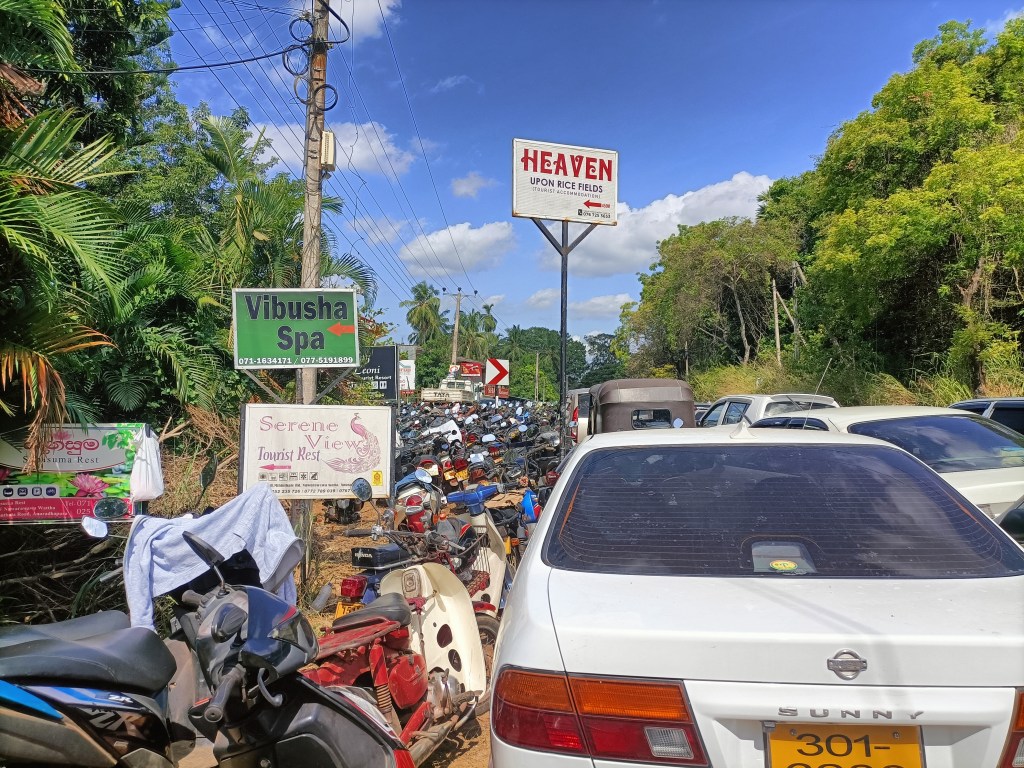
My first lodging was a guest house called “Heaven upon Rice Fields”. I had a nice dinner of the local classic dish – curry rice – before getting a very early night. I woke up early as planned next morning to a view of the sun rising over the paddy fields under my balcony, with a couple of wild peacocks strutting through the rice plants.

Sunrise from the balcony of my room

After a breakfast I headed off to explore the many ancient ruins of the city by bicycle.  Anuradaphura was the first important capital of Sri Lanka, and the home of its first Buddhist kings. Traffic on the roads was light – I suppose many vehicles were sitting in queues for petrol.

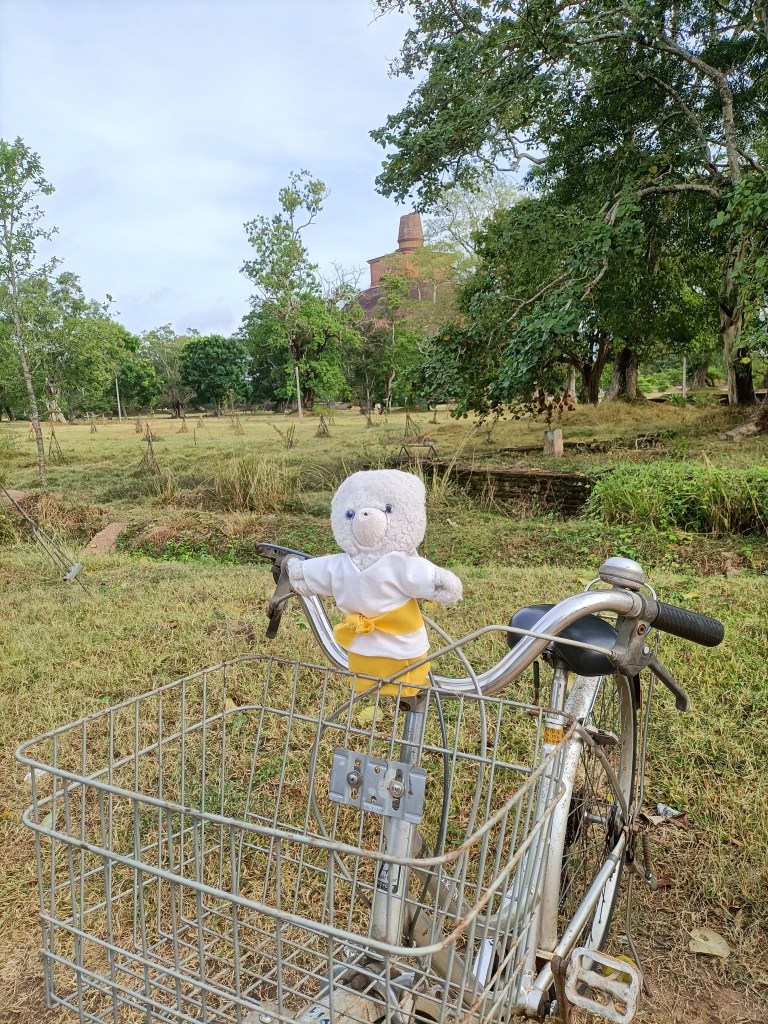
Bicycle – the best way to hunt for temples

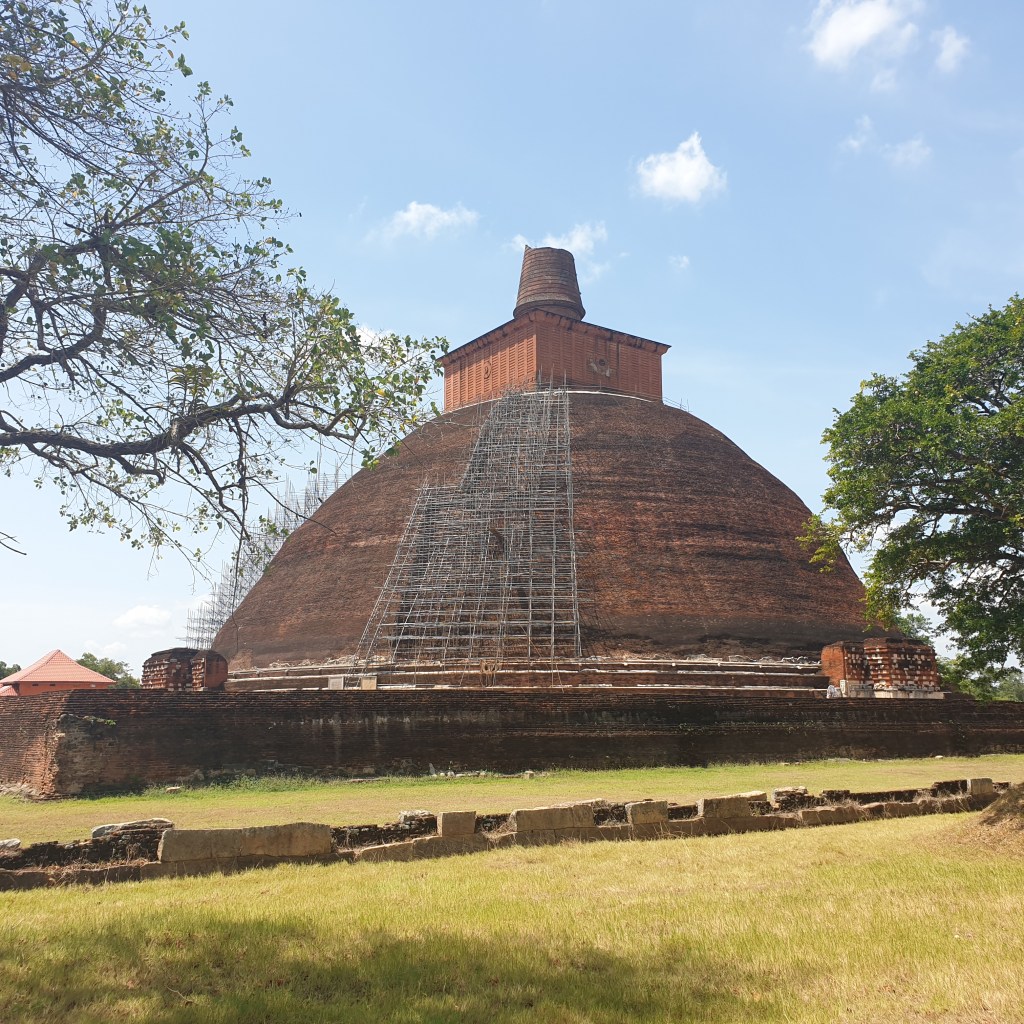
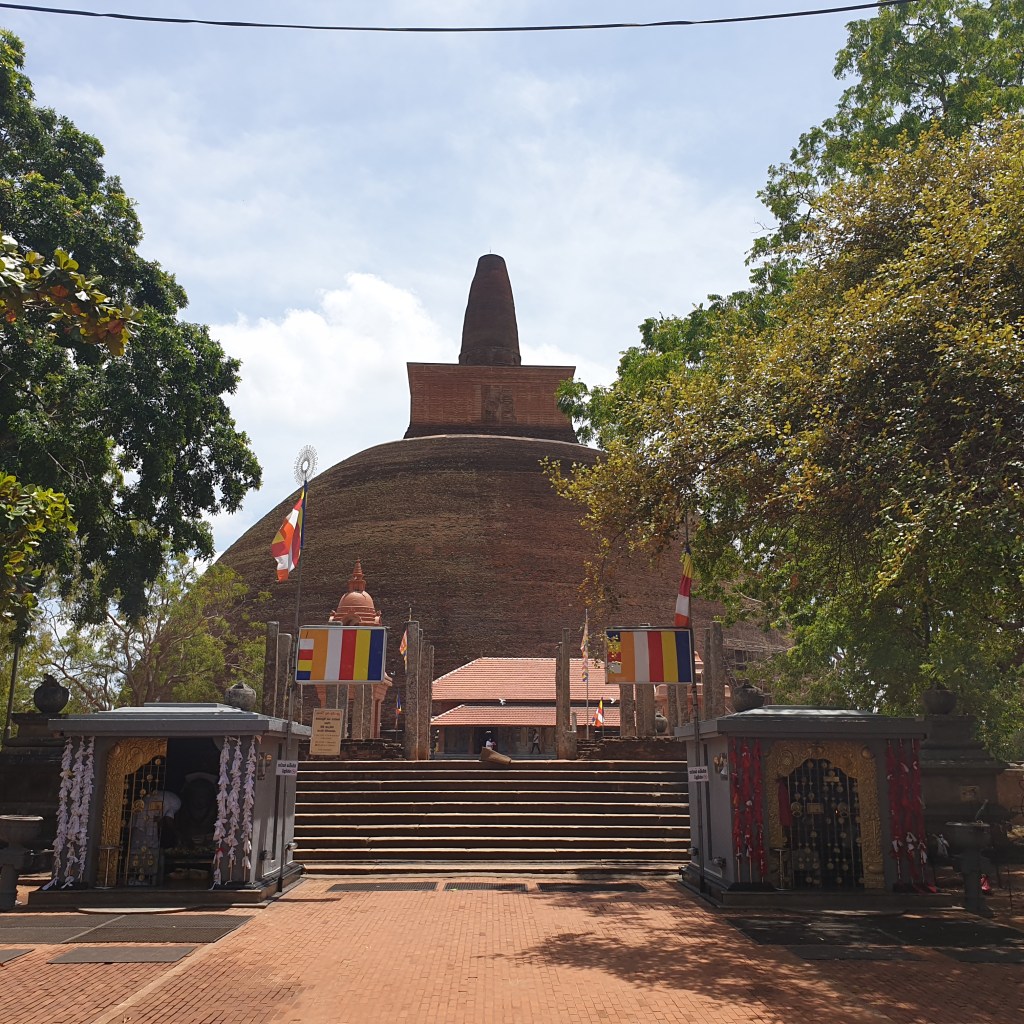
First stop was the Jetavanarama Dagoba (a dome shaped shrine containing relics), a massive construction daring from the 3rd century CE. It was originally about 120m high (the very top part has fallen off) and when built, would have been the third tallest building in the world (after two of the Giza Pyramids).  The dagoba stand amidst the ruins of a huge religious complex that would have housed 3000 monks but whose remains now host peacocks, chipmunks and lots of monkeys.  At my first shrine, I was introduced to a routine that I would repeat several more times in the day – to visit any holy site in Sri Lanka, you have to take off your shoes and hat.  In the early morning, walking barepaw was quite pleasant, but by the end of the day, walking over the hot exposed stones of the shrines became an endurance test that only the toughest bears could pass. I made a mental note to bring some socks with me tomorrow.

Jetavanarama Dagoba – once the third tallest building in the world

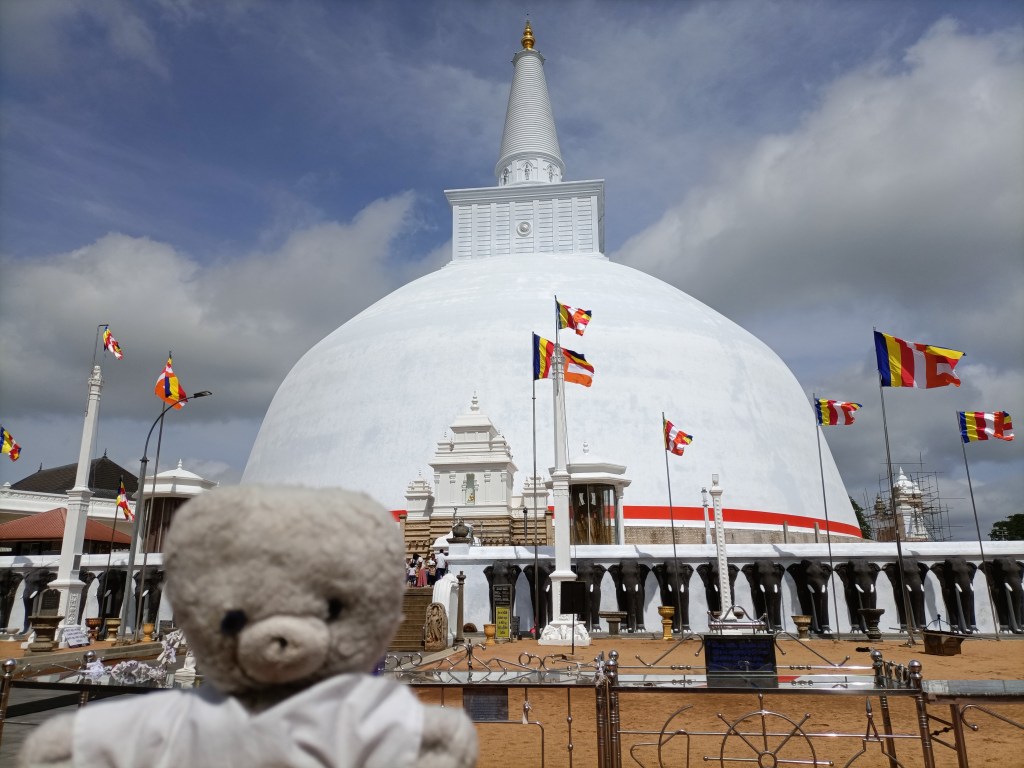
Next, I headed to Ruwanwelisaya Dagoba, a short bike ride away. This was originally built even earlier, in 140BCE, but was repaired and enhanced many times over the coming century.  It remains an active centre of worship, with many pilgrims coming to offer flowers or food to images of Buddha. I took this selfie………..

Ruwanwelisaya Dagoba, surrounded by 350 carved elephants

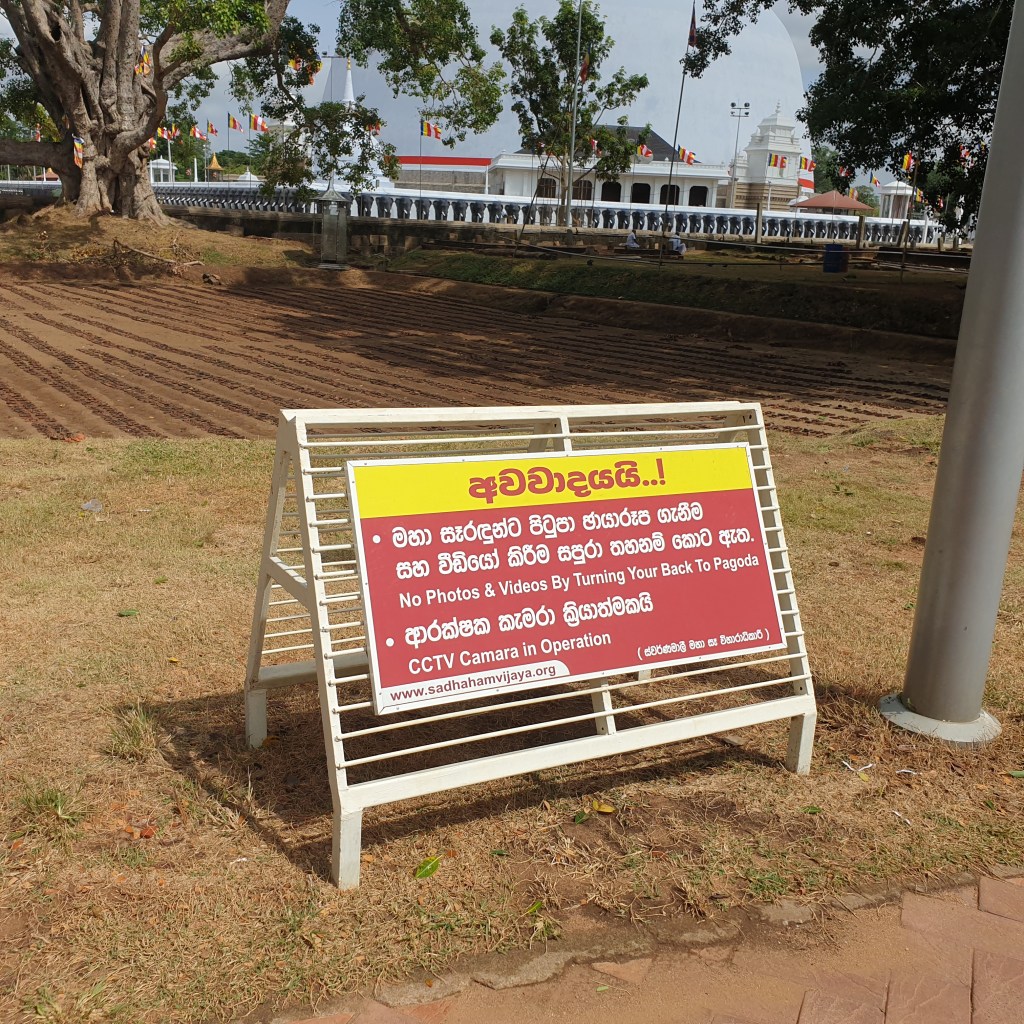
…..before I saw this sign………

oops!

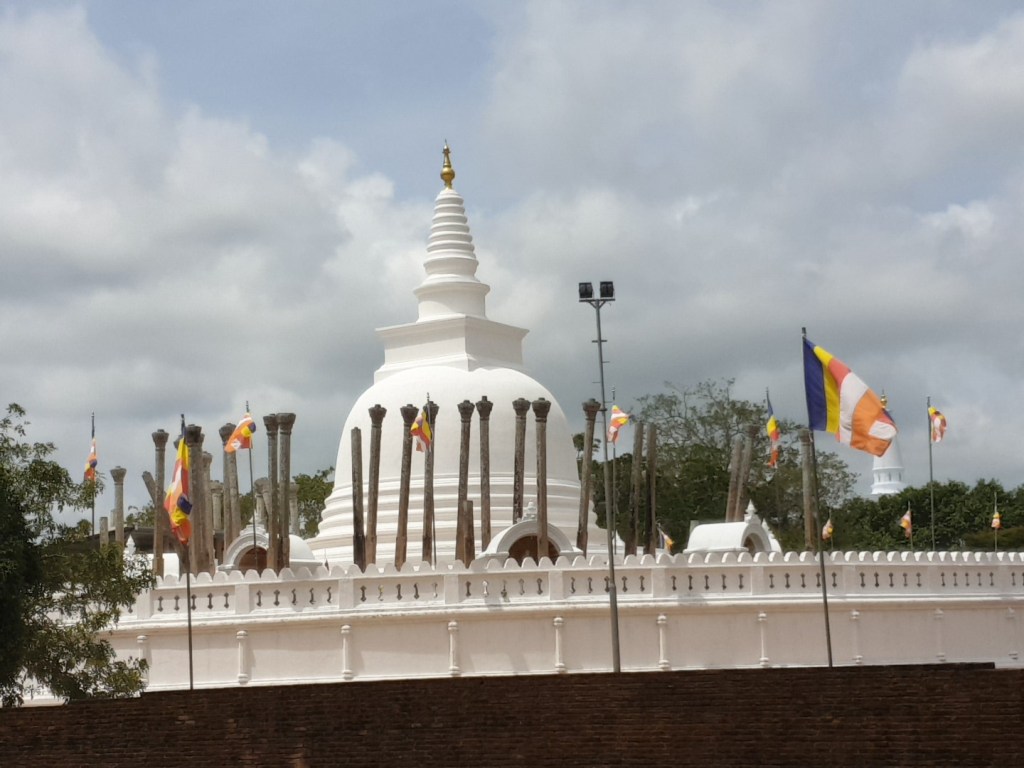
I wasn’t sure whether the rule about not turning your back to the temple applied to  bears, but I thought it best not to wait to find out, so I hurried on to Thuparama, possibly the oldest dagoba in the world. It was originally built in the third century BC but was restored (or as Srilankans complain, crudely modified) by the British in 1862.

My final destination was the dagoba of Abharayagiri, the centre of a huge monastery in the first century BCE. Around the dagoba, the ruins of the buildings that held the monks sprawl over a huge area and it was fun to explore them – almost entirely on my own.

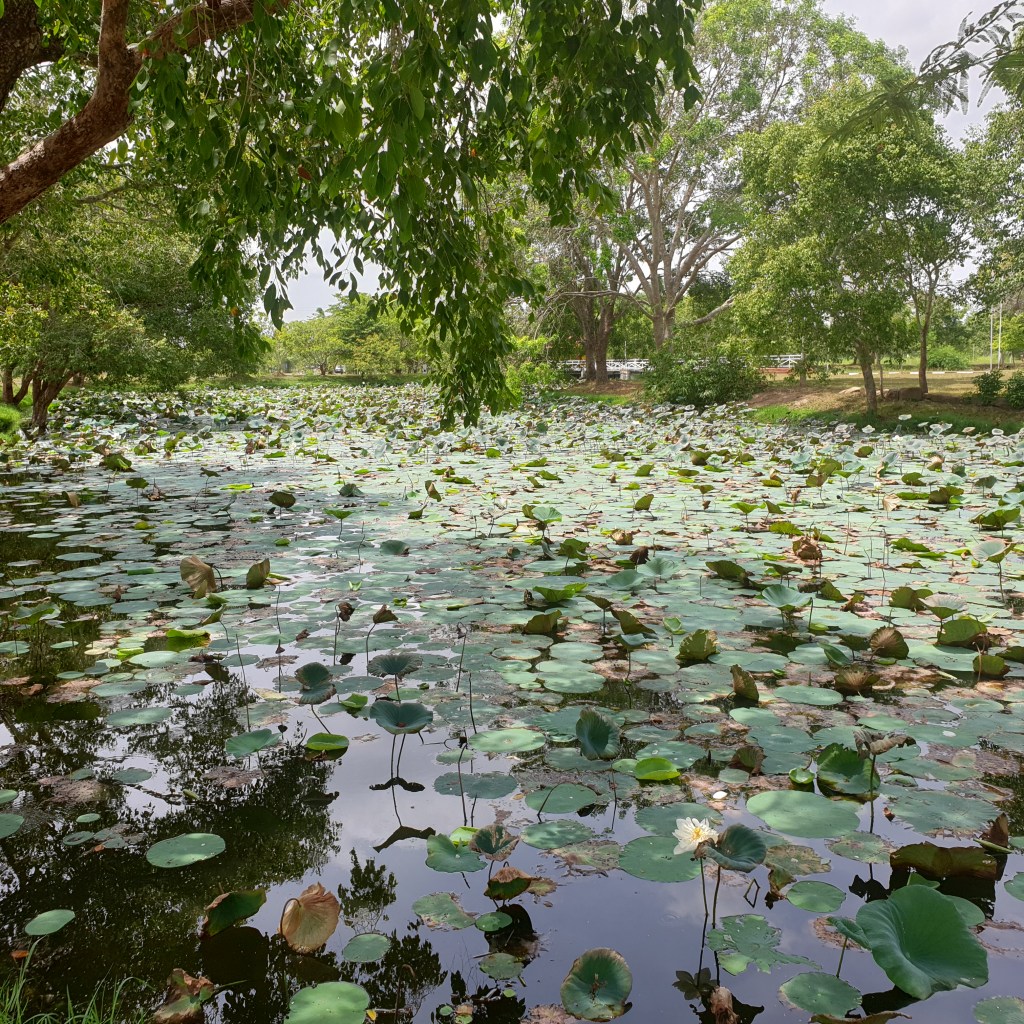
The rides between these different ancient ruins went along small lanes weaving between paddy fields and past small houses. There were also many lakes, some natural and some constructed by long -dead emperors to water their gardens. Water lilies and lotus flowers grew in profusions, and kingfishers, herons, egrets and ibises hunted small fish.

In the early morning it was very pleasant exploring the ruins, but as midday approached, the sun began to beat down. I stopped for a refreshing drink of coconut water at one of the few roadside shops – I was surprised by how few places there were to get anything to eat and drink, and by the absence of souvenir shops.  I was less surprised by the absence of tourists – the most foreign tourists I ever saw at one place was six, and quite often I had these wonderful sites all to myself (plus any local visitors and pilgrims).  As I rode around, people at the roadside – or even people in cars and trucks overtaking – would call out a greeting and ask me where I was from.  The few tourists that make it to Sri Lanka are very welcome and travelling bears are even more of a curiosity.

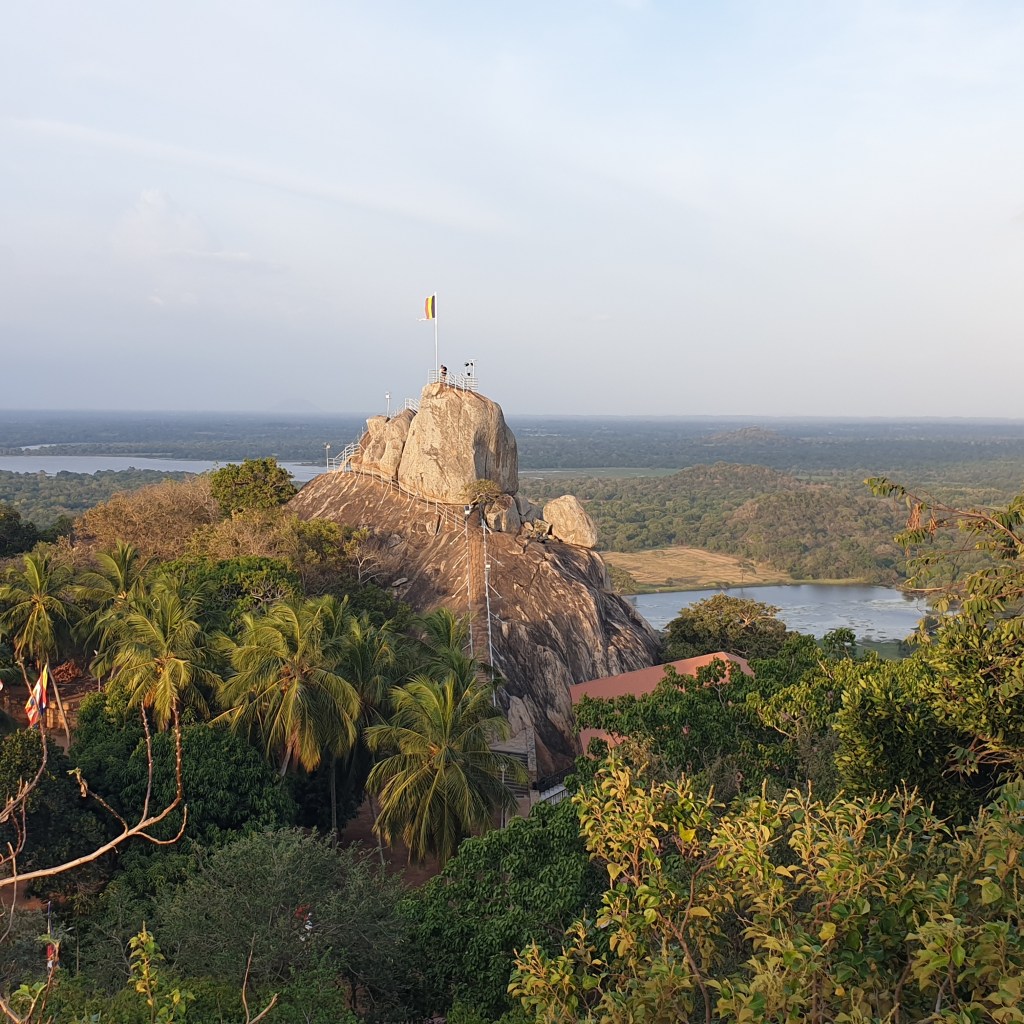
I returned to the hotel at around 15.30, very hot and tired but also very happy with my day’s bicycle exploration.  After enjoying my room’s air con for an hour, I set off again in a tuk-tuk this time to a place called Mihintale.   This is a sacred spot, where in the third century BCE Sri Lanka’s king was converted to Buddhism by a prince sent by the great Indian emperor Asoka. The place where this is supposed to have happened is located on top of a steep mountain, accessible by a steep climb.  In the afternoon heat my little legs were feeling more and more tired. Halfway up there was a ticket office to pay the obligatory entrance fee. Near the office was yet another example of exotic srilankan wildlife – the giant squirrel – which from a teddy bear’s perspective is frighteningly large.

The world’s largest squirrel species – about the size of a well-fed cat- scary if you are small like me

I hurried up to the top and saw that I had yet more climbing to do.  The main ancient temple was on a little plateau, whilst on different pinnacles surrounding it there are yet another dagoba (a modern one), a large statue of Buddha, and a viewpoint with telescope.

The main temple at Mihintale

Being a diligent blogger/travelling bear I climbed up to each of the different viewpoints, my fur soaked in sweat and my naked paws burning on the hot rocks.  I finally reached the large modern dagoba, and enjoyed the view and -finally – a cool evening breeze.

The view – Worth the climb (and burning my paws)

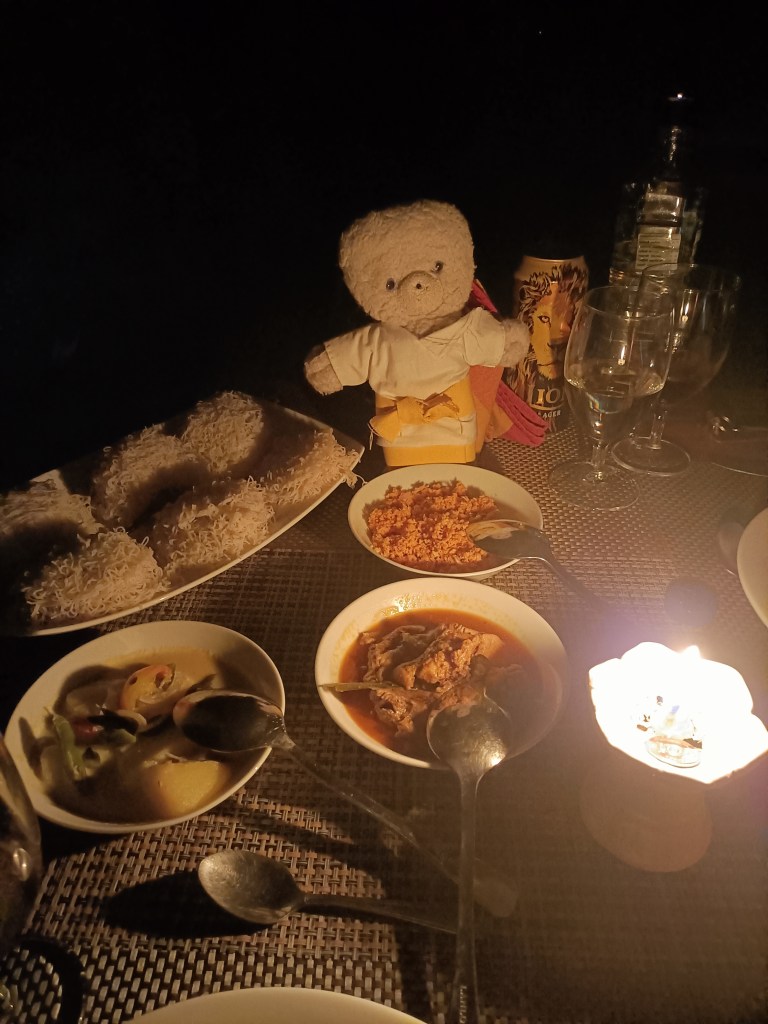
I hoped to see the sunset……but the sun dipped behind thickening clouds on the horizon. I returned to my transport and got home just before the heavy tropical rain started, to find my hotel suffering from one of Sri Lanka’s frequent power cuts.  My hotel owner explained that although he had a back up generator, he had not petrol to put in it, and that the outage would last an hour and a half. I started my dinner by candlelight before the power came back on, exactly at the time predicted by my host.  

Curry and Rice by candlelight

My first impressions of Sri Lanka were very positive, and talking to the rare tourists I met today, it seems to be not too difficult to get around. Maybe it is not such a big problem if my driver doesn’t show up.

Last Day in Morocco – Tangier

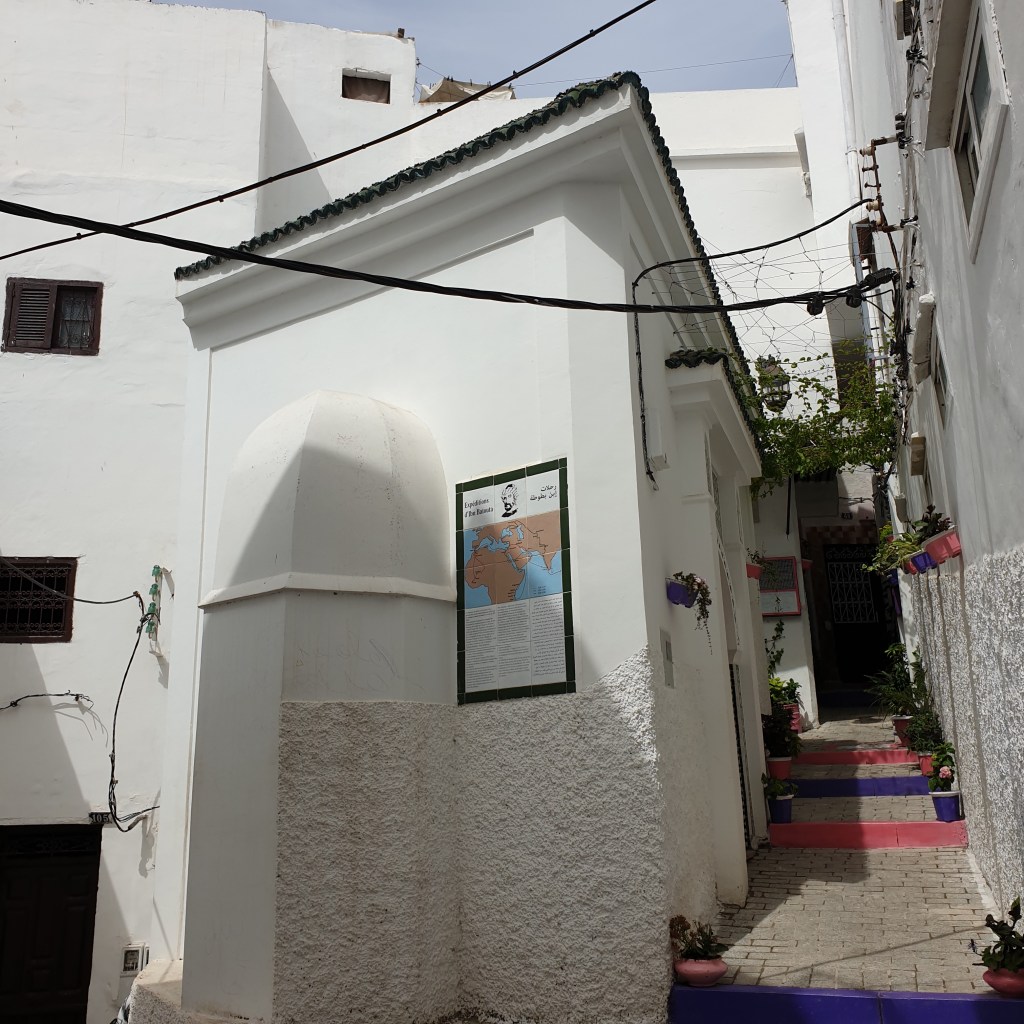
Today I had a whole day to discover Tangier. I started with the various museums in the medina, some of which had been recently created as part of the city’s rejuvenation. The first was a museum devoted to Ibn Battouta who, in three long trips in the first half of the 14th century, visited West Africa (as far as the empire of Mali), Mecca and the Middle East, East Africa, Central Asia, India, Burma and China – easily out-travelling Marco Polo. The museum was housed in a nice old building, but suffered from a lack of objects to display, relying instead on large panels displaying Ibn Battouta’s travels. A great story, but not enough to base a museum on – although I did learn that the 14th Century Emperor of Mali might have been the richest man of all time (correcting for inflation). A bit later in the day, I stumbled on Ibn Battouta’s tomb, hidden down one of the medina alleyways. I wondered if the great traveller would have wanted to be buried in an obscure corner of his hometown, or whether he perhaps had hoped for a more exotic resting place.

Tomb of the great voyager Ibn Battouta

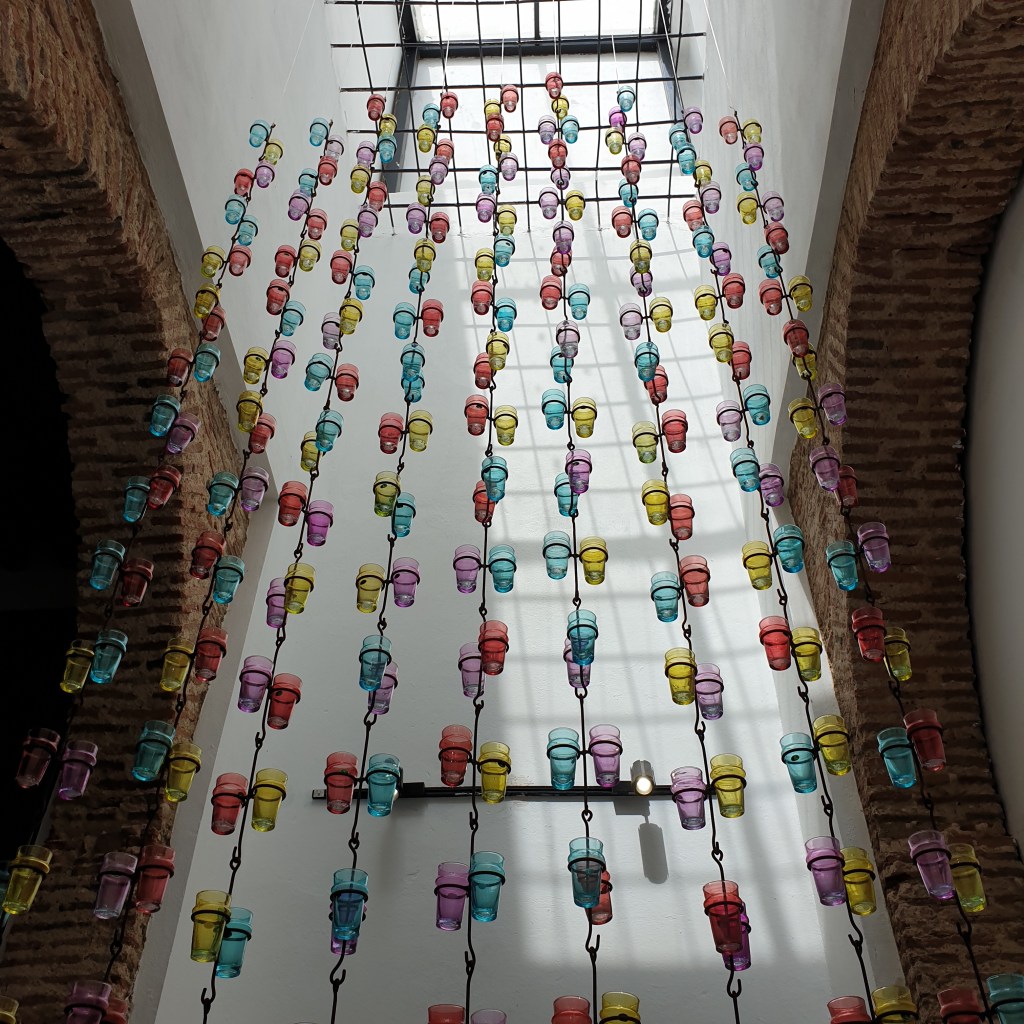
The combined museum of the Kasbah and contemporary art had the same problem – a beautiful old building but not much interesting art or many artefacts of old Kasbah life. Each room had its own security guard wearing a bullet proof vest, who would greet me, wait for me to quickly scan the exhibits, and direct me along a passageway or up stairs to the next room in a bizarrely convoluted route through the museum. The guards smiled broadly, as if they thought that my procession was as comic as I did.  I at least snapped this striking installation of coloured tea glasses…….

The tea glasses reminded me that I needed coffee – which is always nearby in Morocco. I headed to the roof of the Café Bleu, from where there was a great view over Tangier.

I also managed to alarm these two seagulls who had built a nest there, and who squawked at me in a warning not to come any closer.

Two scary seagulls

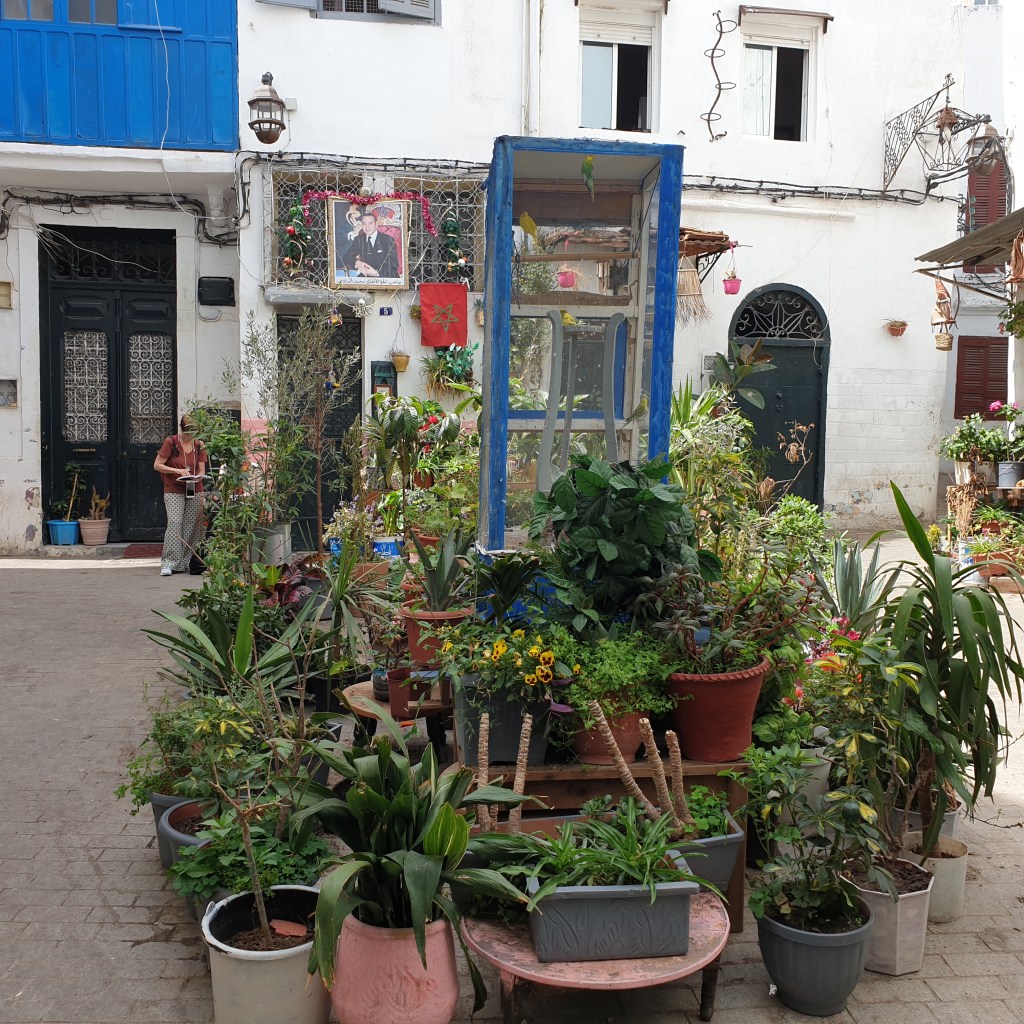
After coffee, my medina exploration became more successful. I found more pretty little alleyways and squares……

A shady square in the medina

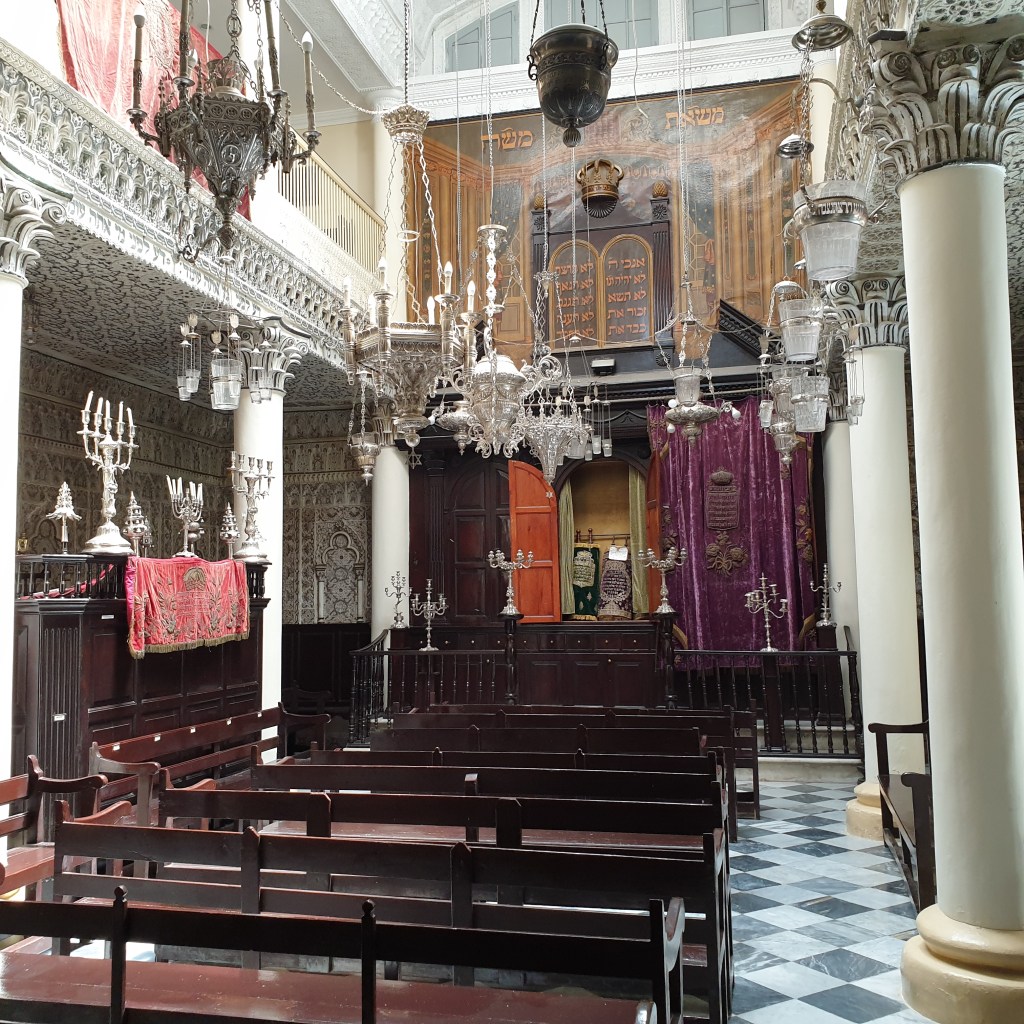
……….and a beautiful old synagogue…..

In the synagogue

…and then the Place Petit Socco, which used to be a centre for drug dealing and prostitution, but now is a good place to drink even more mint tea and watch the comings and goings of people visiting the nearby market.  From there I found one of Tangier’s most interesting buildings – the American Legation.  Morocco was the first country to recognise the independence of the USA, and the first to give it a property to serve as a diplomatic mission.  To this day it is the only foreign property on the US’ list of important historical American buildings. It was a lovely old house, decorated in 1950s style and with a pleasant Andalusian patio and fountain.

In the American Legation

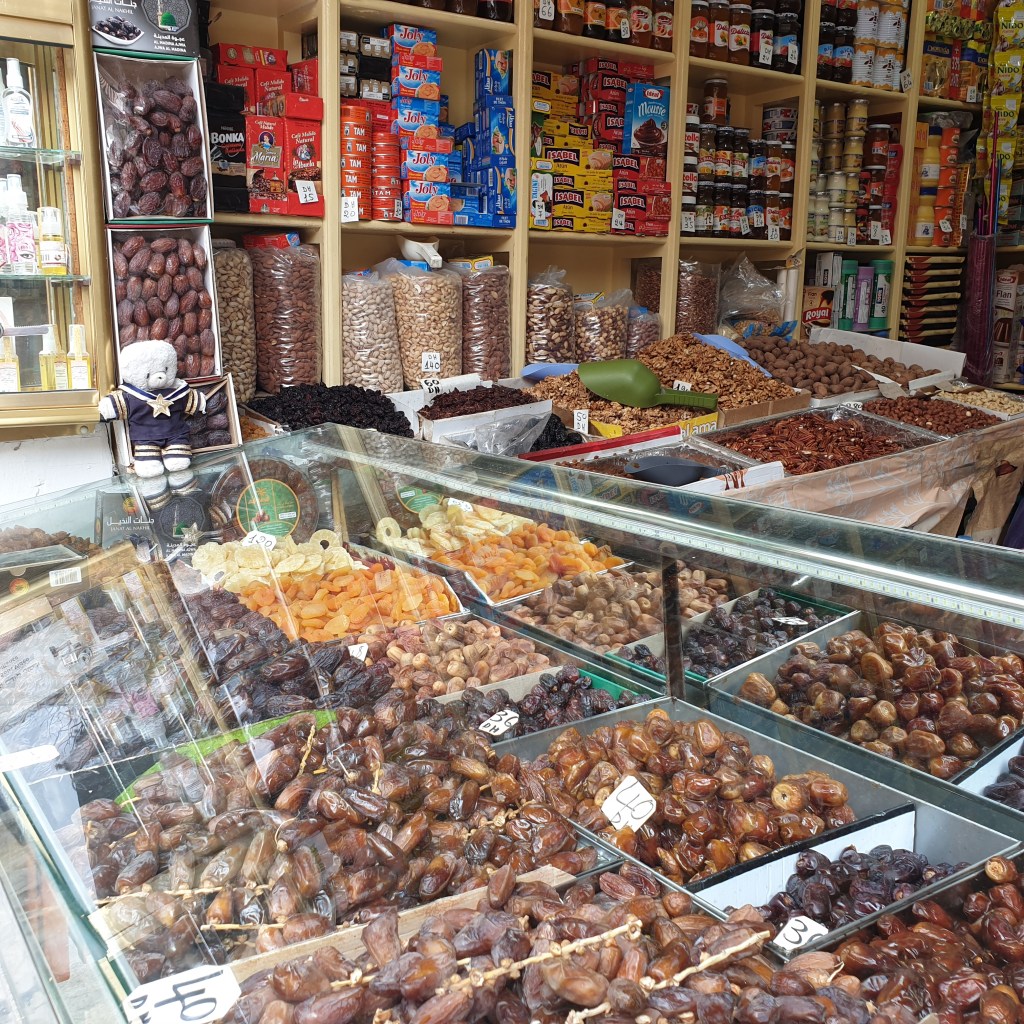
From there I walked through the market, where I bought a few dates for a mid-afternoon snack…

Mmmm……dates

…and then headed on to the “new town” for a coffee in the Grand Café de Paris, opposite the French Embassy, before checking out the view of the sea from the wonderfully named “Terrace des Paresseux” (Terrace of Lazy People). 

Being lazy on the Terrace des Paresseux

Feeling lazy myself, I headed back to the medina for an aperitif on the roof terrace of one of the hotels. My beer represented my first alcohol in six days – another plus for Tangier over other Moroccan cities is that alcohol is more widely available.

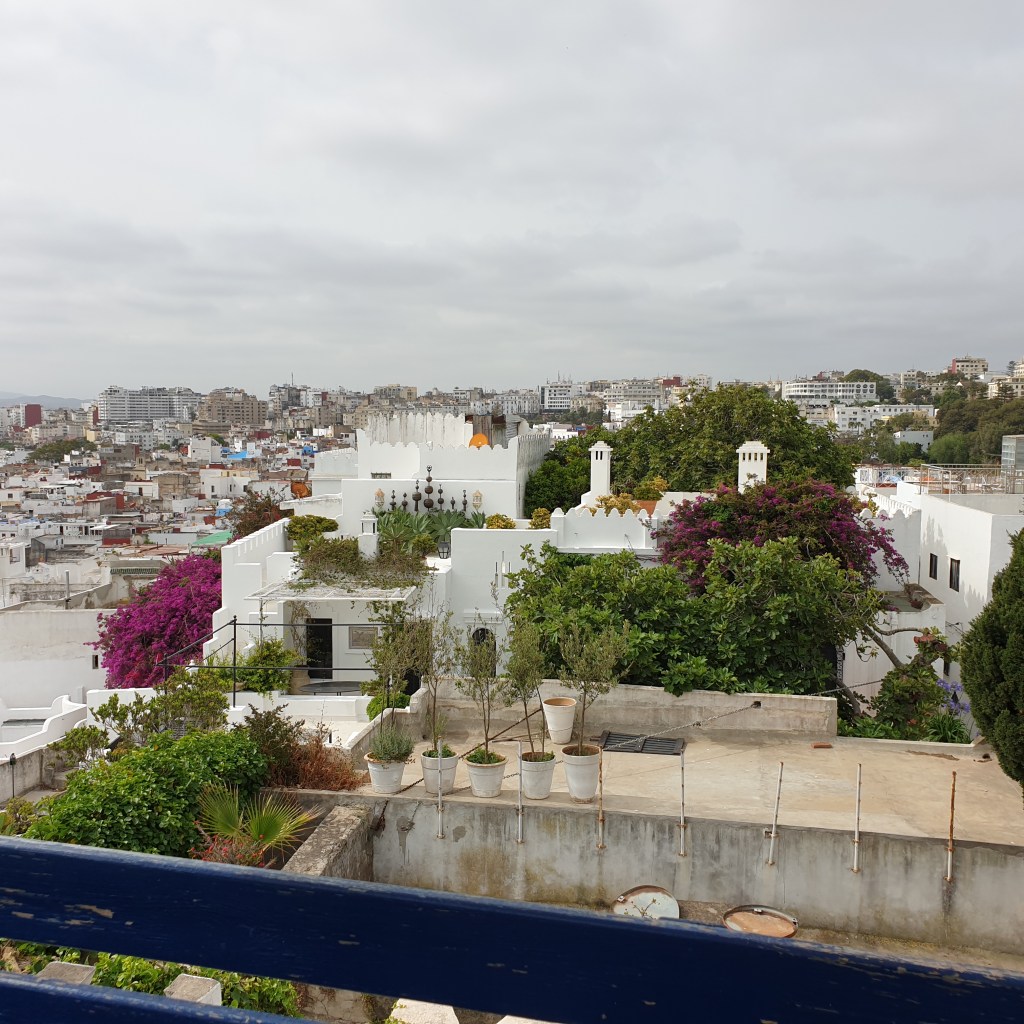
View from the bar of the Dar Nour hotel

Back at my hotel, I climbed all the way to the roof to try to get a first view of Europe from Africa….and after a day of hazy weather that had hidden the European coast, I was finally rewarded with success. It was a nice way to end my second visit to Morocco.

View from my hotel’s roof – the faint strip of land on the horizon to the left is Europe

I had intended to stay longer and return to Marrakesh, but for personal reasons had to cut my trip short.  This will certainly be for a future trip, and I’d also like to explore more of Morocco’s magnificent countryside than I managed this time.

Blog at WordPress.com.

Up ↑